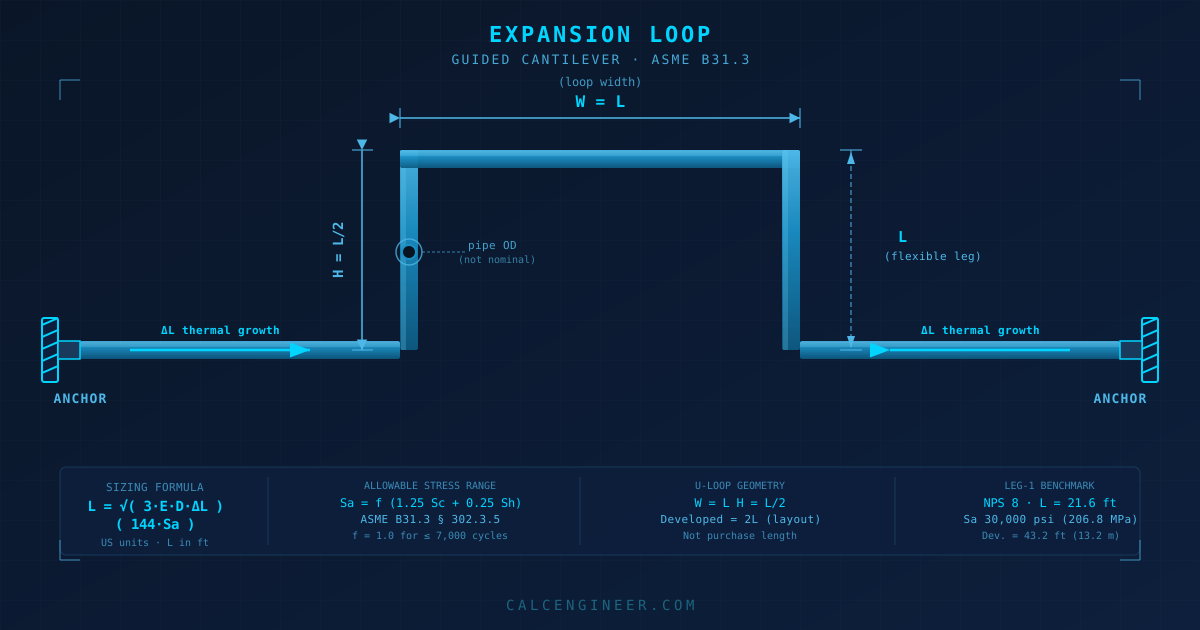
A long pipe anchored at both ends grows toward the anchors as it heats, and if the anchors hold, that growth converts to compressive stress until something yields or the anchor fails. A U-shaped expansion loop placed between the anchors gives the pipe a place to bend, absorbing the thermal growth in its flexible legs instead of transmitting force into the structure. The guided-cantilever method (M.W. Kellogg, Tube Turns) is the classical hand calculation behind expansion loop sizing: it returns the flexible leg length L = sqrt(3EDΔL / 144Sa) needed to keep the bending stress within the ASME B31.3 allowable stress range. This article covers the physics, the formula, the loop geometry, the worked examples from the calculator, and the conservatism boundary between the hand calc and a full 3D flexibility analysis in CAESAR II or AutoPIPE.
Why a Hot Pipe Between Anchors Needs an Expansion Loop
A long pipe grows as it heats, and if it is locked between two anchors with nowhere to flex, that growth turns into force on the anchors and bending stress at the elbows until something yields or cracks. A U-shaped expansion loop gives the pipe a place to bend, absorbing the growth in its flexible legs instead of in the restrained structure.
Thermal growth in a straight pipe segment is the product of the material expansion coefficient, the temperature rise from installation, and the pipe length. A 100-ft (30.5-m) carbon steel line heated from 70 to 350°F (21 to 177°C) grows approximately 2 inches (51 mm). Fully restrained, that pipe develops roughly 188 psi per degree Fahrenheit of additional thermal stress, enough to overstress anchors and elbows over a long run at elevated temperature. A loop placed at the midpoint between anchors lets each leg bend, converting the axial growth into manageable bending in the loop. The guided-cantilever method sizes the flexible leg L so the resulting bending stress stays within the allowable stress range.
The guided-cantilever method is the classical hand calculation (M.W. Kellogg's Design of Piping Systems, Tube Turns guided-cantilever charts) behind expansion loop preliminary sizing, and it is deliberately conservative, commonly sizing loops 15 to 30% longer than a full 3D flexibility analysis in CAESAR II or AutoPIPE, which credits elbow flexibility factors and real boundary conditions. It is a sound preliminary screen, not a substitute for a stamped stress analysis by a qualified engineer under the governing ASME B31 code.
This completes the thermal sub-theme of the Plumbing cluster. The Expansion Tank article (cross-reference: Expansion Tank Sizing) sized a tank for thermal expansion of water in a closed system. This article sizes a loop for thermal expansion of the pipe itself. The physics is the same (heating causes volume or length growth), but the accommodation is different. The structural siblings in this cluster — Pipe Support, Hanger Load, Seismic Bracing — restrain the pipe. Expansion loops release it to move.
Calculator Inputs: Material, Size, Run Length, Temperatures, Stress Basis
The calculator begins with Unit System: US (ft, in, °F, psi) or Metric (m, mm, °C, MPa).
Pipe Material sets the thermal expansion coefficient α and modulus of elasticity E. Carbon steel (A106/A53): α 6.33×10⁻⁶/°F (11.39×10⁻⁶/°C), E 29.0 Mpsi (200 GPa). Stainless 304/316: α 8.9×10⁻⁶/°F (16.0×10⁻⁶/°C), E 28.0 Mpsi (193 GPa). Copper (CDA): α 9.3×10⁻⁶/°F (16.7×10⁻⁶/°C), E 17.0 Mpsi (117 GPa). Stainless grows roughly 40% more than carbon steel for the same temperature rise; copper roughly 47% more.
Nominal Pipe Size (NPS) selects the pipe outside diameter used in the formula. Loop stiffness scales with the actual OD, not the nominal label: NPS 8 uses OD 8.625 in (219.1 mm).
Run Length Between Anchors [ft or m] is the restrained segment whose thermal movement feeds this loop. It is not the full system length; it is the span between the two anchors on either side of the loop.
Installation Temperature [°F or °C] is the strain-free reference, the temperature at which the pipe was anchored. Thermal growth is measured from this temperature, not from ambient.
Maximum Operating Temperature [°F or °C] is the highest service temperature. Minimum Operating Temperature [°F or °C, optional] applies to cooling or cryogenic service and governs when contraction exceeds expansion.
Code Basis selects ASME B31.3 (enter Sc, Sh, and f), ASME B31.1 (enter Sa directly), or Manual Sa for project-specific allowables.
Sc [psi or MPa] is the basic allowable at the cold or minimum temperature, from B31.3 Table A-1. Sh [psi or MPa] is the basic allowable at the hot or maximum temperature. f factor [optional, default 1.0] is the stress-range reduction factor from B31.3 Table 302.3.5, based on cycle count.
Candidate Leg Length [optional] accepts an available pipeway leg and returns a stress ratio plus verdict.
Calculator outputs: thermal growth ΔL, governing ΔT, allowable stress range Sa, stress-required leg, recommended leg (the maximum of stress-required and practical minimum, rounded up), U-loop width W, height H, straight developed length, and (when a candidate is entered) stress ratio and a four-level verdict. A BELOW-MIN-PRACTICAL advisory flag appears when the stress-required leg falls below the practical minimum. The calculator does not compute anchor forces, guide spacing, elbow SIF, full B31 displacement stress, support loads, expansion joints, plastic pipe, buried pipe, or multi-anchor networks.
Thermal Growth: Movement from the Installation Temperature, Not Ambient
Thermal growth is the pipe's length change from the temperature at which it was anchored. That installation temperature, not ambient, is the strain-free reference. Measuring from ambient gives the wrong movement and can undersize the loop.
ΔT_gov = max(|T_max − T_install|, |T_min − T_install|)
ΔL = α × ΔT_gov × L_run   [in or mm]
growth rate = ΔL / L_run   (per 100 ft or per 100 m)

where:
  α       = mean thermal expansion coefficient [in/in/°F or mm/mm/°C]
  ΔT_gov  = governing temperature change from installation [°F or °C]
  L_run   = restrained run length between anchors [in or mm]
The installation temperature is strain-free: the pipe is anchored at some temperature (say 70°F / 21°C) and carries no thermal stress at that condition. Growth is measured up to the hot operating temperature or down to the cold operating temperature. Whichever direction produces the larger movement governs.
Worked example (carbon steel, US and metric):
100 ft (30.5 m) run, 70°F (21°C) install, 350°F (177°C) operating:
ΔT = 350 − 70 = 280°F (155.6°C)
ΔL = 6.33e-6 × 280 × (100 × 12) = 6.33e-6 × 280 × 1200 = 2.13 in (54.1 mm)
growth rate ≈ 2.13 in per 100 ft
Rule of thumb: carbon steel grows approximately 0.75 in (19.1 mm) per 100 ft per 100°F (55.6°C). At 280°F (155.6°C): 0.75 × 2.8 = 2.1 in (53.3 mm). Confirms the calculation above.
Material differences matter for long runs: stainless 304/316 grows approximately 40% more than carbon steel for the same run and temperature rise (α 8.9 vs 6.33 ×10⁻⁶/°F). Copper grows approximately 47% more (α 9.3 vs 6.33). CPVC and PVC expand 4 to 5 times as much as steel; that case requires a separate method not covered in this calculator.
Ambient error: if the pipe is installed at 70°F (21°C) but summer ambient later reaches 90°F (32°C), measuring ΔT from 90°F instead of 70°F understates the temperature rise and undersizes the loop. Always use the temperature at which the pipe was anchored.
Per ASME B31.3 Appendix C: thermal growth ΔL = α·ΔT·L is measured from the installation (strain-free) temperature. Code expansion coefficients are mean values over the operating range. Ambient is not the reference.
The Guided-Cantilever Formula: L = Square Root of 3EDdeltaL over 144Sa
The guided-cantilever method models each loop leg as a cantilever guided at its end and returns the flexible leg length needed to absorb the thermal growth within the allowable stress range.
L = sqrt( 3 × E × D × ΔL / (144 × Sa) )   [L in ft, US units]

where:
  E   = modulus of elasticity at design temperature [psi]
  D   = pipe outside diameter [in]
  ΔL  = full thermal movement assigned to this loop [in]
  Sa  = allowable stress range [psi]
  144 = unit constant converting in² to ft² (mandatory; dropping it errs by a factor of 12)
Metric form: consistent SI units (E in MPa, D and ΔL in mm, Sa in MPa) require no 144 constant; L comes out in mm and should be converted to m.
The cantilever model: each loop leg acts as a beam guided at its far end, bending to absorb the pipe's axial growth. Bending stress in the leg scales with movement and pipe stiffness (E × D), and inversely with leg length squared. Solving for the leg that keeps stress at the allowable gives the square-root formula.
Verified benchmark (calculator LEG-1):
E 28.5×10⁶ psi (196.5 GPa), D 8.625 in (219.1 mm), ΔL 2.73 in (69.3 mm), Sa 30,000 psi (206.8 MPa)

Numerator: 3 × 28,500,000 × 8.625 × 2.73 = 2,013,199,875
Denominator: 144 × 30,000 = 4,320,000
Ratio: 2,013,199,875 / 4,320,000 = 466.0
L = sqrt(466.0) = 21.6 ft (6.58 m)
Do not halve ΔL. A frequent error assumes each leg absorbs half the total growth and halves ΔL before entering the formula. The formula already accounts for the leg geometry: use the full movement assigned to the loop. Halving ΔL undersizes the leg.
Bending stress scales with 1/L²: doubling the leg length quarters the bending stress. This inverse-square relationship is why the candidate check (Section 11) uses the ratio of leg lengths squared.
Per M.W. Kellogg (Design of Piping Systems) and Tube Turns guided-cantilever charts: L = sqrt(3EDΔL / 144Sa), full movement, outside diameter, E at design temperature, 144 constant for US units. This is the classical preliminary loop-sizing hand calculation.
Allowable Stress Range: ASME B31.3 Sa from Cold and Hot Allowables
The allowable stress range Sa is the displacement stress the loop may develop, and ASME B31.3 builds it from the basic allowables at cold and hot temperatures combined with a cycle-count reduction factor.
B31.3: Sa = f × (1.25 × Sc + 0.25 × Sh)

where:
  Sc = basic allowable at cold/minimum temperature [psi or MPa, B31.3 Table A-1]
  Sh = basic allowable at hot/maximum temperature [psi or MPa, B31.3 Table A-1]
  f  = stress-range reduction factor [B31.3 Table 302.3.5, by cycle count]
Worked (calculator Example 4):
Sc 20,000 psi (137.9 MPa), Sh 18,000 psi (124.1 MPa), f 1.0:
Sa = 1.0 × (1.25 × 20,000 + 0.25 × 18,000)
   = 25,000 + 4,500 = 29,500 psi (203.4 MPa)
Why 1.25Sc + 0.25Sh: the displacement stress range formula in B31.3 credits both cold and hot allowables because the pipe cycles between them. The coefficients follow B31.3 self-limiting-stress theory for thermal displacement loads.
The f factor reflects fatigue reduction from thermal cycling. For up to 7,000 full displacement cycles, f = 1.0. Above that threshold, f decreases per Table 302.3.5. When cycle count is uncertain, f = 1.0 is conservative.
B31.1 and Manual modes: ASME B31.1 (Power Piping, used for steam and boiler external piping) uses a different allowable stress basis; Sa is entered directly. Manual mode accepts a project-specific Sa for other codes or materials.
Higher Sa permits a shorter leg: since L = sqrt(... / Sa), doubling Sa shortens L by the square root of 2, approximately 29%. Sa is fixed by material and temperature per the code; it is not a free variable.
Per ASME B31.3, Section 302.3.5: Sa = f(1.25Sc + 0.25Sh), with allowables from Table A-1 and f from Table 302.3.5. This is the code-defined allowable displacement stress range.
U-Loop Geometry: Leg Length vs Loop Width, Height, and Developed Length
The guided-cantilever formula returns one number, the flexible leg L. All other loop dimensions derive from it. Confusing the leg with the developed length is a layout error that leads to under-ordering pipe and under-sizing the pipeway.
Loop width:          W = L
Loop height:         H = L / 2
Straight developed length = 2H + W = 2(L/2) + L = 2L
Worked (LEG-1, L = 21.6 ft / 6.58 m):
W = 21.6 ft (6.58 m)          loop width
H = 21.6 / 2 = 10.8 ft (3.29 m)    loop height (each vertical arm)
Developed = 2 × 10.8 + 21.6 = 43.2 ft (13.2 m) straight pipe in layout
The leg L (21.6 ft) is the flexible arm, the perpendicular member that bends to absorb the growth. The developed length (43.2 ft, equal to 2L) is the total straight pipe added to the run in the layout to form the U. Ordering 21.6 ft instead of 43.2 ft under-orders by half.
Developed length is not the pipe purchase order quantity. It is a layout dimension: the straight pipe span before adding elbow arc lengths, weld takeoff, spool allowances, and routing offsets. The actual order quantity exceeds the developed length.
Loop placement: centering the loop between the two anchors divides the thermal movement equally on both sides, loading each anchor equally. An off-center loop shifts more movement toward one anchor.
Stress ratio in the candidate check: because bending stress scales with 1/L², a candidate leg that is 18/21.6 = 0.833 of the required length has stress 1/0.833² = 1.44 times the allowable. Section 11 works through this numerically.
Per guided-cantilever geometry (M.W. Kellogg, Tube Turns): W = L, H = L/2, straight developed length = 2L. The leg is the flexible arm; the developed length is 2× the leg, before elbows and spool allowances.
Why Outside Diameter and the 144 Constant Matter
Two details in the guided-cantilever formula are common sources of error: it uses the pipe outside diameter rather than the nominal size, and the 144 constant reconciles inch-squared and foot-squared units. Both change the result materially.
Outside diameter:
D = actual OD from pipe schedule tables [in]
NPS 8: OD = 8.625 in (219.1 mm), NOT 8.000 in (203.2 mm)
Loop stiffness scales with OD: a stiffer, larger-OD pipe needs a longer leg
Nominal pipe size is only a label used to look up the actual OD. Using nominal 8 in instead of OD 8.625 in understates D by 7%, understating the required leg by approximately 3.5% (from the square-root scaling). The error is modest but real.
The 144 constant:
144 = in²/ft² (unit conversion in the US formula)
Dropping it gives L roughly 12 times too short (sqrt(144) = 12)
With E in psi, D in inches, and ΔL in inches, the fraction inside the square root carries units of in⁵/lb. The constant 144 converts to ft² so L comes out in feet. Omitting 144 produces a leg 12 times too short, a catastrophic undersize.
Modulus at temperature:
E should be the value at design temperature, not room temperature
Hot steel E is lower than cold E:
  Room temperature: ~29 Mpsi (200 GPa)
  600°F (315°C): ~25 Mpsi (172 GPa)
Lower hot E reduces the numerator and shortens the required leg
Using room-temperature E on a high-temperature system is not conservative
Per guided-cantilever practice: use actual OD (not nominal), retain the 144 constant in US-unit calculations, and use E at the design temperature from ASME B31.3 Appendix C tables.
When Contraction Governs: Chilled Water and Cryogenic Lines
A pipe cooled below its installation temperature contracts, and on chilled-water, refrigerant, and cryogenic lines that contraction can exceed the heating expansion, making the cooling case govern. Both directions must be checked.
ΔT_gov = max(|T_max − T_install|, |T_min − T_install|)
The governing case is the larger movement, whether heating or cooling.
Worked (calculator Example 3):
Stainless pipe, installed at 80°F (26.7°C):
Maximum operating +120°F (48.9°C) → heating: |120 − 80| = 40°F (22.2°C)
Minimum operating −20°F (−28.9°C) → cooling: |−20 − 80| = 100°F (55.6°C) ← governs
ΔT_gov = 100°F (55.6°C), contraction case
The pipe contracts 100°F worth of movement downward from installation, more than twice the 40°F heating rise. The loop is sized for contraction.
Why both directions matter: the installation temperature sits between the hot and cold operating extremes. Whichever extreme is farther from the installation point governs. On a chilled-water system installed in a warm plant, the cooling side almost always dominates.
Cryogenic lines: LNG, liquid nitrogen, and liquid oxygen systems are installed at ambient (50 to 80°F / 10 to 27°C) and operate at temperatures as low as −300°F (−184°C). Contraction is the entire sizing case; heating expansion is negligible by comparison. The expansion loop on a cryogenic line absorbs pipe shrinkage.
A U-shaped loop accommodates movement in either direction with the same geometry. It is sized for the larger movement magnitude regardless of direction.
Per ASME B31.3: take ΔT_gov as the maximum of the heating and cooling ΔT from the installation temperature. On chilled-water and cryogenic systems, contraction commonly governs. ASME B31.3 Appendix C provides expansion coefficients for both temperature directions.
Guided-Cantilever Worked Example: NPS 8 Steam Line to a 21.6-Foot Leg
Scenario: Steam distribution main, NPS 8 carbon steel (OD 8.625 in / 219.1 mm), thermal movement assigned to the loop ΔL 2.73 in (69.3 mm), modulus at design temperature E 28.5×10⁶ psi (196.5 GPa), allowable stress range Sa 30,000 psi (206.8 MPa). Matches calculator benchmark LEG-1.
Step 1. Thermal movement (given):
ΔL = 2.73 in (69.3 mm) assigned to this loop
Corresponds to approximately: 6.33e-6 × 280°F × (130 ft × 12 in/ft) = 2.76 in
(approximately 130 ft run, 280°F rise from installation — consistent with LEG-1)
Step 2. Numerator of the guided-cantilever formula:
3 × E × D × ΔL = 3 × 28,500,000 × 8.625 × 2.73 = 2,013,199,875
Step 3. Denominator:
144 × Sa = 144 × 30,000 = 4,320,000
Step 4. Ratio and square root:
2,013,199,875 / 4,320,000 = 466.0
L = sqrt(466.0) = 21.6 ft (6.58 m)
Step 5. U-loop geometry:
W = 21.6 ft (6.58 m)              loop width
H = 21.6 / 2 = 10.8 ft (3.29 m)  loop height (each vertical arm)
Developed = 2 × 10.8 + 21.6 = 43.2 ft (13.2 m) straight pipe in layout
Step 6. Leg versus developed length:
21.6 ft: the flexible leg — what the formula returns, the arm that bends
43.2 ft: the developed length (2L) — the straight pipe laid out in the pipeway
Ordering 21.6 ft instead of 43.2 ft under-orders by half
Step 7. Practical minimum check:
21.6 ft >> 3 ft practical minimum → stress governs; no BELOW-MIN advisory flag
Step 8. Loop placement:
Center between anchors so thermal growth divides equally on both sides
Step 9. Scope statement:
21.6-ft flexible leg, 43.2-ft developed length, NPS 8 steam.
Guided-cantilever preliminary result.
CAESAR II analysis typically allows approximately 15 to 18 ft (15–30% shorter),
crediting elbow flexibility and real anchor stiffness.
Final loop confirmed by formal stress analysis and qualified engineer under ASME B31.
Step 10. Selected: 21.6-ft flexible leg, 43.2-ft straight developed length. Cross-reference: the Expansion Tank article sized a tank for thermal expansion of water; this sizes a loop for thermal expansion of the pipe. Same thermodynamic driver (heating causes growth), different accommodation.
Candidate Check and B31.3 Allowable: When an 18-Foot Bay Falls Short
Candidate stress ratio check (NPS 8 steam, required leg 21.6 ft, available pipeway leg 18 ft):
Step 1. Stress ratio:
stress_ratio = (L_required / L_candidate)² = (21.6 / 18)² = 1.2² = 1.44
Step 2. Verdict:
1.44 > 1.00 → UNDERSIZED
The bending stress in the 18-ft leg runs 44% over the allowable.
Step 3. Shortfall:
shortfall = 21.6 − 18 = 3.6 ft (1.10 m)
Step 4. Why the ratio is squared: bending stress scales with 1/L². A 18-ft leg is 18/21.6 = 0.833 of the required length. Its stress is 1/0.833² = 1.44 times the allowable. The squared ratio of leg lengths directly equals the stress ratio.
Step 5. Fix options:
Add ≥ 3.6 ft (1.10 m) to the candidate leg (widen or reroute the bay), OR
Engage CAESAR II or AutoPIPE formal 3D analysis, which may credit margin, OR
Replace the U-loop with an expansion joint (a different accommodation)
B31.3 allowable stress range derivation (Example 4):
Step 6. Calculate Sa:
Sc 20,000 psi (137.9 MPa), Sh 18,000 psi (124.1 MPa), f 1.0:
Sa = 1.0 × (1.25 × 20,000 + 0.25 × 18,000) = 25,000 + 4,500 = 29,500 psi (203.4 MPa)
Step 7. Sa governs the leg formula. With Sa 29,500 psi instead of 30,000 psi, the denominator is 144 × 29,500 = 4,248,000, giving L = sqrt(2,013,199,875 / 4,248,000) = sqrt(473.9) ≈ 21.8 ft. A tighter allowable demands a longer leg.
Step 8. f factor effect:
If f = 0.9 (high cycle count):
Sa = 0.9 × (1.25 × 20,000 + 0.25 × 18,000) = 0.9 × 29,500 = 26,550 psi (183.1 MPa)
Lower Sa → longer required leg (more thermal cycling needs more flexibility)
Step 9. Verdict tiers (calculator):
ratio ≤ 0.90:           ADEQUATE
0.90 to 1.00:           ADEQUATE AT LIMIT
1.00 to 1.15:           UNDERSIZED — MARGINAL
1.15 to 1.50:           UNDERSIZED
> 1.50:                 SIGNIFICANTLY UNDERSIZED
Step 10. Results:
18-ft candidate: ratio 1.44, UNDERSIZED, shortfall 3.6 ft (1.10 m)
Sa 29,500 psi (203.4 MPa) per B31.3, f = 1.0
f < 1.0 further reduces Sa and increases the required leg for high-cycle lines
Widen the bay to fit at least 21.6 ft or engage formal analysis. Cross-reference: the loop's own legs need support and guides; use the Pipe Support Spacing Calculator to size them separately.
Conservatism and the Formal Analysis: Why CAESAR II Allows a Smaller Loop
The guided-cantilever method is deliberately conservative. A full 3D flexibility analysis consistently permits a loop 15 to 30% shorter because it models effects the hand calculation does not.
What the guided-cantilever method ignores (by design):
Elbow flexibility: real 90° elbows flex more than the equivalent straight pipe in the guided-cantilever model. ASME B31.3 assigns an in-plane flexibility factor k > 1 and a stress intensification factor i > 1 to pipe bends. CAESAR II and AutoPIPE credit these effects through B31.3 element properties, adding accommodation that the hand calc conservatively ignores.
Real boundary stiffness: actual anchors and guides are not perfectly rigid. Finite stiffness at the boundary adds thermal accommodation that the infinite-stiffness assumption of the guided-cantilever model omits.
Full 3D routing: direction changes and offsets in real piping routes add flexibility beyond a simple U-loop model.
Guided-cantilever result:    21.6-ft leg (conservative preliminary)
CAESAR II typical result:    approximately 15 to 18 ft (15 to 30% shorter)
When the hand calculation is sufficient: preliminary routing, pipeway width feasibility checks, quick screening of multiple loop candidates, small or non-critical systems. The conservative number is always safe to use.
When formal analysis is warranted: tight pipeways where a 15 to 30% reduction matters, critical or large-diameter high-temperature systems, code-stamped designs under ASME B31.3 or B31.1, and nozzle-load-sensitive equipment connections where anchor forces govern.
Per M.W. Kellogg and CAESAR II/AutoPIPE practice: the guided-cantilever method is a conservative preliminary screen, typically 15 to 30% longer than the result of a formal 3D flexibility analysis that credits elbow flexibility and actual boundary stiffness.
Application Boundaries: Anchor Forces, Elbow SIF, Cold Spring, Plastic Pipe
The calculator sizes the flexible leg of a single U-loop on one restrained metal pipe segment by the guided-cantilever method. The following fall outside that scope.
Anchor forces and support loads. The calculator returns the leg length, not the forces that anchors must resist or the spring rate the loop imposes on the structure. Anchor force sizing and guide design require a separate calculation. Cross-reference the Hanger Load Calculator and Pipe Support Spacing Calculator for the loop legs' own support requirements.
Elbow SIF and full B31 stress analysis. The calculator does not apply stress intensification factors at elbows or execute a full ASME B31 displacement stress range analysis. Elbows are typically the highest-stress points in a loop. A stamped design requires a formal stress analysis.
Cold spring. Pre-stressing the pipe at installation to shift the operating stress range (cold spring per ASME B31.3 Section 319.2.4) is not modeled and requires a separate calculation.
Pressure thrust, weight, and dynamic loads. Pressure thrust on expansion joints, pipe weight, wind, seismic, and water hammer are separate load categories. The loop calculator addresses thermal displacement only. Cross-reference the Seismic Bracing Calculator for lateral restraint.
Plastic pipe (CPVC, PVC, PEX). These materials expand 4 to 5 times as much as steel and have significantly different modulus and creep behavior. This calculator applies to metal pipe (carbon steel, stainless, copper) only.
Expansion joints and alternative configurations. Bellows expansion joints, slip joints, Z-bends, L-bends, and lyre loops are alternative thermal accommodation methods not sized here.
Multi-anchor networks. The calculator sizes one restrained segment between two anchors. A system with intermediate anchors or branch connections requires each segment to be sized separately, or a full network model such as CAESAR II.
Buried pipe. Soil friction creates virtual anchors and restrains buried pipe differently from aboveground systems; this case is not modeled.
High temperature above approximately 600°F (315°C). Mean α assumptions weaken above this range; use code expansion tables and consider creep.
Per ASME B31.3, ASME B31.1, and guided-cantilever practice: single U-loop, metal pipe, preliminary leg sizing is the calculator scope. Anchor forces, elbow SIF, cold spring, pressure thrust, plastic pipe, expansion joints, multi-anchor networks, buried pipe, and high-temperature creep require separate qualified analysis, formal stress modeling, and a licensed engineer under the governing code.
Pipe Expansion Loop Sizing Calculator
Pipe expansion loop sizing by the guided-cantilever method: computes thermal growth from the installation temperature, then the flexible leg length L = sqrt(3EDΔL/144Sa) that keeps bending stress within the ASME B31.3 allowable stress range. Returns loop width, height, and straight developed length, checks a candidate leg with a stress ratio, and handles contraction on chilled and cryogenic lines. Covers carbon steel, stainless, and copper. The guided-cantilever result is a conservative preliminary screen; a formal flexibility analysis and qualified engineer govern the final design.
Open Pipe Expansion Loop Sizing CalculatorFAQ
What does the leg length L represent in an expansion loop?
Per the guided-cantilever method: L is the flexible leg, the perpendicular arm of the U-loop that bends to absorb thermal growth. It is not the loop width, height, or developed length. For the NPS 8 LEG-1 benchmark, L = 21.6 ft and the developed length equals 2L = 43.2 ft (13.2 m). W equals L and H equals L/2, so the developer ordering 21.6 ft of pipe instead of 43.2 ft of layout pipe under-orders by half.
Do I measure temperature change from ambient or from the installation temperature?
Per ASME B31.3 Appendix C: from the installation temperature, which is the strain-free state where the pipe was anchored and carries no thermal stress. Using ambient as the reference — rather than the temperature at which the pipe was actually fixed in place — gives a different ΔT and undersizes the loop. If the pipe is anchored at 70°F (21°C) in winter but ambient later reaches 90°F (32°C) in summer, the correct strain-free reference is still 70°F (21°C).
Why does the formula use the outside diameter and not the nominal pipe size?
Per the guided-cantilever method: loop bending stiffness depends on the actual outside diameter. A stiffer, larger-OD pipe requires a longer leg to flex the same thermal growth without overstressing. Nominal pipe size is only a label used to look up the actual OD from schedule tables. For NPS 8, the actual OD is 8.625 in (219.1 mm), not 8.000 in (203.2 mm). Using nominal understates D and understates the required leg.
Does contraction matter, or only thermal expansion?
Per ASME B31.3: both directions must be evaluated. On chilled-water, refrigerant, and cryogenic lines, cooling below the installation temperature can move the pipe more than heating does. The governing ΔT is the larger of the heating rise and the cooling drop from installation. For a stainless line installed at 80°F (26.7°C) and operating between +120°F (48.9°C) and −20°F (−28.9°C), the cooling case governs at 100°F (55.6°C) versus 40°F (22.2°C).
Is the developed length the pipe I order?
Per guided-cantilever geometry: no. The developed length 2L is the straight pipe dimension in the layout, before elbow arc lengths, weld takeoff, spool allowances, and field routing. For LEG-1, the developed length is 43.2 ft (13.2 m) of layout pipe, but the actual pipe order quantity includes elbow arc lengths and spool takeoff in addition to that dimension.
Why is the guided-cantilever result more conservative than a CAESAR II result?
Per M.W. Kellogg and formal flexibility analysis practice: the guided-cantilever method ignores elbow flexibility factors (real elbows flex more than the model assumes) and real boundary conditions at anchors and guides. A 3D flexibility model in CAESAR II or AutoPIPE credits both, commonly allowing a loop 15 to 30% shorter than the hand calculation. The hand calculation is always safe but may oversize the loop relative to what a formal analysis would require.
What allowable stress range do I use for ASME B31.3?
Per ASME B31.3, Section 302.3.5: Sa = f × (1.25Sc + 0.25Sh), where Sc and Sh are the basic allowables at cold and hot temperatures from Table A-1, and f is the stress-range reduction factor from Table 302.3.5 based on cycle count. For up to 7,000 full displacement cycles, f = 1.0. For Sc 20,000 psi (137.9 MPa) and Sh 18,000 psi (124.1 MPa) at f 1.0: Sa = 29,500 psi (203.4 MPa). A lower f reduces Sa and requires a longer flexible leg.
Related Calculators
- Expansion Tank Sizing Calculator: Thermal expansion of water per IPC Section 607.3; the loop accommodates thermal expansion of the pipe, the tank of the water (article).
- Hanger Load Calculator: Support load per MSS SP-58; the loop legs need support and guides sized separately (article).
- Pipe Support Spacing Calculator: Maximum support span from stress and deflection (article).
- Pipe Seismic Bracing Calculator: Lateral seismic restraint per NFPA 13 and ASCE 7; braces must allow thermal loop movement while restraining seismic (article).
- Condensate Return Line Sizing Calculator: Flash-steam condensate sizing for the steam systems that need expansion loops.
- Hazen-Williams Pipe Flow Calculator: Pressurized water pipe flow per AWWA M22 (article).
- Medical Gas Pipe Sizing Calculator: Oxygen, air, and vacuum copper sizing per NFPA 99 (article).
Standards References
- ASME B31.3 (2022) — Process Piping, ASME. Thermal flexibility, displacement stress range, Sa = f(1.25Sc+0.25Sh) from Section 302.3.5, Table A-1 basic allowable stresses, Table 302.3.5 stress-range reduction factor f, and Appendix C expansion coefficients and moduli. Primary code reference for process piping expansion loop design.
- ASME B31.1 (2022) — Power Piping, ASME. Governs steam, hot-water, and boiler external piping. Allowable stress basis differs from B31.3; Sa entered directly for B31.1-governed systems.
- ASME B31.3 Appendix C — Thermal expansion coefficients α and moduli of elasticity E by material and temperature. Source for material properties in the calculator. Growth ΔL = α·ΔT·L measured from the installation (strain-free) temperature.
- M.W. Kellogg Company — Design of Piping Systems, 2nd ed. (Wiley, 1956). Classical source of the guided-cantilever method: L = sqrt(3EDΔL/144Sa), flexible leg sized to keep bending stress at the allowable stress range. Foundational reference for expansion loop preliminary sizing.
- Tube Turns (Chemetron) — Guided-cantilever sizing charts, co-developed with the Kellogg methodology. Reference charts for the hand-calculation method widely used in piping design practice; validates the square-root formula for the U-loop flexible leg.
- CAESAR II (Hexagon) — 3D pipe flexibility and stress analysis software. Credits elbow stress intensification and flexibility factors, real boundary conditions, and full system routing. Commonly allows 15 to 30% shorter loop than the guided-cantilever hand calculation; required for code-stamped stress analysis.
- AutoPIPE (Bentley Systems) — 3D pipe stress analysis software. Alternative formal analysis tool; ASME B31.3 code check including SIF, dynamic loading, and nozzle loads. Used for code-stamped stress analysis of thermal flexibility.
- Copper Development Association (CDA) — Thermal expansion and mechanical property data for copper alloys (UNS C10200, C12200). Source of α 9.3×10⁻⁶/°F (16.7×10⁻⁶/°C) and E 17 Mpsi (117 GPa) for copper piping in the calculator material library.
- ASME B31.3 Section 319 — Flexibility analysis requirements and cold-spring provisions for process piping. Cold spring (pre-stressing at installation) shifts the operating stress range but is not modeled by this calculator.