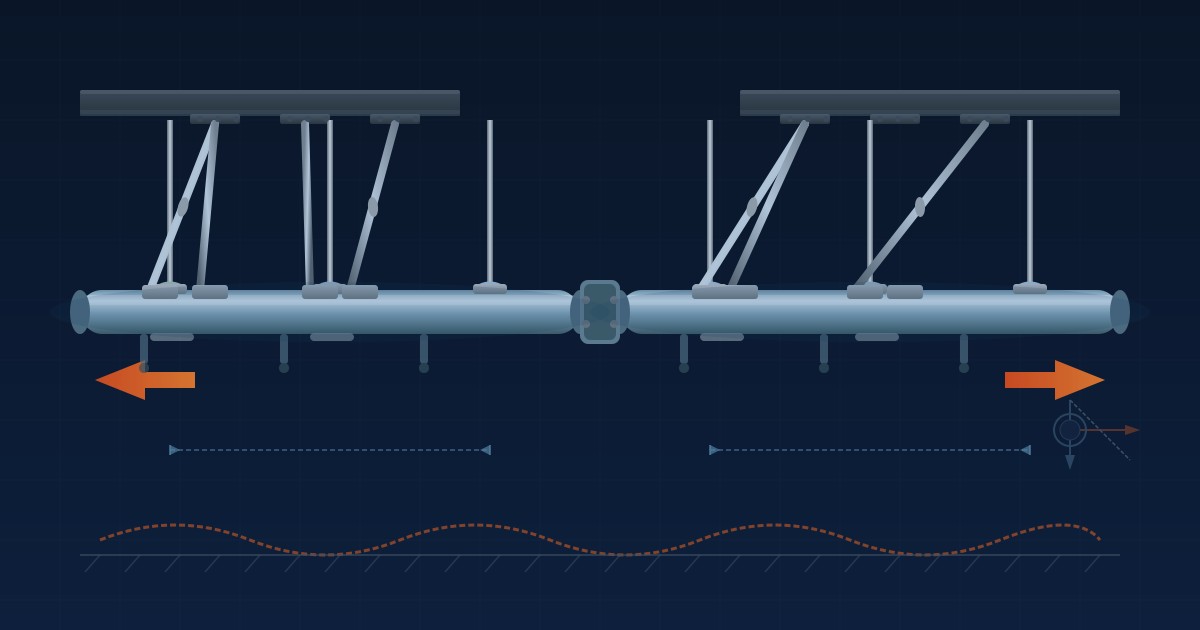
Gravity hangers hold a pipe up, but they do little to stop it from swinging sideways in an earthquake, which is why seismic zones require sway braces: lateral restraint that carries the horizontal seismic force from the pipe to the building structure, per NFPA 13 Chapter 18 for fire sprinkler piping and ASCE 7 Chapter 13 for other mechanical piping.
Why Pipe Needs Seismic Bracing: Lateral Restraint Beyond Gravity Hangers
During an earthquake, a pipe full of water has significant mass, and ground acceleration drives it horizontally. Unbraced, it swings, ruptures at joints, pulls out of fittings, and collides with structure. A sway brace resists that horizontal force. The design force is the seismic coefficient times the zone weight (NFPA 13: Fpw = Cp·Wp) or the ASCE 7 formula with height amplification and bounds. Both convert pipe mass into a horizontal design load in pounds or newtons.
The 1971 Sylmar (San Fernando) earthquake demonstrated this failure mode at scale: unbraced sprinkler systems failed extensively, and the subsequent 1994 Northridge earthquake reinforced those lessons. NFPA 13 Chapter 18 grew directly from Sylmar, establishing the Fpw = Cp·Wp method for fire sprinkler and suppression piping as a codified, life-safety requirement. ASCE/SEI 7 Chapter 13 governs HVAC, plumbing, medical gas, and process piping under the broader nonstructural component provisions. MSS SP-127 covers brace installation details for seismic, wind, and dynamic loads.
This article completes the structural triad in the Plumbing cluster. The Pipe Support Spacing article set how far apart supports go (vertical span, from bending stress and sag). The Hanger Load article set what each support carries (vertical gravity load, weight times span). This article sets lateral restraint: horizontal seismic load. Vertical hangers hold the pipe up; sway braces keep it from swinging sideways. The three together define the three axes of pipe support: vertical span, vertical load, and lateral restraint.
Calculator Inputs: Method, Brace Type, Pipe, Contents, Zone Length, Seismic Parameters
The calculator begins with unit system: US (lb, ft, in) or Metric (N, kg, m, mm). Seismic force in metric is expressed in newtons (N).
Calculation Method selects the governing standard. NFPA 13 (Fpw = Cp·Wp, fitting allowance, Cp from Table 18.5.2.1) for fire sprinkler and suppression piping. ASCE 7 §13.3 (Fp formula with height amplification and bounds) for HVAC, plumbing, medical gas, and process piping.
Brace Type selects lateral/transverse (40 ft or 12.2 m maximum spacing), longitudinal (80 ft or 24.4 m maximum), or four-way/riser (positional, every riser top and floor penetration).
Pipe Material and Size cover Steel Schedule 10 (ASME B36.10M), Steel Schedule 40, CPVC SDR 13.5 (ASTM F439, fire sprinkler, NPS ¾ to 2), and Copper Type L (ASTM B88), in nominal sizes from NPS 1 to 12 (copper to NPS 3, CPVC to NPS 2). The calculator pulls schedule weight per foot and inside diameter from the material and size selection.
Contents set the fluid weight component: water-filled (full bore, standard for sprinkler), empty/dry-pipe (air), or other fluid by density. Zone-of-Influence Length is the tributary pipe length for this brace, center-to-center to adjacent braces, halved at each segment. This is the most influential geometric input.
Optional inputs include insulation or cladding (lb/ft or kg/m), tributary branch weight in the zone if not independently braced (lb or kg), and concentrated weights such as valves or strainers (lb or kg).
NFPA 13-specific inputs add the Fitting Allowance toggle (1.15 multiplier, recommended by default, per NFPA 13, to cover fittings, valves, and heads not individually weighed), Seismic Design Category (A/B exempt, C, D/E/F), and Seismic Coefficient Cp from NFPA 13 Table 18.5.2.1 (0.35 to 0.84 by SDC).
ASCE 7-specific inputs add SDS (short-period design spectral acceleration in g), ap (component amplification factor, 1.0 to 2.5), Rp (response modification factor, 1.5 to 12), Ip (importance factor, 1.0 normal or 1.5 for essential/hazardous facilities), and z/h (height ratio from grade to roof, 0 to 1.0).
An optional Governing Allowable Load input accepts the weakest component in the brace load path (fitting, rod, clamp, anchor, or substrate) and returns a load ratio with a four-tier color verdict: green (ratio ≤ 0.75), amber (0.75 to 1.00), orange (1.00 to 1.25), red (> 1.25).
The calculator produces the seismic design load (Fpw or Fp), a status badge, the Wp weight breakdown, spacing verdict against the 40/80 ft (12.2/24.4 m) code limits, the load ratio and verdict, and recommended maximum brace spacing as the lesser of load-governed and code-prescriptive.
The calculator does not cover brace member, rod, clamp, anchor, or substrate selection; diagonal brace geometry; fluid surge or water hammer; CPVC manufacturer fitting allowables; or four-way numeric spacing. Those require a separate qualified analysis by the engineer of record.
Zone-of-Influence Weight: Total Weight, Not Weight per Foot
The zone-of-influence weight Wp is the total weight the brace restrains: pipe metal, fluid contents, insulation, tributary branches, and concentrated loads over the tributary length. It is a total weight (lb or N), not a weight per foot, and it is the most influential single input in both the NFPA 13 and ASCE 7 calculations.
The weight builds up component by component:
fluid_wpl  = (π/4 × ID²) × ρ_fluid         [lb/ft; water: ρ = 62.4 lb/ft³]
pipe_wpl   = schedule weight per foot        [ASME B36.10M / ASTM B88]
total_wpl  = pipe_wpl + fluid_wpl + insulation_wpl
Wp_base    = total_wpl × zone_length + branch_weight + concentrated_weight
Wp_final   = Wp_base × fitting_factor        [1.15 NFPA 13; 1.0 ASCE 7]
Like the distinction between weight per foot and hanger load in the Hanger Load article, Wp is the full zone weight gathered over the tributary length. Doubling the zone length doubles Wp and therefore doubles the seismic design force. A 50-ft zone of NPS 4 Sch 40 water pipe weighs approximately 760 lb (3,381 N); at Cp 0.5 the brace load is 380 lb (1,690 N).
The components of Wp, in order of typical magnitude:
- Pipe metal: from schedule weight table (ASME B36.10M for steel, ASTM B88 for copper)
- Fluid: water fills the bore at the schedule ID, not the nominal label (full-bore at 62.4 lb/ft³ = 999 kg/m³)
- Insulation or cladding: significant on chilled-water and process lines (mineral wool, calcium silicate)
- Tributary branches: branch lines off the main within the zone, if not independently braced
- Concentrated loads: a 200-lb (890 N) valve can add 25% or more to a short zone's Wp
Worked calculation for NPS 3 Sch 40 water-filled, 40-ft zone (matching the calculator example in Section 11):
pipe_wpl   = 7.576 lb/ft (11.27 kg/m)   from ASME B36.10M
fluid_wpl  = 3.068² × 0.34007 = 9.413 × 0.34007 = 3.20 lb/ft (4.77 kg/m)
total_wpl  = 7.576 + 3.20 = 10.78 lb/ft (16.04 kg/m)
Wp_base    = 10.78 × 40 = 431.2 lb (1,918 N)
Wp_final   = 431.2 × 1.15 = 496 lb (2,206 N)   [NFPA 13 fitting allowance]
Per NFPA 13 and ASCE 7: Wp is the total zone weight (pipe + contents + insulation + branches + concentrated loads) times zone length plus point loads, times 1.15 for the NFPA 13 fitting allowance. Accurate Wp is the most influential factor in the seismic design load.
NFPA 13 Method: Fpw = Cp Times Wp with the Fitting Allowance
The NFPA 13 method for fire sprinkler and suppression piping is direct: multiply the seismic coefficient Cp by the zone weight Wp after applying the 15% fitting allowance. It produces the horizontal sway-brace design force in one step.
Wp_adjusted = Wp × 1.15                   [fitting allowance, NFPA 13]
Fpw = Cp × Wp_adjusted

Variables:
  Fpw = horizontal seismic design force [lb or N]
  Cp  = seismic coefficient [NFPA 13 Table 18.5.2.1, 0.35-0.84 typical]
  Wp  = zone-of-influence weight [lb or N]
The seismic coefficient Cp comes from NFPA 13 Table 18.5.2.1, based on Seismic Design Category: 0.35 to 0.70 for SDC C, 0.50 to 0.84 for SDC D through F. Cp bundles ground motion and amplification into a single table value, making the method fast and deterministic: no building-height calculation, no resonance factor, no bounds checking.
The 15% fitting allowance accounts for fittings, valves, sprinkler heads, and other items not individually weighed in Wp. It is applied by default and is the conservative choice. Turn it off only when every item in the zone has been individually weighed and included in Wp.
Worked example for NPS 3 water-filled sprinkler main, 40-ft zone, Cp 0.5:
Fpw = 0.5 × 496 lb = 248 lb (1,103 N)
The NFPA 13 method originated after the 1971 Sylmar earthquake, where unbraced sprinkler systems failed at scale. NFPA 13 Chapter 18 codified the Cp·Wp approach as a life-safety requirement for fire protection. The 1994 Northridge earthquake confirmed its necessity: buildings with compliant braced sprinkler systems sustained far less piping damage than unbraced systems of the same era.
Per NFPA 13 Chapter 18, Table 18.5.2.1: Fpw = Cp × Wp × 1.15, with Cp by SDC. Direct, deterministic, for fire sprinkler and suppression piping only. Life-safety application: engineer of record and AHJ govern; confirm Cp, SDC, and adopted NFPA 13 edition before applying.
ASCE 7 Method: Fp Formula, Height Amplification, and the Bounds
The ASCE 7 Chapter 13 method for mechanical piping is a formula that amplifies ground acceleration by building height, modulates it by component and structural factors, and clamps the result between upper and lower bounds.
Fp_raw   = 0.4 × ap × SDS × Wp × (1 + 2z/h) × Ip / Rp
Fp_lower = 0.3 × SDS × Ip × Wp
Fp_upper = 1.6 × SDS × Ip × Wp
Fp_final = max(Fp_lower, min(Fp_raw, Fp_upper))

Variables:
  ap  = component amplification factor [1.0 rigid, 2.5 flexible/resonant]
  SDS = short-period design spectral acceleration [g, from ASCE 7 hazard maps]
  z/h = height ratio: component elevation above grade / total building height [0-1]
  Ip  = importance factor [1.0 standard, 1.5 essential facilities or hazardous materials]
  Rp  = response modification factor [1.5-12, by component category per ASCE 7 Table 13.6-1]
The height amplification factor (1 + 2z/h) is the key distinction from the NFPA 13 method. At grade (z/h = 0), the factor is 1.0. At the roof (z/h = 1.0), it is 3.0, tripling the ground acceleration applied to the pipe. A rooftop pipe sees far more seismic force than the same pipe in the building basement or at grade.
The bounds prevent unrealistic results from parameter combinations. Fp_raw can be very low with high Rp or very high with high ap and z/h; the bounds clamp the result between 0.3·SDS·Ip·Wp and 1.6·SDS·Ip·Wp. The importance factor Ip of 1.5 for essential facilities (hospitals, emergency operations centers) and hazardous-material piping raises both bounds, substantially increasing the design force for those occupancies.
Worked example for rooftop HVAC chilled-water pipe, NPS 4 Sch 40, insulated, 20-ft zone, SDS 1.0g, ap 2.5, Rp 6.0, Ip 1.0, z/h 1.0 (roof):
Fp_raw   = 0.4 × 2.5 × 1.0 × 356 × 3.0 × 1.0 / 6.0 = 178 lb (792 N)
Fp_lower = 0.3 × 1.0 × 1.0 × 356 = 106.8 lb (475 N)
Fp_upper = 1.6 × 1.0 × 1.0 × 356 = 569.6 lb (2,533 N)
Fp_final = max(106.8, min(178, 569.6)) = 178 lb (792 N)
(Wp derivation in Section 12 below.)
Per ASCE/SEI 7 Chapter 13: Fp = 0.4·ap·SDS·Wp·(1+2z/h)·Ip/Rp, clamped between bounds. Height amplification and Ip drive the design force for rooftop and essential-facility piping. Applies to HVAC, plumbing, medical gas per NFPA 99, and process piping. Engineer of record and AHJ confirm SDC, ap, Rp, Ip, and adopted ASCE 7 edition.
NFPA 13 vs ASCE 7: Which Standard Governs Which Piping
NFPA 13 and ASCE 7 are not interchangeable. NFPA 13 governs fire sprinkler and suppression piping; ASCE 7 Chapter 13 governs other mechanical piping. Each system uses its own standard throughout, even when both systems serve the same building.
| Aspect | NFPA 13 Chapter 18 | ASCE 7 Chapter 13 |
|---|---|---|
| Applies to | Fire sprinkler / suppression | HVAC, plumbing, medical gas, process |
| Formula | Fpw = Cp × Wp × 1.15 | Fp with height amplification and bounds |
| Seismic input | Cp from Table 18.5.2.1 | SDS, ap, Rp, Ip, z/h |
| Height effect | Not explicit | (1 + 2z/h) factor |
| Fitting allowance | 1.15 | None |
| Lower exemption | SDC A/B sway bracing exempt | Per component category |
Fire protection is a life-safety system: NFPA 13 is the governing standard for sprinkler piping, adopted by reference in the International Building Code and International Fire Code. Its Cp method is codified, deterministic, and widely understood by fire protection engineers and plan reviewers. HVAC, plumbing, medical gas (per NFPA 99), and process piping fall under ASCE 7 Chapter 13 as nonstructural components; the Fp formula accounts for building dynamics that the simpler Cp method does not resolve.
Using NFPA 13 for mechanical piping or ASCE 7 for sprinkler piping is not permitted. An NFPA 13 sprinkler system in a building with mechanical piping uses NFPA 13 for all sprinkler branches and mains; the HVAC and plumbing piping in that same building uses ASCE 7, not NFPA 13. Medical gas piping per NFPA 99 uses ASCE 7 as its seismic basis.
Per NFPA 13 and ASCE 7: fire sprinkler uses NFPA 13 Chapter 18 throughout; mechanical, plumbing, and medical gas piping uses ASCE 7 Chapter 13. Not interchangeable. Confirm which standard governs each system with the engineer of record and AHJ before applying any method.
Lateral, Longitudinal, and Four-Way Braces: Three Restraint Directions
Seismic bracing restrains pipe movement in three directions, and each brace type handles a different one: lateral (transverse), longitudinal (lengthwise), and four-way at risers and floor penetrations.
Lateral (transverse) braces resist horizontal load perpendicular to the pipe axis, preventing the pipe from swinging side-to-side across the run. Maximum spacing is 40 ft (12.2 m) per NFPA 13. Lateral movement is the dominant failure mode: a long unbraced run swings as a pendulum in the transverse direction.
Longitudinal braces resist horizontal load along the pipe axis, preventing the pipe from sliding in its direction of run. Maximum spacing is 80 ft (24.4 m) per NFPA 13, twice the lateral limit. Longitudinal movement is partly restrained by lateral braces on perpendicular runs and by the pipe's own axial stiffness, which is why the code permits wider spacing.
Four-way (riser) braces resist all horizontal directions simultaneously at vertical risers and floor penetrations. They are positional requirements, not a numeric spacing: one four-way brace is required at every riser top and every floor penetration. The calculator flags the four-way brace position but does not return a numeric spacing for it.
A lateral brace on one run can serve as the longitudinal brace for a perpendicular run when the geometry aligns, per NFPA 13. This arrangement is common at tees and elbows where one brace addresses both directions with proper diagonal framing.
Per NFPA 13 Chapter 18: lateral braces at 40 ft (12.2 m), longitudinal braces at 80 ft (24.4 m), four-way braces at every riser and floor penetration. Three directions, three brace types. MSS SP-127 covers brace assembly installation.
Brace Spacing Limits: 40 Feet Lateral, 80 Feet Longitudinal
NFPA 13 sets prescriptive maximum brace spacings that apply regardless of pipe size, pipe material, or calculated seismic load: 40 ft (12.2 m) for lateral braces, 80 ft (24.4 m) for longitudinal braces. A brace that passes the load check can still fail the spacing screen.
| Brace type | Maximum spacing |
|---|---|
| Lateral (transverse) | 40 ft (12.2 m) |
| Longitudinal | 80 ft (24.4 m) |
| Four-way at riser | Every riser top + floor penetration (positional) |
The spacing limits are prescriptive, not load-derived. A NPS 1 branch line still needs a lateral brace within 40 ft of the run, even if its seismic load is small and the load ratio is 0.05. Spacing frequency is independent of the load magnitude.
The load check and spacing check are two independent screens, and both must pass. A brace can have a load ratio of 0.13 (ample capacity margin) yet fail the spacing screen if the zone exceeds 40 ft. Add a brace to bring the zone within the prescriptive limit.
The calculator returns a recommended maximum brace spacing as the lesser of two values:
spacing_load_based = allowable / (Cp × total_wpl × 1.15)    [NFPA 13]
spacing_recommended = min(spacing_load_based, code_limit)
In the worked NPS 3 example (Section 11), the load-based spacing is 306.5 ft (93.4 m), but the code prescriptive limit is 40 ft (12.2 m). The prescriptive limit governs, as it typically does: a light load does not justify fewer braces when the code requires them for pipe restraint frequency.
Per NFPA 13 Chapter 18: lateral 40 ft (12.2 m), longitudinal 80 ft (24.4 m), prescriptive maxima regardless of pipe size or load ratio. Both the spacing screen and the load check must pass. Engineer of record and AHJ confirm adopted edition.
Seismic Design Category and the Sway-Bracing Exemption
The Seismic Design Category (SDC), determined per ASCE 7 from site class and mapped spectral accelerations, sets whether sway bracing is required for fire sprinkler piping under NFPA 13.
| SDC | Sway bracing requirement | Cp range |
|---|---|---|
| A, B | May be exempt (low seismic risk) | N/A |
| C | Required | 0.35 to 0.70 |
| D, E, F | Required, full | 0.50 to 0.84 |
SDC A and B allow an exemption from sway bracing for fire sprinkler piping under NFPA 13 Chapter 18. The exemption is narrow: it covers sway braces (lateral, longitudinal, four-way) only. It does not exempt seismic restraint, seismic clearance gaps at penetrations through walls and floors, or standard gravity hangers, all of which are required regardless of SDC.
The structural engineer of record determines the SDC from ASCE 7 hazard data, site class, and risk category. Do not assume SDC A or B and omit braces without a written determination from the structural engineer, confirmed with the AHJ.
SDC D through F (high seismic zones, including California, the Pacific Northwest, parts of the Central US, and Hawaii) drive Cp values of 0.50 to 0.84. At Cp 0.84, the sway brace must carry 84% of the zone weight as a horizontal force. For a 40-ft zone of NPS 3 water-filled sprinkler main (Wp 496 lb), that is 417 lb (1,854 N) per brace.
Per NFPA 13 Chapter 18 and ASCE 7: SDC A/B may exempt sway bracing, not seismic restraint, clearance, or gravity hangers. SDC C through F require full bracing with Cp rising by category. Confirm SDC with structural engineer and AHJ; do not omit braces on assumed exemption.
NFPA 13 Worked Example: NPS 3 Sprinkler Main, 40-Foot Zone, 248-Pound Brace Load
Scenario: fire sprinkler main, NPS 3 Steel Schedule 40, water-filled, 40-ft (12.2 m) zone at maximum lateral brace spacing, SDC D, Cp 0.5, fitting allowance on, governing allowable 1,900 lb (8,452 N) at the weakest component in the load path.
Step 1. Empty pipe weight per foot from ASME B36.10M:
empty = 7.576 lb/ft (11.27 kg/m)
Step 2. Water weight at schedule ID (3.068 in = 77.9 mm):
water = 3.068² × 0.34007 = 9.413 × 0.34007 = 3.20 lb/ft (4.77 kg/m)
Step 3. Total weight per foot:
total_wpl = 7.576 + 3.20 = 10.78 lb/ft (16.04 kg/m)
Step 4. Zone weight base:
Wp_base = 10.78 × 40 = 431.2 lb (1,918 N)
Step 5. Fitting allowance per NFPA 13 Chapter 18:
Wp = 431.2 × 1.15 = 496 lb (2,206 N)
Step 6. Seismic design load:
Fpw = Cp × Wp = 0.5 × 496 = 248 lb (1,103 N)
Step 7. Load ratio against governing allowable:
load_ratio = 248 / 1,900 = 0.131 → ADEQUATE (green, ratio ≤ 0.75)
Step 8. Spacing check:
40 ft zone ≤ 40 ft lateral limit → PASS
Step 9. Recommended maximum brace spacing:
spacing_load_based = 1,900 / (0.5 × 10.78 × 1.15) = 1,900 / 6.199 = 306.5 ft (93.4 m)
spacing_recommended = min(306.5, 40) = 40 ft (12.2 m)   → code prescriptive governs
Step 10. Result:
The brace carries 248 lb (1,103 N) of horizontal seismic load, well within the 1,900-lb (8,452 N) governing allowable at ratio 0.131. The full 40-ft (12.2 m) zone is acceptable. The load-based calculation would allow 306.5 ft (93.4 m) spacing, but NFPA 13 Chapter 18 caps lateral spacing at 40 ft (12.2 m). The prescriptive limit governs, not the load.
Brace hardware, load-path components (rod, clevis, clamp, anchor), and substrate must be verified by the engineer of record per MSS SP-127 and the manufacturer FM Approved / UL Listed assembly ratings (Tolco/nVent, Cooper B-Line/Eaton, Anvil/ASC, Unistrut, AFCON). Cross-reference the Hanger Load Calculator and Pipe Support Spacing Calculator: the same NPS 3 main needs gravity hangers for vertical load and support spacing for bending stress and sag. Seismic bracing addresses the third axis, lateral restraint.
ASCE 7 Worked Example: Rooftop Mechanical Pipe with Height Amplification
Scenario: rooftop HVAC chilled-water pipe, NPS 4 Steel Schedule 40, water-filled, insulated, ASCE 7 method (mechanical system, not fire sprinkler), 20-ft (6.1 m) zone, SDS 1.0g, ap 2.5, Rp 6.0, Ip 1.0 (standard occupancy), z/h 1.0 (roof level).
Step 1. Weight per foot (NPS 4 Sch 40, water + insulation):
pipe      = 10.79 lb/ft (16.06 kg/m)  from ASME B36.10M
water     = 4.026² × 0.34007 = 16.209 × 0.34007 = 5.51 lb/ft (8.20 kg/m)
insulation = 1.50 lb/ft (2.23 kg/m)   (2-in fiberglass at 4 lb/ft³)
total_wpl = 10.79 + 5.51 + 1.50 = 17.80 lb/ft (26.49 kg/m)
Step 2. Zone weight (no fitting allowance for ASCE 7):
Wp = 17.80 × 20 = 356 lb (1,583 N)
Step 3. Height amplification at roof:
(1 + 2z/h) = 1 + 2(1.0) = 3.0
Step 4. Fp raw:
Fp_raw = 0.4 × 2.5 × 1.0 × 356 × 3.0 × 1.0 / 6.0 = 178 lb (792 N)
Step 5. Bounds per ASCE 7 §13.3:
Fp_lower = 0.3 × 1.0 × 1.0 × 356 = 106.8 lb (475 N)
Fp_upper = 1.6 × 1.0 × 1.0 × 356 = 569.6 lb (2,533 N)
Step 6. Final design force (clamped):
Fp_final = max(106.8, min(178, 569.6)) = 178 lb (792 N)
Step 7. Height effect comparison:
Same pipe at grade (z/h = 0): (1 + 0) = 1.0
Fp_raw_grade = 0.4 × 2.5 × 1.0 × 356 × 1.0 / 6.0 = 59.3 lb
  → clamped to Fp_lower = 106.8 lb (475 N)

Roof:  178 lb (792 N)
Grade: 106.8 lb (475 N) [lower bound controls]
Roof brace load is 1.67 times the grade brace load for this example.
Step 8. Essential-facility variant (hospital, Ip 1.5):
Fp_raw   = 0.4 × 2.5 × 1.0 × 356 × 3.0 × 1.5 / 6.0 = 267 lb (1,188 N)
Fp_lower = 0.3 × 1.0 × 1.5 × 356 = 160.2 lb (712 N)
Fp_final = 267 lb (1,188 N)   → Ip 1.5 raises force 50% vs Ip 1.0 case
Step 9. Result:
Rooftop mechanical pipe: 178 lb (792 N) for standard occupancy, 267 lb (1,188 N) for hospital or essential facility. The height amplification factor of 3.0 at roof level drives the design force substantially above grade. Ip 1.5 adds another 50% for essential-facility piping.
Step 10. Method note: this piping uses ASCE 7 Chapter 13, not NFPA 13, even when fire sprinkler piping in the same building uses NFPA 13. Medical gas piping (NFPA 99) uses ASCE 7 as its seismic basis. Cross-reference the NFPA 13 example in Section 11: the sprinkler pipe in the same building uses Cp × Wp, not the Fp formula.
Per ASCE/SEI 7 Chapter 13: rooftop mechanical pipe design force driven by height amplification (1 + 2z/h = 3.0 at roof) and Ip. Essential facilities (Ip 1.5) see 50% higher design force than standard occupancy. Confirm ap and Rp with ASCE 7 Table 13.6-1.
Application Boundaries: Brace Hardware, Anchorage, Diagonal Braces, Nonseismic Loads
The calculator computes the horizontal seismic design load (Fpw per NFPA 13 or Fp per ASCE 7) and screens spacing against the prescriptive limits. The following are outside its scope and require separate analysis.
Brace member and hardware selection. The calculator produces the design force, not the brace assembly. The engineer of record selects the rod, clevis, clamp, diagonal brace member, and connection hardware against the design load. FM Approved and UL Listed sway brace assemblies from Tolco (nVent), Cooper B-Line (Eaton), Anvil (ASC Engineered Solutions), Unistrut, and AFCON carry rated allowable loads per their listed configurations.
Anchorage and substrate. The concrete anchor, its embedment depth, edge distance, and substrate capacity are a separate check per ACI 318 Chapter 17 and MSS SP-127. Anchor failure in the 1971 Sylmar earthquake was as significant as pipe-joint failure. The calculator accepts a governing allowable as input; it does not determine which component in the load path is weakest.
Diagonal brace geometry. Sway braces are installed at an angle (typically 30 to 60 degrees from vertical). The brace member force along its axis equals the horizontal design load divided by the cosine of the angle from horizontal. A brace at 45 degrees carries 1.41 times the horizontal design load along its member axis. The calculator computes the horizontal force only; the engineer applies the geometry correction when sizing the member.
CPVC and flexible piping. CPVC SDR 13.5 fitting allowables vary by manufacturer listing, often well below pipe weight, and require manufacturer seismic ratings. Flexible piping per NFPA 13 Section 18.1 and the manufacturer defines its own seismic provisions.
Nonseismic loads. The calculator is seismic-only. Fluid surge, water hammer, thermal expansion, wind, and vibration are separate load cases per MSS SP-127 (which covers seismic, wind, and dynamic together). Thermal expansion loops cross-reference the Pipe Expansion Loop Sizing Calculator.
Vertical load. Seismic bracing carries horizontal force; gravity hangers carry vertical force. A pipe needs both gravity support (cross-reference Hanger Load Calculator) and seismic bracing. The two are complementary, not interchangeable.
Per NFPA 13, ASCE 7, and MSS SP-127: seismic design load and spacing screen are the calculator scope. Brace assembly, anchorage, diagonal geometry, CPVC allowables, nonseismic loads, and gravity support require separate qualified analysis by the engineer of record, with approval by the AHJ.
Pipe Seismic Bracing Calculator
Pipe seismic bracing per NFPA 13 and ASCE 7: computes the horizontal sway-brace design load from the zone-of-influence weight, either NFPA 13 Fpw = Cp x Wp with the 15% fitting allowance for fire sprinkler piping, or the ASCE 7 Chapter 13 Fp formula with height amplification and bounds for mechanical piping. Screens lateral (40 ft / 12.2 m) and longitudinal (80 ft / 24.4 m) spacing limits, checks the load against a governing allowable, and recommends maximum brace spacing. Covers steel Schedule 10 and 40, CPVC SDR 13.5, and copper Type L.
Open Pipe Seismic Bracing CalculatorFAQ
What is the maximum spacing between seismic sway braces?
Per NFPA 13 Chapter 18: lateral (transverse) sway braces are required at a maximum of 40 ft (12.2 m), and longitudinal braces at a maximum of 80 ft (24.4 m), regardless of pipe size or seismic load magnitude. Four-way braces are positional requirements at every riser top and floor penetration, not a numeric spacing. Both the spacing screen and the load check must pass independently.
How is the zone-of-influence weight Wp calculated?
Per NFPA 13 Chapter 18: Wp is the total weight of pipe metal, fluid contents, insulation, tributary branch lines, and concentrated loads (valves, strainers) over the tributary length for that brace, multiplied by 1.15 for the NFPA 13 fitting allowance. It is a total weight in pounds or newtons, not a weight per foot. Fpw = Cp × Wp; doubling the zone length doubles Wp and the design force.
When is fire sprinkler pipe exempt from seismic bracing?
Per NFPA 13 Chapter 18 and ASCE 7: Seismic Design Categories A and B may exempt sway bracing for fire sprinkler piping, but the exemption covers lateral, longitudinal, and four-way braces only. It does not exempt seismic restraint, seismic clearance gaps at wall and floor penetrations, or standard gravity hangers, which are required in all SDCs. Confirm the SDC with the structural engineer and AHJ before omitting any brace.
What is the difference between NFPA 13 and ASCE 7 for pipe seismic bracing?
Per NFPA 13 Chapter 18 and ASCE 7 Chapter 13: NFPA 13 applies to fire sprinkler and suppression piping only, using Fpw = Cp × Wp with Cp from a code table (no height calculation). ASCE 7 applies to HVAC, plumbing, medical gas (NFPA 99 basis), and process piping, using Fp = 0.4·ap·SDS·Wp·(1+2z/h)·Ip/Rp clamped between bounds. The two methods are not interchangeable; the governing standard is determined by pipe system type, not building type.
Why do rooftop pipes need stronger seismic bracing than the same pipe at grade?
Per ASCE 7 §13.3: the height amplification factor (1 + 2z/h) scales the ground acceleration by position in the building. At the roof (z/h = 1.0), the factor is 3.0, tripling the effective ground acceleration compared to grade (factor 1.0). In the Section 12 example, the same NPS 4 water pipe produces 178 lb (792 N) at the roof versus 106.8 lb (475 N) at grade after lower-bound clamping, a 1.67 times increase. Essential facilities (Ip 1.5) add another 50%.
What seismic force does a lateral sway brace actually resist?
Per NFPA 13 Chapter 18 and ASCE 7: for NFPA 13, the brace resists Fpw = Cp × Wp. At Cp 0.5, the brace carries 50% of the zone weight as a horizontal force; at Cp 0.84 (SDC D-F), it carries 84% of zone weight. For a 40-ft zone of NPS 3 sprinkler main (Wp 496 lb), Cp 0.5 gives 248 lb (1,103 N). For ASCE 7, the force is governed by the Fp formula with height and bounds, as in Section 12.
Does the calculator size the sway brace and anchor?
Per NFPA 13, ASCE 7, and MSS SP-127: no. The calculator computes the horizontal seismic design force and screens spacing. The engineer of record selects the brace member, rod, clevis, clamp, and anchor, and verifies substrate capacity per ACI 318 and MSS SP-127. The diagonal brace member force exceeds the horizontal design force by 1/cos(brace angle): a 45-degree brace carries 1.41 times the horizontal load along its axis. FM Approved / UL Listed assembly ratings govern hardware selection.
Related Calculators
- Hanger Load Calculator: Vertical gravity load per MSS SP-58; seismic bracing adds lateral restraint to the gravity support this sizes (article).
- Pipe Support Spacing Calculator: Maximum vertical span from bending stress and deflection; the first leg of the structural triad (article).
- Fire Pump Performance Curve Calculator: NFPA 20 fire pump acceptance; the braced sprinkler system this serves (article).
- Pipe Expansion Loop Sizing Calculator: Thermal expansion loops; seismic braces must allow thermal movement while restraining lateral seismic load.
- Hazen-Williams Pipe Flow Calculator: Sprinkler and water pipe flow per AWWA M22 (article).
- Compressed Air Pipe Sizing Calculator: Dry-pipe sprinkler air and shop air sizing (article).
- Grease Trap Sizing Calculator: Commercial kitchen FOG management per PDI G101 (article).
Standards References
- NFPA 13 (2022) — Standard for the Installation of Sprinkler Systems, National Fire Protection Association. Chapter 18: Seismic Protection; Section 18.5: Sway Bracing; Table 18.5.2.1: Seismic Coefficient Cp by SDC; Section 18.1: Flexible Piping.
- ASCE/SEI 7 (2022) — Minimum Design Loads and Associated Criteria for Buildings and Other Structures, American Society of Civil Engineers. Chapter 13: Seismic Design Requirements for Nonstructural Components; Section 13.3: Seismic Design Force; Table 13.6-1: Coefficients for Mechanical and Electrical Components.
- MSS SP-127 — Bracing for Piping Systems: Seismic-Wind-Dynamic, Manufacturers Standardization Society. Brace installation, hardware, anchorage, and assembly requirements.
- ASME B36.10M — Welded and Seamless Wrought Steel Pipe, ASME. Schedule weight, OD, ID, and wall thickness for steel pipe used in Wp calculations.
- ASTM B88 — Standard Specification for Seamless Copper Water Tube, ASTM International. OD, ID, and weight for Type K, L, and M copper tube.
- ASTM F439 — Standard Specification for Chlorinated Poly (Vinyl Chloride) (CPVC) Plastic Pipe Fittings, Schedule 80, ASTM International. CPVC fittings for fire sprinkler applications, NPS ¾ to 2.
- NFPA 99 (2021) — Health Care Facilities Code, National Fire Protection Association. Medical gas piping seismic requirements using ASCE 7 as the design basis.
- 1971 Sylmar (San Fernando) Earthquake — California Division of Mines and Geology. Origin event for NFPA 13 seismic bracing requirements; extensive unbraced sprinkler system failures documented.
- 1994 Northridge Earthquake — USGS. Reinforced Sylmar lessons; sprinkler damage in buildings without compliant braced systems confirmed NFPA 13 Chapter 18 necessity.
- Tolco (nVent) — Tolco Seismic Bracing Catalog: FM Approved / UL Listed sway brace assemblies, allowable loads by configuration and anchor type.
- Cooper B-Line (Eaton) — B-Line Seismic Bracing Systems Catalog: listed sway brace assemblies, clamps, rods, and anchors.
- Anvil (ASC Engineered Solutions) — Grinnell Seismic Brace Products: listed sway brace hardware, allowable load tables, and MSS SP-127 installation details.