Seismic Bracing for Pipes Calculator — Load & Spacing
On this page
Calculate
US: zone length in ft, weights in lb, loads in lb. Metric: zone length in m, weights in kg, loads in N.
NFPA 13 Chapter 18 applies to fire sprinkler and suppression systems. ASCE 7 Chapter 13 applies to mechanical piping classified as nonstructural components.
Lateral braces resist transverse horizontal loads. Longitudinal braces resist lengthwise movement. Four-way bracing is required at every riser and at floor penetrations.
Pipe weights and inside diameters come from the published schedule. CPVC is limited to NPS ¾–2 in this calculator.
Nominal pipe size determines the empty weight per foot and fluid cross-section from the ASME B36.10M schedule table.
Water-filled is the standard basis for fire sprinkler pipe. For dry-pipe systems or other fluids select accordingly.
The tributary pipe length assigned to this brace, typically the center-to-center distance to the adjacent braces on each side, halved for each segment.
Optional tributary weights
Additional distributed weight from insulation, cladding, jacketing, or heat tracing per foot of pipe.
Total weight of branch lines hanging off this main in the zone of influence, if any.
Weight of heavy inline components (valves, filters, strainers, meters) within the zone of influence.
Seismic parameters
NFPA 13 applies a 15% allowance to Wp to account for fittings, valves, and sprinkler heads not individually weighed.
NFPA 13 exempts pipe sway bracing for SDC A/B. SDC is determined from ASCE 7 based on site class and mapped spectral values. Confirm with the project structural engineer.
Cp from NFPA 13 Table 18.5.2.1 based on the seismic zone or spectral acceleration. Typical values: 0.35–0.70 for SDC C, 0.50–0.84 for SDC D-F.
Load check (optional)
Weakest rated allowable load in the brace load path (fitting, rod, clamp, anchor, or substrate, whichever governs). Enter to get a load ratio and adequacy verdict.
Overview
This calculator finds the horizontal seismic design load on a pipe sway brace and screens the brace spacing against NFPA 13 and ASCE 7 prescriptive limits. Two methods are supported: NFPA 13 (Fpw = Cp × Wp), used for fire sprinkler and fire suppression piping, and ASCE 7 Chapter 13 (Fp with upper and lower bounds), used for other mechanical piping classified as nonstructural components. Both methods build the zone-of-influence weight Wp from the pipe metal weight, fluid contents, optional insulation or cladding, tributary branch weight, and concentrated loads such as valves or strainers.
Brace spacing is checked against the NFPA 13 prescriptive limits: 40 ft (12.2 m) for lateral (transverse) braces and 80 ft (24.4 m) for longitudinal braces. Four-way bracing at risers carries an advisory requirement (at every riser top and floor penetration) with no fixed numeric spacing limit. The spacing verdict is independent of the load check; a brace can pass the load ratio but still fail the spacing screen if the zone of influence is too long.
When the weakest allowable load in the brace load path is entered, the calculator returns a load ratio and a color-coded verdict. For NFPA 13 it also returns the maximum recommended brace spacing (the lesser of the load-limited spacing and the code prescriptive limit) so brace locations can be planned before fabrication.
What to Look at First
Seismic load (Fpw or Fp). The primary output is the horizontal seismic design force the brace must resist in lb or N. Compare this against the weakest allowable in the brace load path (the fitting, rod, clamp, anchor, or substrate) to determine adequacy.
Status badge. COMPUTED means the load is calculated but no allowable was entered. COMPUTED / ADEQUATE means the load ratio is ≤ 1.00 and spacing is within the code limit. SPACING-EXCEEDS-LIMIT means you need an additional brace regardless of the load result.
Zone-of-influence weight (Wp). The breakdown shows how Wp is built up from pipe metal, fluid contents, insulation/cladding, tributary branch weight, and concentrated loads. The NFPA 13 fitting allowance adds 15% on top. Understand each line so you can confidently enter or omit optional weights.
Recommended spacing (NFPA only). When an allowable is entered, the calculator returns the maximum practical brace spacing, the lesser of the load-governed spacing and the 40/80 ft code limit. Use this to plan brace locations before fabrication.
How to Use This Calculator
Select the unit system (US or Metric) and the calculation method: NFPA 13 for fire sprinkler piping or ASCE 7 for other mechanical piping.
Choose the brace type (Lateral/transverse, Longitudinal, or Four-way/riser) and the pipe material and size.
Set the pipe contents: Water-filled (default), Empty/Air, or Other fluid. For a custom fluid enter its density.
Enter the zone-of-influence length (the brace spacing or tributary pipe length for this brace).
Optionally add tributary branch weight, insulation/cladding weight per length, and any concentrated load (valve, strainer, etc.).
For NFPA 13: enter the seismic coefficient Cp (from NFPA 13 Table 18.5.2.1 or the authority having jurisdiction) and the Seismic Design Category. For ASCE 7: enter SDS, ap, Rp, Ip, and z/h.
Optionally enter the governing allowable load of the weakest component in the brace load path to get a load ratio and adequacy verdict.
This calculator computes the seismic design load and screens brace spacing only. It does not select, size, or approve brace members, fasteners, anchors, or substrate. All results must be reviewed by the engineer of record and confirmed with the authority having jurisdiction.
Inputs & Outputs
Inputs
Outputs
Formula
Seismic Design Load Formulas
NFPA 13 method: Fpw = Cp × Wp
Wp = (pipe_wpl + fluid_wpl + extra_wpl) × zone_length
   + branch_weight + concentrated_weight
Wp_adjusted = Wp × 1.15   (15% fitting allowance, NFPA 13)

Fpw = Cp × Wp_adjusted
The fitting allowance is applied by default and accounts for fittings, valves, and sprinkler heads not individually weighed. Cp comes from NFPA 13 Table 18.5.2.1 or the authority having jurisdiction.
ASCE 7 method: Fp = 0.4·ap·SDS·Wp·(1 + 2z/h)·Ip/Rp
Fp_raw   = 0.4 × ap × SDS × Wp × (1 + 2z/h) × Ip / Rp
Fp_lower = 0.3 × SDS × Ip × Wp          (lower bound)
Fp_upper = 1.6 × SDS × Ip × Wp          (upper bound)
Fp_final = max(Fp_lower, min(Fp_raw, Fp_upper))
The raw formula value is clamped between the lower and upper bounds. The governing bound is shown in the result breakdown.
Zone-of-influence weight build-up
fluid_wpl = (π/4 × ID²) × ρ_fluid     (lb/ft; water default ρ = 62.4 lb/ft³)
pipe_wpl  = from schedule table (ASME B36.10M or ASTM B88)
total_wpl = pipe_wpl + fluid_wpl + insulation_wpl
Wp_base   = total_wpl × zone_length + branch_weight + concentrated_weight
Wp_final  = Wp_base × fitting_factor  (1.15 for NFPA, 1.0 for ASCE 7)
Spacing limits (prescriptive, independent of load check)
| Brace type | Code limit |
|---|---|
| Lateral (transverse) | 40 ft (12.2 m) |
| Longitudinal | 80 ft (24.4 m) |
| Four-way at riser | At every riser top and floor penetration |
Load ratio
load_ratio = Fp / governing_allowable
| Load ratio | Verdict |
|---|---|
| ≤ 0.75 | ADEQUATE (green) |
| 0.75–1.00 | ADEQUATE / Near limit (amber) |
| 1.00–1.25 | OVER-LIMIT (orange) |
| > 1.25 | SIGNIFICANTLY-OVER (red) |
Recommended maximum spacing (NFPA 13 only)
spacing_load_based = governing_allowable / (Cp × total_wpl × fitting_factor)
spacing_recommended = min(spacing_load_based, code_spacing_limit)
This is the maximum spacing that satisfies both the load ratio (≤ 1.0) and the prescriptive spacing limit.
Variable Reference
| Variable | Meaning | Units |
|---|---|---|
| Cp | NFPA 13 seismic coefficient | dimensionless |
| SDS | Short-period design spectral acceleration | g |
| ap | Component amplification factor | dimensionless |
| Rp | Response modification factor | dimensionless |
| Ip | Importance factor | dimensionless |
| z/h | Height above grade / building height | dimensionless |
| Wp | Zone-of-influence weight | lb or N |
| Fpw / Fp | Horizontal seismic design force | lb or N |
| zone_length | Tributary pipe length for this brace | ft or m |
Standards Basis
NFPA 13 Chapter 18 (seismic protection of fire sprinkler systems), ASCE/SEI 7 Chapter 13 (seismic design requirements for nonstructural components), MSS SP-127 (piping seismic restraint), ASME B36.10M (steel pipe dimensions), ASTM B88 (copper tube dimensions), ASTM F439 (CPVC fittings).
How Seismic Bracing for Pipes Works
Pipe sway bracing limits the horizontal movement of piping during an earthquake, preventing pipe rupture, joint separation, and collision with structural elements. The brace carries a design seismic force (computed from the weight of the pipe, its contents, and any tributary loads) and transfers it to the building structure at a certified anchor point. Two standards govern the design: NFPA 13 Chapter 18 for fire sprinkler and suppression systems, and ASCE 7 Chapter 13 for mechanical piping classified as nonstructural components.
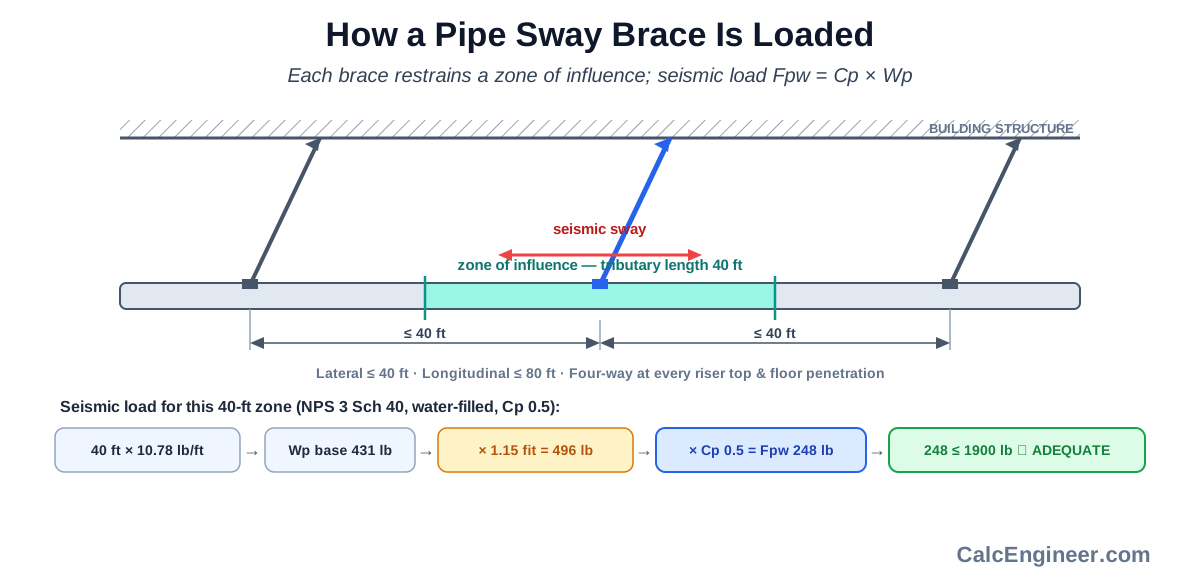
The NFPA 13 method is direct: multiply the seismic coefficient Cp by the zone-of-influence weight Wp, with a 15% fitting allowance added to account for fittings, valves, and sprinkler heads that are not individually weighed. Cp is tabulated in NFPA 13 Table 18.5.2.1 and depends on the seismic zone or mapped spectral acceleration. The ASCE 7 method uses a formula that amplifies the ground acceleration by the height ratio (higher pipes shake more), modulates it by the component amplification factor ap and response modification factor Rp, and bounds the result above and below. Both methods ultimately produce a horizontal force in pounds or newtons.
Brace spacing is enforced separately from the load check. NFPA 13 prescribes 40 ft (12.2 m) maximum for lateral braces and 80 ft (24.4 m) for longitudinal braces, regardless of pipe size or load. A brace can have an adequate load ratio but still fail the spacing screen; you need one additional brace to bring the tributary zone within the limit. Four-way bracing at risers has a positional requirement: one brace at every riser top and at every floor penetration, without a fixed spacing number.
The calculator does not select or approve brace hardware. It produces the design force and a spacing verdict; the engineer of record selects the brace member, attachment fitting, threaded rod, concrete anchor, and verifies the substrate capacity. All results must be confirmed with the authority having jurisdiction before installation.
Zone-of-Influence Weight
The zone-of-influence weight Wp is the total weight of pipe, contents, and accessories that the brace must restrain horizontally. It is not the weight per foot; it is the total weight over the tributary length, plus any concentrated masses. For a simple straight run, Wp equals the weight per foot of pipe-plus-contents multiplied by the zone length (typically the center-to-center distance between adjacent braces), plus optional add-ons for insulation, tributary branch lines, and heavy inline components.
Insulation and cladding add to the distributed weight and can be significant on process piping or chilled-water systems. Branch lines hanging from a main must be accounted for in the main brace zone of influence when the branches are not independently braced. Concentrated loads (large valves, strainers, flow meters, expansion joints) add directly to Wp at their full weight and can dominate the zone weight for short zones.
The NFPA 13 fitting allowance multiplies Wp by 1.15 before applying Cp. This conservative provision is applied by default and covers the cumulative weight of all fittings, elbows, reducers, and sprinkler heads within the zone that were not individually weighed. It can be turned off only when all such items have been explicitly weighed and included in the inputs.
Accurate Wp is the most influential factor in the result. A 50-foot zone of 4-inch steel Schedule 40 water-filled pipe weighs roughly 760 lb, giving a 380 lb seismic load at Cp = 0.5. Doubling the zone length doubles the load. Adding a 200-lb valve increases Wp by over 25%. Understanding each line in the weight build-up prevents both under-designing the brace and over-engineering it.
NFPA 13 vs ASCE 7: When to Use Each
NFPA 13 Chapter 18 is the required method for fire sprinkler and fire suppression piping in all occupancies covered by NFPA 13. It uses a deterministic seismic coefficient Cp that already incorporates the relevant ground motion parameters and amplification factors into a single number. The method is fast, widely understood by fire protection engineers, and codified with the Seismic Design Category exemptions: SDC A and B sites do not require pipe sway bracing under NFPA 13, though restraint and seismic clearance at penetrations still apply.
ASCE 7 Chapter 13 applies to HVAC piping, plumbing, medical gas, process, and other mechanical piping that falls under the general nonstructural component design requirements. The formula is more detailed; it accounts for building height, component resonance through ap, and the structural system response through Rp. The importance factor Ip equals 1.5 for piping in essential facilities or carrying hazardous materials, doubling the lower bound and raising the design force substantially.
The two methods are not interchangeable for the same piping system. An NFPA 13 sprinkler system that also serves as an occupant use hose system must use NFPA 13 for the entire system. Mechanical piping in a building with a fire suppression system still uses ASCE 7, not NFPA 13, for the mechanical pipe bracing. When in doubt, confirm with the authority having jurisdiction which standard governs each system on the project.
Key Facts
- NFPA 13 seismic bracing requirements were first introduced after the 1971 Sylmar earthquake in California, where unbraced sprinkler systems suffered extensive damage.
- The 40-ft lateral brace spacing limit in NFPA 13 is a prescriptive maximum that applies regardless of pipe size or calculated seismic force; a 1-inch branch still needs a brace within 40 feet.
- ASCE 7 height amplification (1 + 2z/h) doubles the effective acceleration for piping at roof level compared to the same pipe at grade.
- In SDC D, E, and F, the NFPA 13 Cp coefficient for fire sprinkler pipe typically ranges from 0.5 to 0.84 g, meaning the brace must resist 50–84% of the pipe weight as a horizontal force.
- MSS SP-127 provides installation requirements for seismic restraints including minimum edge distances, clearance requirements, and approved connection methods.
Applications
- Fire sprinkler systems in commercial, industrial, and residential buildings (NFPA 13)
- HVAC chilled-water, heating hot-water, and condenser-water piping (ASCE 7)
- Medical gas and vacuum systems in hospitals (NFPA 99 / ASCE 7)
- Process and utility piping in industrial facilities in seismic zones
- Dry-pipe and pre-action fire suppression systems in cold storage warehouses
Example Calculation
Example Calculation: NFPA 13 Method
Given: NPS 3 Steel Sch 40 water-filled pipe; zone length 40 ft; Cp = 0.5; allowable 1900 lb; fitting allowance ON.
Pipe weight per foot:
- Empty pipe: 7.576 lb/ft (from ASME B36.10M)
- Water: 3.068² × 0.34007 = 3.20 lb/ft
- Total: 10.78 lb/ft
Zone-of-influence weight:
- Wp_base = 10.78 × 40 = 431.2 lb
- Fitting allowance: 431.2 × 1.15 = 496 lb → Wp = 496 lb
Seismic load:
- Fpw = 0.5 × 496 = 248 lb
Check:
- Load ratio: 248 / 1900 = 0.131 → ADEQUATE
- Spacing: 40 ft ≤ 40 ft → OK
- Recommended max spacing: min(1900 / (0.5 × 10.78 × 1.15), 40) = min(307, 40) = 40 ft
Result: The brace carries 248 lb horizontal seismic load, well within the 1900 lb allowable. The full 40-ft zone is acceptable. The load path, anchor, and substrate must still be verified by the engineer of record.
Standards & References
- NFPA 13 (2022): Standard for the Installation of Sprinkler Systems, Chapter 18: Seismic Protection
- ASCE/SEI 7 (2022): Minimum Design Loads and Associated Criteria for Buildings and Other Structures, Chapter 13: Seismic Design Requirements for Nonstructural Components
- MSS SP-127: Bracing for Piping Systems: Seismic, Wind, Dynamic Design, Selection, Application
- ASME B36.10M: Welded and Seamless Wrought Steel Pipe (pipe weights and dimensions)
- ASTM B88: Standard Specification for Seamless Copper Water Tube (Type L dimensions)
- ASTM F439: Standard Specification for Chlorinated Poly(Vinyl Chloride) (CPVC) Plastic Pipe Fittings
Limitations
- Covers lateral, longitudinal, and four-way brace types only; does not address diagonal brace configurations.
- Pipe profiles are limited to Steel Sch 10/40 (NPS 1–12), CPVC SDR 13.5 (NPS ¾–2), and Copper Type L (¾–3 in).
- Does not account for fluid surge, water hammer, or thermal expansion loads (seismic load only).
- Does not select or size brace members, rods, clamps, anchors, or substrate; engineering judgment required.
- The four-way brace spacing check is advisory (positional requirement, no numeric limit); verify with NFPA 13 and the AHJ.
Common Mistakes to Avoid
- Using weight per foot instead of total zone-of-influence weight: the brace force is Cp × Wp, not Cp × (lb/ft). Always multiply by the full zone length and add concentrated loads.
- Omitting the NFPA 13 fitting allowance: the 1.15 multiplier is required by default and covers fittings that are not individually counted.
- Confusing lateral and longitudinal brace spacing: lateral braces (transverse) have a 40-ft limit, longitudinal braces have an 80-ft limit. Many sprinkler contractors only count one type.
- Skipping four-way bracing at risers: NFPA 13 requires a four-way brace at every riser top and every floor penetration, regardless of riser height or spacing to the nearest lateral brace.
- Applying the SDC A/B exemption without AHJ confirmation: the exemption from sway bracing does not remove the seismic restraint, seismic clearance, or hanger requirements.
Frequently Asked Questions
What is the maximum spacing between seismic sway braces on a fire sprinkler system?
How is the zone-of-influence weight Wp calculated for NFPA 13?
When is fire sprinkler pipe exempt from seismic sway bracing?
What is the difference between NFPA 13 and ASCE 7 for pipe seismic bracing?
Can I use this calculator for grooved-coupling CPVC or flexible pipe?
Frequently Used Together
Engineers often use these calculators in combination for complete project workflows:
Related Calculators
Explore similar calculators that might be useful for your project:
Plumbing Quick Reference — Keep It On Your Phone On Site
A 10-page field reference for catching pressure, velocity, slope, and pump-sizing mistakes before you order pipe, close a wall, or add a booster.
- Velocity limits, fixture pressure minimums, drain slope, and the 80 psi ceiling in one table
- Worked examples that show why a single pressure number gives four different answers
- Keep it on your phone, or print the two field-check pages
Free PDF. Calculators stay free. Unsubscribe anytime.
Calculate
US: zone length in ft, weights in lb, loads in lb. Metric: zone length in m, weights in kg, loads in N.
NFPA 13 Chapter 18 applies to fire sprinkler and suppression systems. ASCE 7 Chapter 13 applies to mechanical piping classified as nonstructural components.
Lateral braces resist transverse horizontal loads. Longitudinal braces resist lengthwise movement. Four-way bracing is required at every riser and at floor penetrations.
Pipe weights and inside diameters come from the published schedule. CPVC is limited to NPS ¾–2 in this calculator.
Nominal pipe size determines the empty weight per foot and fluid cross-section from the ASME B36.10M schedule table.
Water-filled is the standard basis for fire sprinkler pipe. For dry-pipe systems or other fluids select accordingly.
The tributary pipe length assigned to this brace, typically the center-to-center distance to the adjacent braces on each side, halved for each segment.
Optional tributary weights
Additional distributed weight from insulation, cladding, jacketing, or heat tracing per foot of pipe.
Total weight of branch lines hanging off this main in the zone of influence, if any.
Weight of heavy inline components (valves, filters, strainers, meters) within the zone of influence.
Seismic parameters
NFPA 13 applies a 15% allowance to Wp to account for fittings, valves, and sprinkler heads not individually weighed.
NFPA 13 exempts pipe sway bracing for SDC A/B. SDC is determined from ASCE 7 based on site class and mapped spectral values. Confirm with the project structural engineer.
Cp from NFPA 13 Table 18.5.2.1 based on the seismic zone or spectral acceleration. Typical values: 0.35–0.70 for SDC C, 0.50–0.84 for SDC D-F.
Load check (optional)
Weakest rated allowable load in the brace load path (fitting, rod, clamp, anchor, or substrate, whichever governs). Enter to get a load ratio and adequacy verdict.