Steam Pipe Sizing Calculator — Velocity & Pressure Drop
On this page
Calculate
This calculator sizes dry-saturated-steam pipe only. Superheated steam requires both pressure and temperature for its specific volume and is a v2 feature.
Steam flow in mass units, not volumetric. Mass flow is constant along the line; volumetric flow changes with pressure.
Gauge pressure at the pipe inlet. The calculator adds atmospheric pressure for the steam-table lookup. Higher pressure gives a smaller specific volume and smaller pipe.
Leave blank to use the automatic steam-table value. Enter a specific value to override (e.g. from your process data or a different source). Override is shown in the result.
Velocity method is useful for short runs. Pressure-drop method is required for long runs where equipment pressure matters. Both applies both and gives the larger size.
Sets the default target velocity. Mains run faster than branches; choose Custom to enter any target.
Pipe schedule determines the internal diameter for each nominal size. Schedule 80 has a thicker wall and smaller bore than Schedule 40.
Schedule of the pipe you want to check against the sizing limits.
Optional. Select a pipe size to check whether it meets the selected method limit. Leave at None to receive only the sizing result.
Overview
This calculator sizes a dry-saturated-steam distribution pipe by the velocity method, the pressure-drop method, or both. Enter the steam mass flow, gauge pressure, and the calculator reads the specific volume from the saturated-steam table and sizes the pipe.
Steam is compressible, so the same pipe carries more mass at higher pressure: the specific volume falls with rising pressure, and that is why steam sizing uses mass flow and specific volume rather than a fixed volumetric flow. The velocity method sizes the pipe to a target speed and suits short runs. The pressure-drop method limits the loss along the line and is required for long runs where the pressure at the equipment matters. In the both mode the calculator applies both methods and returns the larger of the two required sizes, naming which governed.
What to Look at First
Recommended pipe size. The first output is the standard pipe size and schedule that meets the selected method limit. Check the governing method label: velocity-governed on short runs, pressure-drop-governed on long runs.
Steam velocity. Velocity at the recommended pipe is shown as a percentage of the target. Too high risks water hammer and erosion; too low on a pressure-drop-governed run is not a failure, it just means the pipe is larger than the velocity alone requires.
Pressure drop detail. Read both the allowable (lesser of 10% of inlet and the per-length limit) and the calculated drop. The estimated outlet pressure shows how much pressure reaches the equipment.
Specific volume. The vg value auto-fills from the steam table at the operating pressure. Higher pressure gives a smaller vg and a smaller required pipe, the core trade in steam distribution.
How to Use This Calculator
Choose the unit system: Imperial (lb/hr, psig, ft, in, fpm) or Metric (kg/h, bar g, m, mm, m/s).
Enter the steam mass flow rate and the operating gauge pressure. The calculator converts gauge to absolute for the steam-table lookup.
Check the specific volume the calculator reads from the saturated-steam table, or enter a manual override.
Pick the sizing method: velocity (short runs), pressure drop (long runs), or both (take the larger pipe).
Choose the steam service type to set a target velocity, or enter a custom target.
For the pressure-drop method, enter the straight run length, fitting allowance percentage, pipe roughness, and the per-unit-length pressure-drop limit.
Read the required diameter, recommended standard pipe size, resulting velocity, and pressure drop. Optionally enter a candidate pipe size to check it against the selected method.
This calculator sizes the dry-saturated-steam supply pipe only. Condensate return lines, superheated steam, and two-phase flow follow separate rules and are out of scope.
Inputs & Outputs
Inputs
Outputs
Formula
Calculator Formulas
Steam is compressible. The specific volume at the operating pressure drives both methods.
Steam Properties
P_abs = P_gauge + 14.7 psi          (metric: bar_g + 1.013 = bar_a)
vg = specific volume of dry saturated steam at P_abs   (IAPWS-IF97 steam table)
rho = 1 / vg
Higher pressure → smaller vg → same pipe carries more steam
Velocity Method
US:  V (fpm) = 2.4 × mass_flow(lb/hr) × vg(ft³/lb) / area(in²)
     2.4 = 144 in²/ft² ÷ 60 min/hr
size:  area_req = 2.4 × mass_flow × vg / V_target
       ID_req = sqrt(4 × area_req / π)
Metric:  V (m/s) = mass_flow(kg/s) × vg(m³/kg) / area(m²)
Pressure-Drop Method (Darcy-Weisbach)
L_eq = straight_length × (1 + fitting_pct / 100)
f = Swamee-Jain(roughness / D, Re)     Re = rho × V × D / mu
dP = f × (L_eq / D) × (rho × V² / 2)
allowable_dP = min( 10% of inlet pressure, per-100 limit × length )
Long runs use average iterated steam properties:
  1. Compute dP at inlet vg
  2. P_out = P_in - dP → P_avg = (P_in + P_out) / 2
  3. vg at P_avg from steam table → recompute dP
  4. Iterate until dP stable (≤ 0.05% change)
Governing Size (Both Mode)
required_ID = max( velocity_ID , pressure_drop_ID )
recommended = round UP to next standard pipe size
governing   = whichever method produced the larger ID
Candidate Check
velocity at candidate = mass_flow × vg / candidate_area
ratio = velocity / target_velocity
ratio ≤ 0.85:           UNDER TARGET (oversized)
0.85 < ratio ≤ 1.00:   ON TARGET
1.00 < ratio ≤ 1.20:   OVER TARGET (marginal)
ratio > 1.20:           OVER VELOCITY LIMIT
Low velocity when pressure-drop governs → informational only
Conversions
1 lb/hr = 1/7936.64 kg/s ;   1 kg/h = 1/3600 kg/s
1 psi = 6894.76 Pa ;  1 bar = 100,000 Pa ;  P_abs = P_gauge + 101,325 Pa
1 fpm = 0.00508 m/s ;  6,000 fpm = 30.48 m/s ;  4,800 fpm = 24.38 m/s
1 ft³/lb = 0.0624 m³/kg ;  1 m³/kg = 16.018 ft³/lb
What Is Steam Pipe Sizing
Steam pipe sizing is the process of selecting the minimum internal diameter that lets the steam distribution line carry the required mass flow without running too fast, losing too much pressure, or both. Unlike water pipe sizing, steam sizing has a compressibility correction built in: steam at 100 psig occupies only a fraction of the volume it would at atmospheric pressure, and that fraction falls further as pressure rises. The same nominal pipe therefore carries far more steam at high pressure than at low pressure, which is why steam distribution mains typically run at higher pressure and reduce it near the point of use.
The two fundamental sizing methods answer different questions. The velocity method asks: at what diameter does the steam stay below a target speed? The pressure-drop method asks: at what diameter does the pressure loss along the run stay within an allowable limit? For a short run, velocity alone is a sound check. For a long run, a pipe that satisfies the velocity limit can still lose so much pressure that the equipment at the far end is starved, so the pressure-drop method governs and usually gives the larger size.
Steam Specific Volume and Why It Matters
Specific volume is the space one pound (or kilogram) of steam occupies at a given pressure. At atmospheric pressure, one pound of dry saturated steam takes up about 26.8 cubic feet. At 100 psig (about 114.7 psia), that same pound takes up about 3.9 cubic feet. At 215 psig (about 229.7 psia), it takes up about 2.0 cubic feet.
Because steam compresses, the cross-section of pipe needed to hold a given mass flow at a given velocity falls with rising pressure. The formula is:
area_req = 2.4 × mass_flow(lb/hr) × vg(ft³/lb) / V_target(fpm)
The 2.4 converts between units (144 in²/ft² ÷ 60 min/hr). In metric, V(m/s) = massflow(kg/s) × vg(m³/kg) / area(m²). For the same mass flow and the same velocity target, a higher pressure gives a smaller vg, a smaller area, and a smaller pipe. This is the central trade in steam distribution.
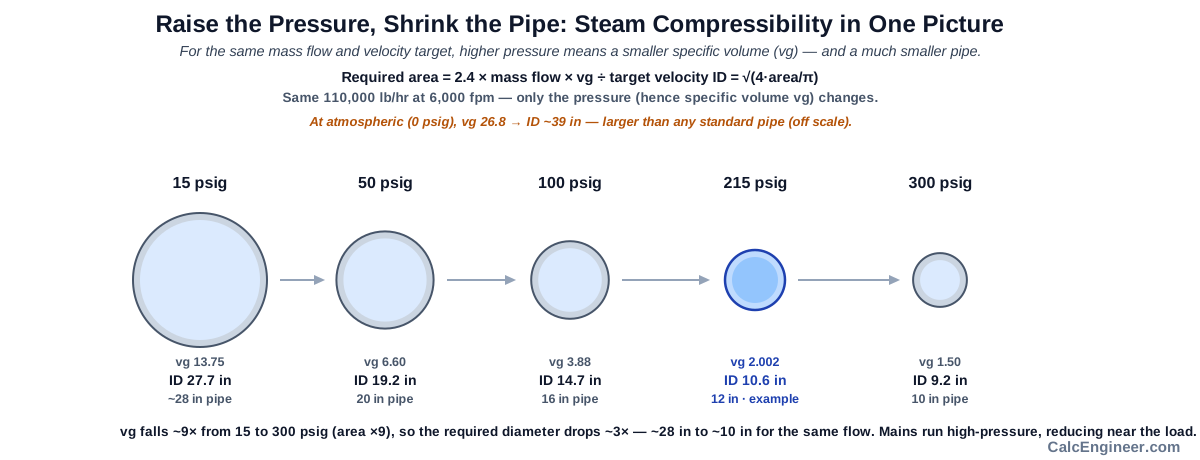
The specific volume must be read from the steam table at the absolute pressure, not the gauge pressure. Steam tables are indexed to absolute pressure (psia or bar absolute), so the calculator adds atmospheric pressure before the lookup. Entering 100 psig and looking up at 100 psia instead of 114.7 psia gives a vg that is too large, which leads to an oversized pipe estimate.
Velocity Method
The velocity method sizes the pipe so the steam moves at a sensible speed. Too fast and the steam carries liquid droplets into equipment, causes erosion in bends, drives noise, and in the worst case produces water hammer. Too slow is rarely a direct problem, though an oversized pipe costs more and loses more heat through its larger surface area.
Typical target velocities:
- Saturated steam main: 4,000 to 6,000 fpm (20 to 30 m/s)
- Branch and low-noise lines: 2,000 to 4,000 fpm (10 to 20 m/s)
- Rule-of-thumb general limit: 80 ft/s = 4,800 fpm = 24.4 m/s
The velocity method gives the required internal diameter directly from the formula, then rounds up to the next standard pipe size from the ASME B36.10M schedule table.
Pressure-Drop Method
On a long run the pressure falls as steam flows, and the specific volume rises as the pressure falls, so the velocity climbs toward the outlet. A pipe sized purely on inlet velocity can exceed the velocity limit before reaching the end. The pressure-drop method accounts for this by limiting the total pressure loss over the run to an allowable, commonly the lesser of 10% of the inlet pressure and a per-unit-length limit (default 1 psi per 100 ft or 0.1 bar per 100 m).
The calculation uses the Darcy-Weisbach equation with an iterated steam-property correction. Starting at the inlet specific volume and the trial pipe, the engine estimates the pressure drop, computes the average pressure halfway along the line, reads the specific volume at that average pressure from the steam table, and iterates until the drop is stable. This gives a more accurate result for long runs than using the inlet specific volume alone.
How to Read the Results
In sizing mode (no candidate entered), the output leads with the recommended standard pipe size, the steam velocity at that size as a percentage of the target, and the pressure drop (when the pressure-drop method is active). In Both mode, the output also names which method governed: velocity on short runs, pressure drop on long ones.
In candidate-check mode (candidate pipe selected), the output shows the actual velocity and pressure drop at the candidate pipe against the target and allowable, and gives a pass/fail verdict per the selected method. A low velocity at a candidate is flagged separately: when the pressure-drop method governs and the velocity is below target, this is informational: a larger-than-necessary-on-velocity pipe is not a failure when pressure drop drives the selection.
Key Facts
- Steam pipe capacity depends on the specific volume at the operating pressure. The same pipe carries more steam at higher pressure because the steam occupies less volume per pound.
- Sizing uses mass flow (lb/hr or kg/h) and specific volume, not a fixed volumetric flow rate.
- The velocity method suits short runs; the pressure-drop method is needed for long runs.
- In the Both mode, the recommended pipe size is the larger of the velocity-required size and the pressure-drop-required size, and the tool names which governed.
- A common saturated-steam main target is about 6,000 fpm (30 m/s); branch lines run slower; a rule of thumb is 80 ft/s, which is 4,800 fpm or 24.4 m/s.
- The specific volume is taken at the absolute pressure: 100 psig is looked up at about 114.7 psia, not 100.
- Allowable pressure drop is commonly the lesser of ten percent of the inlet pressure and a per-100-ft limit.
- This sizes dry saturated steam supply pipe only. Wet steam, superheated steam, and condensate return are separate calculations.
Applications
- Sizing a saturated-steam distribution main from a boiler to the plant.
- Checking a branch line to a single steam-heated unit or process.
- Verifying that a proposed pipe size holds the velocity within target.
- Confirming that a long steam run keeps the pressure drop within an acceptable limit, and estimating the outlet pressure.
- Checking whether an existing pipe can handle an added steam load.
- Comparing how a higher supply pressure, or a different pipe schedule and internal diameter, changes the required size.
Example Calculation
Example 1: Velocity at a Given Pipe Size
Given (Imperial): 110,000 lb/hr of saturated steam at 215 psig, specific volume 2.002 ft³/lb, in a 10-inch Schedule 40 pipe (cross-section 78.9 in²).
V = 2.4 × 110,000 × 2.002 / 78.9
  = 528,528 / 78.9
  = 6,698 fpm
Result: The steam moves at about 6,700 fpm, slightly above a typical 6,000 fpm main target.
Example 2: Sizing to a Target Velocity
Given: same flow and specific volume, sized to a 6,000 fpm target.
area_req = 2.4 × 110,000 × 2.002 / 6,000 = 88.1 in²
ID_req   = sqrt(4 × 88.1 / π) = 10.6 in
Result: Required ID is about 10.6 in, round up to 12-inch Schedule 40 (ID 11.938 in).
Example 3: Higher Pressure, Smaller Pipe
Given: same 110,000 lb/hr at a higher pressure where vg is smaller.
Because vg is smaller, area_req = 2.4 × massflow × vg / V_target is smaller, so the required diameter falls.
Result: Raising the distribution pressure lowers the specific volume, which lowers the required pipe size for the same mass flow.
Example 4: Candidate Over Velocity Limit
Given: a candidate 3-inch pipe with velocity 9,200 fpm vs a 6,000 fpm target.
ratio = 9,200 / 6,000 = 1.53 → OVER VELOCITY LIMIT
Result: At 1.53 times the target, the pipe risks water hammer and noise. A larger pipe is needed.
Example 5: Long Run Where Pressure Drop Governs
Given: a moderate flow on a long run.
Velocity method requires:        4 in
Pressure-drop method requires:   5 in
required_ID = max(4 in, 5 in) = 5 in
Governing method: pressure drop
Recommended: 5 in Sch 40
Result: Pressure-drop method governs on a long line and pushes the size up to 5 inches.
Example 6: Candidate Passes Velocity but Fails Pressure Drop
Given: a candidate 4-inch Schedule 40 pipe on a long run. The flow is moderate enough that velocity stays within target, but the run is long enough that the pressure drop exceeds the allowable limit. Values are illustrative; the calculator iterates the exact drop.
Velocity check:       within target    PASS
Pressure-drop check:  exceeds allowable  FAIL
Verdict (pressure-drop or both mode): NOT ADEQUATE, size up.
Result: The 4-inch pipe looks fine on velocity but loses too much pressure over the long run. In the pressure-drop or both mode the verdict is NOT ADEQUATE. The velocity-only check would have missed it.
Standards & References
- ASME B31.1, Power Piping: the code for steam and high-temperature power piping design, materials, allowable stress, and supports
- Spirax Sarco: Pipes and Pipe Sizing: industry reference for steam pipe sizing by velocity and pressure drop
- ASME B36.10M, Welded and Seamless Wrought Steel Pipe: nominal pipe sizes, schedules, and internal diameters used for sizing
- ASME Steam Tables / IAPWS Industrial Formulation IF-97: saturated-steam specific volume values used in the calculation
Limitations
- This calculator sizes the dry-saturated-steam supply pipe only. It does not size condensate return lines (two-phase flow, separate rules), flash-steam lines, or safety-valve discharge piping.
- It does not handle wet steam, two-phase flow, vacuum steam, or superheated steam. Superheated specific volume depends on both pressure and temperature and is a v2 feature.
- It does not design steam traps, drip legs, separators, or pressure-reducing stations. It does not check pipe expansion, anchors, guides, supports, or perform a code stress analysis under ASME B31.1.
- It does not compute heat loss, insulation, or warm-up load, and does not size the boiler header or balance a full steam network.
- The pressure-drop result uses average, iterated saturated-steam properties and is a planning estimate, not a detailed network calculation. Verify against a steam-system design reference such as Spirax Sarco and a qualified engineer.
Common Mistakes to Avoid
- Sizing steam like water, on a fixed volumetric flow. Steam is compressible; size from mass flow and the specific volume at the operating pressure.
- Looking up the specific volume at gauge pressure. Use absolute pressure: 100 psig is about 114.7 psia.
- Using the velocity method alone on a long run. It ignores pressure drop, and the equipment at the far end can be starved even when the velocity looks fine.
- Sizing a long line on the inlet specific volume. The pressure falls along the run and the specific volume rises; use average iterated properties.
- Chasing one universal target velocity. A main, a branch, and a low-noise line have different targets; pick by service.
- Treating a low velocity as a failure when the pressure-drop method governs. A larger pipe sized for pressure drop simply runs slower, which is fine.
- Using nominal pipe size instead of internal diameter. Velocity and pressure drop depend on the actual internal diameter, which changes with the pipe schedule.
- Applying this to condensate return or superheated steam. Those are separate calculations with different properties.
Frequently Asked Questions
How do you size a steam pipe?
Why is steam sized on mass flow instead of volume?
What is a good steam velocity?
When do I need the pressure-drop method instead of velocity?
Why does higher pressure let me use a smaller pipe?
Does pipe schedule affect steam pipe sizing?
Why can a larger pipe be recommended even when the velocity looks low?
Does this calculator size condensate return lines?
Frequently Used Together
Engineers often use these calculators in combination for complete project workflows:
Related Calculators
Explore similar calculators that might be useful for your project:
Plumbing Quick Reference — Keep It On Your Phone On Site
A 10-page field reference for catching pressure, velocity, slope, and pump-sizing mistakes before you order pipe, close a wall, or add a booster.
- Velocity limits, fixture pressure minimums, drain slope, and the 80 psi ceiling in one table
- Worked examples that show why a single pressure number gives four different answers
- Keep it on your phone, or print the two field-check pages
Free PDF. Calculators stay free. Unsubscribe anytime.
Calculate
This calculator sizes dry-saturated-steam pipe only. Superheated steam requires both pressure and temperature for its specific volume and is a v2 feature.
Steam flow in mass units, not volumetric. Mass flow is constant along the line; volumetric flow changes with pressure.
Gauge pressure at the pipe inlet. The calculator adds atmospheric pressure for the steam-table lookup. Higher pressure gives a smaller specific volume and smaller pipe.
Leave blank to use the automatic steam-table value. Enter a specific value to override (e.g. from your process data or a different source). Override is shown in the result.
Velocity method is useful for short runs. Pressure-drop method is required for long runs where equipment pressure matters. Both applies both and gives the larger size.
Sets the default target velocity. Mains run faster than branches; choose Custom to enter any target.
Pipe schedule determines the internal diameter for each nominal size. Schedule 80 has a thicker wall and smaller bore than Schedule 40.
Schedule of the pipe you want to check against the sizing limits.
Optional. Select a pipe size to check whether it meets the selected method limit. Leave at None to receive only the sizing result.