Condensate Pump Sizing Calculator
On this page
Calculate
Rated or calculated cooling output in BTU per hour
Fraction of total cooling that is sensible (0.60–0.85 typical). Latent fraction = 1 − SHR.
Multiplier for peak loads and coil fouling (typically 1.5–2.0)
Vertical lift the pump must overcome (for reference)
Overview
The Condensate Pump Sizing Calculator helps HVAC engineers estimate the volume of condensate (water) produced by an air-conditioning system and determine the required pump capacity to drain it reliably.
Every cooling coil removes moisture from the air as part of the dehumidification process. The liquid water that collects in the drain pan must be pumped away — especially when gravity drainage is not possible. Undersizing the condensate pump leads to pan overflow, water damage, mold growth, and system shutdowns.
This calculator converts the latent portion of the cooling load into a condensate flow rate, applies a safety factor, and recommends a pump capacity in gallons per hour (GPH) or liters per hour (L/h).
How to Use This Calculator
Enter total cooling capacity – the rated or calculated cooling output of the system in BTU/h or kW.
Enter Sensible Heat Ratio (SHR) – the fraction of total cooling that is sensible (temperature reduction). Typical range 0.65–0.80.
Enter safety factor – a multiplier to account for peak loads, coil fouling, and humidity spikes (typically 1.5–2.0).
Optionally enter discharge head – the vertical lift the pump must overcome in feet or meters (for reference only).
Click "Calculate" – get latent load, condensate mass flow, volumetric flow, recommended pump capacity, and safety margin.
Use the recommended pump capacity to select a condensate removal pump rated at or above the calculated value. Always verify the pump's lift rating meets the installation height before final selection.
Inputs & Outputs
Inputs
Outputs
Formula
Calculator Formulas
Step 1 — Latent Load
Latent Load = Cooling Capacity × (1 − SHR)
The latent load is the portion of total cooling used for dehumidification (moisture removal). SHR is the sensible heat ratio — the fraction of cooling that reduces air temperature. The remainder (1 − SHR) removes moisture.
Step 2 — Condensate Mass Flow
Imperial:  Mass Flow (lb/h) = Latent Load (BTU/h) / 1,061 (BTU/lb)
Metric:    Mass Flow (kg/h) = (Latent Load (kW) × 3,600) / 2,500 (kJ/kg)
The divisor 1,061 BTU/lb is the latent heat of vaporization of water at typical HVAC coil conditions (~60°F / 15°C). The metric equivalent uses 2,500 kJ/kg.
Step 3 — Condensate Volumetric Flow
Imperial:  Flow (GPH) = Mass Flow (lb/h) / 8.34 (lb/gal)
Metric:    Flow (L/h) = Mass Flow (kg/h)  [since 1 L water ≈ 1 kg]
The constant 8.34 lb/gal is the density of water at standard conditions.
Step 4 — Recommended Pump Capacity
Recommended Pump Capacity = Condensate Flow × Safety Factor
Step 5 — Safety Margin Added
Safety Margin Added = Recommended Pump Capacity − Condensate Flow
Variable Reference
| Variable | Meaning | Units |
|---|---|---|
| coolingCapacity | Total cooling output | BTU/h or kW |
| SHR | Sensible Heat Ratio | decimal (0–1) |
| safetyFactor | Design safety multiplier | × (dimensionless) |
| latentLoad | Latent cooling load | BTU/h or kW |
| massFlow | Condensate mass flow rate | lb/h or kg/h |
| condensateFlow | Condensate volumetric flow | GPH or L/h |
| recommendedCapacity | Pump capacity with safety | GPH or L/h |
| safetyMarginAdded | Extra capacity from safety factor | GPH or L/h |
| 1,061 | Latent heat of vaporization | BTU/lb |
| 2,500 | Latent heat of vaporization | kJ/kg |
| 8.34 | Water density | lb/gal |
What is HVAC Condensate Pump Sizing
HVAC condensate pump sizing is the process of calculating how much liquid water an air-conditioning system produces through dehumidification and selecting a pump with enough capacity to remove it reliably.
Every air conditioning system that cools air below its dew point produces condensate — the liquid water that forms on the evaporator coil surface. This water collects in a drain pan and must be removed either by gravity or by a condensate pump. When the drain point is above the equipment (basements, attics, above-ceiling installations), a pump is required.
Why Condensate Pump Sizing Matters
Undersizing a condensate pump is one of the most common causes of water damage in commercial and residential buildings. When the pump cannot keep up with condensate production during peak humidity:
- The drain pan overflows, causing ceiling and wall damage
- Float switches shut down the AC system, leaving the space uncooled
- Standing water promotes mold and bacterial growth
- Equipment corrosion accelerates, reducing system lifespan
Proper sizing requires calculating the latent load (the moisture-removal portion of total cooling), converting it to a volumetric flow rate, and applying a safety factor for peak conditions.
Engineering Applications
Condensate pump sizing applies to virtually every HVAC installation where gravity drainage is not available:
- Residential AC — attic-mounted air handlers, basement units, and ductless mini-splits
- Commercial HVAC — above-ceiling fan coil units, rooftop units with internal drains, and chilled water coils
- Data centers — CRAC and CRAH units with high sensible ratios but significant condensate during economizer operation
- Dehumidifiers — standalone and ducted dehumidification systems in pools, archives, and manufacturing
- Refrigeration — walk-in coolers and display cases with condensate management requirements
Practical Tips
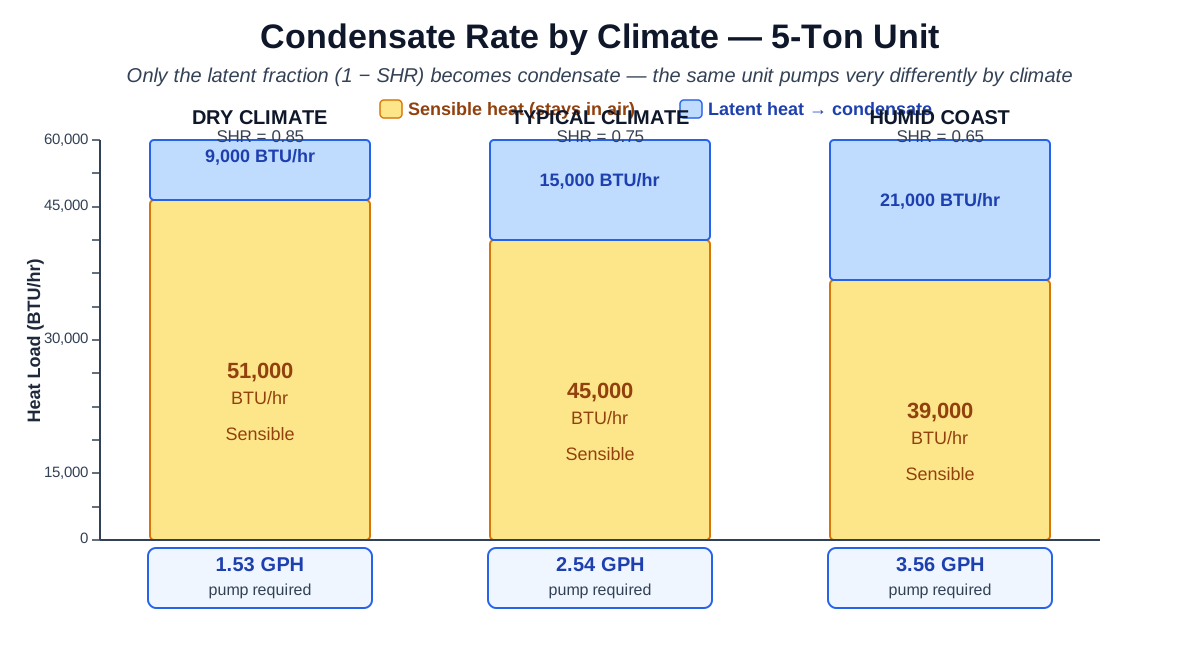
SHR selection: Use the lowest expected SHR for your climate zone. In humid climates (Miami, Houston, Singapore), SHR can drop to 0.65 during peak conditions. In dry climates (Phoenix, Denver), SHR may be 0.85 or higher.
Safety factor: 1.5× is standard. Use 2.0× for critical spaces (above server rooms, museums, hospitals) or systems with highly variable loads.
Discharge head matters: Always verify the pump's maximum lift specification. A pump rated for 5 GPH at 0 ft lift may only deliver 2 GPH at 15 ft lift. Check the manufacturer's performance curve.
Multiple units: When several air handlers drain to one pump, sum all condensate flows before applying the safety factor.
Maintenance: Condensate pumps require regular cleaning. Algae and biofilm buildup can reduce pump capacity by 30–50% over a cooling season. Include a maintenance allowance in your safety factor.
Key Facts
- A typical 5-ton (60,000 BTU/h) residential AC produces about 1–2 gallons of condensate per hour in humid climates.
- Condensate drain pan overflow is one of the leading causes of water damage in commercial buildings.
- The latent heat of vaporization of water is approximately 1,061 BTU/lb (2,500 kJ/kg) at typical HVAC coil temperatures.
- High-humidity climates (e.g., Gulf Coast, Southeast Asia) produce significantly more condensate than dry climates.
- Building codes typically require a secondary drain pan or overflow switch as a backup for condensate removal.
Applications
- Residential and commercial air conditioning condensate removal.
- High-rise building HVAC condensate pumping where gravity drainage is not feasible.
- Data center cooling systems with high latent loads.
- Dehumidifier condensate drainage in basements and crawl spaces.
- Refrigerated display case condensate management in retail.
- Mini-split and ductless system condensate pump selection.
Example Calculation
Example — Imperial
Given:
- Cooling Capacity = 60,000 BTU/h (5 tons)
- Sensible Heat Ratio (SHR) = 0.75
- Safety Factor = 1.5
Step 1 — Latent Load:
Latent Load = 60,000 × (1 − 0.75) = 15,000 BTU/h
Step 2 — Condensate Mass Flow:
Mass Flow = 15,000 / 1,061 = 14.14 lb/h
Step 3 — Condensate Volumetric Flow:
Flow = 14.14 / 8.34 = 1.70 GPH
Step 4 — Recommended Pump Capacity:
Recommended = 1.70 × 1.5 = 2.54 GPH
Step 5 — Safety Margin Added:
Margin = 2.54 − 1.70 = 0.85 GPH
Result: Select a condensate pump rated for at least 2.54 GPH (≈ 61 GPD) with sufficient lift for the installation.
Example — Metric
Given:
- Cooling Capacity = 17.6 kW
- Sensible Heat Ratio (SHR) = 0.75
- Safety Factor = 1.5
Step 1 — Latent Load:
Latent Load = 17.6 × (1 − 0.75) = 4.4 kW
Step 2 — Condensate Mass Flow:
Mass Flow = (4.4 × 3,600) / 2,500 = 6.34 kg/h
Step 3 — Condensate Volumetric Flow:
Flow = 6.34 L/h (since 1 kg water ≈ 1 L)
Step 4 — Recommended Pump Capacity:
Recommended = 6.34 × 1.5 = 9.50 L/h
Step 5 — Safety Margin Added:
Margin = 9.50 − 6.34 = 3.17 L/h
Result: Select a condensate pump rated for at least 9.50 L/h with sufficient lift for the installation.
Standards & References
- ASHRAE Handbook — HVAC Systems and Equipment (condensate drainage and pump selection)
- ASHRAE Standard 62.1 — ventilation and indoor air quality (humidity control)
- IMC (International Mechanical Code) — condensate disposal requirements
- ACCA Manual J — residential cooling load and latent load estimation
- SMACNA HVAC Duct Construction Standards — drain pan and condensate piping
Limitations
- This calculator provides a simplified estimation for preliminary pump selection.
- It assumes standard atmospheric pressure and water properties at typical HVAC coil temperatures (~60°F / 15°C).
- SHR varies with outdoor conditions — use the lowest expected SHR (highest humidity) for conservative sizing.
- Discharge head is shown for reference only — verify the selected pump's lift rating meets the installation requirement.
- Multiple units draining to a single pump must have their flows summed before applying the safety factor.
- Final pump selection should be verified against manufacturer specifications for both flow rate and maximum lift.
Common Mistakes to Avoid
- Using a safety factor of 1.0 — always apply at least 1.5× to handle humidity spikes and coil fouling.
- Forgetting that SHR varies with outdoor humidity — use the worst-case (lowest) SHR for sizing.
- Ignoring discharge head — pumps must be rated for both flow AND lift to the drain point.
- Not accounting for multiple units draining to the same condensate pump.
- Assuming condensate production is constant — it peaks during high-humidity startup conditions.
- Selecting a pump based only on flow rate without checking the maximum lift specification.
Frequently Asked Questions
What is a condensate pump in HVAC?
Why does an AC system produce condensate?
What is Sensible Heat Ratio (SHR)?
How much condensate does a typical AC produce?
What safety factor should I use?
What happens if the condensate pump is undersized?
Frequently Used Together
Engineers often use these calculators in combination for complete project workflows:
Related Calculators
Explore similar calculators that might be useful for your project:
Free HVAC Quick Reference. Formulas & Checks.
Airflow, loads, refrigerant & duct checks — one printable page for the job site.
- Key formulas for airflow, load, refrigerant charge & duct sizing
- Quick sanity checks for the most common HVAC design errors
- Printable one-pager for field use and design review
No spam. Unsubscribe any time.
Calculate
Rated or calculated cooling output in BTU per hour
Fraction of total cooling that is sensible (0.60–0.85 typical). Latent fraction = 1 − SHR.
Multiplier for peak loads and coil fouling (typically 1.5–2.0)
Vertical lift the pump must overcome (for reference)