Cooling Load Calculator
On this page
Calculate
Overview
A cooling load calculator estimates the amount of heat that must be removed from a room or building to maintain comfortable indoor temperatures. Cooling load calculations are essential when designing HVAC systems because they determine the required capacity of air conditioning equipment.
The cooling load depends on several factors including room size, ceiling height, number of occupants, lighting, equipment heat, and outdoor temperature conditions. By estimating the cooling load, engineers and technicians can select appropriately sized air conditioning systems.
Oversized systems increase energy consumption and equipment costs, while undersized systems may fail to maintain indoor comfort during peak conditions.
This calculator provides a simplified estimate of cooling load based on common HVAC design assumptions.
How to Use This Calculator
Enter room area — in m² or ft².
Enter ceiling height — in m or ft.
Enter indoor temperature — in °C or °F.
Enter outdoor temperature — in °C or °F.
Enter number of occupants.
Enter equipment heat load — in W.
Enter lighting load — in W.
Click "Calculate" — get cooling load in W, kW, BTU/hr, and tons of refrigeration.
Use the result as a preliminary capacity estimate when selecting air-conditioning equipment; confirm with a detailed ASHRAE / Manual J load calculation before final sizing.
Inputs & Outputs
Inputs
Outputs
Formula
Calculator Formula
tempDiff = |outdoorTemp − indoorTemp|
envelopeLoad = area × tempDiff × 6.0 × (ceilingHeight / 2.7)
occupantLoad = occupants × 120
coolingLoad = envelopeLoad + occupantLoad + equipmentLoad + lightingLoad
This calculator uses a simplified estimation model that accounts for:
- Envelope load — heat transfer through the building shell based on area, temperature difference, and ceiling height
- Occupant load — approximately 120 W of sensible heat per person
- Equipment load — user-specified heat from electronics and appliances
- Lighting load — user-specified heat from lighting systems
Note: The calculator uses a simplified practical model for quick estimates. Professional HVAC design uses the ASHRAE Heat Balance Method or Radiant Time Series Method for detailed analysis.
Calculator Variables
| Variable | Meaning | Units |
|---|---|---|
| area / A | Room floor area | m² / ft² |
| ceilingHeight / H | Ceiling height | m / ft |
| indoorTemp / Ti | Indoor temperature setpoint | °C / °F |
| outdoorTemp / To | Outdoor design temperature | °C / °F |
| occupants / N | Number of occupants | — |
| equipmentLoad | Heat from equipment | W |
| lightingLoad | Heat from lighting | W |
| coolingLoad / Q | Total cooling load (output) | W, kW, BTU/hr, TR |
What is Cooling Load
Cooling load is the total amount of heat energy that must be removed from a room or building to maintain a comfortable and desired indoor temperature. It is one of the most fundamental calculations in HVAC engineering and directly determines the required capacity of air conditioning equipment.
Every building gains heat from both external and internal sources. External heat enters through walls, windows, and the roof via conduction and solar radiation. Internal heat is generated by occupants, lighting systems, and electrical equipment. The cooling load calculator estimates the total of all these heat gains.
Why Cooling Load Calculation Matters
Accurate cooling load calculation is essential for proper HVAC system sizing:
- Energy efficiency — correctly sized systems minimize energy consumption
- Equipment cost — avoid paying for oversized equipment
- Comfort — undersized systems cannot maintain comfort during peak conditions
- Humidity control — oversized systems short-cycle and fail to dehumidify properly
- Equipment lifespan — proper sizing prevents short cycling that reduces equipment life
Cooling Load Factors by Building Type
The following table shows typical cooling load ranges for different building types:
| Building Type | Cooling Load (W/m²) | Cooling Load (BTU/ft²) |
|---|---|---|
| Residential (well-insulated) | 80–120 | 25–38 |
| Residential (average) | 120–150 | 38–48 |
| Commercial office | 150–200 | 48–63 |
| Retail / shopping | 150–250 | 48–79 |
| Restaurant | 200–350 | 63–111 |
| Hospital | 150–250 | 48–79 |
| Data center | 500–1,000+ | 159–317+ |
| Industrial / warehouse | 80–150 | 25–48 |
Note: Actual cooling loads depend on climate, building orientation, insulation, glazing, and internal heat sources.
Components of Cooling Load
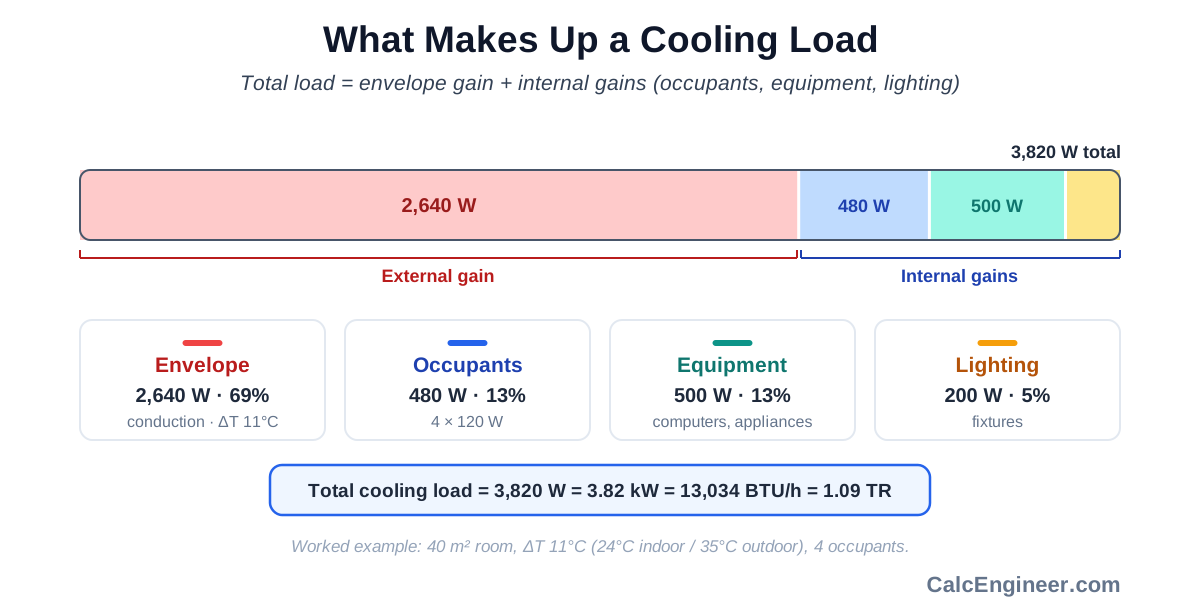
External Heat Gains
External heat enters the building through the building envelope:
- Conduction through walls and roof — heat transfers through solid building materials driven by the indoor-outdoor temperature difference
- Solar radiation through windows — direct sunlight and diffuse radiation entering through glazing can account for 30–50% of total cooling load
- Infiltration — uncontrolled air leakage through cracks, doors, and openings brings hot outdoor air into the conditioned space
Internal Heat Gains
Internal heat is generated inside the building:
- Occupants — each person generates approximately 75–150 W of heat depending on activity level (seated office work ≈ 75 W sensible, heavy physical work ≈ 200+ W)
- Lighting — all lighting systems convert electrical energy to heat; LED lights produce less heat than fluorescent or incandescent
- Equipment — computers, printers, kitchen appliances, and other electrical devices generate heat that must be removed
Unit Conversions
The following table provides common unit conversions used in cooling load calculations:
| Unit | Equivalent |
|---|---|
| 1 kW | 3,412 BTU/hr |
| 1 ton of refrigeration (TR) | 12,000 BTU/hr |
| 1 ton of refrigeration (TR) | 3,517 W |
| 1 BTU/hr | 0.293 W |
| 1 W | 3.412 BTU/hr |
| 1 hp | 2,545 BTU/hr |
Practical Tips
Avoid oversizing air conditioning systems. An oversized system cools the air quickly but shuts off before adequately dehumidifying the space, leading to a cold and clammy indoor environment.
Consider insulation quality when estimating cooling load. Well-insulated buildings with low-E glazing can reduce cooling loads by 30–50% compared to poorly insulated structures.
Account for large windows and solar heat gain. South and west-facing windows in the Northern Hemisphere receive the most solar radiation during summer. External shading devices, low-E coatings, and reflective films can significantly reduce solar heat gain.
Use professional HVAC calculations for large buildings. Simplified calculators are excellent for preliminary estimates, but final equipment selection should be based on detailed load calculations using ASHRAE methods.
For residential projects, ACCA Manual J is the industry standard for cooling and heating load calculations. For commercial projects, refer to ASHRAE Handbook — Fundamentals.
Key Facts
- Cooling load is the total heat that must be removed to maintain indoor comfort.
- Each person generates approximately 75–150 W of heat depending on activity level.
- Solar heat gain through windows can account for 30–50% of total cooling load.
- Poor insulation can increase cooling load by 30–50%.
- Cooling loads vary significantly by climate zone and building orientation.
- Data centers may require 500–1,000 W/m² of cooling capacity.
Applications
- Air conditioning system design and equipment selection.
- Commercial HVAC planning for offices, retail, and hospitals.
- Residential AC system sizing.
- Building energy analysis and efficiency audits.
- Data center cooling design.
- Industrial cooling system sizing.
Example Calculation
Example using Calculator Formula
Given:
- Room Area = 40 m²
- Ceiling Height = 2.7 m
- Indoor Temperature = 24°C
- Outdoor Temperature = 35°C
- Occupants = 4
- Equipment Load = 500 W
- Lighting Load = 200 W
Calculation:
tempDiff = |35 − 24| = 11°C
envelopeLoad = 40 × 11 × 6.0 × (2.7 / 2.7) = 2,640 W
occupantLoad = 4 × 120 = 480 W
coolingLoad = 2,640 + 480 + 500 + 200 = 3,820 W
Results:
- Cooling Load = 3,820 W
- = 3.82 kW
- ≈ 13,034 BTU/hr
- ≈ 1.09 tons of refrigeration
Standards & References
- ASHRAE Handbook — Fundamentals — cooling load calculation methods
- ASHRAE Cooling Load Temperature Difference (CLTD) Method — simplified commercial cooling load estimation
- ASHRAE Heat Balance Method — detailed cooling load analysis
- ASHRAE Radiant Time Series (RTS) Method — advanced cooling load calculation
- ACCA Manual J — residential cooling and heating load calculations
- ASHRAE 90.1 — building envelope energy requirements
Limitations
- This calculator provides a simplified cooling load estimate.
- Detailed HVAC analysis requires: solar radiation data, building orientation, window area and glazing type, wall and roof construction details, ventilation rates.
- Does not account for thermal mass, humidity loads, or dynamic load profiles.
- Use the ASHRAE Heat Balance Method or Radiant Time Series Method for detailed analysis.
- Imperial temperature inputs (°F) are used directly in the formula — the temperature difference is calculated from the raw input values.
Common Mistakes to Avoid
- Ignoring internal heat gains from occupants, lighting, and equipment.
- Using average outdoor temperatures instead of design temperatures.
- Oversizing HVAC systems, leading to short cycling and poor humidity control.
- Ignoring solar heat gain through windows and glazing.
- Not accounting for infiltration and ventilation loads.
- Using the same cooling load factor for all building types.
Frequently Asked Questions
What is cooling load?
How is cooling load calculated?
How many BTU per square foot are required for cooling?
Is cooling load the same as heat load?
What is a ton of refrigeration?
How do occupants affect cooling load?
Frequently Used Together
Engineers often use these calculators in combination for complete project workflows:
Related Calculators
Explore similar calculators that might be useful for your project:
Free HVAC Quick Reference. Formulas & Checks.
Airflow, loads, refrigerant & duct checks — one printable page for the job site.
- Key formulas for airflow, load, refrigerant charge & duct sizing
- Quick sanity checks for the most common HVAC design errors
- Printable one-pager for field use and design review
No spam. Unsubscribe any time.