Fan Power Calculator
On this page
Calculate
Overview
Brake horsepower required at the fan shaft, calculated from airflow, static pressure rise across the fan, and fan efficiency at the operating point. Output in HP, kW, and W. The result is the input to motor selection — apply your safety factor and drive losses (3–5% for belt drive) on top of this number, then round up to the next standard NEMA motor size.
Inputs you’ll need
Airflow (CFM) — the volumetric flow rate the fan must deliver. From your system load calculation or duct sizing.
Static pressure rise (in.w.c.) — the total external static pressure the fan must overcome: ductwork friction, fittings, filters at the dirty condition, coils, dampers, terminal devices. Underestimating this is the most common sizing error.
Fan efficiency (%) — at the actual operating point, not the catalog peak. Backward-curved centrifugal fans run 75–85% at BEP, forward-curved 55–65%, axial 50–70%, vaneaxial 70–80%.
Formula
Calculator Formula
HP = (CFM × Pressure) / (6356 × Efficiency)
This calculator estimates fan motor power using the standard fan power equation. The formula relates airflow volume, static pressure rise, and fan efficiency to determine the required shaft horsepower.
Engineering Reference Formula
P = (Q × ΔP) / η
This is the general engineering formula for fan power, where P is power in watts, Q is volumetric flow rate in m³/s, ΔP is pressure rise in Pascals, and η is fan efficiency as a decimal.
The calculator uses Imperial inputs (CFM, in.w.c.) and outputs HP directly via the constant 6356. The SI form below is provided for reference and unit conversion — to use it, convert CFM to m³/s and in.w.c. to Pa first.
Calculator Variables
| Variable | Meaning | Units |
|---|---|---|
| CFM | Airflow rate | Cubic feet per minute |
| Pressure | Static pressure rise across the fan | Inches of water column (in.w.c.) |
| Efficiency | Fan efficiency (expressed as a decimal in the formula) | % |
| 6356 | Conversion constant (CFM × in.w.c. to HP) | — |
| HP | Fan shaft power | Horsepower |
| P | Fan power (SI form) | W or kW |
| Q | Volumetric flow rate (SI form) | m³/s |
| ΔP | Pressure rise (SI form) | Pa |
| η | Fan efficiency (decimal in SI form) | Decimal (0–1) |
What is Fan Power
Fan power is the mechanical energy required to move a specified volume of air against a given resistance (pressure). It is one of the most fundamental calculations in HVAC and ventilation engineering, directly determining the motor size needed to operate a fan.
Every fan in an HVAC system — whether a supply fan, return fan, exhaust fan, or cooling tower fan — requires a motor that can deliver enough power to move the required airflow against the system’s total pressure drop. The fan power calculation bridges the gap between aerodynamic system design and electrical motor selection.
Key Factors Affecting Fan Power
The following factors determine the power required to operate a fan:
- Airflow volume (CFM or m³/s) — the amount of air the fan must move, determined by ventilation requirements, cooling loads, or process needs
- Pressure rise (in.w.c. or Pa) — the total static pressure the fan must overcome, including duct friction, fitting losses, filter resistance, coil pressure drop, and damper losses
- Fan efficiency (%) — how effectively the fan converts mechanical energy into air movement, varying by fan type, size, and operating point
- Drive type — belt-driven fans incur 3–5% additional losses compared to direct-drive configurations
- System effect — poor inlet or outlet conditions (elbows, obstructions) reduce effective fan performance and increase required power
Why Fan Power Calculation Matters
Accurate fan power calculation underpins proper motor selection and energy-efficient HVAC design. An undersized motor will fail to deliver required airflow, causing comfort problems and potential motor burnout. An oversized motor wastes capital cost and may operate inefficiently at partial load.
Fan energy consumption is a significant portion of total HVAC energy use — typically 30–40% of total system energy in commercial buildings. Proper fan sizing, combined with variable speed drives, can dramatically reduce operating costs and carbon emissions.
Fan Affinity Law: Power vs Speed
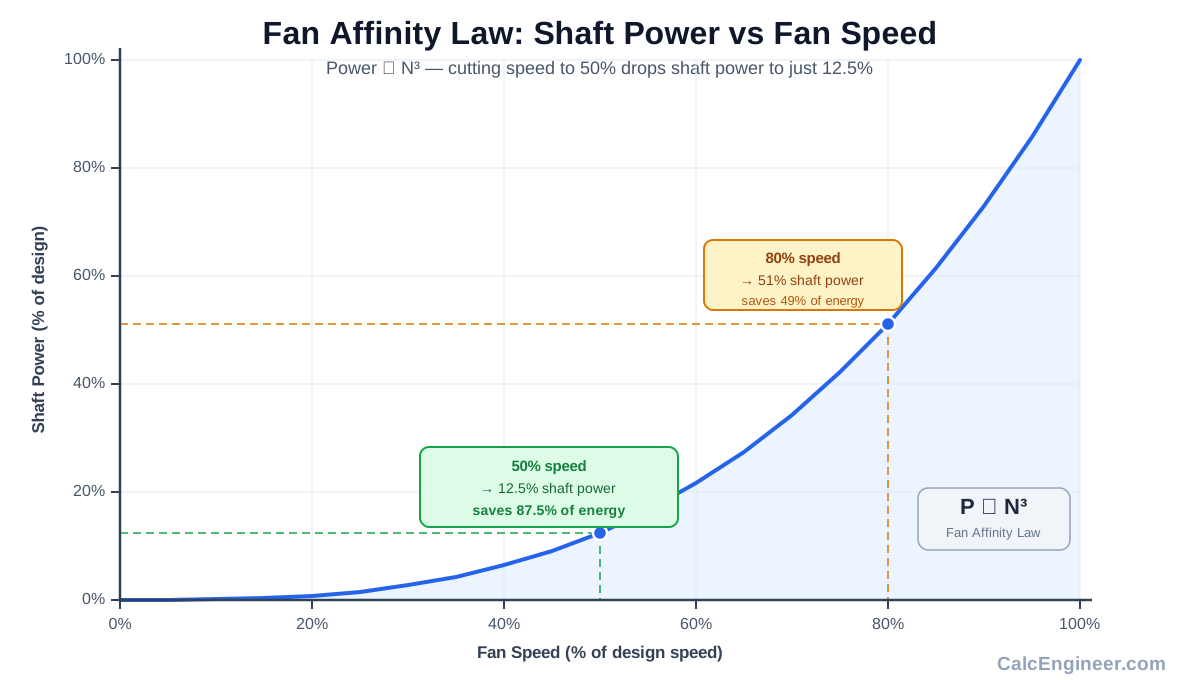
The chart above illustrates the cubic relationship between fan speed and power. At 80% speed, the fan consumes only about 51% of full-load power. At 50% speed, power drops to just 12.5% — which is why VFDs are the single most impactful energy measure in variable-load HVAC systems.
ASHRAE 90.1 fan power limits
Energy code compliance is the constraint that often decides what fan you can actually install. ASHRAE 90.1-2022, Section 6.5.3.1, offers two compliance paths. Option 1 limits motor nameplate horsepower from a tabular reference. Option 2 limits fan brake horsepower more precisely. The formulas below are Option 2 — the method that aligns with this calculator's BHP output.
Constant volume systems
For constant air volume (CAV) systems:
Fan_BHP_max = (CFM × 0.00094) + A
Where A is a pressure-drop adjustment for system components beyond a baseline (heat recovery devices, evaporative coolers, deep filters above MERV 13). Without adjustments, the limit on a 10,000 CFM CAV unit is 9.4 BHP.
Variable volume systems
For variable air volume (VAV) systems:
Fan_BHP_max = (CFM × 0.0013) + A
The higher constant for VAV reflects the additional pressure drop of terminal units and the energy savings VFDs deliver at part-load. A 10,000 CFM VAV system has a 13 BHP cap before pressure adjustments.
What this means for sizing
If your calculated fan BHP exceeds these limits, you have three options: reduce system pressure (fewer fittings, larger ductwork, lower-restriction filters), raise fan efficiency (different fan type, better operating point), or apply a code-compliant pressure adjustment. Oversized motors that exceed these limits without justification will fail energy code review.
The limits are stricter in CA Title 24 (Section 140.4) and ASHRAE 90.1 Appendix G for performance-path compliance — check the local code variant before final selection.
Fan type efficiency comparison
Fan efficiency varies more by type than by size. Use this table to pick the right fan family before sizing — the wrong type at the wrong duty point can double the required power.
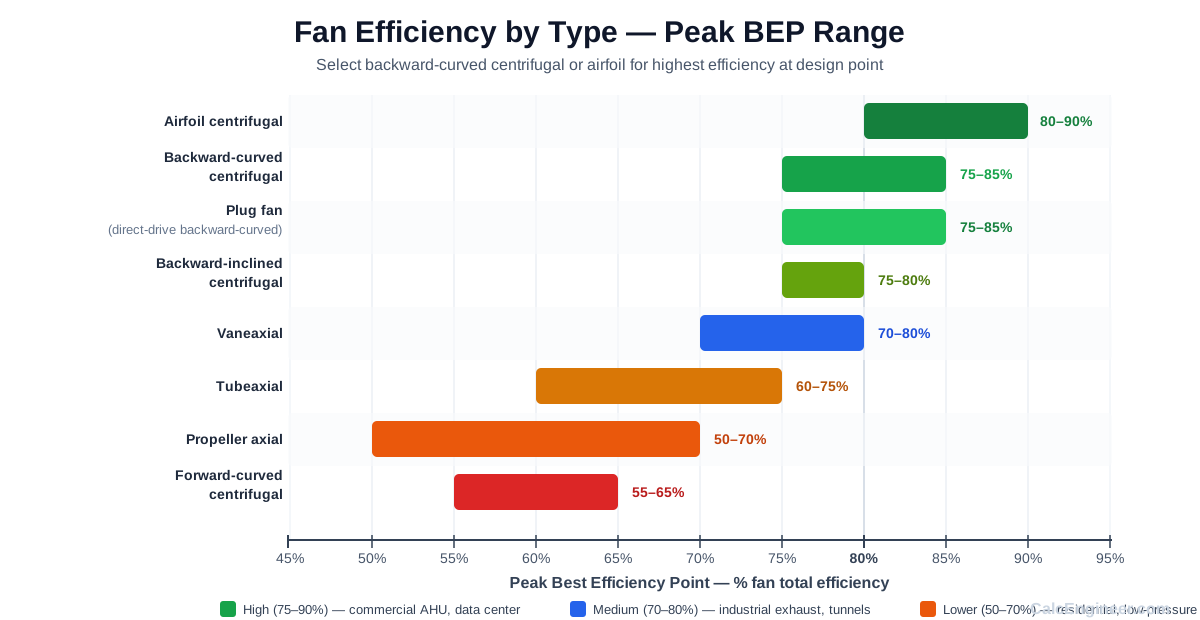
| Fan type | Peak BEP efficiency | Typical operating range | Static pressure | Best use |
|---|---|---|---|---|
| Airfoil centrifugal | 80–90% | 70–85% | High (2–8 in.w.c.) | Large AHUs, high-pressure systems |
| Backward-curved centrifugal | 75–85% | 65–80% | Medium-high (1–6 in.w.c.) | Commercial AHUs, return fans |
| Backward-inclined centrifugal | 75–80% | 65–75% | Medium (1–4 in.w.c.) | General HVAC, moderate dust |
| Forward-curved centrifugal | 55–65% | 50–60% | Low-medium (0.5–3 in.w.c.) | Small AHUs, residential, low-cost |
| Vaneaxial | 70–80% | 65–75% | Medium-high (1–6 in.w.c.) | Industrial exhaust, tunnel ventilation |
| Tubeaxial | 60–75% | 55–70% | Low-medium (0.5–3 in.w.c.) | Building exhaust, cooling towers |
| Propeller axial | 50–70% | 45–65% | Very low (< 0.5 in.w.c.) | Wall fans, condenser cooling |
| Plug fan (direct-drive backward-curved) | 75–85% | 70–80% | Medium (0.5–4 in.w.c.) | Modern AHUs, fan walls |
How to read this for the calculator
- For commercial AHU sizing, plug fans and airfoil centrifugal are the modern choice — high efficiency, lower noise, easier to control with VFDs.
- Forward-curved fans look cheap but cost more to operate over the unit’s life. The 20-percentage-point efficiency gap vs backward-curved means roughly 30% more electrical input for the same airflow.
- Axial fans are not interchangeable with centrifugal at high pressure. Above 3 in.w.c., centrifugal fans almost always win on efficiency.
- The “Typical operating range” is what you should enter into the calculator, not the peak BEP. Real systems rarely operate exactly at BEP.
Special applications: when this calculator needs adjustment
The basic fan power equation works for steady-state ventilation and HVAC duty. Three application categories require additional considerations.
Smoke control fans (NFPA 92, UL 705 Supplement SD)
Smoke control fans must withstand elevated airstream temperatures during a fire event. UL 705 Supplement SD (the smoke control listing merged into UL 705 in 2021) tests fans at 500°F (260°C) for 15 minutes minimum, with extended ratings up to 1000°F (538°C) available for high-rise applications. The European equivalent EN 12101-3 defines classes from F200 (200°C for 120 minutes) to F842 (842°C for 30 minutes). Sizing requires:
- Selecting a UL 705 Supplement SD-listed fan with the temperature class matching the building's smoke control sequence and code requirements.
- Verifying the motor is rated for the elevated ambient temperature class — most smoke control fans place the motor outside the airstream specifically for this reason.
- Sizing emergency power capacity for fan startup current under fire-mode operation.
Confirm the temperature rating and duration against the specific code path: NFPA 92 for smoke control system design, IBC Section 909 for code compliance, and the local Authority Having Jurisdiction for any project-specific overrides.
Laboratory and fume hood exhaust (ASHRAE 110, NFPA 45)
Laboratory exhaust fans face two non-standard conditions:
- Variable static pressure as multiple fume hoods cycle on and off. The fan must hold sash velocity (typically 100 fpm at 18-inch sash height) under all combinations of operating hoods.
- Corrosive or particulate-laden air streams that reduce effective fan efficiency over time as deposits build up on impeller blades. Apply a degradation factor of 5–15% to long-term BHP estimates.
For lab exhaust, oversize the motor by 25–35% above this calculator’s result, and design the system around constant-velocity stacks (Strobic-style induced flow) when discharge dispersion matters.
High-altitude installations
The standard fan power equation assumes sea-level air density (1.20 kg/m³ at 20°C). At altitude, air density drops, which reduces both the mass flow at a given CFM and the required fan power proportionally — but only if the duty is volumetric.
For a fan delivering a fixed CFM:
BHP_altitude = BHP_sea_level × (ρ_altitude / ρ_sea_level)
At 2,000 m / 6,500 ft elevation (Denver, Mexico City), air density is about 80% of sea level. Required BHP drops 20% for the same CFM, but the fan must be selected for the lower density to hit the target airflow — the operating point shifts on the fan curve.
For comfort cooling sized in CFM (not mass flow), apply the altitude correction. For combustion air, process makeup, or any duty specified in mass flow units, consult the equipment manual.
Key Facts
- Fan power scales linearly with airflow and with pressure rise — but cubically with speed (affinity laws).
- Fan efficiency typically ranges from 40% to 85% depending on fan type and operating point.
- Centrifugal fans generally achieve higher efficiencies (60–85%) than axial fans (50–70%).
- The fan affinity laws state that power varies with the cube of speed — doubling fan speed increases power by 8×.
- Motor sizing should include a safety factor of 10–25% above calculated fan power.
- A 20% speed reduction on a VFD-controlled fan cuts power by ~49% — the largest single energy lever in HVAC.
Applications
- HVAC supply and return fan sizing for air handling units.
- Industrial exhaust and ventilation system design.
- Cooling tower fan motor selection.
- Cleanroom and laboratory pressurization systems.
- Smoke exhaust and stairwell pressurization fan sizing.
- Data center cooling airflow management.
- Dust collection and fume extraction systems.
- Agricultural ventilation and drying systems.
Standards & References
- ASHRAE Handbook — HVAC Systems and Equipment (2024), Chapter 21 — Fans. Selection, performance curves, system effect.
- AMCA Standard 210 — Laboratory Methods of Testing Fans for Certified Aerodynamic Performance Rating.
- AMCA Standard 211 — Certified Ratings Program for Air Performance.
- ASHRAE 90.1-2022, Section 6.5.3 — Fan power limitations for HVAC systems by air capacity class.
- SMACNA HVAC Systems Duct Design (4th edition) — system pressure drop methodology and fan sizing.
- NEMA MG 1-2021 — Motors and Generators, including efficiency standards (Premium Efficiency, NEMA MG 1 Part 31 for inverter-fed).
Limitations
- This calculator gives shaft brake horsepower at steady-state design conditions. It does not include drive losses (apply 1.03–1.05 for belt drive separately), motor efficiency (apply NEMA Premium ~93–95% to convert shaft HP to electrical input), system effect from poor inlet/outlet conditions, or off-BEP efficiency degradation. For variable-speed applications, use the affinity laws to project power at other speeds. Final motor selection requires the manufacturer’s fan curve at the actual operating point.
Common Mistakes to Avoid
- Using fan efficiency as a percentage instead of decimal in the formula. The formula expects 0.60, not 60. A common mistake when copying the formula from one units system to another.
- Confusing total pressure with static pressure. The standard fan power equation uses static pressure rise across the fan, not total pressure (which adds velocity pressure). Most HVAC sizing references the static pressure rise.
- Ignoring drive losses. Belt-driven fans lose 3–5% through V-belts, less through synchronous belts. Direct-drive has no drive loss. For belt drives, multiply calculated fan power by 1.03–1.05.
- Underestimating system static pressure. Include filters at the dirty condition (not clean), all fittings (each elbow adds 0.05–0.15 in.w.c.), coils at the design dirty condition, dampers, and terminal devices.
- Using catalog peak efficiency at all operating points. Fans hit BEP at one specific airflow/pressure combination. At off-design points, efficiency drops significantly — often 10–20 percentage points below catalog.
- Sizing motor exactly to calculated fan power. Apply 10–25% safety factor, then round UP to the next standard NEMA size: 0.5, 0.75, 1.0, 1.5, 2.0, 3.0, 5.0, 7.5, 10, 15, 20, 25, 30 HP.
- Ignoring system effect. A poor inlet (elbow within 3 fan diameters of intake) or outlet (sudden expansion) can reduce effective fan performance by 10–30% — invisible in the basic calculation.
Frequently Asked Questions
What is fan power in HVAC?
What is the constant 6356 in the fan power formula?
What is a typical fan efficiency?
What is the difference between brake horsepower and air horsepower?
How do I account for drive losses?
What does ASHRAE 90.1 limit fan power to?
Which fan type has the highest efficiency?
How does the fan affinity law relate to fan power?
Frequently Used Together
Engineers often use these calculators in combination for complete project workflows:
Related Calculators
Explore similar calculators that might be useful for your project:
Free HVAC Quick Reference. Formulas & Checks.
Airflow, loads, refrigerant & duct checks — one printable page for the job site.
- Key formulas for airflow, load, refrigerant charge & duct sizing
- Quick sanity checks for the most common HVAC design errors
- Printable one-pager for field use and design review
No spam. Unsubscribe any time.