Static Pressure Calculator
On this page
Calculate
Overview
A static pressure calculator estimates the pressure exerted by air within an HVAC system due to airflow resistance. Static pressure is one of the most important parameters in duct design, ventilation analysis, and fan performance evaluation.
In HVAC systems, static pressure represents the resistance that air must overcome as it moves through ducts, filters, coils, and fittings. Engineers use static pressure calculations to properly size fans, evaluate system efficiency, and diagnose airflow problems.
If static pressure is too high, it can lead to excessive energy consumption, reduced airflow, and system strain. If it is too low, the system may fail to deliver adequate air distribution. This calculator helps estimate static pressure based on air velocity, duct dimensions, and friction characteristics, supporting both imperial and metric units.
How to Use This Calculator
Enter air velocity — in FPM.
Enter duct length — in ft.
Enter duct diameter — in in.
Select friction factor — choose the friction factor matching your duct material.
Click "Calculate" — get velocity pressure, friction loss, estimated static pressure.
Add fitting, filter, and coil losses to this friction estimate to get total static pressure for fan selection.
Inputs & Outputs
Inputs
Outputs
Formula
Calculator Formula
Velocity Pressure (VP) = (V / 4005)² [in.w.c.]
Friction Loss (ΔP) = f × (L / D) × VP [in.w.c.]
Static Pressure (SP) ≈ Friction Loss [in.w.c.]
This calculator uses the Darcy-Weisbach equation adapted for air duct systems to estimate friction-based static pressure loss. The velocity is input in FPM and the 4005 constant converts to in.w.c. at standard air density.
Engineering Reference Formula
Total Pressure = Static Pressure + Velocity Pressure
TP = SP + VP
Static pressure is the component of total pressure that represents resistance to airflow in the duct system.
Calculator Variables
| Variable | Meaning | Units |
|---|---|---|
| V | Air velocity | FPM |
| 4005 | Conversion constant at standard air density | — |
| f | Darcy friction factor | — |
| L | Duct length | ft |
| D | Duct diameter | ft (converted from inches) |
| VP | Velocity pressure | in.w.c. |
| SP | Static pressure | in.w.c. |
| TP | Total pressure | in.w.c. |
What is Static Pressure
Static pressure is the pressure exerted by air in a system independent of its velocity. In HVAC systems, it represents the resistance to airflow caused by ducts, filters, bends, dampers, and equipment.
It is typically measured in:
- inches of water column (in.w.c.) — the most common unit in North American HVAC
- Pascals (Pa) — the SI unit used internationally
- psi — used in some industrial applications
Static pressure is a key factor in fan selection and overall system performance. Every component in an HVAC system — from the supply duct to the return grille — contributes to the total static pressure that the fan must overcome.
How Static Pressure Works
When a fan pushes air through a duct system, the air encounters resistance from friction against duct walls, turbulence at fittings, and flow restrictions at filters and coils. This resistance manifests as static pressure. The relationship follows TP = SP + VP — total pressure equals static pressure plus velocity pressure.
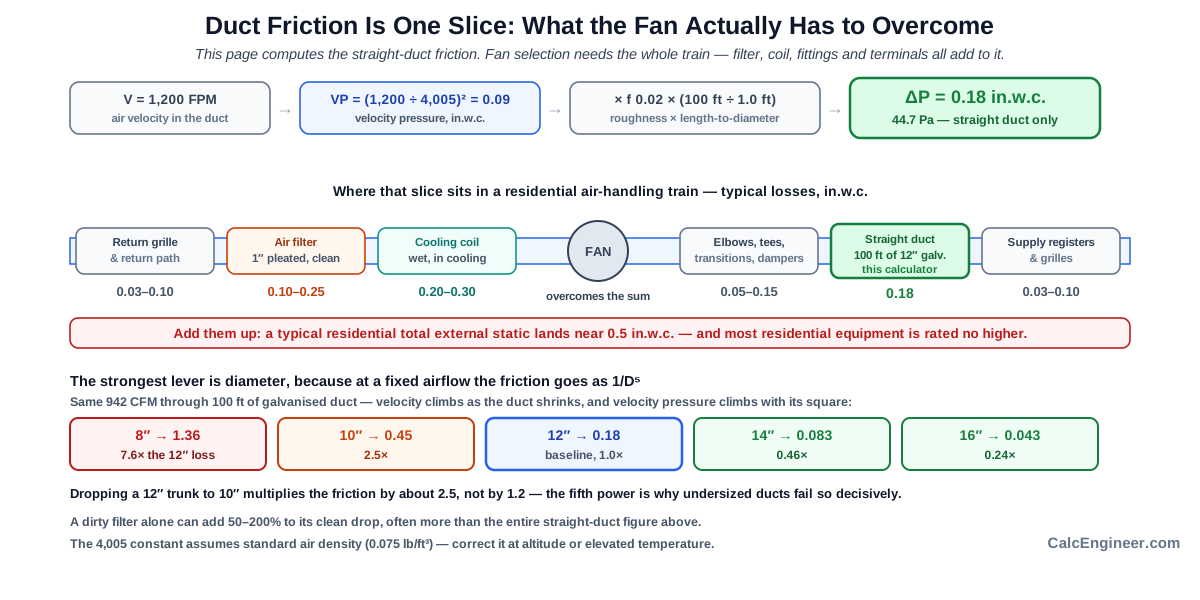
Static pressure increases when airflow resistance increases. This resistance comes from:
- Duct friction — longer ducts and smaller diameters increase friction
- Filters — especially when dirty or high-efficiency (HEPA)
- Coils — heating and cooling coils restrict airflow
- Fittings and bends — elbows, tees, and transitions create turbulence
- Dampers — partially closed dampers add significant resistance
Typical Static Pressure Ranges
| System Type | Static Pressure Range |
|---|---|
| Low-pressure ventilation | Below 0.1 in.w.c. (25 Pa) |
| Residential HVAC | 0.1 – 0.5 in.w.c. (25–125 Pa) |
| Commercial HVAC | 0.5 – 2.0 in.w.c. (125–500 Pa) |
| High resistance / industrial | 2.0+ in.w.c. (500+ Pa) |
Most residential HVAC equipment is designed to operate at or below 0.5 in.w.c. of external static pressure. Commercial systems with longer duct runs, more fittings, and higher-efficiency filters typically operate at higher pressures.
Engineering Applications
Static pressure calculations are essential across all areas of HVAC engineering:
- Residential HVAC — sizing ductwork and selecting furnace/air handler blowers
- Commercial buildings — designing VAV systems, sizing AHU fans, and balancing airflow
- Industrial ventilation — exhaust systems, dust collection, and fume extraction
- Clean rooms — maintaining precise pressure differentials between rooms
- Hospital HVAC — ensuring proper pressure relationships for infection control
Proper static pressure design prevents two common problems: systems that cannot deliver adequate airflow (undersized ducts or fans), and systems that waste energy fighting excessive resistance (oversized fans or restrictive duct layouts). If you already know air velocity, use our Velocity Pressure Calculator to estimate dynamic pressure in the system.
Key Facts
- Static pressure is a key parameter in HVAC diagnostics and system balancing.
- High static pressure reduces airflow and increases energy consumption.
- Static pressure is used together with velocity pressure to calculate total pressure.
- Dirty filters can increase static pressure by 50–200% above clean conditions.
- ASHRAE recommends measuring static pressure at both supply and return sides of the fan.
Applications
- HVAC duct design and sizing
- Fan selection and performance evaluation
- Airflow troubleshooting and diagnostics
- Ventilation system analysis and balancing
- Industrial air handling and exhaust systems
- Clean room and hospital HVAC design
Example Calculation
Example using Calculator Formula
Given:
- Air Velocity = 1200 FPM
- Duct Length = 100 ft
- Duct Diameter = 12 in
- Friction Factor = 0.02 (smooth galvanized steel)
Step 1: Calculate Velocity Pressure
VP = (1200 / 4005)²
VP = (0.2996)²
VP ≈ 0.09 in.w.c.
Step 2: Calculate Friction Loss
ΔP = f × (L / D) × VP
ΔP = 0.02 × (100 / 1.0) × 0.09
ΔP = 0.02 × 100 × 0.09
ΔP ≈ 0.18 in.w.c.
Result: Static Pressure ≈ 0.18 in.w.c. (≈ 44.7 Pa)
This falls within the normal residential HVAC range (0.1–0.5 in.w.c.).
Standards & References
- ASHRAE Handbook — Fundamentals — duct design and pressure loss methods
- SMACNA HVAC Duct Construction Standards — duct fabrication and pressure classes
- ACCA Manual D — residential duct design methodology
- ASHRAE Standard 111 — measurement, testing, and balancing of HVAC systems
Limitations
- This calculator provides a simplified estimation of static pressure based on duct friction only.
- Real HVAC systems include additional pressure losses from: filters, coils, dampers, elbows, tees, transitions, and terminal devices.
- For accurate system design, use detailed duct pressure loss software or the ASHRAE equal friction method.
- The friction factor varies with duct material, age, and condition — actual values may differ from defaults.
- The 4005 constant assumes standard air density (0.075 lb/ft³). Corrections needed at high altitudes or temperatures.
Common Mistakes to Avoid
- Confusing static pressure with velocity pressure — they are different components of total pressure.
- Ignoring filter resistance — dirty filters dramatically increase static pressure.
- Using incorrect units — mixing Pa with in.w.c. without proper conversion.
- Assuming static pressure alone defines system performance — total pressure matters.
- Not accounting for fittings — elbows, tees, and dampers add significant pressure loss.
Frequently Asked Questions
What is static pressure in HVAC?
How is static pressure measured?
What is a normal static pressure for residential HVAC?
What happens if static pressure is too high?
Is static pressure the same as velocity pressure?
Why is static pressure important for fan selection?
How can I reduce static pressure in my HVAC system?
Frequently Used Together
Engineers often use these calculators in combination for complete project workflows:
Related Calculators
Explore similar calculators that might be useful for your project:
Free HVAC Quick Reference. Formulas & Checks.
Airflow, loads, refrigerant & duct checks — one printable page for the job site.
- Key formulas for airflow, load, refrigerant charge & duct sizing
- Quick sanity checks for the most common HVAC design errors
- Printable one-pager for field use and design review
No spam. Unsubscribe any time.