Duct Friction Loss Calculator
On this page
Calculate
Volume airflow through the duct in CFM
Inside diameter of the round duct in inches
Total length of straight duct sections in feet
Equivalent length of fittings (elbows, transitions, etc.) in feet — enter 0 if none
Overview
A Duct Friction Loss Calculator calculates the normalized friction rate of a duct run — the pressure drop per unit length — using airflow, duct diameter, total effective length, and surface roughness. Friction rate is the central metric in ACCA Manual D equal-friction duct sizing: you select a target friction rate (typically 0.08–0.10 in.w.g./100 ft for supply ducts in residential systems), then choose duct diameters that keep every run at or below that target. If a run exceeds the target, increase the duct size or shorten the effective length.
This calculator uses the Darcy–Weisbach equation with the Swamee–Jain friction factor approximation. Enter the airflow, duct diameter, straight duct length, and equivalent fitting length for your run, then select the duct material. The calculator returns friction rate (in.w.g./100 ft or Pa/m) as the primary result, with total friction loss and air velocity as supporting values.
Need total pressure drop to budget fan static pressure across coils, filters, and terminals? Use the Duct Pressure Drop Calculator for that workflow.
How to Use This Calculator
Enter airflow — in m³/h or CFM.
Enter duct diameter — in mm or in.
Enter straight duct length — in m or ft.
Enter equivalent fitting length — in m or ft.
Select duct material / roughness — choose your duct material to set the roughness assumption (Smooth, Medium, Rough, or Very Rough).
Click "Calculate" — get friction rate, total friction loss, air velocity, and total effective length.
Compare the friction rate against your Manual D target (typically 0.08–0.10 in.w.g./100 ft for supply ducts); if above range, increase duct diameter or shorten the run.
Inputs & Outputs
Inputs
Outputs
Formula
Calculator Formula
This calculator uses a Darcy–Weisbach-based duct friction model with the Swamee–Jain explicit friction factor approximation, reporting the result as a normalized friction rate.
Step 1: Total Effective Length
L_total = L_straight + L_equiv
Where:
- L_total = total effective duct length
- L_straight = straight duct length
- L_equiv = equivalent fitting length
Manual D examples use total effective length to represent the added resistance of elbows and other fittings.
Step 2: Duct Cross-Sectional Area
A = π × (D / 2)²
Where:
- A = duct cross-sectional area (m² or ft²)
- D = duct inside diameter (m or ft)
Step 3: Air Velocity
V = Q / A
Where:
- V = air velocity (m/s or fpm)
- Q = airflow (m³/s or CFM)
- A = duct area
Step 4: Reynolds Number
Re = V × D / ν
Where:
- Re = Reynolds number (dimensionless)
- ν = kinematic viscosity of air ≈ 1.516 × 10⁻⁵ m²/s at standard conditions
Step 5: Friction Factor (Swamee–Jain Approximation)
f = 0.25 / [log₁₀(ε / (3.7 × D) + 5.74 / Re⁰·⁹)]²
Where:
- f = Darcy–Weisbach friction factor
- ε = absolute roughness of duct material (m)
Step 6: Total Friction Loss (Darcy–Weisbach)
ΔP = f × (L_total / D) × (ρ × V² / 2)
Where:
- ΔP = total friction pressure loss (Pa)
- ρ = air density ≈ 1.2 kg/m³ at standard conditions
Step 7: Friction Rate
Imperial:
FR = ΔP_inwg / (L_total_ft / 100)
Result in: in. w.g. per 100 ft
Metric:
FR = ΔP_Pa / L_total_m
Result in: Pa/m
ACCA educational guidance describes friction rate as pressure drop per 100 feet.
Calculator Variables
| Variable | Meaning | Units |
|---|---|---|
| Q | Airflow | m³/s / CFM |
| D | Duct inside diameter | m / in |
| L_straight | Straight duct length | m / ft |
| L_equiv | Equivalent fitting length | m / ft |
| ε | Absolute roughness | m |
| V | Air velocity | m/s / fpm |
| Re | Reynolds number | — |
| f | Darcy–Weisbach friction factor | — |
| ΔP | Total friction loss | Pa / in. w.g. |
| FR | Friction rate | Pa/m / in. w.g./100 ft |
| ρ | Air density (standard) | 1.2 kg/m³ |
| ν | Kinematic viscosity (standard) | 1.516 × 10⁻⁵ m²/s |
What is Duct Friction Loss
Duct friction loss is the pressure drop caused by air rubbing against duct walls and flowing through fittings. In HVAC duct design, this loss is expressed as a normalized rate — friction rate — in in. w.g. per 100 ft (imperial) or Pa/m (metric). Friction rate is the foundation of the equal-friction duct sizing method recommended by ACCA Manual D: every branch and trunk in the duct system is sized so its friction rate stays within a target band. ACCA's training material describes friction rate as the pressure-drop rate used directly on duct sizing tools. Getting this number right ensures each room receives its design airflow without overloading the fan.
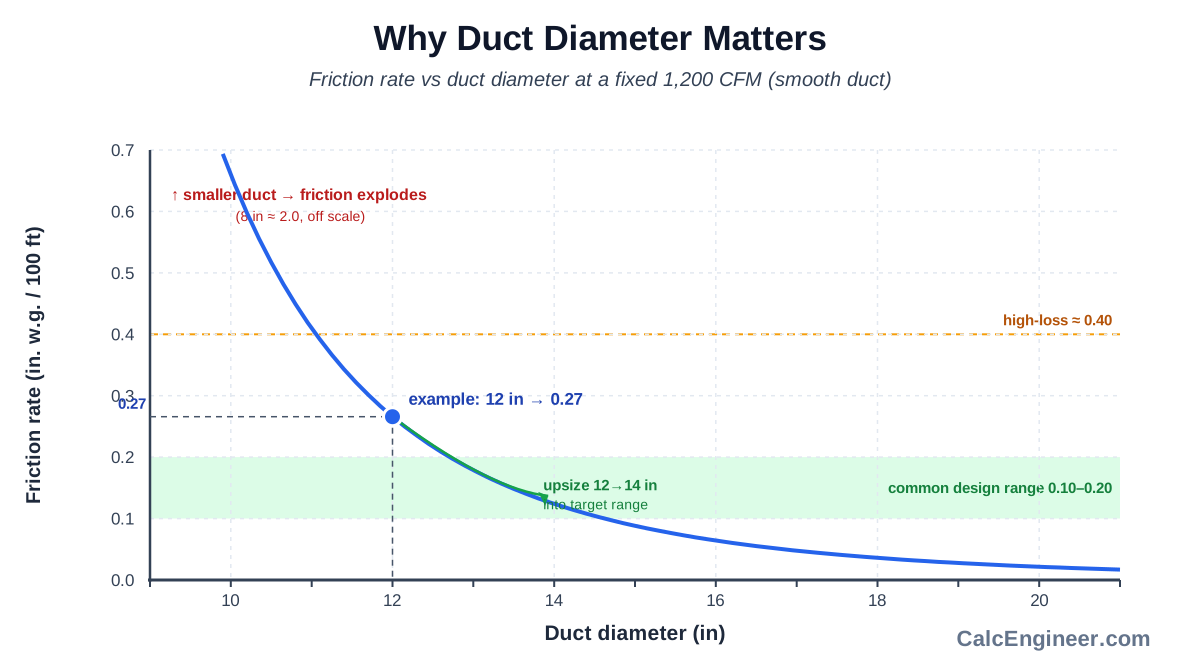
How This Calculator Works
Enter airflow, duct diameter, straight duct length, equivalent fitting length, and duct material. The calculator determines velocity from airflow and cross-sectional area, then uses the Darcy–Weisbach equation with the Swamee–Jain friction factor to compute total friction loss. The primary output is the normalized friction rate — the value you compare against your Manual D target to decide whether the duct diameter is properly sized. If the rate is above target, increase diameter or reduce equivalent fitting length.
Common Residential Friction Rate Targets
Engineering ToolBox and ACCA training materials cite the following typical friction rate references for equal-friction design:
| Application | Target Friction Rate |
|---|---|
| Supply ducts (equal friction) | ~0.10 in. w.g./100 ft |
| Return ducts (equal friction) | ~0.08 in. w.g./100 ft |
| Low pressure loss range | 0.05–0.10 in. w.g./100 ft |
| Medium pressure loss range | 0.10–0.20 in. w.g./100 ft |
| High pressure loss range | up to ~0.40 in. w.g./100 ft |
If the calculated friction rate is above the target, increase duct diameter or reduce equivalent fitting length. If it is well below target, the duct is oversized — acceptable, but may waste space and material.
Practical Tips
When sizing ducts with the equal-friction method, check every branch in the system, not just the longest run. A short branch duct with tight bends and a small diameter can have a higher friction rate than the main trunk.
For flex duct, roughness is significantly higher than sheet metal. Flex duct runs commonly reach 3–10× the friction loss of smooth galvanized duct at the same airflow and diameter. ACCA notes that even about 15% longitudinal compression of flex duct can double the friction rate.
For fittings, a single 90° elbow in a 6–8 in duct can add 10–25 ft of equivalent length. Accurate equivalent lengths are critical for sizing branch ducts correctly.
Need to budget total fan static pressure? That requires summing coil, filter, diffuser, and multi-branch losses — use the Duct Pressure Drop Calculator for that workflow.
Key Facts
- Duct friction loss is the pressure loss caused by resistance as air moves through a duct — the air rubs against the duct surface and loses pressure over distance.
- ACCA Manual D is the ANSI-recognized residential duct-design procedure and uses friction rate and total effective length in sizing logic.
- ACCA's educational material describes friction rate as pressure drop per 100 feet.
- Friction rate rises sharply when airflow stays high in a relatively small duct — doubling velocity roughly quadruples friction loss.
- Engineering ToolBox notes that a common equal-friction design reference is around 0.1 in. H₂O/100 ft for supply ducts and around 0.08 in. H₂O/100 ft for return ducts.
- Flex duct has significantly higher roughness than sheet metal, increasing friction loss by 3–10× for the same airflow and diameter.
- ACCA notes that even about 15% longitudinal compression in flex duct can double friction rate.
Applications
- Residential duct sizing checks.
- Comparing duct diameters at the same airflow.
- Evaluating whether a run is overly restrictive.
- Checking Manual D-style friction assumptions.
- Reviewing fitting-heavy runs.
- Preliminary fan-static-pressure budgeting.
- Educational HVAC design use.
- Branch and trunk resistance comparisons.
Example Calculation
Example: Sizing Check for a Bedroom Supply Run
Given (Imperial):
- Airflow = 400 CFM
- Duct diameter = 8 in
- Straight length = 60 ft
- Equivalent fitting length = 15 ft
- Duct material = Rough (flex duct, ε = 0.9 mm)
Step 1: Total effective length
L_total = 60 + 15 = 75 ft = 22.86 m
Step 2: Area
8 in = 0.2032 m
A = π × (0.2032 / 2)² = 0.03243 m²
Step 3: Velocity
Q = 400 CFM = 0.1888 m³/s
V = 0.1888 / 0.03243 = 5.82 m/s (≈ 1,146 fpm)
Step 4: Reynolds Number
Re = 5.82 × 0.2032 / 1.516e-5 ≈ 78,000
Step 5: Friction Factor
f = 0.25 / [log₁₀(0.0009 / (3.7 × 0.2032) + 5.74 / 78000⁰·⁹)]²
f ≈ 0.031
Step 6: Total Friction Loss
ΔP = 0.031 × (22.86 / 0.2032) × (1.2 × 5.82² / 2)
ΔP ≈ 0.031 × 112.5 × 20.3 ≈ 70.4 Pa ≈ 0.28 in. w.g.
Step 7: Friction Rate
Friction Rate = 0.28 / (75 / 100) ≈ 0.38 in. w.g. per 100 ft (3.08 Pa/m)
Result: Friction Rate ≈ 0.38 in. w.g./100 ft — above the Manual D equal-friction target
Interpretation
At 400 CFM through an 8-inch flex duct with 75 ft total effective length, the friction rate of approximately 0.38 in. w.g./100 ft significantly exceeds the typical residential supply target of 0.10 in. w.g./100 ft. This run needs a larger duct. Upgrading to a 10-inch flex duct drops the friction rate to approximately 0.12 in. w.g./100 ft — near the target. If 10 in does not fit, reduce the equivalent fitting length by using larger-radius elbows, or shorten the run path.
Standards & References
- ACCA Manual D — ANSI-recognized residential duct-design procedure using friction rate and total effective length
- SMACNA HVAC Duct Design — identifies straight-duct friction with the Darcy–Weisbach equation and treats fitting losses as dynamic losses
- ASHRAE Fundamentals — duct design methods, friction charts, and fitting loss coefficients
- ASHRAE Duct Fitting Database — fitting loss coefficients for duct system analysis
- Engineering ToolBox — duct friction charts presenting friction loss in in. w.g./100 ft and Pa/m
Limitations
- This calculator is a first-pass duct-friction tool, not a full system-design engine.
- It does not replace fitting-by-fitting coefficient analysis, leakage analysis, acoustics review, branch balancing, coil/filter pressure-drop review, or full fan-curve verification.
- It assumes standard air density (1.2 kg/m³) — altitude and temperature corrections are not included.
- It uses the Swamee–Jain explicit approximation for friction factor, which is accurate within ±1% of the Colebrook equation for typical duct Reynolds numbers.
- Rectangular ducts are not directly supported — use an equivalent round diameter for approximate results.
- ACCA and SMACNA both make clear that complete duct design involves more than one normalized friction number.
Common Mistakes to Avoid
- Entering airflow without checking whether the resulting duct velocity is reasonable for the duct size.
- Ignoring equivalent fitting length and evaluating only the straight section — fittings can double or triple effective length.
- Comparing total pressure drop and friction rate as though they were the same metric — friction rate is a normalized value.
- Forgetting that the fan must overcome all system losses, not just one duct segment.
- Using smooth-duct roughness values for flex duct installations, which dramatically understates actual friction.
- Not accounting for altitude or temperature effects on air density in non-standard conditions.
Frequently Asked Questions
What friction rate should I use for residential duct sizing?
How does friction rate relate to duct diameter?
What is total effective length and why does it matter?
Why does flex duct have higher friction than sheet metal?
How is this different from the Duct Pressure Drop Calculator?
Frequently Used Together
Engineers often use these calculators in combination for complete project workflows:
Related Calculators
Explore similar calculators that might be useful for your project:
Free HVAC Quick Reference. Formulas & Checks.
Airflow, loads, refrigerant & duct checks — one printable page for the job site.
- Key formulas for airflow, load, refrigerant charge & duct sizing
- Quick sanity checks for the most common HVAC design errors
- Printable one-pager for field use and design review
No spam. Unsubscribe any time.
Calculate
Volume airflow through the duct in CFM
Inside diameter of the round duct in inches
Total length of straight duct sections in feet
Equivalent length of fittings (elbows, transitions, etc.) in feet — enter 0 if none