Duct Insulation Loss Calculator
On this page
Calculate
Temperature of the air inside the duct in °F
Temperature of the surrounding space in °F
Inside diameter of the round duct in inches
Thickness of the insulation layer in inches
Total length of the insulated duct run in feet
Overview
A Duct Insulation Loss Calculator estimates how much heat is lost from a warm duct or gained by a cold duct as air travels through insulated ductwork. This page uses a fixed steady-state cylindrical conduction model for a round insulated duct: it calculates radial heat transfer through the insulation layer from the duct air-side temperature difference, insulation thickness, duct diameter, duct length, and insulation thermal conductivity. DOE notes that insulating ducts reduces heat loss in heating mode and heat gain in cooling mode, and SMACNA states that duct insulation is used to increase thermal resistance, reduce energy loss, and prevent condensation.
Enter the duct air temperature, the surrounding ambient temperature, the inside duct diameter, the insulation thickness, the duct length, and the insulation thermal conductivity used by the calculator. The page converts the dimensions into a cylindrical insulation geometry, computes the radial heat transfer through the insulation, and returns the total heat loss or heat gain over the duct length. Use the result as a first-pass estimate, then review whether real installation conditions such as air leakage, fittings, supports, radiant effects, and duct location could change the actual performance. DOE and SMACNA both emphasize that duct insulation reduces distribution losses, especially when ducts are outside conditioned space.
How to Use This Calculator
Enter duct air temperature — in °C or °F.
Enter ambient temperature — in °C or °F.
Enter inside duct diameter — in mm or in.
Enter insulation thickness — in mm or in.
Enter duct length — in m or ft.
Select insulation thermal conductivity — choose your insulation material.
Click "Calculate" — get total heat loss / gain, heat transfer per unit length, temperature difference.
Compare insulation thickness or k-value options to see how much the distribution loss drops; add air-film resistance for a more exact figure.
Inputs & Outputs
Inputs
Outputs
Formula
Calculator Formula
This calculator uses a fixed steady-state cylindrical conduction model for a round insulated duct.
Step 1: Temperature Difference
ΔT = |T_duct - T_ambient|
Where:
- ΔT = absolute temperature difference (°C or °F)
- T_duct = duct air temperature
- T_ambient = surrounding air temperature
Step 2: Inner and Outer Insulation Radii
r₁ = D_i / 2
r₂ = r₁ + t_ins
Where:
- r₁ = inner insulation radius (m or ft)
- r₂ = outer insulation radius (m or ft)
- D_i = inside duct diameter
- t_ins = insulation thickness
Step 3: Heat Transfer Through Cylindrical Insulation
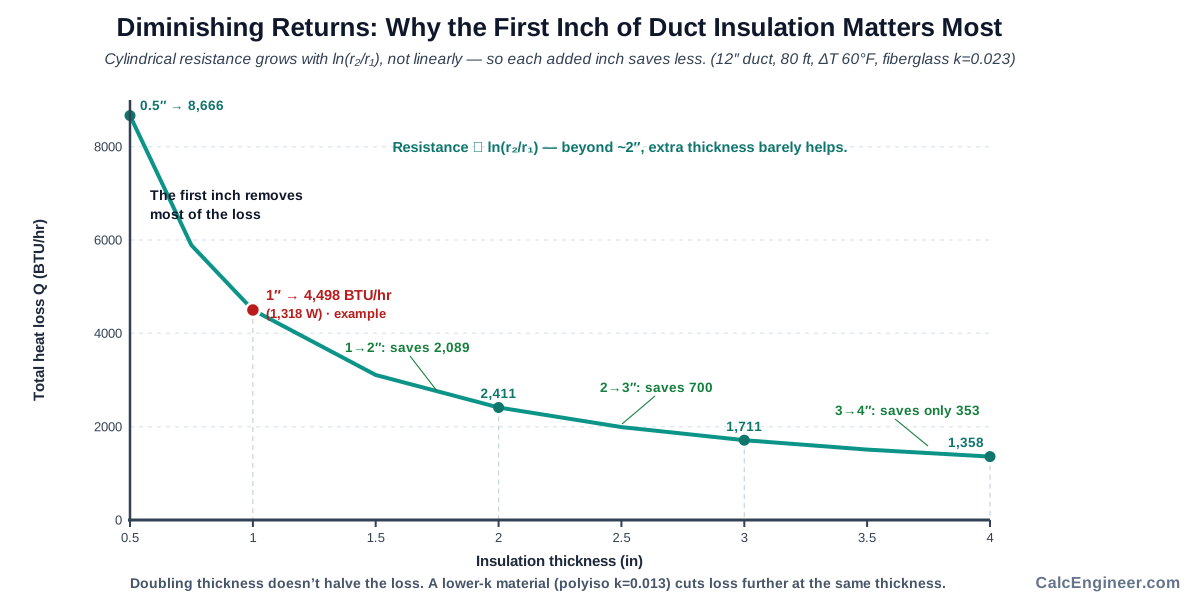
Q = (2πkLΔT) / ln(r₂ / r₁)
Where:
- Q = total heat transfer (W or Btu/hr)
- k = insulation thermal conductivity (W/m·K or Btu/h·ft·°F)
- L = duct length (m or ft)
- ΔT = temperature difference
- ln(r₂ / r₁) = cylindrical insulation resistance term
This is the standard conductive heat-transfer relation for a cylinder or pipe wall.
Step 4: Heat Transfer per Unit Length
Q' = Q / L
Where:
- Q' = heat transfer per unit length (W/m or Btu/hr·ft)
Calculator Variables
| Variable | Meaning | Units |
|---|---|---|
| T_duct | Duct air temperature | °C / °F |
| T_ambient | Ambient temperature | °C / °F |
| D_i | Inside duct diameter | mm / in |
| t_ins | Insulation thickness | mm / in |
| L | Duct length | m / ft |
| k | Insulation thermal conductivity | W/m·K / Btu/h·ft·°F |
| Q | Total heat loss / gain | W / Btu/hr |
| Q' | Heat transfer per unit length | W/m / Btu/hr·ft |
What is Duct Insulation Loss
Duct insulation loss is the heat transfer that occurs between the air inside a duct and the surrounding space through the duct wall and insulation. In heating mode, warm supply air loses heat to colder surroundings; in cooling mode, cold supply air gains heat from warmer surroundings. DOE states that one way duct systems lose energy is by heat transfer through the duct walls, and that insulating ducts reduces those losses.
How This Calculator Works
This calculator treats the insulated duct as a cylindrical heat-transfer path and calculates heat transfer from the duct-to-ambient temperature difference, insulation conductivity, thickness, diameter, and length. Enter the six inputs and the calculator applies the standard Q = (2πkLΔT) / ln(r₂ / r₁) relation to return total heat loss or gain and heat transfer per unit length.
Typical Duct Insulation Conductivity Values
| Material | k (W/m·K) | k (Btu/h·ft·°F) |
|---|---|---|
| Fiberglass blanket | 0.035–0.045 | 0.020–0.026 |
| Mineral wool | 0.030–0.040 | 0.017–0.023 |
| Closed-cell foam | 0.020–0.030 | 0.012–0.017 |
| Polyisocyanurate | 0.020–0.025 | 0.012–0.014 |
| Elastomeric rubber | 0.040–0.055 | 0.023–0.032 |
Practical Tips
When estimating duct insulation loss, always consider the duct location and the temperature difference between duct air and surrounding space.
For duct location, ducts in unconditioned spaces (attics, crawlspaces, garages) experience much larger temperature differences than ducts inside conditioned space. DOE specifically notes that insulating ducts and locating ducts within conditioned space reduce energy losses.
For insulation material, lower k-value materials provide better thermal performance. Closed-cell foam and polyisocyanurate have lower conductivity than standard fiberglass blanket.
Important: This calculator provides a first-pass insulation-loss estimate. Final duct insulation design depends on installation quality, air leakage, compression of insulation, vapor barrier condition, and ambient exposure per DOE and SMACNA standards.
Key Facts
- Duct insulation loss is the heat transfer that occurs between the air inside a duct and the surrounding space through the duct wall and insulation.
- DOE states that one way duct systems lose energy is by heat transfer through the duct walls, and that insulating ducts reduces those losses.
- Increasing insulation thickness increases thermal resistance, which reduces heat transfer through the duct insulation layer.
- Higher thermal conductivity increases heat transfer — lower k-value insulation provides better thermal performance.
- SMACNA states that insulation is applied to ductwork to increase thermal resistance, reduce energy loss, and prevent condensation.
- Ducts in unconditioned spaces (attics, crawlspaces, garages) experience larger temperature differences and therefore higher thermal losses.
- Standard air density of 1.2 kg/m³ (0.075 lb/ft³) is assumed at sea level and approximately 20°C (68°F).
Applications
- Supply duct heat-loss estimates.
- Cooling duct heat-gain estimates.
- Attic and crawlspace duct review.
- Comparing insulation thickness options.
- Estimating distribution losses.
- Checking retrofit insulation benefit.
- Educational HVAC design use.
- Preliminary duct-performance review.
Example Calculation
Example using Calculator Formula
Given (Imperial):
- Duct air temperature = 130°F
- Ambient temperature = 70°F
- Inside duct diameter = 12 in
- Insulation thickness = 1 in
- Duct length = 80 ft
- Insulation thermal conductivity = 0.023 Btu/(h·ft·°F)
Step 1: Temperature difference
ΔT = |130 - 70| = 60°F
Step 2: Convert geometry to radii
D_i = 12 in = 1.0 ft
r₁ = 0.5 ft
t_ins = 1 in = 0.0833 ft
r₂ = 0.5 + 0.0833 = 0.5833 ft
Step 3: Total heat transfer
Q = (2π × 0.023 × 80 × 60) / ln(0.5833 / 0.5)
Q = (693.5) / (0.1542)
Q ≈ 4,498 Btu/hr
Step 4: Heat transfer per foot
Q' = 4,498 / 80 ≈ 56.2 Btu/hr·ft
Result: Total Heat Loss ≈ 4,498 Btu/hr (≈ 1,318 W), Heat Transfer per Foot ≈ 56.2 Btu/hr·ft
Interpretation
In this example, the insulated duct loses about 4,498 Btu/hr to the surrounding space. The insulation substantially reduces the distribution loss compared with an uninsulated duct. The result is useful as a first-pass thermal estimate when comparing insulation thickness or checking whether attic / crawlspace duct losses are large enough to matter in system performance. DOE and SMACNA both support insulating ducts to reduce thermal losses and limit condensation risk.
Standards & References
- DOE Energy Saver — states that insulating ducts reduces heat loss and heat gain in duct systems, especially when ducts run outside conditioned space
- SMACNA HVAC Duct Design — states that duct insulation is used to increase thermal resistance, reduce energy loss, and prevent condensation
- ASHRAE 90.1 — requires ductwork and plenums to be insulated in accordance with specified tables
- ASHRAE Fundamentals — duct heat transfer methods, insulation properties, and cylindrical conduction models
- Energy Code References — commonly require minimum installed duct insulation such as R-6 in many situations
Limitations
- This calculator is a first-pass insulation-loss tool, not a complete duct heat-transfer simulation.
- It does not separately model duct leakage, thermal bridges at hangers, radiant exchange, air-film resistances, moisture effects, changing operating conditions, or transient start-up behavior.
- It assumes a round duct and a steady radial conduction path through the insulation.
- It assumes standard air density (1.2 kg/m³) — altitude and temperature corrections are not included.
- In real installations, DOE notes that leakage and duct location can materially affect overall distribution efficiency in addition to conductive heat loss.
- Rectangular ducts are not directly supported — use an equivalent round diameter for approximate results.
Common Mistakes to Avoid
- Entering a temperature difference in one unit system while using conductivity and dimensions from another.
- Confusing R-value and k-value and entering the wrong insulation property — this calculator uses k-value (thermal conductivity).
- Ignoring duct leakage and assuming insulation alone captures total distribution loss — DOE notes that sealing and insulating both matter.
- Treating a long run in conditioned space the same as a shorter run in a vented attic or crawlspace.
- Using nominal insulation thickness without accounting for compression at hangers, supports, or bends.
- Forgetting that the outer surface of the insulation also has an air-film resistance that this simplified model does not include.
Frequently Asked Questions
What does this Duct Insulation Loss Calculator calculate?
What formula does this calculator use?
Why does insulation thickness reduce heat loss?
Does imperial or metric mode change the result?
Is this calculator using R-value or k-value?
Does this include duct leakage?
Can this calculator replace a full HVAC distribution analysis?
Why do ducts in attics lose more useful energy?
Frequently Used Together
Engineers often use these calculators in combination for complete project workflows:
Related Calculators
Explore similar calculators that might be useful for your project:
Free HVAC Quick Reference. Formulas & Checks.
Airflow, loads, refrigerant & duct checks — one printable page for the job site.
- Key formulas for airflow, load, refrigerant charge & duct sizing
- Quick sanity checks for the most common HVAC design errors
- Printable one-pager for field use and design review
No spam. Unsubscribe any time.
Calculate
Temperature of the air inside the duct in °F
Temperature of the surrounding space in °F
Inside diameter of the round duct in inches
Thickness of the insulation layer in inches
Total length of the insulated duct run in feet