Latent Heat Load Calculator
On this page
Calculate
Volume airflow through the system
Humidity ratio of entering air (mass of water per mass of dry air)
Humidity ratio of leaving air (mass of water per mass of dry air)
Standard air density ≈ 0.075 lb/ft³ (1.202 kg/m³). Enter value in kg/m³.
Overview
A Latent Heat Load Calculator estimates the cooling load associated with moisture removal, not temperature change. This page uses one fixed HVAC model: latent load is calculated from airflow and the difference in humidity ratio between entering and leaving air. The calculator also converts that moisture difference into a water removal rate, which is often the most practical output for dehumidification and coil selection.
Engineering references express latent heat in moist air using airflow multiplied by humidity-ratio difference and a latent heat factor, with common HVAC forms such as 0.68 × CFM × Δgrains and 4840 × CFM × ΔW(lb/lb) in Imperial units, and ρ × hfg × q × ΔW in SI units.
Enter the airflow rate and the humidity ratio difference between entering and leaving air. The calculator first computes the latent heat load, then computes the corresponding moisture removal rate. Use the result for first-pass coil latent-load checks, dehumidification planning, and comparing room or ventilation moisture loads against equipment latent capacity.
How to Use This Calculator
Enter airflow rate — in m³/s or CFM.
Enter entering humidity ratio — in kg/kg or lb/lb.
Enter leaving humidity ratio — in kg/kg or lb/lb.
Enter air density — in kg/m³.
Click "Calculate" — get humidity ratio difference, latent heat load, moisture removal rate.
Compare the latent load and moisture-removal rate against the coil’s rated latent capacity at your design leaving-air dew point.
Inputs & Outputs
Inputs
Outputs
Formula
Calculator Formula
This page uses one fixed latent-load model.
Step 1: Humidity Ratio Difference
ΔW = Win − Wout
Where:
- ΔW = humidity-ratio difference (kg water/kg dry air in metric, lb water/lb dry air in imperial)
- Win = entering humidity ratio
- Wout = leaving humidity ratio
Step 2: Latent Heat Load
Imperial:
QL = 4840 × CFM × ΔW
Where:
- QL = latent heat load, BTU/hr
- CFM = airflow, cfm
- ΔW = humidity ratio difference, lb water/lb dry air
Metric (SI):
QL = ρ × hfg × q × ΔW
Where:
- QL = latent heat load, kW
- ρ = air density, default 1.202 kg/m³
- hfg = latent heat of vaporization of water in air, fixed at 2454 kJ/kg
- q = airflow, m³/s
- ΔW = humidity ratio difference, kg/kg dry air
Step 3: Moisture Removal Rate
Imperial:
ṁwater = QL / 1061
Where:
- ṁwater = moisture removal, lb/hr
- 1061 BTU/lb = fixed latent heat of condensation approximation
Note on Imperial constants: The 4840 factor in Step 2 embeds hṁg ≈ 1076 BTU/lb (latent heat at ~70°F). The 1061 BTU/lb divisor here is a separate approximation at coil condensation temperature (~100°F). Both are standard; the ≈1.4% difference in derived moisture mass is within screening tolerance.
Metric (SI):
ṁwater = ρ × q × ΔW × 3600
Where:
- ṁwater = moisture removal, kg/h
- ρ = air density, kg/m³
- q = airflow, m³/s
- ΔW = humidity ratio difference, kg/kg dry air
Variable Reference
| Variable | Meaning | Units |
|---|---|---|
| airflow / q / CFM | Airflow rate | m³/s / CFM |
| wIn / Win | Entering humidity ratio | kg/kg / lb/lb |
| wOut / Wout | Leaving humidity ratio | kg/kg / lb/lb |
| ΔW | Humidity ratio difference | kg/kg / lb/lb |
| ρ | Air density | kg/m³ |
| hfg | Latent heat of vaporization | 2454 kJ/kg |
| QL | Latent heat load | kW / BTU/hr |
| ṁwater | Moisture removal rate | kg/h / lb/hr |
What is Latent Heat Load
Latent heat load is the portion of HVAC cooling load associated with removing moisture from air. Unlike sensible load, which changes air temperature, latent load changes the air's water vapor content. In cooling and dehumidification applications, latent load represents the energy needed to condense and remove moisture, and it directly affects coil selection, sensible heat ratio (SHR), and dehumidification performance.
Engineering references describe moist-air latent heat using humidity-ratio difference and latent heat of evaporation. The humidity ratio — mass of water vapor per mass of dry air — is the fundamental variable in all latent-load calculations.
Why Latent Load Matters
Latent load is often the hidden driver of HVAC comfort problems. A system may have adequate total tonnage but still fail to control humidity if its sensible heat ratio is too high or its coil dew point is too warm. High latent loads require equipment that can remove moisture effectively, which may mean:
- Lower supply air temperatures
- Lower coil leaving-air dew points
- Dedicated outdoor air systems (DOAS)
- Separate dehumidification equipment
- Variable-speed compressors with enhanced dehumidification modes
Sources of Latent Load
The primary sources of moisture that contribute to latent heat load include:
- Outside air ventilation — humid outdoor air introduced for ventilation carries significant moisture
- Infiltration — uncontrolled air leakage through the building envelope
- Occupants — each person generates approximately 200–300 BTU/hr of latent heat through respiration and perspiration
- Process moisture — cooking, washing, swimming pools, industrial processes
- Moisture migration — vapor diffusion through building materials
Engineering Applications
Latent heat load calculations are essential across many HVAC applications:
- Cooling coil selection — ensuring the coil has sufficient latent capacity at the design leaving-air conditions
- Dedicated outdoor air systems — sizing DOAS units that handle the full ventilation latent load
- Natatoriums and pools — where evaporation creates very high latent loads requiring specialized dehumidification
- Commercial kitchens — where cooking processes generate significant moisture
- Healthcare facilities — where precise humidity control is critical for patient comfort and infection control
- Data centers — where humidity must be maintained within tight bands to prevent static discharge or condensation
Practical Tips
When estimating latent heat load:
- Always verify that you are entering humidity ratio (mass ratio), not relative humidity (percentage)
- Remember that the 4840 factor in Imperial units assumes standard air density — adjust for altitude if needed
- Compare your calculated latent load against the equipment's rated latent capacity, not just total capacity
- Check the sensible heat ratio (SHR) — if your space has a low SHR (high latent fraction), standard equipment may not dehumidify adequately
- For humid climates, the outside-air latent load often dominates the total latent demand
Important: This calculator provides screening estimates using a simplified psychrometric model. Final equipment selection should always be verified using manufacturer data, full psychrometric analysis, and professional engineering judgment.
Key Facts
- Latent heat load is the portion of HVAC cooling load associated with removing moisture from air, not changing temperature.
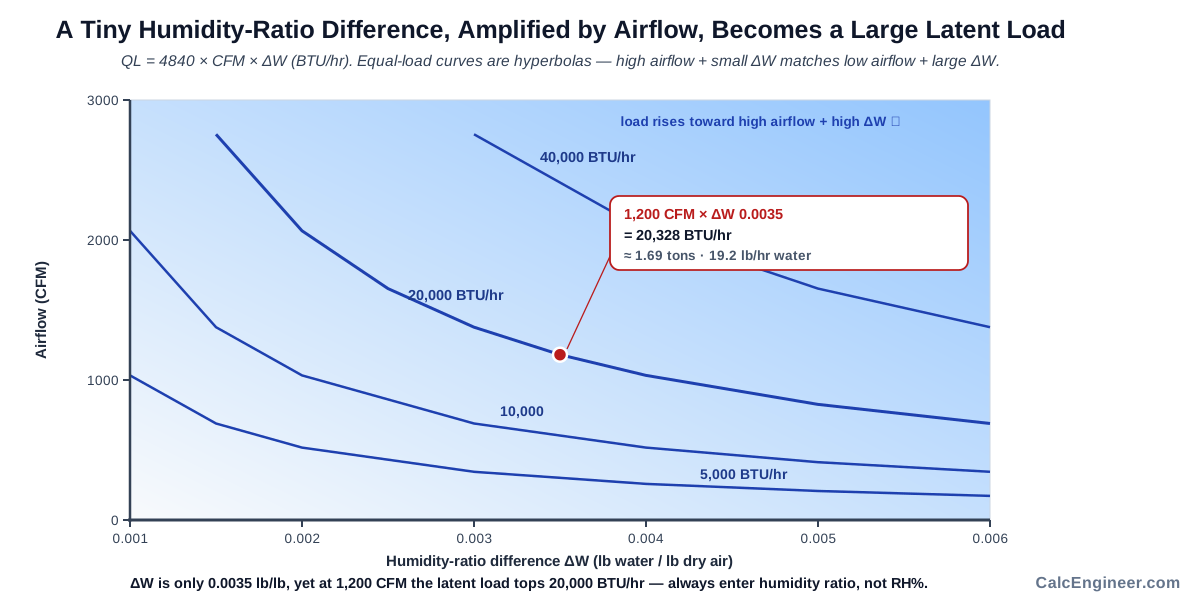
- A small change in humidity ratio at high airflow can create a large latent load.
- High latent loads can require lower SHR equipment, lower coil dew point, or dedicated dehumidification even when sensible load is moderate.
- Latent load is strongly driven by outside air, infiltration, occupancy, and process moisture.
- The latent-load equations used here are standard HVAC engineering approximations based on humidity-ratio difference across an airstream.
Applications
- Cooling coil latent-load checks
- Ventilation latent-load estimation
- Outside-air dehumidification load
- Dedicated outdoor air system (DOAS) analysis
- Natatorium and humid climate screening
- Occupancy moisture-load screening
- Process moisture removal estimates
- Comparing equipment latent capacity to required moisture removal
Example Calculation
Imperial Example
Given:
- Airflow = 1200 CFM
- Entering humidity ratio = 0.0130 lb/lb
- Leaving humidity ratio = 0.0095 lb/lb
Step 1: Humidity-ratio difference
ΔW = 0.0130 − 0.0095 = 0.0035 lb/lb
Step 2: Latent heat load
QL = 4840 × 1200 × 0.0035 = 20,328 BTU/hr
Step 3: Moisture removal rate
ṁwater = 20,328 / 1061 ≈ 19.16 lb/hr
Metric Example
Given:
- Airflow = 1.0 m³/s
- Entering humidity ratio = 0.014 kg/kg
- Leaving humidity ratio = 0.010 kg/kg
- ρ = 1.202 kg/m³
- hfg = 2454 kJ/kg
Step 1: Humidity-ratio difference
ΔW = 0.014 − 0.010 = 0.004 kg/kg
Step 2: Latent heat load
QL = 1.202 × 2454 × 1.0 × 0.004 = 11.80 kW
Step 3: Moisture removal rate
ṁwater = 1.202 × 1.0 × 0.004 × 3600 = 17.31 kg/h
Standards & References
- ASHRAE Handbook — Fundamentals — Psychrometrics; moist-air latent heat relations
- ASHRAE 62.1 — ventilation for acceptable indoor air quality (outside-air moisture contribution)
- ASHRAE Handbook — HVAC Systems and Equipment — coil selection and dehumidification capacity
- ACCA Manual J — residential latent load estimation
Limitations
- This calculator is a screening tool, not a complete psychrometric design engine.
- It does not calculate: sensible load, total cooling load, coil bypass factor, apparatus dew point, or leaving-air saturation automatically.
- Room RH is not computed directly from load balance — only latent load and moisture removal are estimated.
- Outside-air mixing, infiltration generation, and condensate carryover are not modeled automatically.
- Real latent performance depends on full psychrometric state points and actual equipment capacity, not only airflow and humidity-ratio difference.
- The SI formula uses fixed constants (ρ = 1.202 kg/m³, hfg = 2454 kJ/kg) — adjust air density for non-standard conditions.
Common Mistakes to Avoid
- Confusing latent load with total cooling load — latent load is only the moisture-removal portion.
- Entering relative humidity instead of humidity ratio when the calculator expects moisture content directly.
- Forgetting that a small change in humidity ratio at high airflow can create a large latent load.
- Assuming the equipment can handle the latent load just because its total tonnage is high, even though SHR and coil dew point may still be inadequate.
- Ignoring outside-air and infiltration moisture contributions when estimating total latent demand.
Frequently Asked Questions
What does this calculator measure?
What formula does this page use?
What is the difference between latent and sensible load?
What is humidity ratio?
Why can latent load be high even when temperature is moderate?
Does this calculator include outside-air load automatically?
Can this calculator size a dehumidifier?
Does this prove the space will meet RH target?
Frequently Used Together
Engineers often use these calculators in combination for complete project workflows:
Related Calculators
Explore similar calculators that might be useful for your project:
Free HVAC Quick Reference. Formulas & Checks.
Airflow, loads, refrigerant & duct checks — one printable page for the job site.
- Key formulas for airflow, load, refrigerant charge & duct sizing
- Quick sanity checks for the most common HVAC design errors
- Printable one-pager for field use and design review
No spam. Unsubscribe any time.
Calculate
Volume airflow through the system
Humidity ratio of entering air (mass of water per mass of dry air)
Humidity ratio of leaving air (mass of water per mass of dry air)
Standard air density ≈ 0.075 lb/ft³ (1.202 kg/m³). Enter value in kg/m³.