Psychrometric Calculator
On this page
Calculate
Air temperature measured by a standard thermometer
Ratio of actual vapor pressure to saturation vapor pressure at the same temperature
Overview
A Psychrometric Calculator estimates the thermodynamic state of moist air from two standard inputs: dry-bulb temperature and relative humidity at standard atmospheric pressure (101.325 kPa). From those inputs, it calculates key moist-air properties such as humidity ratio, dew point, vapor pressure, and enthalpy.
Dry-bulb temperature and relative humidity are the most commonly measured or specified values in HVAC field conditions and controls. This combination is also the baseline for standard ASHRAE psychrometric charts.
Enter the dry-bulb temperature and relative humidity. The calculator first determines the saturation vapor pressure at the entered dry-bulb temperature, then uses RH to calculate the actual vapor pressure. From that value, it calculates humidity ratio, dew point, enthalpy, and specific volume. This makes the tool useful for HVAC air-state checks, latent-load screening, indoor-air analysis, coil-condition estimates, and dehumidification/humidification discussions.
How to Use This Calculator
Enter dry-bulb temperature — in °C or °F.
Enter relative humidity — in %.
Click “Calculate” — get dew point, humidity ratio, vapor pressure, enthalpy, and specific volume.
Use the results as a quick moist-air state estimate for HVAC checks. For final design, verify barometric pressure, equipment data, and project conditions.
Inputs & Outputs
Inputs
Outputs
Formula
Calculator Formulas
This page uses one fixed psychrometric model at standard atmospheric pressure (101.325 kPa).
Unit handling: In Imperial mode, dry-bulb temperature is entered in °F and converted internally to °C before psychrometric calculations. Outputs are displayed in Imperial units accordingly. In Metric mode, all inputs and outputs use SI units.
Step 1: Saturation Vapor Pressure (Magnus equation)
p_ws = 0.61094 × exp(17.625 × T / (T + 243.04))
Where p_ws is in kPa and T is dry-bulb temperature in °C.
Step 2: Actual Vapor Pressure
p_w = (RH / 100) × p_ws
Step 3: Humidity Ratio
W = 0.62198 × p_w / (P − p_w)
Where P = 101.325 kPa (standard atmospheric pressure).
Step 4: Dew Point (inverse Magnus)
T_dp = 243.04 × ln(p_w / 0.61094) / (17.625 − ln(p_w / 0.61094))
Step 5: Enthalpy
h = 1.006T + W(2501 + 1.86T) (kJ/kg dry air)
Step 6: Specific Volume
v = 0.287042 × (T + 273.15) × (1 + 1.6078W) / 101.325 (m³/kg dry air)
Variable Reference
| Variable | Meaning | Units |
|---|---|---|
| T | Dry-bulb temperature | °C / °F |
| RH | Relative humidity | % |
| p_ws | Saturation vapor pressure | kPa |
| p_w | Actual vapor pressure | kPa / in Hg |
| W | Humidity ratio | kg/kg dry air / grains/lb dry air |
| T_dp | Dew point temperature | °C / °F |
| h | Specific enthalpy | kJ/kg dry air / BTU/lb dry air |
| v | Specific volume | m³/kg dry air / ft³/lb dry air |
| P | Standard atmospheric pressure | 101.325 kPa |
What is Psychrometrics
Psychrometrics is the study of the thermodynamic properties of moist air and how those properties change during heating, cooling, humidification, dehumidification, and mixing processes. In HVAC, psychrometrics is used to understand comfort, latent load, coil behavior, outdoor-air moisture content, and condensation risk.
ASHRAE provides psychrometric charts and moist-air property tools for this purpose, and the Magnus-type saturation vapor pressure equation used here is widely applied in both meteorology and HVAC engineering.
Why Psychrometric Analysis Matters
Psychrometric analysis is central to HVAC design and operation. It enables engineers to size cooling coils by understanding both sensible and latent loads, assess condensation risk by comparing dew point to surface temperatures, evaluate outdoor air latent load by quantifying the moisture content of ventilation air, design dehumidification systems by targeting the required humidity ratio, and verify system performance by comparing measured air states to design conditions.
Dew point is more practical than relative humidity for condensation assessment because RH changes with temperature while dew point tracks absolute moisture content. Humidity ratio is more useful than RH for load calculations for the same reason.
Typical Psychrometric Ranges
These ranges are practical HVAC reference points, not universal pass/fail limits.
| Condition | RH Range | Dew Point (°C) | Dew Point (°F) |
|---|---|---|---|
| Dry Air | < 30% | Varies with T | Varies with T |
| Comfort Zone | 30–60% | 5–16 °C typical | 41–61 °F typical |
| Humid Air | 60–75% | 16–21 °C typical | 61–70 °F typical |
| Very Humid Air | > 75% | > 21 °C typical | > 70 °F typical |
Practical Tips
Always check barometric pressure at elevation — this calculator assumes sea-level standard pressure (101.325 kPa). At 5,000 ft (1,500 m), pressure drops to about 84 kPa, shifting all calculated properties.
Compare dew point against the coldest surface temperature — if a surface is below the dew point, condensation will form. Common cold surfaces include chilled water pipes, supply diffusers, and poorly insulated windows.
Use humidity ratio for latent-load checks — humidity ratio represents actual moisture content and does not change with temperature alone, making it the primary moisture axis on psychrometric charts.
Compare supply air and room air states — plotting both points on a psychrometric chart reveals the sensible and latent capacity of the HVAC system.
Watch for low ΔT syndrome in dehumidification — if the cooling coil cannot bring air below the target dew point, the system removes sensible heat but not enough latent heat.
Unit Conversions
| Conversion | Value |
|---|---|
| 1 °C ΔT | 1.8 °F ΔT |
| 1 kPa | 0.29530 in Hg |
| 1 kPa | 0.14504 psi |
| 1 kg/kg | 7,000 grains/lb |
| 1 kJ/kg | 0.43021 BTU/lb |
| 1 m³/kg dry air | 16.018 ft³/lb dry air |
| Standard atmosphere | 101.325 kPa = 29.92 in Hg |
Key Facts
- This calculator uses one exact input pair: dry-bulb temperature + relative humidity. It does not switch between multiple input modes.
- Psychrometric interpretation depends on both temperature and moisture content. Dew point governs condensation risk, while relative humidity alone can be misleading if the dry-bulb temperature changes.
- Standard psychrometric charts assume standard atmospheric pressure (101.325 kPa / 29.92 in Hg). At higher elevations, psychrometric properties shift.
- Humidity ratio (W) is the primary moisture axis on a psychrometric chart — it represents the actual mass of water vapor per unit mass of dry air.
- The Magnus-type saturation vapor pressure equation used here is widely applied in meteorology and psychrometric work.
- Dew point is the single most useful value for condensation-risk assessment — if a surface is colder than the dew point, condensation will form.
Applications
- HVAC air-state checks — determining the thermodynamic condition of supply, return, or outdoor air.
- Supply-air and room-air comparison — comparing psychrometric states to evaluate system performance.
- Dehumidification screening — checking whether the air moisture level requires active dehumidification.
- Humidification screening — checking whether the air is too dry for comfort or process requirements.
- Condensation-risk checks — comparing dew point against surface temperatures to assess condensation potential.
- Outdoor-air latent-load discussion — estimating the moisture load introduced by ventilation air.
- Coil-condition review — evaluating the leaving-air condition of cooling coils.
- General psychrometric education — understanding the relationships between moist-air properties.
Example Calculation
Given:
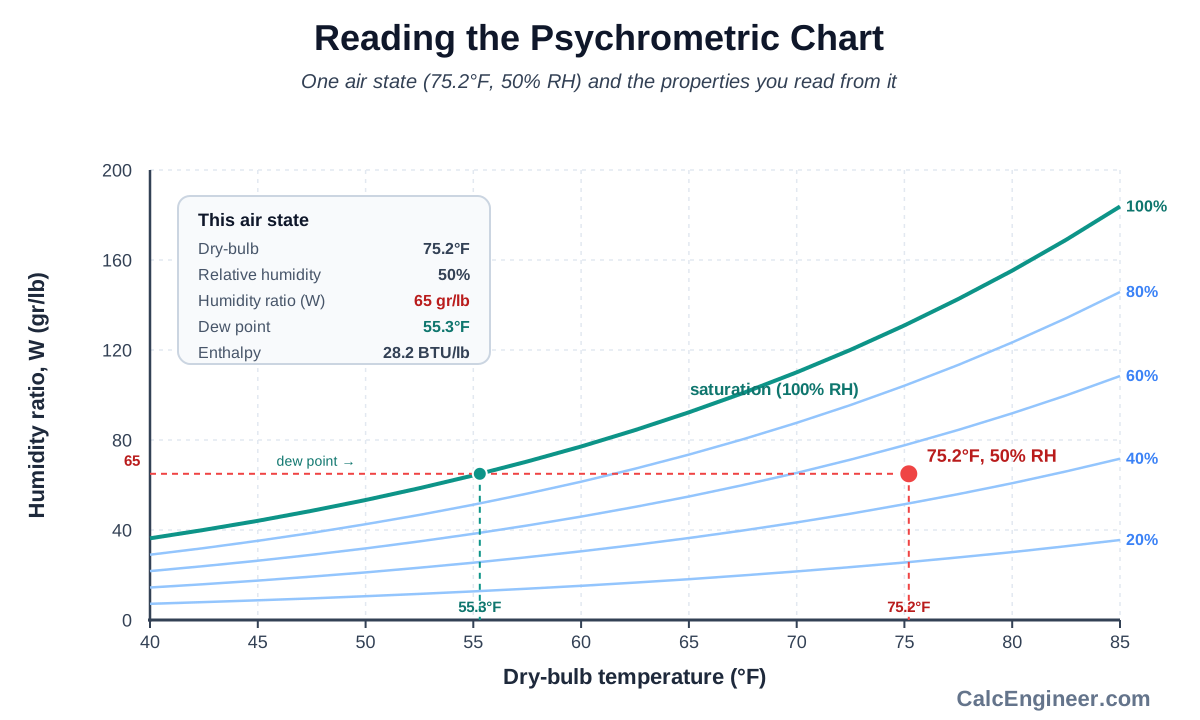
- Dry-Bulb Temperature = 24 °C (75.2 °F)
- Relative Humidity = 50%
Step 1: Saturation vapor pressure
p_ws = 0.61094 × exp(17.625 × 24 / (24 + 243.04))
p_ws ≈ 2.98 kPa
Step 2: Actual vapor pressure
p_w = 0.50 × 2.98 = 1.49 kPa
Step 3: Humidity ratio
W = 0.62198 × 1.49 / (101.325 − 1.49)
W ≈ 0.0093 kg/kg dry air (≈ 65 grains/lb)
Step 4: Dew point
T_dp = 243.04 × ln(1.49 / 0.61094) / (17.625 − ln(1.49 / 0.61094))
T_dp ≈ 12.9 °C (55.3 °F)
Step 5: Enthalpy
h = 1.006(24) + 0.0093(2501 + 1.86 × 24)
h ≈ 47.8 kJ/kg dry air (28.2 BTU/lb)
Result: At 24 °C and 50% RH, the calculated dew point is about 12.9 °C. Condensation is unlikely on surfaces warmer than this dew point, but actual risk depends on the coldest surface temperature in the space.
Standards & References
- ASHRAE Handbook — Fundamentals — psychrometric properties and moist-air calculations
- ASHRAE Standard 55 — thermal environmental conditions for human occupancy (comfort zone guidance)
- ASHRAE Psychrometric Charts — standard reference charts at sea-level atmospheric pressure
- Engineering ToolBox — psychrometric property references and calculation methods
- NOAA / Weather Service — vapor pressure and dew point calculation references
Limitations
- This calculator operates at standard atmospheric pressure (101.325 kPa / 29.92 in Hg) only. It does not apply elevation or barometric pressure correction.
- It uses the Magnus-type saturation vapor pressure equation, which is an approximation. ASHRAE's more rigorous formulations may differ slightly at extreme temperatures.
- The calculator does not model air mixing between two streams, adiabatic saturation, coil bypass factor, or full process-line plotting.
- Results are most accurate in the HVAC-relevant temperature range (approximately −10 °C to 50 °C / 14 °F to 122 °F). Outside this range, accuracy decreases.
- The enthalpy formula is the standard HVAC approximation for moist air and may differ slightly from more rigorous thermodynamic calculations at extreme conditions.
- This is a screening and state-property tool, not a full psychrometric process simulator.
Common Mistakes to Avoid
- Assuming relative humidity alone describes moisture severity — in HVAC, dew point and humidity ratio are often more useful for condensation and latent-load decisions.
- Using psychrometric values without checking barometric pressure — standard psychrometric charts assume standard atmospheric conditions.
- Confusing humidity ratio with relative humidity — humidity ratio is an absolute measure (mass of water per mass of dry air), while RH is relative to saturation at the current temperature.
- Forgetting that RH changes with temperature even when moisture content stays constant — warming air lowers RH, cooling air raises RH.
- Not accounting for altitude when using psychrometric data at elevations significantly above sea level.
- Using wet-bulb temperature interchangeably with dew point — they are different properties and only equal at 100% RH.
Frequently Asked Questions
What does this Psychrometric Calculator calculate?
What formula does this calculator use?
Is this calculator based on dry-bulb and wet-bulb?
What is dew point?
Why is humidity ratio useful in HVAC?
Is this the same as a full ASHRAE psychrometric tool?
Can I use this to check condensation risk?
Does altitude affect psychrometric calculations?
Frequently Used Together
Engineers often use these calculators in combination for complete project workflows:
Related Calculators
Explore similar calculators that might be useful for your project:
Free HVAC Quick Reference. Formulas & Checks.
Airflow, loads, refrigerant & duct checks — one printable page for the job site.
- Key formulas for airflow, load, refrigerant charge & duct sizing
- Quick sanity checks for the most common HVAC design errors
- Printable one-pager for field use and design review
No spam. Unsubscribe any time.
Calculate
Air temperature measured by a standard thermometer
Ratio of actual vapor pressure to saturation vapor pressure at the same temperature