Enthalpy Calculator
On this page
Calculate
Dry-bulb temperature of the air state point
Relative humidity of the air (0–100%)
Overview
Specific enthalpy is the total heat content of moist air per unit mass of dry air — the sum of sensible heat carried by the air-vapor mixture and latent heat bound in the water vapor. It is the single most important quantity in HVAC coil design, because the load on any heating or cooling coil is determined entirely by the enthalpy difference between entering and leaving air multiplied by the mass flow rate through the coil.
Every psychrometric process in an air handling unit moves air from one enthalpy state to another. Cooling and dehumidification drops both dry-bulb temperature and humidity ratio, reducing enthalpy significantly. Sensible cooling alone reduces enthalpy without removing moisture. Humidification adds latent enthalpy at nearly constant sensible enthalpy. Heating adds sensible enthalpy at constant humidity ratio. In each case, the magnitude of the process is defined by Δh — the enthalpy difference between the two state points — not by temperature change alone.
This calculator implements the ASHRAE enthalpy formulation for moist air in both Imperial and Metric unit systems. It operates in two modes: single state point mode, which computes total enthalpy, sensible component, latent component, and sensible heat ratio for one air condition; and two state point mode, which computes the enthalpy difference, component breakdown, SHR, and total coil load when airflow is provided.
The humidity ratio input required for enthalpy can be derived from relative humidity, wet-bulb temperature, dew point temperature, or entered directly. All moisture input paths use the Magnus approximation for saturation pressure and the standard ASHRAE humidity ratio formula, consistent with the psychrometric equations used across this calculator suite.
How to Use This Calculator
Select operating mode — choose from Single State Point, Two State Points.
Enter dry-bulb temperature — in °C or °F.
Select moisture input type — choose from RH, humidity ratio, wet-bulb, or dew point.
Enter relative humidity — in %.
Enter humidity ratio — in g/kg or gr/lb.
Enter wet-bulb temperature — in °C or °F.
Enter dew point temperature — in °C or °F.
Enter state point 2 — dry-bulb temperature — in °C or °F.
Select state point 2 — moisture input type — choose from Relative Humidity, Humidity Ratio, Wet-Bulb Temperature.
Enter state point 2 — relative humidity — in %.
Enter state point 2 — humidity ratio — in g/kg or gr/lb.
Enter state point 2 — wet-bulb temperature — in °C or °F.
Enter state point 2 — dew point temperature — in °C or °F.
Enter airflow (optional) — in m³/h or CFM.
Click "Calculate" — get specific enthalpy, sensible and latent components, SHR, and (in two-point mode) enthalpy difference and coil load.
Use Δh × airflow for coil load, and compare SHR against equipment-rated SHR at entering conditions.
Inputs & Outputs
Inputs
Outputs
Formula
Calculator Formulas
All calculations assume standard atmospheric pressure:
- Imperial: P_atm = 14.696 psi
- Metric: P_atm = 101.325 kPa
Humidity Ratio from Relative Humidity
Saturation pressure (Magnus approximation):
Metric:   P_sat = 0.61078 × exp(17.625 × T / (243.04 + T))   [kPa]
Imperial: P_sat = 0.08855 × exp(17.625 × Tc / (243.04 + Tc))  [psi]
          where Tc = (T_°F − 32) / 1.8
Note: 0.08855 = 0.61078 × 0.1450377 (base Magnus constant × kPa-to-psi conversion). The conversion factor 0.1450377 is not itself the Imperial constant — substituting it raises P_sat by 64% and every downstream humidity ratio with it.
Vapor pressure:
P_v = (RH / 100) × P_sat
Humidity ratio:
Imperial: W = 4350 × P_v / (P_atm − P_v)    [gr/lb]
Metric:   W = 621.945 × P_v / (P_atm − P_v) [g/kg]
Humidity Ratio from Dew Point
At its dew point the air is saturated, so the partial vapor pressure equals the saturation pressure evaluated at T_dp:
P_v = P_sat(T_dp)
The humidity ratio then follows from the same expression as above. Relative humidity plays no part in this route — dew point fixes the moisture content on its own.
Humidity Ratio from Wet-Bulb
The wet-bulb route solves the ASHRAE adiabatic saturation energy balance rather than subtracting a fixed depression coefficient:
Imperial (T in °F, W in gr/lb):
  W_sat_wb = 4350 × P_sat(T_wb) / (P_atm − P_sat(T_wb))
  W = 7000 × [ (1093 − 0.556 × T_wb) × (W_sat_wb / 7000) − 0.240 × (T_db − T_wb) ]
              / (1093 + 0.444 × T_db − T_wb)

Metric (T in °C, W in g/kg):
  W_sat_wb = 621.945 × P_sat(T_wb) / (P_atm − P_sat(T_wb))
  W = 1000 × [ (2501 − 2.326 × T_wb) × (W_sat_wb / 1000) − 1.006 × (T_db − T_wb) ]
              / (2501 + 1.86 × T_db − 4.186 × T_wb)
Each group of constants is a physical quantity rather than a fitted number. The first bracket is the latent heat of vaporization taken at the wet-bulb temperature, the middle term is the sensible heat the air gives up to drive that evaporation, and the denominator is the enthalpy of vapor at the dry-bulb temperature less the enthalpy of make-up water at the wet-bulb temperature.
Linearizing this balance gives the familiar shortcut W ≈ W_sat(T_wb) − c × (T_db − T_wb), with c ≈ 1.58 gr/lb per °F or 0.407 g/kg per °C. That coefficient is a function of both temperatures, not a constant, so the calculator evaluates the full balance and the shortcut error disappears across the whole range.
Enthalpy (Single State Point)
Imperial (T_db in °F, W in gr/lb, h in BTU/lb dry air):
h = 0.240 × T_db + (W / 7000) × (1061 + 0.444 × T_db)
- Sensible: h_s = 0.240 × T_db
- Latent: h_l = (W / 7000) × (1061 + 0.444 × T_db)
- Note: W / 7000 converts gr/lb to lb/lb
Metric (T_db in °C, W in g/kg, h in kJ/kg dry air):
h = 1.006 × T_db + (W / 1000) × (2501 + 1.86 × T_db)
- Sensible: h_s = 1.006 × T_db
- Latent: h_l = (W / 1000) × (2501 + 1.86 × T_db)
- Note: W / 1000 converts g/kg to kg/kg
Sensible Heat Ratio:
SHR = h_s / h × 100 [%]
Enthalpy Difference (Two State Points)
Δh = h₁ − h₂
Δh_s = 0.240 × (T_db1 − T_db2)   [Imperial]
Δh_s = 1.006 × (T_db1 − T_db2)   [Metric]
Δh_l = h_l1 − h_l2
SHR = Δh_s / Δh × 100   [%]
Total Coil Load (if airflow provided)
Imperial:
Q = 4.5 × CFM × Δh   [BTU/h]
Q_s = 1.1 × CFM × ΔT_db   [BTU/h]
Q_l = Q − Q_s   [BTU/h]
(4.5 = 60 min/h × 0.075 lb/ft³ standard air density)
Metric:
Q = (m³/h × Δh × 1.2) / 3600   [kW]
Q_s = (m³/h × 1.2 × 1.006 × ΔT_db) / 3600   [kW]
Q_l = Q − Q_s   [kW]
(1.2 kg/m³ = standard air density at ~20°C; divide by 3600 to convert kJ/h to kW)
Variable Reference
| Variable | Meaning | Units |
|---|---|---|
| T_db | Dry-bulb temperature | °F / °C |
| W | Humidity ratio | gr/lb / g/kg |
| h | Specific enthalpy | BTU/lb / kJ/kg |
| h_s | Sensible enthalpy component | BTU/lb / kJ/kg |
| h_l | Latent enthalpy component | BTU/lb / kJ/kg |
| SHR | Sensible heat ratio | % |
| Δh | Enthalpy difference | BTU/lb / kJ/kg |
| Q | Total coil load | BTU/h / kW |
| Q_s | Sensible coil load | BTU/h / kW |
| Q_l | Latent coil load | BTU/h / kW |
| P_atm | Standard atmospheric pressure | 14.696 psi / 101.325 kPa |
What is Enthalpy in HVAC
Specific enthalpy of moist air is the total thermodynamic energy content of a unit mass of dry air together with the water vapor it carries. In HVAC engineering it is expressed per unit mass of dry air — not per unit mass of the moist air mixture — because the mass of dry air remains constant through heating, cooling, humidification, and dehumidification processes while the mass of water vapor changes.
Enthalpy combines two physically distinct forms of energy: sensible heat, which is associated with the temperature of the air-vapor mixture and is measurable with a thermometer; and latent heat, which is the energy required to evaporate the water vapor and is not measurable by temperature alone. This distinction is critical in HVAC design because sensible and latent loads impose different demands on cooling equipment.
Main Sources of Enthalpy in HVAC Systems
- Sensible heat — temperature-driven energy from solar gains, conduction, occupants, lighting, and equipment
- Latent heat — moisture-driven energy from occupants, infiltration, ventilation, and process loads
- Mixed air — combination of outdoor and return air enthalpies entering the coil
- Supply air — conditioned air leaving the coil at design temperature and humidity
Why Enthalpy Calculation Matters
Enthalpy calculation is the foundation of HVAC coil sizing. The load on any heating or cooling coil is determined entirely by the enthalpy difference between entering and leaving air multiplied by the mass flow rate. Temperature difference alone does not capture the latent load — a coil that is correctly sized for sensible capacity but incorrectly sized for the latent fraction will fail to maintain acceptable indoor humidity.
Typical Enthalpy Ranges
| Condition | Imperial (BTU/lb) | Metric (kJ/kg) |
|---|---|---|
| Winter outdoor air (0°F / −18°C, 10% RH) | ~1 | ~−16 |
| Cooling supply air (55°F / 13°C, 90% RH) | ~22 | ~34 |
| Comfort room air (75°F / 24°C, 50% RH) | ~28 | ~48 |
| Summer outdoor, temperate (90°F / 32°C, 50% RH) | ~42 | ~98 |
| Summer outdoor, hot-humid (95°F / 35°C, 60% RH) | ~52 | ~121 |
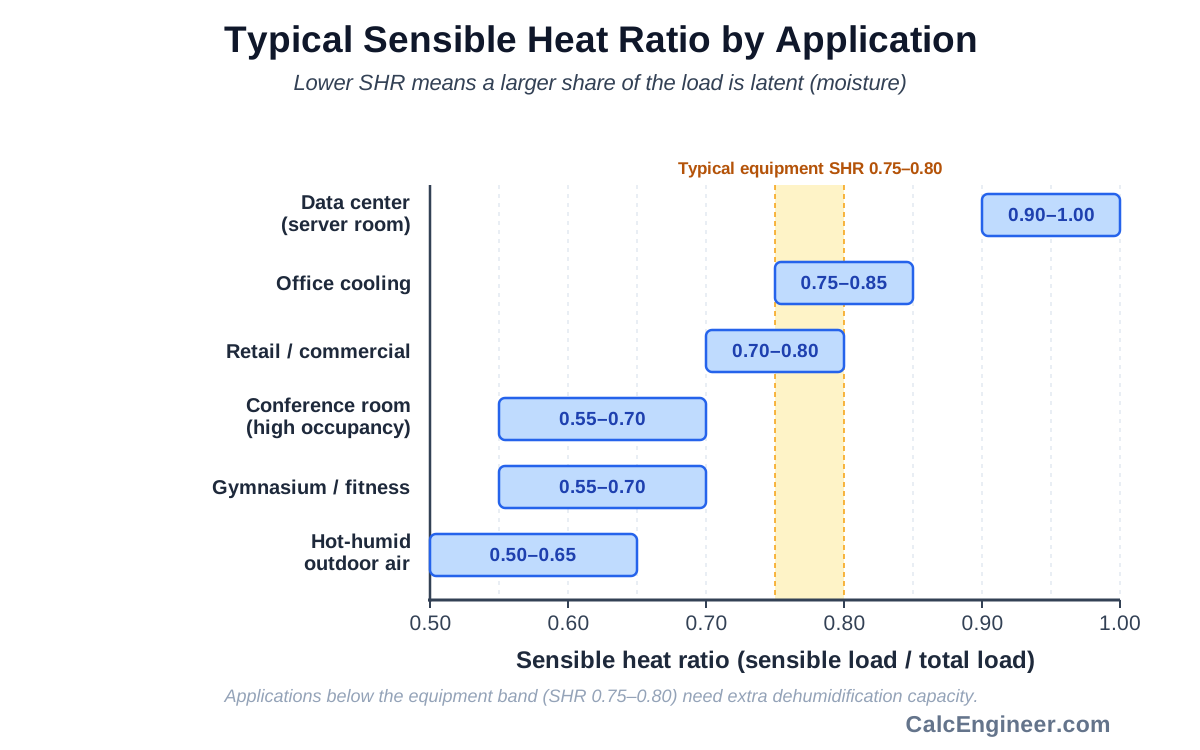
Typical SHR by Application
| Application | SHR Range |
|---|---|
| Office cooling (moderate humidity) | 0.75–0.85 |
| Retail / commercial | 0.70–0.80 |
| Conference room (high occupancy) | 0.55–0.70 |
| Data center / server room | 0.90–1.00 |
| Hot-humid outdoor air cooling | 0.50–0.65 |
| Gymnasium / fitness | 0.55–0.70 |
Practical Tips
For cooling coil sizing, always use the enthalpy difference method (Q = 4.5 × CFM × Δh) rather than the sensible-only formula (Q = 1.1 × CFM × ΔT). The sensible-only formula misses the latent load entirely, which can represent 30–50% of total load in humid climates.
For equipment selection, compare the calculated SHR against the manufacturer's rated SHR at actual entering conditions. A mismatch of more than 0.10 between design SHR and equipment SHR indicates potential comfort or humidity control problems.
For energy recovery, the enthalpy difference between outdoor and exhaust air quantifies the total recoverable energy. In hot-humid climates, latent recovery can exceed sensible recovery — making enthalpy-based ERV sizing essential.
HVAC Unit Conversions
| Conversion | Value |
|---|---|
| 1 BTU/lb | 2.326 kJ/kg |
| 1 BTU/h | 0.2931 W |
| 1 ton of refrigeration | 12,000 BTU/h = 3.517 kW |
| 7,000 grains | 1 pound |
| 1 gr/lb | 0.1429 g/kg |
| Standard air density | 0.075 lb/ft³ = 1.2 kg/m³ |
Key Facts
- The enthalpy formula h = 0.240 × T_db + (W / 7000) × (1061 + 0.444 × T_db) requires W in gr/lb to be divided by 7,000 to convert to lb/lb before the latent term is applied. Omitting this division produces values 7,000 times too large — the most common manual calculation error with Imperial enthalpy.
- Enthalpy is referenced to 0°F (Imperial) or 0°C (Metric) for dry air with zero moisture content. At 0°C and W = 0, h = 0 kJ/kg by definition. Negative enthalpy values are physically valid and occur for cold dry air below these reference temperatures.
- The coil load formula Q = 4.5 × CFM × Δh (Imperial) assumes standard air density of 0.075 lb/ft³. At 5,000 ft elevation, actual density is approximately 0.062 lb/ft³ — the correct factor becomes approximately 3.72 instead of 4.5.
- Sensible heat ratio (SHR) is the ratio of sensible load to total load. Cooling equipment is rated at specific SHR conditions — typically 0.75–0.80 for standard commercial equipment.
- The latent heat of vaporization at 0°C is 2,501 kJ/kg (1,061 BTU/lb). It decreases with increasing temperature — the ASHRAE enthalpy formula captures this variation through the temperature-dependent term.
- Enthalpy difference is the fundamental driver of energy recovery ventilation performance. An ERV with 70% total effectiveness recovers 70% of the enthalpy difference between outdoor and exhaust air — a much larger energy quantity than sensible recovery alone.
Applications
- Cooling coil load calculation — total coil load in BTU/h equals 4.5 × CFM × Δh (Imperial) or (m³/h × Δh × 1.2) / 3600 in kW (Metric).
- Cooling coil selection — SHR must match the load to the equipment at actual entering conditions.
- Energy recovery ventilation sizing — total ERV load = airflow × Δh × effectiveness.
- Economizer control logic — differential enthalpy economizer control compares outdoor air enthalpy to return air enthalpy.
- Psychrometric process line plotting — enthalpy at each process endpoint defines the process on a psychrometric chart.
- Equipment performance verification during commissioning — measured Δh × airflow compared against design load.
Example Calculation
Imperial Example — Two State Points, Cooling Coil
State Point 1 (Entering Air — Mixed OA/RA):
- T_db1 = 80°F, RH1 = 55%
State Point 2 (Leaving Air — Supply Air):
- T_db2 = 55°F, RH2 = 90%
Airflow: 5,000 CFM
State Point 1:
Tc1 = (80 − 32) / 1.8 = 26.67°C
P_sat1 = 0.08855 × exp(17.625 × 26.67 / (243.04 + 26.67)) = 0.5058 psi
P_v1 = 0.55 × 0.5058 = 0.2782 psi
W1 = 4350 × 0.2782 / (14.696 − 0.2782) = 83.94 gr/lb

h1 = 0.240 × 80 + (83.94 / 7000) × (1061 + 0.444 × 80)
h1 = 19.20 + 0.011991 × 1096.52 = 19.20 + 13.15 = 32.35 BTU/lb
h_s1 = 19.20 BTU/lb
h_l1 = 13.15 BTU/lb
State Point 2:
Tc2 = (55 − 32) / 1.8 = 12.78°C
P_sat2 = 0.08855 × exp(17.625 × 12.78 / (243.04 + 12.78)) = 0.2136 psi
P_v2 = 0.90 × 0.2136 = 0.1922 psi
W2 = 4350 × 0.1922 / (14.696 − 0.1922) = 57.65 gr/lb

h2 = 0.240 × 55 + (57.65 / 7000) × (1061 + 0.444 × 55)
h2 = 13.20 + 0.008236 × 1085.42 = 13.20 + 8.94 = 22.14 BTU/lb
h_s2 = 13.20 BTU/lb
h_l2 = 8.94 BTU/lb
Enthalpy Difference:
Δh = 32.35 − 22.14 = 10.21 BTU/lb
Δh_s = 0.240 × (80 − 55) = 6.00 BTU/lb
Δh_l = 13.15 − 8.94 = 4.21 BTU/lb
SHR = 6.00 / 10.21 × 100 = 58.8%
Coil Load:
Q = 4.5 × 5,000 × 10.21 = 229,725 BTU/h
Q_s = 1.1 × 5,000 × 25 = 137,500 BTU/h
Q_l = 229,725 − 137,500 = 92,225 BTU/h

Metric Example — Two State Points, Cooling Coil
State Point 1: T_db1 = 27°C, RH1 = 55% State Point 2: T_db2 = 13°C, RH2 = 90% Airflow: 8,500 m³/h
State Point 1:
P_sat1 = 0.61078 × exp(17.625 × 27 / (243.04 + 27)) = 3.558 kPa
P_v1 = 0.55 × 3.558 = 1.957 kPa
W1 = 621.945 × 1.957 / (101.325 − 1.957) = 12.25 g/kg

h1 = 1.006 × 27 + (12.25 / 1000) × (2501 + 1.86 × 27)
h1 = 27.16 + 0.01225 × 2551.22 = 27.16 + 31.25 = 58.41 kJ/kg
State Point 2:
P_sat2 = 0.61078 × exp(17.625 × 13 / (243.04 + 13)) = 1.495 kPa
P_v2 = 0.90 × 1.495 = 1.345 kPa
W2 = 621.945 × 1.345 / (101.325 − 1.345) = 8.37 g/kg

h2 = 1.006 × 13 + (8.37 / 1000) × (2501 + 1.86 × 13)
h2 = 13.08 + 0.00837 × 2525.18 = 13.08 + 21.13 = 34.21 kJ/kg
Enthalpy Difference:
Δh = 58.41 − 34.21 = 24.20 kJ/kg
Δh_s = 1.006 × (27 − 13) = 14.08 kJ/kg
Δh_l = 31.25 − 21.13 = 10.12 kJ/kg
SHR = 14.08 / 24.20 × 100 = 58.2%
Coil Load:
Q = (8,500 × 24.20 × 1.2) / 3600 = 68.57 kW
Q_s = (8,500 × 1.2 × 1.006 × 14) / 3600 = 39.90 kW
Q_l = 68.57 − 39.90 = 28.67 kW
Wet-Bulb Moisture Input
Imperial — T_db = 80°F, T_wb = 67°F (the AHRI standard indoor cooling rating condition)
Tc_wb = (67 − 32) / 1.8 = 19.44°C
P_sat(T_wb) = 0.08855 × exp(17.625 × 19.44 / (243.04 + 19.44)) = 0.3268 psi
W_sat_wb = 4350 × 0.3268 / (14.696 − 0.3268) = 98.92 gr/lb

Numerator   = (1093 − 0.556 × 67) × (98.92 / 7000) − 0.240 × (80 − 67)
            = 1055.75 × 0.014131 − 3.12 = 14.92 − 3.12 = 11.80
Denominator = 1093 + 0.444 × 80 − 67 = 1061.52

W = 7000 × 11.80 / 1061.52 = 77.81 gr/lb

h = 0.240 × 80 + (77.81 / 7000) × (1061 + 0.444 × 80)
h = 19.20 + 12.19 = 31.39 BTU/lb
Route check: 80°F at 51% RH is the same air state. Entered through the relative humidity route it returns 77.72 gr/lb, a 0.1% difference — the two inputs land on one point of the psychrometric chart.
Metric — T_db = 27°C, T_wb = 19.5°C
P_sat(T_wb) = 0.61078 × exp(17.625 × 19.5 / (243.04 + 19.5)) = 2.2616 kPa
W_sat_wb = 621.945 × 2.2616 / (101.325 − 2.2616) = 14.20 g/kg

Numerator   = (2501 − 2.326 × 19.5) × (14.20 / 1000) − 1.006 × (27 − 19.5)
            = 2455.64 × 0.01420 − 7.55 = 34.87 − 7.55 = 27.32
Denominator = 2501 + 1.86 × 27 − 4.186 × 19.5 = 2469.59

W = 1000 × 27.32 / 2469.59 = 11.06 g/kg

h = 1.006 × 27 + (11.06 / 1000) × (2501 + 1.86 × 27)
h = 27.16 + 28.22 = 55.38 kJ/kg
Route check: the same state entered as 27°C at 49.8% RH returns 11.07 g/kg, a 0.06% difference.
Standards & References
- ASHRAE Handbook — Fundamentals (2021), Chapter 1: Psychrometrics — Primary reference for the enthalpy formulations used on this page
- ASHRAE Handbook — Fundamentals (2021), Chapter 18 — Defines the coil load formula Q = 4.5 × CFM × Δh based on standard air density
- AHRI Standard 210/240-2023 — Performance rating conditions at which manufacturer SHR data is published
- AHRI Standard 550/590-2023 — Chilled water coil rating conditions for two-state-point enthalpy calculations
- ASHRAE Standard 90.1-2022 — Energy recovery ventilation thresholds based on outdoor air enthalpy
- Magnus Formula (Alduchov-Eskridge, 1996) — Saturation vapor pressure approximation used for humidity ratio derivation
Limitations
- The coil load formulas assume standard air density — 0.075 lb/ft³ (Imperial) and 1.2 kg/m³ (Metric). At 5,000 ft elevation, air density is approximately 17% lower and the Imperial factor drops from 4.5 to approximately 3.72.
- The enthalpy formula treats specific heat of dry air and water vapor as constants: 0.240 BTU/lb·°F (1.006 kJ/kg·°C) for dry air and 0.444 BTU/lb·°F (1.86 kJ/kg·°C) for water vapor. These are accurate across the HVAC operating range but introduce small errors at temperature extremes.
- This calculator operates at standard atmospheric pressure (14.696 psi / 101.325 kPa) only. It does not account for variations in barometric pressure due to altitude or weather.
- Two-state-point mode computes Δh as a simple difference h1 − h2. It does not verify whether the process is physically achievable on a specific equipment type.
- The wet-bulb route solves the ASHRAE adiabatic saturation balance in its above-freezing form, which carries the latent heat of liquid water. Below 32°F (0°C) the wick freezes and the sublimation form of the balance applies, so results in that region should be read as indicative rather than exact.
Common Mistakes to Avoid
- Entering W in gr/lb without applying the 7,000 divisor in the Imperial enthalpy formula. The correct calculation is h = 0.240 × T_db + (W / 7000) × (1061 + 0.444 × T_db). Without dividing W by 7,000, the latent term is 7,000 times too large.
- Using total supply airflow instead of outdoor airflow for enthalpy-based ventilation energy calculations. The enthalpy of mixed air (return plus outdoor) is the correct entering condition for a coil load calculation.
- Confusing SHR at design conditions with SHR at rated conditions. Manufacturers publish equipment SHR at standard ARI/AHRI test conditions. If design entering conditions differ significantly, the equipment SHR at actual conditions must be obtained from the manufacturer's performance data.
- Treating Δh as always positive. In a heating process, h_leaving > h_entering, so Δh = h1 − h2 is negative. Always confirm which state point is entering and which is leaving before interpreting the sign of Δh.
- Using the 4.5 multiplier for non-standard density conditions. The factor 4.5 = 60 min/h × 0.075 lb/ft³ is valid at sea-level standard conditions only. At high altitude, the actual density must be calculated and substituted.
- Forgetting that enthalpy is referenced to dry air mass, not moist air mass. When converting between mass flow and volumetric flow, specific volume (ft³/lb dry air) must be used correctly.
- Substituting the kPa-to-psi conversion factor 0.1450377 for the Imperial Magnus constant. The Imperial saturation pressure constant is 0.08855 = 0.61078 × 0.1450377. Using the conversion factor on its own raises P_sat by 64%, and the humidity ratio, the latent enthalpy term and the coil load all inherit that error.
- Carrying a fixed wet-bulb depression coefficient across unit systems without rescaling it. Converting g/kg per °C to gr/lb per °F takes a factor of 7 / 1.8 = 3.889, so 0.407 g/kg·°C pairs with 1.58 gr/lb·°F. If a metric and an Imperial coefficient do not stand in that ratio, at least one of them is wrong.
Frequently Asked Questions
What is the difference between sensible heat and latent heat in HVAC?
Why is enthalpy expressed per pound of dry air rather than per pound of moist air?
What does the factor 4.5 mean in the Imperial coil load formula?
What is sensible heat ratio and how do I use it for equipment selection?
How do I calculate enthalpy for a mixed air condition?
When does the latent component of enthalpy exceed the sensible component?
Is this calculator valid for heating applications as well as cooling?
How does enthalpy relate to energy recovery ventilation sizing?
Frequently Used Together
Engineers often use these calculators in combination for complete project workflows:
Related Calculators
Explore similar calculators that might be useful for your project:
Free HVAC Quick Reference. Formulas & Checks.
Airflow, loads, refrigerant & duct checks — one printable page for the job site.
- Key formulas for airflow, load, refrigerant charge & duct sizing
- Quick sanity checks for the most common HVAC design errors
- Printable one-pager for field use and design review
No spam. Unsubscribe any time.
Calculate
Dry-bulb temperature of the air state point
Relative humidity of the air (0–100%)