Cold Storage Door Infiltration Calculator
On this page
Calculate
Inside cold storage temperature
Outdoor dry-bulb temperature
Outdoor relative humidity
Number of door openings per hour
Average seconds the door stays open each time
Overview
The Cold Storage Door Infiltration Calculator estimates the heat gain caused by warm, humid outside air entering a refrigerated space through an open door. This infiltration load is often one of the largest components of the total refrigeration load, especially in high-traffic freezers and coolers.
The calculator uses the ASHRAE door infiltration model (based on air density difference, door geometry, and opening duration) to compute sensible, latent, and total heat gain. It also accounts for door protection methods such as strip curtains, air curtains, and vestibules.
Accurate infiltration load estimation is essential for sizing refrigeration equipment, avoiding temperature pull-down issues, and reducing energy waste in cold storage facilities.
How to Use This Calculator
Enter door dimensions – width and height in ft or m.
Enter room temperature – inside cold storage temperature (°F or °C).
Enter outside conditions – outdoor dry-bulb temperature and relative humidity (%).
Enter door usage – number of openings per hour and average open time per opening (seconds).
Select protection method – None, Strip Curtain, Air Curtain (Unheated), Air Curtain (Heated), or Vestibule + Air Curtain.
Click "Calculate" – obtain infiltration heat load (total, sensible, latent) and air mass flow.
Use the result to size refrigeration equipment and evaluate door protection effectiveness.
Inputs & Outputs
Inputs
Outputs
Formula
Calculator Formula
The calculator follows the ASHRAE buoyancy-driven doorway infiltration model (Gosney and Olama), written here in terms of air mass flow.
Air mass flow rate (based on density difference and door area)
m_dot = (1/3) * C_d * A * rho_mean * sqrt(g * H * |rho_room - rho_out| / rho_mean) * F_protected * D_f
The 1/3 is not a safety factor - it falls out of integrating the buoyancy velocity profile over the upper half of the doorway, which is the half through which warm air enters:
v(y)  = sqrt(2 * g * y * |rho_room - rho_out| / rho_mean)
V_dot = C_d * W * integral[0 to H/2] v(y) dy
      = C_d * W * sqrt(2 * g * |rho_room - rho_out| / rho_mean) * (2/3) * (H/2)^1.5
      = (1/3) * C_d * A * sqrt(g * H * |rho_room - rho_out| / rho_mean)
Where:
- A = door area (ft2 or m2)
- rho = air density (lb/ft3 or kg/m3) from temperature using ideal gas law
- g = gravitational constant (32.174 ft/s2 or 9.81 m/s2)
- H = door height (ft or m)
- W = door width (ft or m)
- C_d = discharge coefficient (approx 0.65)
- F_protected = fraction of time door is open x protection factor
- D_f = doorway flow factor
Fraction of time open:
F_open = (openings per hour * open time per opening) / 3600
F_protected = F_open * protection_factor
Doorway flow factor:
The buoyancy equation above describes fully established two-way flow. A real door opened for 10-20 seconds never reaches that steady state, so ASHRAE applies a doorway flow factor. The calculator selects it automatically from the entered temperatures:
|T_outside - T_room| >  20 degF (11 degC)  ->  D_f = 0.8
|T_outside - T_room| <= 20 degF (11 degC)  ->  D_f = 1.1
This is a step, not a blend - it is published as a step, and results jump at the threshold accordingly.
Total infiltration heat load:
Q_total = Q_sensible + Q_latent
Sensible heat load:
Q_sensible = m_dot * Cp * |T_outside - T_room|
Latent heat load:
Q_latent = m_dot * h_v * |W_outside - W_room|
Where W = humidity ratio (kg/kg or lb/lb) and h_v = latent heat of vaporization.
Protection Method Correction Factors
| Protection Method | Factor (1 = fully open) | Implied effectiveness E |
|---|---|---|
| None | 1.0 | 0% |
| Strip Curtain | 0.6 | 40% |
| Air Curtain (Unheated) | 0.4 | 60% |
| Air Curtain (Heated) | 0.3 | 70% |
| Vestibule + Air Curtain | 0.15 | 85% |
Source note: the airflow model above follows ASHRAE; these protection factors do not. They are typical in-service values for doors of unknown age and maintenance state. ASHRAE Handbook - Refrigeration (2022), Ch. 24, reports effectiveness of 95% or better for new or well-maintained strip and fast-fold doors, decaying toward roughly 80% for freezer doorways in service - noticeably better than the table above. Use the ASHRAE figures for a new installation with documented maintenance, and the table above for an existing door whose condition you cannot vouch for.
Variable Reference
| Variable | Meaning | Units |
|---|---|---|
| A | Door area | m2 / ft2 |
| rho | Air density | kg/m3 / lb/ft3 |
| C_d | Discharge coefficient | dimensionless |
| g | Gravitational acceleration | m/s2 / ft/s2 |
| H | Door height | m / ft |
| F_open | Fraction of time door is open | dimensionless |
| D_f | Doorway flow factor (0.8 or 1.1) | dimensionless |
| Cp | Specific heat of air | J/(kgK) / BTU/(lbF) |
| h_v | Latent heat of vaporization | J/kg / BTU/lb |
| W | Humidity ratio | kg/kg / lb/lb |
What is Cold Storage Door Infiltration?
Every time a door to a cold room or freezer opens, warm, humid outside air rushes in because of density differences. This air must be cooled and dehumidified by the refrigeration system, adding a significant load. In high-traffic facilities, infiltration can account for 30-60% of the total refrigeration load, often exceeding the load from product cooling or envelope gains.
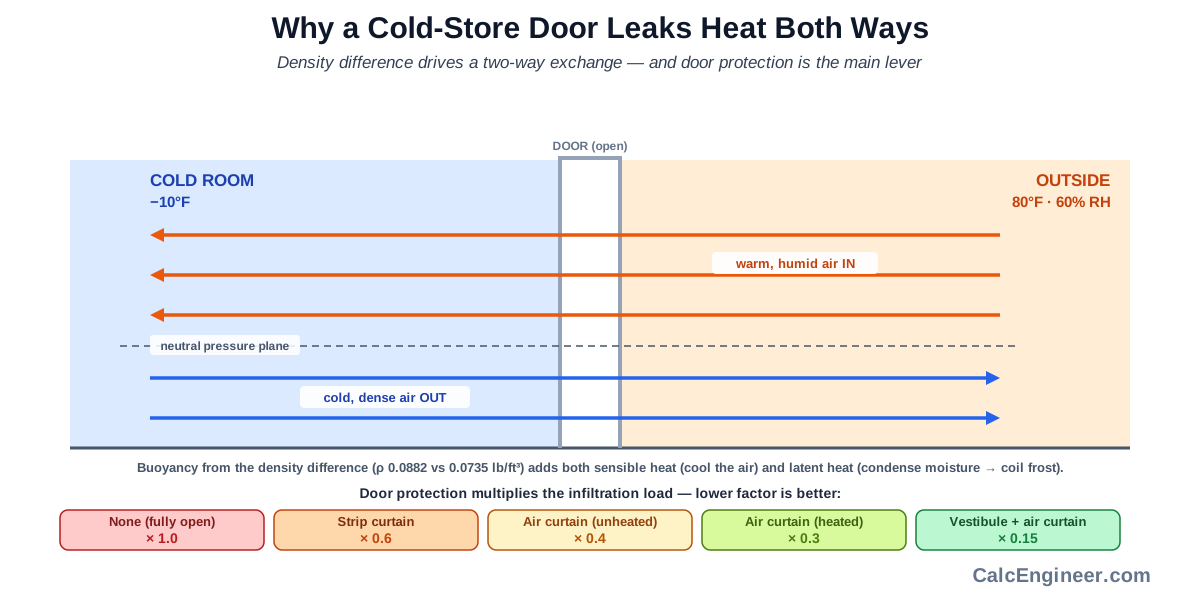
The infiltration load is composed of:
- Sensible heat - cooling the warm air down to room temperature.
- Latent heat - condensing moisture from the incoming air (which can also cause frost on evaporator coils).
Why Infiltration Load Matters
Accurate infiltration load estimation is the foundation of proper refrigeration system sizing for cold storage facilities. An undersized system cannot maintain target temperatures during peak traffic, while an oversized system wastes capital and energy. Infiltration also directly impacts evaporator coil frosting, defrost frequency, and product quality.
Door Protection Methods
Several protection methods can significantly reduce infiltration:
- Strip curtains reduce infiltration by 30-50% by creating a physical barrier of overlapping plastic strips.
- Air curtains (unheated) blow a high-velocity air stream across the doorway, reducing infiltration by 50-70%.
- Air curtains (heated) add warmth to prevent condensation and icing at the threshold, achieving 60-80% reduction.
- Vestibules (airlocks with two doors) combined with air curtains can reduce infiltration by 80-90%.
These ranges describe typical in-service performance and are what the calculator's protection factors are built on. ASHRAE reports higher effectiveness - 95% or better - for new or well-maintained strip and fast-fold doors, so a recently commissioned installation may comfortably beat these figures. The airflow model itself follows ASHRAE; the protection factors are field-typical values from a different source.
Factors Affecting Infiltration
The key factors that determine infiltration heat load include:
- Temperature difference - larger delta-T between inside and outside creates stronger buoyancy-driven airflow.
- Door size - larger doors allow more air exchange per opening.
- Opening frequency and duration - more openings and longer open times increase total infiltration.
- Humidity - high outdoor humidity dramatically increases latent load.
- Protection method - effective door protection is the most practical way to reduce infiltration.
HVAC Unit Conversions
| Unit | Equivalent |
|---|---|
| 1 W | 3.412 BTU/hr |
| 1 kW | 3,412 BTU/hr |
| 1 ton cooling | 12,000 BTU/hr |
| 1 BTU/hr | 0.293 W |
Practical Tips
For high-traffic facilities, consider automatic rapid-roll doors that minimize open time. A door that closes in 3 seconds instead of 15 seconds reduces infiltration by approximately 80%.
For humid climates, pay special attention to latent load. In tropical regions, latent infiltration can exceed sensible infiltration, causing excessive frost buildup on evaporator coils and increasing defrost energy.
For freezer applications (below 0 deg F / -18 deg C), the density difference between inside and outside air is very large, creating strong buoyancy forces. Multiple protection layers (e.g., strip curtain + air curtain) are often justified.
Important: This calculator provides engineering estimates based on the ASHRAE door infiltration model. Final refrigeration system sizing should account for all load components including transmission, product cooling, internal gains, and equipment heat, in addition to infiltration.
Key Facts
- A single 6 ft x 8 ft (1.8 m x 2.4 m) freezer door at -10 deg F (-23 deg C) with 80 deg F (27 deg C), 60% RH outside adds roughly 9,700 BTU/h (2.8 kW) to the hourly average load for every minute per hour it stands fully open.
- High humidity outside greatly increases latent load - in humid climates, latent infiltration can exceed sensible.
- Strip curtains reduce infiltration by 30-50%, air curtains by 50-70%, and vestibules with air curtains by 80-90%.
- ASHRAE recommends designing for worst-case outside conditions (summer design temperature and humidity).
- Reducing door open time by 50% cuts infiltration load by approximately 50%.
- In high-traffic freezers, infiltration can account for 30-60% of the total refrigeration load.
Applications
- Sizing refrigeration systems for cold storage warehouses, distribution centers, and food processing plants.
- Evaluating energy savings from installing or upgrading door protection (strip curtains, air curtains, vestibules).
- Troubleshooting high refrigeration run-time or temperature pull-down issues.
- Estimating frost load on evaporator coils (latent portion).
- Comparing different protection methods for ROI analysis.
- Designing dock door layouts for cold chain logistics facilities.
Example Calculation
Example Calculation (Imperial)
Given:
- Door width = 6 ft, height = 8 ft, Area = 48 ft2
- Room temp = -10 deg F, outside temp = 80 deg F, RH = 60%
- Openings per hour = 10, open time per opening = 15 s
- Protection method: Strip curtain (factor = 0.6)
Step 1 - Fraction open:
F_open = (10 x 15) / 3600 = 0.0417
F_protected = 0.0417 x 0.6 = 0.025
Step 2 - Air densities (ideal gas law):
rho_room = 2116.22 / (53.35 x 449.67 R) = 0.0882 lb/ft3
rho_out  = 2116.22 / (53.35 x 539.67 R) = 0.0735 lb/ft3
rho_mean = (0.0882 + 0.0735) / 2 = 0.0809 lb/ft3
Step 3 - Doorway flow factor:
|80 - (-10)| = 90 deg F > 20 deg F -> D_f = 0.8
Step 4 - Velocity factor and mass flow:
vel = (1/3) x sqrt(32.174 x 8 x |0.0882 - 0.0735| / 0.0809)
    = (1/3) x sqrt(46.83)
    = (1/3) x 6.84 = 2.28 ft/s
m_dot = 48 x 0.0809 x 0.65 x 2.28 x 0.025 x 0.8 = 0.1150 lb/s
Air mass flow = 0.1150 x 3600 = 414 lb/h
Step 5 - Heat loads:
Sensible = 0.1150 x 0.24 x 90 x 3600           = 8,944 BTU/hr
W_outside = 0.0132 lb/lb  (at 80 deg F, 60% RH)
W_room    = 0.0005 lb/lb  (freezer, -10 deg F)
Latent = 0.1150 x 1076 x |0.0132 - 0.0005| x 3600 = 5,636 BTU/hr
Total = 8,944 + 5,636 = 14,580 BTU/hr
Result: Total infiltration load is approximately 14,580 BTU/hr with strip curtain protection - about 304 BTU/hr per ft2 of door.
Example Calculation (Metric)
Given:
- Door width = 1.8 m, height = 2.4 m, Area = 4.32 m2
- Room temp = -23 deg C, outside temp = 27 deg C, RH = 60%
- Openings per hour = 10, open time per opening = 15 s
- Protection: Strip curtain (factor = 0.6)
Step 1 - Fraction open:
F_open = (10 x 15) / 3600 = 0.0417
F_protected = 0.0417 x 0.6 = 0.025
Step 2 - Air densities (ideal gas law):
rho_room = 101325 / (287.05 x 250.15 K) = 1.411 kg/m3
rho_out  = 101325 / (287.05 x 300.15 K) = 1.176 kg/m3
rho_mean = (1.411 + 1.176) / 2 = 1.294 kg/m3
Step 3 - Doorway flow factor:
|27 - (-23)| = 50 deg C > 11 deg C -> D_f = 0.8
Step 4 - Velocity factor and mass flow:
vel = (1/3) x sqrt(9.81 x 2.4 x |1.411 - 1.176| / 1.294)
    = (1/3) x sqrt(4.278)
    = (1/3) x 2.068 = 0.689 m/s
m_dot = 4.32 x 1.294 x 0.65 x 0.689 x 0.025 x 0.8 = 0.0501 kg/s
Air mass flow = 0.0501 x 3600 = 180 kg/h
Step 5 - Heat loads:
Sensible = 0.0501 x 1006 x 50               = 2,519 W = 2.5 kW
W_outside = 0.0134 kg/kg  (at 27 deg C, 60% RH)
W_room    = 0.0005 kg/kg  (freezer, -23 deg C)
Latent = 0.0501 x 2,501,000 x |0.0134 - 0.0005| = 1,618 W = 1.6 kW
Total = 2,519 + 1,618 = 4,137 W = 4.1 kW
Result: Total infiltration load is approximately 4.1 kW with strip curtain protection. Swapping the strip curtain for an unheated air curtain (factor 0.4) brings it to about 2.8 kW; a heated air curtain (factor 0.3) to about 2.1 kW.
Standards & References
- ASHRAE Handbook — Refrigeration (2022), Ch. 24 — Refrigerated-Facility Loads — infiltration air load through doorways: the Gosney and Olama equation, the doorway flow factor, and door protection effectiveness. This calculator was checked against the 2022 edition; chapter numbers shift between editions, so cite the year.
- ASHRAE Handbook — Fundamentals (2025), Ch. 16 — Ventilation and Infiltration — general infiltration theory, neutral pressure plane, and stack-driven flow.
- International Institute of Ammonia Refrigeration (IIAR) - Cold storage door design guidelines.
- ASHRAE Standard 90.1 - Energy efficiency requirements for refrigerated spaces (door protection).
- ISO 23953-2 - Refrigerated display cabinets - Door infiltration test methods.
Limitations
- The model assumes a steady-state density difference; it does not account for wind effects or dynamic pressure fluctuations.
- The doorway flow factor is applied as the published ASHRAE step: 0.8 above a 20 deg F (11 deg C) temperature difference and 1.1 at or below it. Results change abruptly across that threshold - that is a property of the factor as published, not of your inputs.
- Protection factors are typical in-service values, not ASHRAE design values. ASHRAE reports higher effectiveness for new or well-maintained doors, so this calculator is conservative for a new installation. See the source note under the formula.
- Air curtain effectiveness depends on correct installation (air velocity, angle, nozzle design). The calculator uses average factors.
- For very large doors (> 15 ft / 4.5 m height), more complex models may be needed.
- Does not account for multiple doors opening simultaneously.
- The fraction open method assumes random independent openings; for coordinated traffic patterns, manual adjustment may be needed.
Common Mistakes to Avoid
- Using room temperature in Celsius but outside temperature in Fahrenheit (always keep units consistent).
- Forgetting to convert open time per opening from seconds to hours when computing fraction open.
- Overlooking humidity - using only dry-bulb temperature underestimates total load (latent part can be half the total).
- Assuming an air curtain is 100% effective - it is not; always apply a reduction factor.
- Using standard air density without correcting for cold room temperatures (cold air is denser, which affects flow rate).
Frequently Asked Questions
Why is infiltration load so important in cold storage?
How does an air curtain work?
What is the difference between sensible and latent infiltration load?
How much can a strip curtain reduce infiltration?
What is a vestibule and why does it help?
Can I use this calculator for a walk-in cooler?
How accurate is the ASHRAE door infiltration model?
What should I do if the calculator shows very high infiltration load?
Frequently Used Together
Engineers often use these calculators in combination for complete project workflows:
Related Calculators
Explore similar calculators that might be useful for your project:
Free HVAC Quick Reference. Formulas & Checks.
Airflow, loads, refrigerant & duct checks — one printable page for the job site.
- Key formulas for airflow, load, refrigerant charge & duct sizing
- Quick sanity checks for the most common HVAC design errors
- Printable one-pager for field use and design review
No spam. Unsubscribe any time.
Calculate
Inside cold storage temperature
Outdoor dry-bulb temperature
Outdoor relative humidity
Number of door openings per hour
Average seconds the door stays open each time