Refrigerant Charge Calculator
On this page
Calculate
Refrigerant charge shipped with the outdoor unit (from nameplate or installation manual)
Liquid line length already covered by the factory charge (typically 7.5 m / 25 ft)
Total installed liquid line length from outdoor unit to indoor unit
Inside diameter of the liquid (small) refrigerant line
Density of the liquid-phase refrigerant at the expected condensing temperature
Overview
The Refrigerant Charge Calculator estimates the total refrigerant charge for a split-system air conditioner or heat pump installation. Manufacturers ship outdoor condensing units with a factory refrigerant charge that covers a standard liquid line length. When the actual liquid line set is longer than the factory-included length, additional refrigerant must be added.
This calculator uses one fixed model: it computes the internal volume of the extra liquid line length beyond the factory allowance, multiplies by the liquid refrigerant density to determine the additional charge, and adds it to the factory charge to obtain the total system charge.
Accurate refrigerant charge is critical for system efficiency, compressor longevity, and proper superheat and subcooling. Both undercharging and overcharging degrade performance and can cause compressor damage.
How to Use This Calculator
Enter factory charge — in kg or oz.
Enter factory-included line length — in m or ft.
Enter actual liquid line length — in m or ft.
Select liquid line inside diameter — select your liquid line diameter from the dropdown.
Select liquid refrigerant density — select your refrigerant and condensing temperature from the dropdown.
Click "Calculate" — get extra line length, extra line volume, additional charge, and total system charge.
Add the calculated charge for the extra line length, then verify final charge by superheat (fixed orifice) or subcooling (TXV) at the service ports.
Inputs & Outputs
Inputs
Outputs
Formula
Fixed Liquid-Line Charge Adjustment Model
This page uses one exact path:
Extra Length → Line Volume → Additional Charge → Total System Charge
Step 1: Extra Line Length
L_extra = max(L_actual − L_factory, 0)
| Variable | Meaning | Metric | Imperial |
|---|---|---|---|
| L_extra | Extra liquid line length beyond factory allowance | m | ft |
| L_actual | Actual installed liquid line length | m | ft |
| L_factory | Factory-included liquid line length | m | ft |
Step 2: Extra Line Volume
V = π × (d / 2)² × L_extra
| Variable | Meaning | Units |
|---|---|---|
| V | Internal volume of extra liquid line | m³ |
| d | Liquid line inside diameter | m |
| L_extra | Extra line length | m |
Step 3: Additional Charge
m_add = ρ × V
| Variable | Meaning | Units |
|---|---|---|
| m_add | Additional refrigerant mass | kg |
| ρ | Liquid refrigerant density | kg/m³ |
| V | Extra line volume | m³ |
Step 4: Total System Charge
m_total = m_factory + m_add
| Variable | Meaning | Units |
|---|---|---|
| m_total | Total refrigerant charge | kg / oz |
| m_factory | Factory charge from nameplate | kg / oz |
| m_add | Additional charge for extra line length | kg / oz |
What is Refrigerant Charge
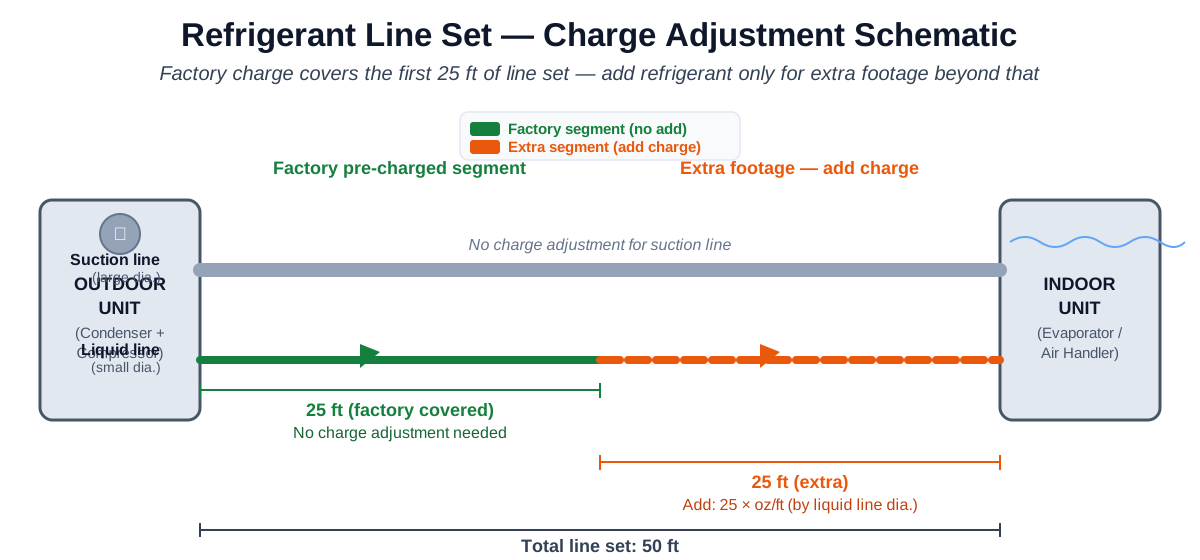
Refrigerant charge is the total mass of refrigerant contained in a refrigeration or air conditioning system. Every split-system air conditioner and heat pump ships from the factory with a pre-measured refrigerant charge in the outdoor condensing unit. This factory charge is designed to cover a standard liquid line length — typically 7.5 m (25 ft) for residential systems.
When the actual installed liquid line set is longer than the factory-included length, additional refrigerant must be added to fill the extra piping. Conversely, if the line set is shorter, the factory charge may be sufficient or even slightly excessive.
Why Correct Charge Matters
Refrigerant charge directly affects system performance, efficiency, and longevity:
- Undercharged systems have low suction pressure, reduced cooling capacity, and compressor overheating — leading to premature compressor failure
- Overcharged systems have elevated head pressure, reduced efficiency, and risk of liquid slugging — which can destroy compressor valves
- Correctly charged systems operate at design superheat and subcooling, delivering rated capacity and efficiency
A 10% charge deviation can reduce system efficiency by 5–10%. Proper charging is one of the most impactful service procedures for HVAC system performance.
How Line Set Length Affects Charge
The liquid (small) line in a split system carries dense liquid refrigerant from the condenser to the expansion device. Because liquid refrigerant is dense (typically 1,000–1,200 kg/m³), even a modest increase in line length adds meaningful refrigerant mass.
The suction (large) line carries low-pressure vapor back to the compressor. Vapor density is much lower (typically 30–80 kg/m³), so the suction line contributes negligible mass and is not included in charge adjustment calculations.
Common Refrigerant Densities
| Refrigerant | Condensing Temp | Liquid Density |
|---|---|---|
| R-410A | 38°C (100°F) | 1,130 kg/m³ |
| R-410A | 32°C (90°F) | 1,150 kg/m³ |
| R-22 | 38°C (100°F) | 1,190 kg/m³ |
| R-32 | 38°C (100°F) | 1,090 kg/m³ |
| R-134a | 38°C (100°F) | 1,050 kg/m³ |
| R-454B | 38°C (100°F) | 1,100 kg/m³ |
Practical Tips
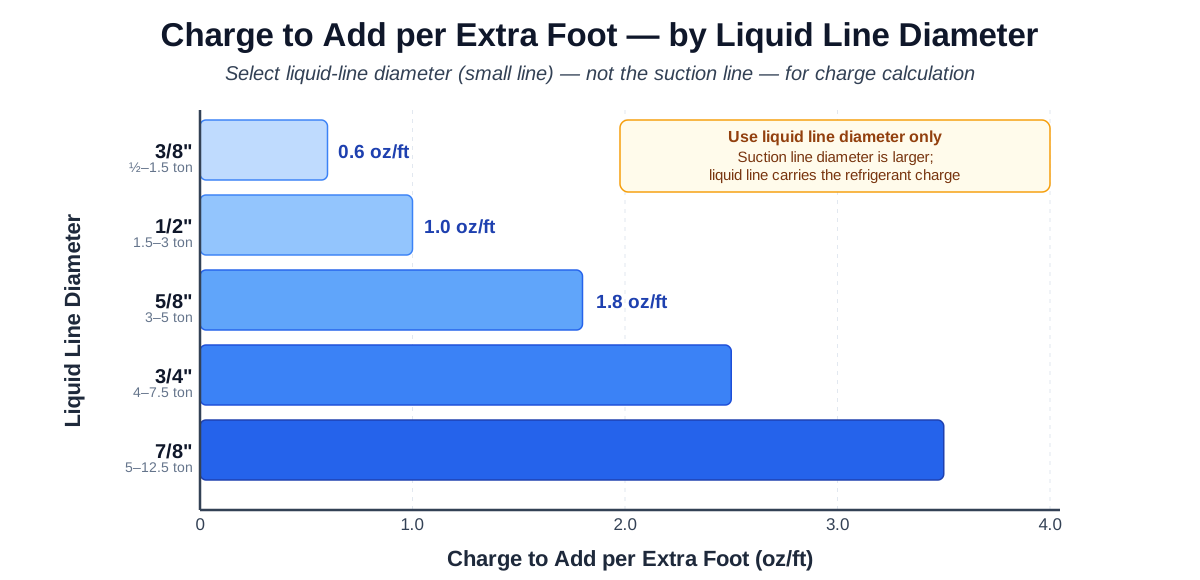
Always start with the manufacturer's installation manual. Most manuals specify the factory charge, factory-included line length, and the charge adjustment rate in oz/ft or g/m for each liquid line size.
When using this calculator, select the liquid line diameter — not the suction line diameter. The liquid line is the smaller of the two refrigerant lines.
After charging to the calculated amount, always verify with field measurements:
- Fixed orifice systems: Measure superheat at the suction line service port
- TXV systems: Measure subcooling at the liquid line service port
Adjust charge until measurements fall within the manufacturer's specified range. Environmental conditions (outdoor temperature, indoor wet-bulb) affect target superheat and subcooling values. This calculator provides a volumetric estimate — always cross-reference with the manufacturer's specific charge adjustment rate.
Key Facts
- Manufacturers ship condensing units pre-charged for a standard liquid line length, typically 7.5 m (25 ft).
- Additional refrigerant is needed only for the liquid (small) line — the suction line carries vapor and contributes negligible mass.
- R-410A is the most common residential refrigerant in existing systems, while R-32 and R-454B are increasingly used in new equipment.
- Overcharging increases head pressure, reduces efficiency, and can cause liquid slugging in the compressor.
- Undercharging causes low suction pressure, poor cooling, and compressor overheating.
- Proper charge is verified by measuring superheat (at the evaporator) and subcooling (at the condenser).
Applications
- Split-system AC installation charge adjustment
- Heat pump line set charge calculation
- Mini-split system refrigerant charge estimation
- VRF system branch piping charge adjustment
- Refrigerant recovery and recharge planning
- Installation manual cross-reference and verification
Example Calculation
Imperial Example
Given:
- Factory charge = 63 oz (R-410A)
- Factory-included line length = 25 ft
- Actual liquid line length = 50 ft
- Liquid line inside diameter = 3/8 in (0.375 in = 0.009525 m)
- Refrigerant = R-410A at 100°F (density = 1,130 kg/m³)
Step 1: Extra Length
L_extra = 50 − 25 = 25 ft = 7.62 m
Step 2: Line Volume
V = π × (0.009525 / 2)² × 7.62
V = π × (0.004763)² × 7.62
V = π × 0.00002269 × 7.62
V = 0.000543 m³
Step 3: Additional Charge
m_add = 1,130 × 0.000543 = 0.614 kg = 21.7 oz
Step 4: Total Charge
m_total = 63 + 21.7 = 84.7 oz (≈ 2.40 kg)
Metric Example
Given:
- Factory charge = 1.8 kg (R-410A)
- Factory-included line length = 7.5 m
- Actual liquid line length = 15 m
- Liquid line inside diameter = 9.52 mm (0.00952 m)
- Refrigerant = R-410A at 38°C (density = 1,130 kg/m³)
Step 1: Extra Length
L_extra = 15 − 7.5 = 7.5 m
Step 2: Line Volume
V = π × (0.00952 / 2)² × 7.5
V = π × (0.00476)² × 7.5
V = π × 0.00002266 × 7.5
V = 0.000534 m³
Step 3: Additional Charge
m_add = 1,130 × 0.000534 = 0.603 kg
Step 4: Total Charge
m_total = 1.8 + 0.603 = 2.403 kg
Standards & References
- AHRI 210/240 — performance rating of unitary air-conditioning and heat pump equipment
- ASHRAE 15 — safety standard for refrigeration systems
- EPA Section 608 — refrigerant handling and recovery requirements
- Manufacturer installation manuals — model-specific charge adjustment rates (oz/ft or g/m)
Limitations
- This calculator estimates charge based on liquid line volume only — it does not account for suction line vapor mass.
- It uses a single liquid-phase density and does not model two-phase flow or flash gas in the liquid line.
- It does not account for vertical elevation changes that affect liquid head pressure and subcooling.
- It does not replace superheat and subcooling verification at the service ports.
- Manufacturer-specific charge rates (oz/ft or g/m) may differ from the volumetric calculation — always cross-reference.
- It does not model TXV vs. fixed orifice charging differences.
- For critical applications, always follow the manufacturer's installation manual and verify with field measurements.
Common Mistakes to Avoid
- Using the suction (large) line diameter instead of the liquid (small) line diameter.
- Forgetting to subtract the factory-included line length before calculating additional charge.
- Using vapor-phase density instead of liquid-phase density for the charge calculation.
- Not accounting for the correct refrigerant type — R-410A, R-22, R-32, and R-134a have different densities.
- Ignoring manufacturer-specific charge adjustment rates and relying solely on generic calculations.
- Not verifying final charge with superheat and subcooling measurements.
Frequently Asked Questions
What does this calculator compute?
Why only the liquid line?
What if my actual line is shorter than the factory length?
Which refrigerant density should I use?
How do I verify the final charge?
Does this work for VRF systems?
Frequently Used Together
Engineers often use these calculators in combination for complete project workflows:
Related Calculators
Explore similar calculators that might be useful for your project:
Free HVAC Quick Reference. Formulas & Checks.
Airflow, loads, refrigerant & duct checks — one printable page for the job site.
- Key formulas for airflow, load, refrigerant charge & duct sizing
- Quick sanity checks for the most common HVAC design errors
- Printable one-pager for field use and design review
No spam. Unsubscribe any time.
Calculate
Refrigerant charge shipped with the outdoor unit (from nameplate or installation manual)
Liquid line length already covered by the factory charge (typically 7.5 m / 25 ft)
Total installed liquid line length from outdoor unit to indoor unit
Inside diameter of the liquid (small) refrigerant line
Density of the liquid-phase refrigerant at the expected condensing temperature