Coil Capacity Calculator
On this page
Calculate
From psychrometric chart or enthalpy calculator
From psychrometric chart or enthalpy calculator
Leave blank to skip water-side calculation
Leave blank to skip water-side calculation
Overview
The Coil Capacity Calculator determines the total, sensible, and latent heat transfer capacity of HVAC cooling and heating coils. Coil capacity is the foundation of equipment selection — a cooling coil must have sufficient total capacity to handle the combined sensible and latent loads of the space, and its sensible heat ratio (SHR) must match the space SHR to maintain proper humidity.
This calculator computes air-side capacity from airflow rate and entering/leaving air conditions using standard psychrometric relationships. It also supports optional water-side (hydronic) capacity calculations from water flow rate and temperature difference.
Accurate coil capacity estimation ensures proper equipment sizing, energy efficiency, and indoor comfort. It is used during design (to select the coil), during commissioning (to verify performance), and during troubleshooting (to identify degraded performance).
How to Use This Calculator
Enter airflow rate — in CFM (Imperial) or m³/h (Metric).
Enter entering air dry-bulb temperature — the air temperature entering the coil.
Enter leaving air dry-bulb temperature — the air temperature leaving the coil.
Enter entering air enthalpy — from psychrometric data based on entering conditions (wet-bulb or RH).
Enter leaving air enthalpy — from psychrometric data based on leaving conditions.
Optionally enter water flow and ΔT — for hydronic coil water-side capacity verification.
Click "Calculate" — get total capacity, sensible capacity, latent capacity, and SHR.
Enthalpy values can be obtained from a psychrometric chart or the CalcEngineer Enthalpy Calculator. For heating coils with no dehumidification, set entering and leaving enthalpies such that latent capacity is zero (SHR = 1.0).
Inputs & Outputs
Inputs
Outputs
Formula
Air-Side Total Capacity
Imperial:
Q_total = 4.5 × CFM × Δh [BTU/hr]
where Δh = (h_entering – h_leaving) in BTU/lb, and 4.5 = 60 min/h × 0.075 lb/ft³.
Metric:
Q_total = (m³/h × Δh × 1.2) / 3600 [kW]
where Δh = (h_entering – h_leaving) in kJ/kg, 1.2 = air density (kg/m³), 3600 = seconds per hour.
Air-Side Sensible Capacity
Imperial:
Q_sensible = 1.1 × CFM × ΔT_db [BTU/hr]
where ΔT_db = (entering DB – leaving DB) in °F, and 1.1 = 60 min/h × 0.075 lb/ft³ × 0.24 BTU/lb·°F.
Metric:
Q_sensible = (m³/h × 1.2 × 1.006 × ΔT_db) / 3600 [kW]
where ΔT_db in °C, 1.006 = specific heat of air (kJ/kg·°C), 1.2 = density.
Latent Capacity & SHR
Q_latent = Q_total – Q_sensible
SHR = Q_sensible / Q_total
Water-Side Capacity (Hydronic Coils)
Imperial:
Q_water = 500 × GPM × ΔT_w [BTU/hr]
where 500 = 8.33 lb/gal × 60 min/h × 1 BTU/lb·°F.
Metric:
Q_water = 1.163 × m³/h × ΔT_w [kW]
where 1.163 = 1000 kg/m³ × 4.186 kJ/kg·°C / 3600 s/h.
Calculator Variables
| Variable | Meaning | Units |
|---|---|---|
| CFM / m³/h | Airflow rate | ft³/min / m³/h |
| Δh | Enthalpy difference (entering − leaving) | BTU/lb / kJ/kg |
| ΔT_db | Dry-bulb temperature difference | °F / °C |
| Q_total | Total capacity (output) | BTU/hr / kW |
| Q_sensible | Sensible capacity (output) | BTU/hr / kW |
| Q_latent | Latent capacity (output) | BTU/hr / kW |
| SHR | Sensible Heat Ratio (output) | dimensionless |
| GPM / m³/h | Water flow rate | gal/min / m³/h |
| ΔT_w | Water temperature difference | °F / °C |
| Q_water | Water-side capacity (output) | BTU/hr / kW |
What is Coil Capacity
Coil capacity is the amount of heat — sensible and latent — that an HVAC coil can add to or remove from an airstream per unit time. It is the foundation of equipment selection: a cooling coil must have sufficient total capacity to handle the combined sensible and latent loads of the space, and its sensible heat ratio (SHR) must match the space SHR to maintain proper humidity.
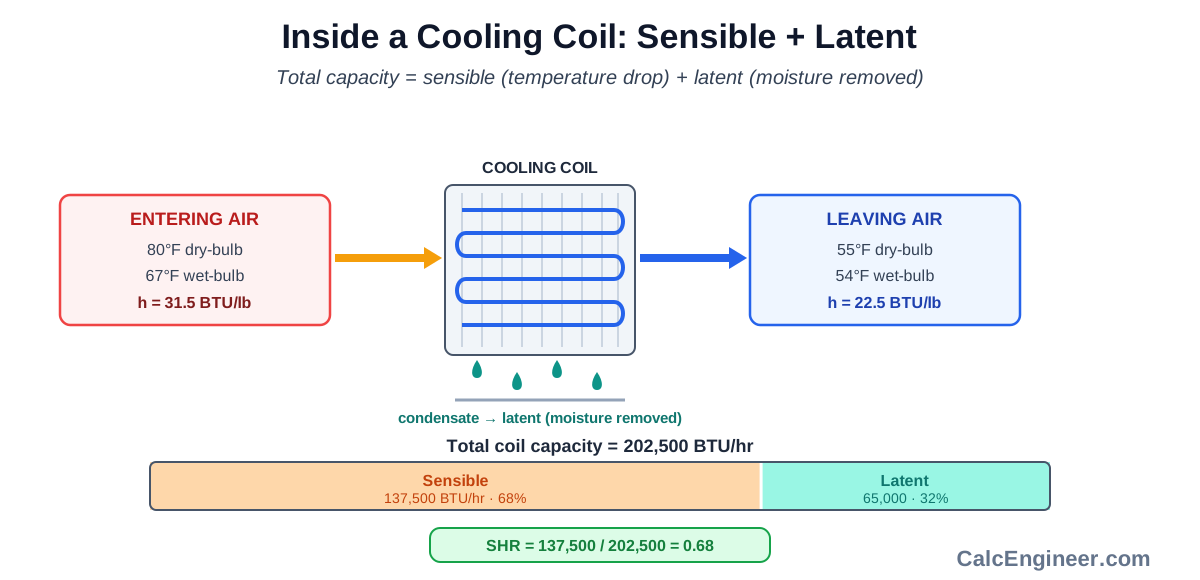
In practice, coil capacity is determined by airflow rate, entering and leaving air conditions (temperature and moisture content), and for hydronic coils, water flow rate and temperature difference.
Main Factors Affecting Coil Capacity
The primary factors that influence coil capacity:
- Airflow rate — higher airflow increases both sensible and total capacity, but may reduce dehumidification (higher SHR)
- Entering air conditions — warmer, more humid air increases total capacity demand
- Leaving air conditions — lower leaving temperature increases sensible capacity; lower leaving enthalpy increases total capacity
- Coil geometry — more rows, more fins per inch, and larger face area increase capacity
- Water temperature and flow — for hydronic coils, colder water and higher flow increase capacity
Why Coil Capacity Matters
Accurate coil capacity calculation is required for proper HVAC system design. An undersized coil cannot maintain comfort — the space will be too warm or too humid. An oversized coil wastes energy and may cause short cycling or overcooling. Matching the coil SHR to the space load SHR ensures both temperature and humidity are controlled simultaneously.
Engineering Applications
Coil capacity calculations are used across all areas of HVAC engineering. AHU designers select cooling and heating coils that match the building load profile. Commissioning agents verify coil performance by measuring airflow, temperatures, and comparing calculated capacity to nameplate ratings.
For hydronic systems, the water-side capacity must be balanced with the air-side capacity. A significant imbalance between water-side and air-side capacity indicates fouling, a measurement error, or improper water flow.
The SHR is particularly important for humidity-sensitive applications such as hospitals, museums, and data centers, where both temperature and humidity must be held within tight tolerances.
Unit Conversions
| Unit | Equivalent |
|---|---|
| 1 kW | 3,412 BTU/hr |
| 1 BTU/hr | 0.000293 kW |
| 1 ton cooling | 12,000 BTU/hr |
| 1 GPM | 0.2271 m³/h |
| 1 m³/h | 4.403 GPM |
| 1 CFM | 1.699 m³/h |
Practical Tips
When calculating coil capacity, always use enthalpy values from a reliable psychrometric source. Small errors in enthalpy can produce large errors in total capacity.
For cooling coils, the entering air enthalpy is typically determined from mixed-air conditions (return air + outdoor air), not just the room conditions.
For heating coils, latent capacity is usually zero (SHR = 1.0) because heating does not remove moisture. Set the enthalpy difference to match the sensible heat only.
Important: This calculator uses standard air density. For high-altitude installations, multiply the constants (4.5 and 1.1 in Imperial, or 1.2 in Metric) by the density correction factor (actual density ÷ standard density).
Key Facts
- The constant 4.5 (Imperial) and 1.2 kg/m³ (Metric) assume standard air density at sea level. For high-altitude applications, density corrections should be applied.
- A typical cooling coil in a commercial HVAC system has a SHR between 0.70 and 0.85, meaning 70–85% of its capacity is sensible cooling, and 15–30% is latent (dehumidification).
- Sensible capacity is proportional to airflow and dry-bulb temperature drop. Total capacity includes the effect of dehumidification.
- For hydronic coils, water flow and temperature difference must be balanced with air-side conditions to achieve the required capacity.
- The SHR of a cooling coil is not fixed; it changes with entering air conditions, coil geometry, and leaving air temperature.
- Coil capacity degrades over time due to fouling, reduced airflow, or improper water flow.
Applications
- Selecting cooling and heating coils for air handling units, fan coils, and rooftop units.
- Balancing air-side and water-side performance in hydronic systems.
- Verifying that a selected coil meets design capacity during commissioning.
- Diagnosing under-performance: compare calculated capacity against nameplate rating.
- Sizing reheat coils for humidity control applications.
- Educational reference for HVAC engineers, technicians, and students.
Example Calculation
Example Calculation (Imperial – Cooling Coil)
Given:
- Airflow = 5,000 CFM
- Entering air: 80°F DB, 67°F WB (RH ≈ 50%)
- Leaving air: 55°F DB, 54°F WB (≈ 90% RH)
- Entering enthalpy ≈ 31.5 BTU/lb
- Leaving enthalpy ≈ 22.5 BTU/lb
Step 1 – Enthalpy difference:
Δh = 31.5 – 22.5 = 9.0 BTU/lb
Step 2 – Total capacity:
Q_total = 4.5 × 5,000 × 9.0 = 202,500 BTU/hr
Step 3 – Sensible capacity:
ΔT_db = 80 – 55 = 25°F
Q_sensible = 1.1 × 5,000 × 25 = 137,500 BTU/hr
Step 4 – Latent capacity:
Q_latent = 202,500 – 137,500 = 65,000 BTU/hr
Step 5 – SHR:
SHR = 137,500 / 202,500 = 0.679
Interpretation: The coil has a SHR of 0.68, indicating significant dehumidification — typical for a standard cooling coil in a humid climate.
Example Calculation (Metric – Cooling Coil)
Given:
- Airflow = 2,500 m³/h
- Entering air: 27°C DB, 19.5°C WB (≈ 50% RH)
- Leaving air: 13°C DB, 12.5°C WB (≈ 90% RH)
- Entering enthalpy ≈ 55 kJ/kg
- Leaving enthalpy ≈ 36 kJ/kg
Step 1 – Enthalpy difference:
Δh = 55 – 36 = 19 kJ/kg
Step 2 – Total capacity:
Q_total = (2,500 × 19 × 1.2) / 3600 = 57,000 / 3600 = 15.83 kW
Step 3 – Sensible capacity:
ΔT_db = 27 – 13 = 14°C
Q_sensible = (2,500 × 1.2 × 1.006 × 14) / 3600 = 42,252 / 3600 = 11.74 kW
Step 4 – Latent capacity:
Q_latent = 15.83 – 11.74 = 4.09 kW
Step 5 – SHR:
SHR = 11.74 / 15.83 = 0.742
Interpretation: SHR of 0.74 — typical for commercial cooling coils.
Standards & References
- ASHRAE Handbook – Fundamentals — Ch. 1 Psychrometrics & Ch. 18 Load Calculations
- AHRI Standard 410 – Forced-Circulation Air-Cooling and Air-Heating Coils
- AHRI Standard 430 – Performance Rating of Central Station Air-Handling Units
- ASHRAE Standard 90.1 – Energy Standard for Buildings (coil efficiency requirements)
- SMACNA HVAC Systems Duct Design – Airflow and pressure drop considerations
Limitations
- This calculator assumes standard air density (0.075 lb/ft³ or 1.2 kg/m³). For altitudes above 1,500 ft (500 m), air density corrections should be applied.
- It uses psychrometric equations based on ideal gas behavior; results are accurate within ±2% for typical HVAC conditions.
- For hydronic coils, the water-side capacity is calculated assuming clean water with standard specific heat. Glycol mixtures require correction.
- The calculator does not account for coil geometry (number of rows, fins per inch), which affects actual performance at off-design conditions.
- For precise coil selection, manufacturer performance data should be used, as coil capacities vary with entering conditions and air/water velocities.
Common Mistakes to Avoid
- Using total airflow incorrectly — the formulas require standard CFM or m³/h at coil face conditions, not free-air CFM.
- Forgetting to convert wet-bulb to enthalpy correctly — enthalpy values are critical for total capacity.
- Assuming SHR is fixed — SHR changes with entering conditions; never use a single SHR for all conditions.
- Mixing Imperial and Metric units in the same calculation.
- Ignoring altitude — using standard density at high elevation overestimates mass flow and capacity.
- Using gauge pressure for water flow instead of actual flow rate.
Frequently Asked Questions
What is the difference between total capacity and sensible capacity?
What is Sensible Heat Ratio (SHR) and why is it important?
What are typical SHR values for cooling coils?
How do I calculate total capacity if I only have dry-bulb and relative humidity?
Why do I get different capacities when using Imperial vs Metric?
What does '4.5' represent in the Imperial total capacity formula?
Can I use this calculator for heating coils?
How does altitude affect coil capacity?
Frequently Used Together
Engineers often use these calculators in combination for complete project workflows:
Related Calculators
Explore similar calculators that might be useful for your project:
Free HVAC Quick Reference. Formulas & Checks.
Airflow, loads, refrigerant & duct checks — one printable page for the job site.
- Key formulas for airflow, load, refrigerant charge & duct sizing
- Quick sanity checks for the most common HVAC design errors
- Printable one-pager for field use and design review
No spam. Unsubscribe any time.
Calculate
From psychrometric chart or enthalpy calculator
From psychrometric chart or enthalpy calculator
Leave blank to skip water-side calculation
Leave blank to skip water-side calculation