Wet Bulb Temperature Calculator
On this page
Calculate
Dry-bulb temperature of the air
Relative humidity of the air (0–100%)
Overview
Wet-bulb temperature is the lowest temperature that air can reach through evaporative cooling alone — the equilibrium temperature of a water-wetted surface freely evaporating into the surrounding air. It is one of the three fundamental psychrometric temperatures (along with dry-bulb and dew point) and is essential for cooling tower sizing, evaporative cooler performance, outdoor heat stress assessment, and HVAC coil entering-air conditions.
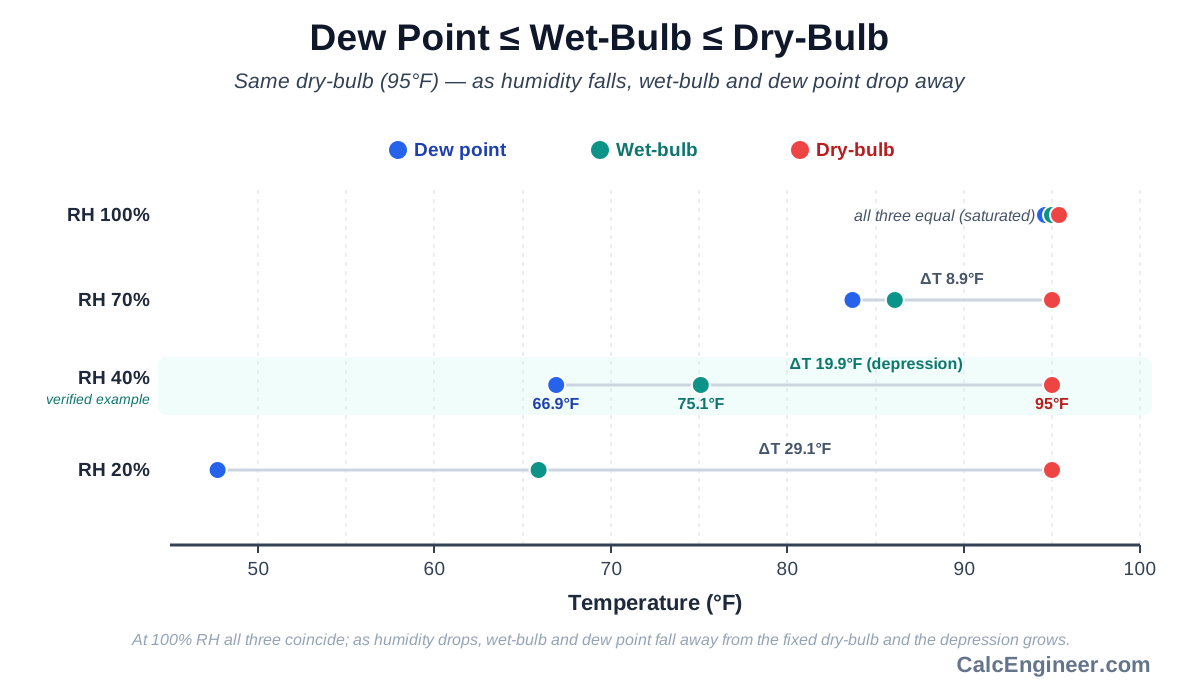
Unlike dew point, which depends only on moisture content, wet-bulb temperature depends on both the moisture content and the dry-bulb temperature of the air. It always lies between the dry-bulb and the dew point: at 100% relative humidity all three temperatures converge; as humidity decreases, the wet-bulb depression (T_db − T_wb) increases, indicating greater evaporative cooling potential.
This calculator derives wet-bulb temperature from any of three common input combinations — dry-bulb with relative humidity, dry-bulb with dew point temperature, or dry-bulb with humidity ratio — by numerically inverting the ASHRAE enthalpy balance equation (ASHRAE Handbook—Fundamentals 2021, Ch. 1, "Thermodynamic Wet-Bulb and Dew-Point Temperature"). It outputs wet-bulb temperature alongside wet-bulb depression, relative humidity, humidity ratio, dew point, vapor pressure, and enthalpy, and classifies the result against ASHRAE comfort thresholds and cooling effectiveness benchmarks.
Both Imperial (°F, gr/lb, psi) and Metric (°C, g/kg, kPa) unit systems are fully supported. All formulas use the Magnus approximation — constants 17.625 and 243.04 over liquid water, 22.587 and 273.86 over ice — with the corrected Imperial saturation pressure constant 0.08855 = 0.61078 × 0.1450377. Humidity ratio is carried dimensionless on the exact mass ratio 0.621945 and converted to g/kg or gr/lb only for display, so the two unit systems return the same physical answer.
How to Use This Calculator
Select input combination — choose from Dry-Bulb + Relative Humidity, Dry-Bulb + Dew Point Temperature, or Dry-Bulb + Humidity Ratio.
Enter dry-bulb temperature — in °C or °F.
Enter the second input based on your selected combination — relative humidity (%), dew point temperature (°C/°F), or humidity ratio (g/kg or gr/lb).
Click "Calculate" — get wet-bulb temperature, wet-bulb depression (ΔT), relative humidity, humidity ratio, dew point, vapor pressure, and enthalpy.
Use the entering wet-bulb for cooling tower / evaporative cooler sizing and coil total-load selection; size to the ASHRAE 0.4%/1% design wet-bulb for the location.
Inputs & Outputs
Inputs
Outputs
Formula
Calculator Formulas
All calculations assume standard atmospheric pressure:
- Imperial: P_atm = 14.696 psi
- Metric: P_atm = 101.325 kPa
Source: ASHRAE Handbook—Fundamentals (2021), Chapter 1, "Thermodynamic Wet-Bulb and Dew-Point Temperature" — liquid-water and over-ice branches.
Humidity Ratio Is Carried Dimensionless
Every step below works in dimensionless humidity ratio — kg of water vapor per kg of dry air, numerically identical to lb/lb — using the exact mass ratio 0.621945. Display units are applied only at the very end:
g/kg  = W × 1000
gr/lb = W × 7000
This is why no rounded 4350 appears in the working equations. The exact value is 7000 × 0.621945 = 4353.615, and carrying the rounded form makes the answer depend on which unit system you happened to have selected.
Saturation Vapor Pressure (Magnus Approximation)
The phase is chosen by the temperature being evaluated:
Over liquid water (T ≥ 0°C / 32°F):
  Metric:   P_sat(T) = 0.61078 × exp(17.625 × T / (243.04 + T))   [kPa]
  Imperial: P_sat(T) = 0.08855 × exp(17.625 × Tc / (243.04 + Tc)) [psi]

Over ice (T < 0°C / 32°F):
  Metric:   P_sat(T) = 0.61078 × exp(22.587 × T / (273.86 + T))   [kPa]
  Imperial: P_sat(T) = 0.08855 × exp(22.587 × Tc / (273.86 + Tc)) [psi]

  where Tc = (T_°F − 32) / 1.8
Note: 0.08855 = 0.61078 × 0.1450377 (base Magnus constant × kPa-to-psi conversion)
Phase Is Selected Per Temperature, Not Per Air State
Each temperature picks its own branch independently:
- the humidity-ratio equation branch is selected by T_wb
- P_sat(T_wb) is evaluated on the branch belonging to T_wb
- P_sat(T_db), used for relative humidity, is evaluated on the branch belonging to T_db
At T_db = +5°C with T_wb = −2°C the humidity-ratio equation runs on the ice branch, while P_sat(+5°C) in the relative-humidity denominator is still computed over liquid water. Applying a single phase to every temperature in the state is a common and avoidable error.
ASHRAE Enthalpy Balance — Wet-Bulb Equation
Derived from the adiabatic saturation energy balance. W and W_sat_wb are dimensionless throughout.
Branch A — T_wb ≥ 0°C (32°F), saturation over liquid water

W_sat_wb = 0.621945 × P_sat(T_wb) / (P_atm − P_sat(T_wb))

Metric (T in °C):
  W = ((2501 − 2.326 × T_wb) × W_sat_wb − 1.006 × (T_db − T_wb))
      / (2501 + 1.86 × T_db − 4.186 × T_wb)

Imperial (T in °F):
  W = ((1093 − 0.556 × T_wb) × W_sat_wb − 0.240 × (T_db − T_wb))
      / (1093 + 0.444 × T_db − T_wb)
Branch B — T_wb < 0°C (32°F), saturation over ice

W_sat_wb = 0.621945 × P_sat_ice(T_wb) / (P_atm − P_sat_ice(T_wb))

Metric (T in °C):
  W = ((2830 − 0.24 × T_wb) × W_sat_wb − 1.006 × (T_db − T_wb))
      / (2830 + 1.86 × T_db − 2.1 × T_wb)

Imperial (T in °F):
  W = ((1220 − 0.04 × T_wb) × W_sat_wb − 0.240 × (T_db − T_wb))
      / (1220 + 0.444 × T_db − 0.48 × T_wb)
The coefficients are specific heats and the latent heat of vaporization (Branch A) or sublimation (Branch B) of water at standard conditions. The two branches do not join continuously at the freezing point, and they are not meant to: evaporating liquid water and subliming ice are different energy balances. ASHRAE notes increased uncertainty in a humidity ratio determined from a wet-bulb reading taken close to 0°C.
An implementation that carries W in g/kg or gr/lb instead must scale the sensible-heat term with it — 1.006 becomes 1006, and 0.240 becomes 1680. The dimensionless form above sidesteps the problem.
Wet-Bulb from Known Humidity Ratio (Iterative Solver)
When the humidity ratio W is known — from relative humidity, dew point, or direct input — the wet-bulb temperature is found by inverting the equation above numerically. There is no closed form: T_wb appears on both sides through W_sat_wb.
Find T_wb such that W(T_db, T_wb) = W_actual
Bracket: T_wb ∈ [−100°C, T_db]   ([−148°F, T_db])
Method:  interval halving, 100 iterations
W increases monotonically with T_wb, so halving the bracket 100 times resolves the root far below any displayed digit. Bisection is used rather than Newton-Raphson specifically because the two branches meet at the freezing point with a small step — a derivative-based step can jump that discontinuity and fail to converge, while interval halving cannot.
Combination A: Dry-Bulb + Relative Humidity
Step 1: P_sat_db = Magnus at T_db, on the branch belonging to T_db Step 2: P_v = (RH / 100) × P_sat_db Step 3: W from vapor pressure
W = 0.621945 × P_v / (P_atm − P_v) [dimensionless]
Step 4: T_wb by inverting the ASHRAE enthalpy balance Step 5: Dew point by inverse Magnus on P_v Step 6: Depression = T_db − T_wb
Combination B: Dry-Bulb + Dew Point
Step 1: P_v = P_sat(T_dp), read on the liquid-water branch (see the note on saturation temperature below) Step 2: W from vapor pressure (same as Combination A, Step 3) Step 3: RH = (P_v / P_sat(T_db)) × 100 Step 4: T_wb by inverting the ASHRAE enthalpy balance Step 5: Depression = T_db − T_wb
Combination C: Dry-Bulb + Humidity Ratio
Step 1: P_v from humidity ratio
P_v = P_atm × W / (0.621945 + W)
Step 2: RH = (P_v / P_sat(T_db)) × 100 Step 3: T_wb by inverting the ASHRAE enthalpy balance Step 4: Dew point by inverse Magnus on P_v Step 5: Depression = T_db − T_wb
Dew Point (Inverse Magnus)
Metric:
  α = ln(P_v / 0.61078)
  T_dp = 243.04 × α / (17.625 − α)   [°C]

Imperial:
  α = ln(P_v / 0.08855)
  T_dp(°C) = 243.04 × α / (17.625 − α)
  T_dp(°F) = 32 + 1.8 × T_dp(°C)
The Imperial inverse runs against the Imperial Magnus constant directly. Converting psi to kPa first and inverting against 0.61078 introduces a round-trip drift of roughly 0.015°F — small, but it is the kind of drift that makes the same air read differently after a unit toggle.
Which Saturation Temperature Is Reported Below Freezing
Below freezing the question "at what temperature does this air saturate" has two different answers, and they are not interchangeable:
- the frost point, over ice — the temperature at which ice actually deposits on a surface
- the dew point, over supercooled liquid water — the temperature at which liquid condensate would form
This calculator reports the dew point over supercooled liquid water on both sides of 0°C. That keeps the value consistent with the dew point accepted as input in Combination B, so a result fed back into the calculator reproduces the same state. The frost point is the higher of the two — roughly 1°F above the dew point near −5°C, about 2°F near −10°C, and close to 4°F near −20°C. If you are predicting frost on a coil, a window, or a duct surface, that offset is the number you need to add.
Enthalpy
Imperial: h = 0.240 × T_db + W × (1061 + 0.444 × T_db)   [BTU/lb]
Metric:   h = 1.006 × T_db + W × (2501 + 1.86 × T_db)    [kJ/kg]
(W dimensionless; equivalently W_gr/7000 or W_g·kg⁻¹/1000.)
Verification
- At RH = 100%: T_wb = T_db = T_dp, depression = 0
- At RH = 0%: T_wb → T_dp → minimum, depression → maximum
- T_dp ≤ T_wb ≤ T_db always holds
- Wet-bulb depression increases as RH decreases (more evaporative cooling potential)
- Below 0°C (32°F) the humidity-ratio equation switches to the over-ice branch, selected by T_wb alone
- The same physical state entered in Metric and in Imperial agrees to within 0.1% after conversion
Variable Reference
| Variable | Meaning | Units |
|---|---|---|
| T_db | Dry-bulb temperature | °F / °C |
| T_wb | Wet-bulb temperature | °F / °C |
| T_dp | Dew point temperature | °F / °C |
| RH | Relative humidity | % |
| W | Humidity ratio (dimensionless internally) | gr/lb / g/kg |
| W_sat_wb | Saturation humidity ratio at T_wb | dimensionless |
| P_v | Partial vapor pressure | psi / kPa |
| P_sat | Saturation vapor pressure | psi / kPa |
| ΔT | Wet-bulb depression (T_db − T_wb) | °F / °C |
| h | Specific enthalpy | BTU/lb / kJ/kg |
| P_atm | Standard atmospheric pressure | 14.696 psi / 101.325 kPa |
What Is Wet-Bulb Temperature?
Wet-bulb temperature is the temperature reading from a thermometer whose sensing bulb is wrapped in a water-saturated wick and exposed to moving air. As water evaporates from the wick, it absorbs latent heat from the thermometer, cooling it below the dry-bulb (ambient) temperature. The equilibrium temperature reached — where the rate of heat gained from the warmer surrounding air equals the rate of latent heat lost through evaporation — is the wet-bulb temperature.
The wet-bulb depression (T_db − T_wb) is a direct measure of the air's evaporative cooling potential. In dry air (low RH), evaporation is rapid and the depression is large — the wet bulb reads well below the dry bulb. In humid air (high RH), evaporation is slow and the depression is small. At 100% relative humidity, no evaporation occurs and the wet-bulb equals the dry-bulb temperature.
Why Wet-Bulb Temperature Matters in HVAC
Wet-bulb temperature is the single most important parameter for sizing cooling towers and evaporative condensers. A cooling tower's capacity is fundamentally limited by the entering wet-bulb temperature — it cannot cool water below this temperature regardless of tower size. The difference between the leaving cold water temperature and the entering wet-bulb temperature (the "approach") is the primary performance metric for tower selection.
In evaporative cooling (swamp cooler) design, wet-bulb temperature determines the lowest achievable supply air temperature. The wet-bulb effectiveness of the cooler, typically 70–90%, defines how close the leaving air temperature approaches the entering wet-bulb temperature.
For HVAC cooling coil design, the entering wet-bulb temperature determines the total (sensible + latent) cooling load on the coil. Two air streams with the same dry-bulb temperature but different wet-bulb temperatures have different total heat content (enthalpy), and the coil must be sized for the higher wet-bulb condition.
Wet-bulb temperature is also the basis for outdoor heat stress indices. The Wet Bulb Globe Temperature (WBGT) index used by OSHA, military, and athletic organizations for heat safety guidelines is dominated by the wet-bulb component, which captures the combined effect of temperature and humidity on the human body's ability to cool itself through perspiration.
Key Facts
- Wet-bulb temperature always lies between dry-bulb and dew point temperatures: T_dp ≤ T_wb ≤ T_db. At 100% RH, all three temperatures are equal. As humidity decreases, the spread between them increases.
- Cooling towers cannot cool water below the entering wet-bulb temperature. The approach (leaving water temperature minus wet-bulb) is the primary performance metric — typical design approaches range from 5–10°F (3–6°C) for HVAC towers.
- The ASHRAE design wet-bulb temperature for a location is the 0.4% or 1% annual exceedance value from ASHRAE Climatic Design Conditions. Equipment sized to the 0.4% design wet-bulb will meet load for 99.6% of annual hours.
- Wet-bulb depression (T_db − T_wb) directly indicates evaporative cooling potential. A depression of 20°F (11°C) or more indicates conditions favorable for evaporative cooling. A depression below 5°F (3°C) means evaporative cooling is ineffective.
- This calculator uses the ASHRAE enthalpy balance equation from the Handbook—Fundamentals (2021), Ch. 1, "Thermodynamic Wet-Bulb and Dew-Point Temperature" — the same thermodynamic basis used in psychrometric software and ASHRAE handbooks. Both branches are implemented: saturation over liquid water at and above freezing, and saturation over ice below it.
- A wet-bulb temperature of 35°C (95°F) is considered the theoretical upper limit of human survivability — above this temperature, the human body cannot cool itself through perspiration regardless of shade, wind, or hydration.
Applications
- Cooling tower sizing and performance evaluation — entering wet-bulb temperature determines the theoretical minimum cold water temperature and tower approach
- Evaporative cooler (swamp cooler) design — wet-bulb temperature sets the lowest achievable supply air temperature; wet-bulb depression indicates cooling potential
- HVAC cooling coil entering-air conditions — wet-bulb temperature determines total enthalpy and latent load on the coil
- Outdoor heat stress assessment — wet-bulb temperature is the dominant component of WBGT (Wet Bulb Globe Temperature) used for occupational and athletic heat safety
- Psychrometric analysis and field measurement — convert sling psychrometer readings (dry-bulb + wet-bulb) to full psychrometric state
- ASHRAE climate data interpretation — design wet-bulb temperatures from ASHRAE Climatic Design Conditions are used for equipment sizing in every HVAC project
Example Calculation
Imperial Example
Given: Combination A — Dry-Bulb + Relative Humidity
- T_db = 95°F, RH = 40%
- P_atm = 14.696 psi
Step 1 — Saturation pressure at 95°F (above freezing, liquid-water branch):
Tc = (95 − 32) / 1.8 = 35.00°C
P_sat = 0.08855 × exp(17.625 × 35.00 / (243.04 + 35.00))
P_sat = 0.08855 × exp(2.2187) = 0.08855 × 9.1950 = 0.8142 psi
Step 2 — Vapor pressure:
P_v = 0.40 × 0.8142 = 0.3257 psi
Step 3 — Humidity ratio (dimensionless, converted for display only):
W = 0.621945 × 0.3257 / (14.696 − 0.3257)
  = 0.202561 / 14.3703 = 0.0140952 lb/lb
W = 0.0140952 × 7000 = 98.67 gr/lb
Step 4 — Wet-bulb by inverting the ASHRAE enthalpy balance:
T_wb is above freezing, so Branch A applies. Solve for T_wb such that
W(95, T_wb) = ((1093 − 0.556 × T_wb) × W_sat_wb − 0.240 × (95 − T_wb))
              / (1093 + 0.444 × 95 − T_wb)
            = 0.0140952
Checking the converged root, T_wb = 75.10°F:
Tc_wb   = (75.10 − 32) / 1.8 = 23.945°C
P_sat_wb = 0.08855 × exp(17.625 × 23.945 / (243.04 + 23.945)) = 0.4302 psi
W_sat_wb = 0.621945 × 0.4302 / (14.696 − 0.4302) = 0.0187570 lb/lb (131.30 gr/lb)

numerator   = (1093 − 41.76) × 0.0187570 − 0.240 × 19.90
            = 19.7182 − 4.7755 = 14.9427
denominator = 1093 + 42.18 − 75.10 = 1060.08
W           = 14.9427 / 1060.08 = 0.0140958 lb/lb  ✓ matches Step 3
Step 5 — Dew point (inverse Magnus, against the Imperial constant directly):
α = ln(0.3257 / 0.08855) = 1.3024
T_dp(°C) = 243.04 × 1.3024 / (17.625 − 1.3024) = 316.53 / 16.3226 = 19.392°C
T_dp(°F) = 32 + 1.8 × 19.392 = 66.91°F
Step 6 — Wet-bulb depression:
ΔT = 95 − 75.10 = 19.90°F
Step 7 — Enthalpy:
h = 0.240 × 95 + 0.0140952 × (1061 + 0.444 × 95)
h = 22.80 + 0.0140952 × 1103.18 = 22.80 + 15.55 = 38.35 BTU/lb
Result summary:
- Wet-Bulb Temperature: 75.10°F
- Wet-Bulb Depression: 19.90°F
- Relative Humidity: 40.0%
- Humidity Ratio: 98.67 gr/lb
- Dew Point: 66.91°F
- Vapor Pressure: 0.3257 psi
- Enthalpy: 38.35 BTU/lb
- Status: MODERATE DEPRESSION — GOOD EVAPORATIVE COOLING
The depression lands 0.10°F below the 20°F excellent threshold, so the calculator reports the band immediately beneath it. Screening thresholds are conventions, not physical discontinuities — a condition this close to the line behaves like one on the other side of it.
Metric Example
Given: Combination B — Dry-Bulb + Dew Point
- T_db = 30°C, T_dp = 18°C
- P_atm = 101.325 kPa
Step 1 — Vapor pressure from dew point:
P_v = 0.61078 × exp(17.625 × 18 / (243.04 + 18))
P_v = 0.61078 × exp(1.2153) = 0.61078 × 3.3714 = 2.0592 kPa
Step 2 — Humidity ratio (dimensionless, converted for display only):
W = 0.621945 × 2.0592 / (101.325 − 2.0592)
  = 1.280627 / 99.2658 = 0.0129018 kg/kg
W = 0.0129018 × 1000 = 12.902 g/kg
Step 3 — Saturation pressure at T_db = 30°C (liquid-water branch):
P_sat_db = 0.61078 × exp(17.625 × 30 / (243.04 + 30))
P_sat_db = 0.61078 × exp(1.9365) = 0.61078 × 6.9346 = 4.2355 kPa
Step 4 — Relative humidity:
RH = (2.0592 / 4.2355) × 100 = 48.62%
Step 5 — Wet-bulb by inverting the ASHRAE enthalpy balance:
T_wb is above freezing, so Branch A applies. Solve for T_wb such that
W(30, T_wb) = ((2501 − 2.326 × T_wb) × W_sat_wb − 1.006 × (30 − T_wb))
              / (2501 + 1.86 × 30 − 4.186 × T_wb)
            = 0.0129018
Checking the converged root, T_wb = 21.75°C:
P_sat_wb = 0.61078 × exp(17.625 × 21.75 / (243.04 + 21.75)) = 2.5983 kPa
W_sat_wb = 0.621945 × 2.5983 / (101.325 − 2.5983) = 0.0163685 kg/kg (16.369 g/kg)

numerator   = (2501 − 50.59) × 0.0163685 − 1.006 × 8.25
            = 40.1105 − 8.2995 = 31.8110
denominator = 2501 + 55.80 − 91.05 = 2465.75
W           = 31.8110 / 2465.75 = 0.0129011 kg/kg  ✓ matches Step 2
Step 6 — Wet-bulb depression:
ΔT = 30 − 21.75 = 8.25°C
Step 7 — Enthalpy:
h = 1.006 × 30 + 0.0129018 × (2501 + 1.86 × 30)
h = 30.18 + 0.0129018 × 2556.80 = 30.18 + 32.99 = 63.17 kJ/kg
Result summary:
- Wet-Bulb Temperature: 21.75°C
- Wet-Bulb Depression: 8.25°C
- Relative Humidity: 48.62%
- Humidity Ratio: 12.90 g/kg
- Dew Point: 18.0°C
- Vapor Pressure: 2.06 kPa
- Enthalpy: 63.17 kJ/kg
- Status: MODERATE DEPRESSION — GOOD EVAPORATIVE COOLING
Sub-Freezing Example — the Ice Branch
Given: Combination A — Dry-Bulb + Relative Humidity
- T_db = −5°C, RH = 60%
- P_atm = 101.325 kPa
Step 1 — Saturation pressure at −5°C. T_db is below freezing, so P_sat(T_db) is taken over ice:
P_sat_db = 0.61078 × exp(22.587 × (−5) / (273.86 − 5))
         = 0.61078 × exp(−0.42005) = 0.61078 × 0.65701 = 0.4013 kPa
Step 2 — Vapor pressure and humidity ratio:
P_v = 0.60 × 0.4013 = 0.2408 kPa
W   = 0.621945 × 0.2408 / (101.325 − 0.2408) = 0.0014814 kg/kg = 1.481 g/kg
Step 3 — Wet-bulb. The solver lands on T_wb = −6.79°C, which is below freezing, so Branch B (over ice) governs the humidity-ratio equation:
W = ((2830 − 0.24 × T_wb) × W_sat_wb − 1.006 × (T_db − T_wb))
    / (2830 + 1.86 × T_db − 2.1 × T_wb)
Result summary:
- Wet-Bulb Temperature: −6.79°C
- Wet-Bulb Depression: 1.79°C
- Relative Humidity: 60.0%
- Humidity Ratio: 1.48 g/kg
- Dew Point: −12.19°C (over supercooled liquid water)
- Vapor Pressure: 0.241 kPa
Two things are worth noting. Both the equation branch and P_sat(T_wb) followed T_wb below freezing, while P_sat(T_db) followed T_db — here both happen to be below zero, but they are still decided separately. And the reported dew point of −12.19°C is the supercooled-liquid value; the frost point for the same air is −10.84°C, which is the temperature that actually matters if you are asking when ice will form on a surface.
Reading Enthalpy Across Unit Systems
The examples above describe different air, but a note applies to all of them: specific enthalpy is measured from a different zero in each system — dry air at 0°F in IP, dry air at 0°C in SI. It therefore cannot be converted by multiplying by 2.326 the way an ordinary energy-per-mass quantity can. Switching the unit toggle on the same air gives 38.35 BTU/lb and 71.40 kJ/kg, not 38.35 and 89.2. The difference is the datum offset, not an error. Enthalpy differences across a process convert normally; absolute values do not.
Standards & References
- ASHRAE Handbook — Fundamentals (2021), Ch. 1 Psychrometrics — Primary reference for the enthalpy balance wet-bulb equation used in this calculator, in the section "Thermodynamic Wet-Bulb and Dew-Point Temperature", together with the saturation pressure formulations and the full psychrometric relationships between thermodynamic properties. Equation numbers are deliberately not cited: the SI and I-P forms are numbered differently.
- ASHRAE Standard 55-2023 — Thermal Environmental Conditions for Human Occupancy — References wet-bulb temperature indirectly through humidity limits and the psychrometric comfort envelope.
- ASHRAE Climatic Design Conditions — Provides design wet-bulb temperatures (0.4%, 1%, 2% annual exceedance) for equipment sizing at locations worldwide.
- Magnus Formula (Alduchov-Eskridge, 1996) — Used for saturation pressure calculation. Constants 17.625 and 243.04 hold within about 0.4% over the range −40°C to +50°C (−40°F to 122°F).
- ASHRAE Enthalpy Balance Equation — The thermodynamic definition of wet-bulb temperature per ASHRAE Handbook—Fundamentals. It is built from fundamental thermodynamic properties rather than instrument-specific psychrometer coefficients, and is the correct reference for HVAC calculations. Psychrometer coefficients of the Sprung form belong to a different equation — one written in partial pressures and carrying an explicit atmospheric-pressure factor, e = e_s(T_wb) − A × P × (T_db − T_wb) — where A is about 0.000653–0.000662 °C⁻¹ for well-aspirated instruments and about 0.00077–0.00080 °C⁻¹ for a naturally ventilated screen such as a Stevenson shield. Those coefficients do not transfer into the humidity-ratio equation.
- CTI Standard STD-201 — Thermal Performance Testing of Cooling Towers — Defines wet-bulb measurement requirements for cooling tower acceptance testing.
Limitations
- All calculations assume standard atmospheric pressure of 14.696 psi (101.325 kPa). At elevations above approximately 1,000 ft (300 m), lower atmospheric pressure increases evaporation rate and lowers the wet-bulb temperature for the same moisture content.
- The Magnus approximation holds within about 0.4% from −40°F to 122°F (−40°C to 50°C). Between 122°F and the 150°F input ceiling (50°C to 65°C) accuracy degrades gradually, and outside that span it should not be relied on — use ASHRAE full-range or IAPWS saturation pressure equations for cryogenic and high-temperature process work.
- This calculator computes the thermodynamic (psychrometric) wet-bulb temperature per the ASHRAE enthalpy balance. A reading taken with a physical psychrometer and corrected with instrument-specific coefficients may differ slightly (typically <0.5°F / 0.3°C) because of heat and mass transfer effects particular to that instrument. Near 0°C the spread widens: ASHRAE notes increased uncertainty in a humidity ratio determined from a wet-bulb reading close to freezing, and the liquid-water and over-ice branches do not join continuously there.
- The solver brackets the root and halves the interval 100 times, which resolves the wet-bulb temperature far below the last displayed digit. That precision is numerical, not physical: field wet-bulb measurements are typically accurate to ±0.5°F (±0.3°C), and that measurement uncertainty dominates the result.
- Wet-bulb temperature calculated here is the thermodynamic (psychrometric) wet-bulb, which differs slightly from the natural wet-bulb temperature used in WBGT heat stress calculations. Natural wet-bulb is measured without forced aspiration and is typically 1–3°F higher.
Common Mistakes to Avoid
- Confusing wet-bulb with dew point temperature. Both are lower than dry-bulb, but they measure different things. Dew point depends only on moisture content and is the condensation threshold. Wet-bulb depends on both moisture content and dry-bulb temperature and represents the evaporative cooling limit. They are equal only at 100% RH.
- Using dry-bulb temperature instead of wet-bulb for cooling tower sizing. Cooling tower capacity is governed by the entering wet-bulb temperature, not the dry-bulb. Using dry-bulb leads to oversized towers in humid climates and undersized towers in dry climates.
- Assuming wet-bulb temperature is constant when dry-bulb changes. Unlike dew point, wet-bulb temperature changes with dry-bulb temperature even at constant moisture content. Heating air at constant humidity ratio raises the wet-bulb temperature (though less than the dry-bulb rise).
- Applying one phase to every temperature in the air state. Below freezing the humidity-ratio equation branch and P_sat(T_wb) follow the wet bulb, while P_sat(T_db) in the relative-humidity denominator follows the dry bulb — at T_db = +5°C with T_wb = −2°C the equation runs over ice but P_sat(+5°C) is still computed over liquid water. Forcing a single phase onto the whole state shifts relative humidity by several percent.
- Neglecting altitude correction for wet-bulb calculations. At higher altitudes, lower atmospheric pressure increases evaporation rate, lowering the wet-bulb temperature for the same moisture content. The standard formulas assume sea-level pressure (101.325 kPa / 14.696 psi).
- Using wet-bulb temperature for condensation risk assessment. Condensation occurs when a surface falls below the dew point, not the wet-bulb temperature. Use the Dew Point Temperature Calculator for condensation analysis.
Frequently Asked Questions
What is wet-bulb temperature and why does it matter in HVAC?
What is the difference between wet-bulb and dew point temperature?
How is wet-bulb temperature used in cooling tower design?
What is wet-bulb depression and what does it indicate?
Why can't I just use a simple formula to calculate wet-bulb from dry-bulb and RH?
Is this calculator valid for outdoor weather conditions?
What is the relationship between wet-bulb temperature and human heat stress?
How does altitude affect wet-bulb temperature?
Frequently Used Together
Engineers often use these calculators in combination for complete project workflows:
Related Calculators
Explore similar calculators that might be useful for your project:
Free HVAC Quick Reference. Formulas & Checks.
Airflow, loads, refrigerant & duct checks — one printable page for the job site.
- Key formulas for airflow, load, refrigerant charge & duct sizing
- Quick sanity checks for the most common HVAC design errors
- Printable one-pager for field use and design review
No spam. Unsubscribe any time.
Calculate
Dry-bulb temperature of the air
Relative humidity of the air (0–100%)