Expansion Tank Sizing Calculator — Hydronic & Water Heater
On this page
Calculate
Hydronic: total loop volume — boiler, piping, coils, radiators, buffer tanks. This is the largest source of sizing error; if estimated, size up. | DHW: heated storage volume of the water heater, not the whole building plumbing.
Hydronic: cold fill temperature before the boiler fires. DHW: incoming cold water temperature.
Hydronic: maximum boiler loop operating temperature. DHW: water-heater thermostat setpoint. Must be above the cold fill or incoming temperature.
Hydronic: system fill pressure (gauge). The tank precharge should match this, and the fill pressure must keep positive pressure at the highest point. DHW: cold supply pressure (gauge).
Hydronic: boiler relief valve setting. DHW: T&P (temperature and pressure) relief valve setting. A margin is applied below this so the tank is sized before the valve lifts.
Margin applied below the relief setting so the tank is sized before the valve lifts. Leave blank to use the default (5 psi / 0.3 bar). Shown in the design basis.
Standard atmosphere 14.696 psia / 1.01325 bar(a) at sea level. Enter a lower value for high-altitude installations. Leave blank for standard.
Height of the highest point above the expansion tank. For reference only — this calculator does not compute fill pressure from height; enter the fill pressure directly.
Overview
This calculator sizes the expansion tank for a closed-loop hydronic heating system or a domestic hot-water system, so the thermal expansion of the heated water is absorbed without the relief valve lifting. Size mode returns the required acceptance volume and the tank volume to provide it; Check mode tests a proposed tank against the requirement.
The physics is thermal expansion working against a gas cushion. When water is heated from its cold fill temperature to the operating temperature, its volume grows by a fraction set by water-density data. In a closed system that extra water has nowhere to go, so a diaphragm or bladder tank takes it up: the gas side is precharged to the fill pressure, and as the water expands it compresses the gas. The tank must be large enough that the gas pressure never climbs past the relief-valve setting. Undersize it and the relief valve weeps on every heating cycle, losing water and inviting corrosion; oversize it and you have paid for tank you do not need.
The calculation keeps three quantities apart, because mixing them is the usual source of error. The expansion volume is the water the system pushes out when it heats. The acceptance volume is how much of that a tank can actually take between the fill pressure and the maximum pressure. The nominal tank volume is the tank's physical size, which is always larger than its usable acceptance. The tool reports all three and selects on acceptance, then leaves the final model choice to a manufacturer chart.
What to Look at First
Required Tank Volume (Size mode). The primary output is the minimum tank volume rounded up to one decimal — this is the smallest tank that can absorb the full expansion without the relief valve lifting.
Required Acceptance Volume. Shown separately because nominal tank volume is not the same as usable acceptance. A 7-gallon tank at typical pressures may accept only 2–3 gallons. Use the acceptance volume to compare against manufacturer ratings.
Acceptance Factor. A small acceptance factor means the pressure band is narrow and the required tank rises sharply. If the factor is below 0.2, check the fill-to-relief gap.
Check mode verdict. The ratio of required to proposed acceptance volume drives the verdict — 1.00 or below is adequate; above 1.50 is significantly undersized and the relief valve will discharge on heat-up.
How to Use This Calculator
Choose the mode. Size returns the required acceptance and tank volume; Check verifies a proposed tank.
Choose the system type: closed hydronic heating, or domestic hot water. This sets the labels and which pressures and temperature limits are used.
Enter the water volume. For hydronic, the total loop volume (boiler, piping, coils, radiators). For domestic hot water, the heated storage volume of the water heater.
Enter the cold and hot temperatures: the cold fill or incoming temperature, and the operating or setpoint temperature.
Enter the pressures: the cold fill or supply pressure (gauge), and the relief-valve setting (gauge). A margin is applied below relief so the tank is sized before the valve lifts.
In Check mode, enter the proposed tank either by its nominal volume or by the manufacturer's rated acceptance volume.
Read the result. Size mode leads with required tank volume and acceptance volume beneath it; Check mode leads with proposed acceptance against required.
This is a preliminary screening tool. Final tank selection must be made from a manufacturer's sizing chart at the same pressure basis. Nominal tank volume is not the usable acceptance volume.
Inputs & Outputs
Inputs
Mode & System
Water Volume & Temperatures
Pressures
Check Mode Parameters
Advanced (Optional)
Outputs
Both Modes
Size Mode
Check Mode
Formula
Expansion Tank Sizing Formulas
Expansion fraction — fractional volume increase of the water from cold to hot, from water-density data:
e = (ρ_cold / ρ_hot) − 1
Required acceptance volume — how much expansion the tank must absorb:
V_acceptance = V_water × e
Absolute pressures — gas behaviour follows absolute pressure, not gauge:
P_fill_abs   = P_fill_gauge   + P_atm
P_max_sizing = P_relief       − margin
P_max_abs    = P_max_sizing   + P_atm
Acceptance factor — fraction of the tank usable between fill and max pressure:
AF = 1 − (P_fill_abs / P_max_abs)
Required tank volume — nominal tank must be at least this large:
V_tank = V_acceptance / AF
Critical rule: AF must use absolute pressures. Using gauge pressure gives a higher AF that makes the tank look smaller than it needs to be — the most common expansion-tank sizing error.
| Variable | Definition |
|---|---|
| V_water | System loop volume (hydronic) or heated storage volume (DHW) |
| ρ_cold | Water density at cold fill / incoming temperature (IAPWS-IF97 table) |
| ρ_hot | Water density at operating / setpoint temperature (IAPWS-IF97 table) |
| e | Expansion fraction (dimensionless) |
| P_fill_gauge | Fill / supply pressure, gauge |
| P_relief | Relief valve setting, gauge |
| margin | Design margin below relief (default 5 psi / 0.3 bar) |
| P_atm | Atmospheric pressure (standard 14.696 psia / 1.01325 bar) |
| AF | Acceptance factor (dimensionless, 0–1) |
| V_acceptance | Required acceptance volume — water the tank must absorb |
| V_tank | Required nominal tank volume |
Recommended precharge = fill/supply pressure, set with no water pressure on the tank.
Decision Model
The verdict runs on two tracks. Track A confirms the inputs are present and physically possible: the hot temperature must exceed the cold, the fill pressure must be below the relief setting, and the margin must leave a usable acceptance band. Track B, in Check mode, compares the proposed tank to the requirement, always by usable acceptance volume rather than nominal size. The hazard direction is undersizing, because a tank that cannot accept the full expansion lets pressure climb until the relief valve discharges.
| Required ÷ proposed acceptance | Verdict | Meaning |
|---|---|---|
| 1.00 or below | Adequate | The tank accepts the full expansion. Much larger than required is oversized but harmless. |
| Above 1.00 to 1.15 | At limit | Marginal; verify the system volume and temperatures. |
| Above 1.15 to 1.50 | Undersized | The tank may not absorb the full expansion; the relief valve may lift on heat-up. |
| Above 1.50 | Significantly undersized | The relief valve is likely to discharge on heating cycles; water loss and corrosion follow. |
Expansion Volume vs Acceptance Volume vs Tank Volume
Three different volumes run through expansion-tank sizing, and treating them as one is the mistake that produces undersized tanks.
The expansion volume is how much the water grows when it heats. It depends only on the system water volume and the temperature rise, and it is the amount of water the system has to push somewhere.
The acceptance volume is how much of that expansion a given tank can actually take. A diaphragm tank starts precharged at the fill pressure, and it can only accept water until the gas behind the diaphragm is compressed to the maximum pressure. That window between fill and maximum pressure is a fraction of the tank, called the acceptance factor, so the acceptance volume is always less than the tank's physical size.
The nominal tank volume is that physical size, the number on the label. Because only the acceptance fraction is usable, a 7-gallon tank might accept only about 2 gallons of expansion at typical pressures. This is why a tank must be chosen by its rated acceptance at the system pressures, not by its nominal gallons, and why the calculator reports the required acceptance volume separately from the required tank volume.
Why Expansion Tank Sizing Uses Absolute Pressure
The acceptance factor measures how far the gas cushion can be compressed, and gas behaviour follows absolute pressure, not gauge. The calculation therefore adds atmospheric pressure to both the fill pressure and the maximum pressure before taking their ratio.
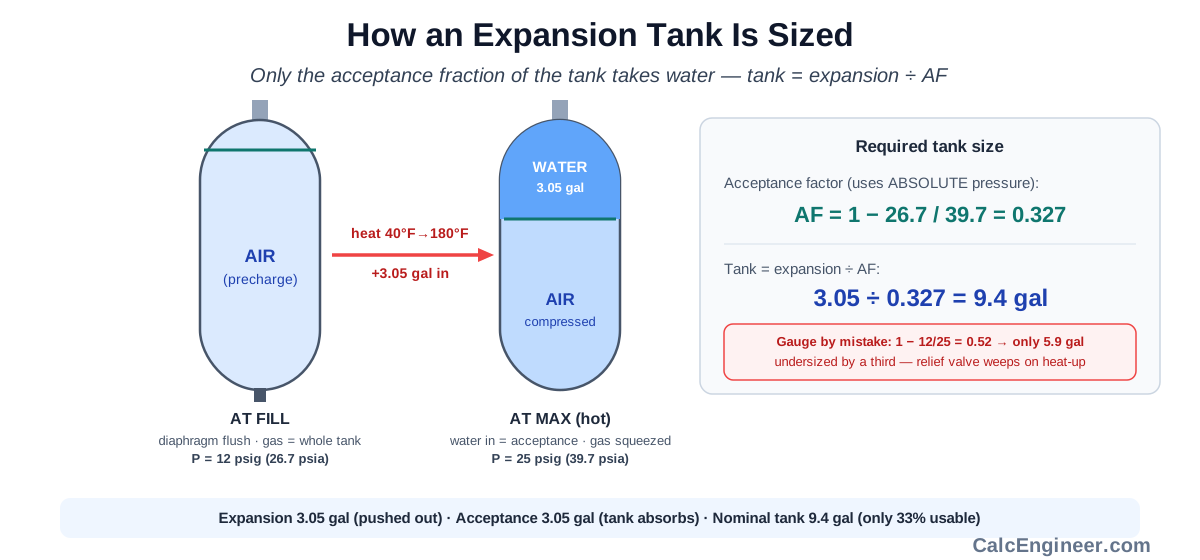
The difference is not small. Take a 100-gallon loop with about 3 gallons of expansion, a 12 psig fill, and a 25 psig maximum after margin. Done correctly with absolute pressures, the acceptance factor is 1 − 26.7/39.7 = 0.327, and the required tank is 3.05 / 0.327 = 9.4 gallons (rounded up). Done with gauge pressures by mistake, it looks like 1 − 12/25 = 0.52, and the tank comes out at 3.05 / 0.52 = 5.9 gallons. The gauge method undersizes the tank by more than a third, and the result is a relief valve that lifts on heat-up. Using absolute pressure is what keeps the sizing honest.
Expansion Tank Precharge Pressure
A diaphragm tank only delivers its rated acceptance if its precharge matches the system. The precharge is the air pressure behind the diaphragm, and it should equal the system fill pressure for a hydronic loop, or the cold supply pressure for a water heater, set with no water pressure on the tank.
If the precharge is too high, the diaphragm is already pushed back when the system fills, so the tank accepts less water before reaching the relief setting and behaves as if it were smaller. If it is too low, the tank starts partly filled with water and again loses usable acceptance. Tanks ship at a factory precharge that often does not match a given system, so the precharge should be checked and adjusted at installation. The calculator reports the recommended precharge alongside the required volume for exactly this reason.
Hydronic Expansion Tank vs Water Heater Expansion Tank
The sizing math is identical for both, but the tanks are different products and are not interchangeable.
A hydronic expansion tank serves a closed heating loop. It is sized from the loop's water volume, the fill pressure, and the boiler relief setting, and its wetted parts are not certified for drinking water. A potable (water-heater) thermal expansion tank serves a closed domestic hot-water system, sized from the heated storage volume, the cold supply pressure, and the T&P relief setting. It has a liner listed for potable water.
Installing a hydronic tank on a potable system is a real mistake with real consequences: the tank is not rated for drinking water, and manufacturers explicitly warn against it. When the system is potable, the tank must be a potable-listed model, even though the required volume comes out of the same calculation.
What is Expansion Tank Sizing
An expansion tank is a small pressure vessel that gives heated water somewhere to go. Water is nearly incompressible, so when it is heated in a closed system, sealed off by a check valve, pressure-reducing valve, or boiler fill valve, the small volume it gains as it warms has nowhere to escape. Without a tank, that expansion drives the system pressure straight up to the relief-valve setting, and the valve discharges to protect the equipment. The expansion tank absorbs the growth instead, holding the pressure within bounds.
The tank does it with a gas cushion behind a diaphragm or bladder. It is precharged with air to the system's cold fill pressure, so at fill the diaphragm sits flush and none of the tank is wasted. As the water heats and expands, it pushes into the tank and compresses the air. Because the air can only be compressed so far before its pressure reaches the relief setting, only a fraction of the tank's volume is actually usable to accept water. That fraction is the acceptance factor, and it is why a 7-gallon tank might accept only about 2 gallons of expansion.
Sizing comes down to two numbers. The first is how much the water expands, which depends on the temperature swing: heating from a 40 °F fill to a 180 °F operating temperature grows the volume by about 3 percent, so 100 gallons of system water yields roughly 3 gallons of expansion. The second is the acceptance factor, set by the gap between the fill pressure and the relief setting. A wide gap means a tank can accept a lot relative to its size; a narrow gap means it can accept little, so the required tank grows. Divide the expansion volume by the acceptance factor and you have the tank volume to look for on a manufacturer chart.
The two common applications differ only in detail. A hydronic heating loop is sized from its total water volume, its fill pressure, and the boiler relief setting, and uses a non-potable tank. A domestic water heater is sized from the heated storage volume, the cold supply pressure, and the T&P relief setting, and must use a tank listed for potable water. The two tanks are not interchangeable, because a hydronic tank is not rated for drinking water.
What Happens If an Expansion Tank Is Too Small
An undersized tank cannot accept the full expansion, so the consequence shows up every time the system heats. As the water expands past what the tank can take, the pressure keeps climbing until it reaches the relief-valve setting, and the valve opens. On a boiler that is the relief valve weeping or dripping on each heating cycle; on a water heater it is the T&P valve discharging.
The damage is cumulative. Each discharge loses water, which is replaced by fresh make-up water carrying dissolved oxygen and minerals, and that feeds corrosion and scale in the boiler or heater. A relief valve cycled repeatedly can also foul and fail to reseat, so it drips continuously. The same symptoms appear when a correctly sized tank has lost its precharge or has a failed bladder, which is why a relief valve that weeps is a standard prompt to check the expansion tank first. Sizing up to the next tank when the system volume is uncertain is cheap insurance against all of this.
Key Facts
- The acceptance factor must use absolute pressures — using gauge pressure is the most common sizing error and always undersizes the tank.
- Nominal tank volume is not the usable acceptance volume; only the acceptance fraction of the tank is usable.
- Heating water from 40 °F to 180 °F expands it by roughly 3 percent.
- The tank precharge must equal the system fill pressure, set with no water pressure on the tank.
- Hydronic and potable expansion tanks use identical sizing math but are different products — not interchangeable.
- A relief valve that weeps on every heating cycle often points to a missing, undersized, or waterlogged expansion tank.
- The system water volume estimate is the largest source of sizing error — when uncertain, size up.
Applications
- Sizing the expansion tank for a residential or commercial hydronic heating loop from its water volume and pressures.
- Sizing a thermal expansion tank for a domestic water heater on a closed potable system with a check valve, PRV, or backflow preventer.
- Checking whether an existing expansion tank is large enough after a boiler or water-heater replacement.
- Checking whether a factory-precharged tank still matches the actual system fill or supply pressure.
- Diagnosing a relief valve that weeps on every heating cycle, which often points to a missing, undersized, or waterlogged expansion tank.
- Comparing how the required tank changes with the fill-to-relief pressure gap before setting the system pressures.
- Confirming the required acceptance volume before selecting a specific model from a manufacturer's sizing chart.
Example Calculation
Example 1 — Hydronic Heating Loop
A residential boiler loop holds 100 gallons of water. It is filled cold at 40 °F and runs at 180 °F, with a 12 psig fill pressure and a 30 psig relief valve. A 5 psi margin is applied below relief.
The correct method, with absolute pressures:
- Expansion fraction (40 °F to 180 °F): e ≈ 0.0305 (from IAPWS-IF97 water density table)
- Expansion volume: 100 × 0.0305 = 3.05 gal
- Absolute fill pressure: 12 + 14.7 = 26.7 psia
- Maximum sizing pressure: 30 − 5 = 25 psig, so 25 + 14.7 = 39.7 psia
- Acceptance factor: 1 − 26.7 / 39.7 = 0.327
- Required tank volume: 3.05 / 0.327 = 9.4 gal (rounded up)
The system needs about 3.1 gallons of acceptance, which calls for roughly a 9.4-gallon tank precharged to 12 psig.
The common wrong method, with gauge pressures:
Using gauge values in the acceptance factor gives 1 − 12 / 25 = 0.52, and 3.05 / 0.52 = 5.9 gal. That 5.9-gallon answer is undersized by more than a third, and the tank would let the relief valve lift on heat-up. The error is using gauge pressure where the calculation needs absolute.
Example 2 — Domestic Water Heater
A 50-gallon water heater on a closed potable system takes incoming water at 50 °F and heats it to a 140 °F setpoint, with 60 psig cold supply pressure and a 150 psig T&P relief valve, 5 psi margin.
- Expansion fraction (50 °F to 140 °F): e ≈ 0.0168 (from table)
- Expansion volume: 50 × 0.0168 = 0.84 gal
- Absolute supply pressure: 60 + 14.7 = 74.7 psia
- Maximum sizing pressure: 150 − 5 = 145 psig → 159.7 psia
- Acceptance factor: 1 − 74.7 / 159.7 = 0.532
- Required tank volume: 0.84 / 0.532 = 1.6 gal
The smaller temperature swing and the wide pressure gap give a high acceptance factor, so the required tank is small — about 1.6 gallons. It must be a tank listed for potable water, not a hydronic tank.
Standards & References
- ASHRAE Handbook — HVAC Systems and Equipment, and Fundamentals. Engineering basis for hydronic expansion tank sizing.
- Xylem / Bell & Gossett — Hydronic system design and expansion tank sizing references.
- Amtrol Extrol — Hydronic Expansion Tanks — Sizing guidance and precharge instructions for closed hydronic systems.
- Amtrol Therm-X-Trol — Potable Thermal Expansion Tanks — Thermal expansion tanks for closed domestic hot-water systems listed for potable water.
- IAPWS-IF97 — International standard for water and steam thermodynamic properties. Source of all density values used to compute the expansion fraction.
Limitations
- This is a screening and preliminary-design tool. The final tank must be selected from a manufacturer's sizing chart for the specific product, at the same pressures and temperatures.
- It does not select a specific tank model, and it does not verify a tank's maximum working pressure, ASME listing, or potable-water certification.
- A hydronic expansion tank and a potable thermal expansion tank are not interchangeable.
- It models water only. Glycol mixtures expand more than water, so a water-only result is non-conservative for a glycol loop.
- It does not size the relief valve, and it does not address air separators, pump location, the point of no pressure change, or the overall system pressurization strategy.
- It does not verify the installation location or any isolation and valving requirements.
- It does not calculate the required cold fill pressure from building height; the fill pressure is an input.
- It does not compute the system water volume from a pipe and equipment inventory; that volume is an input and is the largest source of sizing error.
- It does not diagnose whether an existing tank is waterlogged, isolated by a closed valve, or has a failed bladder.
- Chilled-water and contraction sizing are not covered.
- Results are based on standard IAPWS-IF97 water-property data. Final design should follow manufacturer guidance and professional engineering judgment.
Common Mistakes to Avoid
- Using gauge pressures in the acceptance factor. The factor must use absolute pressures; gauge values make the tank look smaller than it needs to be.
- Confusing nominal tank volume with usable acceptance. Only the acceptance fraction of a tank is usable between fill and relief.
- Checking a proposed tank by nominal gallons only. Compare the usable or manufacturer-rated acceptance volume at the system pressures.
- Leaving the precharge at the factory setting. The precharge must be adjusted to match the system fill or supply pressure.
- Guessing the system water volume too low. When it is an estimate, round up to the next tank.
- Using a hydronic tank on a potable water heater. A domestic hot-water system needs a tank listed for potable water.
- Sizing on the relief setting with no margin. A margin is applied below relief to size before the valve lifts.
- Forgetting that a water heater needs a tank only on a closed system. Required when thermal expansion is trapped by a PRV, check valve, or backflow preventer.
Frequently Asked Questions
How do I size an expansion tank?
Why does the calculation use absolute pressure instead of gauge?
What is acceptance volume on an expansion tank?
What size expansion tank do I need for my water heater?
Do I need an expansion tank on a water heater?
What happens if the expansion tank is too small?
Why does the precharge have to match the fill pressure?
Can I use a hydronic expansion tank on a potable water system?
Frequently Used Together
Engineers often use these calculators in combination for complete project workflows:
Related Calculators
Explore similar calculators that might be useful for your project:
Plumbing Quick Reference — Keep It On Your Phone On Site
A 10-page field reference for catching pressure, velocity, slope, and pump-sizing mistakes before you order pipe, close a wall, or add a booster.
- Velocity limits, fixture pressure minimums, drain slope, and the 80 psi ceiling in one table
- Worked examples that show why a single pressure number gives four different answers
- Keep it on your phone, or print the two field-check pages
Free PDF. Calculators stay free. Unsubscribe anytime.
Calculate
Hydronic: total loop volume — boiler, piping, coils, radiators, buffer tanks. This is the largest source of sizing error; if estimated, size up. | DHW: heated storage volume of the water heater, not the whole building plumbing.
Hydronic: cold fill temperature before the boiler fires. DHW: incoming cold water temperature.
Hydronic: maximum boiler loop operating temperature. DHW: water-heater thermostat setpoint. Must be above the cold fill or incoming temperature.
Hydronic: system fill pressure (gauge). The tank precharge should match this, and the fill pressure must keep positive pressure at the highest point. DHW: cold supply pressure (gauge).
Hydronic: boiler relief valve setting. DHW: T&P (temperature and pressure) relief valve setting. A margin is applied below this so the tank is sized before the valve lifts.
Margin applied below the relief setting so the tank is sized before the valve lifts. Leave blank to use the default (5 psi / 0.3 bar). Shown in the design basis.
Standard atmosphere 14.696 psia / 1.01325 bar(a) at sea level. Enter a lower value for high-altitude installations. Leave blank for standard.
Height of the highest point above the expansion tank. For reference only — this calculator does not compute fill pressure from height; enter the fill pressure directly.