Septic Tank Size Calculator — Bedrooms, Flow & Gallons
On this page
Calculate
Commercial systems (restaurants, offices, retail) are sized per seat, employee, or fixture unit, out of scope for this calculator.
Count any room that could function as a bedroom, including a den or finished basement room. Health departments use the permit bedroom count, not current occupancy.
Per bedroom is the standard planning basis. Per occupant is used when actual occupancy is known and high relative to the bedroom count.
Minimum 2 days (clamped if lower). Default 2 days. Values below 2 are not recommended for conventional systems.
A garbage disposal increases solids load and shortens the pumping interval. It does not automatically multiply the hydraulic flow.
Only if the water softener discharges to the septic system and is locally permitted to do so. Added to the hydraulic daily flow.
Advisory only: does not change the tank size calculation. Rental and vacation homes may have different pumping patterns.
Raises a drain-field advisory only: does not change the tank volume. Slow soil limits the drain field, not the tank.
Enter an existing or proposed tank size to check it against the recommended minimum. Blank = return recommended size only.
Dimension-to-volume helper. Enter length, width, and liquid depth to compute working volume.
Interior width of the tank.
Use the liquid depth below the outlet, not the overall tank height or excavation depth. Excludes freeboard.
Overview
This calculator sizes a residential septic tank using two parallel methods (the bedroom-based planning minimum and the daily wastewater flow times the minimum retention time), then rounds up to the next standard manufactured tank size. Both methods are computed; the larger governs.
The bedroom minimum exists because the tank must serve the home's maximum potential occupancy, not just today's household. A retired couple in a four-bedroom home may sell to a family of six, so the buried tank is sized to the bedroom count. Health departments count any room that could serve as a bedroom, including dens and finished basement rooms.
This sizes the tank only. The drain field, leach trenches, and absorption area come from a soil percolation test and a separate calculation, and a larger tank does not fix poor soil. Local and state rules govern and vary; verify with a licensed designer and the permitting authority before installation.
What to Look at First
Recommended Tank Size. The headline result is the recommended minimum tank size rounded up to a standard manufactured size: this is the number to take to your septic designer or permit application.
Which Method Governs. Look at the pre-rounding base to see whether the bedroom planning minimum or the flow-based volume determined the size. For most homes the bedroom minimum governs; when occupancy or daily use is high, the flow method takes over.
Candidate Tank Verdict (if entered). If you entered an existing or proposed tank size, the result shows AMPLE / ADEQUATE / UNDERSIZED-MARGINAL / UNDERSIZED with the shortfall or surplus in gallons.
Drain Field Warning. This calculator sizes the tank only: the drain field is a separate calculation from a soil percolation test. A larger tank does not fix slow or clay soil.
How to Use This Calculator
Choose the unit system (US gallons/feet or Metric litres/metres).
Select the property type. Commercial systems are out of scope: this calculator sizes residential tanks only.
Enter the number of bedrooms. Count any room that could function as a bedroom, not just the ones currently in use.
Pick the flow basis: per bedroom (150 gallons per bedroom) or per occupant (occupants times gallons per person).
If per occupant, enter the occupant count and optionally the daily use per person (50–100 gallons, 70 typical).
Read the recommended tank size, which method governs, and the estimated pumping interval.
Optional: enter a water softener discharge, retention time, or property use for a more refined result.
Optional: enter an existing or proposed tank size to check it against the recommended minimum.
Optional: use the dimension helper (length × width × liquid depth) to convert tank dimensions to gallons.
This is a planning estimate. Bedroom count, not current occupants, sets the minimum. Local and state health-department rules govern; confirm with a licensed septic designer and the permitting authority before installation.
Inputs & Outputs
Inputs
System & Property
Per-Occupant Flow (if selected)
System Parameters
Advisory Inputs (optional)
Optional Check Inputs
Outputs
Primary Results
Candidate Tank Check (if entered)
Dimension Helper (if entered)
Formula
Septic Tank Sizing Formulas
Two Parallel Methods: take the larger, then round up
Method A — bedroom planning minimum (common table; local code governs)
  1 to 3 bedrooms → 1,000 gal
  4 bedrooms      → 1,250 gal
  5 to 6 bedrooms → 1,500 gal
  each bedroom beyond 6 → +250 gal  (verify local code)

Method B — flow-based retention
  per bedroom:  daily_flow = bedrooms × 150 gpd
  per occupant: daily_flow = occupants × gpd_person (default 70)
  + water softener:  daily_flow += softener_gpd   (if applicable)
  flow_volume = daily_flow × retention_days   (retention ≥ 2 days)

base        = max(bedroom_minimum, flow_volume)
recommended = round UP to next standard size    (never down)
standard sizes: 750 / 1,000 / 1,250 / 1,500 / 2,000 / 2,500 gal
Dimension-to-Volume Helper
gallons = L(ft) × W(ft) × liquid_depth(ft) × 7.5
(liquid depth below the outlet, not overall height)
Candidate Check
shortfall = recommended − candidate_tank
ratio     = candidate_tank / recommended
AMPLE            if ratio ≥ 1.25
ADEQUATE         if 1.00 ≤ ratio < 1.25
UNDERSIZED-MARG  if 0.90 ≤ ratio < 1.00
UNDERSIZED       if ratio < 0.90
Unit Conversions
1 gallon = 3.785 litres
1 ft     = 0.3048 m
150 gpd/bedroom = 568 L/day
What is Septic Tank Sizing
Sizing a septic tank comes down to one honest idea: take the larger of two numbers. The first is the bedroom-based planning minimum, a common table most health departments start from, because bedrooms represent the maximum the house could hold, not who lives there today. The second is the flow-based volume, the estimated daily wastewater flow multiplied by a minimum retention time of two days, so solids have time to settle. This calculator computes both, takes whichever is larger, and rounds up to the next standard manufactured tank size.
Bedrooms drive the minimum for a reason. A retired couple in a four-bedroom house could sell to a family of six next year, and the buried tank has to serve that potential, not the current household. Health departments count any room that could function as a bedroom, including a den or a finished basement room. That is why a lightly occupied home still gets sized to its bedroom count.
Two honesty notes. This sizes the tank only. The drain field, the leach trenches, and the absorption area come from a soil percolation test and a separate calculation, and a bigger tank does not fix poor soil. And this is a planning estimate: local and state health-department rules govern, vary by jurisdiction, and should be confirmed with a licensed designer before installation.
Septic Tank Size by Bedrooms
Most health departments start from a bedroom-based minimum, because the bedroom count stands in for the home's maximum potential occupancy. A common residential planning profile looks like this: one to three bedrooms need a 1,000-gallon tank, four bedrooms usually 1,250, and five to six usually 1,500, with about 250 gallons added for each bedroom beyond six. The key subtlety is what counts as a bedroom: health departments count any room that could function as one, so a den, an office, or a finished basement room can raise the count and the required tank size. These figures are a common planning minimum, not a universal national code, and the local or state health department can require different sizes.
Septic Tank Size by Daily Flow
The second method sizes the tank on wastewater flow and retention. The daily flow is estimated either as 150 gallons per bedroom, or as the occupant count times a per-person design flow of 50 to 100 gallons (70 is typical). That flow is then held for a minimum retention time of two days so solids can settle before effluent moves on to the drain field.
daily_flow  = bedrooms × 150 gpd   (or occupants × gpd per person)
flow_volume = daily_flow × retention_days   (retention at least 2 days)
The flow volume is compared with the bedroom minimum, and the larger of the two is used. For a typical home the bedroom minimum is larger, but when occupancy or daily use is high, the flow method can govern and push the tank up a size.
Septic Tank Size Chart
| Bedrooms | Common planning minimum |
|---|---|
| 1 to 3 bedrooms | 1,000 gal (3,785 L) |
| 4 bedrooms | 1,250 gal (4,731 L) |
| 5 to 6 bedrooms | 1,500 gal (5,678 L) |
| Each bedroom over 6 | +250 gal (+946 L) |
These are common planning minimums used as a starting point. The final requirement is the larger of this bedroom minimum and the flow-based volume, rounded up to the next standard tank size, and local health-department rules govern and can differ.
Septic Tank vs Drain Field
It helps to keep two separate jobs straight. The septic tank handles retention and settling: it holds wastewater long enough for solids to sink and scum to rise, so cleaner effluent leaves the tank. The drain field, also called the leach field or absorption area, handles what the soil can accept: it disperses that effluent into the ground, and its size depends on a percolation test and the soil loading rate.
This calculator sizes the tank. It does not size the drain field, and this is the single most important thing to understand about the result: a bigger tank does not fix a slow-soil site. Clay or slow-draining soil means a larger drain field, not a larger tank, and that is a separate calculation done from perc-test results.
How Septic Tank Sizing Works
The larger of two methods. A septic tank has to satisfy two separate rules, and the binding one is whichever asks for more. The bedroom minimum is a floor set by the home's potential occupancy. The flow-based volume is the estimated daily wastewater held for at least two days so solids can settle. For most homes the bedroom minimum governs: a three-bedroom house flows about 450 gallons a day, which at two days is 900 gallons, below the 1,000-gallon bedroom floor, so 1,000 gallons wins.
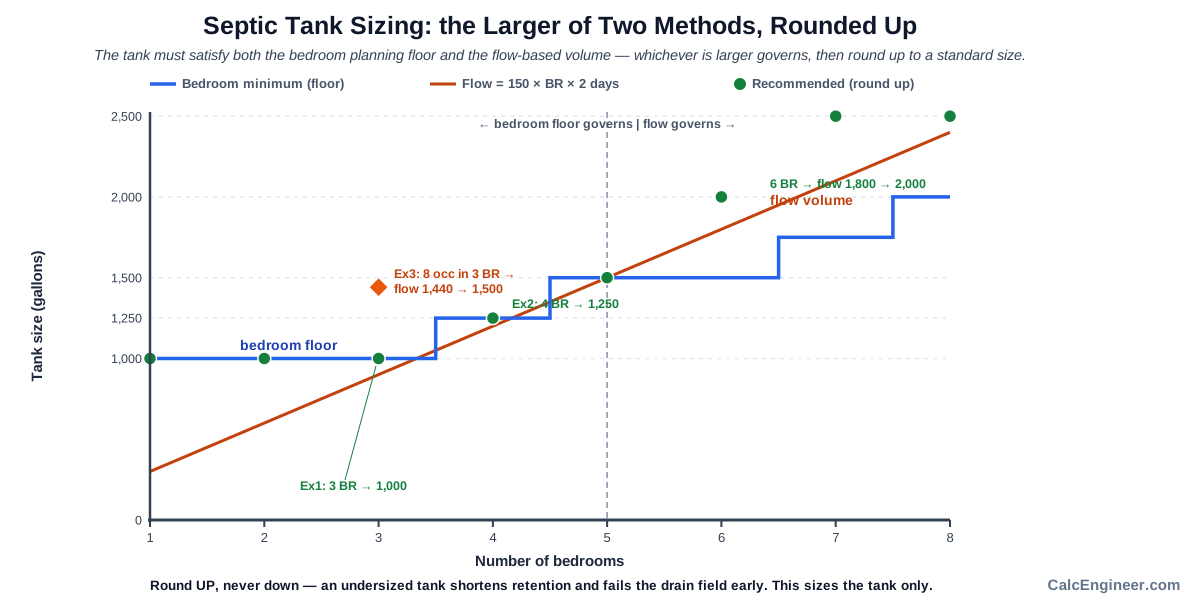
Bedrooms, not occupants. Sizing on the current household is the classic mistake. Two people in a four-bedroom house still need a four-bedroom tank, because the tank is permanent and the occupancy is not. Health departments treat bedrooms as a proxy for maximum load, and they count any room that could be a bedroom.
Round up, never down. Tanks are manufactured in standard sizes, so the calculated minimum is rounded up to the next one. A base of 1,150 gallons becomes a 1,250-gallon tank. Rounding down is never done, because an undersized tank means short retention, solids carried into the drain field, and premature field failure that costs far more than the larger tank would have.
Estimated Pumping Interval
The tank needs pumping when accumulated sludge and scum start to crowd the working volume, and that timing is an estimate, not a fixed schedule. A common range for residential systems is about every three to five years, but it depends on the tank size, the number of occupants, and the solids load. A garbage disposal or high occupancy shortens the interval; low occupancy lengthens it. The reliable approach is to inspect the sludge and scum depth periodically and pump on condition, following local guidance, rather than relying on a single predicted year.
Units
Volume: 1 gallon = 3.785 litres, so a 1,000-gallon tank is about 3,785 litres. Length and depth: 1 ft = 0.3048 m. Volume from dimensions: 1 cubic foot holds about 7.48 gallons, rounded to 7.5 as a practical sizing constant. Daily flow: gallons per day (gpd). 150 gpd per bedroom is about 568 litres per day. Per-person design flow: 50 to 100 gallons per person per day, with 70 typical.
Key Facts
- The recommended size is the larger of the bedroom planning minimum and the flow-based retention volume, rounded up to the next standard manufactured tank size.
- Bedrooms, not current occupants, set the planning minimum. Health departments size on the home's maximum potential occupancy, using the bedroom count as the proxy.
- A three-bedroom home typically needs a 1,000-gallon tank; four bedrooms usually 1,250; five to six usually 1,500.
- The flow-based volume uses a minimum retention time of two days so solids settle before effluent reaches the drain field.
- A garbage disposal increases the solids load and shortens the pumping interval; it does not simply add extra water flow.
- Soil percolation limits the drain field, not the tank. A larger tank does not fix slow or clay soil.
- Standard manufactured tank sizes are 750, 1,000, 1,250, 1,500, 2,000, and 2,500 gallons. The base is always rounded up, never down.
- The pumping interval is a range estimate that varies with actual use and solids, not a guaranteed schedule.
Applications
- Planning a septic tank for new construction on a lot without municipal sewer.
- Checking whether an existing tank is adequate before buying a rural property.
- Estimating whether a future bedroom addition requires a larger tank.
- Sizing up when converting a home to a rental or adding occupants.
- Comparing a current tank size against the recommended planning minimum.
- Converting tank length, width, and liquid depth to a gallon capacity.
Example Calculation
Example 1: Three-bedroom home (bedroom minimum governs)
Given: 3 bedrooms, per-bedroom flow basis, no garbage disposal.
Method A — bedroom minimum:  1,000 gal
Method B — flow-based:  3 × 150 = 450 gpd
                        450 × 2 = 900 gal
base = max(1,000, 900) = 1,000 gal → already a standard size
Recommended: 1,000 gal (3,785 L), bedroom minimum governs.
The flow method asks for 900 gallons but the bedroom floor is 1,000, so the tank is 1,000 gallons. This is the most common residential outcome.
Example 2: Four-bedroom home
Given: 4 bedrooms, per-bedroom basis.
Method A — bedroom minimum:  1,250 gal
Method B — flow-based:  4 × 150 = 600 gpd; 600 × 2 = 1,200 gal
base = max(1,250, 1,200) = 1,250 gal
Recommended: 1,250 gal (4,731 L), bedroom minimum governs.
Example 3: High occupancy (flow method governs)
Given: 3 bedrooms, 8 occupants, per-occupant basis, 90 gpd/person, 2-day retention.
Method A — bedroom minimum:  1,000 gal
Method B — flow-based:  8 × 90 = 720 gpd; 720 × 2 = 1,440 gal
base = max(1,000, 1,440) = 1,440 gal → round up
Recommended: 1,500 gal (5,678 L), flow method governs.
8 occupants in 3 bedrooms triggers a high-occupancy advisory. The 1,440 gal flow volume beats the 1,000 gal bedroom floor and rounds up to 1,500 gal.
Example 4: Candidate tank check
Given: recommended 1,000 gal, existing 900-gal tank.
shortfall = 1,000 − 900 = 100 gal
ratio = 900 / 1,000 = 0.90 → UNDERSIZED-MARGINAL
Result: UNDERSIZED-MARGINAL, short 100 gal. The existing tank is 100 gal below the minimum and should be replaced.
Example 5: Dimension to volume
Given: inside length 8 ft, width 4 ft, operating liquid depth 4 ft.
gallons = 8 × 4 × 4 × 7.5 = 960 gal
Working liquid volume: 960 gal. Use the liquid depth below the outlet, not the overall tank height.
Standards & References
- US EPA Onsite Wastewater Treatment Systems Manual (EPA/625/R-00/008): federal reference for onsite design flow and retention basis
- US EPA Septic Systems (Onsite and Decentralized): program guidance and homeowner resources
- International Private Sewage Disposal Code (IPSDC), ICC: model code for private sewage disposal and tank sizing
- NSF/ANSI Standard 40 covers residential wastewater treatment units. Local and state health-department rules govern septic tank sizing and vary by jurisdiction; confirm requirements with your permitting authority.
Limitations
- This sizes a residential septic tank only, not the drain field, leach trenches, or absorption area, which come from a soil percolation test and the soil loading rate.
- A larger tank does not compensate for poor soil. The drain field is sized separately and is limited by soil percolation, not the tank.
- This is a planning estimate using a common bedroom-based profile, not a permit document. Local and state health-department rules govern and vary by jurisdiction.
- Not for commercial systems (offices, restaurants, retail) sized per seat, per employee, or per fixture unit, or for multi-family without adjustment; these require a licensed engineer.
- Does not design advanced treatment units, mound, sand-filter, or drip systems.
- Does not set setbacks from wells, property lines, or water bodies.
- The pumping interval is an advisory range that varies with actual use and solids, not a guaranteed schedule.
- Gallons-per-day figures are design flows, not metered usage. Confirm sizing with a licensed septic designer and the local permitting authority before installation.
Common Mistakes to Avoid
- Sizing on the current occupants instead of the bedroom count. Two people in a four-bedroom house still need a four-bedroom tank.
- Not counting rooms that could be bedrooms. A den or a finished basement room that a health department would count as a bedroom raises the required size.
- Using only the flow method and ignoring the bedroom floor. The recommended size is always the larger of the two.
- Rounding the calculated volume down to a smaller standard tank. Always round up: an undersized tank fails early and damages the drain field.
- Treating a garbage disposal as extra water flow. It mainly adds solids and shortens the pumping interval.
- Assuming a bigger tank fixes a slow-soil site. Soil limits the drain field, not the tank, and that is a separate calculation.
- Using the overall tank height in the dimension helper. Use the operating liquid depth below the outlet, not the full height or excavation depth.
Frequently Asked Questions
What size septic tank do I need for a 3-bedroom house?
Why is the tank sized on bedrooms instead of the number of people?
How is the flow-based volume calculated?
Can I use a 750-gallon septic tank?
Does adding a bedroom require a larger septic tank?
How often should a septic tank be pumped?
Does this calculator size the drain field too?
Does a garbage disposal mean a bigger tank?
Frequently Used Together
Engineers often use these calculators in combination for complete project workflows:
Related Calculators
Explore similar calculators that might be useful for your project:
Plumbing Quick Reference — Keep It On Your Phone On Site
A 10-page field reference for catching pressure, velocity, slope, and pump-sizing mistakes before you order pipe, close a wall, or add a booster.
- Velocity limits, fixture pressure minimums, drain slope, and the 80 psi ceiling in one table
- Worked examples that show why a single pressure number gives four different answers
- Keep it on your phone, or print the two field-check pages
Free PDF. Calculators stay free. Unsubscribe anytime.
Calculate
Commercial systems (restaurants, offices, retail) are sized per seat, employee, or fixture unit, out of scope for this calculator.
Count any room that could function as a bedroom, including a den or finished basement room. Health departments use the permit bedroom count, not current occupancy.
Per bedroom is the standard planning basis. Per occupant is used when actual occupancy is known and high relative to the bedroom count.
Minimum 2 days (clamped if lower). Default 2 days. Values below 2 are not recommended for conventional systems.
A garbage disposal increases solids load and shortens the pumping interval. It does not automatically multiply the hydraulic flow.
Only if the water softener discharges to the septic system and is locally permitted to do so. Added to the hydraulic daily flow.
Advisory only: does not change the tank size calculation. Rental and vacation homes may have different pumping patterns.
Raises a drain-field advisory only: does not change the tank volume. Slow soil limits the drain field, not the tank.
Enter an existing or proposed tank size to check it against the recommended minimum. Blank = return recommended size only.
Dimension-to-volume helper. Enter length, width, and liquid depth to compute working volume.
Interior width of the tank.
Use the liquid depth below the outlet, not the overall tank height or excavation depth. Excludes freeboard.