Pump Power Calculator — Hydraulic, Brake & Motor HP
On this page
Calculate
Motor mode computes all three powers and the recommended motor size. Brake mode stops at BHP. Hydraulic-only mode returns the useful fluid power with no efficiency input required.
US uses Q in gallons per minute, head in feet, and the 3960 constant. SI uses m³/hr, metres, and ρ × g × Q × H. Motor ladders differ: NEMA HP in US, IEC kW in SI.
Flow rate at the pump duty point. In US: gallons per minute. In SI: cubic metres per hour (the calculator converts internally to m³/s for the ρgQH formula).
If you have a pressure rise across the pump instead of head, use the pressure helper. Enter the RISE (discharge minus suction pressure), not the gauge discharge reading alone.
Total dynamic head: static lift plus pressure head, velocity head, and all friction and minor losses. Do not use vertical lift alone (friction can exceed lift on long runs).
Specific gravity scales the hydraulic power. For non-water fluids enter SG or density. Viscosity effects on the pump curve are not modeled; results for viscous oils are approximate.
Pump efficiency at your actual duty point on the pump curve, as a percentage (e.g. 75 for 75%). Do not use the catalog peak or best-efficiency-point value (duty-point efficiency is usually lower). Required for Brake and Motor modes.
Motor efficiency as a percentage (e.g. 92 for 92%). Required for Motor (full chain) mode. Typical range 90–97% for standard motors. Enter the full-load rated efficiency from the motor nameplate or data sheet.
Motor service factor, dimensionless. Typical NEMA value: 1.15. Multiplied by the candidate nameplate to get available shaft power. Leave blank to default to 1.0. Only used when a candidate motor is entered.
Multiplier applied to BHP before selecting the next standard motor size. Default 1.0 (select next size at or above BHP). Use 1.10–1.15 for conservative selection. Does not affect the candidate-motor check.
Optional. Enter the nameplate rating of the motor you want to check. The calculator multiplies it by the service factor and compares to BHP. Leave blank to skip the candidate check.
Optional. Annual operating hours for an energy estimate. The annual energy (kWh) uses motor electrical input × hours. Only available in Motor mode when motor efficiency is entered.
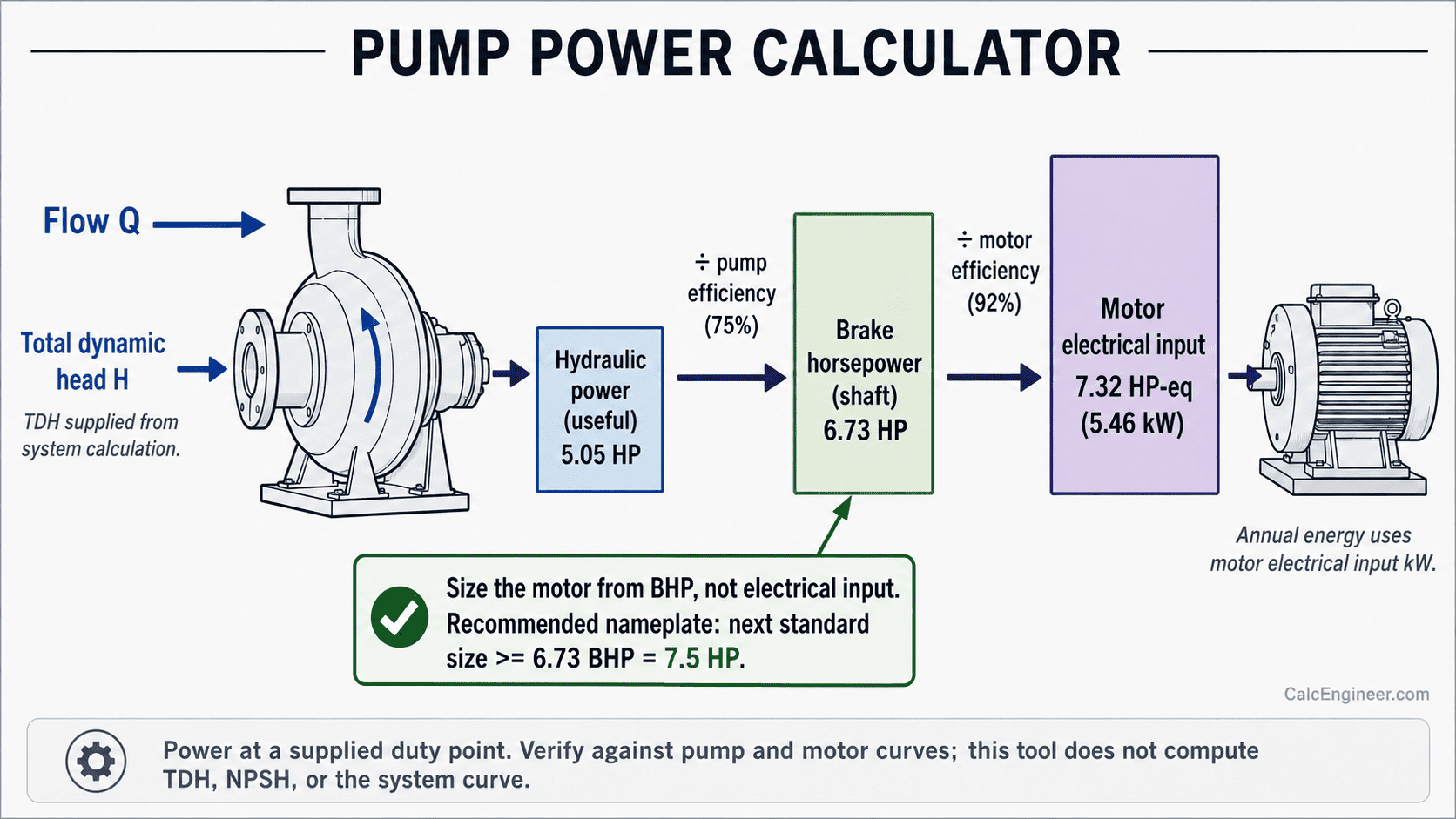
The pump power chain: hydraulic power to the fluid, brake horsepower at the shaft, and motor electrical input, with each step larger because of losses. The motor is sized from brake horsepower.
What to Look at First
Brake horsepower (BHP): this is the figure that sizes the motor. A motor's nameplate rating is its shaft output capability, not the power it draws from the grid. The motor must be sized so its rated output meets or exceeds the BHP. Read the recommended nameplate size directly from the result.
Motor electrical input: this is the figure for the energy bill. The motor draws more from the supply than it delivers to the shaft because of motor losses. This kW figure is what determines annual running cost, not the hydraulic or brake power.
Candidate motor check (Track B). If you entered a candidate motor and a service factor, the result shows whether that motor has adequate shaft power compared to the BHP. A ratio below 1.00 is undersized; 1.00–1.15 is adequate but tight; 1.15 and above is ample.
Overall efficiency. The product of pump efficiency and motor efficiency. A 75% pump and 92% motor give about 69% overall (the motor draws roughly 45% more power than the useful work delivered to the fluid).
How to Use This Calculator
Choose the Solve For mode: Motor input (full chain) to get all three powers and the motor recommendation, Brake/shaft power to stop at BHP, or Hydraulic power only for the fluid power alone.
Select the unit system: US (gpm, ft, HP) or SI (m³/hr, m, kW). All inputs, outputs, and motor ladders switch accordingly.
Enter the flow rate and the total dynamic head: static lift plus pressure, velocity, and friction losses. Use the pressure helper if you have a pressure rise instead of head.
Select or enter the fluid specific gravity (SG = 1.0 for water) or density. Preset options are available for water, seawater, and light oil.
Enter the pump efficiency at your actual duty point. For Motor mode, enter the motor efficiency as well.
Click Calculate to get hydraulic power, brake power, motor electrical input, overall efficiency, and the recommended standard motor nameplate size.
Optional: enter a candidate motor nameplate and a service factor to check whether that motor has enough shaft power over BHP. Enter operating hours for an annual energy estimate.
Enter the pump and motor efficiency at the actual operating point on the pump curve and motor performance curve, not the catalog peak or best-efficiency-point value. Efficiency away from the design point is lower.
Inputs & Outputs
Inputs
Outputs
Formula
Pump Power Energy Chain
Required power rises up the chain because each stage divides out a loss.
Hydraulic (useful) → Brake (÷ η_pump) → Motor electrical input (÷ η_motor)
US Units (Q in gpm, H in ft, power in HP)
Hydraulic HP = Q × H × SG / 3960
  3960 = 33,000 ft·lbf/min per HP ÷ 8.34 lb/gal (water); SG = 1.0 for water
Brake HP (BHP)              = Hydraulic HP / η_pump
Motor electrical (HP-equiv) = BHP / η_motor
SI Units (Q in m³/hr → m³/s: ÷ 3600; H in m; power in W → kW)
Hydraulic W = ρ × g × Q_m³s × H
  ρ [kg/m³], g = 9.81 m/s², Q_m³s = Q_m³hr / 3600
Brake W     = Hydraulic / η_pump
Motor W     = Brake / η_motor
Overall Efficiency
η_overall = η_pump × η_motor
Motor electrical input = Hydraulic / η_overall
Differential Pressure to Head
H_ft = Δpsi × 2.31 / SG    (psi → ft of fluid)
H_ft = Δbar × 33.455 / SG  (bar → ft)
H_ft = ΔkPa × 0.3346 / SG  (kPa → ft)
Note: when head is derived from ΔP via ÷SG, the SG cancels in the hydraulic formula; same pressure rise needs same power regardless of fluid density.
Motor Nameplate Selection (based on BHP, not motor input)
Recommended nameplate = next standard size ≥ BHP × design_margin
Candidate check:  available_shaft = candidate_nameplate × service_factor
                  ratio = available_shaft / BHP
  ratio ≥ 1.15          AMPLE
  1.00 ≤ ratio < 1.15   ADEQUATE (tight)
  ratio < 1.00          UNDERSIZED-MOTOR
Annual Energy (uses motor electrical input)
Annual energy [kWh] = Motor_kW × operating_hours
QA Benchmarks
PWR-1 (US): Q 200 gpm, H 100 ft, SG 1.0, η_pump 0.75, η_motor 0.92
  Hydraulic = 200 × 100 × 1.0 / 3960 = 5.05 HP
  BHP       = 5.05 / 0.75            = 6.73 HP
  Motor     = 6.73 / 0.92            = 7.32 HP-eq = 5.46 kW
  Recommend: next NEMA ≥ 6.73 → 7.5 HP nameplate

SI-1: Q 45.4 m³/hr, H 30.48 m, ρ 1000 kg/m³
  P_hyd = 1000 × 9.81 × (45.4/3600) × 30.48 = 3771 W = 3.77 kW = 5.05 HP

ENERGY: 5.46 kW × 2000 h = 10,920 kWh/yr
| Variable | Meaning | US | SI |
|---|---|---|---|
| Q | Flow rate | gpm | m³/hr |
| H | Total dynamic head | ft | m |
| SG | Specific gravity | n/a | n/a |
| ρ | Fluid density | n/a | kg/m³ |
| η_pump | Pump efficiency | fraction | fraction |
| η_motor | Motor efficiency | fraction | fraction |
| BHP | Brake horsepower | HP | kW |
| P_motor | Motor electrical input | HP-eq | kW |
Key Facts
- Required power rises up the chain: hydraulic is the useful minimum, brake adds pump losses, motor input adds motor losses. Required power increases at each step.
- A motor's nameplate rating is shaft output capability, not the power it draws from the supply. Size the motor from BHP, not from electrical input.
- In US units the constant 3960 converts gpm and feet to HP: it equals 33,000 ft·lbf/min per HP divided by 8.34 lb/gal for water.
- In SI units use ρ × g × Q × H directly (no 3960 constant). Convert Q from m³/hr to m³/s by dividing by 3600.
- Overall efficiency is η_pump × η_motor. A 75% pump and 92% motor give about 69% overall (the motor draws 45% more than the fluid receives).
- Specific gravity scales hydraulic power when head is in feet or metres of fluid. A lighter fluid like oil (SG 0.85) at the same flow and head needs less power than water.
- Use duty-point efficiency, not catalog peak or BEP efficiency. Efficiency drops away from the best-efficiency point, so using BEP overstates pump performance and understates power.
- Total dynamic head is not vertical lift alone; it includes pressure head, velocity head, and friction and minor losses through the entire system.
Applications
- Sizing a pump motor from a known flow rate and total dynamic head
- Estimating the motor electrical input and annual energy cost for a pump system
- Checking whether a candidate motor nameplate has enough shaft capacity with service-factor headroom
- Verifying that a motor stays adequate after a change in flow, head, or fluid specific gravity
- Comparing power demand for different fluids by entering their specific gravity
- Converting a pump pressure rise (psi, bar, or kPa) to total head before computing power
- Screening pump options at a duty point before reading detailed manufacturer pump curves
- Calculating overall efficiency (η_pump × η_motor) for system energy reporting
Example Calculation
Example 1: Full Chain (Water, US)
Given: 200 gpm, 100 ft TDH, water (SG 1.0), pump efficiency 75%, motor efficiency 92%.
Hydraulic HP = 200 × 100 × 1.0 / 3960 = 5.05 HP
BHP          = 5.05 / 0.75             = 6.73 HP
Motor input  = 6.73 / 0.92             = 7.32 HP-eq = 5.46 kW
η_overall    = 0.75 × 0.92             = 0.69 (69%)
Recommended motor: next NEMA size ≥ 6.73 BHP → 7.5 HP nameplate. The motor is chosen from BHP (6.73), not from the electrical input (7.32 HP-eq).
Example 2: Candidate Motor Check with Service Factor
Given: same duty (BHP 6.73 HP), candidate 7.5 HP motor, SF 1.15.
available_shaft = 7.5 × 1.15 = 8.625 HP
ratio           = 8.625 / 6.73 = 1.28  → AMPLE
At SF 1.0: ratio = 7.5 / 6.73 = 1.11 → ADEQUATE (tight).
Example 3: SI Parity and Denser Fluid
Given: 45.4 m³/hr (= 200 gpm), 30.48 m head (= 100 ft), water.
Q_m³s       = 45.4 / 3600 = 0.01261 m³/s
P_hydraulic = 1000 × 9.81 × 0.01261 × 30.48 = 3771 W = 3.77 kW = 5.05 HP
Matches Example 1 exactly. For light oil (SG 0.85, same flow and head in ft): 200 × 100 × 0.85 / 3960 = 4.29 HP (less power because the lighter fluid weighs less per gallon).
Example 4: Pressure Rise to Head
Given: 40 psi rise, water (SG 1.0), 200 gpm.
H_ft = 40 × 2.31 / 1.0 = 92.4 ft
Hydraulic HP = 200 × 92.4 × 1.0 / 3960 = 4.67 HP
For the same 40 psi with oil (SG 0.85): H = 108.7 ft, HP = 200 × 108.7 × 0.85 / 3960 = 4.67 HP, the same power because the same pressure rise needs the same hydraulic power regardless of SG.
Example 5: Annual Energy
Given: motor electrical input 5.46 kW, 2,000 hr/yr.
Annual energy = 5.46 × 2,000 = 10,920 kWh/yr
Uses motor electrical input, not hydraulic or brake power.
Standards & References
- Hydraulic Institute (HI): pump and pumping-system standards, efficiency definitions, and NPSH guidance; source for hydraulic power formulas and the 3960 constant
- NEMA MG-1, Motors and Generators: standard motor horsepower ratings and service factor definitions used in the NEMA HP ladder
- IEC 60034, Rotating electrical machines: standard kW motor ratings for the IEC kW ladder used in SI mode; referenced by name
- Engineering references (Pumps & Systems, Hydraulic Institute): document the 3960 constant derivation and the hydraulic, brake, and motor power chain
Units
The calculator works in US customary units by default and switches to SI on selection. In US mode: flow in gallons per minute (gpm), head in feet (ft), power in horsepower (HP) with kW equivalents, and motor sizes from the NEMA HP ladder. In SI mode: flow in cubic metres per hour (m³/hr), head in metres (m), power in kilowatts (kW) with HP equivalents, and motor sizes from the IEC kW ladder. The US hydraulic formula uses the 3960 constant; the SI formula uses ρ × g × Q × H directly. Conversions used: 1 HP = 0.7457 kW; 1 gpm = 0.2271 m³/hr; 1 ft = 0.3048 m; 1 psi = 2.31 ft of water at SG 1.
Limitations
- This calculator computes power at a single duty point you provide. It does not compute total dynamic head, friction losses, or the system curve.
- It does not check whether the selected pump can actually deliver the entered flow and head on its pump performance curve.
- Specific gravity scales the hydraulic power. Viscosity effects on the pump curve and efficiency are not modeled; results for viscous oils are approximate.
- It does not handle slurries, solids, or non-Newtonian fluids.
- It does not check NPSH available or cavitation. A pump can have adequate power while NPSH is insufficient.
- It does not model variable-speed (VFD) operation, affinity laws, the pump curve shape, or part-load efficiency penalties unless you fold those losses into the efficiency you enter.
- It does not size electrical details such as amps, kVA, power factor, breaker, cable, starter, overload, voltage, or phase.
- Motor drive, coupling, and VFD losses must be folded into the motor efficiency if present; they are not modeled as separate stages.
- It assumes a steady, incompressible-liquid duty point and an electric-motor drive. Engine drives and other prime movers are out of scope.
- Verify results against the actual pump and motor performance curves and a qualified engineer.
Common Mistakes to Avoid
- Sizing the motor from the electrical input instead of brake horsepower. The nameplate rating is shaft output, so choose a motor whose rated output meets or exceeds BHP.
- Confusing the three powers. Hydraulic is useful output, brake is shaft demand, motor input is what the motor draws from the supply. They are not interchangeable.
- Leaving SG at 1.0 for a non-water fluid. A denser or lighter fluid changes hydraulic power directly; seawater at SG 1.025 needs proportionally more power than water.
- Using catalog peak efficiency or BEP efficiency instead of duty-point efficiency. BEP applies only at the best operating point; away from it, efficiency drops and power increases.
- Entering an efficiency value above 100 or mistaking 75 for 0.75. The calculator accepts percent (0–100) and converts internally.
- Using vertical lift alone as the total head. Total dynamic head also includes pressure, velocity, and all friction losses through pipes, fittings, and valves.
- Using the gauge discharge pressure reading as the pressure rise for the head helper. The helper needs the pressure rise across the pump: discharge minus suction.
- Assuming a bigger motor fixes an undersized pump. A larger motor only provides more shaft power. The pump must still reach the duty-point flow and head on its pump curve.
- Treating adequate power as a NPSH check. A pump can have enough motor power and still cavitate if NPSH available is too low.
- Using the motor electrical input kW to pick the motor frame size. Nameplate HP is shaft output; use BHP for sizing, kW input for the energy bill.
Frequently Asked Questions
What is the difference between hydraulic, brake, and motor power?
Why do I size the motor from brake horsepower, not electrical input?
Does specific gravity matter for pump power?
What head should I enter?
How do I check a candidate motor?
Can a bigger motor fix an undersized pump?
Should I use the pump's peak efficiency or the duty-point efficiency?
Does this calculator check NPSH or cavitation?
Can I estimate annual energy consumption?
Frequently Used Together
Engineers often use these calculators in combination for complete project workflows:
Related Calculators
Explore similar calculators that might be useful for your project:
Plumbing Quick Reference — Keep It On Your Phone On Site
A 10-page field reference for catching pressure, velocity, slope, and pump-sizing mistakes before you order pipe, close a wall, or add a booster.
- Velocity limits, fixture pressure minimums, drain slope, and the 80 psi ceiling in one table
- Worked examples that show why a single pressure number gives four different answers
- Keep it on your phone, or print the two field-check pages
Free PDF. Calculators stay free. Unsubscribe anytime.
Calculate
Motor mode computes all three powers and the recommended motor size. Brake mode stops at BHP. Hydraulic-only mode returns the useful fluid power with no efficiency input required.
US uses Q in gallons per minute, head in feet, and the 3960 constant. SI uses m³/hr, metres, and ρ × g × Q × H. Motor ladders differ: NEMA HP in US, IEC kW in SI.
Flow rate at the pump duty point. In US: gallons per minute. In SI: cubic metres per hour (the calculator converts internally to m³/s for the ρgQH formula).
If you have a pressure rise across the pump instead of head, use the pressure helper. Enter the RISE (discharge minus suction pressure), not the gauge discharge reading alone.
Total dynamic head: static lift plus pressure head, velocity head, and all friction and minor losses. Do not use vertical lift alone (friction can exceed lift on long runs).
Specific gravity scales the hydraulic power. For non-water fluids enter SG or density. Viscosity effects on the pump curve are not modeled; results for viscous oils are approximate.
Pump efficiency at your actual duty point on the pump curve, as a percentage (e.g. 75 for 75%). Do not use the catalog peak or best-efficiency-point value (duty-point efficiency is usually lower). Required for Brake and Motor modes.
Motor efficiency as a percentage (e.g. 92 for 92%). Required for Motor (full chain) mode. Typical range 90–97% for standard motors. Enter the full-load rated efficiency from the motor nameplate or data sheet.
Motor service factor, dimensionless. Typical NEMA value: 1.15. Multiplied by the candidate nameplate to get available shaft power. Leave blank to default to 1.0. Only used when a candidate motor is entered.
Multiplier applied to BHP before selecting the next standard motor size. Default 1.0 (select next size at or above BHP). Use 1.10–1.15 for conservative selection. Does not affect the candidate-motor check.
Optional. Enter the nameplate rating of the motor you want to check. The calculator multiplies it by the service factor and compares to BHP. Leave blank to skip the candidate check.
Optional. Annual operating hours for an energy estimate. The annual energy (kWh) uses motor electrical input × hours. Only available in Motor mode when motor efficiency is entered.