Water Heater Sizing Calculator | FHR & Tankless GPM
On this page
Calculate
Sets the default recovery efficiency. You can override it in the candidate section when entering input power.
The temperature at the hot-water tap. Most residential systems run 120 °F (49 °C). Legionella control recommends ≥ 120 °F with a mixing valve at fixtures.
Groundwater temperature at the heater inlet. For tankless, use the coldest winter value. Summer average will oversize the result. Ranges: very cold ~37–40 °F, cold ~40–50 °F, temperate ~55–65 °F, warm ~70–77 °F (USGS).
Fixture ratings (e.g. a 2.0 GPM showerhead) describe mixed outlet flow at use temperature, not pure hot flow. Choose Mixed to enter fixture flow; the tool converts to pure hot demand using the hot fraction.
Total hot water used in the household's single busiest hour (usually the morning rush). Build it from the DOE Energy Saver worksheet: shower 20 gal, shave 2 gal, hand dishwashing or food prep 3 gal, automatic dishwasher 7 gal, clothes washer 25 gal top-load or 15 gal H-axis. These are total gallons at the fixture, so keep the Hot water basis.
Enter a specific heater to get a pass/fail verdict. The rated FHR from the EnergyGuide label is the most accurate option.
Overview
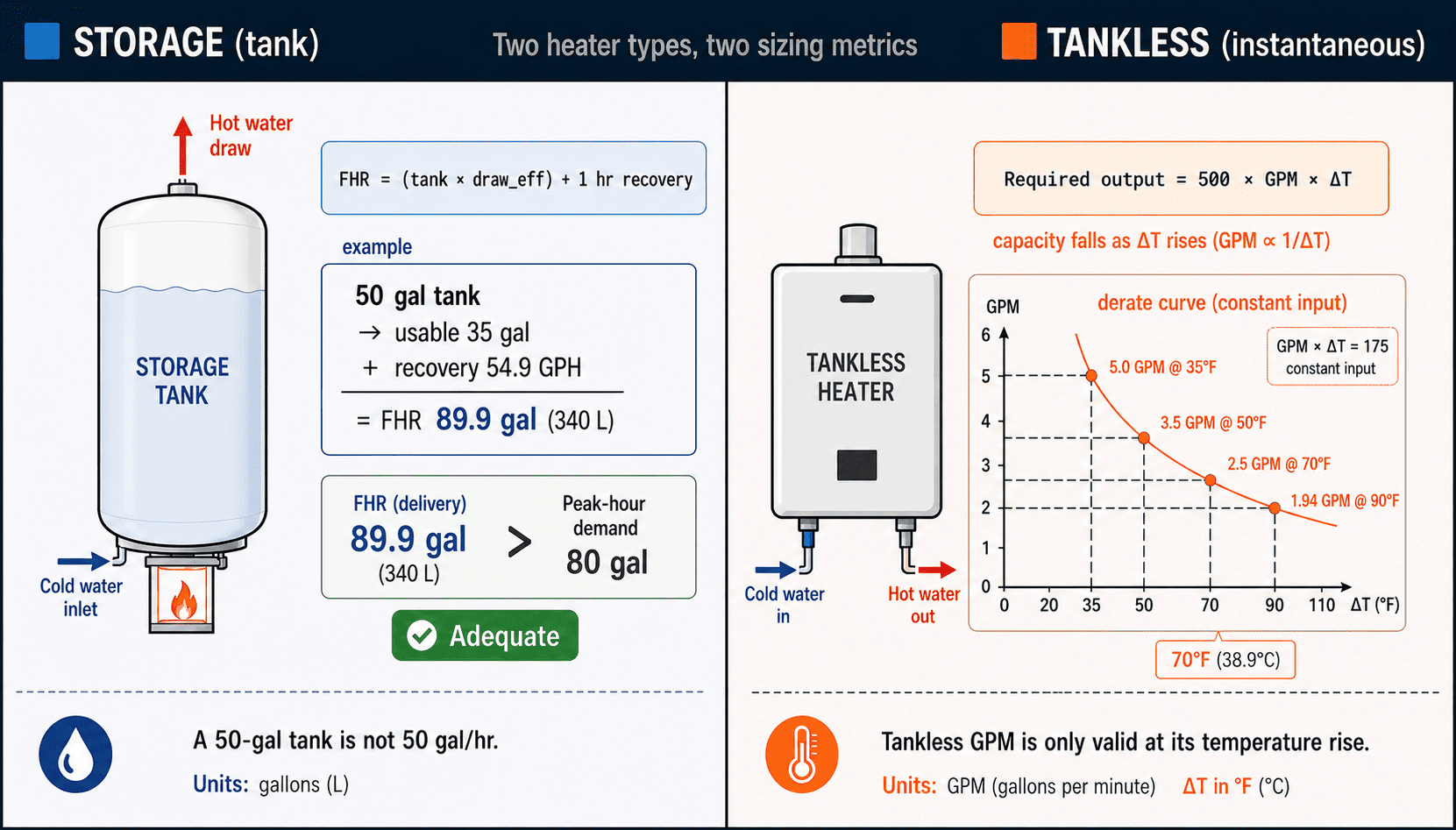
Picking a water heater by tank gallons alone is how households end up with cold showers on a busy morning. A storage heater keeps reheating while you draw water, so what it actually delivers in the worst hour is its first-hour rating (FHR), not its tank size. A tankless heater stores nothing. Its real capacity is the flow it can hold at a given temperature rise, and that flow drops as the incoming water gets colder.
This calculator handles both types as separate problems, because they are. In storage mode it compares your peak-hour demand in gallons against a unit's FHR. In tankless mode it compares your peak simultaneous flow in gallons per minute against what a unit delivers at your design temperature rise. It works in US and metric units, and it converts mixed fixture flow to true hot-water flow so the tankless numbers come out honest.
What to Look at First
Required FHR (Storage, no candidate). When no candidate heater is entered, the primary output is the minimum first-hour rating your peak-hour demand requires. Match this against the EnergyGuide label FHR, not the tank gallons on the side.
Pass/Fail Verdict (when a candidate is entered). The badge shows Adequate, At limit, or Undersized based on whether the heater's FHR or effective GPM covers the demand. The ratio (demand ÷ supply) drives the verdict at 1.00.
Effective GPM (Tankless). A tankless GPM rating is only valid at one temperature rise. The calculator derates the candidate GPM to your design rise: a 5 GPM unit at 35 °F rise delivers only 2.5 GPM at 70 °F. Check that your design rise (inlet to setpoint) matches the coldest winter inlet, not the annual average.
Mixed-Flow Conversion. If you entered mixed fixture flow (shower GPM or morning-rush gallons at use temperature), the hot fraction converts it to pure hot-water demand. This number is always smaller than the mixed flow. If it looks surprisingly low, verify the use temperature and setpoint.
How to Use This Calculator
Choose the heater type: Storage tank or Tankless. The two modes show different fields and produce different outputs.
Choose the fuel type: atmospheric gas, condensing gas, or electric resistance. This sets the default recovery efficiency for the calculation.
Set your delivery (setpoint) temperature. Most residential systems run 120 °F (49 °C).
Enter your cold-water inlet temperature. For tankless, use the coldest seasonal value. Winter is when the unit struggles most.
Pick the demand basis. Hot water direct means you enter pure hot flow from the heater. Mixed fixture flow means you enter the outlet flow at fixture use temperature, and the tool converts it to pure hot demand.
Enter the demand. Storage mode takes peak-hour gallons (the single busiest hour of the day). Tankless mode takes simultaneous fixture flow in GPM.
Optional: enter a candidate heater to get a pass/fail verdict. Storage accepts a rated FHR, or tank size plus recovery rate, or tank size plus input power and efficiency. Tankless accepts a rated GPM at a stated temperature rise, or an input rating with efficiency.
Read the result. Without a candidate you get the required FHR or required GPM. With a candidate you get an adequacy verdict and surplus or deficit.
This is a residential screening tool. Final selection requires the manufacturer's performance table at your specific inlet and setpoint conditions.
Inputs & Outputs
Inputs
Mode & Fuel
Temperatures & Demand Basis
Storage Mode Demand
Storage Candidate (Optional)
Tankless Mode Demand
Tankless Candidate (Optional)
Outputs
All Modes
Storage Mode
Tankless Mode
Formula
Water Heater Sizing Formulas
Temperature rise
ΔT = T_delivery − T_inlet
US: °F      Metric: °C      ΔT(°C) = ΔT(°F) / 1.8
For tankless, use the coldest expected inlet (winter design).
Mixed flow to hot flow (both modes)
hot_fraction  = (T_use − T_cold) / (T_delivery − T_cold)
hot_GPM       = mixed_GPM     × hot_fraction
hot_gallons   = mixed_gallons × hot_fraction
Validity: T_cold < T_use ≤ T_delivery. The fraction is unit-agnostic (ratio of temperature differences).
Storage: recovery, usable volume, first-hour rating
Recovery (GPH) = (Input_BTUh × eff) / (8.33 × ΔT°F)
   electric:     Input_BTUh = kW × 3,412
Usable storage = capacity × draw_eff         draw_eff = 0.70 (screening assumption)
First-Hour Rating = (capacity × draw_eff) + Recovery
Full reheat time  = (capacity × 8.33 × ΔT°F) / (Input_BTUh × eff)     [hours, from cold]
Adequate if FHR ≥ peak-hour demand

Metric: Recovery (L/h) = (Input_kW × 3,600 × eff) / (4.186 × ΔT°C)
Storage: recovery derate (when rated at different ΔT)
GPH_design = GPH_rated × (ΔT_rated / ΔT_design) [constant-input assumption]
Tankless: required heat and effective capacity
Required output  Q_out = 500 × GPM × ΔT°F              (500 = 8.33 lb/gal × 60 min/h)
Required input   Q_in  = Q_out / eff
Capacity vs rise GPM(ΔT) = (Q_in × eff) / (500 × ΔT°F)  →  GPM ∝ 1/ΔT
Candidate derate GPM_eff = min( max_GPM , GPM_rated × ΔT_rated / ΔT_design )
Adequate if GPM_eff ≥ peak simultaneous hot GPM

Metric: Q_out(kW) = 0.0698 × flow(L/min) × ΔT°C
Verdict: demand-to-supply ratio
ratio = demand ÷ supply
  ratio ≤ 0.90           Adequate
  0.90 < ratio ≤ 1.00    Adequate, at limit
  1.00 < ratio ≤ 1.15    Undersized, marginal
  1.15 < ratio ≤ 1.50    Undersized
  ratio > 1.50            Significantly undersized
| Variable | Definition |
|---|---|
| T_delivery | Hot-water setpoint temperature |
| T_inlet | Incoming cold-water temperature |
| T_use | Fixture use (mix) temperature |
| T_cold | Same as T_inlet in the hot-fraction formula |
| ΔT | Temperature rise from inlet to delivery |
| hot_fraction | Fraction of fixture flow that is pure hot water |
| Input_BTUh | Burner or element input rating (BTU/h) |
| eff | Recovery or thermal efficiency (not UEF) |
| draw_eff | Usable fraction of tank volume (0.70, screening assumption) |
| 8.33 | Water weight in lb/gal |
| 500 | 8.33 lb/gal × 60 min/h, tankless BTU·min/(gal·°F·h) |
| 3,412 | BTU/h per kW (1 kW = 3,412 BTU/h) |
| GPM_eff | Effective tankless GPM after derating to design ΔT |
Decision Model
The verdict follows a single ratio: demand divided by supply. For storage, that is peak-hour demand divided by FHR. For tankless, it is required hot GPM divided by effective GPM at design rise. Below 1.00 the heater covers the load; above 1.00 it cannot.
| Ratio (demand ÷ supply) | Verdict | Meaning |
|---|---|---|
| 0.90 or below | Adequate | Strong margin against peak demand |
| Above 0.90 to 1.00 | Adequate, at limit | Heater just covers the load; verify inputs |
| Above 1.00 to 1.15 | Undersized, marginal | Slight shortfall; a cold shower is possible |
| Above 1.15 to 1.50 | Undersized | The heater cannot sustain full peak demand |
| Above 1.50 | Significantly undersized | Heater is well short of the peak load |
Without a candidate, the tool returns the required FHR (storage) or required GPM and BTU/h (tankless) so the user can shop by that specification rather than by tank size or nominal GPM.
Why FHR Matters More Than Tank Size
A storage heater keeps reheating while you draw from it. A 50-gallon tank with a strong burner can deliver 90 gallons in the first hour because it refills 40 gallons of recovery during that time. A 50-gallon tank with a weak element might deliver only 60 gallons. Both are 50-gallon tanks. The FHR captures that difference; the tank size does not.
The FHR is printed on the yellow EnergyGuide label and comes from a standardized DOE test at 125 °F outlet. When the user's setpoint and inlet differ from the test conditions, the rated FHR remains the best available estimate for field conditions at similar temperature rise. A computed FHR from the recovery formula is a screening value, not a rated value.
Tankless Temperature Rise Is Not Optional
A tankless heater is a flow-through heat exchanger. It puts a fixed rate of heat into the water, so its flow rate drops as the temperature rise climbs. A unit that achieves 5.0 GPM at a 35 °F rise delivers exactly half that (2.5 GPM) at a 70 °F rise. The derate formula is GPM ∝ 1/ΔT: flow is inversely proportional to rise. A GPM number on a spec sheet is meaningful only when the test rise is also stated.
Residents in cold climates often discover this the hard way. A unit that works in summer, when groundwater runs 60–65 °F and the rise is 55–60 °F, can struggle in January when groundwater drops to 40 °F and the rise climbs to 80 °F. The same unit has to produce 80/60 = 1.33 times more heat per gallon, so its GPM falls to 60/80 = 0.75 of the summer figure. Winter is always the binding constraint.
Mixed Flow vs Hot Flow
A 2.0 GPM showerhead delivers 2.0 GPM of mixed water at use temperature, not 2.0 GPM of pure 120 °F hot water. The heater only has to supply the hot fraction, the portion that is not diluted with cold water at the mixing valve. At a 50 °F inlet, a 120 °F setpoint, and a 105 °F shower temperature, the hot fraction is (105 − 50) / (120 − 50) = 0.786. The heater only needs to supply 2.0 × 0.786 = 1.57 GPM of hot water, not 2.0 GPM.
For storage, the same math applies to peak-hour gallons. Sizing on the mixed flow overstates the required FHR by the same factor, which leads to a tank that is larger than necessary. The error is common because fixture specs always describe mixed outlet flow.
What is First-Hour Rating and Temperature Rise
First-hour rating is the total gallons of hot water a fully heated storage tank can deliver in one hour of heavy use. It accounts for the water already in the tank plus the reheating that occurs during the draw. It is the number on the EnergyGuide label and is the correct metric for matching a tank to morning peak demand.
Temperature rise is the degrees the heater must lift the incoming water to reach the setpoint. A 120 °F setpoint over 50 °F groundwater is a 70 °F rise. A tankless heater rated at 5 GPM is rated at one specific rise, and it delivers less flow as the rise increases.
Key Facts
- A 50-gallon tank does not deliver 50 gallons per hour. Its FHR can run from 60 to 90 gallons depending on recovery rate.
- The federal flow cap for showerheads is 2.5 GPM. WaterSense labels cap at 2.0 GPM; California requires 1.8 GPM or less.
- The DOE FHR test draws from a fully heated tank at 125 °F outlet under the Uniform Energy Factor method (10 CFR 430 Appendix E).
- Groundwater temperature ranges from about 37 °F in northern Minnesota to 77 °F in southern Florida, affecting both recovery rate and tankless flow.
- The constant 500 in the tankless formula is 8.33 lb/gal × 60 min/h. Not a fudge factor.
- UEF (Uniform Energy Factor) is not the recovery efficiency used in these formulas. UEF is an overall metric that includes standby and cycling losses.
- A tankless GPM rating is meaningless without its temperature rise. Always read them together.
- Gas heaters recover roughly two to three times faster than electric resistance at the same tank size and temperature rise.
Applications
- Homeowners replacing a failed heater who want the right size, not just the same size.
- Plumbers and contractors running a fast field screen before quoting a storage or tankless unit.
- Cold-climate homes where low inlet temperature drives tankless GPM well below the spec-sheet number.
- Remodels that add a bathroom or soaking tub and push peak demand above the existing heater's FHR.
- Anyone weighing storage against tankless, where the winter ΔT is the deciding factor.
- Verifying whether an existing heater can handle a household addition or hot tub filling demand.
- Engineering offices preparing plumbing design documentation that requires a documented FHR or GPM basis.
Example Calculation
Example Calculation
Example 1: Storage, gas, family of four
Given: 50 gal atmospheric gas tank, 40,000 BTU/h burner, 80% efficiency, inlet 50 °F, setpoint 120 °F.
ΔT        = 120 − 50                        = 70 °F (38.9 °C)
Recovery  = (40,000 × 0.80) / (8.33 × 70)   = 54.9 GPH (207.7 L/h)
Usable    = 50 × 0.70                        = 35 gal (132.5 L)
FHR       = 35 + 54.9                        = 89.9 gal (340 L)
Ratio     = 80 / 89.9                        = 0.89   → Adequate
Reheat    = (50 × 8.33 × 70) / 32,000        = 0.91 h (55 min)
Result: FHR 89.9 gal covers the 80 gal peak-hour demand with about a 10% margin.
Example 2: Tankless, mixed flow, winter inlet
Given: shower plus kitchen faucet, 3.5 GPM mixed at 105 °F, inlet 50 °F, delivery 120 °F, candidate rated 5.0 GPM at a 35 °F rise.
hot_fraction = (105 − 50) / (120 − 50)       = 0.786
Hot demand   = 3.5 × 0.786                    = 2.75 GPM (10.4 L/min)
ΔT           = 120 − 50                        = 70 °F (38.9 °C)
Req. output  = 500 × 2.75 × 70                 = 96,250 BTU/h (28.2 kW)
Req. input   = 96,250 / 0.80                   = 120,300 BTU/h (35.3 kW)
Candidate    = 5.0 × 35 / 70                   = 2.5 GPM at 70 °F rise
Ratio        = 2.75 / 2.5                       = 1.10   → Undersized (marginal)
Result: the 5.0 GPM unit falls short at the winter rise. Sizing on the raw 3.5 GPM mixed flow would overstate demand by 27%.
Standards & References
- U.S. Department of Energy, Energy Saver: Sizing a New Water Heater
- eCFR, 10 CFR Part 430, Subpart B, Appendix E. Uniform Test Method for Measuring the Energy Consumption of Water Heaters; defines FHR and Maximum GPM Rating.
- ENERGY STAR: Residential Water Heaters, Key Product Criteria. FHR and GPM definitions for certified units.
- U.S. EPA WaterSense: Showerheads. Flow-rate standards (2.0 GPM WaterSense, 2.5 GPM federal cap).
- U.S. Geological Survey: Water Data for the Nation. Groundwater temperature by region (basis for inlet temperature estimates).
- International Plumbing Code (IPC, ICC) and Uniform Plumbing Code (UPC, IAPMO): local capacity provisions; confirm the edition adopted in your jurisdiction.
- Draw efficiency (0.70): a screening assumption used by this calculator for the usable fraction of a tank, not a figure from the DOE test procedure or from a published standard. Where an EnergyGuide first-hour rating exists, enter it instead.
Limitations
- This is a residential / light-commercial screening tool. It covers single storage or tankless units only.
- It does not size or verify the gas meter, gas pipe, electrical service, breaker, or panel capacity.
- It does not check venting, combustion air, condensate drainage, or code-required clearances.
- It does not model standby heat loss, recirculation-loop loss, tank stratification beyond the draw-efficiency assumption, altitude derating for gas, or scale buildup in hard water.
- It does not check minimum activation flow for tankless units, which matters for low-flow fixtures.
- It covers the first hour of peak demand only. Multi-hour sustained demand (e.g., filling a pool) is not modeled.
- It does not size an expansion tank, estimate energy cost, or check annual consumption.
- Temperature safety, scald protection, mixing valves, Legionella control, and code compliance are separate design checks.
- A manufacturer's performance table governs the final unit selection. The computed FHR from the recovery formula is a screening estimate, not a rated test value.
- Draw efficiency is fixed at 0.70, a screening assumption rather than a figure from the DOE test procedure. Actual usable fraction varies with tank design, stratification, dip tube, and thermostat location.
Common Mistakes to Avoid
- Buying by tank gallons alone. A 40-gallon tank with a strong burner can out-deliver a 50-gallon tank with a weak element.
- Sizing a tankless on the annual-average inlet temperature. Winter is colder, the rise is bigger, and the unit delivers less right when you need it.
- Reading a tankless GPM rating without its temperature rise. The same unit can be 5.0 GPM at 35 °F rise and 2.5 GPM at 70 °F rise.
- Adding fixture flows as if they were pure hot water. Shower and faucet flows are usually mixed. Convert with the hot fraction.
- Using UEF as the efficiency in the recovery formula. Use recovery or thermal efficiency instead.
- Trusting a calculated FHR over a label FHR. The computed value is a screening estimate; the label comes from a standardized DOE test.
- Sizing storage on total daily hot-water use instead of the single busiest hour. The first-hour rating is matched to peak-hour demand, not daily volume.
Frequently Asked Questions
What size water heater does a family of four need?
Does a 50-gallon tank give 50 gallons of hot water per hour?
How do I size a tankless water heater?
What temperature rise should I plan for?
Why does gas recover faster than electric?
Why does my tankless run out of hot water in winter?
What is the difference between first-hour rating and recovery rate?
Is the calculated FHR the same as the FHR on the label?
Frequently Used Together
Engineers often use these calculators in combination for complete project workflows:
Related Calculators
Explore similar calculators that might be useful for your project:
Plumbing Quick Reference — Keep It On Your Phone On Site
A 10-page field reference for catching pressure, velocity, slope, and pump-sizing mistakes before you order pipe, close a wall, or add a booster.
- Velocity limits, fixture pressure minimums, drain slope, and the 80 psi ceiling in one table
- Worked examples that show why a single pressure number gives four different answers
- Keep it on your phone, or print the two field-check pages
Free PDF. Calculators stay free. Unsubscribe anytime.
Calculate
Sets the default recovery efficiency. You can override it in the candidate section when entering input power.
The temperature at the hot-water tap. Most residential systems run 120 °F (49 °C). Legionella control recommends ≥ 120 °F with a mixing valve at fixtures.
Groundwater temperature at the heater inlet. For tankless, use the coldest winter value. Summer average will oversize the result. Ranges: very cold ~37–40 °F, cold ~40–50 °F, temperate ~55–65 °F, warm ~70–77 °F (USGS).
Fixture ratings (e.g. a 2.0 GPM showerhead) describe mixed outlet flow at use temperature, not pure hot flow. Choose Mixed to enter fixture flow; the tool converts to pure hot demand using the hot fraction.
Total hot water used in the household's single busiest hour (usually the morning rush). Build it from the DOE Energy Saver worksheet: shower 20 gal, shave 2 gal, hand dishwashing or food prep 3 gal, automatic dishwasher 7 gal, clothes washer 25 gal top-load or 15 gal H-axis. These are total gallons at the fixture, so keep the Hot water basis.
Enter a specific heater to get a pass/fail verdict. The rated FHR from the EnergyGuide label is the most accurate option.