Tankless Water Heater Sizing Calculator — GPM, Rise & BTU
On this page
Calculate
Gas units are rated in BTU per hour. Electric units are rated in kW and draw heavy current, often 100 to 150 amps or more for a whole home, which usually needs a service upgrade.
Direct: enter the total hot-water flow you expect at the same time. Fixture build-up: select how many of each fixture will run simultaneously; the tool sums their hot-water flows and applies a diversity factor.
The hot-water flow the heater must sustain when all selected fixtures run at the same time. A shower is about 2 GPM, a kitchen faucet about 1.5 GPM, a tub filler about 4 GPM.
The heater setpoint, not the mixed shower temperature. Commonly 120 °F (49 °C). Above 120 °F raises scald risk; 140 °F (60 °C) is the maximum accepted here. Leave blank to use the 120 °F default.
Select a preset or enter your own value below. Always use the coldest-month groundwater temperature, not the annual average. Sizing on the summer average is the most common tankless sizing mistake.
The groundwater temperature entering the heater in your coldest month. Ranges: very cold ~40 °F (4 °C), cold ~50 °F (10 °C), temperate ~60 °F (16 °C), warm ~70 °F (21 °C).
Advanced Parameters (optional, leave empty to use defaults)
Non-condensing units typically achieve 80–85 % efficiency and require metal venting. Condensing units achieve 90–96 % and can use plastic venting. Check the product data sheet.
The input rating of one typical residential gas unit, used to judge whether one unit covers the demand. Default 199,000 BTU/hr. Raise it for a commercial model.
Overview
A tankless water heater has to meet two things at once: the peak hot-water flow in GPM and the temperature rise from the incoming water to the temperature you want. That is different from a storage tank, which is sized by gallons and recovery. A tankless unit heats water as it flows, so the heat it must supply is the flow times the rise times 500. The colder the incoming water, the higher the rise, and the less flow the same unit can deliver. A heater that gives two hot showers at once in summer can manage only one in the coldest part of winter.
This calculator computes the temperature rise, the heat output needed, and the gas input in BTU per hour or the electric power in kW and amps. It shows the size class, whether one unit is enough or two are needed in parallel, and how much flow a reference unit can actually deliver at your rise, which is the tankless version of reading a pump curve.
This is a sizing aid. Final selection uses the manufacturer flow-versus-rise chart for the specific model, and gas line, venting, and electrical are a separate design.
What to Look at First
Temperature Rise and Required BTU/hr. The heat the unit must supply is 500 times the flow in GPM times the rise in Fahrenheit. A higher rise means more heat per gallon, so the same unit delivers less flow. Always use the coldest-month incoming water temperature, not the summer average.
Single-Unit Utilization (U). The calculator compares the required input to the reference single-unit capacity and returns U = required ÷ reference. U below 0.85 is comfortable; 0.85 to 1.00 is marginal; above 1.00 means one unit is not enough.
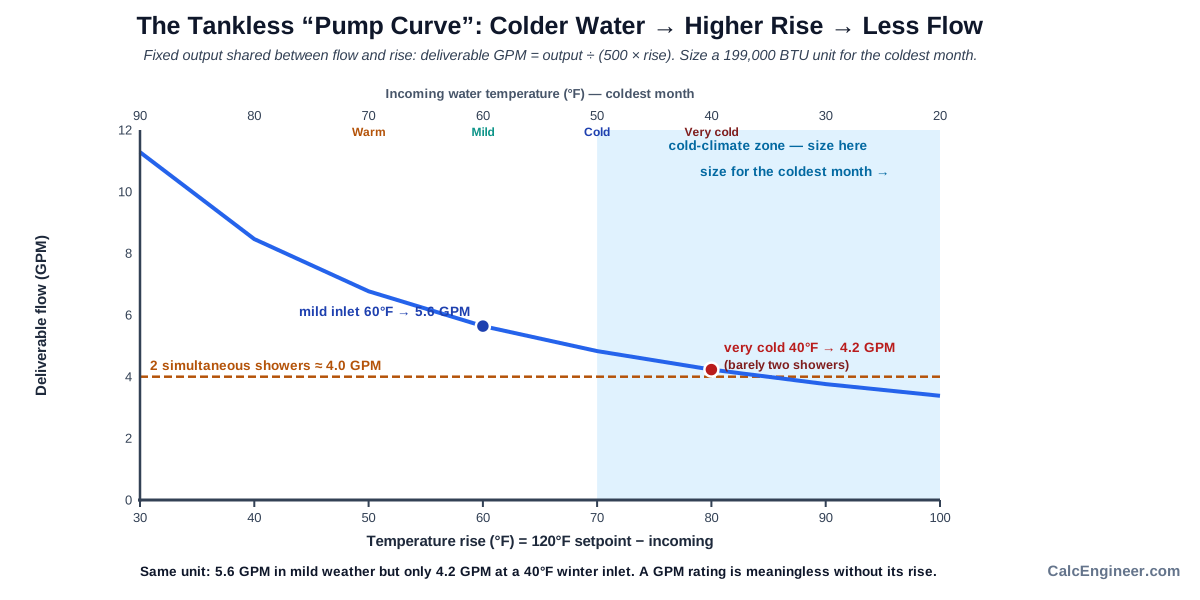
Deliverable GPM at Your Rise. This is how much flow the reference unit can actually deliver at your temperature rise. It is lower than the rated GPM at a lower rise. A 199,000 BTU gas unit delivers about 5.6 GPM at a 60 °F rise but only about 4.2 GPM at an 80 °F rise.
Electric Service Band. For electric units, the calculator shows the required amps. A whole-home electric tankless can need 100 to 150 amps or more, which often requires a panel upgrade.
How to Use This Calculator
Choose your unit system (US or metric) using the Unit System selector inside the calculator. Every field, label, and result follows that selector.
Choose the fuel type: Gas returns a BTU per hour rating with gas-line and venting notes. Electric returns kW and amps with a service impact note.
Choose the flow entry method: Direct GPM lets you enter the peak simultaneous hot-water flow directly. Fixture Build-up lets you select the number of each fixture type running at once and applies a diversity factor.
Enter the desired outlet temperature. This is the heater setpoint, commonly 120 °F. If left blank, 120 °F is used as the default.
Enter the incoming water temperature for your coldest month, or select a preset (Warm 70 °F, Mild 60 °F, Cold 50 °F, Very Cold 40 °F). Always use the coldest-month value, not the annual average.
Read the result. The calculator shows the temperature rise, required output, gas input in BTU/hr or electric power in kW and amps, the deliverable GPM of a reference unit at your rise, the utilization ratio, and the size class.
This is a residential sizing aid. Final selection uses the manufacturer flow-versus-rise chart for the specific model. Gas line, venting, and electrical design are separate.
Inputs & Outputs
Inputs
Mode & Fuel
Flow (Direct)
Fixtures (Build-up Mode)
Temperatures
Advanced (Optional)
Outputs
Demand & Rise
Heat Output & Input
Capacity & Verdict
Formula
Tankless Water Heater Sizing Formulas
Temperature rise
rise = desired_outlet − incoming_water          [°F or °C]
If rise ≤ 0: nothing to heat (physically invalid).
Required heat output (US units)
output_BTU_hr = 500 × Q_GPM × rise_°F
(500 = 8.33 lb/gal × 60 min/hr × 1 BTU/lb-°F ≈ 499.8, rounded)
Gas input rating
input_BTU_hr = output_BTU_hr ÷ efficiency
Non-condensing: 0.80–0.85. Condensing: 0.94.
Electric power and current (single phase)
kW   = output_BTU_hr ÷ 3,412 ÷ 0.99      [electric efficiency 0.99]
amps = kW × 1,000 ÷ voltage              [single-phase estimate]
Deliverable GPM of the reference unit (includes efficiency)
deliverable_GPM = ref_input × eff ÷ (500 × rise_°F)
A higher rise always means lower deliverable flow from the same unit.
Single-unit utilization and verdict
U = round(required_input ÷ reference_input, 2)
  U < 0.85          → Single Unit: OK
  0.85 ≤ U ≤ 1.00   → Single Unit: Marginal (size up or plan for two)
  U > 1.00           → Parallel Units Needed
Metric equivalents
Flow in L/min, temperatures in °C, power in kW.
kW = 0.0698 × flow_Lmin × rise_°C
Conversions: 1 GPM = 3.785 L/min, rise_°C = rise_°F ÷ 1.8
120 °F = 48.9 °C, 60 °F rise = 33.3 °C rise.
Decision Model
The single-unit verdict follows a utilization ratio: U = required input divided by reference unit capacity, rounded to two decimal places.
| U (rounded to 2 decimals) | Verdict | Meaning |
|---|---|---|
| Below 0.85 | Single Unit: OK | One unit covers the demand with comfortable margin |
| 0.85 to 1.00 | Single Unit: Marginal | One unit at or near its limit; size up or plan for two |
| Above 1.00 | Parallel Units Needed | One typical residential unit cannot meet this demand |
The deliverable GPM of the reference unit at the design rise is always shown alongside the required GPM. If the deliverable exceeds the required, one unit covers the flow. If it falls short, the utilization confirms it.
What is Temperature Rise and Why Does GPM Fall
Temperature rise, or delta T, is the degrees the heater must add to the water. It is the desired outlet temperature minus the incoming water temperature. If you want 120 °F at the tap and the incoming water is 60 °F, the rise is 60 °F. If the incoming water drops to 40 °F in the depth of winter, the rise is 80 °F for the same setpoint.
A tankless unit has a fixed heat output, and that output is shared between flow and rise. The heat needed is the flow times the rise times 500, so for a fixed heater, a higher rise means less capacity for flow. This is why a unit rated at 5 GPM at a 35 °F rise delivers only about 2.5 GPM at a 70 °F rise, and about 4.2 GPM for a 199,000 BTU unit at an 80 °F rise.
Cold Climate Sizing
Cold climates drive tankless sizing. Winter groundwater can be near 40 °F, making the rise to a 120 °F setpoint about 80 °F. At that rise, a unit delivers far less flow than its warm-climate rating. The same model that handles a big household in a warm climate may barely cover two showers in a cold one.
The calculator flags a cold-climate condition when the incoming temperature is at or below 45 °F or the rise is at or above 70 °F. This is the most important warning in the result.
Gas vs Electric
Gas units are rated in BTU per hour. A residential whole-home gas unit typically runs 150,000 to 199,000 BTU/hr, which covers most homes even in cold climates. Gas units need an adequate gas line and specific venting.
An electric unit is rated in kW and draws heavy current. A whole-home electric tankless in a cold climate can need 100 to 150 amps or more. Many homes with a 200 A service cannot add that without an upgrade, which is why electric whole-home tankless is often impractical and electric units are more common for point-of-use and warmer climates.
Fixture Build-up and Diversity
When sizing by fixture, the hot-water demand per fixture is an estimate of the actual hot-water flow, not the total mixed flow at the fixture outlet. A shower rated 2.0 GPM at the fixture uses about 2.0 GPM of pure hot water at the heater setpoint, because the rest of the flow is cold water added at the mixing valve.
Most homes do not run every hot-water fixture at once. A diversity factor trims the fixture total to a realistic peak. For example, 2 showers plus 1 kitchen faucet totaling 5.5 GPM at a diversity factor of 80 % gives a peak demand of 4.4 GPM.
Key Facts
- The tankless sizing constant 500 comes from 8.33 lb/gal times 60 min/hr times 1 BTU/lb-°F, about 499.8, rounded to 500.
- A 199,000 BTU gas unit delivers about 8.5 GPM at a 40 °F rise but only about 4.2 GPM at an 80 °F rise — roughly half the flow for double the rise.
- The ENERGY STAR benchmark for a whole-home gas tankless is a minimum of 2.5 GPM at a 77 °F rise, which ties flow to a specific rise.
- Electric tankless efficiency is fixed at about 0.99 because nearly all electricity is converted to heat with minimal standby loss.
- A 31 kW electric unit at 240 V draws about 130 amps — more than most US residential panels can add without an upgrade.
- Groundwater temperature ranges from about 40 °F in northern Minnesota to 77 °F in southern Florida, which shifts the design rise by up to 37 °F.
- The deliverable GPM and the utilization verdict must always agree: if U is 1.00 or below, deliverable GPM at the design rise must be at or above the required GPM.
- A tankless GPM rating is meaningless without the temperature rise it was measured at. Always read them together.
Applications
- Choosing a whole-home tankless unit for a house by peak flow and climate.
- Comparing a gas and an electric tankless for the same demand.
- Checking whether one unit is enough or two are needed in parallel.
- Sizing for a cold-climate home where winter groundwater is near 40 °F.
- Estimating the electric amperage to see whether the service can support an electric unit.
- Sizing a point-of-use tankless for a single fixture or a remote bathroom.
- Checking whether an existing tankless is undersized for the coldest month.
- Planning a tankless upgrade from a storage tank.
Example Calculation
Example Calculations
Case 1 — Warm climate, gas (canonical)
4 GPM, desired 120 °F, incoming 60 °F.
Rise   = 120 − 60                        = 60 °F (33.3 °C)
Output = 500 × 4 × 60                    = 120,000 BTU/hr (35.2 kW)
Input  = 120,000 ÷ 0.85                  = 141,000 BTU/hr
U      = round(141,000 ÷ 199,000, 2)     = 0.71  →  Single Unit: OK
Deliverable GPM = 199,000 × 0.85 ÷ (500 × 60) = 5.6 GPM > 4 GPM ✓
Case 2 — Same 4 GPM, cold climate
4 GPM, desired 120 °F, incoming 40 °F.
Rise   = 120 − 40                        = 80 °F
Output = 500 × 4 × 80                    = 160,000 BTU/hr
Input  = 160,000 ÷ 0.85                  = 188,000 BTU/hr
U      = round(188,000 ÷ 199,000, 2)     = 0.94  →  Single Unit: Marginal
Deliverable GPM = 199,000 × 0.85 ÷ (500 × 80) = 4.2 GPM ≥ 4 GPM ✓ (just)
Same flow, but cold incoming water pushes the unit to the top of the residential range and triggers a cold-climate note.
Case 3 — Capacity falls with rise (same reference unit)
A 199,000 BTU gas unit at 0.85 efficiency, deliverable flow:
| Rise | Deliverable GPM |
|---|---|
| 40 °F | 8.5 GPM |
| 60 °F | 5.6 GPM |
| 80 °F | 4.2 GPM |
Same heater, about half the flow at double the rise.
Case 4 — Electric, heavy service
3 GPM, desired 120 °F, incoming 50 °F.
Rise   = 70 °F
Output = 500 × 3 × 70 = 105,000 BTU/hr = 30.8 kW
kW     = 105,000 ÷ 3,412 ÷ 0.99         = 31.1 kW
Amps   = 31.1 × 1,000 ÷ 240             ≈ 130 A  → Heavy draw
Case 5 — Parallel units needed
7 GPM, desired 120 °F, incoming 40 °F.
Rise   = 80 °F
Output = 500 × 7 × 80                    = 280,000 BTU/hr
Input  = 280,000 ÷ 0.85                  = 329,000 BTU/hr
U      = round(329,000 ÷ 199,000, 2)     = 1.65  →  Parallel Units Needed
Case 6 — Fixture build-up with diversity
2 showers (2 × 2.0 = 4.0 GPM), 1 kitchen faucet (1.5 GPM). Total 5.5 GPM. Diversity 80 %.
Peak = 5.5 × 0.80 = 4.4 GPM
Result shows: Fixture total 5.5 GPM, diversity 80 %, peak used 4.4 GPM.
Standards & References
- US Department of Energy, Tankless or Demand-Type Water Heaters — Sizing and efficiency guidance for on-demand water heaters.
- ENERGY STAR, Demand Water Heaters Technical Bulletin — ENERGY STAR performance criteria including the 2.5 GPM at 77 °F rise benchmark.
- Navien, Tankless Water Heater Sizing Guide — Manufacturer flow-rate-by-temperature-rise sizing guidance.
- Rinnai, Residential FAQ — Temperature rise, minimum activation flow, and sizing methodology.
- ASHRAE Handbook — HVAC Applications (Service Water Heating) — Peak demand and diversity factor references for residential hot-water systems.
- ASPE Plumbing Engineering Design Handbook — Hot-water demand factors and fixture-flow estimates.
Units
The calculator works in either US or metric units, set by its own Unit System selector. The internal selector is authoritative and takes precedence over any global site header selector. Switching the selector converts entered values (for example, 4 GPM becomes 15.1 L/min) rather than reinterpreting the same number.
| Quantity | US | Metric |
|---|---|---|
| Flow | GPM | L/min |
| Temperature and rise | °F | °C |
| Heat output | BTU/hr | kW |
| Gas input | BTU/hr | BTU/hr |
| Electric power | kW | kW |
| Current | amps | amps |
Reference: 1 GPM = 3.785 L/min, so 4 GPM = 15.1 L/min. A rise of 60 °F = 33.3 °C (multiply °F rise by 5/9). 1 kW = 3,412 BTU/hr. 120 °F = 48.9 °C.
Limitations
- This is a residential or light-commercial sizing aid for single or parallel tankless units only.
- It does not size the gas line, combustion air supply, or venting system.
- It does not design the electrical package (wire, breaker, conduit, voltage drop, or three-phase service).
- It does not size a recirculation loop, check minimum activation flow, or model heater pressure drop.
- It does not select a specific manufacturer model; use the manufacturer flow-versus-rise chart for final selection.
- Fixture GPM values are hot-water demand estimates, not tested flow rates at the fixture.
- The electric efficiency of 0.99 is a standard assumption; the actual value for your unit may differ slightly.
- Deliverable GPM uses the constant-input assumption (output varies proportionally with temperature rise); real units vary with modulation and control.
- This is not a storage tank tool. For tank sizing by first-hour rating, use the Water Heater Sizing Calculator.
Common Mistakes to Avoid
- Using the summer incoming water temperature. Size for the coldest month, when the rise is highest and deliverable flow is lowest.
- Reading a GPM rating without its rise. A unit rated 5 GPM at a small rise delivers much less at a large rise.
- Sizing on flow alone or rise alone. A tankless must meet both at the same time.
- Adding up every hot-water fixture at full flow. Use the realistic simultaneous set and apply a diversity factor.
- Using the mixed shower temperature as the desired outlet. Use the heater setpoint, commonly 120 °F.
- Assuming an electric whole-home unit will work on the existing service. It can draw 100 to 150 amps or more and often needs an upgrade.
- Forgetting the gas line and venting. A large gas tankless often needs a bigger gas line and specific venting.
- Treating the calculated BTU as the final selection. Confirm against the manufacturer flow-versus-rise chart for the specific model.
Frequently Asked Questions
What size tankless water heater do I need?
How do I calculate temperature rise for a tankless heater?
Why does the same unit deliver less GPM in winter?
What incoming water temperature should I use?
Should I get a gas or electric tankless for a whole house?
How many BTU or kW do I need for a given flow?
Can one tankless water heater run two showers at once?
What is the difference between tankless sizing and tank sizing?
Do I need to add up every fixture in the house?
What is the minimum flow to start a tankless heater?
What is the difference between condensing and non-condensing units?
Frequently Used Together
Engineers often use these calculators in combination for complete project workflows:
Related Calculators
Explore similar calculators that might be useful for your project:
Plumbing Quick Reference — Keep It On Your Phone On Site
A 10-page field reference for catching pressure, velocity, slope, and pump-sizing mistakes before you order pipe, close a wall, or add a booster.
- Velocity limits, fixture pressure minimums, drain slope, and the 80 psi ceiling in one table
- Worked examples that show why a single pressure number gives four different answers
- Keep it on your phone, or print the two field-check pages
Free PDF. Calculators stay free. Unsubscribe anytime.
Calculate
Gas units are rated in BTU per hour. Electric units are rated in kW and draw heavy current, often 100 to 150 amps or more for a whole home, which usually needs a service upgrade.
Direct: enter the total hot-water flow you expect at the same time. Fixture build-up: select how many of each fixture will run simultaneously; the tool sums their hot-water flows and applies a diversity factor.
The hot-water flow the heater must sustain when all selected fixtures run at the same time. A shower is about 2 GPM, a kitchen faucet about 1.5 GPM, a tub filler about 4 GPM.
The heater setpoint, not the mixed shower temperature. Commonly 120 °F (49 °C). Above 120 °F raises scald risk; 140 °F (60 °C) is the maximum accepted here. Leave blank to use the 120 °F default.
Select a preset or enter your own value below. Always use the coldest-month groundwater temperature, not the annual average. Sizing on the summer average is the most common tankless sizing mistake.
The groundwater temperature entering the heater in your coldest month. Ranges: very cold ~40 °F (4 °C), cold ~50 °F (10 °C), temperate ~60 °F (16 °C), warm ~70 °F (21 °C).
Advanced Parameters (optional, leave empty to use defaults)
Non-condensing units typically achieve 80–85 % efficiency and require metal venting. Condensing units achieve 90–96 % and can use plastic venting. Check the product data sheet.
The input rating of one typical residential gas unit, used to judge whether one unit covers the demand. Default 199,000 BTU/hr. Raise it for a commercial model.