PEX Pipe Sizing Calculator — GPM, Velocity & Size
On this page
Calculate
Direct entry is recommended when the peak flow is known. WSFU estimate applies Hunter's Curve, a screening value.
Peak simultaneous flow, not the sum of all fixture flows.
PEX uses 5 fps for both hot and cold. Hot service adds a temperature and pressure derating advisory.
The connection method changes the effective flow area at each fitting. This is a flow advisory, not part of the size math. Separate from the fitting allowance factor below.
Static pressure at the meter or source. Leave blank (with length) to size on velocity only.
Minimum pressure required at the most remote fixture. Default 15 psi if left blank.
Pressure loss across the water meter at peak flow. Enter 0 or leave blank if not applicable.
Total rise from source to the highest fixture. Costs 0.433 psi per foot of rise.
Straight pipe run only. Do not include fittings; the fitting allowance factor below adds them. This is separate from the fitting system advisory above.
Multiplies the straight length to estimate effective friction length. This is separate from the fitting system advisory above.
Override the default 5 fps PEX limit. Leave blank to use the standard PEX limit. The result shows whether an override is active.
Overview
PEX is sized like other water pipe, by keeping the peak flow inside a velocity limit and a friction limit, but three things are specific to PEX. The velocity limit is a lower 5 feet per second, both hot and cold. PEX inside diameters are smaller than copper at the same nominal size, because PEX is sized to the copper tube size outside diameter with a thicker wall. And the fitting system matters, because insert fittings choke the flow more than cold-expansion fittings. Put together, these mean a PEX size is not hydraulically the same as the same nominal copper size, and PEX often needs one size larger for the same flow.
This calculator takes the peak demand in GPM, or estimates it from a fixture load, and returns the smallest CTS PEX size that stays within both limits. It applies the 5 feet per second PEX limit, uses verified CTS SDR9 inside diameters from ASTM F876, checks friction against the pressure you can spend, and flags how the fitting system affects flow. It also warns where half-inch PEX runs out of capacity, which happens sooner than most people expect.
This is a single-run sizing aid for potable water distribution. It is not a manifold layout designer and not a radiant heating loop tool.
What to Look at First
Velocity and the binding limit. The result names which limit governs: velocity or friction. On short runs velocity usually controls. On long or tall runs friction can force a larger pipe than velocity alone requires.
PEX is not hydraulically the same as copper. PEX CTS SDR9 has smaller inside diameters than copper at the same nominal size, and the velocity limit is a lower 5 fps for both hot and cold. Both effects together mean the same flow often needs one nominal size larger in PEX than in copper.
Fitting system advisory. Cold-expansion (F1960) fittings preserve more flow area than insert fittings. For a velocity-sensitive run, the fitting system can change whether the selected size is adequate. The advisory is shown on every result.
VELOCITY ONLY result. If supply pressure and developed length are left blank, the tool sizes on velocity alone and says friction was not evaluated. That is a first pass, not a full pass. A pipe that looks fine on velocity can still lose too much pressure over a long run.
How to Use This Calculator
Choose the unit system (US or Metric) using the calculator's own selector. Every field, label, and result follows that selector.
Select Size mode (to find the smallest compliant PEX size) or Check mode (to evaluate a specific PEX size).
Enter the peak demand in GPM, or switch to WSFU estimate and enter the fixture load.
Choose the service (hot or cold) and the fitting system. PEX uses 5 fps for both services.
For a friction check, enter the supply pressure, required fixture pressure, any meter loss, elevation rise, developed length, and fitting allowance.
Click Calculate. The result shows the recommended or checked PEX size, velocity, friction loss, which limit governs, the fitting advisory, and the verdict.
Leave supply pressure and developed length blank to size on velocity only. That result is flagged as VELOCITY ONLY and is not a full pass.
Formula
PEX Pipe Sizing Formulas
US units: flow Q in GPM, inside diameter d in inches (CTS SDR9 per ASTM F876), length in feet, pressure in psi.
1. Velocity
   V = 0.4085 × Q / d²                    [fps]

2. PEX velocity limit
   5 fps for both hot and cold (plastic pipe limit). Optional override.

3. Available pressure for friction (one model, no double subtraction)
   available = supply_pressure − required_fixture_pressure
             − (elevation_rise × 0.433) − meter_loss    [psi]
   If available ≤ 0: no pressure budget.

4. Effective friction length (one multiplication)
   effective_length = straight_developed_length × fitting_allowance

5. Allowable friction
   allowable_psi_per_100 = available / (effective_length / 100)

6. Friction loss (Hazen-Williams, C 150 for PEX)
   hf_per_100_ft = 0.2083 × (100/150)^1.852 × Q^1.852 / d^4.8655  [ft/100 ft]
   friction_psi_per_100 = hf_per_100_ft × 0.433

7. Utilization (deterministic rounding per GATE_BOUNDARY_ROUNDING)
   U_velocity = round(V / velocity_limit, 2)
   U_friction = round(friction / allowable, 2)   (when evaluated)
   U = max(U_velocity, U_friction)
     U < 0.85           → PASS
     0.85 ≤ U ≤ 1.00   → MARGINAL (at the limit still passes)
     U > 1.00           → FAIL

8. Size selection (Size mode)
   Smallest CTS size where U_velocity ≤ 1.00 and U_friction ≤ 1.00.
   Binding criterion = the limit with the higher utilization.
   Next size up named for headroom.
Metric note: all relations apply with SI units (L/min, mm, m, kPa). Elevation loss is 9.8 kPa per meter. Friction is shown as kPa per 30 m in metric mode.
PEX CTS SDR9 inside diameters (ASTM F876): 3/8 in 0.350 in (8.9 mm), 1/2 in 0.475 in (12.1 mm), 3/4 in 0.681 in (17.3 mm), 1 in 0.875 in (22.2 mm), 1-1/4 in 1.069 in (27.2 mm), 1-1/2 in 1.264 in (32.1 mm), 2 in 1.653 in (42.0 mm).
How Is PEX Pipe Sized?
Two limits control every PEX water supply run, and both must be satisfied. The first is the velocity limit, 5 feet per second for both hot and cold water. The second is the friction limit, set by the pressure budget remaining after the fixture, elevation, and meter demands have been met. A pipe can pass one limit and fail the other. On short runs velocity usually governs. On long or tall runs friction often forces a larger pipe than velocity alone would require.
PEX has two features that make it size differently from copper. The inside diameter is smaller at the same nominal size, because PEX is made to the copper tube size outside diameter but with a thicker wall under the SDR9 standard. And the velocity limit is a lower 5 feet per second, versus the 8 fps used for copper cold water. Both effects push the velocity up for the same flow, which is why PEX often needs one nominal size larger than copper.
PEX Velocity Limit
PEX uses a velocity limit of about 5 feet per second, for both hot and cold water. This is lower than the 8 fps commonly used for copper cold water. The lower limit reduces noise, wear, and stress at the fittings, where the flow path narrows. Because velocity is V = 0.4085 times GPM divided by the inside diameter squared, and the limit is lower, PEX reaches its limit at a lower flow than copper of the same nominal size.
The limit is a guideline that can vary by code and manufacturer, so the tool lets you override it when your specification calls for a different value. One practical result of the 5 fps limit is that half-inch PEX exceeds it quickly, at only a few GPM, which is why half-inch is a single-fixture branch size rather than a multi-fixture run.
PEX Size Chart by GPM
As a velocity-limited starting point, each CTS PEX size carries roughly the following flow before it reaches 5 fps:
| PEX size (CTS) | Inside diameter | Approx. flow at 5 fps |
|---|---|---|
| 1/2 in | 0.475 in (12.1 mm) | about 2 to 3 GPM |
| 3/4 in | 0.681 in (17.3 mm) | about 5 GPM |
| 1 in | 0.875 in (22.2 mm) | about 9 GPM |
| 1-1/4 in | 1.069 in (27.2 mm) | about 14 GPM |
| 1-1/2 in | 1.264 in (32.1 mm) | about 19 GPM |
| 2 in | 1.653 in (42.0 mm) | about 33 GPM |
These are velocity-limited starting points, not code maximums. A long run can need a larger size once the friction loss is checked against the available pressure.
PEX vs Copper Pipe Size
A nominal PEX size is not the same bore as the same nominal copper size. PEX is made to the copper tube size standard, so it shares the copper outside diameter, but its wall is thicker under SDR9. A 1 inch PEX bore is about 0.875 inch (22.2 mm), while 1 inch copper Type L is about 1.025 inch (26.0 mm). PEX also uses the lower 5 fps limit against copper's 8 fps for cold water.
The two effects stack. At 9 GPM of cold water, 3/4 inch copper runs at 5.97 fps and passes, so copper needs 3/4 inch. The same 9 GPM in 3/4 inch PEX runs at 7.93 fps, over the PEX limit, so PEX needs 1 inch. When you repipe copper in PEX, check the actual flow rather than matching the old nominal size.
PEX Fitting Type and Flow
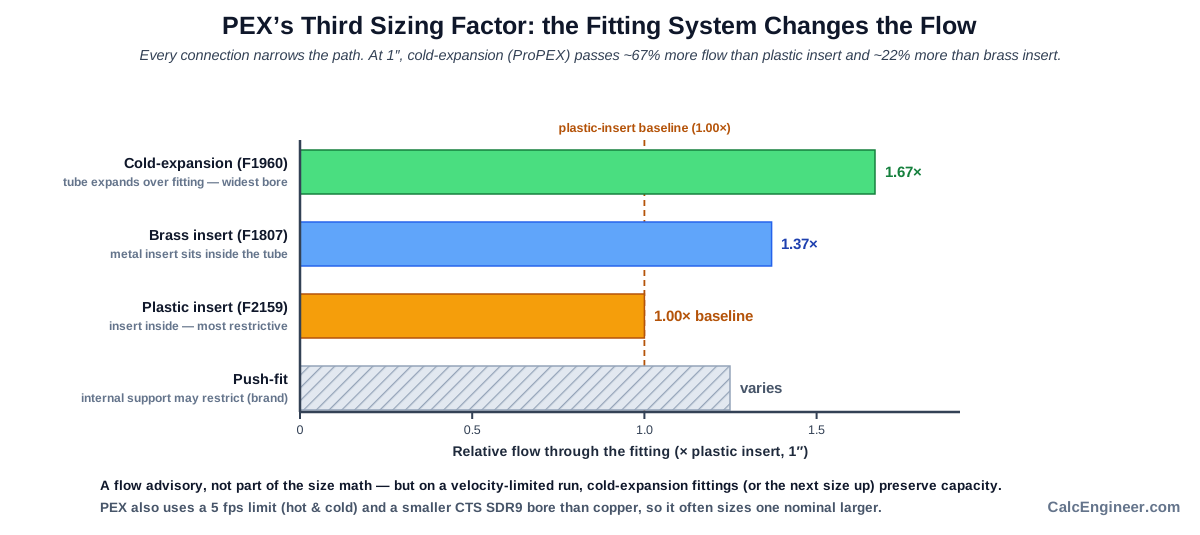
The fitting system is the third factor specific to PEX. Every connection narrows the flow path, and how much depends on the fitting standard. Cold-expansion fittings (ASTM F1960, often called ProPEX) preserve more flow area, because the tubing is expanded over the fitting rather than pushed inside it. Brass insert (F1807) and plastic insert (F2159) crimp fittings sit inside the tubing and restrict more.
In published manufacturer comparisons, a 1 inch cold-expansion fitting may pass about 67 percent more flow than a plastic insert fitting and about 22 percent more than a brass insert fitting, depending on size and brand. Push-fit fittings vary by brand, and some include an internal support that reduces the opening. For a velocity-sensitive run, cold-expansion fittings or the next size up preserve more flow. The calculator gives a fitting advisory, not an exact brand throat calculation.
PEX Friction Loss and Pressure Budget
Velocity is only half the sizing. On a long run, friction loss can govern, and it is checked against the pressure budget. The budget starts with the supply pressure, then subtracts the pressure required at the last fixture, the elevation loss at 0.433 psi per foot, and any meter loss. What remains is the pressure available for pipe friction.
If you leave the pressure and length blank, the tool sizes on velocity alone and says friction was not evaluated. That is a first pass, not a full result. If the budget comes out at zero or negative, no pipe size solves it, and the system needs more supply pressure, zoning, or a booster.
Inputs and Outputs
Inputs
| Input | Imperial | Metric |
|---|---|---|
| Peak flow demand | GPM | L/min |
| Fixture load and type (WSFU) | WSFU | WSFU |
| Service | cold or hot | cold or hot |
| Fitting system | dropdown | dropdown |
| Supply pressure | psi | kPa |
| Required fixture pressure | psi | kPa |
| Meter loss | psi | kPa |
| Elevation rise | ft | m |
| Straight developed length | ft | m |
| Fitting allowance factor | 1.0 to 2.0 | same |
| PEX size (Check mode) | in CTS | mm |
Outputs
| Output | Imperial | Metric |
|---|---|---|
| Peak flow used | GPM | L/min |
| Recommended or checked PEX size, ID used | in CTS | mm |
| Velocity and velocity limit | fps | m/s |
| Velocity utilization | % | % |
| Available pressure for friction | psi | kPa |
| Effective friction length | ft | m |
| Friction loss and allowable | psi/100 ft | kPa/30 m |
| Fitting advisory | text | text |
| Binding criterion and verdict | text | text |
Units
The calculator works in US or metric units, set by its own selector. Switching the unit system converts entered values; it does not reinterpret them.
| Quantity | US (Imperial) | Metric |
|---|---|---|
| Flow | GPM | L/min |
| Velocity | fps | m/s |
| Pressure | psi | kPa |
| Pipe length | ft | m |
| Pipe inside diameter | in | mm |
| Friction loss | psi per 100 ft | kPa per 30 m |
Reference: 1 GPM = 3.785 L/min, 5 fps = 1.52 m/s, 1 psi = 6.895 kPa. Elevation costs 0.433 psi per foot.
Limitations
What this calculator does
- Sizes a single PEX run by velocity and friction, using CTS SDR9 inside diameters.
- Applies the 5 fps PEX limit, with an optional override.
- Computes the friction pressure budget from supply, fixture, elevation, and meter.
- Flags how the fitting system affects flow, and warns on half-inch capacity and hot-service derating.
What this calculator does not do
- Compute the exact fitting-throat velocity, which is brand-specific. It gives a fitting advisory.
- Design a manifold home-run layout or a trunk-and-branch layout.
- The full IPC or UPC segmented method to the most remote fixture.
- A computed temperature and pressure derating check. It shows an advisory.
- Radiant or hydronic heating loop sizing. This is potable water distribution.
Key Facts
- PEX uses a velocity limit of 5 fps for both hot and cold, lower than the 8 fps used for copper cold water.
- PEX inside diameters are smaller than copper at the same nominal size, because PEX is CTS-sized with an SDR9 wall.
- The two effects, lower limit and smaller bore, stack, so PEX often needs one nominal size larger than copper for the same flow.
- Velocity is V = 0.4085 × GPM ÷ (inside diameter in inches)², using the CTS SDR9 inside diameter, not the nominal size.
- Half-inch PEX carries only about 2 to 3 GPM before exceeding 5 fps, so it suits single-fixture branches.
- Cold-expansion (F1960) fittings preserve more flow area than brass insert (F1807) or plastic insert (F2159) fittings.
- Utilization is rounded to two decimal places before banding: a rounded value of 1.00 is a marginal pass, not a fail.
- A velocity-only result is only a first pass; friction must also be checked on long runs.
Applications
- Sizing PEX branches and mains for a house or building remodel or new build.
- Choosing between half-inch and three-quarter-inch PEX for a bathroom or kitchen branch.
- Checking whether a half-inch branch can serve more than one fixture.
- Comparing a PEX size to the copper size it replaces, so a repipe keeps the same flow.
- Deciding when to upsize from three-quarter-inch to 1 inch PEX.
- Checking whether a fitting system affects the size needed.
- Finding whether velocity or friction governs on a long PEX run.
- Sizing hot and cold PEX runs, with the hot temperature and pressure note.
Example Calculation
Example 1: A typical PEX main.
A run must carry 9 GPM of cold water in PEX (limit 5 fps).
- 3/4 in PEX (ID 0.681 in) gives 7.93 fps, over the 5 fps limit.
- 1 in PEX (ID 0.875 in, 22.2 mm) gives V = 0.4085 × 9 / 0.875² = 4.80 fps (1.46 m/s), utilization 96% (marginal).
- Selected: 1 in PEX, velocity governs.
Example 2: PEX versus copper, same 9 GPM.
The same 9 GPM, sized two ways:
- Copper 3/4 in (ID 0.785 in, limit 8 fps): 5.97 fps, passes. Copper needs 3/4 in.
- PEX 3/4 in (ID 0.681 in, limit 5 fps): 7.93 fps, fails. PEX 1 in gives 4.80 fps. PEX needs 1 in.
Same flow, PEX one size larger, because PEX has both a smaller inside diameter and a lower velocity limit.
Example 3: Half-inch PEX runs out fast.
At just 3 GPM, 1/2 in PEX (ID 0.475 in) gives V = 0.4085 × 3 / 0.475² = 5.43 fps, over the limit. Three-quarter-inch PEX carries the same 3 GPM at 2.64 fps. This is why half-inch PEX suits single-fixture branches only.
Example 4: At-limit selection (GATE_SELECTION).
14 GPM. 1 in gives 7.47 fps (fail). 1-1/4 in (ID 1.069 in) gives 5.005 fps. Utilization 5.005 / 5.0 = 1.001, which rounds to 1.00, a marginal pass. Selected: 1-1/4 in, MARGINAL, with 1-1/2 in named as next size up for headroom.
Example 5: No pressure budget.
Supply 40 psi, required fixture 30 psi, elevation 30 ft, meter 2 psi. Available = 40 − 30 − 13.0 − 2 = −5 psi. Shows budget math, then NO PRESSURE BUDGET. A larger pipe cannot fix this.
Standards & References
- ASTM F876, Crosslinked Polyethylene (PEX) Tubing: dimensions, SDR9, and pressure ratings for CTS PEX tubing
- ASTM F877, PEX Hot- and Cold-Water Distribution Systems: system standard for PEX potable water distribution
- ASTM F1960, Cold Expansion Fittings with PEX Reinforcing Rings: cold-expansion (ProPEX) fitting standard
- ASTM F1807, Metal Insert Fittings with a Copper Crimp Ring: brass insert crimp fitting standard
- ASTM F2159, Plastic Insert Fittings with a Copper Crimp Ring: plastic insert crimp fitting standard
- IPC Appendix E, Sizing of Water Piping System (ICC): velocity, friction, and demand methods referenced for the sizing basis
- Engineering ToolBox, ASTM F876 PEX tube dimensions: supporting reference for CTS SDR9 inside diameter values
- Plumbing and Mechanical, How to design and size PEX pipe: fitting-flow comparison reference (brand and size dependent)
Common Mistakes to Avoid
- Matching the old copper nominal size when repiping in PEX. PEX has a smaller bore and a lower velocity limit, so it often needs one size larger.
- Using 8 fps for PEX. PEX uses 5 fps for both hot and cold.
- Using the nominal size in the velocity calculation instead of the CTS SDR9 inside diameter. A 1 in PEX bore is about 0.875 in, not 1 in.
- Running half-inch PEX to multiple fixtures. Half-inch exceeds 5 fps at only about 3 GPM.
- Ignoring the fitting system. Insert fittings restrict flow more than cold-expansion fittings.
- Confusing the fitting allowance factor with the fitting system. The allowance factor multiplies the length for friction; the fitting system is a local-flow advisory.
- Sizing on velocity alone on a long run. Friction can govern once the pressure budget and length are checked.
- Using this potable water tool for a radiant or hydronic loop, which is a different sizing method.
Frequently Asked Questions
How do I size PEX pipe?
What flow does each PEX size carry?
Is PEX the same size as copper?
What velocity limit should I use for PEX?
Do PEX fittings reduce flow?
Why does half-inch PEX carry so little?
Can I size PEX by velocity only?
Should I upsize PEX when replacing copper?
Can I use PEX for hot water?
Can I use this for radiant floor heating?
Frequently Used Together
Engineers often use these calculators in combination for complete project workflows:
Related Calculators
Explore similar calculators that might be useful for your project:
Plumbing Quick Reference — Keep It On Your Phone On Site
A 10-page field reference for catching pressure, velocity, slope, and pump-sizing mistakes before you order pipe, close a wall, or add a booster.
- Velocity limits, fixture pressure minimums, drain slope, and the 80 psi ceiling in one table
- Worked examples that show why a single pressure number gives four different answers
- Keep it on your phone, or print the two field-check pages
Free PDF. Calculators stay free. Unsubscribe anytime.
Calculate
Direct entry is recommended when the peak flow is known. WSFU estimate applies Hunter's Curve, a screening value.
Peak simultaneous flow, not the sum of all fixture flows.
PEX uses 5 fps for both hot and cold. Hot service adds a temperature and pressure derating advisory.
The connection method changes the effective flow area at each fitting. This is a flow advisory, not part of the size math. Separate from the fitting allowance factor below.
Static pressure at the meter or source. Leave blank (with length) to size on velocity only.
Minimum pressure required at the most remote fixture. Default 15 psi if left blank.
Pressure loss across the water meter at peak flow. Enter 0 or leave blank if not applicable.
Total rise from source to the highest fixture. Costs 0.433 psi per foot of rise.
Straight pipe run only. Do not include fittings; the fitting allowance factor below adds them. This is separate from the fitting system advisory above.
Multiplies the straight length to estimate effective friction length. This is separate from the fitting system advisory above.
Override the default 5 fps PEX limit. Leave blank to use the standard PEX limit. The result shows whether an override is active.