Water Pipe Sizing Calculator — GPM, Velocity & Size
On this page
Calculate
Direct entry is recommended when the peak flow is known. WSFU estimate applies Hunter’s Curve, a screening value only.
Peak simultaneous flow, not the sum of all fixture flows.
Sets velocity limit, Hazen-Williams C, and inside diameter table. Copper and steel allow 8 fps cold / 5 fps hot. PEX and CPVC allow 5 fps for both services.
Hot water uses the lower velocity limit (5 fps for metallic pipes) because hot water erodes copper faster.
Static pressure at the meter or source. Leave blank (with length) to size on velocity only.
Minimum pressure required at the most remote fixture. Typically 8 psi for most fixtures, 15–25 psi for flushometer valves.
Pressure loss across the water meter at peak flow. Enter 0 or leave blank if not applicable.
Total rise from source to the highest fixture. Costs 0.433 psi per foot (9.8 kPa per meter).
Straight pipe run only. Do not include fittings; the fitting allowance below adds them.
Multiplies the straight length to account for fittings. 1.5 is a common first-pass value.
Override the default velocity limit. Leave blank to use the material and service default (8 fps cold or 5 fps hot for metallic; 5 fps for plastic).
Overview
Water supply pipe is sized so the peak flow stays inside two limits at once. The first is the velocity limit, which keeps water slow enough to prevent noise, water hammer, and erosion of the pipe wall. The second is the friction limit, set by the pressure available after the fixture, elevation, and meter demands have been met. A pipe that passes velocity can still fail friction on a long run. The right pipe is the smallest standard size that passes both, and the limits are not the same for every material or every service temperature.
This calculator sizes a single water supply run from the peak flow in GPM, or from a fixture load in Water Supply Fixture Units using Hunter's Curve. It applies the correct velocity limit for the chosen material and service, builds the pressure budget from supply pressure, required fixture pressure, elevation, and meter loss, and checks friction with the Hazen-Williams method. The result tells you the recommended or checked pipe size, which limit governs, and what the utilization is against each limit.
This is a single-run sizing aid based on IPC Appendix E and UPC velocity and friction principles. Full code design uses the segmented method section by section to the most hydraulically remote fixture, with local amendments. Use this tool for sizing and screening, and confirm with your local code and a licensed plumber for a permit-ready design.
What to Look at First
Velocity and the binding limit. The result names which of the two limits governs: velocity or friction. On short runs velocity usually controls. On long or tall runs, friction takes over and forces a larger pipe than velocity alone would require.
Material matters. Copper, steel, and stainless allow 8 fps on cold water but only 5 fps on hot. PEX and CPVC are held to 5 fps for both services. The same flow can need a bigger pipe in PEX than in copper, because the velocity limit is lower and the inside diameter is smaller at the same nominal size.
Pressure budget. The friction limit is not a fixed value: it is set by how much pressure remains after the fixture, elevation, and meter demands are met. Check this number first. If little pressure is left for friction, the allowable loss is small and a larger pipe may be forced even when velocity is comfortable.
VELOCITY ONLY result. If supply pressure and developed length are left blank, the tool sizes on velocity only and reports it. That is not a full pass. A pipe that looks fine on velocity can still lose too much pressure over a long or tall run.
How to Use This Calculator
Choose the unit system (US or Metric) using the calculator’s own selector. Every field, label, and result follows that selector.
Select Size mode (to find the smallest compliant pipe) or Check mode (to evaluate a specific pipe size).
Enter the peak demand in GPM, or switch to WSFU estimate and enter the fixture load with a flush-tank or flush-valve basis.
Choose the pipe material and whether the service is hot or cold. These set the velocity limit and the Hazen-Williams C coefficient.
For a friction check, enter the supply pressure, the required pressure at the last fixture, any meter loss, and the elevation rise.
Enter the straight developed length and select a fitting allowance. Enter the straight run only; the allowance adds the fittings.
Click Calculate. The result shows the recommended or checked size, velocity, friction loss, which limit governs, and the verdict.
Leave supply pressure and developed length blank to size on velocity only. That result is flagged as VELOCITY ONLY and is not a full pass.
Formula
Water Pipe Sizing Formulas
US units: flow Q in GPM, inside diameter d in inches, length in feet, pressure in psi.
1. Velocity
   V = 0.4085 × Q / d²                    [fps]

2. Velocity limit (by material and service)
   Metallic (copper, steel, stainless): 8 fps cold, 5 fps hot
   Plastic (PEX, CPVC):                 5 fps cold and hot

3. Available pressure for friction (one model, no double subtraction)
   available = supply_pressure − required_fixture_pressure
             − (elevation_rise × 0.433) − meter_loss    [psi]
   If available ≤ 0: no pressure budget.

4. Effective friction length (one length model, no double fitting count)
   effective_length = straight_developed_length × fitting_allowance

5. Allowable friction
   allowable_psi_per_100 = available / (effective_length / 100)

6. Friction loss (Hazen-Williams)
   hf_per_100_ft = 0.2083 × (100/C)^1.852 × Q^1.852 / d^4.8655  [ft/100 ft]
   friction_psi_per_100 = hf_per_100_ft × 0.433
   C: copper, PEX, CPVC, stainless = 150; galvanized newer = 120; older = 100

7. Size selection (Size mode)
   Smallest standard size where V ≤ velocity_limit
   AND friction_psi_per_100 ≤ allowable_psi_per_100
   Binding criterion = the limit with the higher utilization.

8. WSFU to GPM
   Nonlinear Hunter’s Curve (IPC Table E103.3(3)), split for flush-tank
   and flush-valve systems. Not a linear 1:1 conversion.
Metric note: all relations apply with SI units (L/min, mm, m, kPa). Elevation loss is 9.8 kPa per meter. Friction is shown as kPa per 30 m in metric mode.
How Is Water Pipe Sized?
Two limits control every water supply pipe, and both must be satisfied. The first is the velocity limit, which keeps water slow enough to prevent noise, water hammer, and erosion of the pipe wall. The second is the friction limit, determined by the pressure budget left after the fixture, elevation, and meter demands have been met. A pipe can pass one limit and fail the other. On short runs velocity usually governs. On long or tall runs friction often forces a larger pipe than velocity alone would require.
The right pipe is the smallest standard size that passes both limits, and the limits are not fixed numbers. They depend on the pipe material and, for metallic materials, on whether the water is hot or cold. This calculator applies those rules and returns the binding limit so you know exactly which one is driving the size.
Water Pipe Velocity Limit
Velocity is the first sizing limit and it is not a single value. Copper, galvanized steel, and stainless steel are commonly held to about 8 feet per second on cold water and 5 feet per second on hot. PEX and CPVC are held to about 5 feet per second for both services. Hot water uses the lower limit because higher temperature accelerates erosion of the pipe wall, especially in copper.
Velocity is V = 0.4085 times GPM divided by the inside diameter squared, in feet per second. It uses the actual inside diameter for the material, not the nominal size. Because both the limit and the inside diameter vary with the material, the same flow can be within the limit in copper and over it in PEX of the same nominal size.
Water Pipe Friction Loss and the Pressure Budget
Friction loss is the second limit. As water flows through pipe it loses pressure to friction, calculated here with the Hazen-Williams method using a roughness coefficient set by the material. Copper, PEX, CPVC, and stainless use C = 150. Newer galvanized steel uses C = 120. Older galvanized uses C = 100.
The amount of friction you can accept is set by the pressure budget. Start with the supply pressure. Subtract the required pressure at the most remote fixture, the elevation loss at 0.433 psi per foot of rise, and any water meter loss. What remains is the pressure available for pipe friction. If the run is long and the budget is small, the pipe must be larger to keep friction within the budget, even when velocity is comfortable.
The calculator names the binding criterion so you know whether velocity or friction is controlling the size. That matters because the remedies are different: a velocity problem calls for a larger ID or a lower flow, while a friction problem can also be addressed by increasing supply pressure, reducing run length, or improving meter and elevation conditions.
Copper vs PEX Pipe Size
Copper and PEX of the same nominal size are not the same bore. PEX CTS SDR9 has a smaller inside diameter than copper Type L at each nominal size, and PEX also uses the lower 5 fps velocity limit. Both effects push the velocity up.
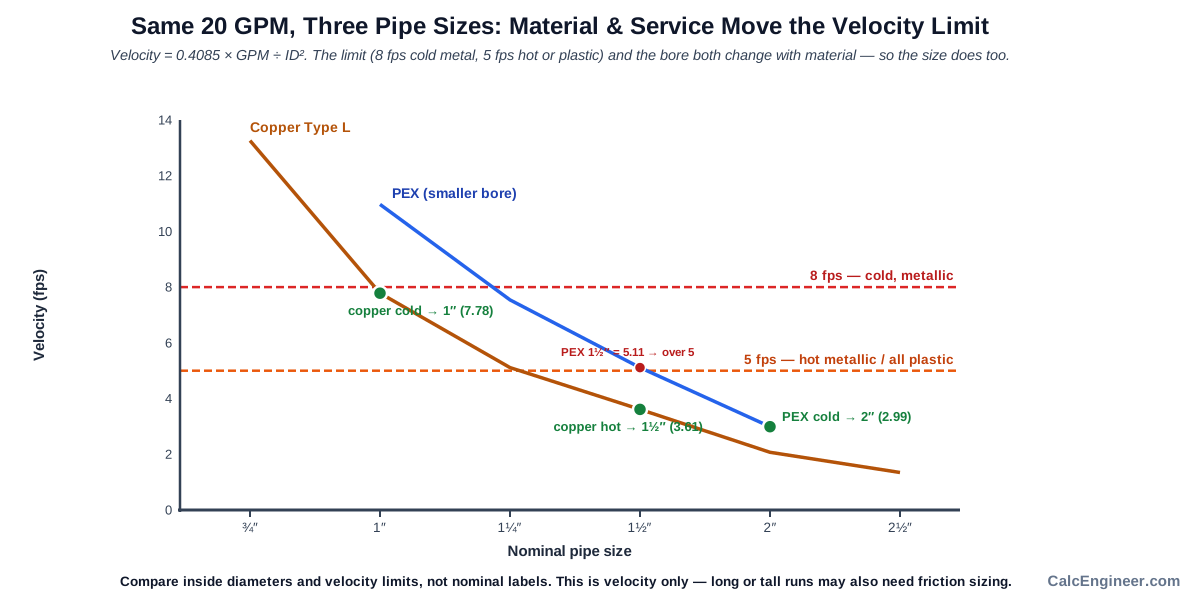
At 20 GPM, cold water in copper fits a 1 inch pipe at 7.78 fps, just under the 8 fps limit. The same 20 GPM in PEX runs at 5.11 fps in a 1.5 inch nominal pipe, which is over the 5 fps limit, so PEX needs 2 inch nominal at 2.99 fps. Same flow, one size larger in PEX. When comparing copper to PEX, compare inside diameters and velocity limits, not nominal labels.
Hot Water Pipe Sizing
Hot water is sized to a lower velocity limit than cold. Copper, steel, and stainless are held to about 5 fps on hot water versus 8 fps on cold. That means the same flow often needs a larger pipe on the hot side.
For example, 20 GPM of cold water fits 1 inch copper, but the same 20 GPM of hot water exceeds the 5 fps limit in 1 inch and 1.25 inch copper, so it needs 1.5 inch. Size the hot and cold runs separately, each against its own limit. This tool sizes a single hot or cold run. It does not size or balance a hot-water recirculation loop.
WSFU to GPM and Hunter's Curve
Water pipe sizing usually starts from a fixture load in Water Supply Fixture Units, then converts to a peak flow in GPM using Hunter's Curve. The curve accounts for the fact that not all fixtures run simultaneously. It is nonlinear: a 40 WSFU system does not demand twice the GPM of a 20 WSFU system.
Hunter's Curve is also different for flush-tank and flush-valve systems. Flushometer valves draw a large instantaneous flow compared to tank-type water closets for the same fixture count. This calculator applies the IPC Table E103.3(3) values for either system type. The WSFU-to-GPM result is a screening estimate. For a full fixture count, use the dedicated Water Supply Fixture Unit Calculator.
Inputs and Outputs
Inputs
| Input | Imperial | Metric |
|---|---|---|
| Peak flow demand | GPM | L/min |
| Fixture load and type (WSFU) | WSFU | WSFU |
| Pipe material | dropdown | dropdown |
| Service | cold or hot | cold or hot |
| Supply pressure | psi | kPa |
| Required fixture pressure | psi | kPa |
| Meter loss | psi | kPa |
| Elevation rise | ft | m |
| Straight developed length | ft | m |
| Fitting allowance factor | 1.0 to 2.0 | same |
| Pipe size (Check mode) | nominal in | nominal mm |
Outputs
| Output | Imperial | Metric |
|---|---|---|
| Peak flow used | GPM | L/min |
| Recommended or checked size, with ID | in | mm |
| Velocity and velocity limit | fps | m/s |
| Velocity utilization | % | % |
| Available pressure for friction | psi | kPa |
| Effective friction length | ft | m |
| Friction loss and allowable | psi/100 ft | kPa/30 m |
| Friction utilization | % | % |
| Binding criterion and verdict | text | text |
Units
The calculator works in US or metric units, set by its own selector.
| Quantity | US (Imperial) | Metric |
|---|---|---|
| Flow | GPM | L/min |
| Velocity | fps | m/s |
| Pressure | psi | kPa |
| Pipe length | ft | m |
| Pipe inside diameter | in | mm |
| Friction loss | psi per 100 ft | kPa per 30 m |
Reference: 1 GPM = 3.785 L/min, so 20 GPM = 75.7 L/min. 8 fps = 2.44 m/s, 5 fps = 1.52 m/s. 1 psi = 6.895 kPa. Elevation costs 0.433 psi per foot or 9.8 kPa per meter. Switching the unit system converts entered values; it does not reinterpret them.
Limitations
What this calculator does
- Sizes a single run by velocity and friction for the selected material and service.
- Applies the correct velocity limit by material and hot versus cold.
- Computes the friction pressure budget from supply, fixture, elevation, and meter.
- Estimates GPM from a WSFU fixture load using Hunter's Curve.
What this calculator does not do
- The full IPC or UPC segmented method to the most hydraulically remote fixture.
- Water meter loss curves by meter size. It takes a single entered value.
- Minimum fixture pressure and minimum branch-size enforcement by fixture type.
- Elevation and pressure zoning floor by floor for tall buildings.
- Hot-water recirculation loop and balancing.
- Booster pump sizing. It only flags when supply pressure is insufficient.
Key Facts
- Water pipe is sized by the worse of two limits: velocity and friction loss. The right pipe passes both.
- Velocity is V = 0.4085 × GPM ÷ (inside diameter in inches)^2, in feet per second.
- The velocity limit depends on material and service: copper, steel, and stainless allow 8 fps cold and 5 fps hot; PEX and CPVC allow 5 fps for both.
- Hot water uses the lower velocity limit because it erodes copper pipe faster.
- PEX of the same nominal size has smaller inside diameters than copper, so the same flow often needs a larger nominal PEX pipe.
- Friction sizing uses the pressure left after required fixture pressure, elevation, and meter loss are subtracted from the supply pressure.
- Elevation costs 0.433 psi per foot of rise, so a tall run can consume a large part of the pressure budget.
- A velocity-only result is not a full pass unless the pressure budget and developed length have also been checked.
Applications
- Sizing the water service and distribution mains for a house or small building.
- Choosing branch pipe sizes for bathrooms, kitchens, and utility runs.
- Comparing copper, PEX, and CPVC for the same demand to see the size difference.
- Checking whether an existing pipe will carry a higher demand after a remodel.
- Checking whether the hot side should be upsized compared with the cold side.
- Finding whether pressure loss, not velocity, is the reason a larger pipe is needed.
- Screening whether the supply pressure is adequate or whether a booster pump may be needed.
- Sizing hot and cold runs separately, each with its own velocity limit.
Example Calculation
Example 1: Copper cold, velocity governed. 20 GPM cold water in Copper Type L. Velocity limit 8 fps.
- 1 in (ID 1.025 in): V = 0.4085 × 20 / 1.025² = 7.78 fps, at or below 8. Selected 1 in copper, binding criterion velocity, utilization 97% (marginal).
Example 2: Same flow, different size. Same 20 GPM, three materials:
- Copper cold (8 fps): 1 in at 7.78 fps. 1 in.
- Copper hot (5 fps): 1 in at 7.78 fps, over limit. 1½ in (ID 1.505) at 3.61 fps. 1½ in.
- PEX cold (5 fps, ID 1.264 in for 1½ in): 5.11 fps, over 5. 2 in PEX (ID 1.653 in) at 2.99 fps. 2 in PEX. Same flow, three different sizes.
Example 3: Friction governed. 30 GPM cold copper. Supply 25 psi, fixture 15 psi, meter 2 psi, no elevation: available = 8 psi. Straight 133 ft × 1.5 = 200 ft effective, allowable = 4.0 psi/100 ft.
- 1¼ in: V 7.66 fps, friction 7.38 psi/100 ft, over 4.0. Fails friction.
- 1½ in: friction 3.17 psi/100 ft, passes. 1½ in, binding criterion friction.
Example 4: No pressure budget. Supply 20 psi, fixture 15 psi, elevation 20 ft (8.66 psi loss), meter 2 psi. Available = 20 − 15 − 8.66 − 2 = negative. NO PRESSURE BUDGET. A booster pump may be required.
Example 5: Velocity only. 20 GPM copper cold, no pressure or length entered. Returns 1 in, flagged as VELOCITY ONLY: friction not evaluated.
Standards & References
- IPC Appendix E, Sizing of Water Piping System (International Code Council): primary basis for velocity, friction, and demand methods
- Uniform Plumbing Code, IAPMO: parallel authority for water pipe sizing in UPC jurisdictions
- Engineering ToolBox, Hazen-Williams friction loss for water: reference for Hazen-Williams C values and friction loss method
- ASTM B88 (Copper Type L), ASTM F876/F877 (PEX CTS SDR9), ASME B36.10M (galvanized steel), ASME B36.19M (stainless): inside diameter standards referenced for the pipe ID tables
- Hunter’s Curve (IPC Table E103.3(3)): the WSFU-to-GPM demand conversion. Original work by Roy B. Hunter, National Bureau of Standards. Flush-tank and flush-valve curves are separate.
Common Mistakes to Avoid
- Sizing on a flat 8 fps for everything. Hot water and plastic pipe use a 5 fps limit, so the same flow needs a larger pipe.
- Using the nominal pipe size instead of the actual inside diameter in velocity and friction math. Copper, PEX, and steel of the same nominal size have different inside diameters.
- Ignoring friction and sizing on velocity alone. On long or tall runs, friction often governs and forces a larger pipe than velocity would suggest.
- Treating a velocity-only result as final. Without the pressure budget and length, friction is not evaluated and the pipe may still be undersized.
- Forgetting to subtract required fixture pressure, elevation, and meter loss from supply pressure. The remaining friction budget is often much smaller than the supply pressure.
- Double counting fittings by entering a run that already includes fittings and then adding a fitting allowance. Enter the straight run only.
- Converting WSFU to GPM as a straight 1-to-1. Hunter’s Curve is nonlinear, and flush-valve systems draw more GPM than flush-tank systems for the same WSFU.
- Treating the result as a code submittal. Code design uses the full segmented method to the most remote fixture, with local amendments.
Frequently Asked Questions
How do I size water supply pipe?
What velocity should water pipe be sized for?
Why does the same flow need a bigger pipe in PEX or for hot water?
What is the difference between velocity sizing and friction sizing?
How do I find the pressure available for pipe friction?
Do I use nominal or inside diameter for sizing?
What is WSFU and how does it become GPM?
Why is a velocity-only result not a full pass?
Can I use this for a code submittal?
Frequently Used Together
Engineers often use these calculators in combination for complete project workflows:
Related Calculators
Explore similar calculators that might be useful for your project:
Plumbing Quick Reference — Keep It On Your Phone On Site
A 10-page field reference for catching pressure, velocity, slope, and pump-sizing mistakes before you order pipe, close a wall, or add a booster.
- Velocity limits, fixture pressure minimums, drain slope, and the 80 psi ceiling in one table
- Worked examples that show why a single pressure number gives four different answers
- Keep it on your phone, or print the two field-check pages
Free PDF. Calculators stay free. Unsubscribe anytime.
Calculate
Direct entry is recommended when the peak flow is known. WSFU estimate applies Hunter’s Curve, a screening value only.
Peak simultaneous flow, not the sum of all fixture flows.
Sets velocity limit, Hazen-Williams C, and inside diameter table. Copper and steel allow 8 fps cold / 5 fps hot. PEX and CPVC allow 5 fps for both services.
Hot water uses the lower velocity limit (5 fps for metallic pipes) because hot water erodes copper faster.
Static pressure at the meter or source. Leave blank (with length) to size on velocity only.
Minimum pressure required at the most remote fixture. Typically 8 psi for most fixtures, 15–25 psi for flushometer valves.
Pressure loss across the water meter at peak flow. Enter 0 or leave blank if not applicable.
Total rise from source to the highest fixture. Costs 0.433 psi per foot (9.8 kPa per meter).
Straight pipe run only. Do not include fittings; the fitting allowance below adds them.
Multiplies the straight length to account for fittings. 1.5 is a common first-pass value.
Override the default velocity limit. Leave blank to use the material and service default (8 fps cold or 5 fps hot for metallic; 5 fps for plastic).