Stormwater Drainage Pipe Sizing Calculator — Runoff & Slope
On this page
Calculate
Total drainage area contributing runoff to the pipe. The Rational Method suits areas under about 200 acres (81 ha); a warning is shown for larger areas.
Direct entry: enter C as a single value. Composite builder: enter up to 3 surface zones with areas; the calculator computes the area-weighted C.
Runoff coefficient: the fraction of rainfall that becomes runoff. Typical values: pavement/roof 0.85–0.95, gravel 0.50–0.70, lawn (clay) 0.25–0.35, lawn (sand) 0.10–0.20, woods 0.05–0.25.
Rainfall intensity for your design return period and time of concentration, from local IDF data (e.g. NOAA Atlas 14 for the US). This tool does not compute the time of concentration; the intensity must already match your Tc and return period.
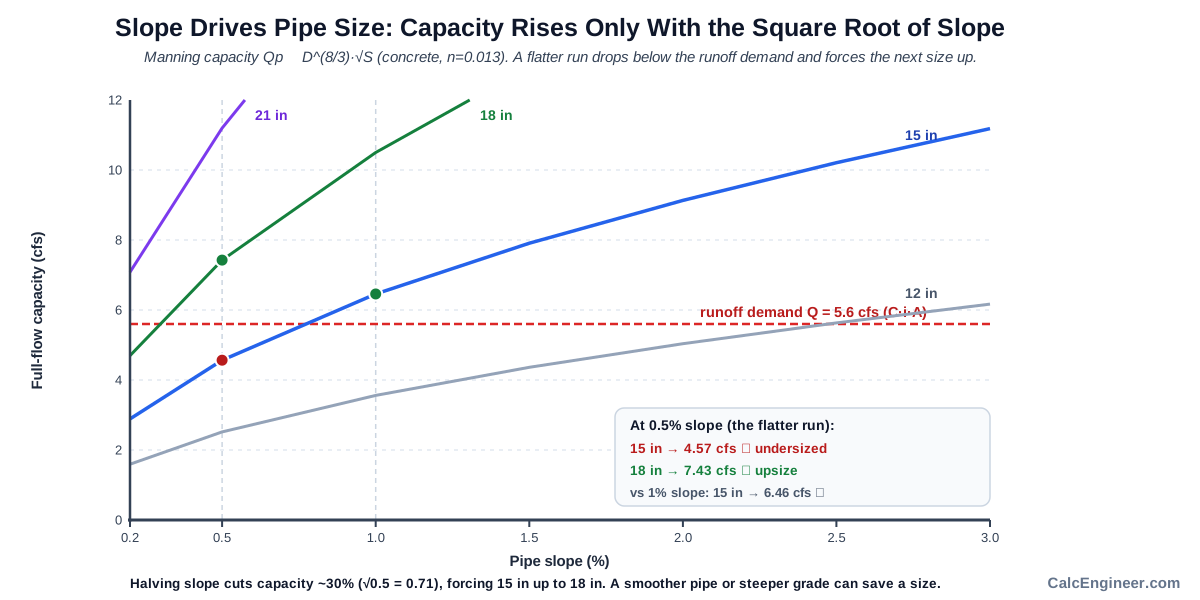
Pipe slope in percent (e.g. 1.0 for 1% = 0.01 ft/ft). Manning capacity scales with the square root of slope, so halving the slope reduces capacity by about 30%.
Material sets Manning's n. Smoother pipes carry more flow at the same size and slope. Concrete and RCP are often required in public right-of-way; PVC and HDPE are common on private sites. Use project or manufacturer n for final design.
Optional. Enter a specific pipe size to check its full-flow capacity and velocity against the required flow. Standard sizes US: 6, 8, 10, 12, 15, 18, 21, 24, 30, 36 in; metric: 150, 200, 250, 300, 375, 450 mm.
Optional record field. Appears in results for documentation. Does not affect the calculation; it is your design storm return period (e.g. 10-year, 25-year, 100-year).
Optional record field. Tc is not used in the calculation — it is already embedded in the rainfall intensity you entered. Enter it here for documentation only.
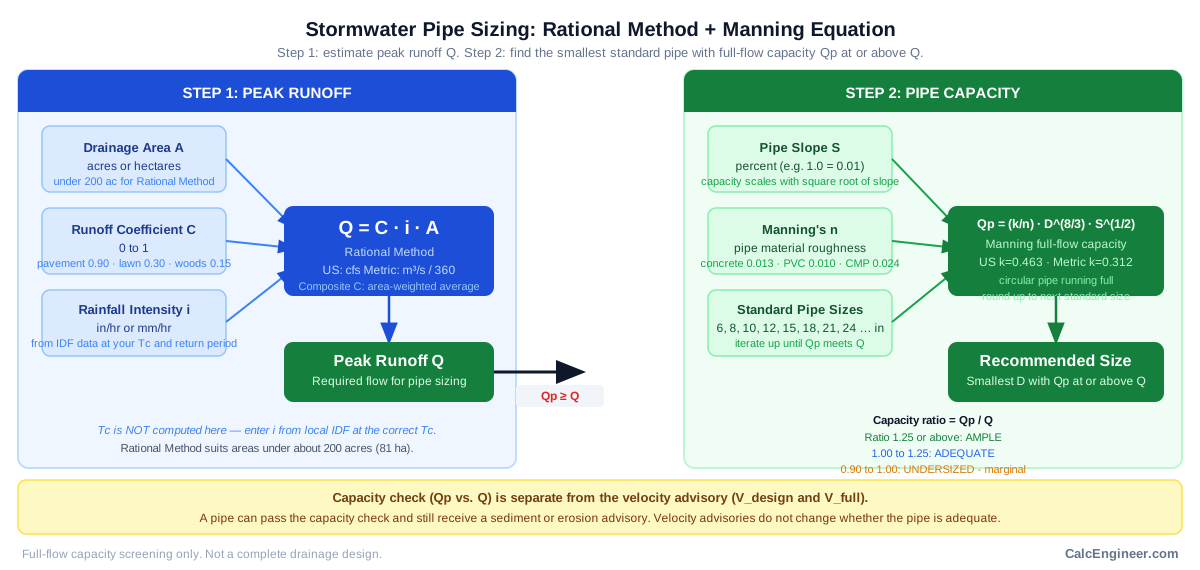
Two-step sizing: Rational Method estimates peak runoff Q; Manning's equation finds the smallest standard pipe whose full-flow capacity Qp meets or exceeds Q. Capacity and velocity checks are independent.
What to Look at First
Recommended pipe size. The first key output is the smallest standard pipe whose full-flow Manning capacity at your slope and material covers the peak Rational Method runoff. Read this with the full-flow capacity and spare margin (a ratio of 1.15 means the pipe has 15 percent spare capacity).
Two velocities. V_design is the velocity at the actual runoff flow; V_full is the velocity if the pipe ran completely full. They differ when the pipe has spare capacity. V_design below about 2.5 ft/s (0.75 m/s) is a sediment advisory; V_full above about 15 ft/s (4.5 m/s) is an erosion advisory. Neither changes whether the pipe is adequate — they are separate checks.
The rainfall intensity you enter controls the result. It must already match your design storm return period and time of concentration. This tool does not compute the time of concentration; use NOAA Atlas 14 or your local IDF data at the correct Tc before coming here.
Optional: candidate pipe check. If you already have a pipe size in mind, enter it in the candidate field to see its capacity, spare margin, and velocity against the same flow.
How to Use This Calculator
Choose the unit system: US (acres, in/hr, cfs, in, ft/s) or Metric (hectares, mm/hr, m³/s, mm, m/s).
Enter the total drainage area.
Enter the runoff coefficient C directly (0 to 1), or use the composite builder to blend up to three surface types by area into an area-weighted C.
Enter the rainfall intensity from your local IDF curve for the design return period and time of concentration. This tool does not compute the time of concentration.
Enter the pipe slope in percent and select the pipe material, which sets Manning's n.
Click Calculate. Read the peak runoff, the recommended standard pipe size, its full-flow capacity and spare margin, and both velocities with their advisories.
Optional: enter a candidate pipe size to check its capacity and velocity against the required flow.
Required inputs: drainage area, runoff coefficient C (or composite surfaces), rainfall intensity, slope, and pipe material. The candidate pipe size, return period label, and time of concentration field are optional. The Rational Method suits small drainage areas, generally under 200 acres (81 ha); use TR-55 or HEC-HMS for larger watersheds.
Inputs & Outputs
Inputs
Outputs
Formula
Stormwater Pipe Sizing Formulas
STEP 1: PEAK RUNOFF (Rational Method)
For small drainage areas (generally under ~200 acres / 81 ha):
US:     Q (cfs)   = C × i (in/hr) × A (acres)
Metric: Q (m³/s)  = C × i (mm/hr) × A (ha) / 360
Where:
- C = runoff coefficient (0 to 1; fraction of rain that runs off)
- i = rainfall intensity from local IDF data at your return period and Tc [in/hr or mm/hr]
- A = drainage area [acres or ha]
- Composite C = Σ(Cₖ × Aₖ) / Σ(Aₖ) — area-weighted for mixed sites
In US units: 1 in/hr over 1 acre ≈ 1 cfs, so the formula is dimensionally direct.
STEP 2: FULL-FLOW PIPE CAPACITY (Manning, circular pipe running full)
US:     Qp (cfs)  = (0.463 / n) × D (ft)^(8/3) × S^(1/2)
Metric: Qp (m³/s) = (0.312 / n) × D (m)^(8/3) × S^(1/2)
Where:
- n = Manning's roughness coefficient (material-dependent)
- D = pipe inside diameter [ft or m]
- S = slope [ft/ft or m/m] (slope % / 100)
- Find the smallest standard D with Qp ≥ Q, round up to standard size
TWO VELOCITIES
V_design = Q_runoff   / (π × D² / 4)   [velocity at design flow]
V_full   = Q_capacity / (π × D² / 4)   [velocity at full-pipe flow]
- Self-cleansing advisory (screening): V_design ≈ 2.5–3 ft/s (0.75–0.9 m/s)
- Erosion advisory: V_full < ~15–20 ft/s (4.5–6 m/s)
- Velocity advisories are separate from the capacity verdict; they do not flip an adequate pipe to undersized.
CAPACITY CHECK AND RATIO
ratio = Qp / Q
ratio ≥ 1.25              AMPLE                 (significant spare capacity)
1.00 ≤ ratio < 1.25       ADEQUATE              (within capacity, some margin)
0.90 ≤ ratio < 1.00       UNDERSIZED - marginal (just below capacity)
ratio < 0.90              UNDERSIZED            (capacity clearly short of required flow)
BUILD-GATE QA BENCHMARKS (engine must reproduce)
RAT-1:   C=0.90, i=2.5 in/hr, A=2.5 ac → Q = 0.90 × 2.5 × 2.5 = 5.625 cfs
MAN-15:  D=1.25 ft (15 in), n=0.013, S=0.01
         Qp = (0.463/0.013) × 1.25^(8/3) × 0.01^0.5 = 35.6 × 1.813 × 0.1 ≈ 6.45 cfs
MAN-18:  D=1.5 ft (18 in), n=0.013, S=0.01
         Qp = 35.6 × 2.949 × 0.1 ≈ 10.5 cfs
VDES:    V_design = 5.625 / (π × 1.25² / 4) = 5.625 / 1.2272 ≈ 4.58 ft/s
VFULL:   V_full   = 6.45  / 1.2272 ≈ 5.26 ft/s
METRIC:  C=0.9, i=63.5 mm/hr, A=1.0117 ha → Q = 0.9 × 63.5 × 1.0117 / 360 ≈ 0.1606 m³/s
| Variable | Meaning | US Units | Metric Units |
|---|---|---|---|
| Q | Peak runoff | cfs | m³/s |
| C | Runoff coefficient | — | — |
| i | Rainfall intensity | in/hr | mm/hr |
| A | Drainage area | acres | hectares |
| Qp | Full-flow pipe capacity | cfs | m³/s |
| n | Manning's roughness | — | — |
| D | Pipe inside diameter | ft | m |
| S | Slope | ft/ft | m/m |
| V | Flow velocity | ft/s | m/s |
Key Facts
- Storm pipe sizing is two steps: peak runoff by the Rational Method (Q = C·i·A), then pipe size by Manning's full-flow capacity — each step independent and transparent.
- In US units, one inch per hour of rain on one acre is about one cubic foot per second, so Q in cfs is roughly C times i times A with no conversion factor needed.
- Runoff coefficients range from about 0.85 to 0.95 for pavement and roofs down to 0.05 to 0.25 for woods; mixed sites use an area-weighted composite C.
- Manning capacity rises with diameter to the 8/3 power and with the square root of slope, so a flatter run often needs a larger pipe.
- Concrete and RCP have Manning's n around 0.013; smooth PVC and HDPE around 0.009–0.011; corrugated metal around 0.024 — material choice directly affects capacity at the same size and slope.
- A pipe can pass the capacity check and still receive a velocity advisory: capacity sizing and the sediment or scour checks are separate questions.
- The rainfall intensity must come from local IDF data for your return period and time of concentration; this tool does not compute the time of concentration.
- This is a full-flow screening tool: it does not check the hydraulic grade line, partial-flow depth, inlet capacity, surcharge, or backwater.
Applications
- Sizing an on-site storm drain for a parking lot, roof, or paved area
- Checking whether an existing storm pipe has enough capacity for a design storm
- Comparing how a flatter or steeper slope changes the required pipe size
- Testing how a smoother pipe material (PVC or HDPE vs. concrete) affects capacity
- Blending a mixed site's surfaces into an area-weighted runoff coefficient
- Screening a candidate pipe size before a detailed hydraulic study
Example Calculation
Example 1 — Parking lot storm drain
Given: 2.5-acre paved parking lot, C = 0.90, 10-year i = 2.5 in/hr, slope 1.0%, concrete pipe (n = 0.013).
Step 1 — runoff:
Q = 0.90 × 2.5 × 2.5 = 5.625 cfs (about 5.6 cfs)
Step 2 — capacity (15 in, D = 1.25 ft):
Qp = (0.463 / 0.013) × 1.25^(8/3) × 0.01^(0.5)
   = 35.6 × 1.813 × 0.1 = 6.45 cfs
6.45 cfs ≥ 5.6 cfs → 15 in is adequate (ratio 1.15)
Velocities:
V_design = 5.625 / (π × 1.25² / 4) = 5.625 / 1.2272 = 4.58 ft/s
V_full   = 6.45  / 1.2272 = 5.26 ft/s
Result: a 15-inch concrete pipe at 1.0% carries 6.45 cfs, comfortably above the 5.6 cfs runoff, at a healthy 4.58 ft/s design velocity. Recommended size: 15 in.
Example 2: Same lot, flatter slope
Given: same 5.6 cfs runoff, pipe slope 0.5%.
15 in capacity at 0.5% = 6.45 × √(0.5 / 1.0) = 6.45 × 0.707 = 4.56 cfs
4.56 cfs < 5.6 cfs → 15 in is UNDERSIZED at 0.5%
Next size up: 18 in (D = 1.5 ft)
Qp = (0.463 / 0.013) × 1.5^(8/3) × 0.005^0.5 = 35.6 × 2.949 × 0.0707 = 7.43 cfs → adequate
Result: halving the slope drops the 15-inch capacity below the runoff, so the pipe upsizes to 18 in. This is the square-root-of-slope effect in action.
Example 3: Composite runoff coefficient
Given: 2.5-acre site — 1.0 ac roof (C = 0.95) + 1.5 ac lawn (C = 0.30).
composite C = (1.0 × 0.95 + 1.5 × 0.30) / 2.5
            = (0.95 + 0.45) / 2.5 = 1.40 / 2.5 = 0.56
Result: blended C = 0.56, weighted toward the larger lawn area. Use this composite C in the Rational Method.
Example 4: Candidate pipe check (capacity and velocity separate)
Given: 5.6 cfs runoff, candidate 12-inch concrete pipe at 1.0%.
12 in (D = 1.0 ft): Qp = (0.463 / 0.013) × 1.0^(8/3) × 0.1 = 35.6 × 1.0 × 0.1 = 3.56 cfs
3.56 cfs < 5.6 cfs → UNDERSIZED
Result: the 12-inch pipe carries only 3.56 cfs against 5.6 cfs needed — UNDERSIZED on capacity. Step up to 15 in minimum.
Example 5: Material roughness changes capacity
Given: 15-in pipe at 1.0%, concrete (n = 0.013) vs. corrugated metal (n = 0.024).
Concrete:          Qp = (0.463 / 0.013) × 1.25^(8/3) × 0.1 = 6.45 cfs
Corrugated metal:  Qp = (0.463 / 0.024) × 1.25^(8/3) × 0.1 = 3.50 cfs
ratio = 0.013 / 0.024 = 0.54
Result: the same 15-inch pipe carries 6.45 cfs in concrete but only 3.50 cfs in corrugated metal — about 54% (because capacity is inversely proportional to n).
Standards & References
- NOAA Atlas 14 Precipitation Frequency Data Server — the official US source for rainfall intensity and IDF curves for the Rational Method
- USDA NRCS TR-55, Urban Hydrology for Small Watersheds — hydrograph method for watersheds larger than about 200 acres or with complex routing needs
- US EPA National Stormwater Calculator — EPA stormwater management guidance and sizing references
- International Plumbing Code (IPC) storm drainage provisions and local drainage manuals — jurisdiction-specific minimum slopes, pipe materials, and design storm requirements; local standards govern and vary
Units
US Customary
- Drainage area: acres
- Rainfall intensity: in/hr
- Flow: cfs
- Pipe size: inches
- Velocity: ft/s
Metric (SI)
- Drainage area: hectares (ha)
- Rainfall intensity: mm/hr
- Flow: m³/s (L/s for small values)
- Pipe size: mm (DN equivalents)
- Velocity: m/s
Formula constants
- US: Q (cfs) = C × i (in/hr) × A (acres)
- Metric: Q (m³/s) = C × i (mm/hr) × A (ha) / 360
- Manning constant: 0.463 (US) · 0.312 (SI)
Conversions
- 1 acre = 0.4047 ha
- 1 in/hr = 25.4 mm/hr
- 1 cfs = 0.02832 m³/s = 28.32 L/s
- 1 ft/s = 0.3048 m/s
- Slope 1% = 0.01 ft/ft
Limitations
- This calculator estimates peak runoff by the Rational Method and checks full-flow pipe capacity by Manning's equation. It does not compute the time of concentration, partial-flow (part-full) depth and velocity, the hydraulic grade line, inlet or catch-basin capacity, surcharge, or backwater.
- The rainfall intensity entered must already match the design storm return period and time of concentration. The Rational Method suits small drainage areas, generally under 200 acres (81 ha); larger or complex watersheds need NRCS TR-55 or HEC-HMS.
- It does not size roof drain leaders under plumbing-code methods, roadway hydraulic grade lines, culverts under headwater control, open channels, swales, or detention and water-quality facilities, and it does not handle pressurized or surcharged flow, tailwater, or backwater.
- It does not set pipe cover, bedding, structural class, or live load, or design outlet erosion protection. Results depend on the C, i, slope, and n supplied.
- This is a planning estimate, not a sealed drainage design, permit submittal, or regulatory determination. Local stormwater standards govern and vary; verify with a licensed civil or drainage engineer.
Common Mistakes to Avoid
- Entering a rainfall intensity that does not match the time of concentration. The intensity must come from IDF data at a duration equal to your Tc, which this tool does not compute.
- Using a single runoff coefficient for a mixed site. Blend the surfaces into an area-weighted composite C rather than picking a single average value.
- Ignoring slope's outsized effect. Capacity scales with the square root of slope, so a flatter run often needs the next pipe size up (halving the slope from 1% to 0.5% cuts capacity by about 30%).
- Treating a low velocity as undersizing. If capacity covers the flow, the pipe is adequate; low velocity is a separate sediment advisory, not a capacity failure.
- Reading full-flow capacity as a full drainage design. This screens capacity only, not the hydraulic grade line, surcharge, inlets, or backwater.
- Using the Rational Method on a large or complex watershed. Above about 200 acres (81 ha), use NRCS TR-55 or HEC-HMS.
- Comparing published capacity tables without matching the basis. Published storm pipe tables may use a different slope, roughness, or part-full vs. full-flow assumption — match slope and Manning's n before comparing.
- Forgetting that material changes capacity. A corrugated-metal pipe (n ≈ 0.024) carries about half the flow of a smooth pipe of the same size and slope.
Frequently Asked Questions
How do you size a stormwater drainage pipe?
What is the Rational Method for stormwater?
Where do I get the rainfall intensity for the Rational Method?
Why does my pipe size change so much when the slope changes?
Can a pipe have enough capacity but still get a velocity warning?
Is this full-flow or part-full pipe sizing?
What Manning's n should I use for stormwater pipes?
Does this calculator size the whole storm drainage system?
How does runoff coefficient C affect pipe size?
Frequently Used Together
Engineers often use these calculators in combination for complete project workflows:
Related Calculators
Explore similar calculators that might be useful for your project:
Plumbing Quick Reference — Keep It On Your Phone On Site
A 10-page field reference for catching pressure, velocity, slope, and pump-sizing mistakes before you order pipe, close a wall, or add a booster.
- Velocity limits, fixture pressure minimums, drain slope, and the 80 psi ceiling in one table
- Worked examples that show why a single pressure number gives four different answers
- Keep it on your phone, or print the two field-check pages
Free PDF. Calculators stay free. Unsubscribe anytime.
Calculate
Total drainage area contributing runoff to the pipe. The Rational Method suits areas under about 200 acres (81 ha); a warning is shown for larger areas.
Direct entry: enter C as a single value. Composite builder: enter up to 3 surface zones with areas; the calculator computes the area-weighted C.
Runoff coefficient: the fraction of rainfall that becomes runoff. Typical values: pavement/roof 0.85–0.95, gravel 0.50–0.70, lawn (clay) 0.25–0.35, lawn (sand) 0.10–0.20, woods 0.05–0.25.
Rainfall intensity for your design return period and time of concentration, from local IDF data (e.g. NOAA Atlas 14 for the US). This tool does not compute the time of concentration; the intensity must already match your Tc and return period.
Pipe slope in percent (e.g. 1.0 for 1% = 0.01 ft/ft). Manning capacity scales with the square root of slope, so halving the slope reduces capacity by about 30%.
Material sets Manning's n. Smoother pipes carry more flow at the same size and slope. Concrete and RCP are often required in public right-of-way; PVC and HDPE are common on private sites. Use project or manufacturer n for final design.
Optional. Enter a specific pipe size to check its full-flow capacity and velocity against the required flow. Standard sizes US: 6, 8, 10, 12, 15, 18, 21, 24, 30, 36 in; metric: 150, 200, 250, 300, 375, 450 mm.
Optional record field. Appears in results for documentation. Does not affect the calculation; it is your design storm return period (e.g. 10-year, 25-year, 100-year).
Optional record field. Tc is not used in the calculation — it is already embedded in the rainfall intensity you entered. Enter it here for documentation only.