Pipe Slope Calculator - IPC 704 & Manning Velocity
On this page
Calculate
Imperial uses inches for diameter, ft/s for velocity, and GPM for capacity. SI uses millimeters for diameter, m/s for velocity, and L/s for capacity. IPC slope comparisons and Manning's equation are the same in both modes.
Inside diameter of the pipe. Typical building drainage: 1.5–15 in (DN 40–375). Use the actual inside diameter when available; nominal-size values are approximations that vary by material and wall schedule.
Choose the slope unit you want to enter. All three formats represent the same physical slope — the calculator converts internally. Reference: 1/4 in/ft = 2.083% = 0.020833 ft/ft; 1/8 in/ft = 1.042% = 0.010417 ft/ft; 1/16 in/ft = 0.521% = 0.005208 ft/ft.
Enter the numeric slope value in the unit selected above. A slope of 1/8 in/ft is entered as 0.125 (in/ft), 1.042 (%), or 0.010417 (ft/ft). Zero and negative slopes are invalid.
Manning's n is a roughness coefficient. Lower values produce higher velocity at a given slope. Typical values: PVC 0.011, cast iron/concrete 0.013, vitrified clay 0.014, corrugated HDPE 0.022. For sanitary sewers, designers sometimes use 0.013 even for smooth pipe to account for biofilm buildup over the service life.
The depth ratio d/D sets the flow area and hydraulic radius. Half-full (d/D = 0.50) is the standard design condition for building drains and sewers — it preserves capacity reserve, allows air space for venting, and protects trap seals. At both half-full and full, the hydraulic radius equals D/4, so velocity is the same at both depths; capacity at half-full is exactly half of full-pipe capacity.
What to Look at First
Velocity status (Track B1): this tells you whether the slope produces enough flow speed to keep the pipe self-cleaning. The common screening minimum is 2 ft/s (0.6 m/s). Below that, solids tend to settle and the line can clog over time. Read the velocity in ft/s and the status badge.
IPC slope status (Track B2): this tells you whether the entered slope meets the IPC Table 704.1 minimum for this pipe size. The slope check and the velocity check are independent — a pipe can meet the IPC minimum slope but still fall short of 2 ft/s (especially in rough pipe), and a steep grade can produce adequate velocity while still being flagged for stranding risk.
Recommended slope: shown only when velocity falls below 2 ft/s. It is the greater of the velocity-driven slope and the IPC minimum, so following it satisfies both checks at once.
Capacity: the result shows flow rate at the selected depth, plus a full-pipe reference. These are hydraulic capacities at the given slope and depth — not the actual drainage load for your fixture layout. Fixture-unit sizing is a separate calculation not covered here.
How to Use This Calculator
Select the unit system: Imperial (in, ft/s, GPM) or SI (mm, m/s, L/s). Diameter entry and result display switch accordingly; slope formats and IPC comparisons are the same in both modes.
Enter the pipe inside diameter. Use preset sizes (1.5, 2, 3, 4, 6, 8 in) or type any value. Use the actual inside diameter when you have it — nominal-size values are approximations unless the material and schedule define the bore exactly.
Enter the slope value and select the format: in/ft, percent (%), or ft/ft. For example, 1/8 in/ft, 1.042%, and 0.010417 ft/ft are all the same slope entered in different formats.
Choose the Manning's n for the pipe material from the dropdown (PVC 0.011, cast iron/concrete 0.013, vitrified clay 0.014, corrugated HDPE 0.022, corrugated metal 0.024), or select Custom and enter your own value.
Select the flow depth condition. Half-full is the default for building drains and sewers. Full and quarter-full presets are available, and you can enter a custom d/D ratio.
Click Calculate. The result shows velocity, capacity, the IPC 704 minimum slope for the entered diameter, and a separate status for each check. If velocity falls below 2 ft/s, a recommended slope is shown.
This is a gravity open-channel flow calculator. Do not apply it to pressurized water supply lines, force mains, fire sprinkler systems, or pressurized drainage. Manning's equation governs gravity drainage; Hazen-Williams or Darcy-Weisbach governs pressurized flow.
Inputs & Outputs
Inputs
Outputs
Formula
Manning's Equation — Gravity Open-Channel Flow
US customary units:
V = (1.49 / n) × R^(2/3) × S^(1/2)
- V = flow velocity, ft/s
- n = Manning's roughness coefficient (dimensionless)
- R = hydraulic radius = A / P, ft
- S = pipe slope, ft/ft
- 1.49 = unit conversion constant for US customary units
SI units:
V = (1.0 / n) × R^(2/3) × S^(1/2)
- V = flow velocity, m/s
- R = hydraulic radius, m
Circular-segment geometry (exact, for any d/D):
θ = 2 × arccos(1 − 2 × (d/D))
A = (D²/8) × (θ − sin θ)
P = (D/2) × θ
R = A / P
Flow capacity:
Q = V × A
Q_gpm = Q × 448.8
Q_Lps = Q × 28.317
Recommended slope (when V < 2 ft/s):
S_velocity_needed = ((2.0 × n) / (1.49 × R^(2/3)))²
S_recommended = max(S_velocity_needed, S_min)
IPC Table 704.1 minimums:
- ≤ 2.5 in pipe: 1/4 in/ft (2.083%, 20.83 mm/m)
- 3–6 in pipe: 1/8 in/ft (1.042%, 10.42 mm/m)
- ≥ 8 in pipe: 1/16 in/ft (0.521%, 5.21 mm/m)
What Is Pipe Slope?
Pipe slope is the downward grade of a drainage pipe — the vertical drop divided by the horizontal run. It is written as a fraction of an inch per foot (such as 1/8 in/ft), as a percent, or as a decimal in ft/ft. Slope drives gravity drainage: there is no pump, so the pipe relies on grade to move wastewater. Pipe slope is not the same as pipe angle. Small plumbing grades are expressed as fall per foot, not as degrees, because the slopes involved are shallow.
The slope has to land in a workable range. Too flat and the flow slows down, solids settle out, and the line eventually clogs. Too steep and the water can run ahead of the solids, leaving them behind on the pipe invert. The IPC sets minimum slopes by pipe size, and Manning's equation tells you the velocity those slopes actually produce for a given pipe material and flow depth.
Drain Pipe Slope Formula
Drain pipe slope sizing combines Manning's equation with a continuity equation for capacity. Manning's gives the velocity that a given slope produces; continuity converts that velocity into a flow rate.
Manning's equation, US customary units:
V = (1.49 / n) × R^(2/3) × S^(1/2)
- V = flow velocity, ft/s
- n = Manning's roughness coefficient (dimensionless), 0.009 to 0.025
- R = hydraulic radius, ft
- S = pipe slope, ft/ft
- 1.49 = unit constant for US customary units
Manning's equation, SI units:
V = (1.0 / n) × R^(2/3) × S^(1/2)
- V = flow velocity, m/s
- R = hydraulic radius, m
- 1.0 = unit constant for SI units
Hydraulic radius (flow area divided by wetted perimeter):
R = A / P
Flow capacity:
Q = V × A
Q_gpm = Q × 448.8
Q_Lps = Q × 28.317
When velocity falls below 2 ft/s, the recommended slope is the greater of the velocity-driven slope and the IPC minimum:
S_velocity_needed = ((2.0 × n) / (1.49 × R^(2/3)))²
S_recommended = max(S_velocity_needed, S_min)
All comparisons use unrounded internal values with a small floating-point tolerance, so a slope that equals the IPC minimum reads as meeting the minimum rather than falling just below it.
IPC 704 Minimum Pipe Slope
IPC Table 704.1 sets the minimum drainage slope by pipe diameter. Smaller pipes need a steeper slope because their smaller hydraulic radius needs more grade to reach self-cleaning velocity. Larger pipes can run flatter because their larger hydraulic radius holds velocity at a lower grade.
- 2.5 in and smaller: 1/4 in/ft (0.0208 ft/ft, 2.08%, 20.83 mm/m)
- 3 in to 6 in: 1/8 in/ft (0.0104 ft/ft, 1.04%, 10.42 mm/m)
- 8 in and larger: 1/16 in/ft (0.0052 ft/ft, 0.52%, 5.21 mm/m)
A 4-inch building sewer falls in the 3-to-6-inch band, so its minimum is 1/8 in/ft. These are code floors, not targets. Designers often run steeper where the site grade allows, for extra scour margin.
The IPC slope check is separate from the velocity check. Meeting the minimum slope does not by itself guarantee self-cleaning velocity, especially in rougher pipe, and a velocity that clears 2 ft/s does not by itself satisfy the code minimum if the slope is below it.
Manning's Equation for Partially Full Pipe
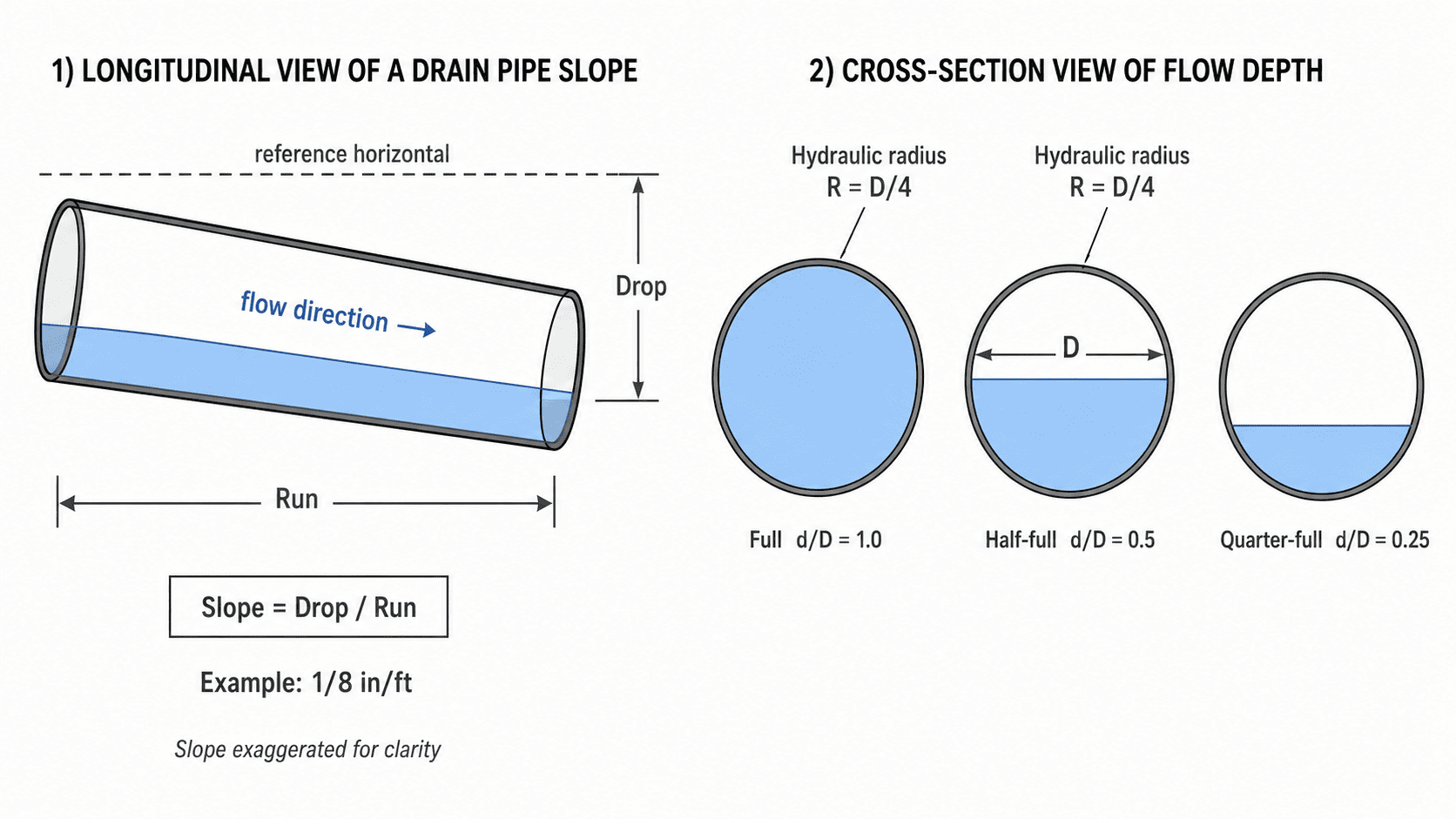
Drain pipe slope is the drop over the run (left). Gravity drains run partially full; the hydraulic radius is D/4 at both full and half-full, which is why half-full velocity equals full-pipe velocity (right). Slope exaggerated for clarity.
Gravity drains run partially full, so the hydraulic radius changes with flow depth. The calculator uses exact circular-segment geometry from the depth ratio d/D rather than fixed approximations, so the presets and custom depths stay consistent.
θ = 2 × arccos(1 − 2 × (d/D))   wetted angle, radians
A = (D² / 8) × (θ − sin θ)        flow area
P = (D / 2) × θ                   wetted perimeter
R = A / P                         hydraulic radius
For both full and half-full circular pipe, this reduces to R = D/4. Because the hydraulic radius is the same at both depths, half-full velocity equals full-pipe velocity. The difference is capacity: half-full carries half the flow because the flow area is half. This is why building drains are designed at half-full, which keeps velocity up while leaving capacity reserve and air space for venting.
Self-Cleaning Velocity
Self-cleaning velocity is the speed that keeps solids suspended and moving so they do not settle and clog the line. The widely used screening minimum is 2 ft/s (0.6 m/s). This is a screening threshold, not a guarantee for every flow condition, but it is the value most sanitary sewer design practice uses as a floor.
- Below 2 ft/s (0.6 m/s): solids tend to settle and deposit
- 2.0 to 2.5 ft/s: meets the screening minimum with limited margin; grit-heavy flows may warrant 2.5 ft/s (0.76 m/s)
- 2.5 to 10 ft/s (0.76 to 3 m/s): comfortable self-cleaning range
- Above 10 ft/s (3 m/s): high-velocity caution for erosion and stranding
- Above 15 ft/s (4.6 m/s): excessive velocity, erosion and hydraulic-jump risk
Velocity at minimum design flow matters more than peak. A pipe that is oversized for its load carries the same flow at a lower depth and lower velocity, which can drop below the self-cleaning minimum even though the line has plenty of capacity.
Recommended Pipe Slope
When the entered slope produces a velocity below 2 ft/s, the calculator reports a recommended slope. It takes the greater of two requirements: the slope needed to reach self-cleaning velocity, and the IPC 704 minimum for the diameter.
S_velocity_needed = ((2.0 × n) / (1.49 × R^(2/3)))²
S_recommended = max(S_velocity_needed, S_min)
This way the recommended slope clears both checks at once. If the recommended slope comes out impractically steep, the better fix is usually a different diameter, a smoother pipe material, or a revised routing, rather than forcing a steep continuous grade that risks stranding solids.
Key Facts
- The IPC minimum slope for a 4-inch building sewer is 1/8 in/ft (1.042%). At that slope, a PVC drain (n = 0.011) running half-full reaches about 2.64 ft/s — above the 2 ft/s self-cleaning screening minimum.
- Half-full velocity equals full-pipe velocity because the hydraulic radius R = D/4 at both depths in a circular pipe. The difference between them is capacity: half-full carries exactly half the flow because the area is half.
- Smooth PVC (n = 0.011) reaches self-cleaning velocity at a flatter slope than corrugated HDPE (n = 0.022). At the same slope and depth, PVC velocity is roughly twice that of corrugated pipe because n appears in the denominator.
- Above about 1/2 in/ft (about 4%), liquid can outrun solids and leave them behind on the pipe invert — the opposite of self-cleaning. Steep terrain is better handled with drop structures than with continuous steep pipe.
- Manning's equation governs gravity drainage. Hazen-Williams governs pressurized water supply. A single building uses both: Manning's for the drain going out, Hazen-Williams for the water supply coming in.
Applications
- Sizing residential building sewers and building drains
- Checking gravity sanitary laterals for self-cleaning velocity
- Verifying site grade against IPC minimum slope before trenching
- Comparing pipe materials (PVC, cast iron, clay, HDPE) by the slope each needs to reach self-cleaning velocity
- Screening storm drain and culvert runs for velocity at a chosen depth condition
- Confirming that a plan-set slope clears both the IPC code minimum and the 2 ft/s velocity screening threshold
Example Calculation
4-Inch PVC Building Sewer at 1/8 in/ft (Half-Full)
A suburban home runs a 4-inch PVC building sewer to the municipal connection. The site allows a 1/8 in/ft slope. Check the velocity and the IPC 704 minimum.
Given:
- Diameter = 4 in (0.333 ft)
- Slope = 1/8 in/ft = 0.010417 ft/ft
- Manning's n = 0.011 (PVC)
- Depth = half-full (d/D = 0.5) → R = D/4 = 0.0833 ft
Geometry (circular-segment engine at d/D = 0.5):
- θ = 2 × arccos(1 − 2 × 0.5) = 2 × arccos(0) = π rad
- A = (0.333² / 8) × (π − 0) = 0.0436 sq ft
- P = (0.333 / 2) × π = 0.5236 ft
- R = 0.0436 / 0.5236 = 0.0833 ft
Manning's equation:
- R^(2/3) = 0.0833^(0.667) = 0.1908
- S^(1/2) = 0.010417^(0.5) = 0.1021
- V = (1.49 / 0.011) × 0.1908 × 0.1021 = 135.45 × 0.1908 × 0.1021 = 2.64 ft/s (0.80 m/s)
Velocity check:
- 2.64 ft/s ≥ 2.0 ft/s → SELF-CLEANING GOOD (32% margin above the 2 ft/s threshold)
IPC slope check:
- 4-in pipe falls in the 3–6 in band → IPC minimum = 1/8 in/ft
- Entered slope = 1/8 in/ft → IPC MINIMUM MET (slope ratio 1.00×)
Capacity at half-full:
- Q = 2.64 × 0.0436 = 0.1151 cfs × 448.8 = 51.6 GPM (3.26 L/s)
- Full-pipe reference: 103 GPM (6.51 L/s)
Result: PASSES SELECTED CHECKS — IPC Slope Met + Self-Cleaning Velocity
Standards & References
- IPC Table 704.1 — Drainage Pipe Slope: International Plumbing Code, Section 704 (Drainage Pipe Cleanouts and Slope) and Table 704.1 — sets minimum drainage slopes by pipe diameter (1/4, 1/8, 1/16 in/ft). International Code Council.
- IPC Section 710 — Drainage System Sizing: International Plumbing Code, Section 710 — drainage system sizing requirements. International Code Council.
- USGS Water Supply Paper 2339 — Manning's Roughness Coefficients: Guide for Selecting Manning's Roughness Coefficients for Natural Channels and Flood Plains. USGS.
- ASCE/WEF MOP FD-5 — Gravity Sanitary Sewer Design: Gravity Sanitary Sewer Design and Construction, Manual of Practice FD-5. Water Environment Federation / ASCE.
- ASPE Plumbing Engineering Design Handbook: Plumbing Engineering Design Handbook, American Society of Plumbing Engineers. Covers building drainage system design at half-full.
- Ten States Standards (GLUMRB) — Wastewater Facilities: Recommended Standards for Wastewater Facilities (Ten States Standards), Great Lakes–Upper Mississippi River Board.
Units
Diameter
inches (in), millimeters (mm)
1 in = 25.4 mm
Slope
in/ft, percent (%), ft/ft, mm/m
1 in/ft = 8.333% = 83.33 mm/m
1% = 10 mm/m
Reference slopes
1/4 in/ft = 0.020833 ft/ft = 2.083% = 20.83 mm/m
1/8 in/ft = 0.010417 ft/ft = 1.042% = 10.42 mm/m
1/16 in/ft = 0.005208 ft/ft = 0.521% = 5.21 mm/m
Velocity
feet per second (ft/s), meters per second (m/s)
1 ft/s = 0.3048 m/s
Flow
gallons per minute (GPM), liters per second (L/s), cubic feet per second (cfs)
1 cfs = 448.8 GPM = 28.317 L/s
Hydraulic radius
feet (ft), meters (m)
1 ft = 0.3048 m
Limitations
- Covers gravity open-channel flow only. Does not apply to pressurized pipes, force mains, or siphonic drainage systems.
- Does not handle storm sewer inlet control, backwater conditions, or hydraulic grade line analysis.
- Does not size fixture units or compute the drainage load for a given fixture layout.
- Does not check venting, traps, trap seal depth, cleanouts, pipe offsets, fittings, or developed length.
- Does not derive the actual flow depth from a design flow — there is no design-flow input. It reports capacity at the depth you select.
- Does not model sediment gradation, grease accumulation, debris, or intermittent low flow.
- Large sewers (≥ 8 in) may be governed by tractive force or boundary shear rather than velocity alone.
- The 2 ft/s self-cleaning screening minimum is a widely used guidance value, not a hard code mandate in the IPC.
- The adopted local code edition and the authority having jurisdiction govern the final design. This tool does not certify code compliance.
Common Mistakes to Avoid
- Treating the IPC minimum slope as a guarantee of self-cleaning velocity. The IPC minimum is a code floor, not a velocity target. Velocity still has to be checked, especially for rougher pipe materials like concrete or corrugated HDPE.
- Oversizing the pipe to add capacity. A larger pipe carries the same flow at a lower depth and lower velocity, which can drop below the 2 ft/s self-cleaning threshold and cause deposits even though the pipe has plenty of capacity.
- Using nominal pipe size instead of the actual inside diameter. The inside diameter drives the hydraulics, and it differs from nominal by material, schedule, and lining. The hydraulic radius is calculated from the actual bore.
- Mixing up slope units. 1/8 in/ft is 1.04%, not 8% or 0.125%. Confirm the unit before entering. The calculator shows all four equivalent formats in the result so you can cross-check.
- Assuming steeper is always better. Above about 1/2 in/ft, liquid can outrun solids and leave them stranded on the pipe invert. Very steep runs need drop structures to maintain controlled velocity.
- Designing at full pipe. Building drains run half-full by design, which preserves capacity reserve and air space for venting. The calculator defaults to half-full.
- Applying Manning's to a pressurized line. Pressurized supply, force mains, and fire lines use Hazen-Williams or Darcy-Weisbach. Manning's is for gravity open-channel flow only.
Frequently Asked Questions
What is the minimum slope for a drain pipe?
What slope does a 4-inch drain pipe need?
Why does drain pipe need a minimum velocity?
Is 2 ft/s a hard code requirement?
Should a drain pipe run full or half-full?
What is Manning's n and which value should I use?
Can a drain pipe slope be too steep?
When do I use Manning's instead of Hazen-Williams?
Frequently Used Together
Engineers often use these calculators in combination for complete project workflows:
Related Calculators
Explore similar calculators that might be useful for your project:
Plumbing Quick Reference — Keep It On Your Phone On Site
A 10-page field reference for catching pressure, velocity, slope, and pump-sizing mistakes before you order pipe, close a wall, or add a booster.
- Velocity limits, fixture pressure minimums, drain slope, and the 80 psi ceiling in one table
- Worked examples that show why a single pressure number gives four different answers
- Keep it on your phone, or print the two field-check pages
Free PDF. Calculators stay free. Unsubscribe anytime.
Calculate
Imperial uses inches for diameter, ft/s for velocity, and GPM for capacity. SI uses millimeters for diameter, m/s for velocity, and L/s for capacity. IPC slope comparisons and Manning's equation are the same in both modes.
Inside diameter of the pipe. Typical building drainage: 1.5–15 in (DN 40–375). Use the actual inside diameter when available; nominal-size values are approximations that vary by material and wall schedule.
Choose the slope unit you want to enter. All three formats represent the same physical slope — the calculator converts internally. Reference: 1/4 in/ft = 2.083% = 0.020833 ft/ft; 1/8 in/ft = 1.042% = 0.010417 ft/ft; 1/16 in/ft = 0.521% = 0.005208 ft/ft.
Enter the numeric slope value in the unit selected above. A slope of 1/8 in/ft is entered as 0.125 (in/ft), 1.042 (%), or 0.010417 (ft/ft). Zero and negative slopes are invalid.
Manning's n is a roughness coefficient. Lower values produce higher velocity at a given slope. Typical values: PVC 0.011, cast iron/concrete 0.013, vitrified clay 0.014, corrugated HDPE 0.022. For sanitary sewers, designers sometimes use 0.013 even for smooth pipe to account for biofilm buildup over the service life.
The depth ratio d/D sets the flow area and hydraulic radius. Half-full (d/D = 0.50) is the standard design condition for building drains and sewers — it preserves capacity reserve, allows air space for venting, and protects trap seals. At both half-full and full, the hydraulic radius equals D/4, so velocity is the same at both depths; capacity at half-full is exactly half of full-pipe capacity.