Well Pump Sizing Calculator — GPM, TDH & Pump HP
On this page
Calculate
Direct entry is recommended when a flow requirement is known. Fixture build-up is a rough residential estimate only. For code design use the local plumbing fixture-unit method.
Peak flow the pump must deliver. Typical residential range: 8 to 15 GPM (30 to 57 L/min). For larger homes or irrigation, calculate from fixture demand.
Depth to water with the pump off, from the wellhead. From your well driller report. The pumping water level equals static level plus drawdown.
How far the water level drops while the pump runs. From a yield test or driller report. If unknown, enter 0 and confirm from a test before final pump selection.
Vertical rise from the wellhead to the highest point served (house, storage tank, etc.). Enter 0 if the wellhead and the highest outlet are at the same elevation. Do not enter horizontal pipe length here.
Use the cut-out pressure, the higher of the two switch settings. 50 psi for a 30/50 system, 60 psi for a 40/60 system. Sizing to the cut-in pressure underestimates head.
Measured from the wellhead down to the pump. Used for pipe friction and the submergence check. Must be deeper than the pumping water level so the pump stays submerged. This is the drop pipe length, not the well depth.
Horizontal pipe run from the wellhead to the pressure tank or house. Added to the drop pipe length for friction. Enter 0 if the pressure tank is at the wellhead.
Adds equivalent pipe length for fittings and bends. Applied to the total pipe length (drop pipe plus service line). A 10% allowance is a common default for a typical residential system.
Nominal pipe size for the drop pipe and service line. 1¼ in is the common residential drop pipe size. Friction rises steeply as size decreases: at 12 gpm, a 1 in pipe loses about four times the head of a 1¼ in pipe.
Sets the inside diameter and the Hazen-Williams friction coefficient. PVC Sch 40 is standard for residential well drop pipe. Steel C 140 applies to new pipe; older galvanized steel can be C 100 or less.
The flow the well can sustain continuously, from a yield test or driller report. If demand exceeds this, the fix is a storage tank, not a bigger pump. If unknown, obtain a yield test before selecting a pump.
Overview
A well pump is not sized by the depth of the well. It is sized by two numbers: the flow it must deliver in gallons per minute, and the total dynamic head in feet that it must pump against. Total dynamic head, or TDH, is the sum of the pumping water level, any elevation rise to the house, the pressure the system must hold, and the friction in the pipe. Once you have the required flow and the TDH, you match those to a pump performance curve. If two wells are both 200 ft deep, they can still need different pumps, because the pumping water level, the pressure setting, the pipe length, and the yield may all differ.
This calculator builds the TDH for you from your well and system numbers, estimates the motor horsepower range, and classifies the pump as a shallow-well jet or a submersible. It also runs the check that matters most: the required flow against the well's sustainable yield. If the demand is higher than the yield, the right answer is a storage tank, not a bigger pump. A larger pump on a weak well just draws the well down faster and risks running it dry.
The tool covers single-speed pumps with a pressure tank and switch. It does not size the electrical wire, breaker, or the pressure tank itself.
What to Look at First
Total dynamic head (TDH) and pump type. The two numbers that define a well pump are the required flow in GPM and the TDH in feet. TDH is the sum of the pumping water level, any elevation rise, the pressure head, and pipe friction. The pump type (submersible vs. shallow-well jet) is determined by the suction lift to the pumping water level.
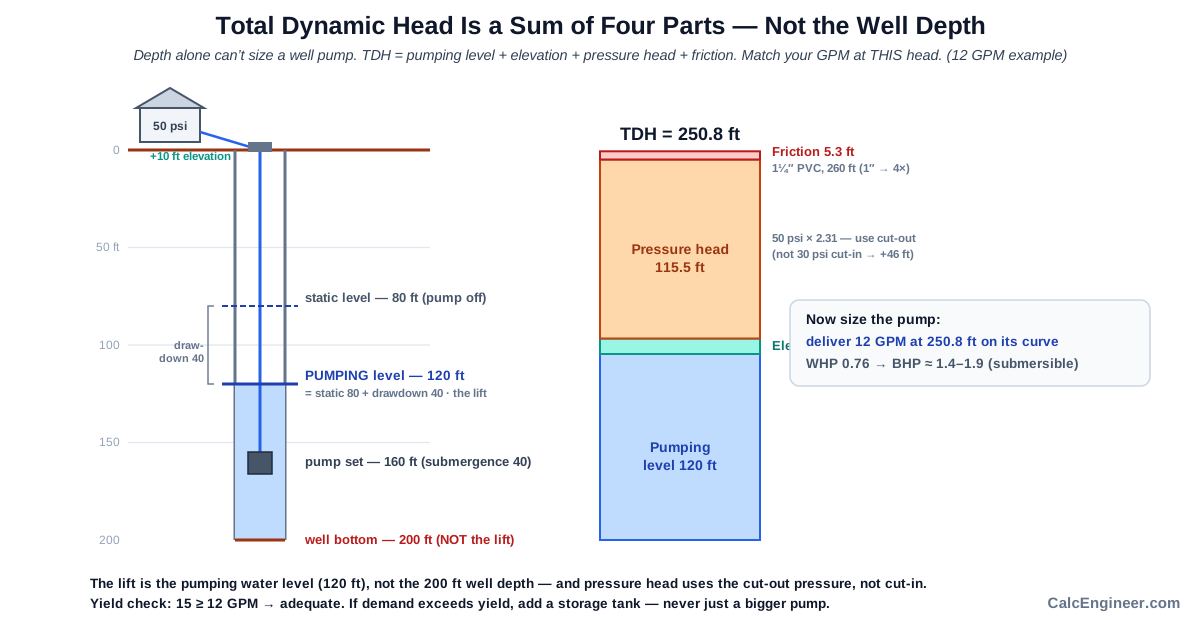
Yield verdict. The yield check is the most important result: it compares the required flow against the well's sustainable yield. If demand is close to or exceeds the yield, the fix is a storage tank, not a larger pump. A pump sized above the yield draws the well down and risks running it dry.
Estimated horsepower range. HP is an estimate from the pump-type efficiency band. It narrows the motor search but the final selection comes from reading a manufacturer pump curve at the required flow and calculated TDH.
Submergence. The pump setting depth must be below the pumping water level. If submergence is zero or negative, the result is suppressed and the depth must be corrected. Low submergence (below 10 ft) triggers a caution to confirm with the manufacturer.
How to Use This Calculator
Choose the unit system (US or Metric) using the calculator's own selector. Every field, label, and result follows that selector.
Enter the desired peak flow in GPM (or L/min in SI), or use the fixture build-up to estimate it from the number of bathrooms.
Enter the static water level and the drawdown from your well driller report. The pumping water level is the sum of the two and is the lift the pump works against.
Enter the pressure switch cut-out setting (the higher number: 50 psi for a 30/50 system, 60 psi for a 40/60 system).
Enter the pump setting depth and the service line length. These set the pipe friction length and the submergence check.
Select the pipe size and material. These set the inside diameter and the Hazen-Williams friction coefficient.
Enter the well's sustainable yield from a yield test or driller report.
Click Calculate. Read the TDH build-up, horsepower range, pump type, yield verdict, and submergence.
Use the pumping water level (static level plus drawdown), not the well depth or the static level alone. The pump is sized for the water level while it is running. If yield is unknown, get a yield test before selecting a pump.
Inputs & Outputs
Inputs
Outputs
Formula
Well Pump TDH Formula
US units: flow Q in GPM, heads in feet, pressure in psi, pipe ID d in inches, length L in feet.
1. Pumping water level (static lift)
   PL = static_level + drawdown                          [ft]

2. Pressure head (water, SG 1.0)
   PH = pressure_psi × 2.31                               [ft]

3. Friction loss (Hazen-Williams over total pipe length)
   L_total = (drop_pipe + service_line) × (1 + fitting_%/100)
   hf/100 = 0.2083 × (100/C)^1.852 × Q^1.852 / d^4.8655 [ft/100 ft]
   FL = hf/100 × L_total / 100                            [ft]
   C: plastic 150, new steel 140, older steel 100

4. Total dynamic head
   TDH = PL + elevation_rise + PH + FL                   [ft]

5. Pump power (Q_size = demand if demand ≤ yield, else yield)
   WHP = Q_size × TDH / 3960          (water horsepower)
   BHP = WHP / efficiency              (brake horsepower)
   Submersible efficiency: 0.40 to 0.55
   Jet pump efficiency:    0.25 to 0.45

6. Pump type (by suction lift = pumping water level, not TDH)
   PL ≤ 25 ft  →  shallow-well jet pump is an option
   PL  > 25 ft  →  submersible pump

7. Submergence
   submergence = pump_setting_depth - PL
   submergence ≤ 0   →  pump not submerged (invalid)
   0 < subm. < 10 ft  →  low-submergence advisory

8. Yield check
   U = demand / yield
   U < 0.85   →  adequate
   0.85 ≤ U < 1.00  →  marginal
   U ≥ 1.00   →  storage system required, size HP to yield
SI note: pressure head in meters = pressure in kPa / 9.81. Flow in L/min converts to GPM (÷ 3.785) for the friction formula. Power in kW = Q [L/min] × TDH [m] × 9.81 / 60,000.
What Size Well Pump Do I Need?
The honest answer is that depth alone cannot tell you. Two things size a well pump: the flow you need in GPM, and the total dynamic head in feet the pump must work against. Start by deciding the peak flow, roughly 8 to 12 GPM for a smaller home and 12 to 15 GPM for a larger one, or build it up from fixtures. Then calculate the TDH from the pumping water level, elevation rise, pressure setting, and pipe friction. The pump is the one that delivers your flow at that head on a manufacturer curve.
Two guardrails decide whether that pump is the right answer. First, use the pumping water level, not the static level and not the well depth, so the pump is sized for the conditions while it runs. Second, compare the flow to the well's sustainable yield. If the demand is higher than the well can sustain, the correct answer is a storage system, not a larger pump.
Pumping Water Level vs Well Depth
These three depths are often confused, and mixing them is the top cause of a badly sized well pump. The well depth is how deep the hole is drilled. It does not set the lift. The static water level is where the water sits when the pump is off. The pumping water level is where the water drops to while the pump runs, and it equals the static level plus the drawdown. The pump lifts water from the pumping water level, so that is the number the lift is built on.
The pump setting depth is separate again. The pump is set below the pumping water level so it stays submerged, but the water column below the pumping level does not add static lift. The setting depth matters for pipe friction and the submergence check. It is not the static lift unless the pumping water level happens to sit at that depth.
Well Yield vs Pump Demand
The well's sustainable yield is the flow it can supply continuously, measured by a yield test. This is the check that separates a real sizing tool from a simple horsepower estimate. If the peak demand is at or below the yield, the pump can be sized directly for the demand at the calculated head. If the demand is close to the yield, the system is marginal and worth a storage buffer. If the demand is above the yield, a bigger pump is the wrong fix.
When demand exceeds yield, the correct design sizes the pump around the sustainable yield and adds a storage tank to cover peak use. A pump sized for the higher demand would draw the water level below the pump intake and risk running the well dry, which damages the pump and the well. The calculator returns a storage-required verdict in that case and computes horsepower on the sustainable yield, not the unmet demand.
Well Pump Horsepower Formula
Water horsepower (WHP) is the power transferred to the water itself: WHP = Q × TDH / 3960, where Q is the flow in GPM and TDH is the total dynamic head in feet. Brake horsepower (BHP) is the motor shaft power needed to deliver that result: BHP = WHP / efficiency. The efficiency factor differs by pump type and is applied as a band to produce a range, not a point estimate, because actual pump efficiency varies by manufacturer, speed, and duty point.
Submersible pumps run at 40 to 55 percent wire-to-water efficiency, while shallow-well jet pumps run at 25 to 45 percent. Jet pumps are less efficient because the ejector that creates suction introduces hydraulic losses that a submerged centrifugal pump avoids entirely. The wider range for jet pumps reflects that spread. For a given WHP, the actual motor draw falls somewhere between the low-efficiency and high-efficiency bounds, so the result is a motor class to evaluate, not a final nameplate specification.
The horsepower result from this calculator is a planning estimate, not a final answer. The final motor size comes from a manufacturer pump curve: locate the intersection of your required flow in GPM and the calculated TDH on the pump's performance chart and read the HP at that duty point. The HP estimate narrows the motor class to evaluate, but the manufacturer curve is always the final authority.
Shallow Well Jet vs Submersible Pump
The pump type is set by the suction lift to the pumping water level, not by the well depth. When the pumping water level is about 25 feet or less below the wellhead, a shallow-well jet pump is an option. The jet pump sits above ground and draws water up by suction through a single pipe. Above 25 feet of suction lift, atmospheric pressure cannot reliably support the water column, so a submersible pump is used instead.
A submersible pump is set below the pumping water level inside the well casing. Because the motor and pump are submerged, there is no suction lift limit from atmospheric pressure. The pump pushes water up the drop pipe rather than pulling it, which is mechanically more efficient and is the reason submersible efficiency bands are higher than jet pump efficiency bands.
Deep-well jet systems exist that place an ejector nozzle in the well and can operate with pumping levels beyond 25 feet. These require separate ejector and nozzle sizing and are outside the scope of this calculator. Note that discharge elevation, the vertical rise from the wellhead to the house or tank, is part of TDH but is not part of the suction lift. Suction lift is only the depth to the pumping water level, measured from the wellhead.
Pressure Switch Cut-Out and Pressure Head
The pressure setting is converted to head at 1 psi = 2.31 feet of water, and it must use the cut-out pressure, the higher of the two switch settings. In a 30/50 system the cut-out is 50 psi, and in a 40/60 system it is 60 psi. The pump has to reach the cut-out pressure to shut off, so that is the pressure the head is built on.
Using the cut-in pressure instead understates the head. A 30/50 system sized on the 30 psi cut-in uses 69.3 feet of head, but the pump actually has to reach 50 psi, which is 115.5 feet. That is 46.2 feet of head missing from the TDH, enough to leave a pump that never satisfies the switch and runs continuously.
Pipe Friction and Drop Pipe Size
Friction loss is the resistance of water moving through the pipe, and it is added to the TDH. It is calculated over the total pipe length using the Hazen-Williams method with a coefficient set by the pipe material. Friction rises steeply as the pipe gets smaller, because the water has to move faster through a narrower bore.
The effect is large. At 12 GPM, a 1 inch pipe loses about 7.76 feet of head per 100 feet, while a 1.25 inch pipe loses only about 2.04 feet per 100 feet, nearly four times less for one size up. On a long drop pipe or a long run to the house, an undersized pipe can add tens of feet to the TDH and push the pump into a larger class than the well actually needs. Sizing the pipe up on long runs is often cheaper than sizing the pump up.
Key Facts
- A well pump is defined by two numbers: the required flow in GPM and the total dynamic head in feet. Depth alone does not size a pump.
- Pumping water level, not well depth and not static level, is the static lift. It equals static level plus drawdown.
- Pressure converts to head at 1 psi = 2.31 feet of water. A 50 psi setting is 115.5 feet of head.
- Use the pressure switch cut-out, the higher number, not the cut-in. A 30/50 system sized on 30 psi (cut-in) is missing 46.2 feet of head compared to the 50 psi cut-out.
- Friction rises steeply as pipe size drops. At 12 GPM, a 1 inch pipe loses about four times the head of a 1.25 inch pipe per 100 feet.
- Suction lift decides pump type. A shallow-well jet pump is limited to about 25 feet of suction lift to the pumping water level. Deeper pumping levels use a submersible.
- If demand exceeds the well's sustainable yield, the fix is a storage tank, not a bigger pump. An oversized pump draws the well down and risks running it dry.
- HP is an estimate from an efficiency band. The final selection is from a manufacturer pump curve at the required flow and TDH.
Applications
- Sizing a submersible pump for a new or replacement residential deep well.
- Sizing a shallow-well jet pump for a shallow water table.
- Checking whether an existing pump can meet a higher demand after adding fixtures or irrigation.
- Checking whether a pump can reach a higher pressure switch setting.
- Estimating the pump horsepower class before reading pump curves.
- Diagnosing weak pressure from an undersized pump, an undersized drop pipe, or a low-yield well.
- Planning a storage-tank system for a low-yield well that cannot meet peak demand directly.
- Comparing pipe sizes to see how much friction a smaller drop pipe adds to the TDH.
Example Calculation
Example 1: A Typical Residential Well (Case 1)
A home needs 12 GPM (45.4 L/min). Static water level 80 ft (24.4 m), drawdown 40 ft (12.2 m), so pumping level 120 ft (36.6 m). Elevation rise 10 ft (3.0 m). Pressure switch cuts out at 50 psi (345 kPa). Pump at 160 ft on 1¼ in PVC Sch 40 drop pipe. Service line 100 ft. Well yield 15 GPM.
Pumping level: 80 + 40 = 120 ft (36.6 m)
Pressure head: 50 × 2.31 = 115.5 ft (35.2 m)
Pipe: 1¼ in PVC Sch 40, ID 1.380 in, C 150, L = 160 + 100 = 260 ft
Friction: 0.2083 × (100/150)^1.852 × 12^1.852 / 1.380^4.8655 = 2.04 ft/100 ft
          FL = 2.04 × 260 / 100 = 5.3 ft
TDH = 120 + 10 + 115.5 + 5.3 = 250.8 ft (76.4 m)
WHP = 12 × 250.8 / 3960 = 0.76 HP
Submersible efficiency 40–55%: BHP 1.38 to 1.90 HP
Yield 15 vs demand 12: U 80%, adequate
Submergence 160 − 120 = 40 ft
Final step: select a submersible that delivers 12 GPM at 251 ft TDH on its pump curve.
Example 2: Low-Yield Well (the Critical Verdict)
Same house needs 12 GPM, but the well yields only 5 GPM (yield test). TDH ~270 ft. Yield utilization: 12 / 5 = 240%. Result: storage system required. HP is computed on 5 GPM (the yield), not 12 GPM. The tool does not present a 12 GPM pump. Add a storage tank sized for peak use.
Example 3: Shallow Well (Jet Pump)
Static level 15 ft, drawdown 3 ft, pumping level 18 ft. With 40 psi and a short pipe run, TDH ~113 ft. Suction lift 18 ft, at or below the 25 ft limit, so a shallow-well jet pump is an option. Estimated motor about 0.51 to 0.91 HP class.
Standards & References
- Franklin Electric AIM Manual, Submersible Motor Application, Installation, and Maintenance: primary manufacturer sizing reference for submersible well pumps
- Grundfos, submersible pump and motor sizing guides: manufacturer TDH and HP sizing methodology
- Goulds Water Technology, pump sizing resources: residential and light-commercial well pump selection
- NFPA 70, National Electrical Code, Article 430 Motors: wire, breaker, and motor protection sizing (out of scope for v1 of this calculator, listed as reference)
- Engineering ToolBox, Hazen-Williams friction loss: Hazen-Williams friction formula and pipe coefficients
Limitations
- This calculator is for single-speed pumps with a pressure tank and pressure switch. It does not model variable-speed or constant-pressure (VFD) systems.
- Electrical sizing (wire gauge, breaker, control box, voltage drop) is outside this calculator. Those use NEC Article 430 and manufacturer motor tables.
- The pressure tank, storage-tank volume, and well recovery rate over time are not sized by this calculator.
- Deep-well jet ejectors and nozzles require separate sizing and are outside v1.
- Friction uses Hazen-Williams over the total pipe length with an optional fitting allowance, not an exact fitting count.
- Water at normal temperature and specific gravity 1.0. The 2.31 psi-to-feet factor assumes water.
- HP is a planning estimate. The pump curve is the final authority.
- Steel Sch 40 uses C 140 (new pipe). Older galvanized steel can be C 100 or less, which significantly increases friction.
Common Mistakes to Avoid
- Sizing on well depth or static water level instead of the pumping water level. Use static level plus drawdown.
- Ignoring drawdown. The pump must work when the level has dropped during pumping.
- Using the pump setting depth as the static lift. The pump may sit far below the pumping water level for submergence, but the water below the pumping level does not add lift.
- Using the pressure switch cut-in instead of the cut-out. The cut-out is the higher number and sets the head the pump must reach to shut off.
- Ignoring pipe friction, especially on long drop pipes with undersized diameter. At 12 GPM a 1 inch pipe loses about four times the head of a 1.25 inch pipe.
- Installing a larger pump on a low-yield well. If the well sustains less than the demand, a larger pump draws it down and can run it dry.
- Entering horizontal pipe length as elevation rise. Elevation rise is vertical difference only.
- Setting the pump at or above the pumping water level. Submergence must be positive.
Frequently Asked Questions
How do I size a well pump?
What is total dynamic head (TDH)?
Why use the pumping water level and not the well depth?
What if my well yield is lower than my water demand?
Should I use a jet pump or a submersible?
Do I use the cut-in or cut-out pressure?
How much horsepower does my well pump need?
Does the pump setting depth add to TDH?
What if my pump is not submerged enough?
Can I just install a bigger pump to be safe?
How does pipe size affect TDH?
Frequently Used Together
Engineers often use these calculators in combination for complete project workflows:
Related Calculators
Explore similar calculators that might be useful for your project:
Plumbing Quick Reference — Keep It On Your Phone On Site
A 10-page field reference for catching pressure, velocity, slope, and pump-sizing mistakes before you order pipe, close a wall, or add a booster.
- Velocity limits, fixture pressure minimums, drain slope, and the 80 psi ceiling in one table
- Worked examples that show why a single pressure number gives four different answers
- Keep it on your phone, or print the two field-check pages
Free PDF. Calculators stay free. Unsubscribe anytime.
Calculate
Direct entry is recommended when a flow requirement is known. Fixture build-up is a rough residential estimate only. For code design use the local plumbing fixture-unit method.
Peak flow the pump must deliver. Typical residential range: 8 to 15 GPM (30 to 57 L/min). For larger homes or irrigation, calculate from fixture demand.
Depth to water with the pump off, from the wellhead. From your well driller report. The pumping water level equals static level plus drawdown.
How far the water level drops while the pump runs. From a yield test or driller report. If unknown, enter 0 and confirm from a test before final pump selection.
Vertical rise from the wellhead to the highest point served (house, storage tank, etc.). Enter 0 if the wellhead and the highest outlet are at the same elevation. Do not enter horizontal pipe length here.
Use the cut-out pressure, the higher of the two switch settings. 50 psi for a 30/50 system, 60 psi for a 40/60 system. Sizing to the cut-in pressure underestimates head.
Measured from the wellhead down to the pump. Used for pipe friction and the submergence check. Must be deeper than the pumping water level so the pump stays submerged. This is the drop pipe length, not the well depth.
Horizontal pipe run from the wellhead to the pressure tank or house. Added to the drop pipe length for friction. Enter 0 if the pressure tank is at the wellhead.
Adds equivalent pipe length for fittings and bends. Applied to the total pipe length (drop pipe plus service line). A 10% allowance is a common default for a typical residential system.
Nominal pipe size for the drop pipe and service line. 1¼ in is the common residential drop pipe size. Friction rises steeply as size decreases: at 12 gpm, a 1 in pipe loses about four times the head of a 1¼ in pipe.
Sets the inside diameter and the Hazen-Williams friction coefficient. PVC Sch 40 is standard for residential well drop pipe. Steel C 140 applies to new pipe; older galvanized steel can be C 100 or less.
The flow the well can sustain continuously, from a yield test or driller report. If demand exceeds this, the fix is a storage tank, not a bigger pump. If unknown, obtain a yield test before selecting a pump.