Sump Pump Capacity Calculator — GPM & Head
On this page
Calculate
US uses gallons per minute, feet, and inches. Metric uses litres per minute, metres, and millimetres. All inputs and outputs switch accordingly.
Basin-rise test on a wet day is the most reliable. Drainage-area method is a rough estimate: actual inflow depends on grading, soil, and drain tile. Known-flow method if you already have a measured or design flow.
Multiplied by the inflow to set the target flow. Default 1.5 (typical). Use 1.2 for a measured stable inflow, 2.0 for a high-risk basement. Leave blank to use 1.5.
Inside diameter of the sump pit. Used to compute gallons per inch for basin-rise inflow, total basin volume, and drawdown volume. Common sizes: 18 in (460 mm) and 24 in (610 mm).
Turn the pump off and measure how many inches the water rises in 60 seconds during active inflow on a wet day. Do not let it rise to the inlet pipe.
Vertical rise from the pump inlet (or basin water level) to the HIGHEST point of the discharge line, not the total pipe length. This is the static component of TDH.
Nominal discharge pipe size (Schedule 40 PVC assumed). Smaller pipe raises friction head sharply at higher flows. Most residential sump pumps use 1½" or 2".
Total length of discharge piping (not including equivalent lengths for fittings). Longer runs increase friction head significantly.
Number of 90° elbows in the discharge line. Each elbow adds an equivalent length of straight pipe to the friction calculation. Leave blank or enter 0 for none.
A check valve prevents backflow when the pump stops. It adds equivalent pipe length to the friction head. Most sump pump installations include a check valve.
Total depth of the sump basin from the bottom to the top. Used to compute total basin volume. Required only for the basin volume display; does not affect the duty point.
Vertical distance between the pump-on float level and the pump-off float level. Used to compute the usable drawdown volume and cycle time. Must be less than basin depth.
A definitive pass/fail requires the pump's flow at your actual TDH, not the zero-head maximum on the box. HP class alone is a rough starting label only.
What to Look at First
Duty point: target GPM at TDH, the primary result. A sump pump is defined by two numbers, not one: the flow it must move and the total head it moves it against. The duty point tells you what to look up on the manufacturer's pump curve.
Total dynamic head (TDH) is the vertical lift plus the friction of the discharge pipe and fittings. Pump flow falls as head rises, so a pump rated 60 GPM at zero head may deliver far less at your actual TDH.
Suggested starting HP class is a rough guide from the duty point. Two pumps of the same HP can have very different curves; always confirm flow at your TDH on the manufacturer's curve, not the zero-head maximum.
Candidate check (Track B). If you enter a candidate pump's flow at your TDH (or curve points), the calculator tells you whether that pump is ADEQUATE, AMPLE, or UNDERSIZED vs the target. A keep-up check (pump flow vs raw inflow) is also shown separately from the safety-target check.
How to Use This Calculator
Choose the unit system: US (gpm, ft, inches) or Metric (L/min, m, mm).
Pick the inflow method: measured basin rise (most reliable on a wet day), drainage area and rainfall, or a known flow rate.
Enter the safety factor (1.5 is typical; 1.2 for measured stable inflow; 2.0 for high-risk).
Enter the vertical lift (static head) from the pump to the highest discharge point.
Select the discharge pipe size and enter the run length, number of elbows, and whether a check valve is present.
Enter basin diameter and depth, and the pump on/off float band depth for basin volume and cycle time.
Read the duty point (target GPM at TDH), suggested HP class, basin volumes, and cycle time.
Optional: enter a candidate pump as its flow at your TDH, or as 2–4 pump-curve points, to get a pass/fail verdict.
The duty point (target GPM at TDH) is what you look up on the pump curve. Do not use the zero-head maximum flow from the pump box: every pump delivers less as head rises.
Inputs & Outputs
Inputs
Outputs
Formula
Step 1: Inflow
Basin-rise method (preferred):
  gal_per_inch = π × (D_in / 2)² / 231    (exact geometry; 231 in³/gallon)
    18 in → 1.10 gal/in;  24 in → 1.96 gal/in
  inflow_gpm = gal_per_inch × inches_risen_in_60s

Drainage-area method (rough estimate):
  inflow_gpm = Area_ft² × i_in/hr / 12 × 7.48 / 60 × C
    i = rainfall intensity (in/hr);  C = runoff coefficient (0–1)

Known flow:
  inflow_gpm = entered directly
Step 2: Target Flow
target_gpm = inflow_gpm × safety_factor
  (1.2 measured-stable / 1.5 default / 2.0 high-risk)
Step 3: Total Dynamic Head (Hazen-Williams, C = 150, Schedule 40 PVC)
TDH = static_head + friction_head
static_head = vertical rise to the highest point of discharge (not pipe length)

hf_per_100ft = 10.67 × 100 × Q_cfs^1.852 / (C^1.852 × D_ft^4.87)
  Q_cfs = q_gpm / 448.831     (GPM → ft³/s)
  D_ft  = pipe_ID_in / 12     (in → ft)
  C     = 150

Fitting equivalent lengths (Hydraulic Institute, Schedule 40 PVC):
  1¼" pipe: elbow 3.5 ft, check valve 10 ft
  1½" pipe: elbow 4.5 ft, check valve 12 ft
  2"  pipe: elbow 5.5 ft, check valve 17 ft
  2½" pipe: elbow 7.0 ft, check valve 22 ft
  3"  pipe: elbow 8.5 ft, check valve 28 ft

total_EL      = pipe_run + n_elbows × elbow_EL + check_valve_EL
friction_head = (hf_per_100ft / 100) × total_EL
Step 4: Basin Volumes and Cycle Time
total_basin_volume  = π × (D_in/2)² × basin_depth_in / 231
usable_drawdown_vol = π × (D_in/2)² × on_off_depth_in / 231
cycle_time_min = usable_drawdown_vol / (pump_gpm_at_TDH − inflow_gpm)
Step 5: Candidate Verdict
ratio = candidate_flow_at_TDH / target_gpm
ratio ≥ 1.25           AMPLE
1.00 ≤ ratio < 1.25    ADEQUATE
0.90 ≤ ratio < 1.00    UNDERSIZED-MARGINAL
ratio < 0.90           UNDERSIZED
pump_flow_at_TDH ≤ inflow_gpm → CANNOT-KEEP-UP (overrides ratio)
Conversions
1 gal = 231 in³ = 3.785 L
1 ft = 0.3048 m
1 GPM = 3.785 L/min = 0.227 m³/h
18 in basin: 1.10 gal/in;  24 in basin: 1.96 gal/in
What Size Sump Pump Do I Need?
The size of a sump pump is not a horsepower number; it is a duty point: the flow it must deliver at the head it must work against. Getting there takes four things. First, the inflow: how fast water enters the pit during a heavy event, best found with the basin-rise test. Second, a safety factor, usually 1.5, to set a target flow above the measured inflow. Third, the total dynamic head: the vertical lift plus the friction of the pipe and fittings. Fourth, the pump curve: the pump you pick has to deliver the target flow at that head, not at zero head.
That is why 'what size sump pump do I need' has no single answer like 'a 1/3 HP.' The same pump can be plenty in a shallow pit with a short pipe and inadequate in a deep basement with a long run, because the head is different. Size on the duty point, then confirm the flow at that head on the manufacturer's curve.
How to Measure Sump Pump Inflow
The most reliable way to find your inflow is the measured basin-rise test, done on a wet day when the ground is saturated. Run the pump until the water drops to the shutoff level, then turn it off and watch the pit. Measure how many inches the water rises in 60 seconds during active inflow, and do not let it rise to the inlet pipe or overflow the pit.
Convert the rise to a flow using the basin's gallons per inch. Each inch of an 18-inch basin holds about 1.1 gallons, and a 24-inch basin about 2 gallons, so inches per minute times gallons per inch gives GPM directly. The other two methods are the drainage-area method, which estimates potential runoff from an area and a rainfall intensity but is only a rough figure, and the known-flow method, which takes a GPM you already have.
Total Dynamic Head for Sump Pumps
Total dynamic head is the resistance the pump works against, in feet of water, and it is the vertical lift plus the friction head. Static head is the vertical rise from the pump inlet to the highest point of the discharge line, not the total pipe length. Friction head comes from the pipe size, the run length plus the equivalent length of the fittings, and the flow. This calculator uses the Hazen-Williams equation (C = 150 for Schedule 40 PVC) to compute friction: smaller pipe and higher flow raise the friction per foot sharply, and a check valve plus every elbow add to the total equivalent length.
Sump Pump GPM at Head
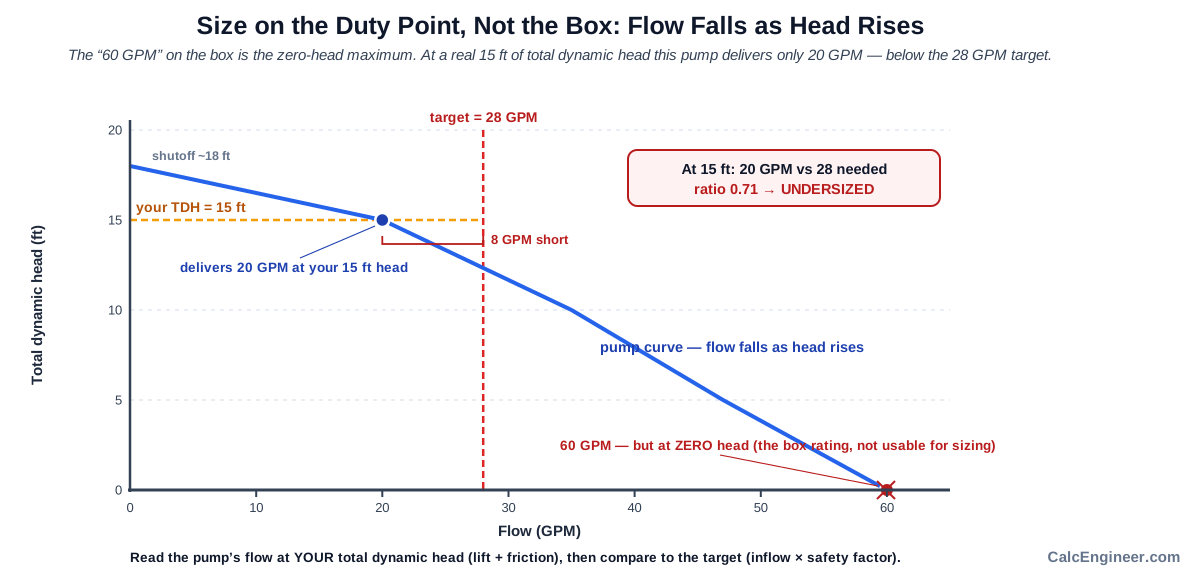
This is where most sizing goes wrong. The GPM on the box is almost always the maximum at zero head, and no real installation has zero head. Every pump has a curve that slopes downward: the higher the lift and the more friction, the less water per minute it moves. A pump rated 60 GPM at zero head might give 35 GPM at 10 feet and 20 GPM at 15 feet. The number that decides the sizing is the pump's flow at your TDH, read from its curve, not the advertised maximum.
Choosing a Pump at the Duty Point
The pump choice comes down to one question: does the pump deliver at least the target flow at the TDH on its curve? Horsepower is a starting label, not the answer. The pump must first exceed the inflow to empty the basin, and then meet the target to have the safety margin you set.
| Pump class | Typical use | Must confirm |
|---|---|---|
| ¼ HP | Light inflow and low head | Flow on the curve at your TDH |
| ⅓ HP | Common residential sump | Flow on the curve at your TDH |
| ½ HP | Higher lift or higher inflow | Flow on the curve at your TDH |
| ¾ HP and up | High inflow and long discharge | Flow on the curve at your TDH and cycle time |
Horsepower is only a starting class. Final selection depends on the pump flow at your total dynamic head, read from the manufacturer curve, not on horsepower or the zero-head maximum.
Sump Pump Cycle Time
Cycle time is how long the pump runs each time it starts, and it is a health check separate from capacity. It uses the usable drawdown volume (the water between the float on and off points), not the total basin volume.
usable_drawdown_vol = π × (D_in/2)² × on_off_depth_in / 231
cycle_time_min = usable_drawdown_vol / (pump_gpm_at_TDH − inflow_gpm)
A cycle under about a minute is short-cycling: the pump starts and stops too often, which wears the motor and switch. A wider float band or a larger basin lengthens the cycle. Note that a pump can meet the target flow and still short-cycle; capacity and cycle time are separate checks.
What Sump Pump Capacity Is
Sump pump capacity is the flow rate the pump delivers at a specific total dynamic head, measured in gallons per minute or litres per minute. It is not the zero-head maximum printed on the box. Because pump flow falls as head rises, the only number that matters for sizing is the flow the pump delivers at your actual TDH, read from the manufacturer's curve.
Capacity has two components that both must be met. The pump must first exceed the raw inflow so the basin can empty. Then it must meet the target flow, which is the inflow multiplied by the safety factor. A pump that meets the target has capacity for both draining and the safety margin. A pump that barely exceeds the inflow can drain the basin but has no margin for a heavier event.
This calculator expresses sump pump capacity as a duty point: the target GPM at the total dynamic head. That pair of numbers is what you look up on the manufacturer's curve to confirm the pump, and it is the most precise way to describe sump pump capacity for a specific installation.
Key Facts
- A sump pump is sized by two numbers: the required flow in GPM and the total dynamic head, not by horsepower alone.
- Pump flow falls as head rises, so a pump rated 60 GPM at zero head may deliver far less at 10 to 15 feet.
- Total dynamic head is the vertical lift (static head) plus the friction of the pipe, fittings, and check valve.
- The target flow is the inflow rate times a safety factor, typically 1.5 (1.2 for measured stable, 2.0 for high-risk).
- The measured basin-rise test on a wet day is the most reliable inflow estimate; drainage-area method is a rough figure.
- Cycle time uses the usable drawdown volume between the float on and off points, not the total basin volume.
- The pump must at least exceed the inflow or the basin never empties; that keep-up check is separate from meeting the safety target.
- A pump can meet the target GPM and still short-cycle if the basin drawdown volume is too small.
Applications
- Sizing a primary sump pump for a basement or crawl space
- Checking a replacement pump's curve before buying, so it clears the duty point
- Diagnosing why a pump runs but the water keeps rising (a keep-up problem)
- Comparing a 1/3 HP and a 1/2 HP pump using the flow at your real head
- Estimating the total dynamic head for a long or high discharge run
- Checking whether a long discharge line needs a larger pipe to lower friction head
Example Calculation
Example 1: Measured Basin-Rise Inflow and Target Flow
Given: 18-inch basin, water rising 8 inches in 60 seconds, safety factor 1.5.
gal_per_inch = π × (18/2)² / 231 = π × 81 / 231 = 1.10 gal/in
inflow_gpm   = 1.10 × 8 = 8.8 GPM
target_gpm   = 8.8 × 1.5 = 13.2 GPM
About 8.8 GPM flows in, so the target is 13.2 GPM once the safety factor is applied.
Example 2: Total Dynamic Head
Given: static lift 13 ft, 1½" pipe (ID 1.610 in), 20 ft run, 2 elbows, check valve, flow 13.2 GPM. Hazen-Williams C = 150 (Schedule 40 PVC).
Q_cfs      = 13.2 / 448.831      = 0.02941 ft³/s
D_ft       = 1.610 / 12          = 0.1342 ft
hf/100 ft  = 10.67 × 100 × (0.02941)^1.852 / (150^1.852 × (0.1342)^4.87)
           ≈ 2.57 ft/100 ft

Elbow EL:       2 × 4.5 ft = 9 ft
Check valve EL: 12 ft
Total EL:       20 + 9 + 12 = 41 ft

friction_head = (2.57 / 100) × 41 ≈ 1.1 ft
TDH           = 13 + 1.1         = 14.1 ft
The pump must deliver 13.2 GPM at 14.1 ft of head. Enter these inputs into the calculator to confirm the match.
Example 3: Candidate Check
Given: target 18 GPM at 14 ft TDH; candidate curve shows 20 GPM at 14 ft.
ratio = 20 / 18 = 1.11 → ADEQUATE
The candidate delivers 20 GPM at the actual head vs 18 GPM needed, adequate with headroom. This uses the flow at 14 ft, not the pump's zero-head maximum.
Example 4: Cannot Keep Up
Given: inflow 20 GPM, candidate delivers only 18 GPM at TDH.
pump flow at TDH (18) ≤ inflow (20) → CANNOT-KEEP-UP
Critical: the basin never empties. The pump must first beat the inflow before the safety target matters.
Example 5: Basin Volume and Cycle Time
Given: 18-inch basin, 6-inch float band, inflow 8.8 GPM, pump 30 GPM at TDH.
usable_drawdown = π × 9² × 6 / 231 = 6.6 gal
cycle_time = 6.6 / (30 − 8.8) = 6.6 / 21.2 = 0.31 min (19 sec)
A 19-second cycle triggers a short-cycle advisory. Widen the float band or enlarge the basin.
Example 6: The Zero-Head Rating Mistake
Given: pump advertised as 60 GPM max; TDH 15 ft; curve at 15 ft shows 20 GPM; target 28 GPM.
box rating: 60 GPM at 0 ft (not usable for sizing)
curve at 15 ft: 20 GPM
target: 28 GPM
ratio: 20 / 28 = 0.71 → UNDERSIZED
Undersized even though the box says 60 GPM. The real check is the flow at 15 ft.
Example 7: Drainage-Area Estimate
Given: 2000 ft² drainage area, 1 in/hr rainfall, runoff coefficient 0.6.
inflow_gpm = 2000 × 1 / 12 × 7.48 / 60 × 0.6 = 12.5 GPM
Rough estimate only. The measured basin-rise test is more reliable for an existing pit.
Example 8: A Larger Discharge Pipe Lowers the Head (Conceptual)
Setup (conceptual): Same pump, same static lift, comparing a 1½" and a 2" discharge pipe on a moderately long run. Actual friction values depend on the exact flow and pipe length.
Smaller pipe (1½"): Higher friction head → higher TDH → pump delivers less flow at that head.
Larger pipe (2"): Lower friction head → lower TDH → pump delivers more flow at that head.
Result: Friction rises sharply as the pipe gets smaller and the flow gets higher. Going up one discharge size can noticeably lower the TDH, which moves the pump to a better operating point on its curve and gives more usable flow. On a long run, the pipe size can matter as much as the pump itself.
Standards & References
- Sump and Sewage Pump Manufacturers Association (SSPMA): sizing guidance for pump capacity and total dynamic head; defines the duty-point methodology used in this calculator
- SSPMA Certified Pumps: pumps tested and rated to SSPMA Recommended Standards; the certified flow-at-head values are the correct input for the candidate check
- Hydraulic Institute: North American authority on pumps, pump curves, and the duty-point concept (flow at head); source for the friction calculation approach and equivalent length methodology
- International Plumbing Code (IPC) / International Residential Code (IRC): sump discharge provisions; local jurisdictional rules vary and should be verified with the authority having jurisdiction
Units
Flow: 1 GPM = 3.785 L/min = 0.227 m³/h
Head: 1 ft = 0.3048 m (14 ft = 4.27 m)
Volume: 1 gallon = 231 in³ = 3.785 L
Basin capacity: 1.10 gal/in (18-inch basin) · 1.96 gal/in (24-inch basin)
Dimensions: basin diameter and depth in inches (US) or mm (metric)
Limitations
- This calculator provides a residential clear-water planning estimate, not a pump-curve substitute or guarantee.
- It estimates the duty point (target flow and TDH) and checks a candidate pump's flow at that head; it does not model a pump curve automatically unless you enter curve points.
- The friction head is a simplified estimate from pipe size, length, and fitting equivalent length, not a full network calculation.
- It does not select a specific pump model, size a battery-backup or secondary pump, or design the pit or perimeter drain-tile system.
- It does not account for pump wear, clogging, or screen blockage; it does not verify the electrical circuit, GFCI, alarm, or backup power.
- It does not check discharge freezing or ice blockage, or local discharge-location rules.
- It does not handle solids, sewage, or effluent ejector applications; use a sewage pump for those.
- Results depend on the inflow, safety factor, lift, and friction inputs you supply. Verify the final pump against its curve at your TDH with a qualified installer.
Common Mistakes to Avoid
- Sizing on horsepower alone. Two same-horsepower pumps can have very different curves; size on flow at your head.
- Using the advertised maximum GPM. That number is usually at zero head; the pump delivers far less at your actual lift.
- Entering the zero-head flow as the candidate flow. The candidate flow must be the pump's flow at your TDH.
- Ignoring total dynamic head. A pump that looks strong at low lift can fall short once the discharge climbs or runs far.
- Measuring total pipe length as static head. Static head is the vertical rise to the highest point, not the pipe length.
- Forgetting the check valve and elbows. Each adds friction head and raises the TDH.
- Using total basin volume for cycle time. Cycle time uses the usable drawdown volume between the float on and off points.
- Setting the safety factor too high. An oversized pump in a small basin short-cycles and wears out early.
Frequently Asked Questions
How do I calculate what size sump pump I need?
What is a good GPM for a sump pump?
Is a 1/3 HP or 1/2 HP sump pump better?
Why is horsepower not enough to size a sump pump?
What is total dynamic head on a sump pump?
How do I measure the inflow into my sump pit?
Why does my pump run but the water keeps rising?
Can a sump pump be too powerful?
Frequently Used Together
Engineers often use these calculators in combination for complete project workflows:
Related Calculators
Explore similar calculators that might be useful for your project:
Plumbing Quick Reference — Keep It On Your Phone On Site
A 10-page field reference for catching pressure, velocity, slope, and pump-sizing mistakes before you order pipe, close a wall, or add a booster.
- Velocity limits, fixture pressure minimums, drain slope, and the 80 psi ceiling in one table
- Worked examples that show why a single pressure number gives four different answers
- Keep it on your phone, or print the two field-check pages
Free PDF. Calculators stay free. Unsubscribe anytime.
Calculate
US uses gallons per minute, feet, and inches. Metric uses litres per minute, metres, and millimetres. All inputs and outputs switch accordingly.
Basin-rise test on a wet day is the most reliable. Drainage-area method is a rough estimate: actual inflow depends on grading, soil, and drain tile. Known-flow method if you already have a measured or design flow.
Multiplied by the inflow to set the target flow. Default 1.5 (typical). Use 1.2 for a measured stable inflow, 2.0 for a high-risk basement. Leave blank to use 1.5.
Inside diameter of the sump pit. Used to compute gallons per inch for basin-rise inflow, total basin volume, and drawdown volume. Common sizes: 18 in (460 mm) and 24 in (610 mm).
Turn the pump off and measure how many inches the water rises in 60 seconds during active inflow on a wet day. Do not let it rise to the inlet pipe.
Vertical rise from the pump inlet (or basin water level) to the HIGHEST point of the discharge line, not the total pipe length. This is the static component of TDH.
Nominal discharge pipe size (Schedule 40 PVC assumed). Smaller pipe raises friction head sharply at higher flows. Most residential sump pumps use 1½" or 2".
Total length of discharge piping (not including equivalent lengths for fittings). Longer runs increase friction head significantly.
Number of 90° elbows in the discharge line. Each elbow adds an equivalent length of straight pipe to the friction calculation. Leave blank or enter 0 for none.
A check valve prevents backflow when the pump stops. It adds equivalent pipe length to the friction head. Most sump pump installations include a check valve.
Total depth of the sump basin from the bottom to the top. Used to compute total basin volume. Required only for the basin volume display; does not affect the duty point.
Vertical distance between the pump-on float level and the pump-off float level. Used to compute the usable drawdown volume and cycle time. Must be less than basin depth.
A definitive pass/fail requires the pump's flow at your actual TDH, not the zero-head maximum on the box. HP class alone is a rough starting label only.