Horizontal Tank Volume Calculator — Fill Depth & Capacity
On this page
Calculate
Inside diameter of the cylindrical shell. Use inside dimensions — outside diameter overstates capacity by twice the wall thickness.
Enter the straight shell length between the heads, or the overall end-to-end length — choose the basis below.
If you have the straight cylindrical length between the heads, use Shell. If you only have the end-to-end overall dimension, switch to Overall — the head depths are subtracted so the heads are not counted twice.
Flat heads add no volume beyond the cylinder. Hemispherical heads add one full sphere's worth across both ends. 2:1 elliptical heads (depth = D/4 each) add half that. Standard dished (ASME F&D) is not yet supported — use a strapping table.
Measured from the inside bottom of the tank to the liquid surface, by gauge stick, sight glass, or level transmitter. Convert any external gauge reading to inside liquid depth first.
Optional. Enter in the same unit as the selected output volume. The calculator reports whether the current fill is above or below the target — not a pass/fail verdict, just the difference.
Overview
This calculator finds the liquid volume in a horizontal cylindrical tank at a measured fill depth, along with the total capacity, the percent full, and the ullage — the empty space above the liquid. It handles the common end-cap (head) types: flat, hemispherical, and 2:1 elliptical. From the tank diameter, the cylindrical length, the head type, and the liquid depth, it returns the volume of liquid in the body and the heads, the full capacity, and how full the tank is.
The reason a horizontal tank needs its own calculator is that the volume is not proportional to the depth. A horizontal cylinder has a circular cross-section, so as the liquid rises the surface width changes, and the wetted cross-section is a circular segment whose area grows non-linearly with depth. At the exact centreline the tank is 50% full by symmetry, but at a quarter of the depth it holds far less than a quarter of the volume. Reading a gauge stick and assuming the volume scales with the depth is the classic mistake, and it is wrong everywhere except the midpoint.
The second thing that matters is the heads. Many tanks are not flat-ended: hemispherical and 2:1 elliptical heads bulge outward and add real capacity beyond the cylinder, and ignoring them understates the tank. This tool models the head type explicitly and adds its contribution, filled to the same depth as the body. The result is exact geometry for a true cylinder; for inventory of record or custody transfer, a tank's calibrated strapping table — which accounts for out-of-roundness, tilt, and deadwood — governs.
The calculator works in US Customary units by default (inches for dimensions, US gallons for volume) and switches to metric on selection (metres, litres). Volume can be reported in US gallons, litres, oil barrels, cubic feet, or cubic metres, with the other units shown as alternates alongside the primary result.
What to Look at First
Liquid volume and percent full. The primary result is the liquid volume at your measured depth, shown in the selected unit alongside the percent full and the ullage. The body and head contributions are listed separately so the head-type effect is visible.
Fill ratio h/D. The fill ratio is the liquid depth divided by the diameter. At h/D = 0.5 (the centreline) the tank is exactly 50% full. At 0.25 it holds only about 19.6% of the body — far less than 25%. Read the fill ratio alongside the percent to see where you are on the non-linear curve.
Head type and its share. For hemispherical or 2:1 elliptical heads, the result shows the head share of total capacity. For a 2 m × 5 m shell, hemispherical heads add about 27% more volume than flat ends — ignoring the head type understates real capacity.
Length basis used. Confirm the length basis in the breakdown — shell length or overall length converted. Using the overall length as the shell length when curved heads are selected counts the heads twice and overstates the capacity; the length-basis row confirms what was actually used.
How to Use This Calculator
Choose the unit system: US Customary (inches) or Metric (metres).
Enter the inside diameter of the cylindrical shell.
Enter the tank length. If you have the straight shell length between the heads, use the default Shell Basis. If you only have the overall end-to-end length, switch to Overall Basis and the head depths are subtracted automatically.
Choose the head type: flat, hemispherical, or 2:1 elliptical.
Enter the liquid depth, measured from the inside bottom of the tank to the liquid surface.
Choose the output volume unit: US gallons, litres, barrels, cubic feet, or cubic metres.
Optionally enter a target volume to see whether the current fill is above or below it.
Click Calculate. Read the liquid volume, total capacity, percent full, percent empty, and ullage, with the cylindrical body and head contributions shown separately.
All results are ideal geometry for a true circular cylinder. Volume is not proportional to depth — it is exactly 50% only at the centreline. For custody transfer or inventory of record, the tank's calibrated strapping table governs.
Inputs & Outputs
Inputs
Outputs
Formula
Horizontal Tank Volume Formula
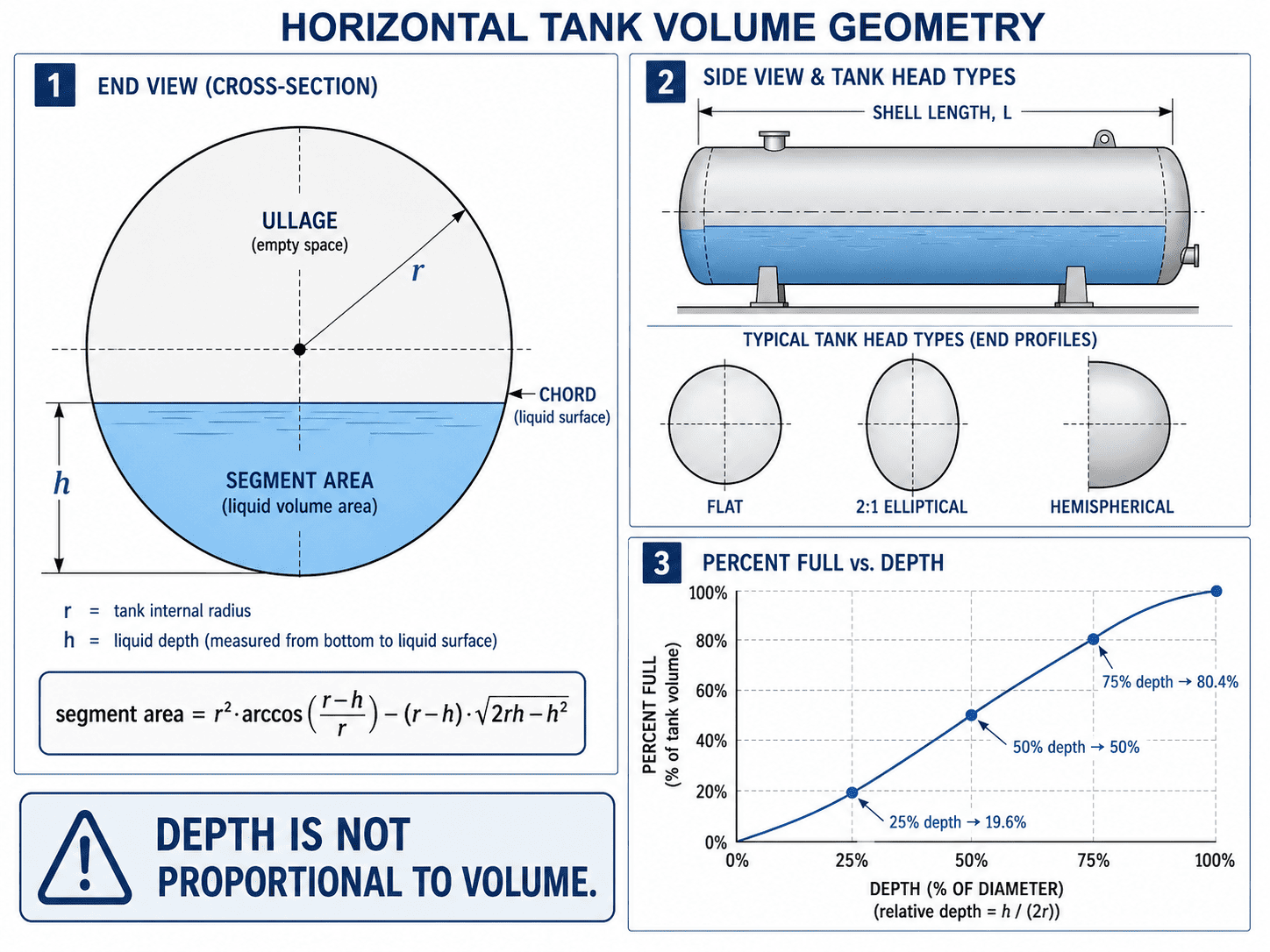
The liquid volume is the cylindrical-body volume plus the head volume, each filled to the same depth. The body uses the circular-segment area, with h the liquid depth from the bottom and r the radius (D/2):
segment area  = r² × arccos((r − h) / r) − (r − h) × √(2rh − h²)
body volume   = segment area × shell length
The arccos is in radians. For more than half full (h greater than r) the term (r − h) is negative, which the formula handles correctly. The full cylinder returns when the segment area reaches πr².
The heads are added by type. Flat heads add nothing. Two hemispherical heads together make a full sphere, and two 2:1 elliptical heads add half of that:
flat:            head volume = 0
hemispherical:   full = (4/3)π r³,    at depth h = π h² (r − h/3)
2:1 elliptical:  full = (2/3)π r³,    at depth h = 0.5 × π h² (r − h/3)
The totals follow directly:
liquid volume  = body volume + head volume
total capacity = full body + full heads
percent full   = liquid volume / total capacity
ullage         = total capacity − liquid volume
fill ratio     = h / D
For the overall-length basis, the shell length is the overall length minus the head depths: hemispherical heads span one full diameter D across both ends; 2:1 elliptical heads span D/2 total.
Flat:           shell = overall
Hemispherical:  shell = overall − D
2:1 Elliptical: shell = overall − D/2
Fill Depth to Tank Volume
The everyday task is turning a depth reading into a volume. You measure the liquid depth from the inside bottom of the tank — with a gauge stick, a sight glass, or a level transmitter — and want the gallons or litres that depth represents. In a horizontal tank that conversion is not a simple proportion, and that is the whole difficulty.
The depth maps to volume through the circular-segment area. At a given depth h, the liquid fills a segment of the circular cross-section whose area is r² × arccos((r − h)/r) − (r − h) × √(2rh − h²); multiply by the tank shell length for the body volume, and add the head contribution. Because that area grows slowly near the bottom, quickly through the middle, and slowly again near the top, equal steps of depth do not give equal steps of volume.
This is why a dip reading cannot be read as a straight percentage. An inch of depth near the centreline adds far more volume than an inch near the bottom or top. For accurate inventory, the depth must go through the segment calculation — or, for a specific tank of record, through its calibrated strapping table — not through a linear depth-to-volume assumption.
Flat vs Hemispherical vs 2:1 Elliptical Heads
The heads are the closed ends of the tank, and the type changes the capacity. The straight cylinder is only the middle section; the ends add — or, for flat heads, do not add — their own volume.
Flat heads are simple closing plates and add no volume; the capacity is the cylinder alone. They create stress concentrations and are used mainly on low-pressure tanks. Hemispherical heads are half-spheres, and the two together make one full sphere's worth of extra volume, the largest addition; they handle pressure best but cost the most to make. 2:1 elliptical heads, whose depth is a quarter of the diameter, sit between the two: the two heads add half the volume of hemispherical heads, with good pressure characteristics, which is why they are common on ASME vessels.
The size of the effect is real. For a 2 m by 5 m shell, flat ends give about 15.7 m³, 2:1 elliptical about 17.8 m³, and hemispherical about 19.9 m³ — the hemispherical tank holds about 27% more than the flat-ended one for the same shell. The head type also changes the depth-to-volume curve, since the heads fill along with the body, so it has to be part of the calculation.
Shell Length vs Overall Tank Length
The length the calculator needs is the straight shell length — the cylindrical section between the heads, measured between the tangent lines where the heads begin. This is the most common input error on a horizontal tank, and it always inflates the result.
The trap is the overall length, the end-to-end dimension that includes the bulged heads. If you enter the overall length as the shell length, and the calculator then adds the head volume on top, the heads are counted twice: once inside the inflated cylinder length, and again as the head contribution. The capacity comes out too high.
The fix is to enter the straight shell length, or to use the length-basis selector and let the calculator convert. For hemispherical heads the two ends span a full diameter, so the shell length is the overall length minus the diameter; for 2:1 elliptical heads, whose depth is a quarter of the diameter each, the shell length is the overall length minus half the diameter. Knowing which length you have, and telling the calculator, keeps the heads from being counted twice.
Horizontal Tank Ullage
Ullage is the empty space above the liquid — the total capacity minus the current liquid volume. Where percent full describes what is in the tank, ullage describes what is left, and it is the number a fill operation actually needs: how much more the tank can take before it is full, or before it reaches a safe fill limit.
The calculator returns the ullage directly, alongside the liquid volume and the percent empty. Because the tank is non-linear with depth, the ullage near the top behaves like the volume near the bottom — a small change in depth near full corresponds to a small change in volume, so the last stretch of filling adds little per unit of depth. That matters for overfill prevention: the depth rises slowly at first as the tank approaches full.
Ullage from ideal geometry is an estimate for planning a fill. For a custody-transfer or inventory-of-record figure, the tank's calibrated strapping table gives the ullage of record, with the real geometry and temperature correction.
Strapping Table vs Ideal Geometry
This calculator uses ideal geometry — a perfect circular cylinder with ideal heads. That is exactly right for design, estimation, and planning, and it is transparent: you can see every term in the formula. But a real tank is not a perfect cylinder, and for figures of record that difference matters.
A strapping table, or tank calibration table, is a measured chart that maps depth to volume for one specific tank. It is built by physically measuring the tank — the API Manual of Petroleum Measurement Standards sets the procedures — and it captures the things ideal geometry cannot: out-of-roundness, a slight tilt, internal deadwood like heaters and baffles, and the bulging of a large tank under liquid load. Custody-transfer tables are accurate to around a tenth of a percent, and tanks are recalibrated periodically as they settle or change.
For custody transfer, the measured volume is also corrected to a standard reference temperature — 15°C or 60°F — because both the liquid and the shell expand with temperature. The rule is simple: use this calculator's geometry to estimate, design, and plan; use the tank's calibrated strapping table with temperature correction for inventory of record and transactions.
What Is Horizontal Tank Volume?
A horizontal tank is a cylinder lying on its side, used for fuel, water, and process liquids. Finding how much liquid is inside from a depth reading is a routine task — dipping the tank with a gauge stick, or reading a sight glass or level transmitter — but it is not as simple as it looks, because the volume does not rise in step with the depth.
The cross-section is the reason. Stand a glass on the table and the surface is a full circle at every height, so the volume is proportional to the depth. Lay the cylinder on its side and the surface is a chord that starts as a narrow strip at the bottom, widens to the full diameter at the centreline, and narrows again toward the top. The wetted area at any depth is a circular segment, and its area grows slowly near the bottom, quickly through the middle, and slowly again near the top. The liquid volume is that segment area times the length of the tank.
The practical consequence is that depth and volume only agree at one point. At the centreline, half the depth, the tank is exactly half full. Below that, the volume lags the depth — a quarter of the depth is only about a fifth of the volume — and above the centreline the volume runs ahead. A gauge reading interpreted as a straight percentage is wrong everywhere except the midpoint, and most wrong near empty and full, which is exactly where knowing the remaining volume or the ullage matters most.
The heads add the final piece. The straight cylinder is only the middle of the tank; the ends are closed by heads. Flat heads add no volume, but hemispherical heads add a full sphere's worth across the two ends, and 2:1 elliptical heads add half of that. A real tank's capacity is the cylinder plus its heads, and the head type also changes the depth-to-volume curve.
Decision Model
This calculator reports geometry, not a pass or fail. The output is the liquid volume at the entered depth, with the capacity, percent full, and ullage. Two facts always travel with the result: volume is non-linear with depth, and the head type changes both the capacity and the depth-to-volume curve.
| Fill depth | Volume (symmetric tank) | Note |
|---|---|---|
| 0 (empty) | 0% | — |
| Quarter depth (h = D/4) | Far less than 25% (about 19.6% of the body) | Non-linear; the bottom holds little |
| Centreline (h = D/2) | Exactly 50% | The one point where depth and volume agree |
| Three-quarter depth (h = 3D/4) | Far more than 75% (about 80.4% of the body) | Mirror of the quarter-depth point |
| Full (h = D) | 100% | — |
Because the tank is symmetric, the volume at depth h and the volume at depth (D − h) always add to the full capacity. If a target volume is entered, the calculator reports the difference — above or below — rather than a verdict.
Key Facts
- Liquid volume in a horizontal tank is the circular-segment area at the fill depth times the shell length, plus the head contribution — not a simple fraction of the diameter.
- Volume is non-linear with depth. At the centreline the tank is exactly 50% full; at a quarter of the depth it holds only about 19.6% of the body volume.
- Because the tank cross-section is symmetric, the volume at depth h and the volume at depth (D − h) always add to the full capacity.
- The head type changes both the total capacity and the depth-to-volume curve. Flat heads add nothing; hemispherical add one full sphere across both ends; 2:1 elliptical add half that.
- The cylindrical length needed is the straight shell length between the heads. Using the overall length including the heads, then adding head volume, counts the heads twice.
- Ullage is the empty space above the liquid — the total capacity minus the liquid volume — and it is what a fill-stop calculation needs.
- The calculator uses inside dimensions. If only outside dimensions are available, the wall thickness must be subtracted first.
- This is ideal geometry for a true cylinder. For inventory of record or custody transfer, a tank's calibrated strapping table and temperature correction govern.
Applications
- Finding the liquid volume in a horizontal fuel, water, or chemical tank from a gauge-stick or level-transmitter reading.
- Determining the total capacity of a tank from its dimensions and head type before installation or purchase.
- Calculating the ullage — the remaining empty space — for a fill-stop or to avoid overfilling.
- Finding how much more liquid can be added before reaching a target fill level or ullage.
- Reporting percent full for inventory and tank-farm management.
- Comparing how the capacity changes with head type — flat versus 2:1 elliptical versus hemispherical — for the same shell.
- Estimating the volume in a partially filled tank for spill-containment or transport planning.
Example Calculation
Example 1 — Half-full tank, flat heads (Metric)
A horizontal tank has a 2 m inside diameter, a 5 m shell length, and flat heads. The liquid depth is 1 m, exactly the centreline (r = 1 m).
segment area = 1² × arccos(0) − 0 × √(…) = π/2 = 1.5708 m²
body volume  = 1.5708 × 5 = 7.854 m³
total capacity = π × 1² × 5 = 15.708 m³
percent full = 7.854 / 15.708 = 50.0%
At the centreline the tank is exactly half full, 7.854 m³ of 15.708 m³, with no head contribution because the ends are flat.
Example 2 — Quarter depth shows the non-linearity (Metric)
The same tank, liquid depth 0.5 m — a quarter of the 2 m diameter.
segment area = 1 × arccos(0.5) − 0.5 × √(2 × 1 × 0.5 − 0.5²)
             = 1.0472 − 0.5 × √0.75
             = 1.0472 − 0.4330
             = 0.6142 m²
body volume  = 0.6142 × 5 = 3.071 m³
percent full = 3.071 / 15.708 = 19.6%
A quarter of the depth gives only 19.6% of the volume, not 25%. This is the non-linearity: near the bottom, each unit of depth holds little. A linear estimate would overstate the contents by more than a quarter here.
Example 3 — Head type changes the capacity (Metric)
The same 2 m × 5 m shell, with three head types:
flat:          capacity = 15.708 m³ (body only)
2:1 elliptical: + (2/3)π × 1³ = 2.094 m³  → 17.802 m³
hemispherical: + (4/3)π × 1³ = 4.189 m³  → 19.897 m³
The hemispherical-headed tank holds about 27% more than the flat-ended one for the same shell. Ignoring the heads, or picking the wrong type, misses real capacity.
Example 4 — Ullage for a fill-stop (Metric)
A 2:1 elliptical-headed tank has a total capacity of 17.802 m³, current liquid volume 12.0 m³.
ullage        = 17.802 − 12.0 = 5.802 m³
percent full  = 12.0 / 17.802 = 67.4%
percent empty = 32.6%
The tank can take about 5.8 m³ more before it is full.
Example 5 — Overall length converted to shell length (Metric)
A tank with a 2 m diameter and 2:1 elliptical heads has an overall end-to-end length of 6 m.
Each head depth = D/4 = 0.5 m
Shell length    = overall − 2 × head depth = 6 − 1.0 = 5 m
The straight shell length is 5 m, not 6. Entering 6 m as the shell length and then adding head volume would count the heads twice and overstate the capacity by about 10%.
Standards & References
- Circular-segment area formula — standard geometry, published in engineering handbooks and tank-gauging references.
- ASME Boiler and Pressure Vessel Code — Head-volume formulas for flat, hemispherical, and 2:1 elliptical heads; pressure-vessel head geometry.
- API MPMS Chapter 2 — Tank Calibration; procedures for horizontal cylindrical tanks and calibrated strapping tables.
- API MPMS Chapters 3 & 12 — Tank Gauging and Calculation of Petroleum Quantities; level measurement and volume correction to a standard temperature for custody transfer.
Limitations
- This is ideal geometry for a perfect circular cylinder — an estimation and design aid, not a calibrated gauging table. For inventory of record or custody transfer, the tank's own strapping table and the applicable API MPMS procedures govern.
- It assumes a perfectly circular, level tank. It does not correct for out-of-roundness, or for longitudinal or transverse tilt, which changes the depth-to-volume relationship and matters most near empty and full.
- It uses inside dimensions. If you have outside dimensions, the wall thickness must be subtracted first.
- It does not model a sump, a sloped or cone bottom, sediment or water heel, internal deadwood such as heaters and baffles, or a foam layer or floating roof.
- It does not correct the liquid volume to a standard reference temperature. Custody transfer applies a volume correction factor to 15°C or 60°F.
- It supports flat, hemispherical, and 2:1 elliptical heads. Standard dished (ASME flanged-and-dished) and other torispherical heads are not yet included; for those, use the manufacturer's data or a strapping table.
- It calculates volume from depth. A target volume entry reports the difference from the current fill, not a depth. Depth from volume requires a reverse mode (planned fast follow).
- Depth must be the inside liquid depth from the bottom. Results are an estimate; final inventory and custody figures follow the calibrated table and professional judgment.
Common Mistakes to Avoid
- Assuming volume is proportional to depth. A horizontal tank is 50% full only at the centreline; at a quarter of the depth it holds about 19.6% of the body, and a linear estimate is wrong everywhere except the midpoint.
- Counting the heads twice. The cylindrical length is the straight shell length between the heads. Entering the overall length and then adding head volume double-counts the ends. Use the Overall length basis or enter the shell length directly.
- Ignoring the head type. Flat ends add no volume, but hemispherical heads add a full sphere across both ends and 2:1 elliptical add half that. Treating a dished or elliptical tank as flat understates its capacity by as much as 27% for hemispherical heads.
- Confusing diameter and radius. The segment formula uses the radius, half the diameter; entering the diameter where the radius belongs throws the volume off by a large factor.
- Using outside dimensions as inside dimensions. The volume uses inside dimensions; the wall thickness must be subtracted from any outside diameter or outside length. The calculator does not do this conversion.
- Using an external gauge reading directly. Depth must be the inside liquid depth from the bottom. A reading from an external datum, a nozzle offset, or above a bottom plate must be converted first.
- Trusting the geometry for custody transfer. Ideal geometry does not account for out-of-roundness, tilt, deadwood, or temperature. For inventory of record, the calibrated strapping table and temperature-corrected volume govern.
Frequently Asked Questions
How do you calculate the volume of a horizontal cylindrical tank?
Why isn't half-depth the same as half-volume?
What is ullage?
Can I calculate tank depth from a volume?
Can I use outside tank dimensions?
What is a tank strapping table?
Does this work for a tank tilted or not perfectly round?
What head types does the calculator support?
Frequently Used Together
Engineers often use these calculators in combination for complete project workflows:
Related Calculators
Explore similar calculators that might be useful for your project:
Plumbing Quick Reference — Keep It On Your Phone On Site
A 10-page field reference for catching pressure, velocity, slope, and pump-sizing mistakes before you order pipe, close a wall, or add a booster.
- Velocity limits, fixture pressure minimums, drain slope, and the 80 psi ceiling in one table
- Worked examples that show why a single pressure number gives four different answers
- Keep it on your phone, or print the two field-check pages
Free PDF. Calculators stay free. Unsubscribe anytime.
Calculate
Inside diameter of the cylindrical shell. Use inside dimensions — outside diameter overstates capacity by twice the wall thickness.
Enter the straight shell length between the heads, or the overall end-to-end length — choose the basis below.
If you have the straight cylindrical length between the heads, use Shell. If you only have the end-to-end overall dimension, switch to Overall — the head depths are subtracted so the heads are not counted twice.
Flat heads add no volume beyond the cylinder. Hemispherical heads add one full sphere's worth across both ends. 2:1 elliptical heads (depth = D/4 each) add half that. Standard dished (ASME F&D) is not yet supported — use a strapping table.
Measured from the inside bottom of the tank to the liquid surface, by gauge stick, sight glass, or level transmitter. Convert any external gauge reading to inside liquid depth first.
Optional. Enter in the same unit as the selected output volume. The calculator reports whether the current fill is above or below the target — not a pass/fail verdict, just the difference.