Pipe support spacing is set by two independent limits, and the maximum span is whichever you hit first: the bending stress at the supports must stay below an allowable, and the midspan sag must stay below a deflection limit. A pipe span that passes one can fail the other.
Why Pipe Support Spacing Has Two Limits: Bending Stress and Midspan Sag
Pipe support spacing is set by two independent limits, and the maximum span is whichever you hit first: the bending stress at the supports must stay below an allowable, and the midspan sag must stay below a deflection limit. A pipe span that passes one can fail the other. Getting both right is what makes preliminary span selection a two-calculation exercise, not a lookup.
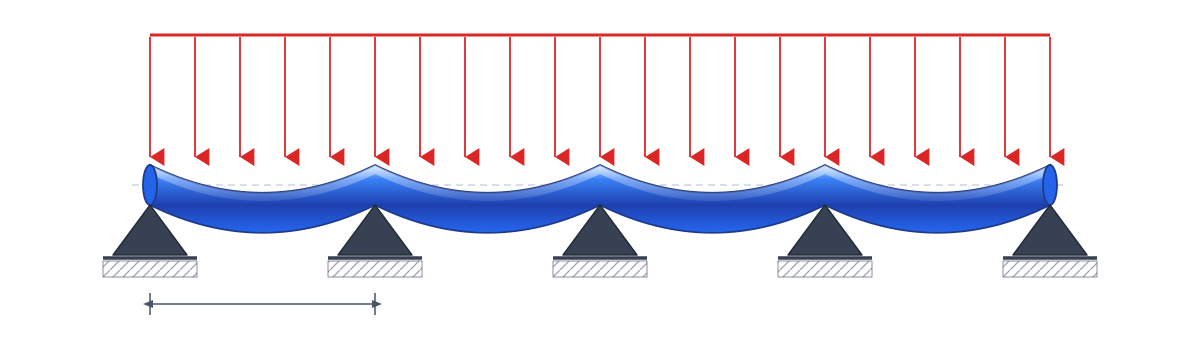
A horizontal pipe between supports acts as a loaded beam. Its own weight plus contents, insulation, and cladding bends it under gravity. Two things happen as the span grows: the pipe sags more at midspan (deflection, which scales with L⁴), and the bending stress at the supports climbs (stress, which scales with L²). The deflection-limited span comes from the sag formula; the stress-limited span from the bending formula. The calculator computes both and reports the smaller.
This is a preliminary dead-weight span, not a full pipe-stress analysis. It does not replace MSS SP-58 span tables or the governing ASME B31 code (B31.1 power piping Table 121.5, B31.3 process piping para 302.3.5). It screens spacing before detailed support and stress review. This is the first structural article in the Plumbing cluster; previous articles sized what flows inside the pipe (water, compressed air, heat). This one sizes how the pipe itself is held up. Cross-reference the Hanger Load Calculator: spacing sets the span, and each support then carries the reaction load that this spacing determines.
Calculator Inputs: Pipe Schedule, Load Case, Stress Allowable, Deflection Limit
The calculator needs thirteen inputs to compute both span limits. Unit system (US or Metric) sets the output format. Pipe material selects the modulus of elasticity and density: Carbon Steel A106/A53 Gr B (E ≈ 29–29.4 Mpsi, 200–203 GPa), Stainless 316L/304 (E ≈ 28 Mpsi, 193 GPa), Copper ASTM B88 Type K/L (E ≈ 17 Mpsi, 117 GPa). Lower-E materials sag more at the same section properties.
Pipe Size and Schedule feed the section properties (I and Z): NPS ½ to 24, Schedule 10/20/40/80, with OD and wall from ASME B36.10M. Copper uses Type K/L dimensions per ASTM B88. Load Case determines the fluid weight component: Empty (pipe metal only, for gas lines in service), Water-filled (pipe plus water, for water/chilled-water/process lines), Hydrotest (pipe plus water even for gas lines tested with water), or Custom fluid density [lb/ft³ or kg/m³]. Optional inputs add Insulation Thickness plus Density (mineral wool ≈ 12 lb/ft³ = 192 kg/m³; calcium silicate ≈ 6 lb/ft³ = 96 kg/m³) and Cladding Weight per unit length (aluminum jacketing ≈ 1 lb/ft = 14.6 N/m).
Stress Allowable Basis sets the bending stress limit: Factor × Sh (default 0.25 of code allowable), 5,000 psi (34.5 MPa) carbon steel screening preset, or Manual entry. Deflection Limit Basis sets δ_allow: B31.1/MSS min(0.1 in = 2.54 mm, 0.5×D), B31.3 project min(0.5 in = 12.7 mm, 0.5×D), L/240 span-dependent, or Manual. Optional inputs are Modulus Override for elevated temperature, Candidate Span to Check (reports stress and sag ratios vs the computed limit), Natural Frequency Estimate (first mode, screens > 4 Hz near rotating equipment), and Operating vs Hydrotest comparison.
Calculator outputs: Max Allowable Span and Governing Criterion (stress or deflection), Stress-Limited Span L_stress, Deflection-Limited Span L_defl, total distributed load w, computed I and Z, Bending Stress at L_max, Midspan Sag at L_max, Deflection Limit used, Stress Allowable used, Candidate Stress Ratio and Sag Ratio, Operating vs Hydrotest comparison, Natural Frequency, and estimated Support Reaction per span. The calculator does not account for concentrated loads (valves, flanges), risers or vertical runs, end spans or anchor spans, longitudinal pressure stress, thermal, seismic, or local support stresses.
Section Properties from the Schedule: Moment of Inertia I and Section Modulus Z
The span is driven by the pipe's section properties, the moment of inertia I and section modulus Z, computed from the actual outside diameter and wall in the schedule, not the nominal size label.
I = π/64 × (OD⁴ − ID⁴)   [in⁴ or mm⁴]
Z = 2·I / OD              [in³ or mm³]

where:
  OD = outside diameter [in or mm], from ASME B36.10M or ASTM B88
  ID = OD − 2 × wall      [in or mm]
I controls sag: deflection is proportional to 1/I (larger I, stiffer pipe, less sag, longer deflection span). Z controls stress: bending stress = M/Z (larger Z, lower stress, longer stress span). A heavier schedule on the same nominal size has more metal and therefore larger I and Z, which extends the allowable span on both limits.
Worked example, NPS 6 Sch 40 (OD 6.625 in = 168.3 mm, wall 0.280 in = 7.11 mm, ID 6.065 in = 154.1 mm):
I = π/64 × (6.625⁴ − 6.065⁴)
  = π/64 × (1926.6 − 1353.5)
  = π/64 × 573.1
  = 28.1 in⁴  (11.70 × 10⁶ mm⁴)

Z = 2 × 28.1 / 6.625 = 8.49 in³  (139.1 × 10³ mm³)
NPS 6 is a label. Sch 10, 40, and 80 share OD 6.625 in but differ in wall, ID, I, and Z. Using nominal-size properties gives a wrong span. The calculator uses schedule-specific OD and wall per ASME B36.10M. Copper ASTM B88 Type K/L sections are similarly schedule-specific; Type L has a thinner wall than Type K and lower I, Z, and allowable span. Material modulus E also affects the deflection span: copper (E ≈ 17 Mpsi = 117 GPa) sags more than carbon steel (E ≈ 29.4 Mpsi = 203 GPa) for identical section dimensions.
Building the Distributed Load: Pipe, Contents, Insulation, Cladding
The distributed load is the total weight per unit length that the pipe carries: its own metal, the fluid inside, insulation, and cladding. Every component adds to bending and sag.
w = w_pipe + w_fluid + w_insulation + w_cladding

w_pipe  = ρ_pipe  × π/4 × (OD² − ID²)
w_fluid = ρ_fluid × π/4 × ID²   (zero for empty or gas)
Critical unit rule: the span formulas require load per length in lb/in (US) or N/mm (metric), not lb/ft or kg/m. Using lb/ft directly in the formula produces a span wrong by a factor of √12 (stress) or the fourth root of 12 (deflection).
w [lb/in] = w [lb/ft] / 12
w [N/mm]  = (mass/length [kg/m]) × 9.807 / 1000
Load cases by application: Empty (gas lines in service, pipe metal only), Water-filled (liquid process or utility lines, pipe plus water at 62.4 lb/ft³ = 1,000 kg/m³), Hydrotest (even gas lines, tested water-filled), Custom (process fluids with known density).
Worked example, NPS 6 Sch 40 carbon steel:
w_pipe  = 18.97 lb/ft  (from ASME B36.10M schedule weight)
w_water = 62.4 × π/4 × (6.065/12)² = 12.5 lb/ft

Empty:       w = 18.97 lb/ft = 1.581 lb/in  (27.7 N/mm)
Water-filled: w = 31.47 lb/ft = 2.622 lb/in  (45.9 N/mm)
Insulation adds weight for steam, hot water, and chilled water systems: 2-in mineral wool on NPS 6 adds roughly 2.5 lb/ft (3.6 N/m); aluminum jacketing (0.040-in) adds ≈ 1 lb/ft (14.6 N/m). Per Euler-Bernoulli beam theory: distributed load includes all components, converted to lb/in (or N/mm) before the span formulas. The lb/ft-to-lb/in conversion is mandatory.
Stress-Limited Span: Continuous-Beam Moment wL² over 10
The stress-limited span keeps the bending stress at the supports below an allowable. For a pipe running over many supports, the bending moment uses the continuous-beam coefficient wL²/10, not the simply-supported wL²/8.
Bending moment (continuous): M = w·L² / 10
Bending stress:              σ = M / Z
Solve for span:              L_stress = √(10 · Z · Sall / w)

where:
  w    = distributed load [lb/in or N/mm],  typical: 0.5–50 lb/in
  Z    = section modulus  [in³ or mm³],      typical: 0.1–500 in³
  Sall = allowable bending stress [psi or MPa], typical: 3,000–8,000 psi (20–55 MPa)
Stress allowable basis: Factor × Sh (0.25 of code-allowable Sh) for gravity spans per common practice; 5,000 psi (34.5 MPa) as a carbon steel screening preset; or a manual project-specific value. ASME B31.3 para 302.3.5 governs the sustained longitudinal stress check in process piping.
Worked example, NPS 6 Sch 40, Z = 8.495 in³ (139.2 × 10³ mm³), w = 3.475 lb/in (608 N/m = 0.608 N/mm), Sall = 5,000 psi (34.5 MPa):
L_stress = √(10 × 5,000 × 8.495 / 3.475)
         = √(424,750 / 3.475)
         = √122,230
         = 349.6 in = 29.1 ft  (8.87 m)
Why wL²/10: a pipe over a row of supports is a continuous beam. Each span is partially restrained by neighboring spans. The continuous moment coefficient wL²/10 is lower (meaning the span can be longer) than the single simply-supported span wL²/8. Using wL²/8 for a continuous run over-shortens the allowable span. Bending stress scales with L²: doubling the span quadruples the bending stress. A heavier schedule (larger Z) directly extends a stress-governed span. Per ASME B31 + continuous-beam theory: stress-limited span L = √(10·Z·Sall/w), using the continuous-beam moment wL²/10.
Deflection-Limited Span: Simply-Supported Sag and the Fourth-Root Solution
The deflection-limited span keeps the midspan sag below a deflection limit. It uses the simply-supported sag formula, which overstates sag for a continuous run and lands on the safe (conservative) side.
Sag (simply-supported): δ = 5·w·L⁴ / (384·E·I)
Fixed δ_allow, solve for span (fourth root):
L_defl = (384 · E · I · δ_allow / (5 · w))^(1/4)

where:
  E       = modulus of elasticity [psi or MPa], CS ≈ 29–29.4 Mpsi (200–203 GPa)
  I       = moment of inertia    [in⁴ or mm⁴], typical: 0.01–4,000 in⁴
  δ_allow = deflection limit     [in or mm],    B31.1/MSS: min(0.1 in = 2.54 mm, 0.5×D)
Deflection limit options: B31.1/MSS SP-58 min(0.1 in, 0.5×D); B31.3 project min(0.5 in, 0.5×D); L/240 span-dependent (cubic-root solution, not fourth-root, because δ = L/240 makes L implicit); or Manual. The L/240 case solves L³ = 384·E·I / (5 × 240 × w), giving L = (384·E·I/(1,200·w))^(1/3).
Worked example, 24-in Sch 40 carbon steel (OD 24 in = 609.6 mm, I = 3,421 in⁴ = 1.424 × 10⁹ mm⁴), water-filled, w = 170.9 lb/ft = 14.24 lb/in (2,493 N/m), E = 29.4 Mpsi = 203 GPa, δ_allow = 0.1 in (2.54 mm) per B31.1/MSS SP-58:
Step 1.  w = 170.9 / 12 = 14.24 lb/in

Step 2.  Numerator: 384 × 29.4 × 10⁶ × 3,421 × 0.1 = 3.863 × 10¹²

Step 3.  Denominator: 5 × 14.24 = 71.2

Step 4.  L_defl = (3.863 × 10¹² / 71.2)^(1/4)
                = (5.426 × 10¹⁰)^(1/4)
                = 482.6 in = 40.2 ft  (12.25 m)
Comparison to span tables: 40.2 ft is slightly under the approximately 42 ft in B31.1 Table 121.5 and MSS SP-58 Table 4 for 24-in carbon steel, consistent and slightly conservative. Deflection scales with L⁴: doubling the span increases sag by 16×. Sag is extremely sensitive to span. Stiffer pipe (larger I) or a looser limit extends the deflection span. Per Euler-Bernoulli beam theory: L_defl = (384·E·I·δ_allow/(5·w))^(1/4), using simply-supported sag (conservative for continuous runs). The L/240 case uses a cubic root.
Continuous Beam vs Simply Supported: Why the Coefficients Differ
A pipe over many supports is a continuous beam, not a single simply-supported span. The calculator uses the continuous coefficient for stress (wL²/10) and the simply-supported formula for sag (conservative), a deliberate mixed basis.
The two beam models produce different moment and sag values at the same span:
Simply-supported (single span, pin ends):
  Moment:  M = wL²/8   (larger moment, higher stress)
  Sag:     δ = 5wL⁴ / (384EI)   (larger sag)

Continuous (many equal spans, partial restraint at interior supports):
  Moment:  M ≈ wL²/10   (lower, about 80% of SS moment)
  Sag:     δ ≈ wL⁴ / (384EI) for interior spans  (roughly 20% of SS sag)
The mixed approach is deliberate: the stress formula uses continuous wL²/10, which is realistic for a pipe running over a series of supports and avoids over-shortening the span. The sag formula uses simply-supported 5wL⁴/384EI, which overstates sag (continuous runs actually sag less because of partial restraint), making the deflection span conservatively safe. Using wL²/8 for stress on a continuous run shortens the span unnecessarily; using the simply-supported sag formula provides safe-side deflection limits. Real pipe runs are partially restrained at supports, falling between the two ideal models. The mixed approach (realistic stress, conservative sag) is standard preliminary practice per MSS SP-58 table derivation.
The Lesser-of-Two Rule: Which Limit Governs and What to Change
The maximum span is the smaller of the stress-limited and deflection-limited spans. Knowing which limit governs tells you what to change to extend the span.
L_max    = min(L_stress, L_defl)
Governing = whichever produced L_max
What governs by pipe type: light small-bore pipe is usually deflection-governed (sag limit bites first); large or heavy water-filled pipe is usually stress-governed (bending stress bites first). The crossover depends on size, schedule, fluid, and limits chosen.
What to change: stress-governed wants a heavier schedule (larger Z extends the stress span; tightening Sall shortens it). Deflection-governed wants stiffer pipe (larger I) or a looser sag limit (larger δ_allow). Changing E also shifts the deflection span. Changing the wrong variable for the governing limit accomplishes nothing.
Worked comparisons from the calculator examples:
NPS 6 Sch 40, water-filled: L_stress = 29.1 ft (8.87 m), L_defl > 29.1 ft
  → stress governs, max span 29 ft (8.8 m)

24-in Sch 40, water-filled:  L_defl = 40.2 ft (12.25 m), L_stress > 40.2 ft
  → deflection governs, max span 40 ft (12.2 m)
Per beam theory and MSS SP-58: maximum span = min(L_stress, L_defl). Both are always computed; checking only one misses the governing criterion. Governing criterion identifies the fix: schedule upgrade for stress-governed, stiffness or sag target for deflection-governed.
Operating vs Hydrotest: Why a Water-Filled Line Governs
A line that runs empty or gas-filled in service is much lighter than the same line full of water during a hydrotest. The added water weight increases both stress and sag, so a spacing acceptable in operation can fail at hydrotest.
Gas line in service:  w = pipe metal only
Same line hydrotest:  w = pipe metal + water

Water component: w_water = 62.4 × π/4 × ID² [lb/ft]  (US)
               = 1,000 × π/4 × ID² [kg/m]    (metric)
Worked example, NPS 6 Sch 40 gas line (I = 28.1 in⁴ = 11.70 × 10⁶ mm⁴), δ_allow = 0.1 in (2.54 mm), E = 29 Mpsi (200 GPa):
Empty (gas service): w = 18.97 lb/ft = 1.581 lb/in  (276.7 N/m)
  L_defl = (384 × 29 × 10⁶ × 28.1 × 0.1 / (5 × 1.581))^(1/4)
         = (3.128 × 10¹² / 7.905)^(1/4) = (395.7 × 10⁹)^(1/4)
         = 504 in = 42.0 ft  (12.80 m)

Hydrotest (water-filled): w = 18.97 + 12.5 = 31.47 lb/ft = 2.622 lb/in  (458.8 N/m)
  L_defl = (384 × 29 × 10⁶ × 28.1 × 0.1 / (5 × 2.622))^(1/4)
         = (3.128 × 10¹² / 13.11)^(1/4) = (238.6 × 10⁹)^(1/4)
         = 453 in = 37.8 ft  (11.52 m)
Filling with water drops the allowable span from 42.0 ft to 37.8 ft (12.80 m to 11.52 m), a reduction of 4.2 ft (1.28 m). A gas line spaced at 42 ft will over-stress and sag excessively when filled with water for hydrotest. Set supports at or below 37.8 ft and both conditions pass. Per ASME B31 and MSS SP-58: any line that will be hydrotested must be checked water-filled. The heavier water case nearly always governs; set spacing for it.
Deflection-Governed Worked Example: 24-Inch Line to 40 Feet
Scenario: large-bore carbon steel header, 24-in Sch 40 (A53-B), I = 3,421 in⁴ (1.424 × 10⁹ mm⁴), water-filled, w = 170.9 lb/ft (2,493 N/m), E = 29.4 Mpsi (203 GPa), deflection limit 0.1 in (2.54 mm) per B31.1/MSS SP-58.
Step 1.  Convert load: w = 170.9 / 12 = 14.24 lb/in  (2,493 N/m = 2.493 N/mm)

Step 2.  Deflection numerator:
           384 × 29.4 × 10⁶ × 3,421 × 0.1 = 3.863 × 10¹²

Step 3.  Deflection denominator: 5 × 14.24 = 71.2

Step 4.  L_defl = (3.863 × 10¹² / 71.2)^(1/4)
                = (5.426 × 10¹⁰)^(1/4)
                = 482.6 in = 40.2 ft  (12.25 m)

Step 5.  Span table comparison: B31.1 Table 121.5 and MSS SP-58 Table 4
           list approximately 42 ft for 24-in CS. Result 40.2 ft is slightly
           under → consistent and conservative.

Step 6.  Stress check at 40.2 ft: for a 24-in line, L_stress at typical Sall
           exceeds 40.2 ft → deflection governs. Large-bore lines are typically
           deflection-governed: high I, but the 0.1-in absolute limit is tight.

Step 7.  Result: L_max = 40.2 ft (12.25 m), deflection-governed.

Step 8.  Practical spacing: set supports at ≤ 40 ft, rounded down for structural
           steel spacing. Support directly at flanges, valves, and fittings.

Step 9.  Hanger reaction (cross-reference): each support carries
           w × span = 170.9 × 40 = 6,836 lb  (30.4 kN) plus any concentrated loads.
           Use Hanger Load Calculator to size the rod and attachment.
The 0.1-in absolute sag limit is tight for a 24-in pipe (0.1 in is only 0.4% of the diameter). Despite the large I, the L⁴ sag sensitivity and tight absolute limit together make deflection bind first.
Stress-Governed Worked Example: NPS 6 Line to 29 Feet, Plus Candidate Check
Scenario: process line, NPS 6 Sch 40 carbon steel, Z = 8.495 in³ (139.2 × 10³ mm³), water-filled, w = 3.475 lb/in (0.608 N/mm), Sall = 5,000 psi (34.5 MPa).
Step 1.  Stress span:
           L_stress = √(10 × 5,000 × 8.495 / 3.475)

Step 2.  Numerator: 10 × 5,000 × 8.495 = 424,750

Step 3.  Divide: 424,750 / 3.475 = 122,230

Step 4.  L_stress = √122,230 = 349.6 in = 29.1 ft  (8.87 m)

Step 5.  Deflection span for this line exceeds 29.1 ft → stress governs.
           Max allowable span = 29 ft (8.8 m), stress-governed.
Candidate span check (proposed 35 ft = 420 in):
Step 6.  Stress ratio = (L_cand / L_stress)² = (35 / 29.1)² = (1.203)² = 1.447 ≈ 1.45

Step 7.  Interpretation: stress ratio 1.45 → candidate 35 ft over stress limit by 45%.
           Verdict: OVER-SPAN, candidate rejected.

Step 8.  Why squared: bending stress ∝ L² (from M = wL²/10, σ = M/Z). The ratio
           of actual to allowable stress at the candidate span equals (L_cand/L_stress)².

Step 9.  Fix: reduce spacing to ≤ 29 ft, or upsize to NPS 6 Sch 80 (larger Z, longer
           stress span). Changing δ_allow will not help a stress-governed line.

Step 10. Hanger reaction at 29 ft:
           w × span = 3.475 lb/in × 12 × 29 = 1,209 lb  (5.38 kN) per support.
           Use Hanger Load Calculator to size the rod and clamp.
Per ASME B31 + continuous-beam theory: candidate stress ratio (L_cand/L_stress)² > 1.0 means the proposed spacing over-stresses the pipe. Rejection threshold is 1.0; candidate 35 ft at ratio 1.45 fails.
Application Boundaries: Concentrated Loads, Risers, Thermal, Seismic, Natural Frequency
The calculator applies to straight horizontal runs with reasonably regular spans and uniform distributed dead-weight load. It produces a preliminary dead-weight span for initial support layout. The following conditions require separate qualified analysis.
Concentrated Loads. Valves, flanges, and heavy fittings are point loads, not uniform. The span formula does not apply at them; support directly adjacent. A heavy valve at midspan invalidates the span table result entirely.
Risers and Vertical Runs. The calculator is for horizontal spans where gravity bends the pipe. Risers, vertical runs, and their guides carry load axially (not in bending) and need a separate design per MSS SP-58.
End Spans, Anchors, Branches. End spans next to nozzles or equipment connections, spans next to anchors, unequal spans, and branch nodes can require shorter spacing than the uniform interior span. These must be checked separately.
Longitudinal Pressure and Thermal. The calculator covers dead-weight bending only. Longitudinal pressure stress and thermal expansion both add to the sustained-stress check per ASME B31.3 para 302.3.5 and B31.1 para 104. Cross-reference the Pipe Expansion Loop Sizing Calculator for thermal.
Seismic, Wind, Water-Hammer, Dynamic. Not included beyond the optional frequency screen. Seismic bracing (lateral and longitudinal) is a separate code-governed design.
Natural Frequency Screening. The optional first-mode estimate screens against the 4 Hz threshold near rotating equipment. The estimate:
f₁ ≈ (π/2) × √(E·I / (m·L⁴))   [Hz]
where m = w/386.09 [lb-s²/in²]  (US)
Detailed vibration analysis is required near pumps and compressors.
Local Support Stresses. Stresses at shoes, clamps, U-bolts, saddles, and point-contact supports are not evaluated. Vapor-barrier damage, insulation crushing, and cold-pipe thermal breaks need separate consideration.
Temperature Derating. E and Sh at elevated temperature differ from room-temperature reference values. Verify temperature-derated values for steam, hot oil, and cryogenic service. Per MSS SP-58 and ASME B31: concentrated loads, risers, end spans, anchor spans, thermal, seismic, and elevated temperature need separate qualified analysis and the seal of a licensed P.E.
Pipe Support Spacing Calculator
Pipe support spacing per beam theory and MSS SP-58: computes the stress-limited span from the continuous-beam moment (wL²/10) and the deflection-limited span from the simply-supported sag formula, then reports the lesser and which criterion governs. Builds the distributed load from pipe, contents, insulation, and cladding using schedule section properties (I, Z) from ASME B36.10M. Compares operating vs hydrotest load cases, checks a candidate span (stress and sag ratios), and screens first-mode natural frequency. Covers carbon steel A106/A53-B, stainless 316L/304, and copper ASTM B88 from NPS ½ to 24.
Open Pipe Support Spacing CalculatorFAQ
What sets the maximum pipe support spacing?
Per MSS SP-58 and beam theory: two limits, whichever you hit first. Bending stress at the supports must stay below an allowable (stress-limited span), and midspan sag must stay below a deflection limit (deflection-limited span). Maximum span is the smaller of the two. A span that passes stress can still fail on sag, and vice versa, so both must always be checked. The governing criterion identifies whether a heavier schedule (stress-governed) or stiffer geometry or looser sag target (deflection-governed) is the right fix.
Why use wL²/10 instead of wL²/8 for the bending moment?
Per continuous-beam theory: a pipe over a series of equally-spaced supports is a continuous beam, not a single simply-supported span. Adjacent spans provide partial end-restraint, reducing the bending moment at each interior support. The continuous coefficient wL²/10 is about 80% of the simply-supported wL²/8. Using wL²/8 for a continuous run over-shortens the allowable span and misrepresents the actual load condition. MSS SP-58 Table 4 span values are derived from the continuous-beam basis.
Why must spans be re-checked at hydrotest?
Per ASME B31: a gas line or empty line is light in service, but the same line filled with water for pressure testing is substantially heavier. For NPS 6 Sch 40, the hydrotest load nearly doubles the empty-line load (31.5 lb/ft vs 19 lb/ft). This drops the allowable deflection span from 42.0 ft to 37.8 ft (12.80 m to 11.52 m) in the worked example. Supports set at the operating span will over-stress and over-deflect the pipe when it is water-filled. Always check the hydrotest load case for any line that will be pressure-tested with water.
What deflection limit should I use?
Per B31.1 Table 121.5 and MSS SP-58 Table 4: the common baseline is min(0.1 in = 2.54 mm, 0.5×D), which limits sag to 0.1 in or half the pipe diameter, whichever is smaller. Some B31.3 process projects use min(0.5 in, 0.5×D). The L/240 limit is span-dependent and gives a longer span on large-bore pipe but can be tighter for short spans. Sloped gravity-drainage lines may need a tighter limit to prevent sag from reversing the slope and trapping liquid. Always confirm the applicable project specification and code edition with the pipe stress engineer of record.
What is the difference between I and Z for span calculations?
Per Euler-Bernoulli beam theory: moment of inertia I controls sag (deflection is proportional to 1/I), so I determines the deflection-limited span. Section modulus Z controls bending stress (σ = M/Z), so Z determines the stress-limited span. Both come from the schedule OD and wall, not the nominal pipe size label. A heavier schedule on the same nominal size increases both I and Z, extending both span limits. Copper (lower E) has the same I as an equal-size steel pipe but sags more because of the lower modulus; the L_defl = (384·E·I·δ/(5·w))^(1/4) formula captures the combined I and E effect.
Does the calculator size the hangers?
Per MSS SP-58: no. The calculator finds the maximum support spacing; hanger, rod, clamp, U-bolt, and structural attachment design is a separate exercise per MSS SP-58 Part II and the structural code. The estimated support reaction shown (w × span per interior support, w × span/2 per end support) is an approximation to feed the hanger sizing. Cross-reference the Hanger Load Calculator for the full reaction including concentrated loads, load factors, and hydrotest condition.
Can this calculator be used for vertical pipe or risers?
Per beam theory: no. The formulas apply to horizontal spans where gravity acts transversely, bending the pipe between supports. Risers and vertical runs carry their own weight axially (tension in the upper portion, compression in the lower) and resist lateral seismic or wind as cantilever or guided columns. Support design for risers follows separate criteria per MSS SP-58 and the applicable ASME B31 code, not the horizontal span formulas.
Related Calculators
- Hanger Load Calculator: Support reaction and hanger rod sizing per MSS SP-58; this spacing calculator sets the span and each support then carries the reaction load it determines.
- Pipe Slope Calculator: Gravity drainage slope per IPC 704 and Manning's equation; sag from excessive support spacing can reverse slope on gravity-drained lines (article).
- Pipe Expansion Loop Sizing Calculator: Thermal expansion loop sizing; thermal movement adds to the sustained longitudinal stress this spacing calculator screens per ASME B31.3 para 302.3.5.
- Compressed Air Pipe Sizing Calculator: Darcy-Weisbach air main sizing; compressed air mains need both flow sizing and support spacing for dead weight plus content weight (article).
- Hazen-Williams Pipe Flow Calculator: Pressurized water pipe flow per AWWA M22 (article).
- Pump Power Calculator: Pump power chain per Hydraulic Institute (article).
- Fire Pump Performance Curve Calculator: NFPA 20 curve acceptance testing and derating (article).