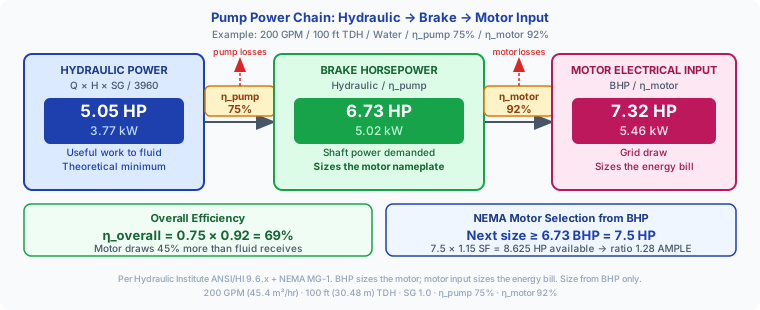
Pump power is not a single figure: it is a chain of three, each larger than the last, because every stage divides out a loss. Hydraulic power is the useful work delivered to the fluid (Q × H × SG / 3960 in US customary, ρgQH in SI). Divide by pump efficiency at the duty point to get brake horsepower (BHP), the shaft demand that sizes the motor. Divide BHP by motor efficiency to get motor electrical input, the grid draw that sizes the energy bill. A pump sizing decision that confuses these three numbers, or uses peak-catalog efficiency instead of duty-point efficiency, undersizes or oversizes the motor and misstates the operating cost. This article covers the complete hydraulic-brake-motor power chain per Hydraulic Institute ANSI/HI 9.6.x standards, NEMA MG-1 motor nameplate selection, and IEC 60034 kW ladder, with a full worked example at 200 GPM (45.4 m³/hr) and 100 ft (30.48 m) TDH from hydraulic power through annual energy cost.
Why Pump Power Is Three Numbers: Hydraulic, Brake, and Motor Input
Pump power is a chain of three distinct figures — hydraulic power, brake horsepower, and motor electrical input — each larger than the last by the ratio of a stage efficiency. Confusing them is the most common pump sizing error, producing either an undersized motor that overheats on startup or an oversized motor that wastes capital and operates at poor power factor.
Hydraulic power is the useful minimum: the actual energy delivered to the fluid, not the energy the pump or motor must supply. In US customary units, it is Q × H × SG / 3960 where Q is flow in GPM, H is total dynamic head in feet, and SG is the fluid specific gravity referenced to water. In SI, it is ρ × g × Q × H where ρ is density in kg/m³, g is 9.81 m/s², and Q is in m³/s. Divide hydraulic power by pump efficiency at the duty point to get brake horsepower, the shaft power the pump actually demands at the operating flow and head. Divide BHP by motor efficiency to get motor electrical input, the watt-hours per hour the utility meter records. A pump at 75% efficiency driven by a 92% motor gives 69% overall: the motor draws 45% more from the grid than the fluid receives as useful work.
The two figures that determine engineering decisions are BHP (motor sizing, because nameplate rating is shaft output capability) and motor electrical input (energy economics, because that is grid draw). Hydraulic Institute standards, specifically ANSI/HI 9.6.x and the Hydraulic Institute Engineering Data Book, define the power formulas and the 3960 constant. NEMA MG-1 (Motors and Generators) establishes the US horsepower nameplate ladder and service factor. IEC 60034 and IEC 60034-30-1 set the international kW nameplate ladder and IE efficiency classes. Cross-reference the Hazen-Williams Pipe Flow article: that article computed friction loss, which enters total dynamic head as the largest variable component. The pump moves the water that Hazen-Williams sized the pipe for.
Calculator Inputs: Flow, Head, Specific Gravity, Pump and Motor Efficiency
The calculator operates in three modes selectable at the top:
Solve For mode: Full motor chain (hydraulic power → BHP → motor input + nameplate recommendation); Brake/shaft only (stop at BHP, no motor efficiency required); Hydraulic power only (fluid power, no efficiencies required).
Unit System: US (GPM, ft, HP, NEMA HP ladder) or SI (m³/hr, m, kW, IEC kW ladder).
Flow Rate Q [GPM or m³/hr]: volumetric flow at the duty point on the pump curve. Not the design maximum, not the rated capacity: the actual operating flow where efficiency is read.
Head entry: Total Dynamic Head [ft or m] entered directly, or converted from pressure rise [psi, bar, or kPa] using the helper input (enter the pressure rise = discharge pressure minus suction pressure, not gauge discharge alone). Conversion: H_ft = Δpsi × 2.31 / SG.
Total Dynamic Head H [ft or m]: static lift plus pressure head plus velocity head plus all friction and minor losses. Not vertical lift alone. Section 8 covers TDH composition.
Fluid: Water (SG 1.000), Seawater (SG 1.025), Light oil (SG 0.85), or Custom SG or density input. Specific gravity scales hydraulic power linearly.
Pump Efficiency η_pump [%]: efficiency at the actual duty point on the pump curve, not catalog peak or best efficiency point (BEP). Required for Brake and Motor modes. Typical centrifugal range: 40-65% for small pumps below 100 GPM, 65-80% for 100-1,000 GPM, 80-88% for large pumps above 1,000 GPM.
Motor Efficiency η_motor [%]: full-load rated efficiency from the motor nameplate or manufacturer datasheet. Required for Motor mode. NEMA Premium standard: 90-97% depending on size, per DOE 10 CFR 431.
Service Factor: default 1.15 for standard NEMA motors per NEMA MG-1 Section 12.55. Multiplied by candidate nameplate for the candidate-check calculation.
Design Margin: multiplier on BHP before selecting the next standard nameplate size. Default 1.0. Conservative practice: 1.10-1.15 to account for future flow increases or efficiency degradation.
Candidate Motor Nameplate [HP or kW]: optional entry to check whether an existing or proposed motor has adequate shaft headroom over BHP at the given service factor.
Operating Hours/Year: optional, for annual energy estimate using motor electrical input.
Calculator outputs: hydraulic power, brake power, motor electrical input, overall efficiency, recommended NEMA or IEC nameplate, candidate-check verdict (Ample / Adequate (tight) / Undersized), and annual energy in kWh. The calculator does not compute TDH from system components, verify the pump curve at the duty point, correct for viscosity, analyze VFD speed-point performance, or size the electrical supply (amps, kVA, breaker, cable).
Hydraulic Power Formula: Q × H × SG / 3960 in US, ρ × g × Q × H in SI
Hydraulic power is the useful work delivered to the fluid: the product of volumetric flow, total dynamic head, and fluid weight. It is the smallest of the three powers and the starting point for the chain.
US customary formula:
Hydraulic HP = Q × H × SG / 3960

where:
  Q    = flow rate [GPM], typical range 1 to 10,000 GPM
  H    = total dynamic head [ft], typical range 5 to 500 ft
  SG   = specific gravity [dimensionless], 1.000 water
  3960 = unit constant [gal·ft·lbf/min per HP]
SI formula:
Hydraulic W = ρ × g × Q_m³s × H

where:
  ρ      = fluid density [kg/m³], 1000 for water
  g      = 9.81 m/s²
  Q_m³s  = flow rate [m³/s] = Q[m³/hr] / 3600
  H      = total dynamic head [m]
Worked example (calculator Example 1 in US, Example 3 in SI):
US:  200 GPM × 100 ft × 1.0 / 3960 = 5.05 HP

SI:  Q_m³s = 45.4 / 3600 = 0.01261 m³/s
     (45.4 m³/hr = 200 GPM; 30.48 m = 100 ft)
     P_hyd = 1000 × 9.81 × 0.01261 × 30.48 = 3,771 W = 3.77 kW

HP parity check: 3.77 kW × 1.341 = 5.05 HP ✓
The two forms produce identical results because the US constant 3960 folds in gravity and the weight of water, while SI uses ρg explicitly. Hydraulic power is the theoretical minimum: no pump delivers fluid at this power level because no pump is 100% efficient. The actual pump requires more input shaft power, which is brake horsepower.
Per Hydraulic Institute ANSI/HI 9.6.x and the HI Engineering Data Book: hydraulic power is Q × H × SG / 3960 (US) or ρgQH (SI). This is the useful fluid-power output, not the shaft or grid demand.
The 3960 Constant: Where It Comes From and Why SI Drops It
The 3960 constant in the US hydraulic power formula is not arbitrary. It bundles the definition of horsepower and the weight of water so that flow in GPM and head in feet produce horsepower directly, without intermediate unit conversion.
Derivation:
1 HP = 33,000 ft·lbf/min (James Watt definition)
Water weight = 8.34 lb/gal at standard conditions

Power = (Q [gal/min] × 8.34 [lb/gal] × H [ft]) / 33,000 [ft·lbf/min per HP]
      = Q × H × 8.34 / 33,000
      = Q × H / 3,956 ≈ Q × H / 3,960
The value 3960 uses 8.34 lb/gal; the more precise 8.345 lb/gal gives 3,956. Engineering references use 3960, 3956, and 3957 interchangeably, all within 0.1% rounding. The calculator uses 3960 per Hydraulic Institute practice. For fluids other than water, SG corrects the formula because 3960 was derived for water weight: hydraulic HP = Q × H × SG / 3960 scales power upward for denser fluids and downward for lighter ones.
SI uses no conversion constant because base units (kg, m, s) are consistent: ρ in kg/m³ multiplied by g in m/s² gives N/m³, multiplied by Q in m³/s and H in m gives watts directly. The 3960 constant exists only to bridge the gallon-foot-pound-minute system to horsepower. Remove the unit mix, and the constant disappears.
Per Hydraulic Institute and engineering pump references: 3960 = 33,000 ÷ 8.34, the horsepower definition divided by water weight per gallon. Use 3956 for higher precision when fluid weight data justifies it.
Brake Horsepower: Hydraulic Power Divided by Duty-Point Pump Efficiency
Brake horsepower is the shaft power the pump actually demands from the motor coupling. It is hydraulic power divided by pump efficiency at the operating duty point.
BHP = Hydraulic HP / η_pump

where:
  η_pump = pump efficiency at the duty point [fraction, 0.40–0.88 centrifugal]
Worked (Example 1):
BHP = 5.05 / 0.75 = 6.73 HP (5.02 kW)
The efficiency used must come from the pump curve at the actual operating flow and head, not from the catalog best efficiency point (BEP). Pump efficiency varies continuously along the curve: it rises from shutoff toward BEP, then falls again at high flow. A pump with 82% BEP efficiency may deliver only 75% at the design duty point if that point falls to the right of BEP. Using 82% instead of 75% in the BHP calculation produces BHP = 6.16 HP rather than 6.73 HP, and the next standard nameplate changes from 7.5 HP to potentially a 7.5 HP with tighter margin or incorrectly to a 5 HP on an aggressive estimate. The resulting motor is undersized at the actual operating point.
Per Hydraulic Institute ANSI/HI 9.6.7 and HI pump efficiency standards: BHP uses efficiency at the duty point. Per Goulds Engineering Data and Bell & Gossett Fluid System Design (Xylem): duty-point efficiency is read at the intersection of the pump curve and system curve, which may differ from BEP by 5-15 percentage points on standard end-suction centrifugal pumps.
The BHP result is the motor-sizing number. The motor nameplate is shaft output capability: select a nameplate whose rated shaft output meets or exceeds BHP.
Motor Electrical Input: Brake Power Divided by Motor Efficiency
Motor electrical input is the power the motor draws from the electrical supply. It is brake power divided by motor efficiency at full load.
Motor input = BHP / η_motor

where:
  η_motor = motor efficiency at full-load nameplate [fraction, 0.90–0.97]
Worked (Example 1):
Motor input = 6.73 / 0.92 = 7.32 HP-equivalent = 5.46 kW
Overall efficiency check:
η_overall = η_pump × η_motor = 0.75 × 0.92 = 0.69 (69%)
Motor input = Hydraulic / η_overall = 5.05 / 0.69 = 7.32 HP-eq ✓
The motor draws 1 / 0.69 = 1.45 times the hydraulic power, or 45% more than the fluid actually receives. This ratio — driven by dual stage losses — is why pump energy audits start with efficiency improvements: raising η_pump from 70% to 80% cuts motor input by 12.5% regardless of the motor selected.
Motor electrical input is NOT the motor-sizing quantity. The nameplate is shaft output capability, not grid draw. Using motor input (5.46 kW = 7.32 HP-equivalent) to select the nameplate would produce 7.5 HP at best, but the selection logic must be from BHP (6.73 HP), not from the 7.32 figure. In practice both arrive at 7.5 HP in this example, but they diverge when efficiency assumptions change.
Per NEMA MG-1 and DOE 10 CFR 431: motor efficiency is defined as shaft output divided by electrical input. NEMA Premium efficiency levels apply at 1 HP and above. Larger motors are more efficient: a 7.5 HP NEMA Premium motor typically achieves 91.7% (WEG, Baldor-ABB, Siemens specifications); a 75 HP motor reaches 95.4%.
Total Dynamic Head: Why Vertical Lift Alone Understates the Power
Total dynamic head is the full energy the pump adds per unit weight of fluid. On long pipe runs, friction loss alone can exceed the static lift, and vertical lift alone understates the true TDH by a factor of two or more.
TDH = static lift + pressure head + velocity head + friction losses + minor losses

where:
  static lift     = elevation change from suction to discharge [ft or m]
  pressure head   = required discharge pressure converted to head
  velocity head   = V² / (2g), usually 0.5–2 ft, often negligible
  friction losses = pipe wall friction (Hazen-Williams or Darcy-Weisbach)
  minor losses    = fittings, valves, bends, check valves (K-factor method)
Cross-reference the Hazen-Williams Pipe Flow article: that article computed friction loss in psi per 100 ft. A 150-ft copper run at 30 GPM produced 6.20 psi friction = 14.3 ft of head. On a system with 20 ft of static lift, 14.3 ft of friction, and 5 ft of minor losses, TDH = 39.3 ft, nearly double the lift alone. Sizing the pump for 20 ft lift underpowers the system and the pump operates far right of BEP, at low efficiency and possible cavitation.
Pressure-rise-to-head conversion (calculator Example 4):
H_ft = Δpsi × 2.31 / SG
40 psi × 2.31 / 1.0 = 92.4 ft
Enter the pressure rise (discharge minus suction pressure), not gauge discharge alone. Gauge discharge alone ignores suction-side pressure, which may be above or below atmospheric.
Per Hydraulic Institute ANSI/HI 9.6.x and HI Engineering Data Book: TDH includes static head, pressure head, velocity head, and all friction and minor losses along the piping system from suction to discharge. This calculator takes TDH as input; compute friction loss separately using Hazen-Williams for water or Darcy-Weisbach for other fluids, then sum all components.
Specific Gravity Scaling: Why Seawater Needs More Power Than Fresh
Specific gravity scales hydraulic power linearly when head is in feet or metres of fluid, because a denser fluid weighs more per unit volume and requires more energy to move the same flow through the same head.
Hydraulic HP = Q × H × SG / 3960

SG examples:  water 1.000, seawater 1.025, light oil 0.85
Comparison at 200 GPM, 100 ft TDH:
Water (SG 1.000):    200 × 100 × 1.000 / 3960 = 5.05 HP
Seawater (SG 1.025): 200 × 100 × 1.025 / 3960 = 5.18 HP (+2.5%)
Light oil (SG 0.85): 200 × 100 × 0.850 / 3960 = 4.29 HP (−15%)
There is a critical exception: when head is derived from a fixed pressure rise rather than a fluid-column height, SG cancels. Converting pressure rise to head via H = Δpsi × 2.31 / SG and then substituting into the hydraulic power formula gives Q × (Δpsi × 2.31 / SG) × SG / 3960 = Q × Δpsi × 2.31 / 3960, independent of SG. The same pressure rise requires the same power regardless of fluid density, because a denser fluid has a shorter head for the same pressure.
Worked (calculator Example 4, Section 8 of the article):
SG 1.0 (water): H = 40 × 2.31 / 1.0 = 92.4 ft; HP = 200 × 92.4 × 1.0 / 3960 = 4.67 HP
SG 0.85 (oil):  H = 40 × 2.31 / 0.85 = 108.7 ft; HP = 200 × 108.7 × 0.85 / 3960 = 4.67 HP ✓
Per Hydraulic Institute: SG scales hydraulic power when head is in feet or metres of fluid column. For a fixed pressure rise, the density terms cancel and power is independent of SG.
Motor Sizing from BHP: NEMA and IEC Ladders, Service Factor, and Design Margin
The motor nameplate is selected by stepping up from BHP to the next standard size on the NEMA or IEC ladder, with a design margin applied before the step.
Recommended nameplate = next standard size ≥ BHP × design_margin
NEMA HP ladder (US): 1, 1.5, 2, 3, 5, 7.5, 10, 15, 20, 25, 30, 40, 50, 60, 75, 100 HP and above.
IEC kW ladder (SI): 0.75, 1.1, 1.5, 2.2, 3, 4, 5.5, 7.5, 11, 15, 18.5, 22, 30, 37, 45, 55, 75 kW and above.
Worked (Example 1): BHP 6.73, margin 1.0, next NEMA size ≥ 6.73 HP = 7.5 HP nameplate.
Service factor candidate check:
available_shaft = candidate_nameplate × service_factor
ratio = available_shaft / BHP

ratio ≥ 1.15        AMPLE (comfortable headroom)
1.00 ≤ ratio < 1.15 ADEQUATE (tight, meets demand, little margin)
ratio < 1.00        UNDERSIZED (shaft cannot deliver BHP)
Worked (Example 2), candidate 7.5 HP, SF 1.15:
available_shaft = 7.5 × 1.15 = 8.625 HP
ratio = 8.625 / 6.73 = 1.28 → AMPLE

At SF 1.0: 7.5 / 6.73 = 1.11 → ADEQUATE (tight)
Service factor must not be confused with design margin. Design margin (1.10–1.15 applied before nameplate selection) is a conservative pick of a larger frame to accommodate future flow increase or wear. Service factor is the motor's built-in overload capacity per NEMA MG-1: a 7.5 HP motor at SF 1.15 can deliver 8.625 HP continuously at higher temperature rise, but nameplate is still 7.5 HP. Running continuously into the service factor shortens insulation life and should not replace proper margin.
Per NEMA MG-1 Section 12.55 and IEC 60034-30-1: nameplate is rated shaft output at rated temperature rise. Select from the standard ladder with nameplate ≥ BHP. Service factor provides built-in overload headroom, checked separately with the candidate check.
Full-Chain Worked Example: 200 GPM, 100 ft Head, Water, 7.5 HP Motor
Scenario: Building pressurization or hydronic circulation pump, 200 GPM (45.4 m³/hr) at the duty point, 100 ft (30.48 m) TDH (includes Hazen-Williams friction loss and static lift from the building system curve), water at SG 1.0, pump efficiency 75% at duty point, motor efficiency 92%, no design margin, NEMA service factor 1.15.
Step 1. Hydraulic power:
HP_hyd = 200 × 100 × 1.0 / 3960 = 5.05 HP (3.77 kW)
Step 2. Brake horsepower:
BHP = 5.05 / 0.75 = 6.73 HP (5.02 kW)
Step 3. Motor electrical input:
Motor_input = 6.73 / 0.92 = 7.32 HP-eq = 5.46 kW
Step 4. Overall efficiency:
η_overall = 0.75 × 0.92 = 0.69 (69%)
Check: 5.05 / 0.69 = 7.32 HP-eq ✓
Step 5. Nameplate selection (sized from BHP, not motor input):
Next NEMA size ≥ 6.73 BHP = 7.5 HP nameplate
Step 6. SI parity verification (Example 3):
Q_m³s = 45.4 / 3600 = 0.01261 m³/s
P_hyd = 1000 × 9.81 × 0.01261 × 30.48 = 3,771 W = 3.77 kW = 5.05 HP ✓
Step 7. Candidate motor check (Example 2):
Candidate: 7.5 HP NEMA, SF 1.15
available_shaft = 7.5 × 1.15 = 8.625 HP
ratio = 8.625 / 6.73 = 1.28 → AMPLE
Step 8. Annual energy (Example 5):
Annual kWh = 5.46 kW × 2,000 hr/yr = 10,920 kWh/yr
At $0.12/kWh: 10,920 × $0.12 = $1,310/year
Note: annual energy uses motor electrical input (grid draw), not hydraulic or brake power.
Step 9. Representative equipment cost:
End-suction centrifugal pump rated for 200 GPM at 100 ft (Grundfos CM, Goulds 3196, Bell & Gossett e-80, Taco 4900, Armstrong 4380): $1,500–$4,000 supply. 7.5 HP NEMA Premium motor (WEG W22, Baldor-ABB ECP, Siemens NEMA, US Motors): $600–$1,200 supply. Installed with starters and controls: $3,000–$8,000.
Step 10. Selection summary:
Motor selected: 7.5 HP NEMA Premium, 4-pole, 1,800 RPM
BHP 6.73 sized the motor; candidate at SF 1.15 gives ratio 1.28 (ample)
Motor draws 5.46 kW; annual energy 10,920 kWh at 2,000 hr/yr; ~$1,310/yr at $0.12
Verify: pump curve intersects system curve at 200 GPM / 100 ft; NPSH_a > NPSH_r
Candidate Motor Check and Annual Energy: Service-Factor Headroom and Running Cost
Two checks complete a pump motor selection after nameplate sizing: whether a candidate motor has adequate shaft power over BHP, and what the chosen motor costs to run annually.
Candidate check procedure:
available_shaft = candidate_nameplate × service_factor
ratio = available_shaft / BHP
| Ratio | Verdict | Meaning |
|---|---|---|
| ≥ 1.15 | Ample | Comfortable headroom over BHP |
| 1.00–1.14 | Adequate (tight) | Meets demand, minimal margin |
| < 1.00 | Undersized | Shaft output below BHP demand |
For the 200 GPM / 100 ft example: at SF 1.15, ratio = 1.28 (ample). At SF 1.0, ratio = 1.11 (adequate tight). The NEMA 7.5 HP frame is correct in both cases, but SF 1.0 leaves no overload reserve.
Service factor is an overload rating, not a continuous-duty upgrade. Running a motor continuously above nameplate (into the SF band) raises winding temperature and shortens insulation life per NEMA MG-1 thermal class limits. Per WEG and Baldor-ABB technical data: continuous operation above nameplate at SF 1.15 corresponds to a 15–20°C winding temperature rise above nameplate rating, reducing expected service life by 30–50% by the Arrhenius insulation degradation rule. Size so BHP stays at or below nameplate for continuous service; reserve the SF for occasional overload.
Annual energy:
Annual kWh = Motor_input [kW] × operating hours [hr/yr]
5.46 kW × 2,000 hr/yr = 10,920 kWh/yr
At 4,000 hr/yr (common for recirculation pumps): 5.46 × 4,000 = 21,840 kWh/yr = $2,620/yr at $0.12/kWh. Over 10 years, energy cost exceeds the installed pump and motor cost, which is why DOE's Pump System Assessment Tool (PSAT) and the DOE Extended Product Approach target pump system efficiency, not just motor or pump efficiency alone.
Per Hydraulic Institute and DOE: verify nameplate selection by BHP, check headroom by service factor, estimate lifecycle cost from motor input times operating hours. Energy dominates pump lifecycle economics at sustained operating hours.
Application Boundaries: NPSH, Affinity Laws, Viscous Fluids, VFD Operation
This calculator applies to a single duty point, steady incompressible-liquid flow, electric-motor drive, and water or water-like fluids scalable by SG.
NPSH and cavitation. The calculator does not check net positive suction head. A pump can have adequate motor power and still cavitate if net positive suction head available (NPSH_a) falls below the pump's required (NPSH_r). Per Hydraulic Institute ANSI/HI 9.6.1: NPSH_a must exceed NPSH_r by at least 0 ft plus any required margin. Cavitation destroys impellers and reduces effective flow. Verify suction conditions separately, especially for high-temperature water, high-altitude installations, and long suction lifts.
Affinity laws and VFD. Variable-frequency drive operation follows the affinity laws: flow is proportional to speed (N), head proportional to N², and power proportional to N³. The cube relationship means 80% speed requires only 0.8³ = 51.2% of full-speed shaft power — the fundamental basis of VFD energy savings. Per Hydraulic Institute and DOE PSAT: VFD savings on variable-flow systems routinely exceed 30–50%. This calculator computes a single fixed-speed operating point. Analyze VFD performance by applying affinity-law speed ratios at each operating point, then fold VFD drive losses (typically 2–3%) into motor input.
Viscous fluids. The SG multiplier in the hydraulic power formula scales for fluid weight, but viscosity changes the pump curve and efficiency independently. Heavy oils above 100 cSt require viscosity correction per Hydraulic Institute ANSI/HI 9.6.7: efficiency drops, head and flow curves shift, and BHP rises substantially above the SG-only estimate. For high-viscosity fluids, apply HI viscosity correction factors or manufacturer pump-selection software before using this calculator's results.
TDH computation. This calculator takes TDH as a single input and does not build the system curve. Compute friction per Hazen-Williams (water, normal temperature) or Darcy-Weisbach (non-water or extreme temperature), add static lift, velocity head, and K-factor minor losses. Cross-reference the Hazen-Williams Pipe Flow Calculator for the friction component.
Pump curve verification. Adequate motor power does not guarantee the pump reaches the duty point. The pump curve (H vs. Q) must intersect the system curve at the required flow and head. An undersized pump impeller or incorrect speed produces insufficient flow regardless of motor size. A larger motor does not move an undersized pump's performance curve.
Electrical supply details. Nameplate HP or kW sizing does not cover full-voltage starting current (NEC Article 430 motor branch circuit), power factor correction, VFD selection, conductor ampacity per NEC 310.15, or overload relay setting. Cross-reference motor current and electrical sizing tools for feeder and protection design.
Engine drives and other prime movers. Out of scope; this calculator assumes electric-motor drive. Engine-driven pumps require separate fuel, torque, and speed analysis per SAE and engine manufacturer data.
Per Hydraulic Institute, DOE PSAT, and NEMA MG-1: single-point electric-motor pump power is the calculator scope. NPSH, VFD affinity, viscosity correction, system-curve computation, pump-curve matching, electrical details, and non-electric prime movers require extended analysis beyond this tool.
Pump Power Calculator
Pump power sizing per Hydraulic Institute ANSI/HI 9.6.x: computes hydraulic power from flow, head, and specific gravity (Q × H × SG / 3960 US, ρgQH SI), then brake horsepower from duty-point pump efficiency, then motor electrical input from motor efficiency. Returns the recommended NEMA or IEC motor nameplate sized from BHP, a candidate-motor check with service-factor headroom ratio and verdict (Ample / Adequate / Undersized), overall efficiency, and optional annual energy. Three modes: full motor chain, brake power only, or hydraulic power only.
Open Pump Power CalculatorFAQ
What is the difference between hydraulic, brake, and motor power?
Per Hydraulic Institute ANSI/HI 9.6.x: hydraulic power is useful work delivered to the fluid and the smallest of the three (5.05 HP in the 200 GPM / 100 ft example). Brake power is the shaft demand after pump losses, larger by the ratio 1 / η_pump (6.73 HP at 75% pump efficiency). Motor electrical input is the grid draw after motor losses, the largest of the three (7.32 HP at 92% motor efficiency). Overall, the motor draws 45% more than the fluid receives because 1 / (0.75 × 0.92) = 1.45.
Why size the motor from brake horsepower, not electrical input?
Per NEMA MG-1: motor nameplate rating is shaft output capability, not grid draw. The shaft must deliver BHP to the pump coupling, so nameplate must equal or exceed BHP. Electrical input (7.32 HP-equivalent = 5.46 kW) is used for energy cost calculations, not for motor frame selection. Selecting from electrical input would produce an undersized motor in systems where motor efficiency is low; in the worked example both happen to suggest 7.5 HP, but the correct logic always uses BHP.
Where does the 3960 constant come from?
Per Hydraulic Institute and engineering pump references: 3960 = 33,000 ft·lbf/min per HP (James Watt definition of horsepower) divided by 8.34 lb/gal (weight of water). This converts gpm × ft into HP directly for water. For SI, ρgQH gives watts directly in base units, so no conversion constant is needed. Common variant values are 3960 (8.34 lb/gal), 3956 (8.345 lb/gal), and 3957; all are within 0.1% of each other.
What head value should I enter for pump power?
Per Hydraulic Institute ANSI/HI 9.6.x: enter total dynamic head, which includes static lift, pressure head, velocity head, pipe friction, and minor losses from fittings and valves. Entering vertical lift alone understates TDH on systems with significant friction. For example, a 20 ft lift with 40 ft of friction and 8 ft of minor losses gives TDH = 68 ft, more than three times the lift. Compute friction with Hazen-Williams; add K-factor minor losses per Crane TP-410.
Does specific gravity affect pump power?
Per Hydraulic Institute: yes, when head is expressed in feet or metres of fluid column. Seawater at SG 1.025 requires 2.5% more power than fresh water for the same flow and head. Light oil at SG 0.85 requires 15% less. However, when head is derived from a fixed pressure rise (using H = Δpsi × 2.31 / SG), SG cancels in the power formula and the same pressure rise requires the same power regardless of fluid density.
How do I check whether a motor is big enough?
Per NEMA MG-1: multiply the candidate motor nameplate by its service factor to get available shaft power. Compare that to BHP: ratio ≥ 1.15 is ample, 1.00–1.14 is adequate (tight), below 1.00 is undersized. For the 7.5 HP candidate at SF 1.15: 8.625 / 6.73 = 1.28, ample. At SF 1.0: 7.5 / 6.73 = 1.11, adequate tight. Select a larger frame (10 HP) if continuous operation above nameplate is anticipated.
Will a bigger motor fix an undersized pump?
Per Hydraulic Institute: no. A larger motor provides more available shaft power, but the pump curve still determines how much flow and head the pump produces. If the pump curve falls short of the required duty point at the system curve intersection, adding motor power does not move the curve. The correct fix is a larger impeller, higher pump speed, or a different pump selection that meets the duty point on its performance curve.
Related Calculators
- Hazen-Williams Pipe Flow Calculator: Friction loss per AWWA M22 + IPC Section 604, a major component of the total dynamic head this pump power calculation requires (article).
- Fire Pump Performance Curve Calculator: Fire pump rating per NFPA 20, the 100/150/65 percent curve points for fire-protection pumps.
- Expansion Tank Sizing Calculator: Thermal expansion control per IPC Section 607.3 for the hydronic loops these pumps circulate (article).
- Water Heater Sizing Calculator: First-hour rating per DOE 10 CFR 430; recirculation pumps move the hot water these heaters produce (article).
- Pipe Slope Calculator: Gravity drainage slope per IPC 704 + Manning's, the non-pumped counterpart to pressurized pump systems (article).
- Compressed Air Pipe Sizing Calculator: Compressed air distribution sizing.
- Grease Trap Sizing Calculator: Commercial kitchen FOG management per PDI G101 (article).