Water is nearly incompressible, so when it heats in a closed system the small volume it gains drives pressure straight to the relief-valve setting unless an expansion tank absorbs it. A check valve, pressure-reducing valve, or backflow preventer at the meter seals the system; nearly every modern residential plumbing connection is closed. When a 50-gallon (189 L) water heater on a closed potable system heats from 50 to 140°F (10 to 60°C), the water expands roughly 0.84 gallons (3.2 L): without an expansion tank, that volume spike hits the T&P valve on every heating cycle. This article covers the acceptance-factor method for sizing both hydronic heating expansion tanks and domestic potable thermal expansion tanks, with two worked examples matching the calculator: a 100-gallon (379 L) boiler loop and the same 50-gallon (189 L) water heater sized in the Water Heater Sizing article, the code-required companion that article referenced four times per IPC Section 607.3.
Why Expansion Tank Sizing per IPC Section 607.3: Thermal Expansion, Relief Valve Protection, and Closed Systems
Water expands when heated, and in a closed system — sealed by a check valve, PRV, or backflow preventer at the meter — that volume has nowhere to go. Pressure climbs directly toward the relief valve setting, and without an expansion tank the relief valve discharges on every heating cycle. IPC Section 607.3 requires thermal expansion control on all closed potable systems; IPC Section 504 covers T&P relief valve requirements; ASME governs the tank as a pressure vessel and the relief valves. The requirement is not optional: install a water heater on a closed system without a thermal expansion tank, and the T&P valve weeps each time the burner fires.
An expansion tank is a small pressure vessel with a gas cushion behind a diaphragm or bladder. Precharged to the system fill pressure, it sits flush at fill conditions with no wasted volume. As water heats and expands, it pushes into the tank and compresses the gas per Boyle's Law (P₁V₁ = P₂V₂, isothermal compression). The gas can only compress so far before reaching the relief setting, so only a fraction of the tank volume — the acceptance factor fraction — is usable. Sizing requires two numbers: how much water expands (temperature swing applied to IAPWS-IF97 water density data), and the acceptance factor (the usable fraction from fill pressure to relief pressure, calculated using absolute pressures, not gauge).
ASHRAE Handbook HVAC Systems and Equipment provides the hydronic expansion tank sizing methodology; Bell & Gossett (Xylem) hydronic system design guides establish the point-of-no-pressure-change principle. IPC Section 607 covers hot-water supply; UPC Section 608 provides an alternative thermal expansion compliance path. This article is the sixth Plumbing cluster sibling: the Water Heater Sizing article sized the 50-gallon heater on a closed potable system; this article sizes the thermal expansion tank that closed system requires by code. The two are a required pair.
Calculator Inputs: System Type, Water Volume, Temperatures, Fill Pressure, Relief Setting
Mode: Size (find required acceptance and tank volume) or Check (verify a proposed or existing tank by acceptance volume).
System Type: Closed hydronic heating loop or Domestic hot water / potable thermal expansion. Sets labels, temperature limits, and which pressures apply.
Unit System: US/Imperial (gal, psig, °F) or Metric (L, bar, °C).
System Water Volume [gal or L]: for hydronic, total loop water volume (boiler, piping, radiators, coils, buffer tanks); for DHW, the heated storage volume of the water heater. This is the largest source of sizing error — estimate high if uncertain.
Cold Fill / Incoming Temperature [°F or °C]: hydronic cold fill before the boiler fires; DHW incoming cold water temperature.
Operating / Setpoint Temperature [°F or °C]: hydronic maximum loop operating temperature; DHW thermostat setpoint. Must exceed cold temperature.
Cold Fill / Supply Pressure [psig or bar(g)]: hydronic fill pressure set at the fill valve; DHW cold supply pressure at the meter. Tank precharge should equal this value.
Relief Valve Setting [psig or bar(g)]: hydronic boiler relief valve; DHW T&P relief valve. The design margin is applied below this setting.
Pressure Margin below Relief [psi or bar]: default 5 psi (0.3 bar). Sizes the tank to stay below the relief setting before the valve lifts.
Atmospheric Pressure [psia or bar(a)]: standard 14.696 psia (1.01325 bar) at sea level; enter lower values for high-altitude sites.
Check mode adds entry for the proposed tank, either by nominal volume or by manufacturer-rated acceptance volume. Calculator outputs include: expansion fraction, absolute fill and max-sizing pressures, acceptance factor, required acceptance volume, required nominal tank volume, and recommended precharge. Check mode returns a verdict (Adequate / At limit / Undersized / Significantly undersized) with the surplus or shortfall. The calculator does not size the relief valve, air separators, pump location, or glycol systems (water only).
Thermal Expansion Fraction: e = (ρ_cold / ρ_hot) − 1 per IAPWS-IF97 Water Density
The expansion fraction measures how much the water volume grows when heated, derived from water density at cold and hot temperatures per IAPWS-IF97 (International Association for the Properties of Water and Steam, Industrial Formulation 1997), the international standard for water and steam thermodynamic properties.
e = (ρ_cold / ρ_hot) − 1

where:
  e      = expansion fraction [dimensionless]
  ρ_cold = water density at cold fill or incoming temperature [kg/m³, per IAPWS-IF97]
  ρ_hot  = water density at operating or setpoint temperature [kg/m³, per IAPWS-IF97]
Water is densest at 39°F (4°C) and becomes less dense as temperature rises, so ρ_cold > ρ_hot always produces a positive expansion fraction. The expansion volume follows directly:
V_expansion = V_water × e
Per IAPWS-IF97, water density is non-linear with temperature; the calculator uses table lookup at both temperatures rather than a fixed coefficient. Typical expansion fractions:
| Cold to Hot | ΔT | e (approx) |
|---|---|---|
| 40 to 180°F / 4 to 82°C (hydronic) | 140°F / 78°C | 0.0305 (3.05%) |
| 50 to 140°F / 10 to 60°C (DHW) | 90°F / 50°C | 0.0168 (1.68%) |
| 50 to 120°F / 10 to 49°C (DHW low) | 70°F / 39°C | 0.0118 (1.18%) |
| 60 to 200°F / 16 to 93°C (high-temp) | 140°F / 78°C | 0.0352 (3.52%) |
Worked preview for both examples:
Hydronic: 100 gal (379 L) × 0.0305 = 3.05 gal (11.5 L) expansion
DHW:       50 gal (189 L) × 0.0168 = 0.84 gal  (3.2 L) expansion
Higher temperature swing produces more expansion. The hydronic loop (40 to 180°F) expands roughly 3%; the DHW system (50 to 140°F) expands roughly 1.7%, a smaller swing despite the larger tank.
Acceptance Factor and the Absolute-Pressure Rule: AF = 1 − P_fill_abs / P_max_abs
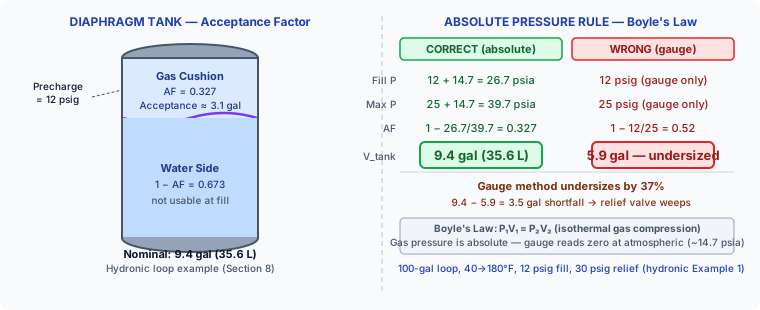
The acceptance factor is the fraction of a diaphragm tank's volume that can be used between fill pressure and maximum sizing pressure. It follows Boyle's Law gas compression and must use absolute pressures, not gauge. Using gauge pressures always undersizes the tank — the single most common expansion-tank sizing error.
Absolute pressure conversions at sea level:
P_fill_abs   = P_fill_gauge + 14.696 psia  (+ 1.01325 bar at sea level)
P_max_sizing = P_relief − margin            (default margin 5 psi / 0.3 bar)
P_max_abs    = P_max_sizing + 14.696 psia
Acceptance factor and required tank volume:
AF = 1 − (P_fill_abs / P_max_abs)

V_tank = V_expansion / AF
The critical absolute-pressure rule, shown both ways using the 100-gallon hydronic example:
Inputs: 100-gal loop, 3.05 gal expansion, 12 psig fill, 30 psig relief, 5 psi margin

CORRECT (absolute pressures per Boyle's Law):
  P_fill_abs = 12 + 14.7 = 26.7 psia (1.84 bar abs)
  P_max_abs  = 25 + 14.7 = 39.7 psia (2.74 bar abs)
  AF         = 1 − 26.7/39.7 = 0.327
  V_tank     = 3.05 / 0.327 = 9.4 gal (35.6 L)

WRONG (gauge pressures):
  AF     = 1 − 12/25 = 0.52
  V_tank = 3.05 / 0.52 = 5.9 gal (22.3 L)
The gauge method undersizes by 3.5 gallons (37%). A 5.9-gallon tank on this loop lets the boiler relief valve weep on every heating cycle. Per Boyle's Law and ASME: gas pressure is absolute — a gauge reads zero at atmospheric pressure, but the gas in the tank is at approximately 14.7 psia. Compressing from 26.7 to 39.7 psia (absolute) represents a different compression ratio than 12 to 25 psig (gauge). The acceptance factor measures how far the gas compresses; that calculation must use absolute pressures.
Acceptance factor interpretation: a wide fill-to-relief pressure gap gives a high AF and a smaller required tank. A narrow gap (AF below 0.2) drives required tank volume sharply upward. If the calculated AF is unexpectedly low, check the fill-to-relief gap.
Three Volumes: Expansion Volume vs Acceptance Volume vs Nominal Tank Volume
Three distinct volumes appear in expansion-tank sizing. Treating them as interchangeable produces undersized tanks.
Expansion Volume. How much the water grows when heated. Depends only on system water volume and temperature rise. This is the volume the system must push somewhere.
V_expansion = V_water × e
Example: 100 gal × 0.0305 = 3.05 gal (11.5 L)
Acceptance Volume. How much of the expansion a given tank can actually absorb between fill and max pressure. Always less than the physical tank size.
V_acceptance = V_tank × AF
Example: 9.4 gal × 0.327 = 3.07 gal (11.6 L)
Nominal Tank Volume. The physical size printed on the label. Larger than acceptance volume because only the AF fraction is usable.
V_tank = V_expansion / AF
Example: 3.05 / 0.327 = 9.4 gal (35.6 L) nominal
A 7-gallon tank sounds large enough for 3 gallons of expansion, but at AF 0.327 it accepts only 2.3 gallons (8.7 L) — short by 0.75 gallons. Per ASME and manufacturer charts (Amtrol, Bell & Gossett, Watts): always select by rated acceptance volume at the system's actual precharge and maximum-pressure basis, not by nominal gallons. The calculator reports required acceptance volume separately from required nominal tank volume to make this distinction explicit.
Precharge Pressure: Why It Must Equal the System Fill Pressure
A diaphragm expansion tank delivers its rated acceptance only when its precharge matches the system fill or supply pressure. Precharge is the air-side pressure behind the diaphragm, set at the factory with no water on the tank.
Recommended precharge = system fill pressure (hydronic)
                      = cold supply pressure (DHW potable)
Precharge too high: the diaphragm is already pushed back at fill conditions, the tank accepts less water before reaching relief pressure, and it behaves smaller than its rated volume.
Precharge too low: the tank starts partially water-filled, the diaphragm cannot fully extend, and usable acceptance drops proportionally.
Tanks ship from the factory with a fixed precharge (often 12 psig for hydronic, 40 psig for potable) that frequently does not match a specific installation. Per manufacturer instructions (Amtrol Extrol, Amtrol Therm-X-Trol, Bell & Gossett, Watts): check and adjust the precharge to equal the system fill or supply pressure before installation, with no water pressure on the tank. Use a tire gauge on the Schrader valve to read it, a pump to raise it, or bleed to lower it.
Worked: a DHW system with 60 psig (4.14 bar) cold supply receives a factory-preset 40-psig tank. If installed without adjustment, the diaphragm starts compressed at the 40 psig factory charge, reducing acceptance — the tank effectively waterlogged from the first fill. Correct procedure: adjust precharge to 60 psig before connecting to the system.
The calculator reports recommended precharge alongside required nominal volume.
Hydronic Worked Example: 100-Gallon Boiler Loop, 40 to 180°F, 12 psig Fill, 30 psig Relief
This example matches calculator Example 1: residential boiler loop, closed hydronic heating, 100 gallons (379 L) total loop water, cold fill 40°F (4°C), operating 180°F (82°C), fill pressure 12 psig (0.83 bar), boiler relief 30 psig (2.07 bar), 5 psi (0.3 bar) margin.
Step 1. Expansion fraction per IAPWS-IF97:
e (40°F to 180°F) = (ρ_40 / ρ_180) − 1 = 0.0305 (3.05%)
Step 2. Expansion volume:
V_expansion = 100 gal × 0.0305 = 3.05 gal (11.5 L)
Step 3. Absolute pressures:
P_fill_abs = 12 + 14.7 = 26.7 psia (1.84 bar abs)
P_max_sizing = 30 − 5 = 25 psig
P_max_abs    = 25 + 14.7 = 39.7 psia (2.74 bar abs)
Step 4. Acceptance factor:
AF = 1 − 26.7/39.7 = 1 − 0.6725 = 0.327
Step 5. Required acceptance volume:
V_acceptance = 3.05 gal ≈ 3.1 gal (11.7 L) required
Step 6. Required nominal tank volume:
V_tank = 3.05 / 0.327 = 9.33 ≈ 9.4 gal (35.6 L)
Step 7. Recommended precharge: 12 psig (0.83 bar), equal to fill pressure.
Step 8. Tank selection:
Required: 9.4-gal nominal, acceptance ≥ 3.05 gal at 12 psig precharge / 25 psig max
Amtrol Extrol #30 (hydronic, ~4.4 gal nominal) — acceptance only 1.44 gal, insufficient
Select: Amtrol Extrol #60 class or Bell & Gossett HFT-15 class (~14 gal nominal)
Verify acceptance from manufacturer chart at this specific pressure basis
Step 9. Gauge-pressure error illustrated:
Wrong (gauge): AF = 1 − 12/25 = 0.52; V_tank = 3.05/0.52 = 5.9 gal
Undersized by 9.4 − 5.9 = 3.5 gal (37%); relief valve weeps each heating cycle
Step 10. Capital: hydronic expansion tank (Amtrol Extrol, Bell & Gossett, 10-15 gal class), $80–$200; expected lifespan 10-15 years. Non-potable product (closed heating loop, not drinking water).
Selected: approximately 10-15 gal nominal hydronic expansion tank, rated acceptance ≥ 3.05 gal at 12 psig precharge and 25 psig max, precharge set to 12 psig at installation. Cross-reference: a hydronic loop also requires an air separator per ASHRAE Handbook HVAC Systems and Equipment; the expansion tank is the primary pressure-control device.
Domestic Water Heater Worked Example: 50-Gallon Potable, 50 to 140°F, 60 psig Supply, 150 psig T&P
This example matches calculator Example 2 and continues the suburban residence narrative from the Water Heater Sizing article: the same 50-gallon (189 L) gas water heater, now on a closed potable system with a PRV at the meter. Inputs: 50 gallons (189 L) heated storage, incoming 50°F (10°C), setpoint 140°F (60°C), cold supply 60 psig (4.14 bar), T&P relief 150 psig (10.34 bar), 5 psi (0.3 bar) margin. Note: this example uses 140°F to match the calculator default; the Water Heater article used 120°F — the higher setpoint increases expansion, making the sizing conservative.
Step 1. Expansion fraction per IAPWS-IF97:
e (50°F to 140°F) = (ρ_50 / ρ_140) − 1 = 0.0168 (1.68%)
Step 2. Expansion volume:
V_expansion = 50 gal × 0.0168 = 0.84 gal (3.2 L)
Step 3. Absolute pressures:
P_supply_abs = 60 + 14.7 = 74.7 psia (5.15 bar abs)
P_max_sizing = 150 − 5 = 145 psig
P_max_abs    = 145 + 14.7 = 159.7 psia (11.01 bar abs)
Step 4. Acceptance factor:
AF = 1 − 74.7/159.7 = 1 − 0.4678 = 0.532
Step 5. Required acceptance volume:
V_acceptance = 0.84 gal ≈ 0.9 gal (3.4 L) required
Step 6. Required nominal tank volume:
V_tank = 0.84 / 0.532 = 1.58 ≈ 1.6 gal (6.1 L)
Step 7. Recommended precharge: 60 psig (4.14 bar), equal to cold supply pressure.
Step 8. Tank selection:
Required: 1.6-gal nominal, acceptance ≥ 0.84 gal at 60 psig precharge / 145 psig max
Amtrol Therm-X-Trol ST-5 (potable, 2.0 gal nominal) — adequate
MUST be potable-listed (Therm-X-Trol, Watts DET series), NOT a hydronic Extrol
Step 9. Why the tank is small: the modest temperature swing (90°F / 50°C) produces low expansion (0.84 gal), and the wide pressure gap (60 to 145 psig) gives a high acceptance factor (0.532). A 50-gallon heater on this system needs only a 1.6-gallon (6.1 L) nominal tank.
Step 10. Capital and code: potable thermal expansion tank (Therm-X-Trol ST-5, Watts DET), $40–$90; required by IPC Section 607.3 on closed potable systems. Without it, the T&P valve weeps on every heating cycle, leading to premature valve failure and water damage.
Selected: approximately 2-gal nominal potable-listed thermal expansion tank, rated acceptance ≥ 0.84 gal at 60 psig precharge and 145 psig max, precharge set to 60 psig at installation. MUST be potable-listed per IPC Section 607.3 and NSF/ANSI 61 — hydronic tanks are not certified for drinking water.
Hydronic Expansion Tank vs Potable Thermal Expansion Tank: Same Math, Different Product
The sizing math for both system types is identical. The difference is the liner certification, not the formula.
| Parameter | Hydronic Tank | Potable Thermal Expansion Tank |
|---|---|---|
| System served | Closed heating loop | Closed domestic hot water |
| Volume source | Loop water volume | Storage water heater volume |
| Typical fill pressure | 12 psig (0.83 bar) | 40–60 psig (2.76–4.14 bar) |
| Relief basis | Boiler relief, 30–50 psig | T&P relief, 150 psig |
| Liner certification | Not potable-rated | NSF/ANSI 61 for drinking water |
| Example products | Amtrol Extrol, Bell & Gossett | Amtrol Therm-X-Trol, Watts |
| Governing code | ASHRAE + ASME | IPC Section 607.3 + ASME |
Installing a hydronic tank on a potable system is a real error. The hydronic tank liner uses EPDM rated for heating fluid, not drinking water; manufacturers explicitly warn against substitution. Per IPC Section 607.3 and NSF/ANSI 61: potable systems require a potable-listed tank, even though the required volume comes from the same calculation. Verify the tank listing matches the system before purchase.
Both tank types use the same formulas: e = (ρ_cold / ρ_hot) − 1 for expansion fraction, AF = 1 − P_fill_abs / P_max_abs for acceptance factor, V_tank = V_expansion / AF for nominal size. The pressures differ (hydronic 12/30 psig; potable 60/150 psig), but the math is identical.
What Happens When the Tank Is Undersized: Relief Valve Weeping and Corrosion
An undersized tank cannot absorb the full expansion volume, so pressure climbs to the relief setting on each heating cycle and the valve discharges. The damage is cumulative.
Failure sequence:
1. Water heats, expands beyond tank acceptance capacity
2. System pressure reaches relief valve setting
3. Valve opens, discharges water (boiler: relief valve drip; DHW: T&P valve discharge)
4. System cools, pressure drops, valve reseats
5. Repeats on every heating cycle
Each discharge replaces lost water with fresh make-up water carrying dissolved oxygen and minerals. Oxygen feeds boiler and heater corrosion; minerals build scale. A repeatedly-cycled relief valve can foul and fail to reseat, producing a continuous drip rather than a cycle drip.
The same symptoms occur from a correctly-sized tank that has lost precharge, has a failed bladder, or has become waterlogged. This is why a weeping relief valve is a standard prompt to inspect the expansion tank first. Diagnosis: tap the tank — a hollow sound at the top indicates air charge present; a uniform water-filled sound indicates a waterlogged or failed bladder. Check precharge at the Schrader valve with a tire gauge (system pressure off).
Per ASME and manufacturer service manuals (Amtrol, Bell & Gossett, Watts): undersized, waterlogged, and precharge-mismatched tanks all produce the same relief valve discharge symptom. Sizing up when system water volume is uncertain is inexpensive insurance against premature relief valve failure.
Check Mode: Verifying an Existing Tank by Acceptance Volume
Check mode determines whether a proposed or existing tank is adequate, always by usable acceptance volume rather than nominal size. Used after boiler or heater replacement, or when diagnosing a weeping relief valve.
Check method:
1. Enter system parameters (volume, temperatures, pressures) to obtain required acceptance
2. Enter proposed tank: nominal volume OR manufacturer-rated acceptance at system pressures
3. If nominal volume entered: usable acceptance = nominal × AF
4. Compare: ratio = required acceptance / proposed usable acceptance
Verdict thresholds:
| Ratio (required / proposed) | Verdict |
|---|---|
| ≤ 1.00 | Adequate |
| 1.00 to 1.15 | At limit |
| 1.15 to 1.50 | Undersized |
| > 1.50 | Significantly undersized |
Worked: the 4.4-gal Amtrol Extrol #30 on the 100-gallon hydronic loop from Section 8:
Proposed nominal 4.4 gal × AF 0.327 = 1.44 gal usable acceptance
Required acceptance = 3.05 gal
Ratio = 3.05 / 1.44 = 2.12 → Significantly undersized
The relief valve discharges; tank provides less than half the needed acceptance
Replacement: select ≥ 9.4-gal nominal with acceptance ≥ 3.05 gal
A common check scenario is water-heater replacement. An older system may have had no PRV (open system, no expansion tank required). Adding a new PRV with the heater replacement creates a closed system — IPC Section 607.3 now requires an expansion tank. Check mode confirms whether any existing tank is sufficient or confirms the need for a new one. The PRV setpoint is also the cold fill pressure this calculator asks for, so the two devices are sized against the same number: a valve set at 60 psig gives the AF 0.532 used in Example 2, while resetting the same valve to 75 psig drops AF to 1 − 89.7/159.7 = 0.438 and raises the required acceptance volume by 21% against identical heating conditions.
Sizing the PRV that closes the system?
Required Cv at peak, typical and minimum demand, Cv utilization and turndown for stability screening, and the ISA cavitation index on absolute pressures. Returns the intermediate setpoint for staged reduction when the ratio is too high for one valve, a parallel arrangement when turndown is too wide, the 80 psi code ceiling check, and the closed-system consequence that makes this expansion tank mandatory.
Open Pressure Reducing Valve Sizing CalculatorPer manufacturer instructions and IPC Section 607.3: verify by acceptance volume at the actual system pressures, not by nominal gallons. A nominally large tank can be acceptance-undersized at high fill pressures. Re-verify after any boiler or water heater change.
Application Boundaries: Glycol Mixtures, Chilled Water, High Altitude, Point of No Pressure Change
This calculator applies to water-only closed systems (hydronic heating and domestic potable hot water) at standard to moderate altitude, sizing for heating expansion.
Glycol Mixtures. Propylene glycol and ethylene glycol antifreeze (common in hydronic and solar thermal systems) expand more than water. A 30-50% glycol solution expands approximately 10-15% more than water over the same temperature rise. Using the water-only result for a glycol loop undersizes the tank; size up per the glycol manufacturer's expansion coefficient data.
Chilled Water and Contraction. Chilled-water systems operate below fill temperature and contract rather than expand. Combined heating/cooling systems may require both expansion and contraction analysis. This calculator covers heating expansion only.
High Altitude. Atmospheric pressure drops with altitude: 14.696 psia at sea level falls to approximately 12.2 psia at 5,000 ft (1,524 m). Lower atmospheric pressure changes the acceptance factor calculation through P_fill_abs and P_max_abs. For high-altitude sites, enter the actual local atmospheric pressure.
Point of No Pressure Change. In hydronic systems, the expansion tank connection point is the point of no pressure change relative to the pump, per ASHRAE Handbook and Bell & Gossett system design guidance. The pump should pump away from the expansion tank (toward the system). This calculator sizes the tank but does not address pump location or pressurization strategy.
Relief Valve Sizing. The calculator sizes the expansion tank, not the relief valve. Boiler relief valve capacity is governed by ASME Section IV (Heating Boilers); T&P relief valve ratings by ANSI Z21.22 / CSA 4.4 for water heaters.
System Volume Estimation. The largest practical error source. The calculator takes system water volume as a direct input; it does not compute volume from pipe and equipment inventory. Estimate boiler, distribution piping, and emitters separately; size up by 10-15% if the estimate is uncertain.
Large Commercial and Steam Systems. Large hydronic, steam, and district heating systems exceed the residential and light-commercial scope. Use ASHRAE Handbook HVAC Systems and Equipment detailed methodology and manufacturer engineering data.
Per IAPWS-IF97, ASME Boiler and Pressure Vessel Code, and ASHRAE Handbook: water-only heating expansion at standard altitude is the calculator's scope. Glycol, chilled water, high altitude, pump placement, air separation, relief valve capacity, and commercial-scale systems require extended analysis and professional engineering judgment.
Expansion Tank Sizing Calculator
Expansion tank sizing per IAPWS-IF97 water density and absolute-pressure acceptance factor: computes thermal expansion fraction from cold and hot temperatures, acceptance factor from absolute fill and relief pressures, and required acceptance volume and nominal tank volume. Size mode returns the required tank for closed hydronic heating loops and domestic potable hot-water systems. Check mode verifies a proposed tank by usable acceptance volume at system pressures, returning an Adequate / At limit / Undersized / Significantly undersized verdict. Recommended precharge equals the system fill or cold supply pressure.
Open Expansion Tank Sizing CalculatorFAQ
How do I size an expansion tank?
Per IAPWS-IF97 and Boyle's Law: find the expansion volume by multiplying system water volume by the expansion fraction from the temperature rise, then divide by the acceptance factor. For a 100-gallon (379 L) hydronic loop heating from 40 to 180°F (4 to 82°C) at 12 psig fill and 30 psig relief (5 psi margin): expansion volume = 100 × 0.0305 = 3.05 gal (11.5 L); AF = 1 − 26.7/39.7 = 0.327; required nominal tank = 3.05 / 0.327 = 9.4 gal (35.6 L). Always use absolute pressures in the acceptance factor calculation.
Why does expansion tank sizing use absolute pressure, not gauge?
Per Boyle's Law: the acceptance factor measures gas compression, and gases follow absolute pressure, not gauge. A gauge reads zero at atmospheric pressure (approximately 14.7 psia), but the gas in the tank is at 14.7 psia absolute, not zero. For the hydronic example: absolute AF = 1 − 26.7/39.7 = 0.327, giving 9.4 gal. Gauge AF = 1 − 12/25 = 0.52, giving 5.9 gal. The gauge method undersizes by 37%, producing a tank that cannot absorb the full expansion and causes the relief valve to weep on every heating cycle.
What is the difference between acceptance volume and nominal tank volume?
Per ASME and manufacturer charts: acceptance volume is how much expanded water the tank can actually receive between fill pressure and max pressure; nominal tank volume is the physical size on the label. Only the acceptance fraction is usable. A 7-gallon (26.5 L) nominal tank at AF 0.327 accepts only 2.3 gallons (8.7 L). The required nominal size is always larger than the required acceptance volume. Select by rated acceptance at the specific system precharge and max-pressure basis, obtained from the manufacturer's sizing chart for that model.
What size expansion tank does a 50-gallon water heater need?
Per IPC Section 607.3: it depends on temperature rise, supply pressure, and T&P relief setting, not on tank gallons alone. For the standard example (50-gal potable, 50 to 140°F / 10 to 60°C, 60 psig supply, 150 psig T&P): expansion volume = 0.84 gal (3.2 L), AF = 0.532, required tank = 1.6 gal (6.1 L) nominal. An Amtrol Therm-X-Trol ST-5 (2.0 gal nominal) with precharge adjusted to 60 psig is adequate. The tank must be potable-listed per NSF/ANSI 61.
Why must the precharge match the system fill pressure?
Per manufacturer instructions (Amtrol, Bell & Gossett, Watts): the precharge determines where the diaphragm sits at fill conditions. Precharge equal to fill pressure means the full acceptance is available from the start. Precharge too high pushes the diaphragm back, reducing usable acceptance; precharge too low allows water into the tank at fill, also reducing usable acceptance. Tanks ship with a factory default (often 12 psig hydronic, 40 psig potable) that may not match a given system. Check and adjust at installation with no water pressure on the tank.
Can I use a hydronic expansion tank on a water heater?
Per IPC Section 607.3 and NSF/ANSI 61: no. Potable systems require a potable-listed expansion tank with a drinking-water-certified liner. Hydronic expansion tanks use EPDM rubber not rated for potable water; manufacturers (Amtrol, Bell & Gossett) explicitly prohibit their use on potable systems. The sizing formulas are identical, but the products are not interchangeable. For DHW systems, specify Amtrol Therm-X-Trol, Watts DET, or equivalent potable-listed products only.
Why does a relief valve weep on every heating cycle?
Per ASME and IPC: the relief valve weeps when the expansion tank cannot absorb the full expansion volume and pressure reaches the relief setting. Common causes: missing expansion tank (no thermal expansion control on a closed system), undersized tank, waterlogged tank (failed bladder, waterlogged diaphragm), or precharge-mismatched tank. Per the diagnosis procedure: tap the tank for hollow sound (air present) versus full sound (waterlogged); check precharge with a tire gauge with system water pressure off. A properly sized, correctly precharged expansion tank keeps the relief valve closed throughout the heating cycle.
Related Calculators
- Water Heater Sizing Calculator: First-hour rating and tankless GPM per DOE 10 CFR 430; the expansion tank is the code-required companion on a closed potable system (article).
- Pressure Reducing Valve Sizing Calculator: Required Cv, turndown stability and ISA cavitation screening per ASSE 1003; the valve that closes the system and sets the cold fill pressure this tank is sized against.
- Hazen-Williams Pipe Flow Calculator: Pressurized water service per AWWA M22 and IPC Section 604, the cold supply feeding the heater and expansion tank (article).
- Pipe Slope Calculator: Gravity drainage slope per IPC 704 and Manning's equation (article).
- Drain Field Sizing Calculator: Residential onsite wastewater per IPC Section 802 (article).
- Pump Power Calculator: Pump power for hydronic circulation and pressure boosting.
- Horizontal Tank Volume Calculator: Tank volume for storage applications.
- Grease Trap Sizing Calculator: Commercial kitchen FOG management per PDI G101 (article).