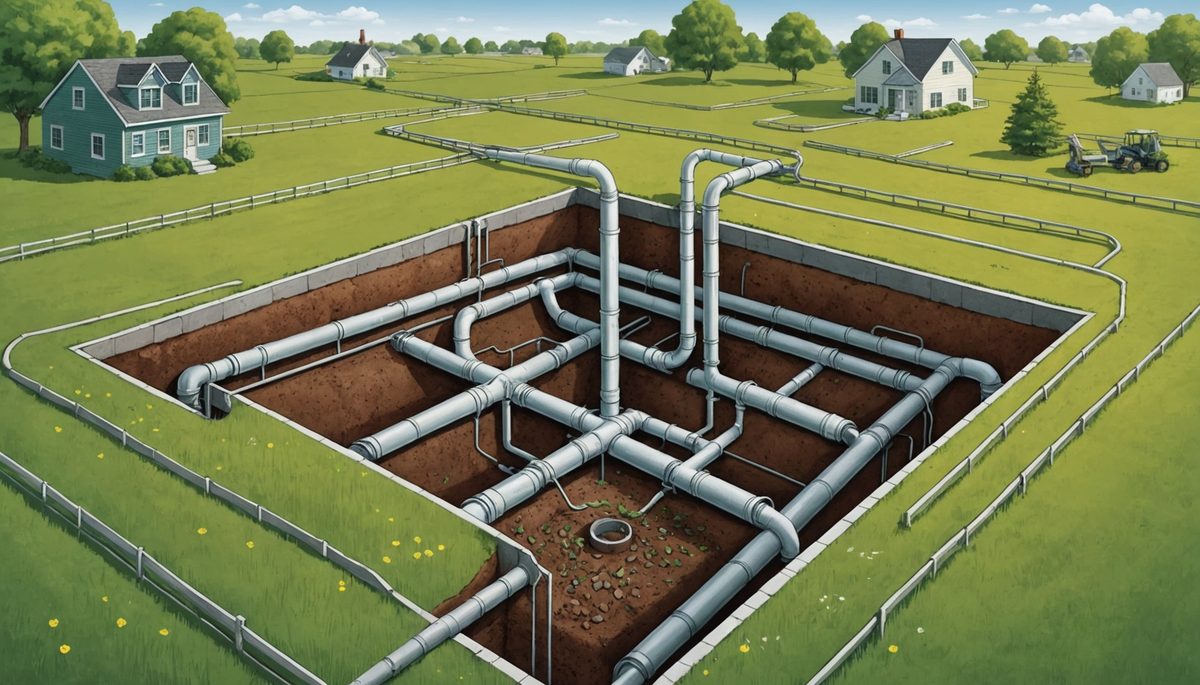
Drain field sizing collapses to a single calculation in most residential conversations: square footage of trench bottom area. A 4-bedroom house produces 600 GPD (2,271 L/day), the soil perc test came back at 30 minutes per inch, so the contractor lays 1,200 square feet (111 m²) of trench and calls it done. What gets skipped is the percolation methodology, the slope correction, the distribution method selection, and the 100% reserve area requirement that IPC Section 802.5 mandates for future system replacement. This article covers the complete IPC Section 802 + EPA 40 CFR Part 503 sizing chain from daily wastewater flow to installed trench configuration, with USGS percolation test methodology, soil loading rate lookup, and the full rural Texas 4-bedroom worked example.
Why Drain Field Sizing per IPC Section 802 + EPA 40 CFR Part 503: Groundwater Protection, System Lifespan, and Property Value
A drain field is the final treatment stage in an onsite wastewater system. Septic tank effluent percolates through engineered trenches into native soil, where bacterial action and soil filtration complete the wastewater treatment process per IPC Section 802 and EPA 40 CFR Part 503. Undersized drain fields fail through three simultaneous mechanisms: surface seepage from saturated soil (groundwater and surface water contamination per Clean Water Act Section 402), sewage backup into the residence (plumbing failure and health emergency), and shortened system lifespan — typical 20–25 years reduced to 5–10 years per EPA Onsite Wastewater Treatment Systems Manual (EPA/625/R-00/008) studies.
Drain field sizing follows mass balance: daily wastewater volume must equal the soil's daily absorption capacity. Per IPC Section 802.4, daily design flow in GPD is established by household occupancy (number of bedrooms plus fixture count). Per IPC Section 802.4.2 and USGS soil testing, soil absorption rate in GPD per square foot is determined through field percolation testing. The ratio establishes required trench surface area. Slope correction per IPC Section 803.6 (5–15% slopes require 10–30% area increase) and system type factor (gravity versus pressure-dosed distribution) modify the basic calculation.
IPC Section 802 and IAPMO UPC Chapter 8 establish the design framework adopted by most US jurisdictions through state health department amendments: Texas TCEQ Title 30 Chapter 285, California SWRCB OWTS Policy, Florida DOH 64E-6, and North Carolina 15A NCAC 18A .1900. EPA 40 CFR Part 503 governs federal sewage sludge treatment standards. NSF/ANSI 40, NSF/ANSI 245, and NSF/ANSI 350 certify residential wastewater treatment equipment performance. State adoption varies: Texas TCEQ accepts conventional drain fields in most counties; California SWRCB requires advanced treatment in Tier 2 areas; Massachusetts Title 5 requires nitrogen-removal systems in coastal zones. Verify with the AHJ before final design.
The complete residential septic system consists of three components: the septic tank (solids settling, anaerobic digestion), the drain field (this article's focus), and optional intermediate components (distribution box, pressure dosing pump, advanced treatment unit). Cross-reference the Grease Trap Sizing article in this Plumbing cluster: that article handles commercial FOG management; this article handles residential onsite wastewater. Together they establish the Plumbing cluster authority foundation for the calcengineer.com site.
Calculator Inputs: Daily Wastewater Flow, Percolation Rate, Soil Classification, Slope, System Type
The drain field sizing calculator accepts five inputs per IPC Section 802.4.1, 802.4.2, and 803.6.
Daily Wastewater Flow [GPD or L/day] is the total daily volume requiring treatment, sized per IPC Section 802.4.1 bedroom basis: 75 GPD (284 L/day) per bedroom, with fixture additions for garbage disposal (+25 GPD / 95 L/day), whirlpool (+25 GPD / 95 L/day), and pool auto-fill (+50 GPD / 189 L/day). Residential range: 150–900 GPD (568–3,407 L/day) for 1–6 bedrooms.
Soil Percolation Rate [min/inch or min/cm] is the time for water to drop 1 inch in a USGS test hole. Range: Class I Excellent (less than 10 min/inch) through Class VI Severe (above 120 min/inch). Classes V and VI do not permit conventional drain fields per IPC Section 802.4.2.
Soil Classification per USDA Natural Resources Conservation Service Soil Survey, Class I–VI, mapping directly to IPC Section 802.4.2 loading rates from 1.2 GPD/sq ft (49 L/m²/day) for coarse sand down to 0.1 GPD/sq ft (4 L/m²/day) for heavy clay. Class VI (impervious clay, hardpan) is not permitted for conventional systems.
Site Slope [%]: 0–5% uses standard sizing with no correction; 5–10% adds 10%; 10–15% adds 20% and requires engineered cross-slope trenches per IPC Section 803.6; 15–30% adds 30%; above 30% requires an alternative system or different site.
System Type determines a distribution factor: gravity distribution box per IPC Section 804.1 (factor 1.00, no area reduction), pressure distribution per IPC Section 804.2 (factor 0.90, 10% reduction), and drip distribution per IPC Section 805.3 (factor 0.75, 25% reduction). Mound systems per IPC Section 805.1 and sand filters per IPC Section 805.2 use separate sizing methodology.
Calculator outputs include required drain field area [sq ft or m²], trench configuration (lateral count × length × width), septic tank capacity recommendation per IPC Section 802.4, reserve area requirement per IPC Section 802.5 (typically 100%), and estimated capital cost range. The calculator does not account for groundwater depth restrictions, setback requirements from wells and surface water, local code amendments beyond IPC baseline, or climate-zone frost depth corrections.
Daily Wastewater Flow per IPC Section 802.4.1: 75 GPD per Bedroom + Fixture Additions
Daily wastewater flow drives the drain field sizing calculation per IPC Section 802.4.1. Residential design uses bedroom count as the primary occupancy proxy, assuming 2 occupants per bedroom at 37.5 GPD (142 L/day) per occupant, producing 75 GPD (284 L/day) per bedroom.
IPC Section 802.4.1 daily wastewater flow allowances by bedroom count:
| Bedrooms | Daily Flow Q (GPD) | Daily Flow Q (L/day) |
|---|---|---|
| 1 (studio or efficiency) | 150 | 568 |
| 2 bedroom | 300 | 1,136 |
| 3 bedroom | 450 | 1,703 |
| 4 bedroom | 600 | 2,271 |
| 5 bedroom | 750 | 2,839 |
| 6 bedroom | 900 | 3,407 |
| Each additional bedroom | +150 | +568 |
Formula basis:
Q_residential = (number_bedrooms + 1) × 75 GPD
              = (number_bedrooms + 1) × 284 L/day
Fixture additions per IPC Section 802.4.1 that increase design flow:
- Garbage disposal: +25 GPD (95 L/day)
- Whirlpool / jacuzzi / hot tub: +25 GPD (95 L/day)
- Pool with automatic fill: +50 GPD (189 L/day)
Worked example preview for the rural Texas 4-bedroom cluster scenario:
IPC Table 802.4.1 direct lookup: 600 GPD (2,271 L/day)
Garbage disposal addition:       +25 GPD (95 L/day)
Conservative design basis:        650 GPD (2,460 L/day)
Commercial flow rates per IPC Section 803.4 Table: restaurant per seat at 30–50 GPD; office per worker at 10–15 GPD; school per student at 5–10 GPD. Local code amendments modify these baselines: Texas TCEQ Chapter 285.91 includes seasonal occupancy corrections; California SWRCB requires 60 GPD per bedroom in water conservation areas; Florida DOH 64E-6 applies peaking factor adjustments. Confirm with the AHJ for specific jurisdiction adoption.
Soil Percolation Test Methodology per USGS Standard: 3-Hole Test, 2-Foot Depth, 24-Hour Pre-Soak
Soil percolation rate is the critical engineering parameter determining drain field sizing per IPC Section 802.4.2 and USGS Standard Percolation Test methodology. The test measures the speed at which water drops 1 inch in a saturated test hole, directly correlating with the soil's ability to receive wastewater without surface seepage.
USGS Standard Percolation Test — four-step methodology per USGS Water Resources Investigations Reports:
Step 1. Test hole preparation. Excavate 3 test holes, 8–12 inches (203–305 mm) diameter, 24 inches (610 mm) deep, located in the proposed drain field area (not over existing fill or disturbed soil). Minimum 4 ft (1.22 m) separation between holes. Scrape hole sides clean to avoid smearing soil that seals capillaries.
Step 2. Pre-soak period (24 hours). Fill all 3 holes with clean water to 12-inch (305 mm) depth. Maintain water level continuously for 24 hours by refilling periodically. Pre-soaking saturates soil to eliminate initial fast-absorption rate distortion from dry-soil conditions.
Step 3. Percolation rate measurement. After the pre-soak, drain each hole completely, then refill to 6-inch (152 mm) depth with clean water. Measure time for the water level to drop 1 inch (25.4 mm) using a meter stick or depth gauge. Average measurements across all 3 holes for the design percolation rate. Discard any outlier reading deviating more than 50% from the average.
Step 4. Multiple readings for stabilization. Take percolation readings every 30 minutes for 4 hours after the pre-soak. Use the slowest sustained rate (last 4 readings stabilized) as the design percolation rate. Soil reaches steady-state saturation after initial fast readings.
Soil classification by percolation rate per IPC Section 802.4.2:
| Percolation Rate | Soil Class | Soil Texture | Suitability |
|---|---|---|---|
| 5–15 min/inch (2–6 min/cm) | Class I (Excellent) | Coarse sand, fine sand | Highly suitable |
| 15–30 min/inch (6–12 min/cm) | Class II (Good) | Sandy loam | Suitable |
| 30–45 min/inch (12–18 min/cm) | Class III (Fair) | Loam, silt loam | Suitable with standard sizing |
| 45–60 min/inch (18–24 min/cm) | Class IV (Marginal) | Clay loam, silty clay loam | Larger area required |
| 60–90 min/inch (24–35 min/cm) | Class V (Poor) | Clay, heavy soils | Advanced treatment recommended |
| 90+ min/inch (35+ min/cm) | Class VI (Severe) | Heavy clay, hardpan | Conventional system not permitted |
Percolation testing must be performed by a licensed soil tester per state health department certification: Texas TCEQ Soil Evaluator license, California Health Department certified evaluator, Florida DOH licensed. Per IPC Section 802.4.2 Note: testing during wet season after rainfall gives the most conservative reading. Dry-season testing may overstate soil absorption capacity. Some states require seasonal testing windows per state health department adoptions.
Soil Absorption Rate Lookup per IPC Section 802.4.2: Class I to Class VI Soil Classification and GPD/sq ft Loading
IPC Section 802.4.2 establishes soil loading rate in gallons per day per square foot of trench bottom surface based on soil classification from the percolation test. Loading rate translates daily wastewater flow to required drain field area through the simple relationship: area equals flow divided by loading rate.
IPC Section 802.4.2 absorption rate table (trench bottom loading):
| Soil Class | Percolation Rate | Loading Rate (GPD/sq ft) | Loading Rate (L/m²/day) |
|---|---|---|---|
| I — Coarse sand | 5–15 min/inch | 1.2 | 49 |
| I — Fine sand | 5–15 min/inch | 1.0 | 41 |
| II — Sandy loam | 15–30 min/inch | 0.75 | 31 |
| III — Loam | 30–45 min/inch | 0.5 | 20 |
| III — Silty loam | 30–45 min/inch | 0.4 | 16 |
| IV — Clay loam | 45–60 min/inch | 0.3 | 12 |
| IV — Silty clay loam | 45–60 min/inch | 0.25 | 10 |
| V — Clay (light) | 60–90 min/inch | 0.2 | 8 |
| V — Clay (heavy) | 90+ min/inch | 0.1 | 4 |
| VI — Impervious | 120+ min/inch | None permitted | None permitted |
Higher loading rate (Class I) means less drain field area is required. Lower loading rate (Class V) means significantly more area or an alternative system. Class VI soils are not permitted for conventional drain fields; they require alternative treatment systems per IPC Section 805.
Cluster narrative preview: rural Texas 4-bedroom residence with medium loam soil (Class III, 30 min/inch / 12 min/cm, loading rate 0.5 GPD/sq ft / 20 L/m²/day):
Required area = Daily flow / Loading rate
              = 600 GPD / 0.5 GPD/sq ft
              = 1,200 sq ft (111 m²)
Per IPC Section 802.4.2 commentary: state health department adoptions may modify loading rates downward but rarely upward. Texas TCEQ Chapter 285.91 Table maintains IPC loading rates. California SWRCB OWTS Policy requires a 30% loading rate reduction in critical groundwater protection areas. Florida DOH 64E-6 requires reserve area sizing equal to the primary area for future replacement.
Drain Field Sizing Formula: A_required = Q_daily / Loading_rate × Slope_factor
Drain field sizing reduces to a mass balance with slope correction per IPC Section 802.4.2 and 803.6. Required absorption area equals daily wastewater flow divided by soil loading rate, multiplied by slope correction factor and system type factor.
Complete sizing formula:
A_required = Q_daily / Loading_rate × Slope_factor × System_factor

where:
  A_required    = required trench bottom area [sq ft or m²]
  Q_daily       = daily wastewater flow [GPD or L/day] per IPC 802.4.1
  Loading_rate  = soil absorption rate [GPD/sq ft] per IPC 802.4.2
  Slope_factor  = 1.00 (0–5%), 1.10 (5–10%), 1.20 (10–15%), 1.30 (15–30%)
  System_factor = 1.00 gravity, 0.90 pressure distribution, 0.75 drip
Numeric verification — rural Texas baseline using IPC Table 802.4.1 direct lookup:
Q_daily       = 600 GPD (2,271 L/day)
Loading_rate  = 0.5 GPD/sq ft (20 L/m²/day) — medium loam Class III, 30 min/inch
Slope_factor  = 1.00 (flat site, 0–5% slope)
System_factor = 1.00 (gravity distribution box)

A_required = 600 / 0.5 × 1.00 × 1.00 = 1,200 sq ft (111 m²)
Trench configuration per IPC Section 803.4 (3 ft / 914 mm standard trench width):
Linear_trench_feet = 1,200 / 3 = 400 linear feet (122 m)
Lateral_length     = 400 / 4 laterals = 100 ft per lateral (30.5 m per lateral)
Maximum lateral length per IPC Section 803.4 is 100 ft (30.5 m). Longer laterals require pressure distribution or multiple distribution zones.
Slope correction examples per IPC Section 803.6 applied to the 1,200 sq ft baseline:
0–5% slope (level site):  A = 1,200 × 1.00 = 1,200 sq ft (111 m²) — baseline
5–10% slope:              A = 1,200 × 1.10 = 1,320 sq ft (122 m²)
10–15% slope:             A = 1,200 × 1.20 = 1,440 sq ft (134 m²)
15–30% slope:             A = 1,200 × 1.30 = 1,560 sq ft (145 m²)
System type corrections per IPC Section 805 applied to the 1,200 sq ft baseline:
Gravity (conventional):  A = 1,200 × 1.00 = 1,200 sq ft (111 m²) — baseline
Pressure distribution:   A = 1,200 × 0.90 = 1,080 sq ft (100 m²) — 10% reduction
Drip distribution:       A = 1,200 × 0.75 =   900 sq ft (84 m²) — 25% reduction
Per IPC Section 802.5: reserve area equal to the primary area must be designated for future system replacement. Texas TCEQ Chapter 285 and Florida DOH 64E-6 require 100% reserve. California SWRCB requires 50% reserve.
Trench Configuration per IPC Section 803: Sidewall and Bottom Loading Calculations
Required trench surface area can be achieved through different trench configurations, with tradeoffs between depth, width, and linear length. IPC Section 803 establishes geometry requirements ensuring proper effluent dispersion and soil contact for biological treatment.
Trench depth per IPC Section 803.4: 18–36 inches (457–914 mm) below grade. Standard practice: 24–30 inches (610–762 mm). Deeper trenches reduce sidewall benefit; shallow trenches risk freeze damage in cold climates per IPC Section 803.4 commentary.
Trench width per IPC Section 803.4: 18–36 inches (457–914 mm). Standard: 36 inches (914 mm), matching standard contractor excavation equipment. Narrower trenches (18–24 inches / 457–610 mm) suit tight lot conditions but require more linear feet.
Lateral length per IPC Section 803.5: 100 ft (30.5 m) maximum per lateral for gravity distribution. Longer runs require pressure dosing or multiple distribution zones.
Center-to-center spacing per IPC Section 803.5: 9 ft (2.74 m) minimum between adjacent lateral centerlines. Texas TCEQ Chapter 285.91 requires 10 ft (3.05 m) minimum. Wider spacing (12–18 ft / 3.7–5.5 m) improves percolation independence where lot space permits.
Sidewall infiltration credit per IPC Section 803.5: trench sidewalls contribute additional absorption area. Most conservative practice uses bottom-only loading rate without sidewall credit, which is the standard basis for IPC Section 802.4.2 calculations.
Trench configuration options achieving 1,200 sq ft (111 m²) required trench bottom area:
| Configuration | Trench Width | Lateral Length | Number of Laterals | Total Bottom Area |
|---|---|---|---|---|
| Standard | 3 ft (914 mm) | 100 ft (30.5 m) | 4 laterals | 1,200 sq ft (111 m²) |
| Wide | 4 ft (1.22 m) | 100 ft (30.5 m) | 3 laterals | 1,200 sq ft (111 m²) |
| Narrow | 2 ft (610 mm) | 100 ft (30.5 m) | 6 laterals | 1,200 sq ft (111 m²) |
| Short-trench | 3 ft (914 mm) | 60 ft (18.3 m) | 7 laterals | 1,260 sq ft (117 m²) |
Setback requirements per state health department adoptions: Texas TCEQ Chapter 285.91 requires 50 ft (15.24 m) from water wells, 25 ft (7.62 m) from property lines, and 25 ft (7.62 m) from building foundations. California SWRCB requires 100 ft (30.48 m) from drinking water sources. Florida DOH 64E-6 requires 75 ft (22.86 m) from drinking water wells.
Rural Texas 4-Bedroom Worked Example: 600 GPD Design Flow, 30 min/inch Medium Loam, 1,200 sq ft Drain Field
The cluster narrative scenario is a rural single-family residence in Texas: 4-bedroom home, 2,500 sq ft (232 m²) living area, single-story slab-on-grade, 5-acre rural lot with no municipal sewer connection available. Site soil testing returned 30 min/inch (12 min/cm) percolation rate (medium loam, Class III soil). Site slope: 3% (flat to gently sloping terrain). Groundwater table: 5 ft (1.52 m) below surface. Existing well: 75 ft (22.86 m) from the proposed drain field location. Property line: 30 ft (9.14 m) from the closest proposed trench. IPC 2021 edition per Texas TCEQ Chapter 285.91.
Step 1. Daily wastewater flow per IPC Section 802.4.1.
4-bedroom residential per IPC Table 802.4.1 direct lookup:
Q_daily = 600 GPD (2,271 L/day)

Garbage disposal addition: +25 GPD (95 L/day)
Design basis (conservative): 650 GPD (2,460 L/day)
Step 2. Septic tank sizing per IPC Section 802.4 (preceding component).
Per IPC Table 802.4: 4-bedroom requires 1,500 gal (5,678 L) minimum
Selected: 1,500 gal (5,678 L) concrete tank per ASTM C913
Manufacturer: Roth Multi-Tank or Cor-Lok local concrete supplier
Step 3. Soil percolation test per USGS Standard.
Test holes: 3 holes in proposed drain field area
Hole geometry: 10 in (254 mm) diameter, 24 in (610 mm) depth
Pre-soak: 24 hours with maintained 12 in (305 mm) water level
Percolation readings: every 30 minutes for 4 hours after pre-soak
Average rate: 30 min/inch (12 min/cm)
Soil class per IPC Section 802.4.2: Class III (Medium Loam)
Step 4. Soil absorption rate per IPC Section 802.4.2.
Class III Medium Loam loading rate: 0.5 GPD/sq ft (20 L/m²/day)
Step 5. Drain field area calculation per the Section 7 formula.
Q_daily       = 650 GPD (conservative with garbage disposal)
Loading_rate  = 0.5 GPD/sq ft (Class III loam)
Slope_factor  = 1.00 (3% slope, within 0–5% range)
System_factor = 1.00 (gravity distribution box)

A_required = 650 / 0.5 × 1.00 × 1.00 = 1,300 sq ft (121 m²)
Conservative check using IPC Table 802.4.1 direct lookup:
A_conservative = 600 / 0.5 = 1,200 sq ft (111 m²)
Design basis: 1,300 sq ft (121 m²) including garbage disposal allowance.
Step 6. Trench configuration per IPC Section 803.4.
Trench width: 3 ft (914 mm) standard
Trench depth: 30 in (762 mm) below grade
Linear trench feet: 1,300 / 3 = 433 linear ft (132 m)
Lateral length: 433 / 5 laterals = 87 ft per lateral (26.5 m per lateral)
Total trench area: 5 × 87 × 3 = 1,305 sq ft (121 m²) — satisfies 1,300 sq ft
Step 7. Center-to-center spacing and footprint per IPC Section 803.5.
5 laterals × 10 ft Texas TCEQ spacing = 40 ft (12.19 m) total field width
Lateral length: 87 ft (26.5 m)
Drain field footprint: 40 ft × 90 ft (12 m × 27 m) = 3,600 sq ft (335 m²)
Reserve area per IPC 802.5 (100%): additional 3,600 sq ft (335 m²)
Total buildable area required: 7,200 sq ft (669 m²) — well within 5-acre lot
Step 8. Setback verification per Texas TCEQ Chapter 285.91.
From existing well:     75 ft (22.86 m) available — 50 ft (15.24 m) required — adequate
From property line:     30 ft (9.14 m) available — 25 ft (7.62 m) required — adequate
From building:          30 ft (9.14 m) available — 25 ft (7.62 m) required — adequate
Vertical groundwater separation: 60 in (1,524 mm) groundwater depth
  minus 30 in (762 mm) trench bottom depth = 30 in (762 mm) separation
  exceeds 24 in (610 mm) minimum — adequate
Step 9. Distribution method per IPC Section 804.
Gravity distribution box (lowest cost, no mechanical components)
Box connects to 5 laterals through equal-flow distribution outlets
Manufacturer: Infiltrator D-Box or precast concrete per ASTM C913
Step 10. Capital cost analysis (2026 rural Texas pricing).
Septic tank (1,500 gal concrete, Roth or equivalent):  $1,800–$2,800
Distribution box (concrete D-box):                       $250–$450
Lateral piping (5 × 87 ft = 435 ft 4-in PVC per ASTM D2729): $400–$600
Drain field gravel (13 cubic yards):                     $325–$650
Excavation labor (3–5 days, 1,300 sq ft area):         $2,500–$4,500
Septic tank installation labor:                           $800–$1,500
Permits and percolation test (Texas TCEQ):               $300–$600
Site clearing:                                            $500–$1,000

Total installed cost: $6,875–$12,100 — typical range $8,000–$12,000
Step 11. Operating cost analysis per EPA Onsite Wastewater Manual.
Septic tank pumping (every 3–5 years, amortized):  $100/year
Annual inspection (recommended):                    $200/year
Replacement parts (filters, baffles, average):       $50/year
Sludge testing if required by AHJ:                $100–$200/year

Total annual operating: $450–$650/year typical
Selected configuration: 5-lateral conventional gravity drain field, 1,300 sq ft (121 m²) trench bottom, 87 ft (26.5 m) lateral length × 3 ft (914 mm) trench width, 1,500 gal (5,678 L) concrete septic tank, gravity distribution box, $8,000–$12,000 capital, $450–$650/year operating, 25–30 year lifecycle, 100% reserve area designated per IPC Section 802.5 and Texas TCEQ Chapter 285.91.
Distribution Method Selection per IPC Section 804: Gravity Distribution Box vs Pressure Distribution vs Drip
IPC Section 804 establishes three distribution methods for onsite wastewater treatment: gravity, pressure-dosed, and drip irrigation. Selection follows the cost versus effluent distribution quality tradeoff per ASCE 89 sanitary engineering principles.
Gravity Distribution Box per IPC Section 804.1: concrete box receives septic tank effluent and distributes equal flow to 4–7 lateral lines. No mechanical components, lowest maintenance. Cost: $250–$450 installed. Suitable for standard 1–7 bedroom homes on Class I–III soils. Lateral length limited to 100 ft (30.5 m) per IPC Section 804.1; cannot serve high-volume commercial applications.
Pressure Distribution per IPC Section 804.2: submersible pump delivers effluent through pressurized lateral network, providing superior uniformity across all laterals. Pump requirements: 0.5–1 HP submersible. Cost: $1,500–$3,500 incremental over gravity. Area reduction of 10% allowed per IPC Section 805.2. Applications: sites with slope above 5%, high-flow installations, or Class III–IV soils where distribution uniformity matters.
Drip Distribution per IPC Section 805.3 (classified as alternative system): filtered effluent delivered through small-diameter PVC distribution lines, each emitter at 0.5–1.5 gal/hr. Best soil saturation control, lowest hydraulic loading peaks. Cost: $3,500–$7,500 incremental over gravity. Area reduction of 25% allowed per IPC Section 805.3. Manufacturer: Geoflow Wasteflow drip distribution system. Applications: severely restricted lot sizes, sensitive groundwater areas, clay-heavy Class IV–V soils.
Selection comparison:
| Parameter | Gravity D-Box | Pressure Distribution | Drip Distribution |
|---|---|---|---|
| Capital cost (4-bedroom) | $250–$450 | $1,800–$3,800 | $4,000–$8,000 |
| Annual maintenance | $100 | $300 (pump) | $500 (filter + emitters) |
| Drain field area required | 100% baseline | 90% | 75% |
| System lifespan | 25–30 years | 20–25 years | 15–20 years |
| Soil suitability | Class I–III | Class II–IV | Class III–V |
Per state health department adoptions: Texas TCEQ Chapter 285.91 permits all three methods. California SWRCB OWTS Policy promotes pressure distribution in protected groundwater zones. Florida DOH 64E-6 requires drip distribution in coastal nitrogen-sensitive areas.
Alternative Systems per IPC Section 805: Mound Systems, Sand Filters, Aerobic Treatment Units
IPC Section 805 establishes alternative systems for sites where conventional gravity drain fields cannot be installed due to soil limitations, high water tables, restricted lot sizes, or sensitivity to nitrogen loading per EPA 40 CFR Part 503 Subpart B (Land Application Standards).
Mound System per IPC Section 805.1: engineered above-grade drain field consisting of sand fill plus lateral lines in gravel. Used where shallow groundwater (below 4 ft / 1.22 m) prevents conventional trench depth. Construction: 2–3 ft (610–914 mm) sand fill, lateral lines in gravel, sodded cover. Cost: 1.5–2.5 times a conventional system ($12,000–$25,000 typical residential). Lifespan: 20–25 years.
Sand Filter per IPC Section 805.2: pretreatment system filtering septic tank effluent before the drain field, providing 70–90% additional treatment per EPA Onsite Wastewater Manual. Allows reduced drain field area where soil percolation is marginal. Cost: $4,000–$10,000 incremental. Lifespan: 20–30 years.
Aerobic Treatment Unit (ATU) per IPC Section 805.4 and NSF/ANSI 40: mechanical treatment with continuous aeration, reducing BOD load by 90% or more per NSF/ANSI 40 and NSF/ANSI 245. Effluent meets Class II treatment criteria per EPA 40 CFR Part 503 Subpart A. Manufacturers: Norweco Singulair, Hoot Aerobic Systems, Bio-Microbics RetroFAST. Cost: $5,000–$15,000 incremental ($14,000–$25,000 total system). Required in California SWRCB OWTS Policy critical areas and Florida DOH 64E-6 nitrogen-sensitive coastal zones.
Alternative system selection guidance per IPC Section 805 and state health department adoptions:
| Site Condition | Recommended System |
|---|---|
| Standard sandy loam, large lot | Conventional gravity drain field |
| Shallow groundwater below 4 ft | Mound system |
| Restricted lot size | Drip distribution or ATU |
| Marginal percolation Class IV–V | Sand filter pretreatment |
| Nitrogen-sensitive watershed | ATU with NSF/ANSI 245 certification |
| Failed conventional system replacement | Drip distribution or ATU |
Per Texas TCEQ Chapter 285: ATU systems require a licensed operator with quarterly service visits. Per California SWRCB: advanced systems require Class III operator certification with monthly testing.
Manufacturer Survey: Infiltrator Chambers, Eljen GSF, Presby Enviro-Septic, Roth Tanks
Modern onsite wastewater treatment uses engineered chamber and filter systems replacing traditional pipe-in-gravel construction. Selection considers regional availability, installation simplicity, area reduction credits per state code, and manufacturer warranty per IPC Section 802.2 and NSF/ANSI 40.
Drain field component manufacturers (2026 distributor pricing):
| Manufacturer | Product | Type | Area per Unit | Cost Range |
|---|---|---|---|---|
| Infiltrator Water Technologies | Quick4 Equalizer 36 | Chamber | 36 sq ft (3.3 m²) | $80–$150 per chamber |
| Infiltrator | Quick4 Plus | Chamber | 45 sq ft (4.2 m²) | $120–$220 per chamber |
| Infiltrator | Sidewinder | Chamber | 60 sq ft (5.6 m²) | $180–$320 per chamber |
| Eljen | GSF (Geotextile Sand Filter) | Modular pretreatment | 25–40% area reduction | $400–$800 per 4-ft module |
| Presby Environmental | Enviro-Septic Advanced | Pretreatment + field | 30–50% area reduction | $300–$600 per 100-ft section |
| Norweco | Singulair Green (NSF/ANSI 40 + 245) | ATU | Replaces conventional field | $4,500–$8,500 per unit |
| Hoot Aerobic Systems | H-Series (NSF/ANSI 40 + 245) | ATU | Replaces conventional field | $3,800–$7,500 per unit |
| Geoflow | Wasteflow | Drip distribution | 25% IPC 805.3 reduction | $2,500–$5,000 per system |
Septic tank manufacturers:
| Manufacturer | Material | Capacity Range | Cost Range |
|---|---|---|---|
| Roth Multi-Tank | Polyethylene | 750–1,500 gal (2,839–5,678 L) | $1,200–$2,400 |
| Norwesco | Polyethylene | 1,000–2,000 gal (3,785–7,571 L) | $1,500–$2,800 |
| Cor-Lok Containment | Concrete ASTM C913 | 750–3,000 gal (2,839–11,357 L) | $1,800–$3,500 |
Selection considerations: Infiltrator chambers eliminate gravel requirement and reduce installation labor 30–50%; chamber systems are US-wide. Eljen GSF and Presby Enviro-Septic are specialized for northeastern and mid-Atlantic markets. ATU manufacturers (Norweco, Hoot) require licensed service contractors for NSF/ANSI 40 warranty maintenance. Polyethylene tanks (Roth, Norwesco) offer 30–50-year corrosion-free service; concrete tanks (Cor-Lok) provide structural strength but require corrosion monitoring. Verify equipment with local plumbing supplier and AHJ approved lists per IPC Section 802.2.
Application Boundaries: High Water Table, Cold-Climate Frost Depth, Steep Slopes, Restricted Lot Sizes
The drain field sizing calculator applies to standard residential onsite wastewater systems per IPC Section 802 and 803, daily wastewater flow 150–1,500 GPD (568–5,678 L/day), soil classification Class I–V, site slopes 0–15%, and groundwater depth above 4 ft (1.22 m). The following conditions require extended methodology beyond standard calculator scope.
High Water Table (groundwater less than 4 ft / 1.22 m below grade) per IPC Section 803.5: standard trench depth (18–36 in / 457–914 mm) cannot achieve the minimum 24 in (610 mm) vertical separation from groundwater required by IPC Section 803.5. Solutions: mound system per IPC Section 805.1, raised drain field configuration, or ATU pretreatment. Common in Florida coastal areas, Texas Gulf Coast, Louisiana, and Pacific Northwest coastal regions. Cost impact: $12,000–$25,000 for a mound system versus $6,000–$12,000 conventional.
Cold-Climate Frost Depth per IPC Section 803.4 and IRC Section R403: frost depth varies from 12 in (305 mm) in Texas to 60 in (1,524 mm) in North Dakota per ASHRAE 169-2021 and USGS frost depth maps. Trench bottom must be below frost depth for biological treatment functionality. Solutions: deeper trenches (32–60 in / 813–1,524 mm), thermal insulation cover, or heated mound systems. Cost impact: deeper trenches add 20–40% to excavation labor.
Steep Slopes above 15% per IPC Section 803.6: standard slope corrections extend to a 15% practical limit. Slopes above 15% require engineered cross-slope trench design; above 30%, Texas TCEQ Chapter 285.91 commentary requires professional engineer design and likely an alternative system. Site engineering adds $2,000–$5,000 incremental.
Restricted Lot Sizes: a standard 1,200 sq ft (111 m²) drain field requires 5,000–10,000 sq ft (465–929 m²) of buildable area with required setbacks and 100% reserve. Lots under 1 acre may not accommodate the required setback distances. Solutions: drip distribution (25% area reduction), pressure dosing (10% reduction), or ATU pretreatment. California SWRCB Tier 1 areas, Florida coastal zones, and North Carolina Outer Banks permit smaller lots with advanced treatment.
Climate-Sensitive Areas: Texas TCEQ Chapter 285 establishes special protection around drinking water wells, springs, and karst features. California SWRCB OWTS Policy Tier 2 areas require advanced treatment and reserve area. Florida DOH 64E-6 coastal zones require ATU with NSF/ANSI 245 certification. Massachusetts Title 5 requires nitrogen-removal systems in Cape Cod watershed areas. Cost impact for advanced treatment requirements: $5,000–$15,000 incremental.
Per IPC Section 802.1, state health department adoptions, and EPA Onsite Wastewater Manual: standard drain field calculation provides the baseline; specific site conditions may modify the result materially. Always confirm with the AHJ for local code amendments and required permits before finalizing design.
Drain Field Sizing Calculator
Residential drain field sizing per IPC Section 802.4.2 + EPA 40 CFR Part 503: calculates required trench bottom area from daily wastewater flow (GPD or L/day), soil percolation rate (min/inch or min/cm) per USGS Standard Percolation Test, soil classification (Class I to VI per IPC 802.4.2), site slope correction (0–30%), and system type factor (gravity, pressure distribution, or drip). Outputs trench configuration (lateral count × length × width), septic tank capacity recommendation, and 100% reserve area requirement per IPC Section 802.5.
Open Drain Field Sizing CalculatorFAQ
How do I size a drain field for my home?
Per IPC Section 802.4.1 + 802.4.2 + USGS Standard Percolation Test: drain field sizing combines daily wastewater flow with soil absorption rate. Daily flow per IPC Section 802.4.1 is 75 GPD (284 L/day) per bedroom plus fixture additions (garbage disposal +25 GPD, whirlpool +25 GPD). A 4-bedroom residence produces 600 GPD (2,271 L/day) per IPC Table 802.4.1 direct lookup. Soil absorption rate per IPC Section 802.4.2, from the USGS percolation test (3-hole method, 24-hour pre-soak, 2-foot depth), for medium loam Class III at 30 min/inch is 0.5 GPD/sq ft (20 L/m²/day). Required area = Daily flow divided by Loading rate times Slope factor: 600 divided by 0.5 times 1.00 = 1,200 sq ft (111 m²) for a standard flat site. Multiply by 100% for reserve area per IPC Section 802.5, giving a total buildable area requirement of 2,400 sq ft (223 m²).
How is the soil percolation test performed?
Per USGS Standard Percolation Test methodology and IPC Section 802.4.2 testing requirements: excavate 3 test holes, 8–12 in (203–305 mm) diameter, 24 in (610 mm) depth, in the proposed drain field area. Pre-soak: fill all 3 holes to 12 in (305 mm) depth with clean water and maintain that level continuously for 24 hours. Test: refill to 6 in (152 mm) depth, then measure time for the water level to drop 1 in (25.4 mm) using a meter stick. Take readings every 30 minutes for 4 hours after the pre-soak. Use the slowest sustained rate (last 4 readings stabilized) as the design percolation rate, averaged across the 3 holes. Discard outliers deviating more than 50% from the average. The result classifies soil into IPC Section 802.4.2 Class I–VI categories. Testing must be performed by a licensed soil tester per state health department certification (Texas TCEQ, California Health Department, Florida DOH).
What is the difference between gravity, pressure, and drip distribution?
Per IPC Section 804 and 805: gravity distribution per IPC Section 804.1 uses a concrete box to divide effluent across 4–7 lateral lines; lowest cost ($250–$450), no mechanical components, suitable for most standard residential sites. Pressure distribution per IPC Section 804.2 pumps effluent through a pressurized network for superior uniformity, allows a 10% drain field area reduction, costs $1,500–$3,500 incremental, and is useful for sloped sites or higher flows. Drip distribution per IPC Section 805.3 uses filtered effluent delivered through small-diameter emitter networks, provides the best soil contact and dispersion, allows a 25% area reduction, costs $3,500–$7,500 incremental, and is used for restricted lots or sensitive groundwater areas. Selection: gravity for standard sites, pressure for challenging terrain, drip for significant area savings or sensitive areas.
Why do I need a reserve area?
Per IPC Section 802.5 and state health department adoptions: reserve area is undeveloped space equal to or exceeding the primary drain field area, reserved for future system replacement. Drain fields have a lifespan of 20–30 years per EPA Onsite Wastewater Manual; soil clogs progressively and the system eventually requires replacement. Without designated reserve area, replacement requires new percolation testing and often site engineering work. IPC Section 802.5 mandates reserve area in most adoptions. Texas TCEQ Chapter 285.91 and Florida DOH 64E-6 both require 100% reserve (area equal to the primary field). California SWRCB OWTS Policy requires 50% reserve. Failure to designate reserve area during subdivision platting can make properties unable to obtain replacement permits — a serious resale issue for rural lots.
Can I install a drain field on a sloped site?
Per IPC Section 803.6: standard drain field installation is permitted up to 15% slope with area corrections. Slope correction factors per IPC Section 803.6: 0–5% slope uses standard sizing; 5–10% adds 10% area; 10–15% adds 20% area; 15–30% adds 30% area and requires engineered cross-slope trenches. Above 30% slope, an alternative system or different site is required per Texas TCEQ Chapter 285.91 commentary. Slope corrections reflect increased flow concentration on the downslope soil. Engineered cross-slope trenches run perpendicular to the slope to distribute effluent evenly across the grade. Site engineering adds $2,000–$5,000 incremental for slopes above 15%. Per California SWRCB OWTS Policy: slopes above 15% commonly impede percolation; consult a soil scientist before finalizing site selection.
What happens when my drain field fails?
Per EPA Onsite Wastewater Manual, Texas TCEQ Chapter 285, IPC Section 802.5, and IPC Section 806: drain field failure typically presents as surface seepage of wastewater over the drain field area (black or gray sludge at grade), sewage backup into the residence through lowest-elevation drains, slow-draining household plumbing fixtures, and standing water or muddy patches over the drain field during dry weather. Failure progression: minor soil clogging reduces absorption rate, then wastewater backs up. Resolution per state health department and EPA Onsite Wastewater Manual: pump the septic tank, install pretreatment (sand filter, Eljen GSF, or Presby Enviro-Septic) to extend remaining drain field life. If failure is terminal, rebuild the drain field in the designated reserve area per IPC Section 802.5. Replacement cost: $8,000–$15,000 typical for a residential site. Severe contamination may trigger state environmental response (Texas TCEQ, California DTSC) with groundwater monitoring requirements per EPA 40 CFR Part 503.
Related Calculators
Grease trap sizing for commercial kitchen wastewater FOG management per PDI G101 and IPC Section 1003 is the commercial Plumbing complement to this residential drain field article: Grease Trap Sizing Calculator article | Grease Trap Sizing Calculator. Expansion tank sizing per ASME Section VIII and IPC Section 504 for domestic hot water systems: Expansion Tank Sizing Calculator. Condensate return line sizing per ASHRAE 90.1 and IPC Section 716: Condensate Return Line Sizing Calculator. Fire pump performance curves per NFPA 20 and UL 448 for fire suppression: Fire Pump Performance Curve Calculator. Hanger load calculations per IPC Section 305 and ASME B31 for piping support design: Hanger Load Calculator. Pipe flow using Hazen-Williams per ASCE 89 and IPC Section 1004 for drainage line sizing: Hazen-Williams Pipe Flow Calculator. Compressed air pipe sizing per ASHRAE Handbook HVAC Systems Chapter 14: Compressed Air Pipe Sizing Calculator.