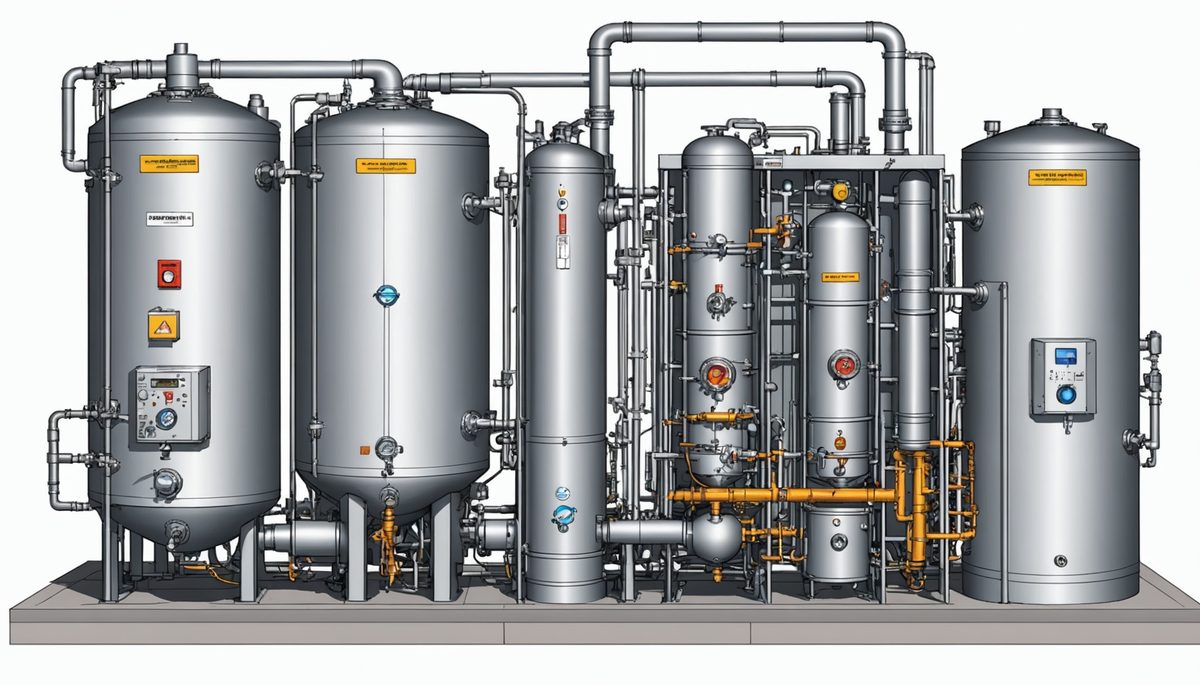
A water heater sized by tank gallons leaves the household short on the morning when two people shower, laundry runs, and the dishwasher cycles at the same time. The DOE defines capacity through first-hour rating (FHR) per 10 CFR 430 Appendix E, not tank volume, because a storage heater keeps reheating while you draw from it. A 50-gallon atmospheric gas tank typically delivers 85-90 gallons in the first hour; the same-size electric tank delivers only 55-65 gallons. Tankless heaters carry a separate constraint: rated GPM on the spec sheet is paired with a specific test temperature rise, and that flow drops when winter groundwater pushes the rise to 70-80°F. This article covers the DOE FHR method from formula to decision, with cross-references to the Plumbing cluster: the same cold water sized by Hazen-Williams pipe flow enters the heater, and the used water exits via gravity drainage per IPC Section 704.
Why Water Heater Sizing by First-Hour Rating, Not Tank Gallons: Peak-Hour Demand and Recovery
A storage water heater keeps reheating while you draw from it, so what it actually delivers in the busiest hour is its first-hour rating (FHR) per DOE 10 CFR 430 Appendix E, not its tank size. Tank gallons alone mislead: a 50-gallon tank with a strong burner delivers 90 gallons in the first hour, refilling 40 gallons of recovery during the draw, while a 50-gallon tank with a weak electric element delivers only 60. Sizing by tank gallons leaves households with cold showers on a busy morning.
FHR combines two quantities: usable storage (tank capacity × draw efficiency) plus one hour of recovery (reheat during the draw). Per DOE, the FHR number is printed on the yellow EnergyGuide label from a standardized 125°F outlet test under the Uniform Energy Factor method. Tankless heaters store nothing; their capacity is flow in GPM at a given temperature rise, and that flow drops as inlet water gets colder. Two heater types, two distinct sizing problems.
DOE 10 CFR 430 Appendix E defines both FHR and Maximum GPM Rating. AHRI establishes draw-efficiency standards (0.70 screening default). ENERGY STAR and EPA WaterSense set fixture-flow standards. IPC Section 501 and Section 607 govern water heater installation and hot-water distribution. This article is the fifth Plumbing cluster sibling: the Hazen-Williams article sized the pressurized water service bringing cold water into the residence; this article sizes the heater that warms it. The used hot water leaves via the Pipe Slope article gravity drain and reaches the Drain Field. Together they complete the building water cycle: pressurized supply in, heat, gravity drainage out.
Calculator Inputs: Heater Type, Fuel, Setpoint, Inlet Temperature, Peak Demand, Candidate
Heater Type: Storage (tank) or Tankless (instantaneous). The two modes activate different input fields and produce different outputs: FHR in gallons (or liters) for storage, GPM (or L/min) at temperature rise for tankless.
Unit System: US/Imperial (gal, GPM, °F, BTU/h) or Metric (L, L/min, °C, kW).
Fuel Type: sets the default recovery efficiency. Atmospheric gas: 80%. Condensing gas: 95%. Electric resistance: 98%.
Delivery (Setpoint) Temperature [°F or °C]: hot-water temperature at the tap, typically 120°F (49°C). Legionella control requires storage at 120°F minimum per ASHRAE 188, with thermostatic mixing valves at fixtures per IPC Section 424 limiting delivery to safe temperatures.
Cold-Water Inlet Temperature [°F or °C]: groundwater temperature at the heater. For tankless, use the coldest expected winter value; the summer average undersizes the unit. USGS regional groundwater ranges: very cold 37-40°F (3-4°C), cold 40-50°F (4-10°C), temperate 55-65°F (13-18°C), warm 70-77°F (21-25°C).
Demand Flow Basis: pure hot flow (at setpoint temperature) or mixed fixture flow (at use temperature, converted by the calculator via hot fraction).
Peak-Hour Hot-Water Demand [gal or L] (storage): total hot water in the single busiest hour. DOE per-use averages: shower 12 gal (45 L), bath 20 gal (76 L), shave 2 gal (7.6 L), hand dishwashing 4 gal (15 L), auto dishwasher 6 gal (23 L), clothes washer 7 gal (26 L).
Peak Simultaneous Flow [GPM or L/min] (tankless): sum of all fixtures running at the same time.
Candidate Heater (optional): None (shows required FHR or GPM only), rated FHR from the EnergyGuide label (preferred), or tank plus input power plus efficiency. Tankless: rated GPM at test rise, or input BTU/h (kW) plus efficiency.
Calculator outputs for storage: ΔT, required FHR, recovery rate, usable storage, candidate FHR, demand/FHR ratio, surplus or shortfall, full reheat time. For tankless: required output BTU/h (kW), required input, required GPM, derated effective GPM, flow ratio, surplus or deficit. Both modes return Adequate/At limit/Undersized when a candidate is entered.
The calculator does not model gas-line or electrical-service capacity, venting, standby or recirculation loss, expansion tank sizing, minimum activation flow for tankless, or multi-hour sustained demand.
First-Hour Rating Formula: FHR = Usable Storage + One Hour of Recovery per DOE 10 CFR 430
FHR quantifies what a storage heater delivers in one hour of heavy use, combining stored hot water plus reheating during the draw, per DOE 10 CFR 430 Appendix E.
FHR = (Capacity × draw_eff) + Recovery_GPH

where:
  FHR        = first-hour rating [gal or L]
  Capacity   = nominal tank size [gal or L]
  draw_eff   = usable draw fraction [0.70 AHRI screening default]
  Recovery   = one hour of recovery [GPH or L/h]
Usable storage:
Usable = Capacity × 0.70
Example: 50 gal × 0.70 = 35 gal (132.5 L)
The 0.70 draw efficiency per AHRI screening represents the usable fraction before cold water mixing from the dip tube dilutes hot-water quality. Actual draw efficiency varies with tank design, stratification, and thermostat placement; 0.70 is the conservative screening default.
Per DOE: the FHR printed on the yellow EnergyGuide label is the authoritative figure, measured at 125°F outlet under the Uniform Energy Factor test (10 CFR 430 Appendix E). The formula produces a screening estimate; label FHR governs selection. For units without an available label FHR, the formula provides an order-of-magnitude screening check.
Formula preview using the cluster narrative:
50-gal gas tank, 40,000 BTU/h, 80% efficiency, 50°F inlet, 120°F setpoint
ΔT = 70°F (38.9°C)
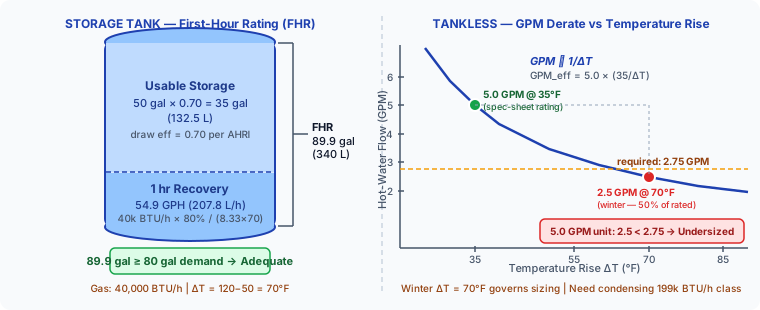
Recovery = (40,000 × 0.80) / (8.33 × 70) = 54.9 GPH (207.8 L/h)
Usable   = 50 × 0.70 = 35 gal (132.5 L)
FHR      = 35 + 54.9 = 89.9 gal (340 L)
FHR matching: select the heater whose EnergyGuide FHR equals or exceeds the peak-hour demand. Per DOE and AHRI: match label FHR to peak-hour demand, not to tank gallons.
Temperature Rise: Delivery Setpoint Minus Cold Inlet, and Why Winter Governs
Temperature rise (ΔT) is the degrees the heater must lift incoming water to reach setpoint. It drives both storage recovery rate and tankless flow.
ΔT = T_delivery − T_inlet
US: °F     Metric: °C     ΔT(°C) = ΔT(°F) / 1.8

Example: 120°F setpoint − 50°F groundwater = 70°F rise (38.9°C)
Winter governs design: groundwater drops in cold months, pushing ΔT higher. Using the summer average inlet temperature undersizes storage recovery and significantly undersizes tankless units. USGS groundwater temperature data provides regional guidance: cold-climate regions reach 37-40°F (3-4°C) in January, producing ΔT 80-83°F (44-46°C) at a 120°F setpoint.
Setpoint guidance: most residential systems set at 120°F (49°C). Legionella control per ASHRAE 188 requires tank water above 120°F; thermostatic mixing valves per IPC Section 424 and ASSE 1017 limit delivery temperature at the fixture to prevent scalding while maintaining Legionella control at the tank.
Why ΔT governs both heater modes:
- Storage: higher ΔT requires more energy per gallon of recovery, reducing GPH and FHR.
- Tankless: higher ΔT reduces GPM proportionally, because the heat exchanger output is fixed.
Seasonal swing: summer inlet 65°F (18°C) gives ΔT 55°F (30.6°C); winter inlet 40°F (4°C) gives ΔT 80°F (44.4°C). The heater moves 80/55 = 1.45× more heat per gallon in winter. Tankless GPM in winter = (55/80) × summer GPM = 0.69× summer performance.
Per DOE and USGS: design ΔT from the coldest expected winter inlet, not the annual average. Winter ΔT is the binding constraint for both storage recovery and tankless flow capacity.
Storage Recovery Rate: GPH = (Input BTU/h × Efficiency) / (8.33 × ΔT)
Recovery rate measures how fast a storage heater reheats in gallons per hour. It depends on burner or element input, recovery efficiency, and temperature rise.
Recovery (GPH) = (Input_BTUh × eff) / (8.33 × ΔT°F)

where:
  Input_BTUh = burner input [BTU/h] or element power (kW × 3,412)
  eff        = recovery efficiency [0.80 atmospheric gas, 0.95 condensing, 0.98 electric]
  8.33       = water weight [lb/gal]
  ΔT         = temperature rise [°F]

Metric: Recovery (L/h) = (Input_kW × 3,600 × eff) / (4.186 × ΔT°C)
Worked: 40,000 BTU/h × 0.80 / (8.33 × 70) = 32,000 / 583.1 = 54.9 GPH (207.8 L/h).
Gas vs. electric recovery comparison (same tank, same ΔT):
Gas — 40,000 BTU/h (11.72 kW), 80% efficiency:
  Recovery = (40,000 × 0.80) / (8.33 × 70) = 54.9 GPH (207.8 L/h)

Electric — 4.5 kW (15,354 BTU/h), 98% efficiency:
  Recovery = (15,354 × 0.98) / (8.33 × 70) = 25.8 GPH (97.6 L/h)

Gas recovers at 2.1× the rate of a standard electric element.
Full reheat time from a cold tank:
Reheat (h) = (Capacity × 8.33 × ΔT°F) / (Input_BTUh × eff)
50 × 8.33 × 70 / (40,000 × 0.80) = 29,155 / 32,000 = 0.91 h ≈ 55 min
Recovery efficiency note: use thermal or recovery efficiency, not Uniform Energy Factor (UEF). UEF incorporates standby and cycling losses and does not substitute for recovery efficiency in these formulas. Per DOE and AHRI: recovery rate is one component of FHR. The gas-to-electric 2.1× recovery advantage means a gas tank can be physically smaller than an electric tank while achieving the same FHR.
Tankless GPM Derate: Flow Inversely Proportional to Temperature Rise
A tankless heater is a flow-through heat exchanger delivering a fixed heat rate into water, so flow drops as ΔT climbs — GPM is inversely proportional to temperature rise.
GPM(ΔT) ∝ 1/ΔT
GPM_eff = GPM_rated × (ΔT_rated / ΔT_design)

Example: unit rated 5.0 GPM at 35°F rise
         At design 70°F rise: 5.0 × (35/70) = 2.5 GPM
A spec-sheet GPM number is meaningful only paired with its test rise. Always read GPM and ΔT together; GPM alone is insufficient for specification.
Required output and input:
Required output Q_out = 500 × GPM × ΔT°F
  (500 = 8.33 lb/gal × 60 min/h)
Required input  Q_in  = Q_out / eff

Metric: Q_out (kW) = 0.0698 × flow (L/min) × ΔT°C
Winter constraint: a unit handling two showers in summer (inlet 60-65°F, rise 55-60°F) struggles in January at inlet 40°F, rise 80°F. The same unit must deliver 80/60 = 1.33× more heat per gallon, and GPM falls to 60/80 = 0.75 of summer performance. Cold climates require condensing units with 199,000 BTU/h class input or staged parallel units.
Effective GPM with manufacturer cap:
GPM_eff = min(max_GPM, GPM_rated × ΔT_rated / ΔT_design)
Per DOE Maximum GPM Rating and manufacturer specifications (Rinnai, Navien, Noritz, Takagi): size tankless for required GPM at the design winter rise, not the test rise on the box.
Mixed Fixture Flow vs Pure Hot Flow: The Hot-Fraction Conversion
Fixture ratings describe mixed outlet flow at use temperature, not pure hot flow from the heater. The heater supplies only the hot fraction: the portion not diluted by cold water at the thermostatic mixing valve.
hot_fraction = (T_use − T_cold) / (T_delivery − T_cold)
hot_GPM      = mixed_GPM × hot_fraction
hot_gallons  = mixed_gallons × hot_fraction

Validity: T_cold < T_use ≤ T_delivery
Worked: 2.0 GPM WaterSense showerhead, 50°F inlet, 120°F setpoint, 105°F shower temperature:
hot_fraction = (105 − 50) / (120 − 50) = 55/70 = 0.786
hot flow = 2.0 × 0.786 = 1.57 GPM
The heater supplies 1.57 GPM of 120°F water, not 2.0 GPM. Entering the full 2.0 GPM mixed flow as pure hot demand overstates required tankless GPM by 1/0.786 = 27%.
Storage applies the same math to peak-hour gallons: entering mixed-flow peak-hour totals as pure hot demand overstates required FHR by the same factor. Per DOE and WaterSense: convert mixed fixture flow to pure hot demand via hot fraction before entering the sizing calculation.
Storage Worked Example: 50-Gallon Gas Tank, Family of Four, 80-Gallon Peak Demand
Cluster narrative: suburban 4-person household, the same residence whose 1.5-in copper water service was sized in the Hazen-Williams article. Atmospheric gas storage, replacement decision. Setpoint 120°F (49°C), winter inlet 50°F (10°C).
Step 1. Peak-hour demand per DOE use averages.
2 showers × 12 gal  = 24 gal (90.8 L)
1 bath               = 20 gal (75.7 L)
Auto dishwasher      =  6 gal (22.7 L)
Clothes washer       =  7 gal (26.5 L)
Hand wash + misc     = ~13 gal (49.2 L)
Total peak-hour demand ≈ 70-80 gal; design at 80 gal (303 L)
Step 2. Temperature rise.
ΔT = 120 − 50 = 70°F (38.9°C)
Step 3. Candidate heater: 50-gal atmospheric gas, 40,000 BTU/h, 80% efficiency (Rheem Performance, AO Smith ProLine, Bradford White Defender class).
Step 4. Recovery rate.
Recovery = (40,000 × 0.80) / (8.33 × 70) = 32,000 / 583.1 = 54.9 GPH (207.8 L/h)
Step 5. Usable storage.
Usable = 50 × 0.70 = 35 gal (132.5 L)
Step 6. First-hour rating.
FHR = 35 + 54.9 = 89.9 gal (340 L)
Step 7. Adequacy verdict.
ratio = demand / FHR = 80 / 89.9 = 0.89 → Adequate (strong margin)
Step 8. Full reheat time (cold tank).
(50 × 8.33 × 70) / (40,000 × 0.80) = 29,155 / 32,000 = 0.91 h ≈ 55 min
Step 9. Electric 50-gallon alternative comparison.
Electric: 4.5 kW (15,354 BTU/h), 98% efficiency
Recovery = (15,354 × 0.98) / (8.33 × 70) = 25.8 GPH (97.6 L/h)
FHR      = 35 + 25.8 = 60.8 gal (230 L)
ratio    = 80 / 60.8 = 1.32 → Undersized
Electric 50-gal needs a 66-80 gal tank or heat-pump upgrade to meet 80-gal demand.
Step 10. Capital and operating costs (2026).
50-gal atmospheric gas (Rheem/AO Smith/State): $700-$1,400 installed
50-gal condensing gas:  $1,800-$3,200 (direct-vent, higher efficiency)
50-gal heat pump (Rheem ProTerra, AO Smith Voltex): $1,800-$3,000 installed
Gas operating cost: ~$300-$400/year
Heat pump operating: ~$120-$180/year (3-4× efficiency per ENERGY STAR)
Lifespan: 10-15 years (anode-rod dependent per NSF/ANSI 372)
Selected: 50-gal atmospheric gas, FHR 89.9 gal (340 L) covers 80-gal (303 L) peak demand with 12% margin, 55-min reheat, $700-$1,400 installed. Cross-reference Expansion Tank Sizing Calculator: thermal expansion from water heating requires an expansion tank on closed systems per IPC Section 607.3 and ASME.
Tankless Worked Example: Winter Inlet, Mixed Flow, GPM Derate to Design Rise
Same 4-person suburban household, evaluating tankless as an alternative. Winter inlet 50°F (10°C), setpoint 120°F (49°C). Peak simultaneous use: shower plus kitchen faucet.
Step 1. Peak simultaneous mixed flow.
Shower:          2.0 GPM (7.57 L/min) at 105°F (40.6°C)
Kitchen faucet:  1.5 GPM (5.68 L/min) at 105°F
Total mixed:     3.5 GPM (13.25 L/min) at 105°F
Step 2. Hot-fraction conversion.
hot_fraction = (105 − 50) / (120 − 50) = 55/70 = 0.786
hot demand   = 3.5 × 0.786 = 2.75 GPM (10.4 L/min)
Step 3. Temperature rise.
ΔT = 120 − 50 = 70°F (38.9°C)
Step 4. Required output and input.
Q_out = 500 × 2.75 × 70 = 96,250 BTU/h (28.2 kW)
Q_in @ 80% eff = 96,250 / 0.80 = 120,313 BTU/h (35.3 kW)
Step 5. Candidate: rated 5.0 GPM at 35°F rise (Rinnai RL94iN / Navien NPN-180S non-condensing class).
Step 6. Effective GPM at design winter rise.
GPM_eff = 5.0 × (35/70) = 2.5 GPM (9.46 L/min)
Step 7. Adequacy check.
2.5 GPM < 2.75 GPM required
ratio = 2.75 / 2.5 = 1.10 → Undersized, marginal
The 5.0-GPM spec-sheet unit falls short at the 70°F winter rise — a larger condensing unit is required.
Step 8. Correct unit: condensing tankless 199,000 BTU/h, 95% efficiency (Rinnai RUR199iN / Navien NPN-240A class).
Max output = 199,000 × 0.95 = 189,050 BTU/h (55.4 kW)
GPM at 70°F = 189,050 / (500 × 70) = 5.4 GPM (20.4 L/min)
5.4 GPM > 2.75 GPM → Adequate
Step 9. Hot-fraction error illustration (skipping the conversion).
Entering 3.5 GPM as pure hot flow:
Q_out = 500 × 3.5 × 70 = 122,500 BTU/h (vs 96,250 correct)
Overstates required output by 3.5/2.75 = 27%
Pads the unit selection by 27% unnecessarily.
Step 10. Capital and operating (2026).
Condensing tankless 199k BTU/h (Rinnai/Navien): $1,500-$3,500 installed
Gas line upgrade (3/4-in minimum often required): $300-$800 additional
Operating: ~$200-$300/year (no standby loss, per DOE Energy Saver)
Lifespan: 20 years (vs 10-15 for storage, per Noritz/Takagi warranty data)
Selected: condensing tankless 199,000 BTU/h delivers 5.4 GPM at 70°F winter rise, covers 2.75 GPM pure hot demand with 96% margin, 20-year life, $1,500-$3,500 plus potential gas-line upgrade. Winter ΔT, not summer performance, was the governing constraint.
Storage vs Tankless Selection: First Cost, Recovery, Winter Flow, Lifecycle
Storage and tankless solve hot-water delivery differently. Storage buffers demand with stored volume; tankless provides continuous flow limited by heat input and temperature rise.
| Parameter | Storage Tank | Tankless |
|---|---|---|
| Sizing metric | First-hour rating (gal/L) | GPM at design ΔT |
| Capacity limit | Peak-hour volume | Simultaneous flow |
| Winter impact | Slower recovery | Lower GPM |
| First cost (gas) | $700-$1,400 | $1,500-$3,500 + gas upgrade |
| Operating cost | Higher (standby loss) | Lower (no standby) |
| Lifespan | 10-15 years | 20 years |
| Footprint | Large floor tank | Wall-mounted compact |
| Continuous supply | Limited by tank volume | Unlimited within GPM |
| Reheat after depletion | 30-60 min | Instant (no depletion) |
Storage suits: high simultaneous peak demand (multiple baths filling at once), tighter budget, electric-only homes without adequate gas capacity, simpler install without gas-line upgrade. Tankless suits: continuous-demand scenarios (long showers, spa), space-constrained installations, 20-year lifecycle priority, adequate gas supply.
Winter ΔT governs tankless selection in cold climates: condensing units at 199,000 BTU/h class input maintain adequate GPM at 70-80°F rise where smaller non-condensing units fall short. Storage handles cold inlet through longer recovery time while maintaining FHR.
Heat pump water heaters (storage variant): Rheem ProTerra, AO Smith Voltex. Per DOE ENERGY STAR Key Product Criteria: 3-4× efficiency of electric resistance, lowest operating cost ($120-$180/year). Trade-offs: slower recovery, ambient air temperature dependency (efficiency drops in cold garages), and higher first cost ($1,800-$3,000).
Per DOE and ENERGY STAR: match heater type to demand pattern. Storage for peak-volume buffering, tankless for continuous flow, heat pump for operating-cost minimization. Winter ΔT governs tankless sizing and cold-climate unit selection.
Peak-Hour Demand Estimation per DOE Use Averages and Fixture Flow
Peak-hour demand is the total hot water used in the single busiest hour, typically the morning rush. DOE per-use averages provide a residential screening baseline.
| Use | Gallons (hot) | Liters |
|---|---|---|
| Shower | 12 gal | 45.4 L |
| Bath | 20 gal | 75.7 L |
| Shave | 2 gal | 7.6 L |
| Hand dishwashing | 4 gal | 15.1 L |
| Auto dishwasher | 6 gal | 22.7 L |
| Clothes washer | 7 gal | 26.5 L |
Peak-hour estimation method:
1. Identify the single busiest hour (usually morning)
2. Sum hot-water uses occurring in that hour per DOE averages
3. Apply hot fraction if entering mixed-flow basis
4. Result = peak-hour demand = required FHR for storage
4-person morning example: 2 showers (24 gal) + 1 bath (20 gal) + dishwasher (6 gal) + washer (7 gal) + misc (13 gal) = 70-80 gal. Design at 80 gal (303 L).
Fixture flow standards reduce peak demand and permit smaller heaters. Per EPA WaterSense: showerhead 2.0 GPM (7.6 L/min) labeled vs. 2.5 GPM (9.5 L/min) federal cap. Faucet: 1.5 GPM (5.7 L/min) WaterSense vs. 2.2 GPM (8.3 L/min) federal. California Title 20: 1.8 GPM (6.8 L/min) showerhead. Lower fixture flow proportionally reduces peak-hour demand: a WaterSense household needs measurably less FHR than a standard-flow household.
For commercial and multifamily buildings, ASHRAE Handbook HVAC Applications Chapter 50 (Service Water Heating) provides detailed demand methodology beyond residential DOE screening, analogous to Hunter's Curve for plumbing fixture units. Per ASHRAE Chapter 50: demand factor analysis is required for restaurants, hotels, and multifamily above the residential screening scope.
Per DOE, ENERGY STAR, EPA WaterSense, and ASHRAE Chapter 50: residential peak-hour demand comes from the DOE use-average method applied to the busiest hour. WaterSense fixtures reduce demand. Match required FHR (storage) or required GPM (tankless) to the calculated peak.
Application Boundaries: Recirculation Loss, Multi-Hour Demand, Heat Pump Units, Commercial
This calculator applies to single residential or light-commercial storage or tankless heaters sized for first-hour or peak-simultaneous demand, standard residential fixtures, and single-unit configurations. The following applications require extended methodology.
Recirculation Loop Loss. Hot-water recirculation systems maintain distribution temperature by continuously reheating the loop. This standby loss is not modeled; add per ASHRAE Handbook Chapter 50. Loop recirculation typically adds 20-40% to heater output demand depending on loop length and insulation.
Multi-Hour Sustained Demand. Pool or spa filling, commercial laundry, and processes with continuous sustained draw exceed the first-hour scope. Multi-hour sustained demand requires recovery-rate-limited analysis beyond FHR screening.
Heat Pump Water Heaters. Rheem ProTerra and AO Smith Voltex deliver 3-4× electric efficiency per DOE ENERGY STAR but with reduced recovery capacity in cold ambient air (garage installations in winter drop heating output below rated). The recovery rate formula assumes gas or resistance electric; HPWH units require the manufacturer EnergyGuide FHR, which reflects actual performance including ambient-air effects.
Commercial Systems. Restaurants, hotels, hospitals, and multifamily buildings exceed residential screening scope. Use ASHRAE Chapter 50 demand methodology with storage-recovery sizing per IPC Section 607 hot-water distribution design.
Gas Supply and Electrical Capacity. Condensing tankless units require 3/4-in or 1-in gas supply and a properly sized meter. Electric tankless demands 100-150A dedicated service. This calculator does not size gas piping or electrical feeders.
Venting and Combustion Air. Condensing units require PVC venting and condensate drainage. Atmospheric gas requires Category I B-vent plus combustion air per IPC and IFGC. This calculator does not evaluate venting design.
Thermal Expansion. Closed systems (check valve or PRV at the meter) require a thermal expansion tank per IPC Section 607.3 and ASME to absorb the pressure rise from heating. Water expands approximately 2% from 50°F to 120°F (10°C to 49°C). Cross-reference the Expansion Tank Sizing Calculator. The PRV itself is a separate sizing problem: its setpoint becomes the cold fill pressure the expansion tank is sized against, and IPC Section 604.8 caps static pressure at fixtures at 80 psi.
Service pressure above 80 psi?
Pressure reducing valve sizing per ASSE 1003 and ISA RP75.23: required Cv at peak, typical and minimum demand, Cv utilization and turndown for stability screening, and the cavitation index on absolute pressures. Returns the staged intermediate setpoint when the reduction ratio is too high for one valve, a parallel arrangement when turndown is too wide, and the closed-system consequence that makes a thermal expansion tank mandatory with your new heater.
Open Pressure Reducing Valve Sizing CalculatorMinimum Activation Flow. Most tankless units require 0.4-0.7 GPM (1.5-2.6 L/min) minimum flow to activate the burner. Low-flow WaterSense fixtures (1.0-1.5 GPM) may fall below this threshold in cold-water-only draws. Verify with the manufacturer's minimum activation flow specification.
Scald and Legionella Controls. Maintaining storage at 120°F (49°C) per ASHRAE 188 conflicts with scald risk at the fixture. IPC Section 424 and ASSE 1017 address thermostatic mixing valve requirements. Per IPC Section 504: T&P relief valves are mandatory safety devices; the calculator does not verify relief valve sizing.
Per DOE, IPC Section 501, and ASHRAE Chapter 50: residential first-hour screening covers single-unit peak-demand sizing. Recirculation, multi-hour sustained demand, commercial scale, HPWH cold-ambient performance, gas or electrical service capacity, venting, expansion, activation flow, and scald-control design require extended analysis and manufacturer data.
Water Heater Sizing Calculator
Residential water heater sizing per DOE 10 CFR 430 + AHRI: storage mode computes required first-hour rating from peak-hour demand (gal or L), recovery rate, and temperature rise; tankless mode computes required GPM (L/min) at design rise with the inverse-ΔT derate. Inputs include heater type, fuel (recovery efficiency), setpoint, cold inlet (use winter minimum), and mixed-vs-hot demand basis. Enter a candidate heater (rated FHR or GPM at rated rise) for an Adequate/Undersized verdict with surplus or shortfall.
Open Water Heater Sizing CalculatorFAQ
What size water heater does a family of four need?
Per DOE peak-hour sizing: size by first-hour rating, not headcount. A 4-person household with overlapping morning showers, laundry, and a dishwasher typically develops 70-90 gallons (265-340 L) of peak-hour demand using DOE use averages: 2 showers (24 gal), 1 bath (20 gal), dishwasher (6 gal), washer (7 gal), plus miscellaneous (13 gal). A 50-gallon atmospheric gas tank with 40,000 BTU/h input delivers 89.9 gal (340 L) FHR at 70°F rise, comfortably meeting 80-gal design demand. For tankless in a cold climate at 50°F inlet, the same household needs a unit delivering 2.75 GPM of pure hot flow at 70°F rise, which requires a condensing 199,000 BTU/h class heater. A 5.0-GPM-rated non-condensing unit derated at winter rise delivers only 2.5 GPM — short of the 2.75 GPM required.
Does a 50-gallon tank deliver 50 gallons of hot water per hour?
Per DOE 10 CFR 430 Appendix E: no. While hot water is drawn, the burner or element continues reheating, so the first-hour delivery equals usable stored water plus one hour of recovery. A 50-gallon atmospheric gas tank (40,000 BTU/h, 80% efficiency, 70°F rise) delivers: usable storage 35 gal (132.5 L) plus recovery 54.9 GPH (207.8 L/h), totaling 89.9 gal (340 L) FHR. A 50-gallon electric tank (4.5 kW, 98% efficiency, same ΔT) delivers only 60.8 gal (230 L) FHR because electric recovery reaches just 25.8 GPH (97.6 L/h). The gap between tank volume and FHR is widest for gas units, which is why a 40-gallon gas tank often outperforms a 50-gallon electric in first-hour delivery.
How do I size a tankless water heater?
Per DOE Maximum GPM Rating methodology: sum the GPM of all fixtures that may run simultaneously, convert mixed outlet flow to pure hot flow using hot fraction: hot_GPM = mixed_GPM × (T_use − T_cold) / (T_delivery − T_cold). Determine design ΔT from the coldest winter inlet per USGS groundwater data for your region. Find a unit delivering the required pure hot GPM at that exact ΔT. Per DOE inverse-ΔT relationship: a unit rated 5.0 GPM at 35°F rise delivers 5.0 × (35/70) = 2.5 GPM at 70°F winter rise — always specify GPM at the winter design rise, not the summer test rise on the spec sheet.
What temperature rise should I design for?
Per USGS groundwater temperature data and DOE Energy Saver guidance: subtract the coldest expected winter inlet temperature from the setpoint. For a 120°F (49°C) setpoint over 50°F (10°C) winter groundwater, ΔT = 70°F (38.9°C). In cold-climate regions, USGS records January groundwater at 37-40°F (3-4°C), producing ΔT 80-83°F (44-46°C). The difference between designing at 50°F summer average versus 40°F winter inlet is 10°F of additional rise, which reduces tankless GPM by 10/70 = 14% and increases required BTU/h proportionally. Use the coldest expected winter inlet in all tankless specifications.
Why does my tankless run out of hot water in winter?
Per DOE inverse-ΔT relationship: colder inlet water produces larger temperature rise, and tankless flow is inversely proportional to rise. A unit delivering 4.0 GPM at 35°F rise (inlet 85°F, setpoint 120°F) delivers 4.0 × (35/70) = 2.0 GPM at 70°F rise (inlet 50°F, setpoint 120°F) — half the summer flow with no change to the unit. The spec sheet did not lie; the unit is providing full rated heat transfer, but winter ΔT has doubled the heat required per gallon. Cold-climate solutions include condensing units with higher BTU/h input, parallel manifolded units, or switching to a heat pump storage tank with adequate FHR.
Why does gas recover faster than electric at the same tank size?
Per AHRI draw-efficiency standards and DOE recovery methodology: a 40,000 BTU/h (11.72 kW) gas burner delivers nearly three times the raw input of a standard 4.5 kW (15,354 BTU/h) electric element. Accounting for efficiencies (80% gas vs. 98% electric): gas delivers 32,000 BTU/h useful heat vs. 15,047 BTU/h for electric. At 70°F rise: gas recovery = 54.9 GPH (207.8 L/h), electric recovery = 25.8 GPH (97.6 L/h). The 2.1× gas advantage means a gas FHR for a 50-gal tank is 89.9 gal (340 L) while the same electric tank delivers 60.8 gal (230 L). This is why plumbers routinely size a 40-gallon gas tank for applications that demand a 66-80 gallon electric.
Do I need an expansion tank with a new water heater?
Per IPC Section 607.3 and ASME: closed systems, where a check valve or pressure-reducing valve at the meter prevents backflow into the supply main, require a thermal expansion tank to absorb the volume increase each heating cycle produces. Water expands approximately 2% when heated from 50°F to 120°F (10°C to 49°C): a 50-gallon (189 L) tank adds roughly 1.0 gallon (3.8 L) per cycle. Without an expansion tank, this pressure spike repeatedly trips the T&P relief valve, causing premature valve failure and water damage. Nearly all modern residential systems with a PRV or backflow device are closed systems. Cross-reference the Expansion Tank Sizing Calculator to size the tank for the specific system pressure and temperature range.
Related Calculators
- Expansion Tank Sizing Calculator: Thermal expansion tank per IPC Section 607.3 + ASME, required on closed systems with any new water heater to absorb heating-cycle pressure rise.
- Pressure Reducing Valve Sizing Calculator: Required Cv, turndown stability and cavitation screening per ASSE 1003 + ISA RP75.23; required above 80 psi static and the device that turns the heater's supply into a closed system.
- Hazen-Williams Pipe Flow Calculator: Pressurized water service sizing per AWWA M22 + IPC Section 604, the cold-water supply that feeds the heater (article).
- Pipe Slope Calculator: Gravity drainage slope per IPC 704 + Manning's equation, sizing the drain that carries used hot water away (article).
- Drain Field Sizing Calculator: Residential onsite wastewater per IPC Section 802 (article).
- Horizontal Tank Volume Calculator: Tank volume for storage and fuel-oil applications.
- Pump Power Calculator: Pump power for hot-water recirculation and pressure-boosting.
- Grease Trap Sizing Calculator: Commercial kitchen FOG management per PDI G101 (article).