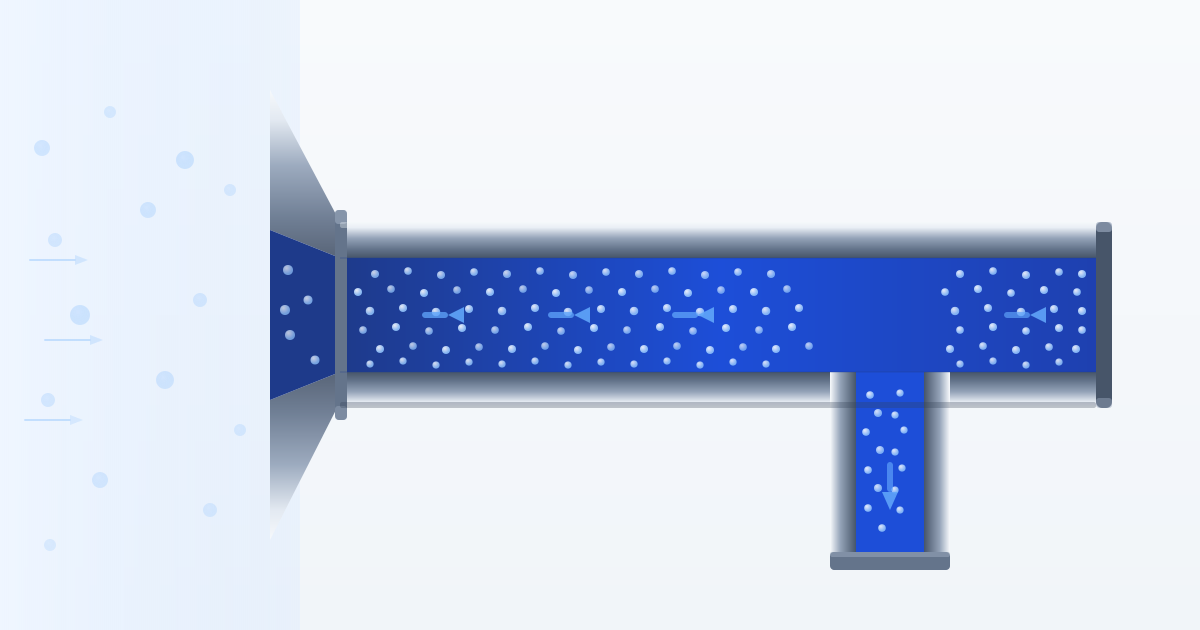
Compressed air flows through pipe at line pressure, not at the atmospheric volume the compressor rating describes. A 100 scfm (47.2 L/s) compressor at 100 psig (6.9 bar) pushes only 12.8% of that volume through the pipe at line conditions — the rest is the compression itself. Sizing pipe on free air delivery without converting to in-line volume overstates velocity and pressure drop by a factor of nearly eight, producing steel four times larger than necessary. The Darcy-Weisbach method with absolute-pressure-ratio correction resolves this: it converts free air delivery to in-line volume, computes in-line density and velocity, and applies the friction equation against two governing limits — velocity for condensate and noise control, pressure drop for continuous energy cost.
Why Compressed Air Pipe Sizing Differs from Water: The Compressibility Correction
Compressed air pipe sizing differs from water pipe sizing in one decisive way: air is compressible, so the volume actually flowing through the pipe at line pressure is a fraction of the free air delivery (FAD) the compressor is rated for. At 100 psig (6.9 bar), in-line air occupies only about 12.8% of its free-air volume, so velocity and pressure drop are far lower than a naive free-air calculation suggests.
A compressor rated at 100 scfm (47.2 L/s) free air delivery — at standard atmospheric pressure — delivers only about 12.8 scfm equivalent in-line volume at 100 psig line pressure. Sizing the pipe on the full 100 scfm without this correction overstates velocity and pressure drop by a factor of 7.8, leading to massively oversized pipe. The calculator converts FAD to in-line volume via the absolute pressure ratio before applying Darcy-Weisbach. This single correction separates compressed air sizing from water distribution design.
The method is Darcy-Weisbach (ΔP = f(L/D)(ρV²/2)) with compressibility correction, the industry standard for pipe friction in both compressible and incompressible flow. Two limits govern: velocity (noise, condensate carryover) and pressure drop (energy cost). Per the Compressed Air Challenge (CAC) Best Practices: distribution mains should target 1-2% maximum pressure drop and 6 m/s (20 ft/s) maximum velocity. Cross-reference the Hazen-Williams article: that article sized pressurized water distribution using the Hazen-Williams C-factor — incompressible, empirical, calibrated for water at normal temperature. This article sizes compressed air distribution using Darcy-Weisbach with the pressure ratio correction — compressible, physics-based, applicable to any gas. Same goal (pipe size from velocity and pressure-drop limits), different fluid physics.
Calculator Inputs: Free Air Delivery, Line Pressure, Length, Velocity and Pressure-Drop Limits
The calculator accepts parameters across two modes synchronized with the deployed calculator fields.
Calculation Mode selects Size Pipe (find recommended nominal size) or Check Existing Pipe (verify adequacy of a known installation).
Unit System selects Imperial (scfm, psig, ft, in) or Metric (L/s, bar, m, mm).
Flow Rate Unit accepts scfm, cfm (local/actual), L/s, m³/min, or m³/h. Compressors are universally rated in scfm or m³/min at standard atmospheric.
scfm Reference Pressure specifies Standard (14.696 psia / 101.325 kPa) or local atmospheric at site elevation. High-altitude plants have lower local atmospheric pressure, reducing P_abs and in-line density.
Flow Rate (FAD) [scfm or L/s] is free air delivery at standard atmospheric, as rated by the compressor nameplate. Typical plant air compressors: 20-2,000 scfm (9.4-944 L/s). Atlas Copco, Ingersoll Rand, Kaeser, Sullair, and Gardner Denver all publish FAD ratings at standard conditions.
Line Pressure (gauge) [psig or bar(g)] is gauge pressure at the pipe inlet. Typical plant air: 90-125 psig (6.2-8.6 bar). The calculator converts to absolute by adding local atmospheric.
Pipe Length (straight) [ft or m] is the straight run; add fitting equivalent length separately via the advanced input.
Pipe Material selects Steel Sch 40 (ASME B36.10M), Steel Sch 80, Copper Type L (ASTM B88), or Stainless Sch 40S. Internal diameter per material and schedule is drawn from the ASME B36.10M pipe dimension table.
Velocity Limit [ft/s or m/s] defaults to 20 ft/s (6 m/s) for distribution mains per CAC Best Practices. Drops to tools permit 30 ft/s (9 m/s).
Pressure Drop Limit Mode selects Absolute (psi or bar) or Percent of line pressure (%). Both are accepted per CAC guidance.
Pressure Drop Limit defaults to 1.5 psi (0.103 bar) absolute or 2%, consistent with CAC distribution main targets.
Equivalent Fitting Length [ft or m] (advanced) adds elbows, tees, and valves converted to equivalent straight length per Crane TP-410. Typical compressed air distribution runs add 20-60% to straight pipe length.
Air Temperature [°F or °C] (advanced) corrects in-line density for elevated temperatures. Default 68°F (20°C); compressed air from an aftercooler typically runs 100-110°F (38-43°C).
Darcy Friction Factor (advanced) defaults to 0.020 for turbulent flow in commercial steel. Range 0.005-0.100; use Moody chart with actual roughness and Reynolds number for precision.
Local Atmospheric Pressure [psia] (advanced) defaults to sea-level 14.696 psia. At 5,000 ft (1,524 m): approximately 12.23 psia, reducing P_abs and slightly increasing in-line volume.
Calculator outputs in Size mode: recommended NPS and material, governing constraint (velocity or pressure drop), actual velocity and pressure drop at the selected size, and the compressibility breakdown. Check mode outputs: velocity, pressure drop, two ratios versus limits, and a four-level verdict (ADEQUATE / AT LIMIT / UNDERSIZED / SIGNIFICANTLY UNDERSIZED).
Free Air Delivery to In-Line Volume: The Pressure Ratio Correction
Free air delivery (FAD) is the volume at atmospheric pressure; in-line volume is what actually flows at line pressure. The conversion is the absolute pressure ratio, and it is the foundation of compressed air pipe sizing.
Q_line = Q_FAD × (P_ref / P_abs) × (T_line / T_ref)

where:
  Q_line = in-line (compressed) flow [m³/s]
  Q_FAD  = free air delivery at reference atmospheric [m³/s]
  P_ref  = reference pressure [101,325 Pa for scfm standard conditions]
  P_abs  = absolute line pressure = P_gauge × 6,894.76 + 101,325 [Pa]
  T_line / T_ref = temperature correction [≈ 1.0 for small differences]
Absolute line pressure:
P_abs = P_gauge + P_atm
Example: 100 psig × 6,894.76 Pa/psi + 101,325 Pa = 789,801 Pa (≈ 114.5 psia)
Pressure ratio (the key compressibility factor):
P_ref / P_abs = 101,325 / 789,801 = 0.1283
In-line volume is 12.83% of free-air volume at 100 psig (6.9 bar)
Worked example matching the calculator:
Q_FAD = 100 scfm × 0.0004719 m³/s per scfm = 0.04719 m³/s
Q_line = 0.04719 × 0.1283 = 0.006054 m³/s (6.054 L/s at line pressure)
The 100 scfm compressor pushes only 0.006054 m³/s through the pipe at 100 psig. Sizing on the full free-air flow (0.04719 m³/s) would oversize by 1 / 0.1283 = 7.8 times. Compressors are rated at standard atmospheric (14.696 psia / 101.325 kPa) because that is the universal reference for FAD comparison across manufacturers. The pipe sees compressed air at line pressure, so the conversion is mandatory before any velocity or pressure-drop calculation.
Temperature correction: hotter air at constant pressure expands, reducing density. At 100°F (38°C) inlet versus 68°F (20°C) reference, the temperature ratio (293/311) = 0.942 reduces in-line volume about 6%. This is significant in some applications but minor compared to the pressure ratio.
Per ideal gas law (PV = nRT) and the FAD definition: convert free air delivery to in-line volume via the absolute pressure ratio before any velocity or pressure-drop calculation. Skipping this step oversizes pipe 8-9 times at typical plant pressures of 90-125 psig (6.2-8.6 bar).
In-Line Air Density and Velocity: Why Compressed Air Moves Slower Than You Think
Compressed air is dense, and its in-line velocity is low because the compressed volume is small. Both in-line density and velocity follow from the same absolute pressure ratio.
In-line density from the ideal gas law:
ρ_line = ρ_ref × (P_abs / P_ref) × (T_ref / T_line)

where:
  ρ_ref = 1.2 kg/m³ at standard conditions (101,325 Pa, 20°C)
Worked: ρ_line = 1.2 × (789,801 / 101,325) = 1.2 × 7.795 = 9.354 kg/m³. Compressed air at 100 psig (6.9 bar) is 7.8 times denser than atmospheric air — 9.354 vs 1.2 kg/m³.
Velocity at the selected pipe bore:
V = Q_line / A_pipe,   where A_pipe = π/4 × D²

Worked at 1½ in Sch 40 (ID 1.610 in = 0.04089 m):
  A = π/4 × 0.04089² = 0.001314 m²
  V = 0.006054 / 0.001314 = 4.61 m/s (15.1 ft/s)
Why velocity is low: the compressed in-line volume (0.006054 m³/s) is small, so even in a 1½ in (40.9 mm) pipe, velocity is only 15.1 ft/s (4.61 m/s) — comfortably under the CAC 20 ft/s (6 m/s) mains limit. Without the compressibility correction, velocity calculated on free air through that same pipe would be 15.1 × 7.8 = 117.8 ft/s (35.9 m/s), pointing to a 4 in pipe. The correction returns the correct 1½ in.
The density-velocity interaction in pressure drop: Darcy-Weisbach depends on ρ × V². At 100 psig, ρ_line is 7.8 times higher than atmospheric but V is 7.8 times lower. The V² term means pressure drop from in-line conditions differs from a naive atmospheric calculation, and the correct approach is always to use in-line ρ and V derived from the pressure-ratio correction.
Per ideal gas and Darcy-Weisbach: in-line density rises with line pressure (9.354 kg/m³ at 100 psig) and in-line velocity falls proportionally. Both derive from the same pressure ratio applied to FAD.
Darcy-Weisbach Pressure Drop for Compressed Air: ΔP = f (L/D)(ρV²/2)
Darcy-Weisbach is the industry-standard friction pressure-drop equation, physics-based and applicable to both compressible and incompressible flow with in-line fluid properties:
ΔP = f × (L_total / D) × (ρ_line × V² / 2)

where:
  f       = Darcy friction factor [dimensionless; 0.020 default, turbulent commercial steel]
  L_total = total equivalent pipe length including fittings [m]
  D       = internal diameter [m]
  ρ_line  = in-line air density at line pressure and temperature [kg/m³]
  V       = in-line velocity [m/s]
Worked example (matching calculator, 100 scfm, 100 psig, 100 ft, 1½ in Sch 40):
ΔP = 0.020 × (30.48 / 0.04089) × (9.354 × 4.61² / 2) = 3,041 Pa = 0.441 psi
The Darcy friction factor: the default 0.020 applies to turbulent flow in commercial steel pipe at typical compressed air Reynolds numbers. For precision, use the Moody chart or Colebrook-White equation with actual pipe roughness and Reynolds number. Absolute roughness for commercial steel: ε ≈ 0.046 mm; for copper: ε ≈ 0.0015 mm. Typical range 0.005-0.100 across all pipe materials and flow regimes.
Why Darcy-Weisbach and not Hazen-Williams for air: Hazen-Williams is an empirical formula calibrated for water at normal temperature in turbulent flow — it requires no fluid properties beyond the C-factor. Darcy-Weisbach is physics-based, using actual fluid density and a friction factor derived from Reynolds number and relative roughness. It applies to any fluid, any temperature, and any flow regime. Cross-reference the Hazen-Williams article: water distribution uses the C-factor (empirical roughness), no density input. Compressed air uses Darcy f with in-line density; there is no equivalent Hazen-Williams formulation for compressible flow.
Total length L_total includes fittings: straight pipe plus equivalent fitting length per Crane TP-410. A 90° standard elbow in 1 in pipe adds approximately 3-4 ft equivalent; a globe valve adds 30-40 ft. Ignoring fitting losses understates ΔP by 20-60% on typical runs.
Fixed-density validity limit: the Darcy calculation above uses fixed in-line density at the inlet conditions. This is accurate when pressure drop is below approximately 10% of absolute line pressure. Above that threshold, density changes significantly along the run and a full compressible-flow analysis (isothermal or adiabatic model) is required.
Per Darcy-Weisbach and the Compressed Air Challenge: ΔP = f(L/D)(ρV²/2) with in-line density and velocity is valid for single-phase compressed air below approximately 10% pressure drop. Above that, use compressible-flow analysis.
The Velocity Limit: 20 ft/s Mains, 30 ft/s Drops, and Condensate Carryover
The velocity limit protects against noise, vibration, and condensate carryover — not pressure loss directly. The standard limit for distribution mains is 20 ft/s (6 m/s); branch drops to tools allow 30 ft/s (9 m/s) per CAC Best Practices.
Velocity-required minimum diameter:
D_vel = √(4 × Q_line / (π × V_limit))

Worked:
  D_vel = √(4 × 0.006054 / (π × 6.096)) = √(0.0012647) = 0.03556 m = 1.40 in (35.6 mm)
Why the velocity limit exists: at velocities above 6 m/s (20 ft/s), fast-moving air picks up liquid condensate droplets and carries them downstream to pneumatic tools and processes. At distribution mains, contamination reaches everything downstream. Below the limit, condensate settles at drip legs, where it can be removed by auto-drains. Noise and pipe vibration increase with velocity and become significant above 6-9 m/s (20-30 ft/s), a concern for facilities with noise regulations per OSHA or local codes.
Velocity limits by application per CAC Best Practices:
- Distribution mains: 20 ft/s (6 m/s) — keep condensate out of the system
- Branch drops to tools: 30 ft/s (9 m/s) — shorter runs, tolerable for intermittent demand
- Continuous high-flow operations: 20 ft/s (6 m/s) applies throughout
Why mains must meet the stricter limit: mains feed the entire system. Condensate carryover from an undersized main contaminates every connected tool and process downstream. ISO 8573 compressed air purity classes for food, pharma, and electronics applications permit condensate concentrations of 0.1-10 mg/m³; exceeding the velocity limit makes achieving these classes without excessive drying difficult.
On short runs (under approximately 100 ft / 30 m), friction loss is small and velocity sets the required pipe size. On long runs, pressure drop accumulates and governs instead. Section 9 covers which constraint dominates for a given application.
Per CAC Best Practices and ISO 8573: limit distribution mains to 6 m/s (20 ft/s). Higher velocity raises noise and carries condensate to tools and processes, degrading air quality and equipment life.
The Pressure-Drop Limit: CAC's 1 to 2 Percent on Mains, 10 Percent Total
The pressure-drop limit is an energy-cost constraint. Every psi of pipe friction must be compensated by running the compressor at higher discharge pressure, which costs energy continuously — 24 hours a day, every day the system operates.
Pressure-drop-required minimum diameter:
D_pres = [8 × f × L_total × ρ_line × Q_line² / (π² × ΔP_limit)]^(1/5)

Worked:
  ΔP_limit = 1.5 psi × 6,894.76 = 10,342 Pa
  D_pres = [8 × 0.020 × 30.48 × 9.354 × 0.006054² / (π² × 10,342)]^0.2
         = [8 × 0.020 × 30.48 × 9.354 × 0.00003665 / 102,095]^0.2
         = [0.000332]^0.2 = 0.02448 m = 0.96 in (24.5 mm)
CAC pressure-drop guidelines per CAC Best Practices for Compressed Air Systems:
- Total system (compressor to point of use): ≤ 10% of gauge pressure
- Distribution mains: ≤ 1-2% of line pressure
- Practical main target: 1.5 psi (0.103 bar) absolute or 2%
Energy cost of pressure drop: a rule of thumb from CAC is that every 2 psi (0.14 bar) of unnecessary pressure drop costs approximately 1% more compressor energy. A distribution main with 5 psi (0.34 bar) of avoidable friction forces the compressor to run at 5 psi higher discharge pressure, adding 2.5% to annual energy cost. For a 50 HP (37 kW) compressor running 6,000 hr/yr at $0.12/kWh, that is approximately $670/yr wasted — every year the undersized pipe remains in service.
Why the main limit is 1-2%: the distribution main is the longest path in the system. Budget the majority of the 10% total allowance for drops, hoses, filters, dryers, and regulators. Mains must absorb minimal pressure loss to leave room for the balance of the system.
Absolute versus percent limits: 1.5 psi absolute is a simple, verifiable target. The 2% percent limit scales with line pressure: at 100 psig, 2% = 2.0 psi; at 125 psig, 2% = 2.5 psi. Both forms are accepted; use whichever matches the system specification.
Per CAC Best Practices and Darcy-Weisbach: total pressure drop ≤ 10% of gauge, mains ≤ 1-2%. Pressure drop is a continuous energy penalty — undersized pipe raises compressor energy every hour the plant runs.
Dual-Constraint Sizing: Velocity-Governed vs Pressure-Drop-Governed
Compressed air pipe must satisfy two independent limits simultaneously. The calculator computes both required diameters and selects the larger; which governs depends on run length, flow rate, and the ratio of the two limits.
D_req = max(D_vel, D_pres)
The next standard nominal size with ID ≥ D_req is selected from the ASME B36.10M table.
Worked example at 100 scfm, 100 psig, 100 ft, velocity limit 20 ft/s (6.096 m/s), ΔP limit 1.5 psi:
D_vel  = 1.40 in (velocity-required)
D_pres = 0.96 in (pressure-drop-required)
D_req  = max(1.40, 0.96) = 1.40 in — velocity-governed
At 100 ft, velocity governs. The pipe is sized by the velocity limit, not pressure drop.
Which constraint governs:
- Short runs (under approximately 100 ft / 30 m): velocity governs. Friction is small; velocity sets the pipe size.
- Long runs (over approximately 200 ft / 60 m): pressure drop governs. Friction accumulates with length; ΔP sets the size.
- The crossover length depends on flow rate, pressure, and the relative values of the two limits.
Why both constraints must be checked: a pipe that meets the velocity limit can still fail the pressure-drop limit on a long run. Checking only velocity misses the governing constraint for long mains, producing undersized pipe and avoidable energy waste.
Worked illustration (same 100 scfm at 500 ft / 152 m instead of 100 ft):
D_pres scales with L^(1/5): 0.96 × (500/100)^0.2 = 0.96 × 1.38 = 1.32 in
D_req = max(1.40, 1.32) = 1.40 in — still velocity-governed
At low flow (100 scfm) and moderate pressure (100 psig), even at 500 ft the velocity limit still governs. Increasing flow to 500 scfm (236 L/s) at 100 ft shifts the balance: D_vel scales with Q^0.5 and D_pres with Q^0.4, so higher flows push pressure-drop-required diameter above velocity-required.
The calculator reports which limit governs. Velocity-governed: you could tolerate higher ΔP without penalty. Pressure-drop-governed: tightening the velocity limit will not help.
Per Darcy-Weisbach and CAC Best Practices: size for the larger of velocity-required and pressure-drop-required diameter. Short runs are typically velocity-governed; long mains are typically pressure-drop-governed.
Size Mode Worked Example: 100 scfm, 100 psig, 100 ft to 1½-Inch Steel
Scenario: plant compressed air distribution main, 100 scfm (47.2 L/s) FAD, 100 psig (6.9 bar) line pressure, 100 ft (30.5 m) straight run, Steel Schedule 40 per ASME B36.10M, Darcy f = 0.020, velocity limit 20 ft/s (6.096 m/s), pressure-drop limit 1.5 psi (0.103 bar).
Step 1. Absolute line pressure.
P_abs = 100 psig × 6,894.76 Pa/psi + 101,325 Pa = 789,801 Pa (≈ 114.5 psia)
Step 2. Compressibility ratio.
P_ref / P_abs = 101,325 / 789,801 = 0.1283
In-line volume is 12.83% of free-air volume.
Step 3. In-line volumetric flow.
Q_FAD = 100 scfm × 0.0004719 m³/s per scfm = 0.04719 m³/s
Q_line = 0.04719 × 0.1283 = 0.006054 m³/s (6.054 L/s at line pressure)
Step 4. In-line density.
ρ_line = 1.2 × (789,801 / 101,325) = 1.2 × 7.795 = 9.354 kg/m³
Step 5. Velocity-required diameter.
V_limit = 20 ft/s = 6.096 m/s
D_vel = √(4 × 0.006054 / (π × 6.096)) = √(0.0012647) = 0.03556 m

Convert: 0.03556 m / 0.0254 = 1.40 in
Step 6. Pressure-drop-required diameter.
ΔP_limit = 1.5 psi × 6,894.76 Pa/psi = 10,342 Pa
L_total = 100 ft × 0.3048 = 30.48 m

D_pres = [8 × 0.020 × 30.48 × 9.354 × 0.006054² / (π² × 10,342)]^0.2
       = [0.000332]^0.2 = 0.02448 m = 0.96 in (24.5 mm)
Step 7. Required diameter.
D_req = max(1.40 in, 0.96 in) = 1.40 in — velocity-governed
Step 8. Select standard pipe from ASME B36.10M.
1 in Sch 40: ID 1.049 in (26.6 mm)  — below 1.40 in
1¼ in Sch 40: ID 1.380 in (35.1 mm) — below 1.40 in
1½ in Sch 40: ID 1.610 in (40.9 mm) — ≥ 1.40 in → selected
Step 9. Verify at 1½ in Sch 40 (ID = 0.04089 m).
A = π/4 × 0.04089² = 0.001314 m²
V = 0.006054 / 0.001314 = 4.61 m/s (15.1 ft/s)  ≤ 20 ft/s ✓

ΔP = 0.020 × (30.48 / 0.04089) × (9.354 × 4.61² / 2) = 3,041 Pa = 0.441 psi  ≤ 1.5 psi ✓
Step 10. Result and economic comparison.
1½ in Steel Sch 40 per ASME B36.10M: V = 15.1 ft/s (4.61 m/s), ΔP = 0.441 psi (3,041 Pa)
Both limits met. Governing: velocity.
ΔP = 0.441 psi = 0.44% of 100 psig — well under CAC 1-2% main target.

Without compressibility correction (sizing on free air directly):
  V_FAD through 1½ in = 35.9 m/s (117.8 ft/s) → would indicate 4 in pipe needed
  Material cost: 1½ in Sch 40 ≈ $8-12/ft installed vs 4 in ≈ $30-45/ft
  Correction saves approximately 70% in pipe material and installation cost for this run.
Cross-reference the Pump Power article: the compressor delivering this 100 scfm at 100 psig is sized by the hydraulic power chain covered there — brake horsepower and motor sizing follow the same FAD and discharge pressure inputs.
Check Mode and Equivalent Fitting Length: Verifying an Existing Line
Check mode computes velocity and pressure drop for an existing pipe diameter and compares each to its limit. It is the standard tool for auditing installed systems before adding load.
Check ratios:
V_ratio   = V / V_limit
ΔP_ratio  = ΔP / ΔP_limit
Governing = max(V_ratio, ΔP_ratio)
Verdict per calculator:
| Governing Ratio | Verdict |
|---|---|
| ≤ 1.00 | ADEQUATE |
| 1.00 - 1.15 | AT LIMIT |
| 1.15 - 1.50 | UNDERSIZED |
| > 1.50 | SIGNIFICANTLY UNDERSIZED |
Worked: existing 1 in Sch 40 carrying 100 scfm at 100 psig, 100 ft straight.
ID = 1.049 in = 0.02664 m
A = π/4 × 0.02664² = 0.000557 m²
V = 0.006054 / 0.000557 = 10.87 m/s (35.7 ft/s)
V_ratio = 35.7 / 20 = 1.78 → SIGNIFICANTLY UNDERSIZED (velocity)
The 1 in pipe runs at 35.7 ft/s — 1.78 times the limit. At that velocity, condensate carries throughout the downstream system. Upgrade to 1½ in.
Equivalent fitting length: real pipe runs include elbows, tees, ball valves, and pressure regulators. Each fitting adds equivalent straight-pipe length per Crane TP-410. Typical equivalent lengths at 1 in nominal pipe: 90° standard elbow ≈ 3-4 ft (0.9-1.2 m); tee through-branch ≈ 7-10 ft (2.1-3.0 m); globe valve ≈ 30-40 ft (9.1-12.2 m). A typical compressed air distribution run adds 20-60% to physical pipe length in equivalent fitting loss. Omitting fitting equivalent length understates pressure drop proportionally and can cause an actually undersized line to pass the check.
Worked with fittings: 100 ft straight + 40% fittings = 140 ft (42.7 m) total equivalent length. At 1½ in selected above: ΔP scales linearly with L_total, giving 0.441 × 1.4 = 0.617 psi — still within the 1.5 psi limit, but 42% higher than the straight-pipe-only result.
When to run Check mode: before adding compressors, tools, or production equipment to an existing compressed air system; whenever an existing line has shown reduced delivery pressure at endpoints; when an energy audit identifies high compressor discharge pressure suggesting excessive distribution losses.
Per Darcy-Weisbach and CAC Best Practices: verify existing compressed air pipe by velocity and pressure-drop ratios including equivalent fitting length. Omitting fittings understates pressure drop by 20-60% on typical plant runs.
Pipe Materials and the Energy Cost of Undersized Air Pipe
Pipe material selection affects internal diameter, air purity classification, and corrosion performance. Undersized pipe carries a continuous energy penalty that typically exceeds material cost savings within one year of operation.
Material options per calculator:
| Material | Standard | Notes |
|---|---|---|
| Steel Sch 40 | ASME B36.10M | Most common for plant mains; carbon steel corrodes |
| Steel Sch 80 | ASME B36.10M | Thicker wall, smaller ID than Sch 40 at same nominal size |
| Copper Type L | ASTM B88 | Food, pharma, clean air; corrosion-resistant |
| Stainless Sch 40S | ASME B36.10M | Corrosive environments; highest air purity |
Aluminum pipe systems (Transair/Parker, Aignep): not in the calculator but widely used in modern plant installations. Smooth bore, modular push-to-connect, lower pressure drop than steel at equivalent nominal size — approximately 40% lower friction for the same bore due to smooth internal surface (Darcy f ≈ 0.012-0.016 vs 0.020 for steel).
Why material affects sizing: the same nominal pipe size has different internal diameters by material and schedule. Steel Sch 80 has a smaller ID than Sch 40 at the same nominal size, producing higher velocity and pressure drop for identical flow. The calculator uses ASME B36.10M and ASTM B88 actual ID tables rather than nominal size.
Energy cost of undersized pipe per CAC Best Practices:
Rule of thumb: every 2 psi (0.14 bar) unnecessary pressure drop ≈ 1% additional compressor energy
Undersized pipe forcing +5 psi higher discharge: ≈ 2.5% energy penalty, 24/7, 365 days
For a 50 HP (37 kW) compressor running 6,000 hr/yr at $0.12/kWh: annual energy ≈ $26,640/yr. A 2.5% penalty from undersized distribution pipe = $666/yr wasted, every year the undersized pipe remains. The pipe upgrade that eliminates this typically costs less than two years of wasted energy.
Air purity per ISO 8573: material selection ties to purity class requirements. Carbon steel internal corrosion produces rust particles; ISO 8573-1 Class 1-2 (food, pharma, electronics) requires clean pipe materials — copper per ASTM B88 or stainless. For general industrial air at Class 3-5, steel is acceptable with adequate filtration downstream.
Per CAC Best Practices and ISO 8573-1: material affects both ID (and therefore sizing) and air purity. Undersized pipe carries an energy penalty; the savings from correct sizing typically exceed the additional pipe material cost within one to two years.
Application Boundaries: Filters and Dryers, Looped Mains, High Pressure Drop, Two-Phase
The calculator sizes single straight pipe runs for steady-state single-phase compressed air below approximately 10% pressure drop. The following applications require separate analysis.
Filters, Dryers, Regulators, Couplers. The calculator covers pipe friction only. Coalescing filters, refrigerated or desiccant dryers, pressure regulators, hose assemblies, and quick-connect couplers each add pressure drop, often larger than the pipe itself at design flow. Add their published ΔP values to the pipe ΔP for the total system budget. A refrigerated dryer at full flow may consume 1-3 psi (0.07-0.21 bar); a coalescing filter, 0.5-1.5 psi (0.03-0.10 bar). These losses push the system toward the 10% total allowance per CAC.
Looped and Branched Mains. The calculator sizes a single pipe run. Looped distribution mains (ring mains) allow air to reach any point from two directions, roughly halving velocity and pressure drop compared to a single-path main for the same total flow. Branched systems require per-branch sizing with flow apportioned by demand at each branch. Both require network analysis beyond the single-run model.
High Pressure Drop (above 10% of line pressure). Fixed-density Darcy-Weisbach assumes density is constant along the pipe. When ΔP exceeds approximately 10% of absolute line pressure (14.5 psi at 100 psig), density varies significantly from inlet to outlet and a full compressible-flow analysis is required. For plant air distribution designed to the 1-2% CAC target, this limit is not a concern; it applies to long, undersized runs or high-pressure gas systems.
Two-Phase and Condensation. The calculator assumes single-phase dry gas. Moisture condensation, oil carryover from an inadequate separator, and two-phase slug flow are outside the calculator scope. Proper air treatment — refrigerated or desiccant drying, coalescing filtration — is required before the sizing model applies.
Transient and Surge. Sudden pneumatic tool demand, valve closure, and receiver charging create transients. The calculator is steady-state; transient analysis is separate.
Friction Factor Precision. The default f = 0.020 suits typical turbulent steel at Reynolds numbers common in compressed air distribution (Re ≈ 100,000-1,000,000). For smooth aluminum bore or precision work, compute f from the Moody chart using actual pipe roughness and Reynolds number via Colebrook-White.
Per Darcy-Weisbach, CAC Best Practices, and ISO 8573: single straight-run pipe friction below 10% pressure drop is the calculator scope. Filters and dryers, looped networks, high pressure drop, two-phase flow, transients, and compressor sizing all require separate analysis.
Compressed Air Pipe Sizing Calculator
Compressed air pipe sizing per Darcy-Weisbach with FAD compressibility correction: converts free air delivery to in-line volume via the absolute pressure ratio, computes in-line density and velocity, and applies Darcy-Weisbach for pressure drop. Size mode selects the smallest standard pipe satisfying both the velocity limit (default 6 m/s / 20 ft/s) and the pressure-drop limit (default 1.5 psi or 2%), reporting the governing constraint and actual values at the selected size. Check mode verifies an existing pipe with velocity and pressure-drop ratios against user-defined limits. Covers Steel Sch 40 and 80 (ASME B36.10M), Copper Type L (ASTM B88), and Stainless Sch 40S from ½ in to 12 in nominal.
Open Compressed Air Pipe Sizing CalculatorFAQ
Why does compressed air pipe sizing need a compressibility correction?
Per ideal gas law and the FAD definition: compressed air at line pressure occupies a fraction of its free-air volume. At 100 psig (6.9 bar), in-line volume is 12.83% of the free-air (FAD) volume — a pressure ratio of 0.1283. Sizing pipe on the full free-air volume without this correction overstates velocity and pressure drop by a factor of 7.8, leading to pipe that is 4 times larger than needed. The absolute pressure ratio (P_ref / P_abs) converts FAD to in-line flow before any velocity or friction calculation.
What pressure drop should I target for compressed air distribution mains?
Per the Compressed Air Challenge Best Practices: total system pressure drop from compressor to point of use should not exceed 10% of gauge line pressure. Distribution mains specifically should be held to 1-2%. A practical target is 1.5 psi (0.103 bar) absolute or 2% of line pressure on the main. Every 2 psi of avoidable pressure drop costs approximately 1% more compressor energy, running continuously; undersized mains are a recurring energy penalty, not a one-time cost.
What velocity limit applies to compressed air distribution pipe?
Per CAC Best Practices: 6 m/s (20 ft/s) for distribution mains and 9 m/s (30 ft/s) for branch drops to tools. The mains limit is stricter because high velocity carries condensate droplets throughout the system, contaminating downstream processes and tools. At or above 9 m/s, ISO 8573 purity targets for moisture content become difficult to maintain without oversized dryers. For continuous-flow applications, apply the 6 m/s limit throughout.
Why use Darcy-Weisbach instead of Hazen-Williams for compressed air?
Per Darcy-Weisbach and Crane TP-410: Darcy-Weisbach is physics-based, using actual fluid density and a friction factor derived from Reynolds number and pipe roughness. It applies to any fluid including compressible gases. Hazen-Williams is empirical, calibrated for water at approximately 60°F (15.6°C) in turbulent flow — it has no density or viscosity input and cannot represent compressible flow. As the cross-reference Hazen-Williams article shows, water pipe sizing uses the C-factor; compressed air sizing requires in-line density and Darcy f. Applying Hazen-Williams to compressed air gives meaningless results.
How much does in-line volume shrink at line pressure?
Per ideal gas law: at 100 psig (6.9 bar) line pressure, in-line volume is 12.83% of free-air volume — a 7.8 reduction. At 125 psig (8.6 bar): P_abs = 963,000 Pa; pressure ratio = 101,325 / 963,000 = 0.1052; in-line volume is 10.52% of free air, a 9.5 reduction. Higher line pressure compresses more, reducing in-line volume further. A 100 scfm (47.2 L/s) compressor delivers 12.83 scfm (6.05 L/s) at 100 psig or 10.52 scfm (4.97 L/s) at 125 psig in-line.
How do I account for elbows and valves in compressed air piping?
Per Crane TP-410 pipe friction practice: convert each fitting to equivalent straight-pipe length and add to physical pipe length before applying Darcy-Weisbach. Representative equivalent lengths at 1 in nominal: 90° standard elbow ≈ 3-4 ft (0.9-1.2 m); tee through-branch ≈ 7-10 ft (2.1-3.0 m); globe valve (fully open) ≈ 30-40 ft (9.1-12.2 m); ball valve (full port) ≈ 0.5-1 ft (0.15-0.30 m). Typical plant air distribution runs add 20-60% to straight pipe length from fittings. Omitting fitting losses understates pressure drop by that same 20-60% and can pass an actually undersized line.
Does undersized compressed air pipe waste energy?
Per CAC Best Practices: yes, significantly and continuously. Every 2 psi (0.14 bar) of unnecessary distribution pressure drop requires the compressor to run at 2 psi higher discharge to deliver the same end pressure, costing approximately 1% more compressor energy. A 50 HP (37 kW) compressor running 6,000 hr/yr at $0.12/kWh costs approximately $26,640/yr. Undersized pipe adding 5 psi avoidable drop costs $666/yr in wasted energy. Upgrading the pipe eliminates that penalty; the material and installation cost typically pays back within one to two years for a continuously running plant air system.
Related Calculators
- Hazen-Williams Pipe Flow Calculator: Pressurized water distribution per AWWA M22 and IPC Section 604 using the Hazen-Williams C-factor — the incompressible-flow counterpart to Darcy-Weisbach for compressed air (article)
- Pump Power Calculator: Hydraulic, brake, and motor power per Hydraulic Institute; sizes the compressor driver delivering the free air to this pipe (article)
- Fire Pump Performance Curve Calculator: NFPA 20 curve acceptance; dry-pipe fire suppression systems use compressed air supervisory pressure on the pipe network (article)
- Pipe Slope Calculator: Gravity drainage slope per IPC Section 704 and Manning's equation; condensate drainage from compressed air mains requires slope to drip legs (article)
- Expansion Tank Sizing Calculator: Thermal expansion control per IPC Section 607.3 (article)
- Water Heater Sizing Calculator: First-hour rating per DOE 10 CFR 430 (article)
- Grease Trap Sizing Calculator: Commercial kitchen FOG management per PDI G101 (article)