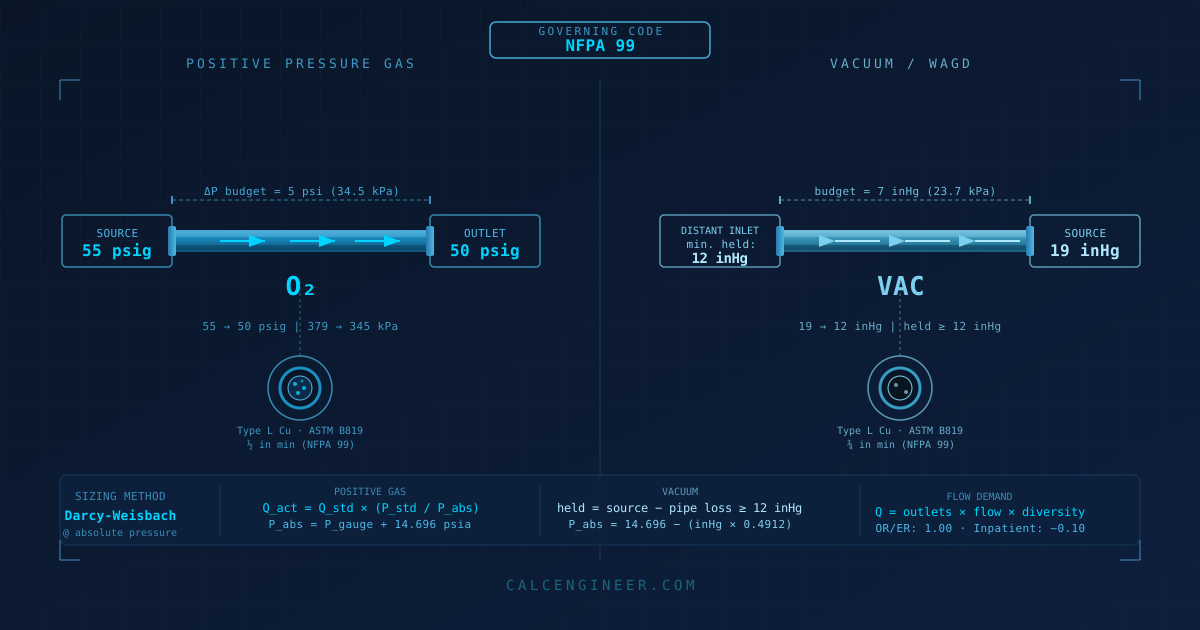
Medical gas pipe sizing occupies a distinct niche in healthcare mechanical engineering: the gas is compressible like shop air, but it carries oxygen and medical gases for patient care under NFPA 99 (Health Care Facilities Code), a life-safety standard that imposes minimum pipe sizes, operating pressures, and installation requirements that industrial compressed air distribution does not share. The sizing method is recognized engineering practice, not a table in the code — flow demand scaled by area diversity, converted to actual flow at absolute line pressure, then sized by Darcy-Weisbach against a 5 psi (34.5 kPa) pressure-drop budget for positive gases and a held-vacuum criterion for suction lines. NFPA 99 minimum sizes and ASTM B819 oxygen-cleaned copper define the material floor.
Why NFPA 99 Governs Medical Gas but Does Not Size the Pipe
NFPA 99, the Health Care Facilities Code, governs medical gas materials, installation, minimum sizes, operating pressures, and testing, but it contains no pipe-sizing table. The actual size comes from recognized engineering practice based on flow demand, diversity, allowable pressure drop, and equivalent length: the same friction-loss physics used for any compressible-gas pipe, applied within NFPA 99 limits.
This distinction matters because engineers new to medical gas often search NFPA 99 for a sizing chart and find none. NFPA 99 sets the floor: ½-in (12.7 mm) minimum for mains and branches, ¾-in (19.1 mm) for vacuum, operating pressures of 50 psig (345 kPa) delivery for most gases and 55 psig (379 kPa) source, and the test criteria. Sizing follows the same Darcy-Weisbach compressible-flow method used for compressed air (cross-reference the Compressed Air Pipe Sizing article), applied within those code limits. The calculator applies that practice and enforces NFPA 99 minimums as hard limits, but it is a design screen, not a code-compliance verdict.
Two honesty statements apply to every result from this calculator. NFPA 99 governs installation, materials, and testing but does not specify the sizing method; the adopted edition of NFPA 99, the project specifications, and the engineer of record govern. Medical gas design is a life-safety discipline: final design must be prepared and reviewed by a qualified medical gas designer or engineer (ASSE 6010 personnel) and verified by required NFPA 99 testing before the system serves patients. The calculator provides a sound engineering screen, not a stamped design.
Calculator Inputs: System Type, Gas, Segment, Demand, Length, Pressures
The calculator begins with Unit System: US (SCFM, psig, inHg, ft, in) or Metric (NL/min, kPa, m, mm).
System Type selects Positive-Pressure Gas (oxygen, medical air, nitrous oxide, CO₂, nitrogen, instrument air) or Vacuum/WAGD. These are physically distinct systems that never share outlets or piping.
Gas sets default operating pressures, gas density, viscosity, and per-outlet flow. Most positive gases deliver at 50 psig (345 kPa) from a 55 psig (379 kPa) source. Instrument air delivers at 175 psig (1,207 kPa) from a 190 psig (1,310 kPa) source. Gas selection drives the absolute-pressure calculation in the Darcy equation.
Segment Type selects Main/Branch (½-in minimum), Outlet Drop to Individual Inlet (½-in minimum), or Vacuum/WAGD Branch (¾-in minimum). This controls which NFPA 99 minimum size applies as the code floor.
Demand Basis accepts Direct Design Flow or Build from Outlets and Diversity. The second mode multiplies outlet count by per-outlet flow by area diversity factor to produce the design flow.
Design Flow is the segment design flow in SCFM (or NL/min). Example: 4 OR oxygen outlets at 1.0 SCFM each with OR diversity 1.00 yields 4.0 SCFM (113.3 NL/min).
Length Basis selects Actual Run times Factor (default 1.50) or Direct Equivalent Length from a detailed fitting takeoff.
Actual Run Length in ft (or m) is the measured pipe centerline from segment start to end.
Equivalent-Length Factor defaults to 1.50 (50% fitting allowance). Typical range: 1.30 to 2.00. A route with many elbows and tees may warrant 1.75 or higher.
Source Pressure is the segment start pressure: 55 psig (379 kPa) for oxygen and most positive gases, 190 psig (1,310 kPa) for instrument air. For vacuum, the source vacuum level in inHg or kPa is entered separately.
Delivery Pressure is the required pressure at the segment end: 50 psig (345 kPa) for oxygen. The difference source minus delivery is the allowable pressure-drop budget.
Vacuum Pressures set source vacuum (typically 19 inHg, 64.3 kPa gauge) and minimum required vacuum at the most distant inlet (12 inHg, 40.6 kPa gauge). The budget is 7 inHg (23.7 kPa).
Candidate Pipe Size (optional) accepts a specific Type L nominal size. If provided, the calculator returns a pass/fail verdict. If blank, it returns the required size.
Calculator outputs include: Required Size (hydraulic result, code minimum, selected), Driven-to-Min badge when the code floor governs, pressure drop per 100 ft (or held vacuum), four-level verdict (COMPUTED / ADEQUATE / UNDERSIZED / AT LIMIT), and a transparency block showing standard flow, actual flow, absolute pressure, gas density, velocity, Reynolds number, and Darcy friction factor.
The calculator does not size source equipment, compressors, vacuum pumps, or receivers; does not cover NFPA 99 verification testing; does not address oxygen cleaning, brazing, or purge procedures; does not evaluate valves or alarm panels; and handles one segment, not a full multi-branch network.
Flow Demand and Diversity: Connected Load Times the Area Factor
The design flow is the connected outlet load scaled by a diversity factor that reflects how many outlets realistically operate at once.
Connected load = outlets × per-outlet flow   [SCFM or NL/min]
Design flow    = connected load × diversity factor

Diversity by area type:
  Operating room, ER, critical care: 1.00 (no diversity; all outlets can run simultaneously)
  General inpatient (patient rooms):  ~0.10 (illustrative; confirm against project demand basis)
Per-outlet flow by gas and area type (typical values): oxygen approximately 1.0 SCFM (28.3 NL/min) per OR outlet; medical-surgical vacuum approximately 3.0 SCFM (85.0 NL/min) per inlet. Confirm with project specifications and the clinical demand basis for the facility before finalizing.
A critical error in medical gas sizing is using the 6 SCFM (170 NL/min) 3-second outlet test criterion from NFPA 99 as a per-outlet design flow. That figure is a verification test parameter: a transient flow test applied to the installed outlet before commissioning, not a steady-state demand. Using it as design flow massively oversizes the pipe. Per NFPA 99 and recognized practice, design flow comes from connected outlet load times the area diversity factor.
Worked illustration:
OR oxygen branch:
  4 outlets × 1.0 SCFM × 1.00 (OR diversity) = 4.0 SCFM (113.3 NL/min)

General inpatient comparison:
  40 outlets × 1.0 SCFM × 0.10 (inpatient diversity) = 4.0 SCFM (113.3 NL/min)
  (10 times the outlets, same design flow: diversity is 10 times lower)
Standard vs actual flow: outlet ratings are standard flow (SCFM at standard atmospheric conditions, 14.696 psia / 101.3 kPa). The Darcy equation uses actual flow at line pressure, which is compressed for positive gases and rarefied for vacuum. That conversion is the subject of Section 6.
Equivalent Length and the Allowable Pressure-Drop Budget
Fittings add resistance beyond the straight run, captured as equivalent length, and the source-to-delivery pressure difference is the budget spread over that total length.
L_equiv = L_actual × 1.50   (50% fitting allowance; 1.30-2.00 typical)
Example: 60 ft (18.3 m) × 1.50 = 90 ft (27.4 m) equivalent length

ΔP_allow = P_source - P_delivery
Example (oxygen): 55 - 50 = 5 psi (34.5 kPa) total budget

Allowable rate = ΔP_allow / (L_equiv / 100)
               = 5 / (90 / 100) = 5.56 psi/100 ft (1.27 kPa/m)
Both constraints must be met: the per-100-ft pressure-drop rate must not exceed the allowable rate, and the total pressure drop across the segment must not exceed the budget (5 psi for oxygen and most positive gases). On long runs the total governs; on short low-flow runs, the NFPA 99 code floor typically governs before hydraulics do.
Pressure budgets by gas system per NFPA 99 and recognized practice: oxygen, medical air, nitrous oxide, CO₂, and nitrogen use a 5 psi (34.5 kPa) budget (55 minus 50 psig). Instrument air uses 15 psi (103 kPa) (190 minus 175 psig). Vacuum budget: 19 inHg source less 12 inHg minimum equals 7 inHg (23.7 kPa) available for pipe friction.
Compressible-Gas Pressure Drop: Darcy-Weisbach at Absolute Pressure
Medical gas is compressible, so pressure drop uses Darcy-Weisbach with density and velocity evaluated at the average absolute line pressure, not gauge.
Gauge to absolute conversion:
Positive gas: P_abs = P_gauge + 14.696 psia
  Oxygen source: 55 psig + 14.696 = 69.70 psia (480.6 kPa abs)

Vacuum: P_abs = 14.696 - (vacuum_inHg × 0.4912)
  19 inHg vacuum: P_abs = 14.696 - (19 × 0.4912) = 14.696 - 9.333 = 5.36 psia (37.0 kPa abs)
Average absolute pressure, gas density, and actual flow:
P_avg    = (P_in_abs + P_out_abs) / 2
ρ_line   = ρ_std × (P_avg / P_std)        [gas profile at standard conditions]
Q_act    = Q_std × (P_std / P_avg)        [standard to actual volume]

Oxygen at 55 psig source (P_avg ≈ 69.70 psia):
  Q_act = 4.0 SCFM × (14.696 / 69.70) = 0.84 ACFM (23.9 L/min actual)
  The compressed gas flows at 21% of its standard volume.
Darcy-Weisbach equation:
V     = Q_act / A          [A = π/4 × ID², actual bore per ASTM B819]
Re    = ρ_line × V × ID / μ
f     = Darcy friction factor (Swamee-Jain, copper roughness ε = 1.5 µm)
ΔP/L  = f × (1/ID) × (ρ_line × V² / 2)
Critical distinction: the Darcy friction factor equals 4 times the Fanning friction factor. Mixing them introduces a 4× error in computed pressure drop. The calculator uses the Darcy factor (not Fanning) throughout.
Why absolute pressure matters: gas density is proportional to absolute pressure, not gauge. Feeding the gauge value (55) instead of absolute (69.70) into density calculation underestimates density by 32%, making velocity and pressure drop incorrect. For vacuum, the absolute pressure is below atmospheric, so gas density is far lower than standard and actual volume is far larger than standard flow suggests. Cross-reference the Compressed Air Pipe Sizing article: same Darcy compressible method used for shop air (FAD to in-line volume via pressure ratio). Medical gas adds diversity factors, NFPA 99 minimums, and the vacuum inversion to those same physics.
NFPA 99 Minimum Sizes: When the Code Floor Governs, Not Hydraulics
NFPA 99 sets minimum pipe sizes that override hydraulics. On short, low-flow segments, friction loss allows a smaller pipe than code permits, and the calculator flags this as driven-to-min.
Per NFPA 99:
  Main / branch:           ½ in (12.7 mm) minimum
  Outlet drop to inlet:    ½ in (12.7 mm) minimum
  Vacuum / WAGD piping:    ¾ in (19.1 mm) minimum
The calculator produces three sizing values:
Hydraulic required = smallest Type L where ΔP/100 ≤ allowable rate AND total ΔP ≤ budget
Profile minimum    = ½ in (main/branch/drop) or ¾ in (vacuum)
Selected required  = max(hydraulic, profile minimum)
When the hydraulic result is smaller than the profile minimum, the NFPA 99 floor governs and the calculator shows "DRIVEN TO MIN SIZE." For a 4-outlet oxygen branch at 4.0 SCFM (113.3 NL/min) over 90 equivalent ft (27.4 m), friction loss in ½-in pipe is well within the 5 psi (34.5 kPa) budget, so hydraulics alone would allow a sub-½-in tube. NFPA 99 requires ½ in minimum for a branch, so the selected size is ½ in: driven to the code floor.
NFPA 99 minimums exist to ensure mechanical robustness, cleaning access, future capacity, and consistent installation in a life-safety gas system. A pipe that is hydraulically sufficient but thinner than the code floor is not acceptable regardless of how well the friction numbers work out. Vacuum piping carries the ¾-in (19.1 mm) minimum because its rarefied gas expands to a much larger actual volume, requiring more cross-sectional area even for modest standard-flow demands.
Positive Pressure vs Vacuum: Two Sizing Problems, One System
Positive-pressure gas and vacuum are sized by opposite physical criteria. Positive gas is sized so pressure drop stays within budget; vacuum is sized so held vacuum stays above the minimum at the most distant inlet.
Positive-pressure sizing:
P_source = 55 psig (379 kPa); P_delivery = 50 psig (345 kPa)
Budget: 5 psi (34.5 kPa) across the segment
Gas is compressed (dense); actual volume << standard volume
Criterion: total ΔP ≤ 5 psi (34.5 kPa)
Vacuum sizing:
Source vacuum: 19 inHg (64.3 kPa); Minimum at distant inlet: 12 inHg (40.6 kPa)
Budget: 7 inHg (23.7 kPa) for pipe friction
Gas is rarefied (below atmospheric); actual volume >> standard volume
Criterion: held_vacuum = source_vacuum - pipe_loss ≥ 12 inHg (40.6 kPa)
Why vacuum needs larger pipe: at 19 inHg (5.36 psia / 37.0 kPa abs), gas density is only 36% of standard atmospheric density. For 3.0 SCFM (85.0 NL/min) design flow, the actual volume in a vacuum line is 8.23 ACFM (233.0 L/min), versus 0.84 ACFM (23.9 L/min) for the same 4.0 SCFM in an oxygen branch at 55 psig. Higher actual volume drives higher velocity and greater friction loss at any given pipe size, explaining both the ¾-in (19.1 mm) minimum and the tendency for vacuum branches to be hydraulically sized above that floor.
WAGD (Waste Anesthetic Gas Disposal) scavenges anesthetic agents from operating rooms. It is a vacuum sub-system sized by the same held-vacuum criterion and minimum pipe sizes as medical-surgical vacuum.
Oxygen-Cleaned Type L Copper per ASTM B819
Medical gas piping is a regulated component: oxygen-cleaned seamless Type L (or Type K) copper tube to ASTM B819, not ordinary plumbing or refrigeration copper.
ASTM B819 Type L seamless copper, actual inside diameters:
  ½ in nominal:   0.545 in (13.84 mm)
  ¾ in nominal:   0.785 in (19.94 mm)
  1 in nominal:   1.025 in (26.04 mm)
  1¼ in nominal:  1.265 in (32.13 mm)
  1½ in nominal:  1.505 in (38.23 mm)
  2 in nominal:   1.985 in (50.42 mm)
Oxygen systems require hydrocarbon-free internal surfaces because oil or grease in high-oxygen concentration presents an ignition hazard. CGA G-4.1 governs oxygen cleaning. Ordinary copper tube carries manufacturing oils and is not acceptable for oxygen-cleaned service.
ASTM B819 medical gas tube is distinct from ASTM B88 plumbing copper (covered in the Hanger Load and Pipe Support Spacing articles) and from refrigeration copper. Medical gas tube ships with capped ends, cleaning certification, and traceability. Substituting uncertified tube is an NFPA 99 installation violation.
Friction calculations must use the actual bore from ASTM B819, not the nominal size. Using nominal dimensions underestimates the bore and overstates velocity and pressure drop: ½-in nominal has an actual ID of 0.545 in (13.84 mm), not 0.500 in (12.70 mm). Joints are brazed under a continuous nitrogen purge per NFPA 99 to prevent internal oxide scale that would contaminate the gas stream: an installation requirement separate from pipe sizing.
Positive-Pressure Worked Example: Four-Outlet Oxygen Branch to Half-Inch
Scenario: Oxygen branch serving 4 operating-room outlets, 60 ft (18.3 m) straight run, source 55 psig (379 kPa), delivery 50 psig (345 kPa), OR diversity 1.00. Matches Calculator Example 1.
Step 1. Connected load and design flow:
Connected load = 4 outlets × 1.0 SCFM = 4.0 SCFM (113.3 NL/min)
Design flow    = 4.0 SCFM × 1.00 (OR diversity) = 4.0 SCFM (113.3 NL/min)
Step 2. Equivalent length:
L_equiv = 60 ft × 1.50 = 90 ft (27.4 m)
Step 3. Allowable pressure drop:
ΔP_allow = 55 - 50 = 5 psi (34.5 kPa)
Allowable rate = 5 / (90 / 100) = 5.56 psi/100 ft (1.27 kPa/m)
Total cap: actual ΔP ≤ 5 psi (34.5 kPa)
Step 4. Absolute line pressure:
P_abs = 55 + 14.696 = 69.70 psia (480.6 kPa abs)
Step 5. Actual flow at line pressure (compressed):
Q_act = 4.0 SCFM × (14.696 / 69.70) = 0.84 ACFM (23.9 L/min actual)
The gas is compressed to 21% of its standard volume at this line pressure.
Step 6. Hydraulic size at 0.84 ACFM (23.9 L/min) actual flow:
At 0.84 ACFM through ½-in Type L (ID 0.545 in / 13.84 mm):
Friction loss is well within the 5.56 psi/100 ft allowable rate.
Hydraulic required: below ½ in.
Step 7. NFPA 99 minimum:
Segment type: branch. Profile minimum = ½ in (12.7 mm) per NFPA 99.
Step 8. Selected size:
Selected = max(hydraulic below ½ in, minimum ½ in) = ½ in Type L
Result: DRIVEN TO MIN SIZE (NFPA 99 code floor governs; hydraulics are not the constraint)
Step 9. Interpretation: at 4.0 SCFM (113.3 NL/min) over 90 equivalent ft (27.4 m), even ½-in pipe loses far less than 5 psi (34.5 kPa). Pressure drop is not the binding constraint. The branch minimum in NFPA 99 governs. A main supplying several OR branches would carry higher aggregate diversified flow, and hydraulics would drive the size above the ½-in floor.
Step 10. Result: ½ in Type L oxygen-cleaned copper per ASTM B819, driven to NFPA 99 branch minimum. Pressure drop within 5 psi budget with margin. A qualified medical gas designer (ASSE 6010) must prepare and review the final design, verified by required NFPA 99 testing before patient use.
Vacuum Worked Example: Medical-Surgical Branch and Held Vacuum
Scenario: Medical-surgical vacuum branch, 3.0 SCFM (85.0 NL/min) design flow, 60 ft (18.3 m) straight run, source 19 inHg (64.3 kPa), minimum 12 inHg (40.6 kPa) at the most distant inlet. Matches Calculator Example 2.
Step 1. Vacuum budget:
Budget = 19 - 12 = 7 inHg (23.7 kPa) available for pipe friction
Step 2. Source absolute pressure:
P_abs = 14.696 - (19 × 0.4912) = 14.696 - 9.333 = 5.36 psia (37.0 kPa abs)
At 5.36 psia, gas density is 36% of standard atmospheric density.
Step 3. Design flow:
3.0 SCFM (85.0 NL/min) at standard conditions.
Step 4. Equivalent length:
L_equiv = 60 ft × 1.50 = 90 ft (27.4 m)
Step 5. Actual flow at vacuum pressure (rarefied):
Q_act = 3.0 SCFM × (14.696 / 5.36) = 8.23 ACFM (233.0 L/min actual)
The rarefied gas expands to 2.74 times its standard volume at this vacuum level.
Step 6. Why vacuum needs ¾ in: at 8.23 ACFM (233.0 L/min) actual flow, velocity and friction in ½-in tube would be excessive. NFPA 99 sets a ¾-in (19.1 mm) minimum for vacuum; hydraulics often drive the size further above that floor on longer or higher-flow branches.
Step 7. Held vacuum check (two outcomes):
If pipe friction loss = 4 inHg (13.5 kPa):
  held_vacuum = 19 - 4 = 15 inHg (50.8 kPa) ≥ 12 inHg → ADEQUATE

If pipe friction loss = 8 inHg (27.1 kPa):
  held_vacuum = 19 - 8 = 11 inHg (37.3 kPa) < 12 inHg → UNDERSIZED
Step 8. Sizing logic: select the smallest Type L size of ¾ in or larger where held vacuum at the most distant inlet reaches or exceeds 12 inHg (40.6 kPa). The most distant inlet governs, just as the most remote outlet governs in positive-gas sizing.
Step 9. Interpretation: vacuum sizing is the inverse of positive-gas sizing. Instead of limiting pressure drop from source to outlet, the criterion ensures that available vacuum at the patient inlet stays above the clinical minimum of 12 inHg. The 2.74 ratio of actual to standard volume is the physical driver: the same design flow that fits ½-in pipe at 55 psig needs ¾-in or larger at 19 inHg vacuum.
Step 10. Result: ¾ in or larger Type L oxygen-cleaned copper per ASTM B819, sized so held vacuum at the most distant inlet is at or above 12 inHg (40.6 kPa). WAGD branches use the same criterion. A qualified designer (ASSE 6010) governs; NFPA 99 verification testing is required before patient use.
Sizing Segment by Segment: Why the Whole Hospital Is Not One Calculation
A medical gas system is a branching tree, and each segment is sized for the flow downstream of it, not the whole-facility demand. Sizing starts at the most remote run and works back toward the source.
Each segment carries only its downstream design flow:
Outlet drop: 1 outlet × 1.0 SCFM = 1.0 SCFM (28.3 NL/min), ½-in minimum
OR branch:   4 outlets × 1.0 × 1.00 (OR diversity) = 4.0 SCFM (113.3 NL/min)
Floor main:  5 OR branches × 4.0 SCFM × applicable building diversity (aggregated)
Riser:       all floors aggregated with full-building diversity
Sizing one segment for total hospital demand massively oversizes branches. The remote branch serving 4 OR outlets sees 4.0 SCFM (113.3 NL/min); the riser feeding all ORs sees the diversified aggregate of many branches. Each level of the tree applies its own diversity factor appropriate to the simultaneous-use probability at that level.
The most-remote-run method applies: identify the path from the source to the most hydraulically demanding outlet (highest flow demand and greatest equivalent length), size that path first to just meet the delivery pressure at the far end, then size feeding mains for the diversified aggregate they carry. Outlets nearer to the source have pressure margin to spare.
The calculator sizes one segment. A complete network requires each segment to be sized separately, starting from the remote ends and working toward the source. Per recognized practice and the Compressed Air parallel: segment-by-segment sizing with diversity applied at each branch level, most-remote path first, is the standard method for medical gas pipe networks.
Application Boundaries: Source Equipment, Verification Testing, Network Analysis
The calculator sizes one copper pipe segment (positive gas or vacuum) using recognized engineering practice within NFPA 99 limits. The following are outside its scope and require separate qualified analysis.
Source and supply equipment. The calculator does not size manifolds, bulk oxygen storage, reserve supply, medical air compressors, dryers, vacuum pumps, or receivers. Source equipment sizing follows separate NFPA 99 provisions.
Verification testing. NFPA 99 requires extensive installed-system testing before patient use: cross-connection tests, standing-pressure tests, outlet flow-velocity tests (the 6 SCFM / 3-second criterion), labeling, and verifier sign-off per ASSE 6030. The calculator does not perform any of these.
Oxygen cleaning and brazing. Oxygen cleaning per CGA G-4.1 and brazing under continuous nitrogen purge per NFPA 99 are installation requirements separate from sizing. The calculator assumes properly specified ASTM B819 tube with qualified installation.
Valves, alarms, and zone equipment. Zone valves, area alarm panels, master alarm panels, pressure switches, and vacuum switches are NFPA 99 components that require separate attention.
System and risk category. NFPA 99 risk assessment and system category (Categories 1 through 4) drive facility-specific requirements beyond pipe sizing.
Multi-branch network. The calculator sizes one segment. Full longest-run network analysis requires each segment to be sized independently; the calculator supports that process one segment at a time.
Non-US jurisdictions. ISO 7396-1 covers international medical gas pipeline systems; UK HTM 02-01 and Canada CSA Z7396.1 have jurisdiction-specific requirements differing from NFPA 99. This calculator is US/NFPA 99 basis (v1).
Pipe support and seismic bracing. Support spacing and seismic restraint for medical gas copper piping follow general pipe support principles. Cross-reference the Hanger Load Calculator, Pipe Support Spacing Calculator, and Pipe Seismic Bracing Calculator. ASCE 7 is the seismic design basis for medical gas piping per NFPA 99.
Per NFPA 99 and recognized practice: single-segment Type L sizing within NFPA 99 minimums is the calculator scope. A qualified medical gas designer or engineer (ASSE 6010) must prepare and review the final design; an ASSE 6030 verifier must conduct required testing before patient use.
Medical Gas Pipe Sizing Calculator
Medical gas pipe sizing by recognized engineering practice within NFPA 99 limits: builds design flow from outlet count, per-outlet flow, and area diversity; applies the equivalent-length pressure-drop budget; and solves Darcy-Weisbach at average absolute pressure for compressible gas. Positive-pressure gases (oxygen, medical air, nitrous oxide, instrument air) are sized by pressure-drop budget; vacuum and WAGD by held vacuum above 12 inHg (40.6 kPa). Enforces NFPA 99 minimum sizes (½-in positive, ¾-in vacuum) and Type L copper per ASTM B819. NFPA 99 governs installation and testing; recognized engineering practice governs sizing; a qualified designer governs the final design.
Open Medical Gas Pipe Sizing CalculatorFAQ
Does NFPA 99 give a pipe-sizing table?
Per NFPA 99: no. The Health Care Facilities Code governs medical gas materials, installation, minimum sizes, operating pressures, and testing requirements, but it contains no pipe-sizing table or sizing procedure. Pipe sizing follows recognized engineering practice: flow demand times diversity, converted to actual flow at absolute line pressure, and sized by Darcy-Weisbach within the NFPA 99 pressure budget and minimum sizes.
What pressures do medical gas systems operate at?
Per NFPA 99 and recognized practice: most positive gases (oxygen, medical air, nitrous oxide, CO₂, nitrogen) deliver at approximately 50 psig (345 kPa) from a 55 psig (379 kPa) source, leaving a 5 psi (34.5 kPa) pipe-friction budget. Instrument air delivers at 175 psig (1,207 kPa) from 190 psig (1,310 kPa). Medical-surgical vacuum must hold at least 12 inHg (40.6 kPa) at the most distant inlet; source vacuum is typically 19 inHg (64.3 kPa), leaving a 7 inHg (23.7 kPa) budget.
What is the minimum medical gas pipe size per NFPA 99?
Per NFPA 99: ½ in (12.7 mm) for mains, branches, and outlet drops to individual inlets; ¾ in (19.1 mm) for vacuum and WAGD piping. On short low-flow runs, friction loss may allow a smaller pipe hydraulically, but the NFPA 99 floor governs. The calculator reports this as driven-to-min and shows that the code minimum, not hydraulics, determines the selected size.
Should I use the 6 SCFM, 3-second test figure as the per-outlet design flow?
Per NFPA 99: no. That 6 SCFM (170 NL/min) 3-second criterion is an outlet verification test parameter applied to the installed system before commissioning. It is a transient flow check, not a steady-state demand. Using it as per-outlet design flow produces massively oversized pipe. Per-outlet design flow comes from the gas type, area type, and the clinical demand basis established for the facility.
Why does a vacuum line need larger pipe than an oxygen line at the same SCFM rating?
Per recognized practice: vacuum operates below atmospheric pressure. At 19 inHg (5.36 psia / 37.0 kPa abs), gas density is only 36% of standard atmospheric density. The same 3.0 SCFM (85.0 NL/min) that flows at 0.84 ACFM (23.9 L/min) in an oxygen branch at 55 psig expands to 8.23 ACFM (233.0 L/min) in a vacuum branch at 19 inHg. That larger actual volume drives higher velocity and greater friction loss, requiring more pipe area: hence the ¾-in (19.1 mm) minimum and often a hydraulically driven larger size as well.
What copper tube is required for medical gas piping?
Per ASTM B819 and CGA G-4.1: oxygen-cleaned seamless copper tube, Type L or Type K, shipped with capped ends and cleaning certification. This is distinct from ASTM B88 plumbing copper and refrigeration copper; ordinary plumbing tube carries manufacturing oils incompatible with oxygen service. Joints are brazed under continuous nitrogen purge per NFPA 99 to prevent internal oxide scale. Friction calculations use the actual bore from ASTM B819: ½-in nominal equals 0.545 in (13.84 mm) ID, not the nominal 0.500 in (12.70 mm).
Can I use this calculator as the basis for a final medical gas design?
Per NFPA 99: no. This calculator provides a flow-demand, diversity, and pressure-drop basis grounded in recognized engineering practice, but medical gas systems are life-safety infrastructure for patient care. A qualified medical gas designer or engineer (ASSE 6010) must prepare and review the final design. An ASSE 6030 verifier must conduct the required NFPA 99 testing before the system serves patients. The adopted edition of NFPA 99, the engineer of record, and the authority having jurisdiction govern.
Related Calculators
- Compressed Air Pipe Sizing Calculator: Darcy-Weisbach compressible-gas sizing with FAD compressibility correction; the industrial-air counterpart to medical gas (article).
- Hazen-Williams Pipe Flow Calculator: Pressurized water pipe flow per AWWA M22; the incompressible-fluid counterpart for water distribution (article).
- Hanger Load Calculator: Vertical support load per MSS SP-58 for medical gas copper mains and branches (article).
- Pipe Support Spacing Calculator: Maximum support span from bending stress and deflection for copper tube (article).
- Pipe Seismic Bracing Calculator: Medical gas seismic restraint per ASCE 7, the seismic basis for NFPA 99 medical gas piping (article).
- Fire Pump Performance Curve Calculator: NFPA 20 fire pump acceptance testing; shares the NFPA code family with medical gas (article).
- Condensate Return Line Sizing Calculator: Flash-steam condensate line sizing for hospital steam systems sharing mechanical space with medical gas.
Standards References
- NFPA 99 (2021) — Health Care Facilities Code, National Fire Protection Association. Governs medical gas materials, installation, minimum pipe sizes, operating pressures, testing, and system categories. Contains no pipe-sizing table; sizing follows recognized engineering practice within NFPA 99 limits.
- ASTM B819 — Standard Specification for Seamless Copper Tube for Medical Gas Systems, ASTM International. Oxygen-cleaned Type K and Type L seamless copper tube, capped and traceable. Required for medical gas piping under NFPA 99; provides actual inside diameters used in friction calculations.
- CGA G-4.1 — Cleaning Equipment for Oxygen Service, Compressed Gas Association. Governs hydrocarbon removal procedures for oxygen-grade copper tube and system components.
- ASTM B88 — Standard Specification for Seamless Copper Water Tube, ASTM International. Plumbing copper Types K, L, M; referenced for comparison only; not interchangeable with ASTM B819 for medical gas service.
- ISO 7396-1 — Medical Gas Pipeline Systems, Part 1: Pipeline Systems for Compressed Medical Gases and Vacuum, International Organization for Standardization. International standard for medical gas pipeline systems; covers design, installation, and testing outside North America.
- ASSE 6010 — Medical Gas Systems Installer, American Society of Sanitary Engineering. Installer qualification and certification; final medical gas design must be prepared and reviewed by ASSE 6010 qualified personnel.
- ASSE 6020 — Medical Gas Systems Inspector, American Society of Sanitary Engineering. Inspection certification for medical gas system installations.
- ASSE 6030 — Medical Gas Systems Verifier, American Society of Sanitary Engineering. Verifier qualification; NFPA 99 requires an ASSE 6030 verifier to conduct required testing before a medical gas system serves patients.
- UK HTM 02-01 — Medical Gas Pipeline Systems: Design, Installation, Validation and Verification, UK Department of Health. UK jurisdictional equivalent of NFPA 99 medical gas provisions; referenced for international scope boundary.
- CSA Z7396.1 — Medical Gas Pipeline Systems, Part 1, Canadian Standards Association. Canadian medical gas pipeline standard; jurisdiction-specific requirements differ from NFPA 99 (v1 of calculator is US/NFPA basis).
- Darcy-Weisbach (fluid mechanics) — Recognized engineering practice for pipe friction in compressible and incompressible flow: ΔP = f(L/D)(ρV²/2). Darcy friction factor equals 4× Fanning factor; mixing them is a 4× error. Swamee-Jain approximation used for turbulent-flow friction factor with copper roughness ε = 1.5 µm.
- PM&E / Plumbing-Mechanical Design Literature — Recognized engineering sizing practice for medical gas: flow demand × diversity × area type, converted to actual flow at absolute line pressure, sized by Darcy-Weisbach within NFPA 99 pressure budgets and minimum sizes.