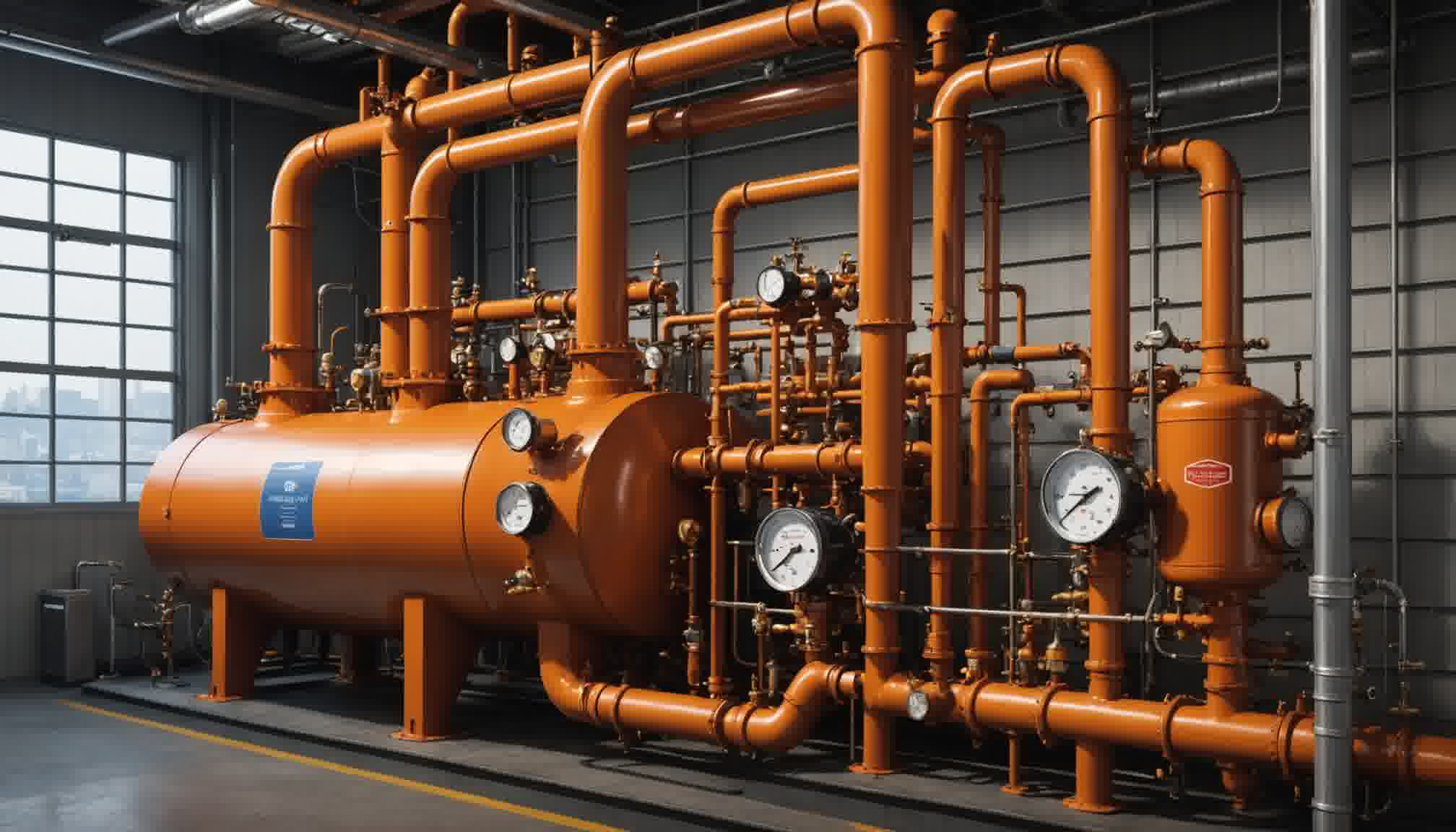
A condensate return line looks like an ordinary liquid pipe problem, and treating it as one is exactly why undersized condensate return lines are so common: the moment hot condensate passes through a trap into a lower-pressure return, part of it flashes to steam, and that flash steam, though a small fraction of the mass, becomes almost the entire volume moving through the pipe. A line sized on the condensate flow alone comes out several pipe sizes too small.
The velocity-based method codified by Spirax Sarco is the industry standard for this sizing problem. Compute the flash fraction from an enthalpy balance across the trap pressure drop (IAPWS-IF97 steam tables), convert the flash mass to volume via steam-table specific volume, add the small liquid volume, and size the pipe so the combined two-phase velocity stays within the limit for that line type. Trap discharge lines carry up to 5,000 fpm (83 ft/s / 25 m/s); common headers a lower 3,000 fpm (50 ft/s / 15 m/s); pumped subcooled returns just 7 ft/s (2 m/s) as a liquid line.
This article covers the flash physics, the enthalpy-balance flash fraction, the mass-to-volume conversion that turns 13% of the mass into 99% of the volume, and the worked examples from the calculator: 1,000 lb/h (453.6 kg/h) at 100 psig trap discharge sizing to 1½ in, not the ½ in a liquid-only calculation returns. It completes the steam sub-theme in the Plumbing cluster: the Pipe Expansion Loop article sized loops for the thermal growth of hot steam pipe; this sizes the return for the flash steam of the condensate coming back. Supply, use, return: the steam cycle.
Why a Condensate Line Is Sized for Flash Steam, Not the Water
A condensate return line looks like an ordinary liquid pipe problem, and treating it as one is exactly why undersized condensate lines are so common: the moment hot condensate passes through the trap into a lower-pressure return, part of it flashes to steam, and that flash steam, though a small fraction of the mass, becomes almost the entire volume moving through the pipe.
Condensate leaves a trap at the saturation temperature for the upstream pressure. In the lower-pressure return, it is hotter than the new boiling point, so some instantly re-evaporates. At 100 psig flashing to atmospheric, about 13% of the mass flashes, but that steam occupies roughly 200 times the volume of the water it came from. In the return line the flash steam is 99% of the flow by volume; the liquid is a thin film along the bottom. The line is sized for the flash vapor, and a line sized on the condensate flow alone comes out several pipe sizes too small.
The method is velocity-based two-phase sizing: compute the flash fraction from an enthalpy balance across the pressure drop, convert the flash mass to volume via steam-table specific volume, add the small liquid volume, and size the pipe so the combined velocity stays within a line-type limit. Steam tables (IAPWS-IF97) give the properties; Spirax Sarco codifies the velocity method. It is a screening estimate, not a two-phase pressure-drop or trap-backpressure analysis. This completes the steam sub-theme with the Expansion Loop article: that sized loops for the thermal growth of hot steam pipe; this sizes the return for the flash steam of the condensate coming back.
Calculator Inputs: Line Type, Condensate Load, Supply and Return Pressure
Calculation Mode selects Size (recommended pipe size) or Check (verify a given pipe; returns the nearest passing size when it fails).
Unit System selects Imperial (lb/h, psig, ft, in) or Metric (kg/h, bar(g), m, mm). All outputs follow the selected system.
Line Type sets the velocity limit and whether flash applies. Trap Discharge uses 5,000 fpm (83 ft/s / 25 m/s), flash applies. Common/Dry Return Header uses 3,000 fpm (50 ft/s / 15 m/s), flash applies. Pumped/Wet Return uses 7 ft/s (2 m/s), no flash (subcooled liquid).
Condensate Load [lb/h or kg/h] is the simultaneous load entering this specific line, not the total boiler capacity. At steady state this equals the steam consumption of the equipment served by the traps draining into the line.
Supply (Trap Inlet) Pressure [psig or bar(g)] is the pressure at the trap inlet, not the boiler header if a control valve drops it first. This pressure sets the flash fraction.
Return Line Pressure [psig or bar(g)] is the back pressure downstream of the trap, including lift and pressurized return back pressure. Blank or zero means vented atmospheric.
Pipe Material selects Steel Sch 40 or Sch 80 per ASME B36.10M. Condensate lines are normally carbon steel.
Velocity Limit [ft/s or m/s] defaults to the line-type value. Editable for project-specific practice.
Condensate Subcooling [optional, °F below saturation] reduces or eliminates the flash fraction. Blank assumes saturated condensate arriving at the trap.
Local Atmospheric Pressure [optional, psia] defaults to sea level (14.696 psia); lower for high-altitude installations.
In Check mode, the user also enters the nominal pipe size and schedule, or the actual inside diameter. The calculator returns: recommended pipe size and schedule (Size mode), flash fraction by mass, flash volume share, flash and liquid mass flows, total volumetric flow, two-phase velocity versus the limit, and a four-level verdict: velocity ratio ≤ 1.00 adequate / 1.00–1.15 at limit / 1.15–1.50 undersized / > 1.50 significantly undersized. The calculator does not account for trap selection or backpressure derate, rigorous two-phase pressure drop, waterhammer from layout or sag, vent lines, flash-recovery vessels, or supply pressures above 600 psig (41 bar).
Flash Steam: Why Hot Condensate Boils Behind the Trap
Flash steam forms because condensate leaving a trap carries more heat than the liquid can hold at the lower return pressure, so the excess heat boils off part of the water instantly.
The mechanism begins with saturation temperature: it drops with pressure. At 100 psig, saturated water is approximately 338°F (170°C); at atmospheric (0 psig), the boiling point is 212°F (100°C). Condensate at 338°F (170°C) entering an atmospheric return is 126°F (70°C) above the new boiling point. That excess sensible heat cannot stay in the liquid, so it vaporizes part of the water through the available latent heat.
The re-evaporation is instantaneous at the pressure drop, hence the term "flash." It is not gradual boiling from external heating; it is an immediate phase change the moment condensate crosses the trap into the lower-pressure return. The energy source is the condensate's own heat: the condensate cools from 338°F to 212°F (170°C to 100°C), and the released sensible heat provides the latent heat to flash approximately 13% of the mass.
Higher pressure drop produces more flash: a larger supply-to-return pressure gap means more excess heat and a larger flash fraction. High-pressure steam systems venting condensate to atmospheric return produce the highest flash fractions. Per Spirax Sarco: flash steam is the instantaneous re-evaporation of condensate when it drops to a lower pressure behind the trap. The condensate's own excess sensible heat, released as it cools to the new saturation temperature, vaporizes part of the mass.
The Flash Fraction: An Enthalpy Balance Across the Pressure Drop
The flash fraction is the mass share that re-evaporates, and it comes from an enthalpy balance: the excess liquid heat divided by the latent heat available at the return pressure.
x = (hf_supply − hf_return) / hfg_return

where:
  x          = flash steam mass fraction (quality), 0 to 1
  hf_supply  = saturated-liquid enthalpy at supply pressure [kJ/kg or Btu/lb]
  hf_return  = saturated-liquid enthalpy at return pressure [kJ/kg or Btu/lb]
  hfg_return = latent heat of vaporization at return pressure [kJ/kg or Btu/lb]
All properties are from IAPWS-IF97 / ASME steam tables at absolute pressure (gauge pressure plus atmospheric).
Worked example (calculator Example 1, 100 psig supply to 0 psig return):
Supply 100 psig → 114.70 psia (790.8 kPa):
  hf_supply  = 718.7 kJ/kg (308.9 Btu/lb)

Return 0 psig → 14.696 psia (101.3 kPa):
  hf_return  = 419.0 kJ/kg (180.2 Btu/lb)
  hfg_return = 2256.5 kJ/kg (970.3 Btu/lb)

x = (718.7 − 419.0) / 2256.5 = 299.7 / 2256.5 = 0.133 = 13.3% by mass
The numerator (718.7 − 419.0 = 299.7 kJ/kg) is the excess heat: the sensible heat the condensate must shed to cool to the return saturation temperature. The denominator hfg_return (2256.5 kJ/kg) is the latent heat each kilogram of flash absorbs. Their ratio is the mass fraction that flashes.
Subcooling reduces the flash. If condensate is below saturation at the supply pressure:
hf_supply,eff = hf_supply,sat − cp × ΔT_subcool   (cp ≈ 4.18 kJ/kg·K, 1.0 Btu/lb·°F)
Sufficient subcooling → x = 0 (liquid-only line)
Typical flash fractions run 10–15% by mass for common industrial pressure drops. Higher supply pressure or lower return pressure raises x. Per IAPWS-IF97 and Spirax Sarco: flash fraction x = (hf_supply − hf_return)/hfg_return, an enthalpy balance across the pressure drop. Subcooling lowers hf_supply,eff and can zero the flash.
Mass versus Volume: How 13 Percent Becomes 99 Percent of the Flow
The counterintuitive core of condensate sizing is that a small mass fraction of flash becomes almost the entire flow volume, because low-pressure steam is hundreds of times less dense than water.
ṁ_flash  = x × ṁ_condensate
ṁ_liquid = (1 − x) × ṁ_condensate
Q_flash  = ṁ_flash × vg_return
Q_liquid = ṁ_liquid × vf_return
Q_total  = Q_flash + Q_liquid
Worked example (calculator Example 1, 1,000 lb/h / 453.6 kg/h):
ṁ_flash  = 0.133 × 1,000 = 133 lb/h (60.3 kg/h)
vg (0 psig, atmospheric) = 26.80 ft³/lb (1.6718 m³/kg)
Q_flash  = 133 × 26.80 / 3600 = 0.989 ft³/s (0.02801 m³/s)

ṁ_liquid = 867 lb/h (393.3 kg/h)
vf (0 psig, atmospheric) = 0.0167 ft³/lb (0.001044 m³/kg)
Q_liquid = 867 × 0.0167 / 3600 = 0.004 ft³/s (0.000114 m³/s)

Q_total  = 0.989 + 0.004 = 0.993 ft³/s (0.02813 m³/s)
Flash volume share = 0.989 / 0.993 = 99.6%
13% of the mass, 99.6% of the volume. The 133 lb/h (60.3 kg/h) of flash steam accounts for nearly all the pipe volume; the 867 lb/h (393.3 kg/h) of liquid is a thin film along the pipe bottom. The specific-volume ratio vg/vf = 26.80/0.0167 ≈ 1,600 explains why: each pound (kilogram) of steam occupies roughly 1,600 times the volume of a pound (kilogram) of liquid water at atmospheric pressure.
The often-quoted figure of "flash occupies 200 times the condensate volume" follows from the per-pound original condensate: 0.133 × 1,600 ≈ 213. Each pound of condensate entering the trap produces steam that takes up approximately 200 times its liquid volume in the return line.
Per Spirax Sarco and steam tables: flash mass (13%) becomes flow volume (99.6%) because vg >> vf (~1,600× at atmospheric). The line must be sized for the flash vapor volume, not the liquid.
Two-Phase Velocity and the Required Diameter
With the total two-phase volume known, the required pipe diameter follows from the velocity limit: the pipe must be large enough that the combined flash-plus-liquid flow stays within the ceiling for that line type.
A = (π/4) × d²
v = Q_total / A
d_required = √(4 × Q_total / (π × v_limit))

where:
  d       = inside diameter [m or in, from schedule table — NOT nominal size]
  v_limit = line-type velocity limit [m/s or ft/s]
Worked example (calculator Example 1, trap discharge limit 25 m/s / 83.3 ft/s):
d_req = √(4 × 0.02813 / (π × 25.40)) = √0.001410 = 0.03755 m = 1.48 in (37.6 mm)
Next standard ≥ 1.48 in: 1½ in Sch 40 (ID 1.610 in / 40.9 mm)
Velocity at 1½ in: 0.02813 / (π/4 × 0.04089²) = 21.4 m/s = 70.2 ft/s ≤ 83.3 → adequate
ID not nominal: velocity is calculated on the actual bore from the pipe schedule table. 1½ in Sch 40 has ID 1.610 in (40.9 mm), not 1.500 in (38.1 mm). Using the nominal label understates velocity and can produce an apparent pass on a pipe that actually runs over the limit.
A tighter velocity limit demands a larger pipe for the same flow. A common header at 3,000 fpm (50 ft/s / 15 m/s) needs a larger pipe than the same flow in a trap discharge at 5,000 fpm. Check mode inverts the calculation: for a given pipe, it computes velocity, compares to the limit, and returns the ratio as a verdict.
Per Spirax Sarco and ASME B36.10M: required diameter d = √(4Q_total/(π·v_limit)), using total two-phase volume and the schedule inside diameter. The line-type velocity limit sets the pipe size.
Three Line Types: Trap Discharge, Common Header, Pumped Return
Three condensate line types carry three velocity limits because they serve different roles and tolerate different velocities.
| Line type | Velocity limit | Flash applies? |
|---|---|---|
| Trap discharge | 5,000 fpm (83 ft/s / 25 m/s) | Yes |
| Common/dry header | 3,000 fpm (50 ft/s / 15 m/s) | Yes |
| Pumped/wet return | 7 ft/s (2 m/s) | No (subcooled liquid) |
Trap discharge is the short individual line from one trap to the condensate return main. Short and terminal, it accepts the higher velocity (5,000 fpm). Flash applies: the trap is the pressure-drop point, so the full flash fraction occurs here.
Common/dry header collects flash and condensate from multiple traps and runs plant-wide. The lower limit (3,000 fpm) controls noise and erosion across the system. It carries the simultaneous load of all traps draining into it, not the load of one trap.
Pumped/wet return receives condensate from a vented receiver where flash has already been given up, and a pump moves the subcooled liquid. No flash applies: the condensate is subcooled below saturation temperature, and the line sizes as an ordinary liquid pipe at 7 ft/s (2 m/s). Supply and return pressures are not used in this mode.
Why the header runs slower: combined flash-and-condensate flow from many traps runs throughout the plant; high-velocity wet steam here erodes fittings and generates noise across the entire system. Trap discharge lines are short, individual, and terminal, so they tolerate more velocity. Per Spirax Sarco: trap discharge 5,000 fpm (flash), common header 3,000 fpm (flash, combined simultaneous load), pumped return 7 ft/s (subcooled liquid, no flash).
Subcooling and Return Pressure: What Shrinks the Flash
Two things reduce the flash fraction and can shrink the return line: subcooling the condensate below saturation, and raising the return pressure. Both cut the flash, but return pressure carries a back pressure penalty.
Subcooling reduces the effective supply enthalpy:
hf_supply,eff = hf_supply,sat − cp × ΔT_subcool   (cp ≈ 4.18 kJ/kg·K, 1.0 Btu/lb·°F)
Sufficient subcooling → x = 0, liquid-only line
Subcooled condensate carries less sensible heat to flash. Pumped returns from a vented receiver typically run subcooled, with little or no flash, and size near liquid lines.
Raising return pressure affects both terms in the flash fraction formula: hf_return rises and hfg_return falls, reducing x. A pressurized return or a lifted return (back pressure from elevation head) both cut the flash fraction and can shrink the required line.
The trade-off: raising return pressure reduces the flash and can shrink the pipe, but every trap draining into that return must discharge against the higher back pressure. That back pressure reduces trap capacity. The calculator credits the lower flash fraction from higher return pressure; it does not check the back pressure penalty on the traps. Verify trap back pressure separately.
Worked illustration:
100 psig supply, 0 psig return:  x = 13.3% (large flash, larger line)
100 psig supply, 15 psig return: hf_return higher, hfg_return lower, x ≈ 9%
  (smaller line, but 15 psig back pressure on every trap discharging into this return)
Per Spirax Sarco and steam tables: subcooling lowers hf_supply,eff and can zero the flash; higher return pressure lowers x but adds trap back pressure not checked by the calculator. Verify separately.
The Cost of Undersizing: Backpressure, Flooding, and Waterhammer
An undersized condensate return line chokes on its own flash steam, and the consequences cascade: back pressure, waterlogged equipment, erosion, and waterhammer.
1. Line too small for flash volume → flash steam chokes the pipe
2. Choking raises pressure in the return line (back pressure)
3. Back pressure is felt at every trap discharging into that return
4. Trap cannot discharge condensate against the back pressure
5. Condensate floods back into the equipment the trap drains
6. Flooded heat exchanger or coil loses heat transfer
Back pressure is the core failure: the undersized line's flash steam raises return-line pressure, and every trap on that line must discharge against it. A trap that cannot clear condensate floods the equipment it drains, destroying heat transfer. A flooded coil does not heat.
Erosion follows from velocity: flash steam running above the velocity limit is abrasive. High-velocity wet steam erodes pipe walls and fittings, especially at elbows, reducing service life.
Waterhammer comes from the combination of high-velocity two-phase flow and poor drainage. Slugs of condensate accelerated by flash steam slam into fittings and direction changes, damaging piping. Noisy, hammering condensate returns are a diagnostic sign of an undersized or improperly sloped line.
An oversized line wastes pipe but avoids all of these consequences. Headers are often sized generously on purpose. Per Spirax Sarco: an undersized line chokes on flash steam, raising back pressure that floods equipment, erodes fittings, and drives waterhammer. Oversizing wastes pipe; undersizing cascades to equipment damage.
Trap Discharge Worked Example: 1,000 lb/h at 100 psig, the Half-Inch Mistake and the Inch-and-a-Half Truth
Scenario: Trap discharge line from a steam trap to an atmospheric vented return. Condensate load 1,000 lb/h (453.6 kg/h), supply 100 psig, return 0 psig. Trap discharge velocity limit 5,000 fpm (83.3 ft/s / 25 m/s), Steel Sch 40. Matches calculator Example 1.
Step 1. Absolute pressures:
P_supply = 100 + 14.696 = 114.70 psia (790.8 kPa)
P_return = 0 + 14.696  = 14.696 psia (101.3 kPa)
Step 2. Steam-table properties (IAPWS-IF97):
hf_supply  = 718.7 kJ/kg (308.9 Btu/lb)
hf_return  = 419.0 kJ/kg (180.2 Btu/lb)
hfg_return = 2256.5 kJ/kg (970.3 Btu/lb)
vg_return  = 26.80 ft³/lb (1.6718 m³/kg)
vf_return  = 0.0167 ft³/lb (0.001044 m³/kg)
Step 3. Flash fraction:
x = (718.7 − 419.0) / 2256.5 = 299.7 / 2256.5 = 0.133 = 13.3% by mass
Step 4. Mass flows:
ṁ_flash  = 0.133 × 1,000 = 133 lb/h (60.3 kg/h)
ṁ_liquid = 867 lb/h (393.3 kg/h)
Step 5. Volumetric flows:
Q_flash  = 133 × 26.80 / 3600 = 0.989 ft³/s (0.02801 m³/s)
Q_liquid = 867 × 0.0167 / 3600 = 0.004 ft³/s (0.000114 m³/s)
Q_total  = 0.993 ft³/s (0.02813 m³/s)
Flash volume share = 99.6%
Step 6. Required diameter:
d_req = √(4 × 0.02813 / (π × 25.40)) = √0.001410 = 0.03755 m = 1.48 in (37.6 mm)
Step 7. Selected pipe:
Next standard ≥ 1.48 in: 1½ in Sch 40 (ID 1.610 in / 40.9 mm)
Velocity = 0.02813 / (π/4 × 0.04089²) = 21.4 m/s = 70.2 ft/s ≤ 83.3 ft/s → adequate
Step 8. The liquid-only mistake (calculator Example 2):
Sizing on liquid alone (867 lb/h at 7 ft/s liquid-line limit):
Q_liquid = 0.004 ft³/s → d_req ≈ 0.35 in → nearest standard: ½ in
½ in vs 1½ in: three sizes too small
Step 9. Why the gap:
Liquid volume:     0.004 ft³/s → ½ in
Two-phase volume:  0.993 ft³/s (248× larger) → 1½ in
Ignoring flash undersizes by 248× in volume, three pipe sizes
Step 10. Result: 1½ in Steel Sch 40, velocity 70.2 ft/s (21.4 m/s), flash 13.3% by mass and 99.6% by volume. Sizing for flash steam (1½ in) rather than liquid alone (½ in) is the entire point of this method. Cross-reference: the Pipe Expansion Loop article sized the thermal loops for the steam supply piping that fed this equipment; these results size the condensate return from those same traps.
Common Header and Pumped Return Worked Examples
Common header — calculator Example 3: Same 1,000 lb/h (453.6 kg/h) condensate load, same 100 psig supply to atmospheric return, routed through a common/dry return header at 3,000 fpm (50 ft/s / 15.24 m/s).
Step 1. Flash physics are identical to Example 1:
x = 13.3%
Q_total = 0.993 ft³/s (0.02813 m³/s)
Step 2. Required diameter at header velocity limit:
d_req = √(4 × 0.02813 / (π × 15.24)) = √0.002350 = 0.04848 m = 1.91 in (48.5 mm)
Step 3. Selected pipe:
Next standard ≥ 1.91 in: 2 in Sch 40 (ID 2.067 in / 52.5 mm)
Velocity = 0.02813 / (π/4 × 0.05250²) = 13.0 m/s = 42.6 ft/s ≤ 50 ft/s → adequate
Step 4. One size up from the trap discharge result (1½ in → 2 in), driven entirely by the lower header velocity limit. Same flow, tighter limit, larger pipe.
Step 5. On a real common header, size for the sum of simultaneous trap discharge loads, not one trap. This example isolates the velocity-limit effect at the same single-trap load.
Pumped/wet return: Condensate collects in a vented receiver and subcools below saturation. A pump moves the subcooled liquid, no flash occurs.
Step 6. No flash, liquid-only sizing at 7 ft/s (2.13 m/s):
Q_liquid = 1,000 lb/h × 0.0167 ft³/lb / 3600 = 0.00464 ft³/s (0.000131 m³/s)
d_req = √(4 × 0.00464 / (π × 7)) = √0.000844 = 0.029 ft = 0.35 in → ½ in Sch 40
Step 7. At ½ in Sch 40 (ID 0.622 in / 15.8 mm):
v = 0.00464 / (π/4 × 0.0518²) = 2.20 ft/s (0.67 m/s) ≤ 7 ft/s → well within limit
Step 8. Why small: no flash steam, only liquid volume. The pumped return is the one case sized like an ordinary liquid pipe.
Step 9. Contrast:
Same 1,000 lb/h load — three outcomes:
  Trap discharge:    1½ in (flash, 5,000 fpm limit)
  Common header:     2 in  (flash, 3,000 fpm limit)
  Pumped subcooled:  ½ in  (no flash, 7 ft/s liquid limit)
Flash steam is the entire difference.
Per Spirax Sarco: common header sizes up to 2 in for the lower velocity limit; pumped subcooled return sizes down to ½ in with no flash. Same load, three sizes.
Application Boundaries: Two-Phase Pressure Drop, Trap Backpressure, Flash Recovery
The calculator applies velocity-based two-phase sizing to trap discharge lines, common headers, and pumped subcooled returns for steel Sch 40/80 pipe at supply pressures up to 600 psig (41 bar). The following fall outside that scope.
Two-phase pressure drop. The calculator sizes by velocity, not rigorous two-phase pressure drop along the line. A pipe passing on velocity can still develop excessive pressure drop over a long run. Detailed two-phase methods (Lockhart-Martinelli, homogeneous model) are separate calculations required for long headers.
Trap backpressure and derate. High velocity in the result warns of possible back pressure, but the actual back pressure and its effect on trap discharge capacity are a separate calculation. A trap discharging against backpressure loses capacity and may fail to clear condensate; verify using manufacturer derate curves.
Waterhammer and layout. Waterhammer from lift, sagging runs, poor drainage pitch, and layout geometry is not analyzed. Proper slope, drip legs, and drainage are design details beyond the velocity screen.
Vent lines and flash recovery. Flash-recovery vessels (capturing flash steam for reuse) and vent line sizing are separate calculations. The calculator estimates the flash volume a recovery vessel would handle but does not size the vessel or vent line.
Trap selection. The calculator sizes the line, not the trap. Trap type (float-and-thermostatic, thermodynamic, thermostatic), capacity, and selection are separate per manufacturer — Spirax Sarco, Armstrong, TLV, and Watson McDaniel each publish selection guides.
Simultaneous load on headers. For common headers, determining the simultaneous condensate load from all traps (load diversity) is a system analysis; the calculator takes the simultaneous load as input. ASHRAE Handbook HVAC Systems covers steam condensate system design and diversity.
Supply above 600 psig. Supply above 600 psig (41 bar) is outside the steam-table range used; the calculator rejects it. High-pressure systems need extended property tables.
Subcooling estimate. The calculator takes subcooling as input; predicting actual subcooling from line losses and receiver cooling is a separate thermal analysis.
Condensate pump sizing. The pump moving pumped returns is sized separately (cross-reference Pump Power Calculator). Pump flow and head come from the condensate load and system lift.
Per Spirax Sarco and IAPWS-IF97: velocity-based flash-steam line sizing is the calculator scope. Two-phase pressure drop, trap backpressure/derate, waterhammer, flash recovery, trap selection, simultaneous-load diversity, high pressure, and pump sizing require separate qualified analysis and manufacturer guidance.
Condensate Return Line Sizing Calculator
Condensate return line sizing for flash steam per the Spirax Sarco velocity method and IAPWS-IF97 steam tables: computes the flash fraction from the enthalpy balance across the trap pressure drop, converts flash mass to volume via steam-table specific volume, adds the liquid, and sizes the pipe so two-phase velocity stays within the line-type limit. Handles trap discharge (5,000 fpm / 25 m/s), common headers (3,000 fpm / 15 m/s), and pumped subcooled returns (7 ft/s / 2 m/s). Size and Check modes, steel Schedule 40 and 80 per ASME B36.10M. A velocity screen, not a two-phase pressure-drop or trap back pressure analysis.
Open Condensate Return Line Sizing CalculatorFAQ
Why is a condensate return line sized for flash steam, not the condensate?
Per Spirax Sarco: the flash steam is almost the entire volume. A small mass fraction flashes behind the trap, but low-pressure steam occupies hundreds of times the liquid's volume. At 100 psig to atmospheric, 13% flashes by mass and that steam is 99.6% of the flow by volume. Sizing on the liquid alone lands three pipe sizes too small.
How much flash steam does condensate produce?
Per IAPWS-IF97 steam tables: 10–15% by mass for typical industrial pressure drops. At 100 psig to atmospheric, the flash fraction is 13.3% from the enthalpy balance x = (hf_supply − hf_return)/hfg_return. That 13% of the mass occupies roughly 200 times the volume of the condensate it came from, because steam-specific volume vg is approximately 1,600 times the liquid-specific volume vf at atmospheric.
What velocity limit should a condensate return line use?
Per Spirax Sarco: by line type. Trap discharge lines use approximately 5,000 fpm (83 ft/s / 25 m/s), common headers use approximately 3,000 fpm (50 ft/s / 15 m/s), and pumped subcooled liquid returns use 7 ft/s (2 m/s). Headers run slower to limit erosion and noise across the plant system.
Does subcooling change the required pipe size?
Per steam physics: yes. Subcooled condensate carries less sensible heat than saturated condensate at the same pressure, reducing the effective hf_supply,eff and therefore the flash fraction. Sufficient subcooling drives x to zero, and the line sizes as an ordinary liquid pipe. Pumped returns from vented receivers are the typical subcooled case.
Does higher return pressure reduce the pipe size?
Per steam tables: it lowers the flash fraction by raising hf_return and lowering hfg_return, which can shrink the required line. However, higher return pressure also raises the back pressure every trap must discharge against, cutting trap capacity. The calculator credits the lower flash fraction from higher return pressure but does not analyze the back pressure penalty on the traps; verify trap back pressure separately.
What happens if the condensate return line is too small?
Per Spirax Sarco: the line chokes on flash steam, raising back pressure that prevents traps from discharging condensate. Condensate floods back into the equipment being drained, destroying heat transfer. A flooded heat exchanger or process coil does not heat. High-velocity wet steam also erodes fittings and drives waterhammer. Oversizing wastes pipe but is safe; undersizing cascades to equipment damage.
Is this a two-phase pressure-drop calculator?
Per Spirax Sarco: no. It sizes by velocity, using the total flash-plus-liquid volume to keep two-phase velocity within the line-type limit. The actual two-phase pressure drop along the line and the trap back pressure are separate, more detailed calculations requiring Lockhart-Martinelli or homogeneous methods and manufacturer trap derate data.
Related Calculators
- Pipe Expansion Loop Sizing Calculator: Guided-cantilever thermal loops for the steam supply piping that feeds these traps (article).
- Compressed Air Pipe Sizing Calculator: Darcy-Weisbach compressible-gas sizing, a single-phase counterpart to two-phase flash (article).
- Pump Power Calculator: Hydraulic, brake, and motor power for the condensate pump on a pumped return (article).
- Hazen-Williams Pipe Flow Calculator: Pressurized water pipe flow per AWWA M22, single-phase liquid sizing (article).
- Expansion Tank Sizing Calculator: Thermal expansion control per IPC Section 607.3 for hot-water and hydronic systems (article).
- Hanger Load Calculator: Support load per MSS SP-58 for the steam and condensate piping (article).
- Medical Gas Pipe Sizing Calculator: Oxygen, air, and vacuum copper sizing per NFPA 99 (article).
Standards References
- IAPWS-IF97 (2012) — International Steam Tables, IAPWS. The industrial formulation for steam and water properties: saturated-liquid enthalpy hf, latent heat hfg, saturated-vapor and liquid specific volumes vg and vf by pressure. Primary source for all flash fraction and volume calculations in this article.
- ASME Steam Tables (2009) — ASME Steam Tables, ASME. Tabulated hf, hfg, vg, vf for saturated steam and water consistent with IAPWS-IF97. Cross-check reference for steam property values.
- ASME B36.10M (2018) — Welded and Seamless Wrought Steel Pipe, ASME. Nominal pipe sizes, outside diameters, and inside diameters by schedule for carbon and alloy steel pipe. Source of schedule IDs (1½ in Sch 40 ID 1.610 in / 40.9 mm, 2 in Sch 40 ID 2.067 in / 52.5 mm) used throughout.
- Spirax Sarco — Sizing Condensate Return Lines, Spirax Sarco Engineering. The velocity-based two-phase sizing method for condensate return: flash fraction from enthalpy balance, volume via specific volume, velocity limits by line type (trap discharge 5,000 fpm, header 3,000 fpm, pumped 7 ft/s). Foundational industry reference for condensate system design.
- Spirax Sarco — Flash Steam (Steam Engineering Tutorials), Spirax Sarco Engineering. Flash steam formation mechanism: instantaneous re-evaporation of condensate crossing a trap into lower-pressure return. The condensate's own excess sensible heat provides the latent heat for flash. Reference for flash steam physics and calculation.
- Armstrong International — Steam and Condensate Engineering Reference, Armstrong International. Condensate return system design, trap selection, and condensate recovery. Manufacturer reference for steam trap capacity and back pressure derate.
- TLV — Steam Trap Selection and Condensate Return (Engineering Resources), TLV Co., Ltd. Condensate return system design including line sizing, trap types, and back pressure effects. Manufacturer guidance complementing the Spirax Sarco velocity method.
- ASHRAE Handbook: HVAC Systems and Equipment (2020) — Chapter on Steam Systems, ASHRAE. Steam distribution, condensate return system design, diversity of simultaneous load for headers, and system design for hospitals, campuses, and industrial plants. Background reference for common-header load determination.
- Watson McDaniel — Steam Trap Handbook, Watson McDaniel. Trap types (float-and-thermostatic, thermodynamic, thermostatic), capacity, and back pressure derate guidance for condensate return system design.