Well Pressure Tank Sizing Calculator — Drawdown, the Acceptance Factor, and Minimum Pump Run Time
On this page
Calculate
This selector governs every field, label, result and export on this page, and it takes priority over the site header switch. Switching converts the values you entered rather than reinterpreting them, so 10 gpm becomes 37.9 L/min and returns to exactly 10 gpm when you switch back. The acceptance factor is dimensionless and reads the same in both systems, because it is a ratio of volumes.
The System and the Tank
This is the first question because one answer means the drawdown method does not describe the system at all. A conventional system runs the pump at one speed between a cut-in and a cut-out, and the tank exists to give the motor a decent run between starts. A constant pressure or variable speed system holds a target pressure by changing the pump speed, uses a much smaller buffer tank or none at all, and is sized from the drive manufacturer guidance rather than here.
This decides whether a pre-charge target means anything. Bladder and diaphragm tanks are captive air: the charge is sealed on the air side and can be set to a target with the tank drained. An air over water tank has no barrier, the air dissolves into the water and leaves with it, so the page reports the drawdown arithmetic and withholds a pre-charge figure rather than printing an instruction that does not exist on that vessel. If you are not sure, a captive air tank has a valve like a tyre valve, usually on the top.
The Pump
Use the delivery between cut-in and cut-out, from a measured fill rate or from the pump curve, not the maximum on the nameplate and not a figure guessed from the horsepower. A well pump does not have one operating pressure: it works from cut-in up to cut-out and delivers less as the pressure rises, so the flow at cut-out is the conservative reading. A 1 horsepower pump is not automatically 10 gallons per minute. The required drawdown scales directly with this number.
The result carries a flow confidence badge from this answer, because everything below it scales directly with the flow. A measured fill rate or a curve read at cut-out reads strong, a curve at the mid point reads acceptable, and a nameplate maximum or an estimate reads weak. A nameplate figure is a maximum at a favourable point on the curve rather than a delivery over the switch range, and it can put the answer two tank sizes out.
The Pressure Switch
The acceptance factor depends entirely on these two pressures. Non standard pairs work here, because the factor is computed from Boyle's law rather than looked up in a chart that covers three settings. Higher settings deliver less water from the same shell: the same tank gives up about 35 percent of its volume at 20/40 and about 26 percent at 40/60 on the field pre-charge rule.
The Minimum Pump Run Time
Everything on this page follows from how long the pump motor should run before it is allowed to stop, and there is no default that is safe for every motor. Amtrol defines Effective Sizing Protection I as a selection based on about one minute of running time, recommended for pumps up to three quarters of a horsepower, and ESP II as about two minutes. Trade guidance is looser and commonly quotes one minute below 2 horsepower. One minute is a floor rather than a target in every version of the rule.
Optional, and None of These Block the Sizing
Enter a tank to check one rather than size one. The page returns the drawdown that shell delivers and the run time it produces, which is the figure that matters. This is the nominal volume printed on the tank, which is the shell rather than the water: a 44 gallon tank delivers about 11.3 gallons at 40/60.
Two conventions are in circulation and they differ by about 5 percent of the delivered drawdown, so the page computes from the one you choose and names it rather than picking silently. Service instructions and Flexcon specification sheets use 2 psi below cut-in. Commonly published acceptance factor tables of 37, 31 and 27 percent align with the charge at cut-in. Neither is wrong.
Enter a charge read at the air valve to turn a sizing into a diagnosis. The page recomputes the factor from it and reports the drawdown and run time the tank is actually delivering. Read it with the tank empty of water and the system depressurised: a tank holding water reads system pressure at the air valve and tells you nothing about the charge.
From the tank data plate. Ratings differ by brand: Well-X-Trol tanks are rated 150 psig except the WX-252 at 100, and Flexcon tanks are rated 125 psig. A switch setting that is safe on one is not automatically safe on another. Left empty, the rating check is reported as not evaluated rather than as passed.
A refinement of a few percent rather than a correction, and the direction is favourable. The acceptance factor uses absolute pressure, which falls with altitude, so at about 5,000 feet the factor at 40/60 rises from 0.258 to 0.266. Left empty, the calculation uses sea level atmospheric pressure of 14.7 psi.
Overview
A 44 gallon pressure tank does not hold 44 gallons of water. On a 40/60 switch it gives up about 11 to 13 gallons between pump starts, and the rest of the shell is the air that pushes that water out. The air is not wasted space; it is the mechanism.
The second thing worth knowing is that the tank is not sized for the house. It is sized for the pump motor. The number that decides the minimum is the pump's flow rate multiplied by the shortest run the motor should be allowed, and household demand changes how often the pump cycles rather than how much drawdown each cycle needs.
Those two facts explain the most common failure on a well system. Someone raises the pressure switch from 30/50 to 40/60 for better showers, the acceptance factor falls with the pressure ratio, and a tank that was adequate starts short cycling with nothing else changed. Published guidance puts the cost of that at a pump life falling from around fifteen years to five or less.
There is a third that costs more drawdown than either. The air pre-charge is the only setting on the tank, and it decides the acceptance factor as directly as the switch does. A 44 gallon tank at 40/60 with a correct 38 psi charge delivers about 11 gallons on the field convention. At 20 psi it delivers about 7.5, a third of the water gone, and the symptom is identical to an undersized tank.
What to Look at First
Read the system type before anything else. A conventional pressure switch and tank is what this page sizes. A constant pressure or variable speed system holds pressure by modulating the pump rather than by drawing down a tank, uses a much smaller buffer or none at all, and is routed away rather than answered with a number that would be wrong by a wide margin.
Then read the required drawdown, not the tank size. The minimum follows from the pump flow multiplied by the minimum run time, which is a motor protection figure. Nothing in it is about how much water the household uses. The tank volume is the consequence, obtained by dividing that drawdown by an acceptance factor that has nothing to do with the household either.
Then read the acceptance factor together with the pre-charge convention printed beside it. Two conventions are in circulation and they differ by about 5 percent of the delivered drawdown, so a factor quoted as a property of the switch setting alone is not a complete statement.
Where a tank is short, read the run time rather than the gallons. Three gallons of missing drawdown is an abstraction. The same tank described as giving the pump forty-five seconds instead of sixty is not.
How to Use This Calculator
Say what kind of system it is. A conventional pressure switch and tank is what this page sizes. A constant pressure or variable speed system holds pressure by modulating the pump rather than by drawing down a tank, and the drawdown method does not apply to it.
Say what kind of tank. Bladder and diaphragm tanks are captive air: the charge is sealed on the air side and can be set to a target. An air over water tank has no barrier, the air dissolves into the water, and there is no sealed charge to set, so the page reports the arithmetic and withholds a pre-charge figure that would not mean anything on that vessel.
Enter the pump flow over the switch range. A well pump does not have one operating pressure; it works from cut-in up to cut-out and delivers less as the pressure rises. The flow at cut-out is the conservative reading. If you do not have a pump curve, a measured fill rate over the switch range is the best practical substitute. Do not use the nameplate maximum and do not infer it from horsepower.
Enter the pressure switch cut-in and cut-out, either as a standard pair or as your own figures. Non standard pairs work, because the acceptance factor is computed rather than looked up.
Choose how the run time is set. Enter it directly, derive it from the motor horsepower, or take two minutes as best practice. The manufacturer position is one minute for pumps up to three quarters of a horsepower and two minutes above that.
Add the optional inputs to turn a sizing into a diagnosis. A tank volume checks a tank you already have. A measured pre-charge computes the drawdown that tank is actually delivering. A tank maximum working pressure checks the switch against the vessel rating.
Inputs & Outputs
Inputs
Outputs
Well Pressure Tank Sizing Formula
Two short calculations and one that most people have never seen.
Absolute pressure
p_abs = p_gauge + atmospheric
Atmospheric is 14.7 psi at sea level, or 101.3 kPa. Boyle's law works in absolute pressure, and using gauge pressure here returns a materially wrong factor.
Acceptance factor, from Boyle's law
f = p_pre_abs * (1 / p_in_abs - 1 / p_out_abs)
The fraction of the shell delivered between cut-out and cut-in. Flexcon's own sizing guide notes that what hydronic work calls the acceptance factor is called the drawdown factor in water well work; they are the same quantity.
Pre-charge, field rule
p_pre = p_cut_in - 2
Set 2 psi below the cut-in pressure, checked with the tank empty of water and the system depressurised.
Required drawdown
drawdown_gal = pump_gpm * run_time_min
The whole sizing basis. A 10 gallon per minute pump on a one minute run needs 10 gallons.
Tank volume required
tank_gal = drawdown_gal / f
Round up to the next size available in the product line being used.
Drawdown a given tank delivers
drawdown_gal = tank_gal * f
Run time a given tank produces
run_time_min = drawdown_gal / pump_gpm
The figure that matters, because a shortfall in seconds lands harder than a shortfall in gallons.
Unit conversions
L = gal * 3.785411784
kPa = psi * 6.895
The remaining rules are conditions rather than equations: the run time thresholds and their source, the pre-charge convention, the tank type distinctions, the common size list and the sensitivity caveat.
Pressure Tank Drawdown Chart
Drawdown is the water a tank delivers between the pump switching off at cut-out and switching on again at cut-in. It is a fraction of the shell, and this is what that fraction looks like.
Computed on the field convention, with the pre-charge 2 psi below cut-in, a tank delivers about 35 percent of its shell at 20/40, about 30 percent at 30/50, about 26 percent at 40/60 and about 23 percent at 50/70.
Applied to common tank sizes at 40/60, that gives about 5.2 gallons from a 20 gallon tank, 8.3 from a 32 gallon tank, 11.3 from a 44 gallon tank, 22.2 from an 86 gallon tank and 30.7 from a 119 gallon tank. In litres those are 19.7, 31.4, 42.8, 84.0 and 116.2.
At 30/50 the same tanks deliver about 5.9, 9.4, 13.0, 25.4 and 35.1 gallons. At 20/40, about 6.9, 11.0, 15.2, 29.7 and 41.0.
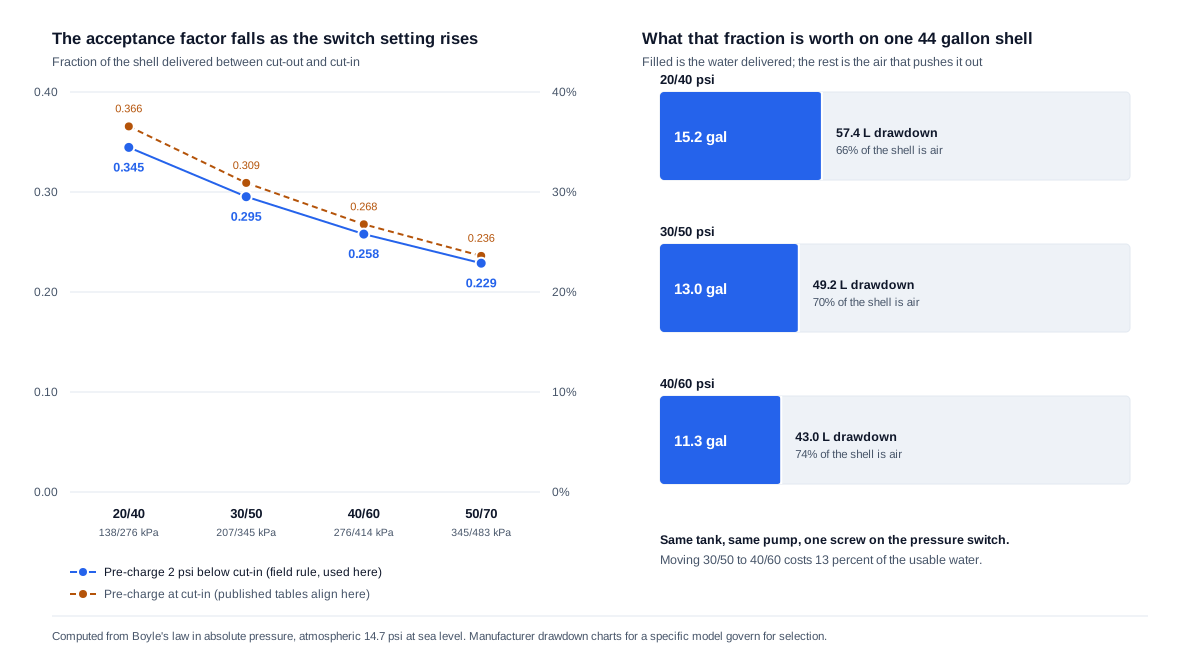
Manufacturer figures for real products sit in the same region and are not identical to these. The Well-X-Trol WX-202, a 20 gallon tank, publishes 8.0, 6.2 and 5.4 gallons at 20/40, 30/50 and 40/60. The WX-203 at 32 gallons publishes 9.9 at 30/50 and 8.6 at 40/60. The WX-250, sold as 44 gallons, publishes 17.7, 15.0 and 12.9. The Flexcon FlexLite FL 5, a 15 gallon tank, publishes 6.0, 5.1 and 4.4.
Two things follow from comparing those with the computed figures, and both are covered in their own section further down.
The nominal name on a tank is not reliably its shell volume. The WX-250 publishes drawdowns about 10 percent above what 44 gallons produces at every one of its settings, and the FL 5 runs 14 to 16 percent above what 15 gallons produces at every one of its settings. A consistent offset across all settings points to a shell larger than the name rather than to an error in the arithmetic.
And manufacturers do not share one pre-charge convention. Flexcon states on every sheet that its drawdown figures assume a pre-charge 2 psi below cut-in. Amtrol states no convention at all.
So use a computed chart to understand what changes when the switch setting changes, and use the manufacturer's chart for the exact model to select a tank.
Tank Volume Versus Usable Water
The number on a pressure tank is the volume of the shell. What comes out of it between pump starts is a quarter to a third of that, and the difference is the single most common misunderstanding on the subject.
A 20 gallon tank delivers about 5.2 gallons at 40/60. A 32 gallon tank delivers about 8.3. A 44 gallon tank delivers about 11.3. An 86 gallon tank delivers about 22.2.
The rest of the shell is compressed air, and it is not dead space. It is the entire mechanism. The pump fills the tank against that air, compressing it until the pressure reaches cut-out. When a tap opens, the air expands and pushes the water out. Without it the tank would hold water at whatever pressure the pump left it at and deliver almost none of it before the pressure collapsed.
That is why a tank with more water in it and less air would deliver less rather than more. A waterlogged tank, one that has lost its air charge entirely, is a shell full of water that delivers almost nothing, and the pump starts on every draw.
The practical error this produces is specific. Someone with a 10 gallon per minute pump reasons that a 20 gallon tank gives two minutes of run time. It gives about thirty seconds, which is half the one minute floor and a quarter of the two minute figure the manufacturer recommends above three quarters of a horsepower.
The ratio is not fixed either. It falls as the pressure switch setting rises, which is the next section.
Pressure Switch Settings and Drawdown
The same tank delivers different amounts of water depending on where the pressure switch is set, and the relationship is not obvious until it is written down.
On the field convention a tank delivers about 35 percent of its shell at 20/40, 30 percent at 30/50, 26 percent at 40/60 and 23 percent at 50/70. Higher settings deliver less.
The reason is the pressure ratio. Drawdown depends on how much the trapped air expands between cut-out and cut-in, and at higher absolute pressures the same 20 psi differential is a smaller proportional change. Twenty psi is a large fraction of a 40 psi absolute range and a small fraction of a 70 psi one.
This produces the field pattern the page exists to catch. A household wants better pressure. Someone moves the switch from 30/50 to 40/60. A 44 gallon tank that delivered about 13.0 gallons now delivers about 11.3, a loss of about 13 percent, and a pump that ran for 78 seconds now runs for 68. On a system that was already near the floor, that is the difference between adequate and short cycling, with nothing changed but a screw on the switch.
The honest qualification is that the run time does not always fall by the full amount. Run time is drawdown divided by pump flow, and a pump delivers less at higher pressure, so the required drawdown falls at the same time as the available drawdown. At a 5 percent flow drop the run time penalty is about 8 percent rather than 13. At a 13 percent flow drop it disappears. So the drawdown loss is a fact about the tank and the run time loss depends on the pump curve, which makes it an upper bound rather than a prediction.
The arithmetic runs the other way too, and this is worth knowing when a larger tank is not immediately available. Lowering the switch increases the drawdown: the same 44 gallon tank delivers about 15.2 gallons at 20/40. Dropping a setting is a real intervention on a short cycling system rather than a compromise, provided the lower pressure is acceptable at the fixtures.
Pre-Charge Setting and Short Cycling
The air pre-charge is the only adjustment on a pressure tank, and it decides the drawdown as directly as the switch setting does. It is also the first thing to check when a pump starts short cycling, because a wrong charge produces exactly the symptom of an undersized tank.
The rule is to set the charge 2 psi below the pressure switch cut-in. That is 18 psi on a 20/40 switch, 28 psi on a 30/50 and 38 psi on a 40/60.
The check has a condition that is easy to miss and invalidates the reading if it is skipped. It must be done with the tank empty of water and the system depressurised. A tank holding water reads system pressure at the air valve, which tells you nothing about the charge behind the diaphragm.
What a wrong charge costs is larger than most people expect. On a 44 gallon tank at 40/60 with a 10 gallon per minute pump, the correct 38 psi charge delivers about 11.3 gallons and a 68 second run. At 30 psi it delivers 9.6 gallons and 58 seconds. At 20 psi it delivers 7.5 gallons and 45 seconds, a third of the drawdown gone. At 5 psi it delivers 4.2 gallons and 25 seconds.
None of those tanks is undersized. The one running at 45 seconds is a correctly sized tank behaving like a small one, and the repair is a tyre gauge and a few minutes.
A charge that is too high causes a different failure. If the pre-charge sits above the cut-in pressure, the tank will not begin accepting water until the system reaches the charge, so part of the intended drawdown is unavailable from the other direction. This is a common condition on new installations, because tanks commonly ship with a factory charge of 38 psi. That suits a 40/60 switch and is 10 psi too high for a 30/50 system, so a brand new correctly sized tank can short cycle from the day it is commissioned unless the charge is bled down to 28.
A tank that has lost its charge completely is described as waterlogged. The shell fills with water, the drawdown approaches nothing, and the pump starts on every draw. On a bladder tank that usually means the bladder has failed and the tank is replaced. On a diaphragm tank the diaphragm cannot be replaced either.
Manufacturer Chart Versus Boyle's Law
This calculator computes the acceptance factor rather than reading it from a table, and that choice is worth explaining because it has both an advantage and a limit.
The advantage is that a computed factor works everywhere a table does not. It handles a non standard switch pair such as 35/55, which no published chart covers. It makes the pre-charge assumption visible instead of hidden inside a figure. And it allows the sensitivity comparison across settings to exist at all, because a chart gives one number rather than a relationship.
The limit is that a computation from a nominal tank volume is not the same thing as a manufacturer's measured figure for a specific product, and the gap is larger than rounding.
Two manufacturers make the point between them.
Flexcon prints its convention on every specification sheet: total drawdown assumes the tank pre-charge is set at 2 psi below cut-in pressure. That is the field rule, stated openly.
Amtrol prints no convention. Its Well-X-Trol WX-202 at 20 gallons and WX-203 at 32 gallons publish figures that match a computation at the cut-in pressure closely, which would suggest the other convention.
But the figures cannot settle it, because a second unknown moves the same way. Flexcon's FlexLite FL 5 is a 15 gallon tank publishing 6.0, 5.1 and 4.4 gallons at the three standard settings. Computed on 15 gallons at Flexcon's own stated convention those come to 5.17, 4.43 and 3.87, so the published figures run 14 to 16 percent above the computation at the convention the manufacturer says it used. The Well-X-Trol WX-250, sold as 44 gallons, runs about 10 percent above a computation on 44 gallons at every setting.
A consistent offset across every switch setting points to a shell that holds more than its nominal name, not to a wrong convention. So the difference between a published figure and a computed one mixes two things, the pre-charge convention and the real shell volume, and neither can be extracted from the numbers alone.
The conclusion is the practical one. Compute to understand what is happening: why a higher switch setting costs drawdown, what a wrong pre-charge is doing, how much a longer run time costs in tank size. Read the manufacturer's chart for the exact model to make the selection, because it reflects the real shell and the manufacturer's own stated conditions.
The pressure ratings differ between brands too, which is a smaller version of the same lesson. Well-X-Trol tanks carry a maximum working pressure of 150 psig except the WX-252 at 100. Flexcon tanks are rated 125 psig. A switch setting that is safe on one is not automatically safe on the other.
Minimum Pump Run Time
Everything on this page follows from one number that has nothing to do with plumbing: how long the pump motor should run before it is allowed to stop.
Every start draws heavy current and puts heat into the motor. A motor that starts constantly never gets the running period that carries that heat away, and it wears out. Published guidance puts the cost of short cycling at a pump life falling from around fifteen years to five or less, and an undersized tank is described as the most common cause of premature pump failure in well systems.
The manufacturer position is the most specific available. Amtrol defines Effective Sizing Protection I as a tank selection based on approximately one minute of running time, recommended for pumps up to three quarters of a horsepower. Effective Sizing Protection II is based on approximately two minutes. On that basis a 1 horsepower pump is already in the two minute category.
Trade guidance is generally looser, commonly quoting one minute below 2 horsepower and two minutes at 2 horsepower and above. Several sources recommend two minutes regardless of size. The one minute figure is a floor rather than a target in every version of the rule.
What that costs is straightforward and worth seeing before the choice is made. A 10 gallon per minute pump at 40/60 needs about 39 gallons of tank for a one minute run and about 78 gallons for two minutes. Doubling the run time doubles the shell, which is why the manufacturer chart has two columns and why the decision is worth making deliberately rather than by default.
The run time is also the best way to express a shortfall. A tank that is three gallons short of its requirement is an abstraction. The same tank described as giving the pump forty-five seconds instead of sixty is not.
Captive Air Versus Air Over Water Tanks
Three tank types are in service and they are not interchangeable, particularly for the pre-charge instruction this page produces.
A bladder tank holds the water inside a replaceable rubber bladder within the shell. The air charge sits outside the bladder, sealed. If the bladder fails it can be changed on many models without replacing the vessel.
A diaphragm tank uses a fixed diaphragm bonded into the shell to separate air from water. It works the same way in service and cannot be repaired: a failed diaphragm means a new tank.
Both are captive air tanks. The charge is sealed on the air side, it can be measured at a valve with the tank drained, and the rule of setting it 2 psi below cut-in applies to both.
An air over water tank, often an older galvanized vessel, has no barrier at all. The air sits directly on the water, dissolves into it over time, and leaves with the water. These tanks lose their air steadily rather than through a failure, and they are maintained with an air volume control that admits air automatically, or by draining and recharging them periodically.
Boyle's law still describes the air in an air over water tank at any instant, so the drawdown arithmetic is not meaningless. What does not apply is the pre-charge procedure. There is no sealed charge to set to a target and no valve reading that means what it means on a captive air tank, so this calculator reports the arithmetic for such a tank and withholds a pre-charge figure rather than printing an instruction that does not exist on that vessel.
If you are diagnosing a tank and do not know which type it is, the air valve is the clue. A captive air tank has a valve like a tyre valve, usually on the top, and the tank rings hollow above the water line. An air over water tank generally has an air volume control fitted to the pump or the tank rather than a simple charging valve.
Constant Pressure Systems Are Different
Not every well system is sized this way, and using the drawdown method on the wrong kind of system produces a tank several times larger than it needs to be.
A conventional system runs the pump at one speed between two pressures. The pressure at the tap therefore varies constantly between cut-in and cut-out, and the tank exists to give the motor a decent run between starts.
A constant pressure system, usually built around a variable frequency drive, changes the pump speed instead. It holds a target pressure by matching the pump output to the demand, so the pressure at the tap stays roughly constant and the pump does not stop and start with every draw.
That changes what the tank is for. On a variable speed system the tank is a small buffer that absorbs minor fluctuations and lets the drive settle, rather than a store that has to carry a full pump cycle. Such systems typically use a much smaller tank than a conventional one of the same duty, and some use none at all.
So the drawdown times run time method does not apply. There is no fixed cut-in and cut-out pair to compute an acceptance factor from, and the motor is not being protected from frequent starts in the same way.
This calculator asks the system type as its first question for that reason, and routes a constant pressure system away rather than returning a number that would be wrong by a wide margin. Sizing a variable speed system means following the drive manufacturer's own guidance, which is specific to the equipment.
What Is a Well Pressure Tank
A well pressure tank is a vessel that stores water under pressure between pump cycles. It is what lets a tap run without the pump starting, and it is the reason a well system does not switch on every time someone washes their hands.
Inside a modern tank the water is separated from a charge of compressed air by a rubber bladder or a diaphragm. As the pump fills the tank, the air is compressed and the pressure rises. When it reaches the cut-out setting the pressure switch stops the pump. As water is drawn off, the compressed air expands and pushes it out, the pressure falls, and at the cut-in setting the switch starts the pump again.
The water that comes out between those two events is the drawdown, and it is a fraction of the shell rather than all of it. How large a fraction depends on the pressure ratio between cut-in and cut-out, which is why the same tank delivers less at a higher switch setting.
What the tank is really protecting is the pump motor. Every start draws heavy current and generates heat, and a motor that starts constantly wears out fast. The tank exists so that each start is followed by a run long enough to matter, which is why sizing it begins with a run time rather than with a household.
Key Facts
- The required drawdown is the pump flow rate multiplied by the minimum pump run time. A 10 gallon per minute pump on a one minute run needs 10 gallons of drawdown.
- Amtrol defines Effective Sizing Protection I as a tank selection based on approximately one minute of running time, recommended for pumps up to three quarters of a horsepower, and Effective Sizing Protection II as approximately two minutes.
- Trade guidance more commonly quotes one minute below 2 horsepower and two minutes at 2 horsepower and above, which is less conservative than the manufacturer position.
- The acceptance factor is the fraction of the shell delivered as drawdown, and it comes from Boyle's law using absolute pressures. Flexcon notes that what hydronic work calls the acceptance factor is called the drawdown factor in water well work.
- Computed with the pre-charge 2 psi below cut-in, the factors are 0.345 at 20/40, 0.295 at 30/50, 0.258 at 40/60 and 0.229 at 50/70.
- Computed with the pre-charge at the cut-in pressure they are 0.366, 0.309, 0.268 and 0.236.
- Manufacturers do not share one convention and do not all state the one they use. Flexcon prints on every specification sheet that its drawdown figures assume a pre-charge 2 psi below cut-in. Amtrol prints no convention.
- The nominal name on a tank is not reliably its shell volume. The Well-X-Trol WX-250, sold as 44 gallons, publishes drawdowns about 10 percent above what 44 gallons produces at every setting. The Flexcon FlexLite FL 5, a 15 gallon tank, publishes figures 14 to 16 percent above what 15 gallons produces at Flexcon's own stated convention.
- Because both the convention and the real shell volume are unknown from published figures, the difference between a chart figure and a computation cannot be attributed to either one alone.
- Published drawdowns for real products: the Well-X-Trol WX-202 at 20 gallons gives 8.0, 6.2 and 5.4 gallons at 20/40, 30/50 and 40/60. The WX-203 at 32 gallons gives 9.9 and 8.6 at 30/50 and 40/60. The WX-250 at 44 gallons gives 17.7, 15.0 and 12.9. The FlexLite FL 5 at 15 gallons gives 6.0, 5.1 and 4.4.
- Raising the pressure switch reduces the drawdown of an existing tank. A 44 gallon tank delivers about 13.0 gallons at 30/50 and about 11.3 at 40/60 on the field convention, a fall of about 13 percent.
- The run time consequence is smaller than the drawdown loss, because a pump delivers less at higher pressure and the required drawdown falls with it. At a 5 percent flow drop the run time penalty is about 8 percent; at a 13 percent flow drop it disappears.
- The air pre-charge is set 2 psi below the cut-in pressure and must be checked with the tank empty of water and the system depressurised.
- Both Amtrol and Flexcon ship tanks with a factory pre-charge of 38 psig, which suits a 40/60 switch. A tank installed on a 30/50 switch has to be bled down to 28 psi.
- An incorrect pre-charge costs more drawdown than a modest error in tank size. A 44 gallon tank at 40/60 delivers about 11.3 gallons at 38 psi, 9.6 at 30 psi, 7.5 at 20 psi and 4.2 at 5 psi.
- A tank that has lost its charge is called waterlogged: the shell fills with water and the drawdown approaches nothing.
- Maximum working pressure differs by brand. Well-X-Trol tanks are rated 150 psig except the WX-252 at 100 psig. Flexcon tanks are rated 125 psig.
- Common residential tank sizes are 20, 32, 44, 86 and 119 gallons, with other designations in other product lines. These are product sizes rather than standards.
- Short cycling can cut pump life from around fifteen years to five or less, and an undersized tank is described as the most common cause of premature pump failure in well systems.
- There is no plumbing code table for pressure tank sizing. This is manufacturer and trade practice, and the manufacturer's chart for the exact model governs for final selection.
Applications
- A homeowner replacing a failed tank checks what size the existing pump actually needs, rather than matching the old tank because it was there.
- A well contractor sizing a new installation converts the pump's rated flow into a drawdown requirement and then into a shell volume, and can show the customer why the larger tank is not an upsell.
- A service technician called to a short cycling pump checks the pre-charge before quoting a tank, because a low charge produces the same symptom and costs nothing to fix.
- A homeowner who raised the pressure switch for better showers finds out why the pump started cycling, and can see what the same tank delivered at the old setting.
- A plumber working a non standard switch setting gets a factor computed from Boyle's law rather than a chart that only covers three pairs.
- An installer setting up a new tank finds that the factory 38 psi charge suits a 40/60 switch and has to be reduced for a 30/50 system.
- A designer comparing two brands finds that the maximum working pressure is not the same on both, and that a switch setting acceptable on one may not be on the other.
Example Calculations
Example 1. The shell is not the water
Given: a 44 gallon tank on a 40/60 pressure switch, pre-charged 2 psi below cut-in at 38 psi.
The acceptance factor is the pre-charge absolute pressure multiplied by the difference of the reciprocals: 52.7 times the quantity one over 54.7 minus one over 74.7, which is 0.258.
Result: about 11.3 gallons of drawdown from a 44 gallon shell, or 42.8 litres from 166.6. The other three quarters is air, and it is the air that pushes the water out. A tank holding more water and less air would deliver less, not more.
Example 2. Sizing from the pump rather than the house
Given: a 10 gallon per minute pump, a one minute minimum run time, and a 40/60 switch.
The required drawdown is 10 times 1, which is 10 gallons. The tank volume is 10 divided by 0.258, which is about 38.8 gallons.
Result: the next common size at or above 38.8, which is a 44 gallon tank. Note what did not enter that calculation: the number of bathrooms, the fixture count, or how much water the household uses in a day. A busy house cycles the pump more often; it does not change the drawdown each cycle requires.
Example 3. Two minutes doubles the tank
Given: the same 10 gallon per minute pump held to a two minute run, which is the manufacturer position for pumps above three quarters of a horsepower.
The required drawdown becomes 20 gallons and the tank becomes 20 divided by 0.258, which is about 77.5 gallons.
Result: an 86 gallon tank rather than a 44. Doubling the run time doubles the shell, and that is the real cost of the more conservative rule. It is also why the manufacturer chart has two columns rather than one.
Example 4. Raising the switch shrinks the tank
Given: a 44 gallon tank, moved from a 30/50 switch to 40/60 with the pre-charge adjusted accordingly.
At 30/50 the factor is 0.295 and the drawdown is about 13.0 gallons. At 40/60 the factor is 0.258 and the drawdown is about 11.3.
Result: about 13 percent of the usable water gone, with nothing changed but the switch. On a 10 gallon per minute pump that is 78 seconds of run time falling to 68.
The honest qualification is that the run time does not always fall by the full 13 percent, because a pump delivers less at higher pressure and the required drawdown falls at the same time. At a 5 percent flow drop the penalty is about 8 percent. At a 13 percent flow drop it disappears entirely. The drawdown loss is a fact about the tank; the run time loss depends on the pump curve and is an upper bound.
Example 5. The pre-charge costs more than the tank size
Given: a correctly sized 44 gallon tank on a 40/60 switch with a 10 gallon per minute pump, checked at four different air charges.
At the correct 38 psi the drawdown is about 11.3 gallons and the run time about 68 seconds. At 30 psi it is 9.6 gallons and 58 seconds. At 20 psi it is 7.5 gallons and 45 seconds. At 5 psi it is 4.2 gallons and 25 seconds.
Result: a tank that is not undersized at all, short cycling at 45 seconds because of a setting that takes five minutes and a tyre gauge to correct. The symptom is identical to an undersized tank, which is why the charge is checked before the tank is replaced.
One condition on that check is easy to miss. It must be done with the tank empty of water and the system depressurised, because a tank with water in it reads system pressure at the air valve and tells you nothing about the charge.
Example 6. Two manufacturers, two conventions, and a gap neither explains
Given: the Flexcon FlexLite FL 5, a 15 gallon tank publishing 6.0, 5.1 and 4.4 gallons at 20/40, 30/50 and 40/60, on a sheet that states its drawdowns assume a pre-charge 2 psi below cut-in.
Computed on 15 gallons at that stated convention, the figures come to 5.17, 4.43 and 3.87. The published values run 14 to 16 percent higher at every setting.
Result: the gap is not the convention, because the manufacturer named it. A consistent offset across all three settings points to a shell that holds more than its 15 gallon name. The Well-X-Trol WX-250 shows the same pattern at about 10 percent on a nominal 44 gallons.
So a computation from a nominal volume understates what a real tank delivers, and by an amount that varies by model. Compute to understand the relationship; read the manufacturer chart to select the product.
Example 7. Nameplate flow oversizes the tank
Given: a pump whose nameplate reads 15 gallons per minute, where a measured fill rate over the switch range gives 10.
At the nameplate figure the one minute requirement is 15 gallons of drawdown and the tank is 15 divided by 0.258, about 58 gallons, which points to an 86 gallon tank. At the measured figure the requirement is 10 gallons and the tank is about 39, which points to a 44.
Result: two tank sizes apart, from one input. A nameplate figure is a maximum at a favourable point on the curve rather than a delivery over the switch range, so it inflates the requirement. The error is in the safe direction for the motor and expensive for the customer, and it is still an error. The flow confidence badge on the result exists for this reason.
Example 8. The tank that arrives set for the wrong switch
Given: a new tank installed on a 30/50 pressure switch, straight from the box.
Both Amtrol and Flexcon ship with a factory pre-charge of 38 psig, which is 2 psi below a 40 psi cut-in and correct for a 40/60 system.
Result: on a 30/50 switch that charge is 10 psi too high. The tank will not begin accepting water until the system reaches 38 psi, which is above the 30 psi cut-in, so much of the intended drawdown is unavailable and the pump short cycles on a brand new correctly sized tank. The charge has to be bled down to 28 psi before the system is commissioned.
Example 9. A constant pressure system asks the wrong question
Given: a variable speed well system, entered on this page.
Result: no tank size is returned. A constant pressure system holds a target pressure by changing the pump speed rather than by drawing down a tank between two switch settings. There is no cut-in and cut-out pair to compute an acceptance factor from, the tank is a small buffer rather than a store, and applying the drawdown method here would return a tank several times larger than the system needs. The calculator routes the case away and points at the drive manufacturer's guidance.
Example 10. The switch that exceeds the tank
Given: a tank with a maximum working pressure of 125 psig, on a system someone wants to run at 60/80.
Result: the drawdown arithmetic works and is not the only check. A 60/80 switch is within a 125 psig rating and would exceed a 100 psig one, and Well-X-Trol tanks are rated 150 psig except the WX-252 at 100 while Flexcon tanks are rated 125. The pump, the tank and the downstream plumbing all carry ratings, and a switch setting that is acceptable on one brand of tank is not automatically acceptable on another.
Example 11. An air over water tank gets arithmetic and no instruction
Given: an older galvanized tank with no bladder or diaphragm.
Result: the drawdown arithmetic is reported, because Boyle's law still describes the air above the water. The pre-charge target is withheld. There is no sealed charge to set on such a tank: the air dissolves into the water continuously and is replaced by an air volume control or by draining and recharging. Printing a 38 psi target here would be an instruction that does not correspond to any procedure on that vessel.
Standards & References
- Amtrol Well-X-Trol Tank Sizing Chart Carries the published drawdown figures by model and switch setting, the factory pre-charge of 38 psig, the maximum working pressure of 150 psig for all models except the WX-252 at 100 psig, and the Effective Sizing Protection definitions: ESP I based on approximately one minute of running time and recommended for pumps up to three quarters of a horsepower, and ESP II based on approximately two minutes.
- Amtrol Well-X-Trol Specification Sheet The same sizing data and definitions in the manufacturer's own specification format.
- Flexcon Industries FlexLite Series Specification Sheet Diaphragm type pre-charged tanks with published volume and drawdown by model at 20/40, 30/50 and 40/60, a maximum working pressure of 125 psi and an adjustable pre-charge of 38 psi.
- Flexcon Industries Well-Rite Sell Sheet States on the drawdown table that total drawdown assumes the tank pre-charge is set at 2 psi below cut-in pressure, which is the clearest published statement of a pre-charge convention found for this page.
- Flexcon Industries Tank Sizing Guide Sets out the acceptance factor calculation using absolute pressure, and notes that what is called the acceptance factor in hydronic applications is called the drawdown factor in water well applications.
- Amtrol Well-X-Trol WX-250, 44 Gallon Tank Published drawdowns of 17.7 gallons at 20/40, 15.0 at 30/50 and 12.9 at 40/60.
- Amtrol Well-X-Trol WX-202, 20 Gallon Tank Published drawdowns of 8.0 gallons at 20/40, 6.2 at 30/50 and 5.4 at 40/60, with the factory pre-charge of 38 psi and the instruction to set the charge 2 psi below cut-in with the pump off and the tank drained.
- DrillerDB, Well Pressure Tank Guide Sets out the acceptance factor as a consequence of Boyle's law computed with atmospheric pressure at 14.7 psi, gives the standard rule that drawdown should at least equal the pump flow in gallons per minute times a one minute run time for motors under 2 horsepower and two minutes above, and notes that manufacturers publish per model versions of the same table.
- SC Well Service, Pressure Tank Sizing Guide The drawdown formula as pump flow times minimum run time, the requirement that the pre-charge be set 2 psi below cut-in, and the effect of an incorrect pre-charge on delivered drawdown.
- Mid Atlantic Water, Well Water Pressure Tank Sizes Worked comparison of tank sizes against a 10 gallon per minute pump, and the argument for sizing to a two minute run rather than the one minute floor.
- Note on attribution There is no plumbing code table for pressure tank sizing; this is manufacturer and trade practice throughout. The acceptance factor arithmetic on this page is computed from Boyle's law rather than read from a chart, which is what allows it to work at non standard switch settings and to show the sensitivity to a change in setting. The observation that published drawdowns exceed a computation from nominal volume, and that the excess is consistent across switch settings for a given model, is arithmetic performed on published figures rather than a statement any of these sources makes. Flexcon states its pre-charge convention; Amtrol does not, and the convention cannot be inferred from the figures because the real shell volume is also unknown. For final selection the manufacturer's drawdown chart for the exact model governs over any computation on this page.
Units
Volume is entered and reported in gallons and litres, at 3.785411784 litres per gallon. A 44 gallon tank is 166.6 litres and 11.3 gallons of drawdown is 42.8 litres. The common product sizes of 20, 32, 44, 86 and 119 gallons are 75.7, 121.1, 166.6, 325.5 and 450.5 litres.
Pressure is entered and reported in psi and kilopascals, at 6.895 kPa per psi. The standard switch settings of 20/40, 30/50 and 40/60 psi are 137.9/275.8, 206.8/344.7 and 275.8/413.7 kPa.
Atmospheric pressure enters the calculation directly, because Boyle's law works in absolute pressure. Sea level atmospheric is 14.7 psi or 101.3 kPa, and it is added to every gauge pressure before the factor is computed. Using gauge pressure instead returns a factor that is wrong by a large margin rather than a small one.
Flow is entered in gallons per minute or litres per minute, at 3.785411784 litres per minute per gallon per minute. A 10 gallon per minute pump is 37.9 litres per minute.
Run time is entered in minutes in both systems. The result also reports it in seconds, because a shortfall of a quarter of a minute reads as nothing and a shortfall of fifteen seconds reads as something.
The acceptance factor is dimensionless and identical in both unit systems, because it is a ratio of volumes.
The internal unit selector governs the fields, labels, math, on-screen result and any exported result, and it takes priority over any site-wide unit switch. Switching converts the values you entered rather than reinterpreting them.
Limitations
- This calculator sizes a conventional pressure switch and tank system. A constant pressure or variable speed system holds pressure by modulating the pump rather than by drawing down a tank, uses a much smaller tank or none at all, and is not sized by this method.
- It covers captive air tanks, meaning bladder and diaphragm types. An air over water tank has no sealed charge to set, so the page reports the arithmetic and withholds a pre-charge target that would not describe any procedure on that vessel.
- It does not verify pump selection. The pump flow you enter is used as given, and choosing a pump against a required pressure and flow is a different calculation on a different page.
- The acceptance factor is computed from Boyle's law rather than read from a manufacturer chart. That is deliberate, because it works at any switch setting and makes the pre-charge assumption explicit, and it is an approximation of a specific product. For final selection the manufacturer's drawdown chart for the exact model governs.
- Nominal tank names are not reliably shell volumes. Published drawdowns for at least two models from two manufacturers exceed a computation from their nominal volume by 10 to 16 percent, consistently across every switch setting.
- Manufacturers do not share one pre-charge convention and do not all state the one they use, so the difference between a published figure and a computed one cannot be attributed to convention alone.
- The sensitivity comparison across switch settings holds the pump flow constant to isolate the tank effect. A real pump delivers less at higher pressure, so the run time penalty of raising a switch is an upper bound rather than a prediction.
- The pump flow has to be the delivery over the switch range. A nameplate maximum or a figure inferred from horsepower will be high, and the required drawdown scales directly with it.
- Maximum working pressures differ by brand and model, so a switch setting acceptable on one tank is not automatically acceptable on another.
- Well yield is a separate question. A tank sized correctly for the pump says nothing about whether the well can supply that pump.
- This page does not count pump cycles over a day, estimate pump flow from an observed fill time, size multiple tanks with differing settings, or address water treatment, well construction or pressure at fixtures.
Common Mistakes to Avoid
- Reading the tank name as usable water. A 44 gallon tank delivers about 11 to 13 gallons between pump starts depending on the switch setting. The rest of the shell is the air that does the work.
- Sizing the tank from household demand. The minimum is the pump flow multiplied by the run time. Household demand decides how often the pump cycles, not how much drawdown each cycle needs.
- Using the nameplate flow. A pump delivers less at higher pressure, and a well pump works across a range rather than at a point. The flow at cut-out is the conservative figure, and a nameplate figure can put the answer two tank sizes out.
- Inferring flow from horsepower. A 1 horsepower pump is not automatically 10 gallons per minute. The output depends on the curve and the total head, and horsepower is useful for choosing a run time rule rather than a flow.
- Raising the pressure switch without checking the tank. The acceptance factor falls with the pressure ratio, so a tank that was adequate at 30/50 can short cycle at 40/60 with nothing else changed.
- Checking the pre-charge with water in the tank. The gauge reads system pressure at the air valve, not the charge. The tank has to be drained and the system depressurised.
- Installing a new tank without adjusting the factory charge. Tanks commonly ship at 38 psi, which suits a 40/60 switch and is 10 psi too high for a 30/50 system.
- Replacing a tank that is short cycling before checking the charge. A low pre-charge produces the same symptom as an undersized tank, and one of the two costs nothing to fix.
- Using gauge pressure in the acceptance factor. Boyle's law works in absolute pressure, and leaving out the 14.7 psi atmospheric term produces a factor that is wrong by a wide margin.
- Taking a published chart figure as a computed one, or the reverse. Published figures exceed a computation from nominal volume by 10 to 16 percent on the models examined here, and manufacturers do not share one pre-charge convention. Use the chart for selection and the computation for understanding.
- Assuming the pressure rating is the same across brands. Well-X-Trol tanks are rated 150 psig except the WX-252 at 100. Flexcon tanks are rated 125 psig.
- Taking the one minute run time as a target. It is a floor. The manufacturer position is one minute only for pumps up to three quarters of a horsepower, and two minutes above that.
Frequently Asked Questions
What size well pressure tank do I need?
How much water does a 44 gallon pressure tank actually hold?
What is drawdown?
Why does a higher pressure switch setting reduce the drawdown?
What should the air pre-charge be?
How long should a well pump run per cycle?
My pump is short cycling. Is the tank too small?
Is there a code requirement for pressure tank size?
Should I use pump horsepower to size the tank?
What if I have a constant pressure well system?
Why does the calculator use absolute pressure?
Does a bigger pressure tank hurt anything?
Can a low pre-charge make a correctly sized tank short cycle?
Is the tank model number the exact shell volume?
Frequently Used Together
Engineers often use these calculators in combination for complete project workflows:
Related Calculators
Explore similar calculators that might be useful for your project:
Plumbing Quick Reference — Keep It On Your Phone On Site
A 10-page field reference for catching pressure, velocity, slope, and pump-sizing mistakes before you order pipe, close a wall, or add a booster.
- Velocity limits, fixture pressure minimums, drain slope, and the 80 psi ceiling in one table
- Worked examples that show why a single pressure number gives four different answers
- Keep it on your phone, or print the two field-check pages
Free PDF. Calculators stay free. Unsubscribe anytime.
Calculate
This selector governs every field, label, result and export on this page, and it takes priority over the site header switch. Switching converts the values you entered rather than reinterpreting them, so 10 gpm becomes 37.9 L/min and returns to exactly 10 gpm when you switch back. The acceptance factor is dimensionless and reads the same in both systems, because it is a ratio of volumes.
The System and the Tank
This is the first question because one answer means the drawdown method does not describe the system at all. A conventional system runs the pump at one speed between a cut-in and a cut-out, and the tank exists to give the motor a decent run between starts. A constant pressure or variable speed system holds a target pressure by changing the pump speed, uses a much smaller buffer tank or none at all, and is sized from the drive manufacturer guidance rather than here.
This decides whether a pre-charge target means anything. Bladder and diaphragm tanks are captive air: the charge is sealed on the air side and can be set to a target with the tank drained. An air over water tank has no barrier, the air dissolves into the water and leaves with it, so the page reports the drawdown arithmetic and withholds a pre-charge figure rather than printing an instruction that does not exist on that vessel. If you are not sure, a captive air tank has a valve like a tyre valve, usually on the top.
The Pump
Use the delivery between cut-in and cut-out, from a measured fill rate or from the pump curve, not the maximum on the nameplate and not a figure guessed from the horsepower. A well pump does not have one operating pressure: it works from cut-in up to cut-out and delivers less as the pressure rises, so the flow at cut-out is the conservative reading. A 1 horsepower pump is not automatically 10 gallons per minute. The required drawdown scales directly with this number.
The result carries a flow confidence badge from this answer, because everything below it scales directly with the flow. A measured fill rate or a curve read at cut-out reads strong, a curve at the mid point reads acceptable, and a nameplate maximum or an estimate reads weak. A nameplate figure is a maximum at a favourable point on the curve rather than a delivery over the switch range, and it can put the answer two tank sizes out.
The Pressure Switch
The acceptance factor depends entirely on these two pressures. Non standard pairs work here, because the factor is computed from Boyle's law rather than looked up in a chart that covers three settings. Higher settings deliver less water from the same shell: the same tank gives up about 35 percent of its volume at 20/40 and about 26 percent at 40/60 on the field pre-charge rule.
The Minimum Pump Run Time
Everything on this page follows from how long the pump motor should run before it is allowed to stop, and there is no default that is safe for every motor. Amtrol defines Effective Sizing Protection I as a selection based on about one minute of running time, recommended for pumps up to three quarters of a horsepower, and ESP II as about two minutes. Trade guidance is looser and commonly quotes one minute below 2 horsepower. One minute is a floor rather than a target in every version of the rule.
Optional, and None of These Block the Sizing
Enter a tank to check one rather than size one. The page returns the drawdown that shell delivers and the run time it produces, which is the figure that matters. This is the nominal volume printed on the tank, which is the shell rather than the water: a 44 gallon tank delivers about 11.3 gallons at 40/60.
Two conventions are in circulation and they differ by about 5 percent of the delivered drawdown, so the page computes from the one you choose and names it rather than picking silently. Service instructions and Flexcon specification sheets use 2 psi below cut-in. Commonly published acceptance factor tables of 37, 31 and 27 percent align with the charge at cut-in. Neither is wrong.
Enter a charge read at the air valve to turn a sizing into a diagnosis. The page recomputes the factor from it and reports the drawdown and run time the tank is actually delivering. Read it with the tank empty of water and the system depressurised: a tank holding water reads system pressure at the air valve and tells you nothing about the charge.
From the tank data plate. Ratings differ by brand: Well-X-Trol tanks are rated 150 psig except the WX-252 at 100, and Flexcon tanks are rated 125 psig. A switch setting that is safe on one is not automatically safe on another. Left empty, the rating check is reported as not evaluated rather than as passed.
A refinement of a few percent rather than a correction, and the direction is favourable. The acceptance factor uses absolute pressure, which falls with altitude, so at about 5,000 feet the factor at 40/60 rises from 0.258 to 0.266. Left empty, the calculation uses sea level atmospheric pressure of 14.7 psi.