Water Softener Sizing Calculator — Grain Capacity
On this page
Calculate
Use direct entry when you have a metered daily water use figure. If you enter daily water use, the people and per-person fields are ignored.
Permanent household occupants. Accounts for typical daily bathing, cooking, and drinking use.
Typical residential use: 75 to 80 gal (284 to 303 L) per person per day. Leave blank to use the 75 gal (284 L) default.
From a water test report or annual water quality report. 1 gpg = 17.118 mg/L as CaCO3. Moderately hard: 3.5–7 gpg; hard: 7–10.5 gpg; very hard: above 10.5 gpg.
Well water is more likely to contain iron, manganese, or low pH. If set to well or unknown and iron/Mn/pH are blank, a testing advisory is shown.
From a water test. Blank means untested (advisory shown); 0 means tested and none. On well water, iron is the most common cause of softener underperformance. Softener operating limit: below 5 mg/L ferrous iron.
Ferrous iron looks clear from the tap and turns rusty after standing, and the resin can exchange it. Ferric iron is already red or brown, and it coats the resin and cannot be exchanged. Iron bacteria bring slime and foul the resin outright.
From a water test. Blank means untested; 0 means tested and none. Softener operating limit: below 0.5 mg/L. Above that limit, a dedicated manganese filter is required upstream.
Blank means untested (guard not applied). pH at or below 6.7 requires pH correction upstream. Softeners are compatible with pH above 6.7. The EPA secondary pH range is 6.5 to 8.5.
Days between regeneration cycles. Healthy window: 3 to 14 days; ideal 5 to 10. Leave blank for the 7-day default. Below 3 days: too frequent, wastes salt. Above 14 days: channeling and stagnation risk.
Efficient uses less salt per regeneration and meets the NSF/ANSI 44 salt-efficiency floor of 3,350 grains/lb. High capacity delivers more grains per cycle but is less efficient and typically needs a smaller tank. Both settings are always shown side by side.
Enter a specific unit to check whether it is adequate. The nameplate maps to a resin volume before any delivered-capacity math; the label is not the usable capacity.
Grains per gallon of compensated hardness added per 1 mg/L of ferrous iron. Published values range from 1 to 5; the default of 5 is the conservative dominant convention. Ferric iron and bacteria are not sized; they trigger the pre-treatment guard.
Grains per gallon of compensated hardness added per 1 mg/L of manganese. Published values range from 3 to 8; the default of 5 is a midrange conservative value. Manganese above 0.5 mg/L triggers the pre-treatment guard regardless of this factor.
Overview
Water softener sizing is not just people times hardness times days. The correct size depends on compensated hardness, the delivered capacity at your chosen salt setting, a reserve for peak days, the target regeneration interval, salt efficiency, and whether the water is even inside the range a softener can treat. This calculator sizes the usable delivered capacity, not the marketing label on the softener.
The single most important idea on this page is that the nameplate grain rating is not the usable capacity. A softener labeled 48,000 grains delivers close to that figure only when it is regenerated with a heavy salt dose. Run the same unit at an efficient, NSF-style salt dose and it delivers far less, because capacity per regeneration is set by how much salt you use, not by the label on the tank. The calculator computes the delivered capacity for the salt setting you select and sizes from that, then shows both settings side by side so the tradeoff is visible in tank size and in monthly salt use.
This tool sizes the softener only. It does not size pipe, select a pump, or compute water pressure. It pairs naturally with a household demand estimate for daily water use and with a well pump context, since well water is where iron, manganese, and low pH most often appear.
What to Look at First
Recommended unit and delivered capacity. The most important result is the resin volume (cubic feet) and the delivered capacity at your chosen salt setting — not the nameplate grains on the tank. A softener labeled 48,000 grains delivers closer to 30,000 at an efficient salt dose. The calculator sizes from the delivered figure, then shows both settings side by side so the tradeoff in tank size and monthly salt cost is visible.
Pre-treatment flag. If the calculator returns PRE-TREATMENT REQUIRED, no grain capacity resolves the problem. Ferric iron, iron bacteria, over-limit ferrous iron (above 5 mg/L), manganese above 0.5 mg/L, or pH at or below 6.7 all need a dedicated upstream filter or pH correction before a softener is appropriate. The sizing shown underneath is conditional on those issues being fixed.
Regeneration interval. The recommended unit shows the estimated days between regeneration cycles. The healthy window is 3 to 14 days. An interval below 3 days triggers a frequent-regeneration caution; above 14 days triggers an oversize caution; a unit can pass on capacity and still be the wrong choice if it regenerates too rarely.
Salt setting comparison. The efficient setting (NSF-style, ~5.5 lb salt per cubic foot) and the high-capacity setting (~15 lb per cubic foot) are always shown side by side. The efficient setting gets more grains per pound of salt but usually requires a larger resin volume to hold the same regeneration interval.
How to Use This Calculator
Choose the unit system (US or Metric) using the calculator's own selector. Every field, label, and result follows that selector.
Enter household size, or switch to direct entry and type your daily water use in gallons or liters. If you enter daily water use directly, the people and per-person fields are ignored.
Enter your measured water hardness in grains per gallon (US) or milligrams per liter as calcium carbonate (Metric). Use your water quality report or a lab test result.
If you are on well water, enter iron, manganese, and pH if tested. Leave them blank if untested; the calculator flags the assumption rather than hiding it. Enter zero only if a test confirmed none.
If you entered iron, select the iron form: ferrous (clear-water), ferric (red-water), iron bacteria, or unknown. This determines whether the softener can handle the iron at all.
Choose a salt setting. Efficient is the default. High capacity delivers more grains per cycle but at lower salt efficiency and higher monthly cost.
Set the target regeneration interval if you want something other than the 7-day default.
Optionally, check a specific candidate unit by selecting its nameplate grains or entering resin volume in cubic feet.
Click Calculate. Read the recommended unit, delivered and usable capacity, regeneration interval, salt use, and the verdict. Watch for a pre-treatment flag, an oversize caution, or a frequent-regeneration flag.
The nameplate grain rating on a softener is not the usable capacity. It reflects a heavy salt dose. At an efficient dose the same tank delivers less, and usable capacity is lower still after the 25% reserve. Always size from delivered capacity at the salt setting you intend to run.
Inputs & Outputs
Inputs
Outputs
Formula
The calculator uses a fixed model. Values are stored at full precision and rounded only for display, so converting between unit systems and back returns the original numbers.
INPUTS
  people            persons
  gpd_per_person    gallons per person per day     (default 75)
  daily_water_gal   = people * gpd_per_person       (or entered directly)
  hardness_gpg      measured hardness in gpg         (or mg/L as CaCO3 / 17.118)
  iron_ppm          ferrous iron in mg/L             (optional)
  iron_form         ferrous | ferric | bacteria | unknown
  mn_ppm            manganese in mg/L                (optional)
  pH                water pH                          (optional)
  target_days       target regeneration interval     (default 7)
  reserve           reserve fraction                  (fixed 0.25)
  salt_mode         efficient | high_capacity         (default efficient)
  cuft              candidate resin volume, cu ft     (optional)
  nameplate         candidate nameplate grains        (optional)

COMPENSATED HARDNESS  (ferrous iron only; ferric or bacteria route to the guard)
  iron_comp = 5 * iron_ppm       (only if iron_form is ferrous)
  mn_comp   = 5 * mn_ppm
  comp_gpg  = hardness_gpg + iron_comp + mn_comp

DAILY LOAD
  daily_load_grains = daily_water_gal * comp_gpg

REQUIRED CAPACITY AT TARGET INTERVAL
  required_grains = daily_load_grains * target_days

CANDIDATE MAPPING  (nameplate maps to resin volume BEFORE delivered is computed)
  if nameplate entered and cuft blank:
     cuft = ladder_lookup(nameplate)
     24000 -> 0.64,  32000 -> 1.0,  40000 -> 1.25
     48000 -> 1.5,   64000 -> 2.0,  80000 -> 2.5

DELIVERED CAPACITY  (salt-setting dependent, NOT the nameplate)
  per_cuft  = 20000 if salt_mode is efficient else 32000
  delivered = cuft * per_cuft
  salt_lb   = cuft * (5.5 if salt_mode is efficient else 15)
  salt_eff  = delivered / salt_lb                grains per pound

USABLE CAPACITY  (reserve applied to the unit)
  usable = (1 - reserve) * delivered

UTILIZATION AND INTERVAL  (only when usable > 0 and daily_load_grains > 0)
  U               = required_grains / usable      round to 2 decimals BEFORE banding
  achievable_days = usable / daily_load_grains
  monthly_salt_lb = salt_lb * 30 / achievable_days

SALT THRESHOLDS
  nsf_salt_met = salt_eff >= 3350
  ca_salt_met  = salt_eff >= 4000

VERDICT BANDS (on U, after round)
  U <= 1.00   PASS       reaches the target interval with the 25 percent reserve intact
  U <= 1.33   MARGINAL   covers demand but consumes the reserve; regenerates at or under target
  U >  1.33   FAIL       cannot cover the target interval; regenerates more often than target

INDEPENDENT INTERVAL FLAGS  (shown separately from pass or fail)
  achievable_days > 14   OVERSIZED CAUTION       channeling and stagnation risk
  achievable_days < 3    FREQUENT REGENERATION   salt and water waste, resin wear

PRETREATMENT GUARD  (pre-empts the green verdict)
  iron_form is ferric or bacteria
    or iron_ppm > 5 or mn_ppm > 0.5 or pH <= 6.7
      -> PRETREATMENT REQUIRED; sizing is shown as conditional only

UNIT CONVERSIONS
  mg/L as CaCO3 = gpg * 17.118
  liters        = gallons * 3.785411784
  kilograms     = pounds  * 0.45359237
Compensated Hardness
Measured hardness is the calcium and magnesium in your water, reported in grains per gallon or in milligrams per liter as calcium carbonate. That number describes the water. It is not always the number the resin has to handle. Dissolved iron and manganese are also captured by cation exchange resin, so they occupy exchange sites that would otherwise hold hardness. Sizing from measured hardness alone in a well with iron gives a unit that runs out early.
Compensated hardness is the measured hardness plus a sizing allowance for those metals. The calculator adds 5 grains per gallon for each 1 milligram per liter of ferrous iron, and 5 grains per gallon for each 1 milligram per liter of manganese. Published allowances vary, roughly 1 to 5 for iron and 3 to 8 for manganese, so both factors are shown in the result and can be edited. A water at 10 grains per gallon with 3 milligrams per liter of ferrous iron carries a compensated load of 25 grains per gallon, two and a half times the measured figure.
The two numbers stay separate in the output on purpose. The hardness classification badge always reads from measured hardness, so a 12-grain water is reported as very hard whether or not iron is present. The sizing math always reads from compensated hardness. Mixing them would either mislabel the water or undersize the softener, and the result shows each contribution as its own line so the arithmetic is auditable.
Nameplate Capacity vs Delivered Capacity
The grain number printed on a softener is a marketing label tied to a test condition, not a fixed property of the tank. Manufacturers quote capacity at a heavy salt dose, roughly 15 pounds of salt per cubic foot of resin, because that dose produces the largest number. A unit sold as 48,000 grains is 1.5 cubic feet of resin measured that way.
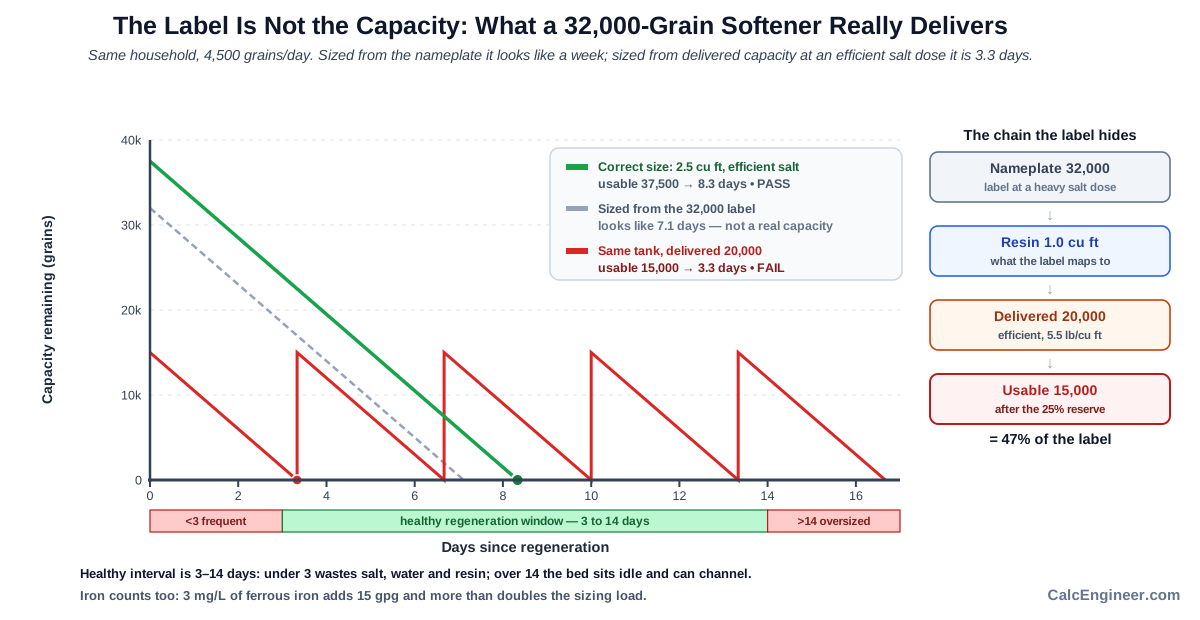
Delivered capacity is what the same tank actually removes on the salt dose you run. At an efficient dose near 5.5 pounds per cubic foot, one cubic foot of resin delivers about 20,000 grains rather than about 32,000. So that 48,000-grain unit delivers about 30,000 grains when run efficiently. Then the reserve applies: sizing holds the working load to 75 percent of delivered capacity so a heavy day does not push hard water through. The usable figure for that unit at an efficient setting is about 22,500 grains, less than half the number on the label.
This is why the calculator maps a nameplate entry to a resin volume first, then computes delivered capacity from the resin volume and the salt setting, and never treats the label as capacity. Every result shows the chain in full: nameplate, resin volume, delivered, and usable. If a sizing tool quotes only nameplate grains, it is answering a different question than the one that determines whether your water stays soft.
Efficient vs High-Capacity Salt Setting
Choosing the salt setting is an operating decision with a cost on both sides, and it is usually the reason two competent quotes propose different tanks for the same house. At the high-capacity setting, roughly 15 pounds of salt per cubic foot, each cubic foot delivers about 32,000 grains at about 2,133 grains per pound of salt. At the efficient setting, roughly 5.5 pounds per cubic foot, each cubic foot delivers about 20,000 grains at about 3,636 grains per pound.
More salt buys more capacity per regeneration, but it buys it inefficiently. The high setting removes fewer grains for every pound of salt you pour into the brine tank, which means more salt purchased, more sodium or potassium chloride sent to the drain, and a higher monthly bill. The efficient setting gets more work out of each pound, but since each regeneration recovers less capacity, holding the same interval usually calls for a larger resin volume.
For a four-person household at 15 grains per gallon, the efficient path lands on 2.5 cubic feet and uses about 49.5 pounds, or 22.45 kilograms, of salt per month. The high-capacity path reaches the same weekly interval with a smaller 1.5 cubic foot tank but uses about 84 pounds, or 38.28 kilograms, per month. Neither setting is wrong. A high-capacity setting is a legitimate choice when tank space or budget is tight and longer intervals matter more than salt use. The calculator shows both so the tradeoff is a decision rather than an accident.
Water Softener Grain Capacity Chart
Residential softeners are built around a small ladder of standard resin volumes. Use this to translate a market size into the resin volume the sizing math actually works from. The grain figures are market nameplate labels measured at a heavy salt dose; delivered capacity depends on the salt dose you run.
Nameplate 24,000 grains: resin volume 0.64 cu ft. Delivered at high salt about 20,480 grains, at efficient salt about 12,800 grains. Nameplate 32,000 grains: resin volume 1.0 cu ft. Delivered at high salt about 32,000 grains, at efficient salt about 20,000 grains. Nameplate 40,000 grains: resin volume 1.25 cu ft. Delivered at high salt about 40,000 grains, at efficient salt about 25,000 grains. Nameplate 48,000 grains: resin volume 1.5 cu ft. Delivered at high salt about 48,000 grains, at efficient salt about 30,000 grains. Nameplate 64,000 grains: resin volume 2.0 cu ft. Delivered at high salt about 64,000 grains, at efficient salt about 40,000 grains. Nameplate 80,000 grains: resin volume 2.5 cu ft. Delivered at high salt about 80,000 grains, at efficient salt about 50,000 grains.
One note on the smallest rung. The 24,000-grain label is the only entry where the market number rounds up past the modeled delivered capacity: 0.64 cubic feet at a heavy salt dose works out to about 20,480 grains, not 24,000. Reaching the labeled figure would take a salt dose above the practical 15 pounds per cubic foot. Treat it as an approximate label, as with every rung on this ladder.
Water Softener Regeneration Frequency
Regeneration is the cycle that washes accumulated hardness off the resin with brine and sends it to the drain. How often it happens is a direct result of sizing: divide the usable capacity by the daily softening load and you have the interval in days. A four-person household producing 4,500 grains a day on a unit with 37,500 grains of usable capacity regenerates about every 8.3 days.
The healthy range is 3 to 14 days, with 5 to 10 days the comfortable middle and 7 days the common design target. Inside that window the resin bed is exercised often enough to stay clean and channel-free, and not so often that salt and rinse water are wasted. The calculator defaults to a 7-day target and reports the interval the recommended or candidate unit actually achieves, which is often more useful than the pass or fail label alone.
Both ends of the window are failure modes, and the calculator flags them independently of the capacity verdict. Below 3 days a unit is working too hard: every cycle costs salt and several tens of gallons of rinse water, and the resin ages faster. Above 14 days the water sits in the bed between cycles, which invites channeling and stagnation. A unit can pass on capacity and still be flagged for either, because reaching enough grains and running on a sensible schedule are two separate questions.
Iron and Manganese in Softener Sizing
Iron and manganese decide whether a softener is even the right equipment, which makes them a question of applicability before they are a question of capacity. The form of the iron matters more than the amount. Ferrous iron, the clear-water form, is dissolved: it pours clear from the tap and turns rusty after standing. Resin can exchange it, so it is handled as a sizing allowance. Ferric iron is already oxidized, arriving red, brown, or visibly particulate. It does not exchange; it coats and plugs the bed. Iron bacteria bring slime and odor and foul the resin outright.
There are numeric limits even on the form that does work. A softener is a reasonable tool when pH is above 6.7, ferrous iron is below 5 milligrams per liter, and manganese is below about 0.5 milligrams per liter. Past those points the resin fouls faster than regeneration can clean it, capacity falls off, and the unit needs frequent cleaning or premature replacement. Acidic water below pH 6.7 is aggressive to both the resin and the plumbing around it.
When any of those conditions is present, the calculator returns a pretreatment result instead of a capacity number, and shows the sizing as conditional on the problem being fixed upstream. The right answer is a dedicated iron or manganese filter, an oxidation-filtration or greensand system, or pH correction ahead of the softener. Buying a larger tank does not address any of them. It is worth separating these treatment limits from the EPA aesthetic thresholds of 0.3 milligrams per liter for iron and 0.05 for manganese, which are the levels where staining and metallic taste begin. Water can exceed the aesthetic level and still be well inside what a softener handles.
Can a Water Softener Be Too Big?
Yes, and it is the failure mode people rarely check because the symptoms do not look like a sizing problem. Oversizing is what happens when the recommendation comes from a nameplate number, a generous household estimate, or a sales instinct that more capacity must be safer. The capacity math passes easily. The schedule is what breaks.
A single-person household at 8 grains per gallon produces about 600 grains a day. Put that on a 2.5 cubic foot unit at a high salt setting and the utilization is 0.07, which looks like an excellent pass. The regeneration interval works out to about 100 days. Water sits in the resin bed for three months at a time. Flow finds preferential paths through a bed that is never fully exercised, which is called channeling, and once channels form the effective capacity drops well below the rating. Stagnant water in a bed that rarely cycles is its own concern.
This is why the oversize caution is a separate flag rather than part of the pass or fail band. A unit can hold plenty of grains and still be the wrong unit. Demand-initiated regeneration, which triggers on measured water use rather than on a timer, helps by adapting the schedule to actual demand, but it does not turn a tank that is several sizes too large into a good match. The usual fixes are a smaller resin volume, a lower salt setting so each cycle recovers less and the unit cycles more often, or a forced regeneration schedule that keeps the bed from sitting past the healthy window.
What Is a Water Softener Sizing Calculation
A water softener is a tank of cation exchange resin. As hard water flows through, calcium and magnesium ions stick to the resin and sodium or potassium ions are released in their place. Over time the resin fills with hardness and must be recharged, which is called regeneration. During regeneration a strong brine of salt washes the hardness off the resin and down the drain, and the resin is ready again. Sizing a softener means choosing enough resin, and enough salt per regeneration, that the unit removes a full cycle of household hardness before it needs to recharge, without recharging so often that it wastes salt or so rarely that water sits stagnant in the resin bed. A larger tank is not automatically better if it regenerates too rarely.
Capacity is measured in grains of hardness removed per regeneration. The catch is that grain capacity is not a fixed property of the tank. The same resin volume delivers more grains when regenerated with more salt and fewer grains when regenerated with less. Manufacturers advertise the capacity at a high salt dose, which is why the label reads high. Sizing correctly means working from the delivered capacity at the salt dose you intend to run, applying a reserve for heavy-use days, and matching the result to a regeneration interval that falls in a healthy range. That is what this calculation does, and it is why two identical tanks can call for different household sizing depending only on the salt setting.
Key Facts
- Hardness unit conversion: 1 grain per gallon equals 17.118 milligrams per liter as calcium carbonate.
- USGS hardness classes as calcium carbonate: soft is 0 to 60 mg/L, moderately hard is 61 to 120, hard is 121 to 180, very hard is above 180. In grains per gallon that is under 3.5, 3.5 to 7.0, 7.0 to 10.5, and above 10.5.
- The hardness badge uses measured hardness, while sizing uses compensated hardness. Iron and manganese raise the sizing load but do not change the hardness classification.
- Typical residential water use: 75 to 80 gallons per person per day.
- Iron compensation, default: add 5 grains per gallon per 1 mg/L of ferrous iron. Published values range from about 1 to 5; the default is conservative and editable.
- Manganese compensation, default: add 5 grains per gallon per 1 mg/L. Published values range from about 3 to 8.
- Reserve capacity: 25 percent. Size so the working load fills no more than 75 percent of delivered capacity.
- Regeneration interval: healthy range is 3 to 14 days, ideal is 5 to 10, default target is 7. Below 3 days wastes salt and water; above 14 days risks channeling and stagnation.
- Delivered capacity model: about 32,000 grains per cubic foot at roughly 15 lb salt (high capacity), about 20,000 grains per cubic foot at roughly 5.5 lb salt (efficient).
- Salt efficiency: about 2,133 grains per pound at the high setting, about 3,636 grains per pound at the efficient setting.
- NSF/ANSI 44 salt-efficiency threshold: at least 3,350 grains per pound. California requires at least 4,000 grains per pound. The theoretical maximum for this resin chemistry is about 6,000 grains per pound.
- Standard resin ladder: 0.64, 1.0, 1.25, 1.5, 2.0, and 2.5 cubic feet, labeled 24,000, 32,000, 40,000, 48,000, 64,000, and 80,000 grains. The 0.64 rung is the one case where the market label rounds up from the modeled delivered capacity.
- EPA secondary aesthetic thresholds: iron 0.3 mg/L, manganese 0.05 mg/L, pH range 6.5 to 8.5. These are staining and taste levels, separate from the treatment limits below.
- Softener operating range: pH above 6.7, ferrous iron below 5 mg/L, manganese below about 0.5 mg/L. Ferric iron, iron bacteria, or over-limit metals need dedicated pretreatment.
Applications
- A homeowner on hard municipal water uses this to pick a first softener, entering household size and the hardness from the annual water quality report, then reading the recommended grain capacity and resin volume.
- A well-water household uses it to account for iron and manganese, which raise the effective hardness the resin must handle, and to catch the cases where a softener alone is the wrong tool because the iron is ferric or the water is acidic.
- A buyer comparing quotes uses the efficient versus high-capacity comparison to see why one contractor proposes a smaller tank and another a larger one for the same house. The difference is usually the salt setting, and this page makes that explicit along with the monthly salt cost.
- A shopper checking a specific listing uses the candidate input to test whether a 32,000, 48,000, or 64,000 grain unit is actually enough at an efficient salt setting, rather than trusting the number in the product title.
- Anyone budgeting for running costs uses the monthly salt estimate to compare two units before buying, since a smaller tank at a heavy salt setting can cost noticeably more to run every month than a larger tank run efficiently.
- An owner of an existing softener uses the candidate check to confirm whether the unit they already have is adequate, undersized, or oversized for their current household and water, and whether it is regenerating on a healthy schedule.
- A plumber or water-treatment installer uses it as a fast sanity check during a site visit, sizing from measured hardness and a realistic salt setting rather than from a nameplate number.
Example Calculations
Example 1. Baseline household, efficient vs high-capacity salt
Household: 4 people, 75 gallons per person per day, hardness 15 grains per gallon, no iron or manganese, target interval 7 days, reserve 25 percent.
Step 1, daily water use: 4 x 75 = 300 gallons per day (1,135.62 liters per day in Metric).
Step 2, compensated hardness: no iron or manganese, so compensated hardness equals measured hardness. 15 gpg (256.77 mg/L as CaCO3). USGS class: very hard.
Step 3, daily softening load: 300 gallons x 15 gpg = 4,500 grains per day.
Step 4, required capacity at 7-day target: 4,500 x 7 = 31,500 grains. With 25% reserve, the unit must deliver at least 31,500 / 0.75 = 42,000 grains.
Step 5, efficient setting: at 20,000 grains per cubic foot, 42,000 grains needs at least 2.1 cubic feet, so the ladder gives 2.5 cubic feet. That unit delivers 50,000 grains, usable 37,500, utilization 0.84, PASS, regenerating about every 8.3 days. Salt per regeneration: 13.75 lb (6.24 kg). Salt efficiency: 3,636 grains per pound, which meets the NSF threshold but is below the California threshold. Estimated salt use: about 49.5 lb (22.45 kg) per month.
Step 6, high-capacity setting for comparison: at 32,000 grains per cubic foot, 42,000 grains needs at least 1.31 cubic feet, so the ladder gives 1.5 cubic feet. That unit delivers 48,000 grains, usable 36,000, utilization 0.88, PASS, regenerating about every 8.0 days. Salt per regeneration: 22.5 lb (10.21 kg). Salt efficiency: 2,133 grains per pound, below the NSF threshold. Estimated salt use: about 84 lb (38.28 kg) per month.
Result: the same household needs a 2.5 cu ft unit for efficient NSF-style use, or a smaller 1.5 cu ft unit if you accept heavy salt use. The salt setting drives both the tank size and the salt bill: about 50 lb/month efficient versus about 84 lb/month at high capacity.
Example 2. Ferrous iron compensation
Household: 3 people, 75 gallons per person per day, hardness 10 gpg, 3 mg/L ferrous iron, target 7 days.
Daily water use: 225 gallons (851.72 liters). Iron contribution: 3 x 5 = 15 gpg. Compensated hardness: 25 gpg (427.95 mg/L as CaCO3). Daily load: 225 x 25 = 5,625 grains per day. Required at target: 39,375 grains. Required delivered (with reserve): 52,500 grains.
At high-capacity setting: ladder gives 2.0 cu ft: 64,000 delivered, 48,000 usable, utilization 0.82, PASS at about 8.5 days, 30 lb (13.61 kg) salt per regen. At efficient setting: requirement is about 2.6 cu ft, which exceeds the ladder, so 2.5 cu ft is the practical choice and lands MARGINAL at about 6.7 days.
Result: 3 ppm of iron more than doubles the sizing load and moves this household from about 1.25 cu ft to 2.0 cu ft or more.
Example 3. Ferric iron guard
Same household as Example 2, same 3 mg/L of iron, but the iron is the ferric red-water form rather than ferrous.
Result: PRE-TREATMENT REQUIRED. Ferric iron does not exchange onto the resin; it coats and plugs the bed. No grain capacity solves it. The correct step is an iron filter or oxidation-filtration system upstream, after which the sizing in Example 2 applies.
Example 4. Oversized unit
Household: 1 person, 75 gallons per day, hardness 8 gpg (136.94 mg/L as CaCO3), on a 2.5 cu ft unit at high-capacity setting.
Daily load: 600 grains. The unit delivers 80,000 grains with 60,000 usable. utilization 0.07, a trivial pass. However, the achievable interval is about 100 days.
Result: capacity passes and OVERSIZED CAUTION fires anyway. Water would sit in the resin bed for months between cycles, risking channeling and stagnation. Fix: a smaller resin volume, a lower salt setting, or demand-initiated regeneration with a forced cycle inside the 3–14 day window.
Example 5. Nameplate check at efficient setting
A shopper enters a 32,000-grain unit as the candidate and selects efficient salt, for the 4-person household at 15 gpg from Example 1.
The calculator maps 32,000 grains to 1.0 cu ft, then computes delivered capacity at efficient setting as 20,000 grains, not 32,000. Usable after reserve: 15,000 grains. Daily load: 4,500 grains. utilization 2.10, FAIL against the 7-day target. Achievable interval: about 3.3 days.
Result: sized from the label the unit looks like it covers a week with room to spare. Sized from delivered capacity at the intended setting, it regenerates every three days and sits just above the frequent-regeneration threshold. The label is not the capacity.
Standards & References
- USGS, Hardness of Water, Water Science School Classification of soft, moderately hard, hard, and very hard water as calcium carbonate. Source of the 60 / 120 / 180 mg/L as CaCO3 thresholds used for the hardness badge.
- US EPA, Secondary Drinking Water Standards Aesthetic thresholds for iron 0.3 mg/L, manganese 0.05 mg/L, and the pH range 6.5 to 8.5. These are staining and taste levels, not the softener operating limits.
- NSF/ANSI 44 Technical Requirements Certification standard for residential cation exchange water softeners. Requires at least 3,350 grains of hardness removed per pound of salt and no more than 5 gallons of regeneration water per 1,000 grains removed. This calculator evaluates the salt-efficiency threshold only; regeneration water use is not modeled.
- Water Conditioning and Purification International (WC&P) Industry reference on NSF/ANSI 44 efficiency, the 3,350 grains per pound rating floor, the California 4,000 grains per pound requirement, and the salt-dose versus capacity relationship. Cited for the capacity and salt relationship; a trade publication rather than a code or standards body.
Units
Hardness is reported as calcium carbonate, in grains per gallon or in milligrams per liter, which is the same as parts per million. Convert with 1 grain per gallon equals 17.118 milligrams per liter as calcium carbonate. Milligrams per liter and parts per million as calcium carbonate are interchangeable for hardness.
Grain capacity is the standard rating unit for softeners in both Imperial and metric markets. One pound of salt is 0.45359237 kilograms. One gallon is 3.785411784 liters.
Useful reference points: 8 grains per gallon is 136.94 milligrams per liter as calcium carbonate; 15 grains per gallon is 256.77; 25 grains per gallon is 427.95. A 300 gallon per day household uses 1,135.62 liters per day. Salt use of 50 pounds per month is 22.68 kilograms per month, and 22.5 pounds per regeneration is 10.21 kilograms.
The internal unit selector governs the fields, labels, math, on-screen result, and any exported result, and it takes priority over any site-wide unit switch. Switching converts the values you entered rather than reinterpreting them, so 15 grains per gallon becomes 256.77 milligrams per liter, not a different number.
Limitations
- This calculator evaluates the salt-efficiency threshold only. NSF/ANSI 44 efficiency also limits the water used per 1,000 grains removed, and full certification covers product testing beyond either number, so a passing salt-efficiency result is not a claim of NSF certification.
- It sizes grain capacity and regeneration interval. It does not compute the service flow rate through the resin, the pressure drop across the softener, or the water used during regeneration. It does not size an iron filter, a pump, or pipe.
- The delivered-capacity figures are a representative model of standard resin at two salt settings. A specific unit may differ. When a manufacturer publishes the delivered capacity and salt dose for a unit, use those numbers; custom manufacturer specifications are planned as a later input.
- The compensation factors for iron and manganese sit inside a documented range and are editable. They are a sizing allowance, not a promise that the softener will fully remove the metal. Where iron is ferric or bacterial, where ferrous iron exceeds 5 mg/L, where manganese exceeds 0.5 mg/L, or where pH is 6.7 or below, a softener alone is the wrong tool.
- Results assume a single household with typical daily use. Seasonal irrigation, large fluctuations in occupancy, or resin that has fouled or aged will shift the real interval.
Common Mistakes to Avoid
- Treating the nameplate grain rating as usable capacity. The label reflects a heavy salt dose. At an efficient salt dose the same tank delivers less, and sizing from the label oversizes at high salt and undersizes at efficient salt.
- Ignoring salt setting when comparing quotes. Two quotes can both be technically correct if one assumes high-capacity salt use and the other assumes efficient salt use. Compare delivered capacity and salt use, not only nameplate grains.
- Ignoring the form of iron. Ferrous clear-water iron can be added to hardness and sized with capacity. Ferric red-water iron and iron bacteria cannot, and adding grains only produces a confident but wrong answer.
- Assuming a softener removes all iron. A softener handles limited ferrous iron, but ferric iron, iron bacteria, high iron, high manganese, and low pH all need upstream treatment first.
- Confusing the hardness classification with the sizing number. The USGS class is read from measured hardness. The sizing load uses compensated hardness, which includes iron and manganese. A 12-grain water that is very hard by class can carry a much larger compensated load once iron is added.
- Forgetting the reserve. Sizing so the load exactly equals delivered capacity leaves no buffer for peak days and pushes the unit into hard-water breakthrough during heavy use.
- Chasing the longest possible interval. Oversizing so the softener regenerates only every few weeks lets water sit in the resin bed, which invites channeling and stagnation. A healthy interval is 3 to 14 days.
- Forgetting monthly salt use. A smaller unit at a heavy salt setting may reach the same interval as a larger efficient unit while using far more salt every month, which changes the real cost of ownership.
- Entering zero for an untested value. Leaving iron or manganese blank tells the calculator the value is unknown and triggers a testing note. Entering zero states there is none. On well water these are different claims.
- Mixing salt settings mentally. Reading a capacity at one salt dose and a salt cost at another gives a number that no real unit produces. The calculator keeps the delivered capacity, the salt use, and the interval on the same setting.
Frequently Asked Questions
What size water softener do I need for a family of four?
Is a 32,000-grain softener really 32,000 grains of usable capacity?
Why does efficient salt use require a larger softener?
What is compensated hardness?
How do I know if I need iron treatment before a softener?
How often should a water softener regenerate?
What is salt efficiency and why does it matter?
Can a water softener be too big?
What happens if iron or manganese is untested?
How do I convert water hardness from parts per million to grains per gallon?
Will a water softener remove iron and manganese?
Should I size by nameplate grains or delivered capacity?
Frequently Used Together
Engineers often use these calculators in combination for complete project workflows:
Related Calculators
Explore similar calculators that might be useful for your project:
Plumbing Quick Reference — Keep It On Your Phone On Site
A 10-page field reference for catching pressure, velocity, slope, and pump-sizing mistakes before you order pipe, close a wall, or add a booster.
- Velocity limits, fixture pressure minimums, drain slope, and the 80 psi ceiling in one table
- Worked examples that show why a single pressure number gives four different answers
- Keep it on your phone, or print the two field-check pages
Free PDF. Calculators stay free. Unsubscribe anytime.
Calculate
Use direct entry when you have a metered daily water use figure. If you enter daily water use, the people and per-person fields are ignored.
Permanent household occupants. Accounts for typical daily bathing, cooking, and drinking use.
Typical residential use: 75 to 80 gal (284 to 303 L) per person per day. Leave blank to use the 75 gal (284 L) default.
From a water test report or annual water quality report. 1 gpg = 17.118 mg/L as CaCO3. Moderately hard: 3.5–7 gpg; hard: 7–10.5 gpg; very hard: above 10.5 gpg.
Well water is more likely to contain iron, manganese, or low pH. If set to well or unknown and iron/Mn/pH are blank, a testing advisory is shown.
From a water test. Blank means untested (advisory shown); 0 means tested and none. On well water, iron is the most common cause of softener underperformance. Softener operating limit: below 5 mg/L ferrous iron.
Ferrous iron looks clear from the tap and turns rusty after standing, and the resin can exchange it. Ferric iron is already red or brown, and it coats the resin and cannot be exchanged. Iron bacteria bring slime and foul the resin outright.
From a water test. Blank means untested; 0 means tested and none. Softener operating limit: below 0.5 mg/L. Above that limit, a dedicated manganese filter is required upstream.
Blank means untested (guard not applied). pH at or below 6.7 requires pH correction upstream. Softeners are compatible with pH above 6.7. The EPA secondary pH range is 6.5 to 8.5.
Days between regeneration cycles. Healthy window: 3 to 14 days; ideal 5 to 10. Leave blank for the 7-day default. Below 3 days: too frequent, wastes salt. Above 14 days: channeling and stagnation risk.
Efficient uses less salt per regeneration and meets the NSF/ANSI 44 salt-efficiency floor of 3,350 grains/lb. High capacity delivers more grains per cycle but is less efficient and typically needs a smaller tank. Both settings are always shown side by side.
Enter a specific unit to check whether it is adequate. The nameplate maps to a resin volume before any delivered-capacity math; the label is not the usable capacity.
Grains per gallon of compensated hardness added per 1 mg/L of ferrous iron. Published values range from 1 to 5; the default of 5 is the conservative dominant convention. Ferric iron and bacteria are not sized; they trigger the pre-treatment guard.
Grains per gallon of compensated hardness added per 1 mg/L of manganese. Published values range from 3 to 8; the default of 5 is a midrange conservative value. Manganese above 0.5 mg/L triggers the pre-treatment guard regardless of this factor.