Hot Water Demand Calculator — GPH, Storage & Recovery
On this page
Calculate
Fixture method uses the count of each fixture and the ASHRAE hot-water demand per fixture. Per-capita uses the number of people, gallons per person per day, and a peak-hour fraction. Both apply a demand factor for diversity.
Sets the demand factor for diversity, the storage capacity factor, and the hot-water demand per fixture. The same fixtures need different storage in different building types, because the use pattern differs.
Fixture Counts (number served by this heater)
Number of lavatories (bathroom sinks) served. Hot-water demand: 2 GPH (apartment/residence/office), 6 GPH (hotel, hospital), per ASHRAE building-type column.
Number of bathtubs served. Hot-water demand: 20 GPH (apartment/residence/hotel), 10 GPH (hospital). Not typically applicable for office, school, or industrial.
Number of showers served. Hot-water demand: 30 GPH per fixture across all building types, per ASHRAE.
Number of kitchen sinks served. Hot-water demand: 10 GPH per sink across applicable building types, per ASHRAE.
Number of dishwashers served. Hot-water demand: 15 GPH per unit across applicable building types, per ASHRAE.
Number of laundry units (washers) served. Hot-water demand: 35 GPH per unit for apartment, residence, hotel, hospital, and industrial, per ASHRAE.
Optional Parameters
Rise from incoming cold water to storage temperature (commonly 140°F storage). Used to convert the recovery rate into heater energy in BTU/hr and kW. Leave blank to omit the energy line.
Share of the tank volume that is usable before the outlet temperature drops. ASHRAE assumes about 70–80 %. The actual tank is the net storage divided by this fraction.
Override the ASHRAE demand factor for this building type. Leave blank to use the ASHRAE default. Use only when you have a project-specific diversity study.
Override the ASHRAE storage capacity factor. Leave blank to use the ASHRAE default. Enter a project-specific value when your building's peak pattern differs from the ASHRAE type.
Overview
Hot water demand is not the sum of every fixture running at once. Fixtures rarely all run together, so the real number is the total possible demand trimmed by a demand factor for that diversity. This calculator uses the ASHRAE method: it adds up the hot water demand of the fixtures, or works from the occupancy, applies a demand factor for the building type, and returns the probable peak-hour demand. That probable demand is the recovery rate the heater must sustain, and it pairs with a storage capacity that also depends on the building type.
The building type matters more than people expect. The same fixtures need very different storage in an apartment than in an office, because the use pattern is different. The tool reports the total possible demand, the probable peak-hour demand, the sustained flow, the net storage and the actual tank size, and, if you enter a temperature rise, the recovery energy.
This is a demand estimate that sits upstream of choosing a heater. It is not the same as sizing a tankless heater, which works from a peak flow in GPM and a temperature rise. This tool produces the demand; the heater tools consume it.
What to Look at First
Probable Peak-Hour Demand (Recovery Rate). This is the gallons per hour the heater must produce continuously. It equals the total possible demand trimmed by the ASHRAE demand factor for your building type. The fixture total is never the right sizing number; the probable peak is.
Building Type. Building type drives the whole calculation: it sets the demand factor for diversity, the storage capacity factor, and the hot-water demand per fixture. The same fixtures need very different storage in an apartment (factor 1.25) versus an office (factor 2.00), because the use pattern is different.
Net Storage vs Actual Tank. The storage result is net usable hot water. The actual tank is larger because only about 70–80 % of a tank is usable before the outlet temperature drops from stratification. The calculator divides net storage by a usable fraction (default 0.75) to estimate the tank size.
Recovery Energy (optional). Enter a temperature rise from incoming cold water to storage temperature (commonly 80 °F for 60 °F incoming to 140 °F storage) to get the heater energy in BTU/hr and kW.
How to Use This Calculator
Choose your unit system (US or metric) using the Unit System selector inside the calculator. Every field, label, and result follows that selector.
Choose the method: Fixture, where you enter the count of each fixture type, or Per-capita, where you enter the occupancy and daily hot water use per person.
Choose the building type. This sets the demand factor, the storage capacity factor, and the hot-water demand per fixture column.
For the fixture method, enter the count of each fixture type served by this water heater. For per-capita, enter the occupancy, the gallons per person per day, and the peak-hour fraction.
Optionally enter a temperature rise to get the recovery energy in BTU/hr and kW, and a usable storage fraction for the actual tank size.
Read the result. The calculator shows the total possible demand, the probable peak-hour demand and recovery rate, the sustained flow, the net storage, the actual tank size, and the optional recovery energy.
This is a demand estimate upstream of heater selection. It uses the ASHRAE demand-factor method. For tankless sizing by instantaneous GPM and temperature rise, use the Tankless Water Heater Sizing Calculator.
Inputs & Outputs
Inputs
Mode & Building Type
Fixture Counts
Per-Capita Inputs
Optional Parameters
Outputs
Fixture / Per-Capita Demand
Probable Peak and Recovery
Storage and Tank
Formula
Hot Water Demand Formulas (ASHRAE Method)
Fixture method:
1. Total possible maximum demand
   total_GPH = sum over fixtures of ( count x gph_per_fixture[building_type] )

2. Probable maximum demand (diversity)
   probable_GPH = total_GPH x demand_factor[building_type]
Per-capita method:
1. Daily demand
   daily_gal = occupancy x gallons_per_person_per_day

2. Peak-hour demand
   peak_hour_GPH = daily_gal x peak_hour_fraction   (about 1/7 = 0.14 common)

   Note: the peak-hour demand IS the probable demand; the demand factor
   is not applied again because the peak-hour fraction already handles diversity.
Common (both methods):
3. Recovery rate (ASHRAE: probable maximum demand = recovery rate)
   recovery_GPH = probable_GPH

4. Sustained peak-hour flow (NOT instantaneous)
   peak_GPM = probable_GPH / 60

5. Net storage capacity
   storage_gal = probable_GPH x storage_capacity_factor[building_type]

6. Actual tank size (usable-storage correction)
   tank_gal = storage_gal / usable_fraction       (usable: about 0.70 to 0.80)

7. Recovery energy (optional, if temperature rise entered)
   recovery_BTU_hr = 8.33 x recovery_GPH x rise_°F
   recovery_kW = recovery_BTU_hr / 3,412
Standard ASHRAE demand and storage factors:
Building type        demand factor   storage capacity factor
Apartment            0.30            1.25
Private residence    0.30            0.70
Hotel or motel       0.25            0.80
Hospital             0.25            0.60
Office building      0.30            2.00
School               0.40            1.00
Industrial plant     0.40            1.00
Metric note: demand in liters per hour (1 GPH = 3.785 L/hr), storage in liters, flow in L/min, energy in kW. Values convert rather than reinterpret.
Decision Model
This calculator produces a demand estimate, not a pass/fail verdict. The result is the probable peak-hour demand (recovery rate) and the storage capacity. Any comparison to a specific heater is done in the heater sizing tools.
| Building Type | Demand Factor | Storage Factor | Interpretation |
|---|---|---|---|
| Apartment | 0.30 | 1.25 | Moderate diversity; moderate storage |
| Private residence | 0.30 | 0.70 | Moderate diversity; low storage needed |
| Hotel or motel | 0.25 | 0.80 | High diversity; moderate storage |
| Hospital | 0.25 | 0.60 | High diversity; steady demand; low storage |
| Office building | 0.30 | 2.00 | Moderate diversity; high peak, large storage |
| School | 0.40 | 1.00 | Low diversity (peaked breaks); moderate storage |
| Industrial plant | 0.40 | 1.00 | Low diversity; moderate storage |
What is a Hot Water Demand Factor
A demand factor is the fraction of the total possible hot water demand that actually occurs at the peak. If you add up the hot water every fixture would use running flat out, you get the total possible demand, but no building ever runs every fixture at once. The demand factor trims that total down to the probable maximum demand, the realistic peak. It is a diversity factor, not an efficiency factor and not a safety factor.
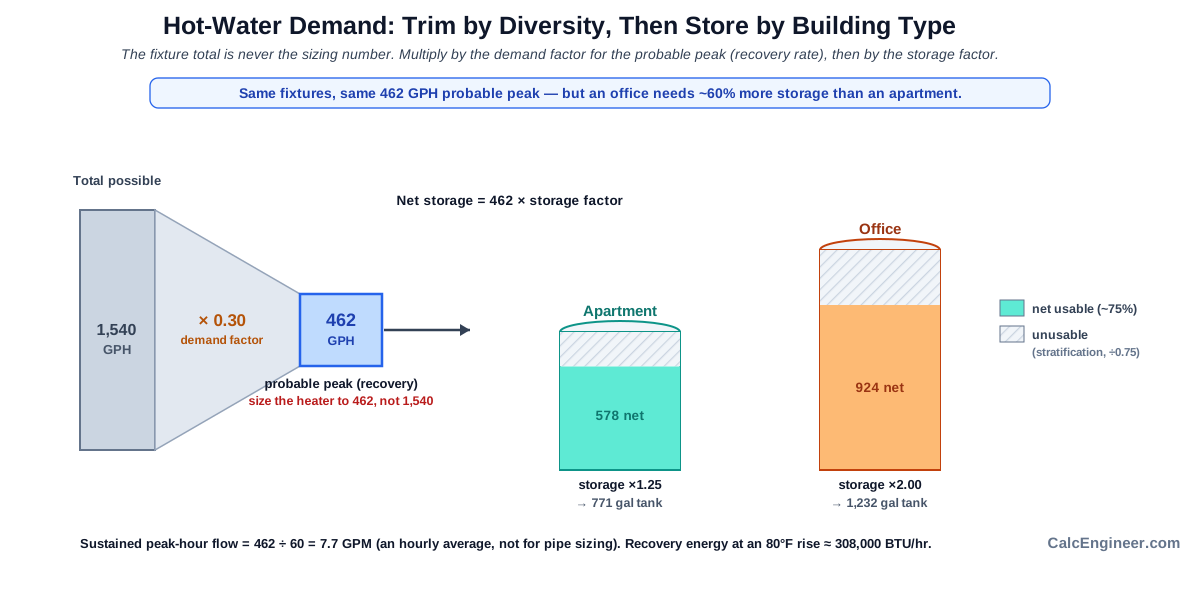
Demand factors from ASHRAE range from about 0.25 for a hotel or hospital, where use is spread out across many rooms and shifts, to about 0.40 for a school, where use is sharply peaked around class breaks. An apartment or office is about 0.30. A building with a total possible demand of 1,540 GPH in an apartment, at a demand factor of 0.30, has a probable peak of 462 GPH — and that 462 figure, not the 1,540, is what the heater must actually keep up with.
Hot Water Storage Capacity
Storage capacity is the probable peak demand times a storage capacity factor, and that factor also comes from the building type. The factors range from about 0.60 for a hospital, where demand is steady and a large tank is not needed to ride through peaks, to 2.00 for an office building, where demand is sharply peaked and a tank is needed to sustain delivery. This is why the same fixtures need very different storage in different buildings.
An apartment at a 1.25 storage factor and an office at 2.00 can share the same 462 GPH peak demand but need 578 and 924 gallons of storage. One more step: the storage number is net usable storage, but only part of a real tank is usable before the outlet temperature drops from mixing and stratification. ASHRAE assumes about 60 to 80 percent of a tank is usable, so the actual tank is larger than the net storage by about 25 to 66 percent.
Key Facts
- The ASHRAE demand factor trims the total possible demand to the probable peak; the heater is sized to the probable peak, not the total.
- A school has a demand factor of 0.40 because everyone uses hot water at the same breaks, but an office has a storage factor of 2.00 because its short sharp peaks are best met from a tank.
- The recovery rate equals the probable maximum demand by the ASHRAE method; no separate recovery capacity factor is used.
- Net storage is less than the actual tank size because only about 70–80 % of a tank is usable before the outlet temperature drops from stratification.
- A hospital has the lowest storage factor (0.60) because its demand is steady around the clock and a large tank is not needed to ride through peaks.
- The sustained peak-hour flow is the probable demand divided by 60; it is a peak-hour average, not an instantaneous flow, and must not be used for pipe sizing.
- Recovery energy in BTU/hr is 8.33 times the recovery GPH times the temperature rise: 8.33 x 462 GPH x 80 °F rise = 307,800 BTU/hr.
- The ASHRAE per-fixture hot-water demand values were developed before modern low-flow fixtures and can be conservative.
Applications
- Estimating the peak hourly hot water demand for an apartment, hotel, office, school, or hospital.
- Finding the recovery rate a central water heater must sustain.
- Sizing the storage tank capacity for a building.
- Comparing how much storage the same fixtures need in different building types.
- Estimating the recovery energy in BTU/hr for a given temperature rise.
- Producing the demand figure that feeds a tank or tankless heater selection.
- Checking whether an existing storage system is undersized for the peak-hour demand.
- Estimating a central domestic hot water plant load for early design.
Example Calculation
Case 1 — Apartment, fixture method (canonical)
20-unit apartment, each unit with 1 lavatory (2 GPH), 1 bathtub (20 GPH), 1 shower (30 GPH), 1 kitchen sink (10 GPH), 1 dishwasher (15 GPH).
Per unit:  2 + 20 + 30 + 10 + 15            = 77 GPH
Total:     77 x 20 units                    = 1,540 GPH (total possible demand)
Demand factor (apartment):                    0.30
Probable peak: 1,540 x 0.30                 = 462 GPH (recovery rate)
Sustained flow: 462 / 60                    = 7.7 GPM
Storage factor (apartment):                   1.25
Net storage: 462 x 1.25                     = 578 gallons
Actual tank (usable 0.75): 578 / 0.75       = 771 gallons
Case 2 — Same fixtures, office (building-type difference)
The ASHRAE office column sets bathtub demand to 0 (not applicable). With the same 20 units:
Per unit (office):  2 + 0 + 30 + 10 + 15    = 57 GPH   (no bathtub, no laundry)
Total:     57 x 20 units                    = 1,140 GPH (total possible demand)
Demand factor (office):                       0.30
Probable peak: 1,140 x 0.30                 = 342 GPH (recovery rate)
Sustained flow: 342 / 60                    = 5.7 GPM
Storage factor (office):                      2.00
Net storage: 342 x 2.00                     = 684 gallons
Actual tank (usable 0.75): 684 / 0.75       = 912 gallons
The office needs a higher storage factor (2.00 vs 1.25) but the bathtub exclusion reduces the total, so the probable peak is lower. The actual tank (912 gal) is still larger than the apartment (771 gal) because of the higher storage factor.
Case 3 — Per-capita method
200 occupants, 40 GPD per person, peak-hour fraction 1/7 ≈ 0.14.
Daily demand: 200 x 40                      = 8,000 gal/day
Peak-hour demand: 8,000 x 0.14             = 1,143 GPH (recovery rate)
Sustained flow: 1,143 / 60                 = 19.1 GPM
Case 4 — Recovery energy
Probable peak 462 GPH, temperature rise 80°F (60°F incoming to 140°F storage).
Recovery energy: 8.33 x 462 x 80 = 307,800 BTU/hr (90.2 kW)
Case 5 — Override active
Apartment, total 1,540 GPH, demand factor overridden from 0.30 to 0.25.
Probable peak: 1,540 x 0.25 = 385 GPH (shown with override note)
Standards & References
- ASHRAE Handbook, HVAC Applications, Service Water Heating chapter — Hot-water demand per fixture, demand factor, storage capacity factor method.
- ASHRAE Service Water Heating sizing method (UpCodes) — Code-referenced version of the ASHRAE demand-factor and storage-factor method.
- US Department of Energy, Sizing a New Water Heater — DOE guidance on water heater sizing methods and efficiency.
- ASPE Plumbing Engineering Design Handbook — Service water heating demand factors and domestic hot water design.
- International Plumbing Code and Uniform Plumbing Code — Water heater sizing and installation requirements.
Units
The calculator works in either US or metric units, set by its own Unit System selector. The internal selector is authoritative and takes precedence over any global site header selector. Switching the selector converts entered values rather than reinterpreting the same number.
| Quantity | US | Metric |
|---|---|---|
| Demand (rate) | GPH (gallons per hour) | L/hr (liters per hour) |
| Daily demand | gal/day | L/day |
| Flow | GPM | L/min |
| Storage | gallons | liters |
| Temperature rise | °F | °C |
| Recovery energy | BTU/hr | kW |
Reference points: 1 GPH = 3.785 L/hr; 462 GPH = 1,749 L/hr. 578 gallons = 2,188 liters. 462 GPH / 60 = 7.7 GPM = 29.1 L/min. Recovery energy: 307,800 BTU/hr = 90.2 kW (divide BTU/hr by 3,412).
Limitations
- This is a demand estimate using the ASHRAE demand-factor method. It is not the full ASHRAE storage-versus-recovery trade-off curve, which is a v2 feature.
- The sustained peak-hour flow is a peak-hour average, not an instantaneous flow. Do not use it for pipe sizing or tankless heater sizing.
- The ASHRAE per-fixture values were developed before modern low-flow fixtures and can be conservative. Confirm against your project or code basis.
- For mixed-use buildings, calculate the major uses separately and combine. One building type may not represent the whole demand pattern.
- This calculator does not select a specific tank or heater model, size a recirculation loop, or compute the mixing-valve calculation between storage and delivery temperature.
- Recovery energy uses one temperature rise from incoming water to storage temperature. It does not model the mixing valve between storage and delivery temperature.
- For on-demand (tankless) sizing by instantaneous peak GPM and temperature rise, use the Tankless Water Heater Sizing Calculator.
Common Mistakes to Avoid
- Using the total possible demand as the sizing number. Apply the demand factor, because fixtures rarely all run at once.
- Using the same storage for every building type. The storage capacity factor differs, so an office needs far more storage than an apartment for the same fixtures.
- Confusing the probable demand with the total possible demand. The heater is sized to the probable peak, not the total.
- Using the sustained peak-hour GPM for pipe sizing. Pipe sizing uses the instantaneous fixture-unit demand, which is higher.
- Treating this as a tankless sizing. A tankless heater is sized from the instantaneous peak GPM and the temperature rise, not the peak-hour GPH.
- Forgetting the usable-storage correction. The actual tank is larger than the net storage, because part of the tank is unusable.
- Mixing gallons per person per day with gallons per person per hour in the per-capita method. Enter the daily value and let the peak-hour fraction find the peak.
- Applying the ASHRAE per-fixture values without judgment for a low-flow modern building, where they can be conservative.
Frequently Asked Questions
How do I calculate hot water demand?
What is a demand factor?
What is the difference between total and probable demand?
How much storage do I need?
Why is the actual tank larger than the storage result?
What is the recovery rate?
Is this the same as the flow I use for pipe sizing?
Should I use the fixture method or the per-capita method?
Can I use this for a mixed-use building?
Why can ASHRAE fixture values be conservative?
Frequently Used Together
Engineers often use these calculators in combination for complete project workflows:
Related Calculators
Explore similar calculators that might be useful for your project:
Plumbing Quick Reference — Keep It On Your Phone On Site
A 10-page field reference for catching pressure, velocity, slope, and pump-sizing mistakes before you order pipe, close a wall, or add a booster.
- Velocity limits, fixture pressure minimums, drain slope, and the 80 psi ceiling in one table
- Worked examples that show why a single pressure number gives four different answers
- Keep it on your phone, or print the two field-check pages
Free PDF. Calculators stay free. Unsubscribe anytime.
Calculate
Fixture method uses the count of each fixture and the ASHRAE hot-water demand per fixture. Per-capita uses the number of people, gallons per person per day, and a peak-hour fraction. Both apply a demand factor for diversity.
Sets the demand factor for diversity, the storage capacity factor, and the hot-water demand per fixture. The same fixtures need different storage in different building types, because the use pattern differs.
Fixture Counts (number served by this heater)
Number of lavatories (bathroom sinks) served. Hot-water demand: 2 GPH (apartment/residence/office), 6 GPH (hotel, hospital), per ASHRAE building-type column.
Number of bathtubs served. Hot-water demand: 20 GPH (apartment/residence/hotel), 10 GPH (hospital). Not typically applicable for office, school, or industrial.
Number of showers served. Hot-water demand: 30 GPH per fixture across all building types, per ASHRAE.
Number of kitchen sinks served. Hot-water demand: 10 GPH per sink across applicable building types, per ASHRAE.
Number of dishwashers served. Hot-water demand: 15 GPH per unit across applicable building types, per ASHRAE.
Number of laundry units (washers) served. Hot-water demand: 35 GPH per unit for apartment, residence, hotel, hospital, and industrial, per ASHRAE.
Optional Parameters
Rise from incoming cold water to storage temperature (commonly 140°F storage). Used to convert the recovery rate into heater energy in BTU/hr and kW. Leave blank to omit the energy line.
Share of the tank volume that is usable before the outlet temperature drops. ASHRAE assumes about 70–80 %. The actual tank is the net storage divided by this fraction.
Override the ASHRAE demand factor for this building type. Leave blank to use the ASHRAE default. Use only when you have a project-specific diversity study.
Override the ASHRAE storage capacity factor. Leave blank to use the ASHRAE default. Enter a project-specific value when your building's peak pattern differs from the ASHRAE type.