Water Supply Fixture Unit Calculator — WSFU & GPM Demand
On this page
Calculate
WSFU is dimensionless and identical in both systems. Only the demand in GPM or L/min changes with the unit selector.
Private is a dwelling or private bathroom. Public is a fixture used by the public or an unknown number of people, which carries a higher WSFU. A public flush tank toilet is 5 WSFU, a private one is 2.2.
The demand table has two columns. Use the flushometer column when the system predominantly serves flushometer valve water closets, and the flush tank column otherwise. Most commercial systems are flushometer, most dwellings are flush tank.
Water Closets
A flush tank refills slowly from a small supply. Private: 2.2 WSFU, Public: 5.0 WSFU. Enter each type on its own row so a mixed building counts correctly.
A flushometer valve draws a large flow directly from the pipe for a few seconds. Private: 6.0 WSFU, Public: 10.0 WSFU.
Bathroom Groups (Private Only)
Private bathroom group (toilet, lavatory, and tub or shower): flush tank = 3.6 WSFU total. Use the group value OR individual fixtures, not both. Public restrooms use individual fixtures.
Private bathroom group with flushometer valve toilet: 8.0 WSFU total. About 2.2 times the flush tank version. Private only.
Other Fixtures
Private: 0.7 WSFU total (0.5 cold, 0.5 hot). Public: 2.0 WSFU total (1.5 cold, 1.5 hot).
Private: 1.4 WSFU total (1.0 cold, 1.0 hot). Public: 4.0 WSFU total (3.0 cold, 3.0 hot).
Per shower head. Private: 1.4 WSFU total. Public: 4.0 WSFU total.
Private (faucet): 1.4 WSFU total (1.0 cold, 1.0 hot). Public/hotel/restaurant: 4.0 WSFU total (3.0 cold, 3.0 hot).
Private, automatic: 1.4 WSFU, hot supply only. No cold load.
Automatic clothes washer: 1.4 WSFU total (1.0 cold, 1.0 hot). IPC Table E103.3(2), private occupancy.
One to three laundry trays counted as a single fixture: 1.4 WSFU total (1.0 cold, 1.0 hot). Private, faucet.
Offices, faucet: 3.0 WSFU total (2.25 cold, 2.25 hot).
Private, faucet: 2.0 WSFU total (1.5 cold, 1.5 hot). Private use only.
Private, faucet: 3.0 WSFU total (2.25 cold, 2.25 hot). Private use only.
3/4 in flushometer valve, public: 5.0 WSFU (cold only). Public use only.
Offices, 3/8 in valve: 0.25 WSFU each (cold only).
Outdoor hose connection: 2.5 WSFU (cold only). IPC Table E103.3(2). This calculator counts every hose bibb at full value; if your IPC edition carries a note reducing additional bibbs, adjust the count accordingly.
Continuous Demand (Optional)
Lawn sprinklers, cooling equipment, and similar continuous flows are added directly in GPM after the fixture conversion. They are not run through the fixture unit curve, because they are not intermittent.
What to Look at First
The single biggest number on this page is determined by how the toilets flush. A private water closet is 2.2 WSFU with a flush tank but 6.0 WSFU with a flushometer valve. That difference of 2.7 times moves the total load more than any other single input.
Check the System Type selector next: it governs which demand table column converts your load to GPM, and the flushometer column is much higher at small loads than the flush tank column.
Both effects compound, so a building with flushometer valves is not just heavier on the fixture side but also reads from a steeper conversion curve.
How to Use This Calculator
Choose your unit system with the calculator's own selector. WSFU is a code value that is identical in both systems. Only the demand in GPM or L/min changes units.
Choose the occupancy. Private is a dwelling or private bathroom. Public is a fixture used by the public or by an unknown number of people, and it carries a higher value.
Enter the count of each fixture. Water closets and urinals have separate rows for flush tank and flushometer valve, so a building with both types can be counted correctly.
Check the system type. It sets which demand column converts your total. Most commercial buildings are flushometer, most dwellings are flush tank.
Add a continuous demand if the system serves lawn sprinklers, cooling equipment, or similar. That flow is added in GPM after the conversion.
Click Calculate. You get the cold, hot, and total WSFU, the peak demand in GPM, the table rows used for the conversion, and the combined demand with any continuous flow.
Formula
Step 1: Total Fixture Load
total_cold  = Σ ( count × wsfu_cold )  for each fixture row
total_hot   = Σ ( count × wsfu_hot )   for each fixture row
total_wsfu  = Σ ( count × wsfu_total ) for each fixture row
Each column is summed independently. Never add total_cold and total_hot to get total_wsfu.
Step 2: Hot and Cold Split Rule
cold = hot = 0.75 × total_wsfu (rounded to nearest 0.1)
Applies to fixtures with both hot and cold supply. Water closets and urinals draw cold only: cold = total_wsfu, hot = 0.
Step 3: Peak Demand (IPC Table E103.3(3))
Column A: tank-type flush (default)
Column B: flushometer valve (predominantly flush valve fixtures)

demand_gpm = table lookup using total_wsfu in the selected column
Step 4: Interpolation Inside Table Range
demand_gpm = gpm_low + (total_wsfu − wsfu_low) / (wsfu_high − wsfu_low) × (gpm_high − gpm_low)
Below the smallest row: use the first row as an estimate. Above the largest row: do not extrapolate.
Step 5: Continuous Demand
flow_GPM     = flow_L_min / 3.785          (metric input only)
combined_gpm = demand_gpm + flow_GPM
Continuous flows are added after conversion; never summed as WSFU.
Metric Note
1 GPM = 3.785 L/min
demand_L_min = demand_gpm × 3.785
WSFU values never change between unit systems. Only the demand output converts.
Variable Reference
| Variable | Meaning | Units |
|---|---|---|
| wsfu_cold / wsfu_hot / wsfu_total | Fixture unit weight per fixture | none |
| count | Number of fixtures of that type | none |
| total_wsfu | Combined fixture unit load | WSFU |
| demand_gpm | Peak flow from IPC Table E103.3(3) | GPM |
| combined_gpm | demand + continuous flow | GPM |
| flow_GPM | Continuous demand (e.g. hose bib) | GPM |
What Is a Water Supply Fixture Unit
A water supply fixture unit, or WSFU, is a weighted number that represents the probable demand a fixture places on the water supply piping. It accounts for how much water the fixture uses, how long it draws, and how often it is used. It is a code load value, not a measured flow rate.
The weighting exists because fixtures do not all run at once. If you added the flow rating of every fixture in a building, you would size the main for a moment that never happens, and the pipe would be enormous and expensive. The fixture unit method, which comes from Roy Hunter's probability work at the National Bureau of Standards, builds that diversity into the numbers. You sum the units, then convert the total through a demand curve that already accounts for simultaneous use.
The WSFU total is the input to demand conversion, not the final design flow by itself. The conversion is where the method earns its keep. It is deliberately non-linear: at low loads a small number of fixtures can realistically all run together, so the demand rises steeply, while at high loads the odds of everything running at once collapse and the curve flattens. This is why a large building needs proportionally less pipe capacity per fixture than a small one.
WSFU to GPM Conversion
The most common mistake in supply sizing is treating fixture units as a flow rate. They are not. A total of 43 WSFU does not mean 43 gallons per minute. The number only becomes a flow after you look it up in the code demand table, IPC Table E103.3(3).
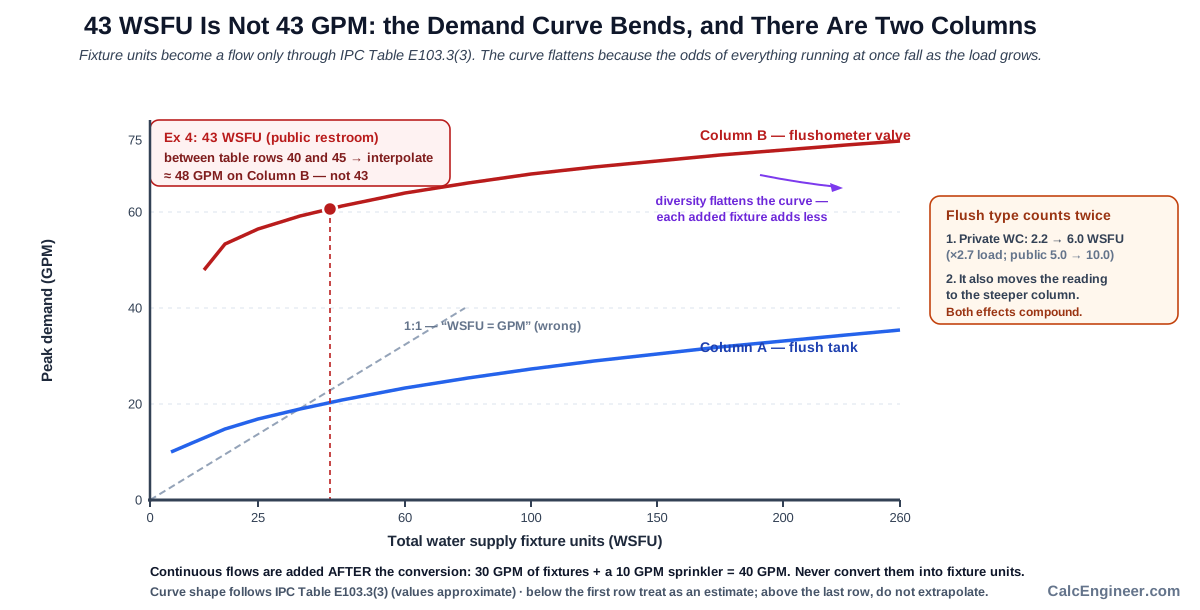
The conversion is deliberately non-linear, and the reason is probability. With a handful of fixtures, it is realistic that several run at once, so the curve rises steeply at the low end. With hundreds of fixtures, the chance that all of them open at the same second collapses, so each additional fixture adds less demand than the one before. That is why the curve flattens, and why a large building needs proportionally less pipe capacity per fixture than a small one.
The table has two columns, and picking the wrong one is the second common error. One column applies to systems that predominantly use flush tanks, the other to systems that predominantly use flushometer valves. The flushometer column is much higher at small loads.
Flush Tank vs Flushometer WSFU
Nothing on this page moves the answer more than how the toilets flush.
- Private water closet, flush tank: 2.2 WSFU
- Private water closet, flushometer valve: 6.0 WSFU
- Public water closet, flush tank: 5.0 WSFU
- Public water closet, flushometer valve: 10.0 WSFU
A private toilet nearly triples its load when it goes from a tank to a flush valve, and a public one doubles. A flushometer valve takes the entire flush directly out of the supply pipe in a few seconds, so the pipe has to carry a large flow for that short burst. A flush tank stores the water in advance and refills slowly through a small supply, spreading the same volume over roughly twenty seconds. Pipe is sized for the peak, not the average.
Mixed buildings are common. Count each toilet type on its own row, then choose the system type that describes the building as a whole.
Private vs Public WSFU
The same fixture carries a higher load in public use than in private use, because it serves more people and gets used more often.
- Lavatory: 0.7 total private, 2.0 total public
- Bathtub: 1.4 total private, 4.0 total public
- Kitchen sink: 1.4 total private, 4.0 total in a hotel or restaurant
Using a private value in a public building is a silent undersizing error, because it can cut the load by half or more before the conversion even happens. The calculator switches every applicable row when you change the occupancy.
Cold, Hot, and Total WSFU
The code table gives three numbers for most fixtures: a cold load, a hot load, and a total load. They exist because the cold branch, the hot branch, and the whole system are sized separately.
For a fixture with both supplies, the code sets the cold value and the hot value each at three quarters of the total. That produces a result that looks wrong at first glance:
- Bathtub, private: cold 1.0, hot 1.0, total 1.4
- Lavatory, public: cold 1.5, hot 1.5, total 2.0
- Bathroom group, private, flush tank: cold 2.7, hot 1.5, total 3.6
Cold plus hot always comes to more than the total. That is intentional, not a math error. The cold branch has to handle its own worst moment and the hot branch has to handle its own worst moment, but those two moments do not coincide.
Water closets and urinals draw cold only, so their cold value equals their total and their hot value is zero. A dishwasher is the reverse, hot only.
WSFU vs DFU
Water supply fixture units and drainage fixture units are two separate scales for two separate systems.
A WSFU measures the load a fixture places on the potable water supply piping. A DFU measures the load the same fixture places on the drain, waste, and vent system. Both come from the same probability work, but the values are different.
- Private water closet, flush tank: 2.2 WSFU on the supply side, 3 DFU on the drainage side
The reason they differ is behavioral. On the supply side, a flush tank refills slowly through a small supply, which is a modest demand. On the drainage side, the same toilet dumps its entire bowl volume into the drain at once, which is a heavy load.
Use WSFU with this calculator to estimate the water demand, and use the Drainage Fixture Unit Calculator for the drain side. Never carry a total from one into the other.
Continuous Demand in WSFU Calculations
Not every load on a water service comes from plumbing fixtures. Lawn sprinklers, cooling tower make-up water, process equipment, and similar devices draw water steadily rather than in short bursts. The fixture unit method does not describe them correctly, because a fixture unit assumes intermittent use.
The code handles this by keeping continuous flows outside the fixture unit system. You convert the fixture load to GPM first, then add the continuous flow to that result in GPM.
- Fixture demand from the conversion: 30 GPM
- Lawn sprinkler running continuously: 10 GPM
- Combined demand: 40 GPM, which is about 151 L/min
In metric, enter the continuous flow in L/min and the calculator converts it to GPM before adding, so 37.9 L/min contributes 10 GPM and not 37.9.
Bathroom Group WSFU
A bathroom group is a code shortcut for a water closet, a lavatory, and a tub or shower serving one bathroom. Instead of counting the three fixtures separately, you can use a single group value.
- Private bathroom group, flush tank: cold 2.7, hot 1.5, total 3.6
- Private bathroom group, flushometer valve: cold 6.0, hot 3.0, total 8.0
The group value replaces the individual fixtures, so never count both. The group value is private only. The calculator warns if a group and its component fixtures are both entered.
WSFU Demand Table Interpolation
Real fixture schedules rarely land exactly on a listed load, so the mechanics of reading the table matter. There are four cases.
The total matches a listed row. Use that row directly. No interpolation is needed.
The total falls between two rows. Interpolate linearly between them: demand equals the lower row plus the fraction of the gap times the GPM difference between the two rows.
The total is below the smallest listed row. Use the first row and treat the result as an estimate. Do not extend the curve downward.
The total is above the largest listed row. Do not extrapolate. Take the demand from the full code table or from engineering design.
Key Facts
- A water supply fixture unit is a weighted supply load, not a flow rate.
- The total WSFU is the sum of every fixture at its value for that occupancy and supply control.
- Converting the total to GPM uses the code demand table and is not proportional. Doubling the load does not double the flow.
- The demand table has two columns: one for flush tank systems and one for flushometer valve systems.
- A private water closet is 2.2 WSFU with a flush tank and 6.0 with a flushometer valve.
- A public water closet is 5.0 WSFU with a flush tank and 10.0 with a flushometer valve.
- For a fixture with both hot and cold supplies, each side is three quarters of the total, so cold plus hot adds up to more than the total.
- A private bathroom group is 3.6 WSFU with a flush tank and 8.0 with a flushometer valve, lower than counting its fixtures individually.
- If the total falls between demand table rows, the GPM demand is interpolated between them.
- Continuous flows such as lawn sprinklers are added in GPM after the conversion, never summed as fixture units.
- WSFU is a supply value and DFU is a drainage value. The same private toilet is 2.2 WSFU on the supply side and 3 DFU on the drain side.
Applications
- Sizing the water service and building main from a fixture schedule.
- Comparing the supply load of a flush tank design against a flushometer design.
- Estimating peak demand before selecting a meter or a booster pump.
- Checking how much load a renovation or an added restroom puts on an existing main.
- Producing the GPM demand that feeds the Water Pipe Sizing Calculator.
- Separating the cold branch load from the total.
- Adding irrigation or cooling flow to a domestic demand for a combined service.
- Working through a plumbing license exam problem.
- Verifying that an existing service main can support the load of a tenant improvement or a change of occupancy.
- Documenting the design demand for a permit application or an engineer's submission.
Example Calculation
Example 1: Private bathroom group, flush tank
One private bathroom group with a flush tank water closet.
- Cold: 2.7 WSFU
- Hot: 1.5 WSFU
- Total: 3.6 WSFU
Cold plus hot comes to 4.2, which is more than the total of 3.6. Each side is sized for its own peak, and those peaks do not happen at the same instant.
Example 2: The same group with a flushometer valve
One private bathroom group, flushometer valve water closet.
- Cold: 6.0 WSFU
- Hot: 3.0 WSFU
- Total: 8.0 WSFU
Identical fixtures, about 2.2 times the supply load, purely because of how the toilet flushes.
Example 3: The water closet by itself, all four combinations
- Private, flush tank: 2.2 WSFU
- Private, flushometer valve: 6.0 WSFU
- Public, flush tank: 5.0 WSFU
- Public, flushometer valve: 10.0 WSFU
Example 4: Public restroom
Four public water closets with flushometer valves, plus two public lavatories.
- Cold column: 4 times 10.0, plus 2 times 1.5, equals 43.0 WSFU
- Total column: 4 times 10.0, plus 2 times 2.0, equals 44.0 WSFU
Converting 43 WSFU: the demand table lists rows at 40 and 45, so 43 sits between them and the demand is interpolated using the flushometer column.
Example 5: Adding a continuous demand
A building whose fixtures convert to 30 GPM, plus a lawn sprinkler drawing 10 GPM continuously.
- Fixture demand: 30 GPM
- Continuous demand: 10 GPM
- Combined demand: 40 GPM (about 151 L/min)
The sprinkler flow is added after the conversion.
Example 6: Metric continuous demand
A continuous demand entered as 37.9 L/min converts to 10.0 GPM before it is added. If the fixtures convert to 30 GPM, the combined demand is 40 GPM, or about 151 L/min. The WSFU totals themselves do not change at all between unit systems.
Example 7: The three-quarters rule across the table
For any fixture with both a hot and a cold supply, each branch is assigned three quarters of the total WSFU. A sampling from IPC Table E103.3(2) private values:
- Lavatory: cold 0.5, hot 0.5, total 0.7; sum of branches is 1.0, total is 0.7
- Bathtub: cold 1.0, hot 1.0, total 1.4; sum is 2.0, total is 1.4
- Kitchen sink: cold 1.0, hot 1.0, total 1.4; same pattern
- Public lavatory: cold 1.5, hot 1.5, total 2.0; sum is 3.0, total is 2.0
In every row the two branches sum to more than the total. The cold branch and the hot branch each have to carry their own peak, but those peaks do not occur at the same instant. This is the code's built-in diversity allowance, not a math error.
Example 8: Total lands exactly on a table row
Three public flush tank water closets: 3 times 5.0 WSFU equals 15.0 WSFU total. If IPC Table E103.3(3) lists 15 as a row in the flush tank column, the demand reads directly from that row with no interpolation. When the total matches a listed row exactly, use that row and note it as an exact match.
Example 9: Total falls below the smallest table row
One private lavatory: 0.7 WSFU. The flush tank demand table begins at 1 WSFU. Because 0.7 falls below the first listed row, the calculator uses the first row as an estimate and flags the result as approximate. The code does not extrapolate below the table minimum.
Example 10: Supply load versus drainage load for the same fixture
One private water closet, flush tank:
- Supply side: 2.2 WSFU. The flush tank refills slowly through a small supply connection, a modest demand on the pipe.
- Drainage side: 3 DFU. The same toilet dumps its entire bowl volume into the drain at once, a heavy load on the waste piping.
WSFU and DFU are separate scales for separate systems. The supply pipe is sized with WSFU and this calculator. The drain is sized with DFU and a drainage fixture unit calculator. Never carry a total from one system into the other.
Standards & References
- IPC Appendix E, Sizing of Water Piping System, International Code Council. The parent appendix containing both the fixture load table (E103.3(2)) and the demand table (E103.3(3)).
- Water Supply Fixture Units assigned to fixtures, UpCodes. IPC Table E103.3(2), the fixture load table with cold, hot, and total columns.
- Demand in GPM corresponding to fixture load in WSFU, UpCodes. IPC Table E103.3(3), the WSFU-to-GPM conversion table.
- IPC Table E103.3(2), Load Values Assigned to Fixtures. Source of every fixture value in this calculator.
- IPC Table E103.3(3), Table for Estimating Demand. Source of the WSFU to GPM conversion.
Units
Water supply fixture units are dimensionless. A total of 43 WSFU is 43 WSFU in both unit systems. Only the demand converts when you switch systems. Conversion reference points: 1 GPM equals 3.785 L/min, 10 GPM equals 37.9 L/min, 40 GPM equals 151.4 L/min, and 48 GPM equals 181.7 L/min. In metric mode, a continuous demand entered in L/min is converted to GPM before the code rule is applied: 37.9 L/min is treated as 10 GPM and not as 37.9 GPM. WSFU totals themselves never change between unit systems.
Limitations
- This version uses the IPC Appendix E tables. The UPC and the NSPC assign different values and are not included.
- If a total falls above the largest row of the demand table, the tool does not extrapolate. Take the demand from the code or from engineering design.
- Hot water piping and cold branches that serve no flushometer valves would use the flush tank column even in a flushometer building. Separate branch conversion is planned for a later version.
- This version reports total system demand only. Separate hot and cold branch demand conversion is planned for version 2.
- Confirm the code your jurisdiction enforces and any local amendments.
- WSFU counts load. It does not produce pipe diameter, velocity, pressure drop, or meter size.
Common Mistakes to Avoid
- Treating fixture units as a flow rate. WSFU is a weighted load. It only becomes GPM after you convert it through the demand table.
- Adding fixture flow ratings in GPM instead of using fixture units. That assumes everything runs at once.
- Scaling demand in proportion to the load. The conversion is not linear.
- Reading the wrong demand column. A flushometer system draws far more at the same fixture unit count than a flush tank system.
- Using a private value for a public fixture. A public flush tank toilet is 5.0 WSFU, not 2.2.
- Expecting cold plus hot to equal the total. Each side is three quarters of the total by code convention.
- Counting a bathroom group and its individual fixtures both. The group value already covers the toilet, lavatory, and tub or shower.
- Turning a lawn sprinkler into fixture units. Continuous flows are added in GPM after the conversion.
- Using this total to size a drain. Drainage uses DFU, a different scale entirely.
- Interpolating outside the table. If the load is above the table, do not extend the line.
- Assuming one flush type applies to the whole building. Mixed buildings often have both flush tanks and flushometer valves. Each type has its own row, and the system type selector governs which demand column converts the total.
- Using the total system demand to size an individual branch. The combined demand covers the entire building. Each branch carries only the fixtures it serves. Apply the conversion to each branch's fixture load separately, not the whole-building total.
Frequently Asked Questions
What is a water supply fixture unit (WSFU)?
How do I convert WSFU to GPM?
What is the WSFU of a toilet?
Why do the cold and hot values add up to more than the total?
What is the difference between WSFU and DFU?
How do I handle lawn sprinklers or cooling equipment?
Which demand column should I use, flush tank or flushometer?
Why does a flushometer valve carry so much more supply load than a flush tank?
Can I add cold WSFU and hot WSFU to get the total WSFU?
Does this calculator size the water pipe?
Can this calculator be used for the Uniform Plumbing Code?
Frequently Used Together
Engineers often use these calculators in combination for complete project workflows:
Related Calculators
Explore similar calculators that might be useful for your project:
Plumbing Quick Reference — Keep It On Your Phone On Site
A 10-page field reference for catching pressure, velocity, slope, and pump-sizing mistakes before you order pipe, close a wall, or add a booster.
- Velocity limits, fixture pressure minimums, drain slope, and the 80 psi ceiling in one table
- Worked examples that show why a single pressure number gives four different answers
- Keep it on your phone, or print the two field-check pages
Free PDF. Calculators stay free. Unsubscribe anytime.
Calculate
WSFU is dimensionless and identical in both systems. Only the demand in GPM or L/min changes with the unit selector.
Private is a dwelling or private bathroom. Public is a fixture used by the public or an unknown number of people, which carries a higher WSFU. A public flush tank toilet is 5 WSFU, a private one is 2.2.
The demand table has two columns. Use the flushometer column when the system predominantly serves flushometer valve water closets, and the flush tank column otherwise. Most commercial systems are flushometer, most dwellings are flush tank.
Water Closets
A flush tank refills slowly from a small supply. Private: 2.2 WSFU, Public: 5.0 WSFU. Enter each type on its own row so a mixed building counts correctly.
A flushometer valve draws a large flow directly from the pipe for a few seconds. Private: 6.0 WSFU, Public: 10.0 WSFU.
Bathroom Groups (Private Only)
Private bathroom group (toilet, lavatory, and tub or shower): flush tank = 3.6 WSFU total. Use the group value OR individual fixtures, not both. Public restrooms use individual fixtures.
Private bathroom group with flushometer valve toilet: 8.0 WSFU total. About 2.2 times the flush tank version. Private only.
Other Fixtures
Private: 0.7 WSFU total (0.5 cold, 0.5 hot). Public: 2.0 WSFU total (1.5 cold, 1.5 hot).
Private: 1.4 WSFU total (1.0 cold, 1.0 hot). Public: 4.0 WSFU total (3.0 cold, 3.0 hot).
Per shower head. Private: 1.4 WSFU total. Public: 4.0 WSFU total.
Private (faucet): 1.4 WSFU total (1.0 cold, 1.0 hot). Public/hotel/restaurant: 4.0 WSFU total (3.0 cold, 3.0 hot).
Private, automatic: 1.4 WSFU, hot supply only. No cold load.
Automatic clothes washer: 1.4 WSFU total (1.0 cold, 1.0 hot). IPC Table E103.3(2), private occupancy.
One to three laundry trays counted as a single fixture: 1.4 WSFU total (1.0 cold, 1.0 hot). Private, faucet.
Offices, faucet: 3.0 WSFU total (2.25 cold, 2.25 hot).
Private, faucet: 2.0 WSFU total (1.5 cold, 1.5 hot). Private use only.
Private, faucet: 3.0 WSFU total (2.25 cold, 2.25 hot). Private use only.
3/4 in flushometer valve, public: 5.0 WSFU (cold only). Public use only.
Offices, 3/8 in valve: 0.25 WSFU each (cold only).
Outdoor hose connection: 2.5 WSFU (cold only). IPC Table E103.3(2). This calculator counts every hose bibb at full value; if your IPC edition carries a note reducing additional bibbs, adjust the count accordingly.
Continuous Demand (Optional)
Lawn sprinklers, cooling equipment, and similar continuous flows are added directly in GPM after the fixture conversion. They are not run through the fixture unit curve, because they are not intermittent.