Drainage Fixture Unit Calculator — DFU Load & Pipe Size
On this page
Calculate
DFU is dimensionless and identical in both systems. Only the drain-size reference (in vs mm) and the water closet flush volume (gpf vs Lpf) change with the unit selector.
Enter the count of each fixture type, or enter fixtures by their drain or trap size for fixtures not in the type list. The by-drain-size table uses the IPC table.
Private is a dwelling or private bathroom. Public is a fixture used by the public or an unknown number of people, which carries a higher DFU. A public toilet is 4 DFU, a private one is 3.
IPC and UPC assign some fixtures different DFU values. A clothes washer is 2 DFU under the IPC and 3 under the UPC. Choose the code your jurisdiction enforces. The by-drain-size table and the drain-size reference use the IPC table.
Number of water closets (toilets). DFU depends on flush volume and use: 3 DFU private 1.6 gpf, 4 DFU public 1.6 gpf, 4 DFU private over 1.6 gpf, 6 DFU public over 1.6 gpf.
A water closet at 1.6 gpf or less is 3 DFU private, 4 public. A water closet over 1.6 gpf is 4 DFU private, 6 public.
Number of lavatories (washbasins). 1 DFU each for both private and public use.
Number of bathtubs. 2 DFU each.
Number of single-head shower stalls. 2 DFU each.
Number of kitchen sinks. 2 DFU each.
Number of dishwashers. 2 DFU each.
Number of clothes washers. 2 DFU each under the IPC, 3 DFU each under the UPC. The code selection above sets the value.
Number of 2 inch floor drains. 2 DFU each.
Number of urinals. 4 DFU each (public/commercial value per IPC Table 709.1, no separate private row for urinals).
Number of bidets. 1 DFU each.
Number of drinking fountains. 0.5 DFU each. Totals can be fractional: do not round down before checking the size reference.
A private bathroom group (water closet, lavatory, and tub or shower) is 5 DFU, lower than summing them (6 DFU) because of code diversity. Do not also count those fixtures individually. Public restrooms use individual fixtures.
For pumps, cooling, or other continuous flows, add the flow. The code counts 1 GPM of continuous flow as 2 DFU (IPC Section 709.3). In metric, the flow in L/min is converted to GPM first.
What to Look at First
Total DFU load: the sum of every fixture at its DFU value for the use and code. A private toilet is 3 DFU, a public one is 4. Use and code both matter. Read the total first.
Minimum branch drain size: the horizontal-branch reference from IPC Table 710.1(2). This is a starting point, not the final size. The Sanitary Drain Pipe Sizing Calculator handles full sizing by application and slope.
Private vs. Public: the same set of fixtures totals more in a public building. A toilet, lavatory, and bathtub are 6 DFU private, 7 DFU public, because the toilet steps up from 3 to 4.
Water closet minimum: any drain serving a toilet is at least 3 in, regardless of DFU total. A single toilet is only 3 DFU, which by capacity alone would fit a smaller pipe, but the 3 in rule applies.
How to Use This Calculator
Choose your unit system (US or metric) using the calculator's own selector. DFU is a code value identical in both systems; only the drain-size reference and flush volume convert.
Choose the method: by fixture type (default) to enter counts per fixture, or by fixture drain size for fixtures not in the type list.
Select the use (private or public) and the code (IPC or UPC). These set the DFU values.
Enter the count of each fixture. For a water closet, set the flush volume (1.6 gpf or less, or over 1.6 gpf).
Optionally add a continuous or semi-continuous flow in GPM (or L/min in metric), which the code counts as 2 DFU per GPM.
Read the result: the per-fixture breakdown, total DFU load, and minimum horizontal-branch drain size, with the water closet 3 in rule applied where relevant.
This calculator counts the drainage load. It does not size the pipe by application and slope. That is the Sanitary Drain Pipe Sizing Calculator. DFU is a drainage value, not a water supply fixture unit (WSFU); do not use this total to size the supply pipe.
Inputs & Outputs
Inputs
Setup
Fixture Counts (By Fixture Type)
Fixture Counts (By Drain Size, IPC 709.2)
Continuous Flow
Outputs
Results
Formula
The tool sums the DFU of each fixture at the selected use and code, adds any continuous flow at 2 DFU per GPM, then picks the smallest horizontal branch from IPC Table 710.1(2) at or above the total. Any branch serving a water closet is at least 3 in.
DFU is a dimensionless code load value.

1. Total DFU load
   total_DFU = sum over fixtures of
   ( count x dfu_value[fixture, use, code] )

2. Continuous flow (optional)
   flow_GPM = flow_L_min / 3.785  (metric only; use GPM for Imperial)
   continuous_DFU = 2 x flow_GPM   (IPC 709.3: 1 GPM = 2 DFU)
   total_DFU = total_DFU + continuous_DFU

3. Drain-size reference (IPC Table 710.1(2), horiz. fixture branch)
   pick smallest branch size whose capacity >= total_DFU
   (do not floor a fractional total first)
   1-1/2 in : 3 dfu     2 in : 6 dfu      2-1/2 in : 12 dfu
   3 in    : 20 dfu     4 in : 160 dfu    6 in    : 620 dfu

4. Water closet minimum
   if any water closet is present: reference = at least 3 in
   (even when DFU capacity alone allows a smaller pipe)
The DFU value depends on the fixture, the use (private or public), the flush volume for water closets, and the code (IPC or UPC). Continuous flow adds 2 DFU per GPM. A fractional total is carried forward, not rounded down. A water closet forces a 3 in minimum reference.
Overview
A drainage fixture unit, or DFU, is a weighted load value that lets you add up very different fixtures on one scale. A toilet does not put the same load on a drain as a sink, so the code assigns each fixture a DFU value based on how much it discharges, how long, and how often. Adding up the DFU of every fixture gives the total drainage load, and that total is what sizes the drain. The total DFU is the number you carry into drain sizing, but it is not the same as a final pipe size.
The value is not the same for every situation. A private toilet is 3 DFU, but a public one is 4, so the use matters. A clothes washer is 2 DFU under the IPC and 3 under the UPC, so the code matters. This calculator adds up the DFU for your fixtures, for your use and code, and returns the total plus a horizontal-branch drain-size reference.
The pipe diameter is a reference here, not the final size. This tool counts the drainage load; choosing the exact pipe diameter by application and slope is the Sanitary Drain Pipe Sizing Calculator. And DFU is a drainage value, not a water supply fixture unit, so it is not the number you use to size the supply pipe.
DFU Values by Fixture
Each fixture has a code DFU value that reflects its discharge. The representative IPC Table 709.1 values are below, with the private and public columns. A water closet also depends on the flush volume.
| Fixture | Private DFU | Public DFU |
|---|---|---|
| Water closet, 1.6 gpf or less | 3 | 4 |
| Water closet, over 1.6 gpf | 4 | 6 |
| Lavatory | 1 | 1 |
| Bathtub | 2 | 2 |
| Shower (single head) | 2 | 2 |
| Kitchen sink | 2 | 2 |
| Dishwasher | 2 | 2 |
| Clothes washer (IPC) | 2 | 2 |
| Floor drain (2 in) | 2 | 2 |
| Urinal | (public value) | 4 |
| Bidet | 1 | 1 |
| Drinking fountain | 0.5 | 0.5 |
| Bathroom group (1.6 gpf, private) | 5 | (individual fixtures) |
A lavatory is the lightest common fixture at 1 DFU, a toilet the heaviest at 3 to 6, and a drinking fountain is a half. Fixtures not in the table are valued by their drain or trap size: a 1-1/2 in drain is 2 DFU, a 2 in is 3, a 3 in is 5, and a 4 in is 6.
Private vs Public DFU
The same fixture carries a higher DFU in public use than in private use, because a public fixture is used by more people, more often, so its probable load is greater. The clearest case is the water closet: 3 DFU private, 4 DFU public. The code has separate private and public columns for this reason.
The effect is that the same set of fixtures totals more in a public building than in a dwelling. A toilet, a lavatory, and a bathtub are 6 DFU as private fixtures, but 7 DFU as public ones, because the toilet steps up from 3 to 4. Choose private for a dwelling or a private bathroom, and public for a fixture used by the public or by an unknown number of people. Getting this wrong undersizes or oversizes the drain.
IPC vs UPC DFU Values
The two model codes do not assign identical DFU values. Roughly half of US jurisdictions use the IPC and half use the UPC, and their tables diverge on some fixtures. The clearest example is the clothes washer: 2 DFU under the IPC, 3 DFU under the UPC. That one difference can shift a total enough to change the drain-size reference on a small project near a threshold.
Always use the code your jurisdiction enforces, and confirm any local amendments, which can change values again. In this calculator, the DFU values follow the code you choose where the values are verified, such as the clothes washer. The by-drain-size table and the drain-size reference use the IPC table in v1, which is noted in the result when UPC is selected.
Bathroom Group DFU
A bathroom group is a code shortcut. Instead of counting a water closet, a lavatory, and a tub or shower separately, the code lets you use a single group value, and that value is lower than the sum, because of diversity within the group. A private bathroom group at 1.6 gpf is 5 DFU, while the same three fixtures counted individually are 6 DFU (3 plus 1 plus 2).
The important rule is that the group and the individual fixtures are alternatives, not additions. If you use the 5 DFU group value, do not also count the toilet, lavatory, and tub or shower on top of it, or you count the same load twice and oversize the drain. The group value is a private-use value; a public restroom is counted from its individual fixtures. The calculator warns if a group and its component fixtures are both entered.
DFU vs WSFU
Drainage fixture units and water supply fixture units are two different things, and confusing them is a common error. A DFU is a drainage load, the load a fixture puts on the drain, waste, and vent system. A WSFU is a water supply fixture unit, the load the same fixture puts on the potable water supply pipe. They come from the same Hunter probability method, but they are separate values for separate purposes.
The same fixture has a different DFU and WSFU, because draining and supplying are different. A toilet drains a large slug of water quickly, but on the supply side a flush tank refills slowly, so its DFU and WSFU are not the same number. Use DFU with this calculator to size the drain side, and use the Water Supply Fixture Unit Calculator to size the supply pipe. Do not carry a DFU total into a supply calculation.
DFU to Drain Size Reference
The total DFU maps to a minimum drain size through the code capacity table. This calculator uses the IPC Table 710.1(2) horizontal fixture branch capacity for the reference:
| Branch size | Maximum DFU |
|---|---|
| 1-1/2 in | 3 |
| 2 in | 6 |
| 2-1/2 in | 12 |
| 3 in | 20 |
| 4 in | 160 |
| 6 in | 620 |
The reference is the smallest branch whose capacity is at or above your total. A total of 18 DFU fits a 3 in branch, and 26 DFU steps up to a 4 in branch, since it exceeds the 3 in capacity of 20.
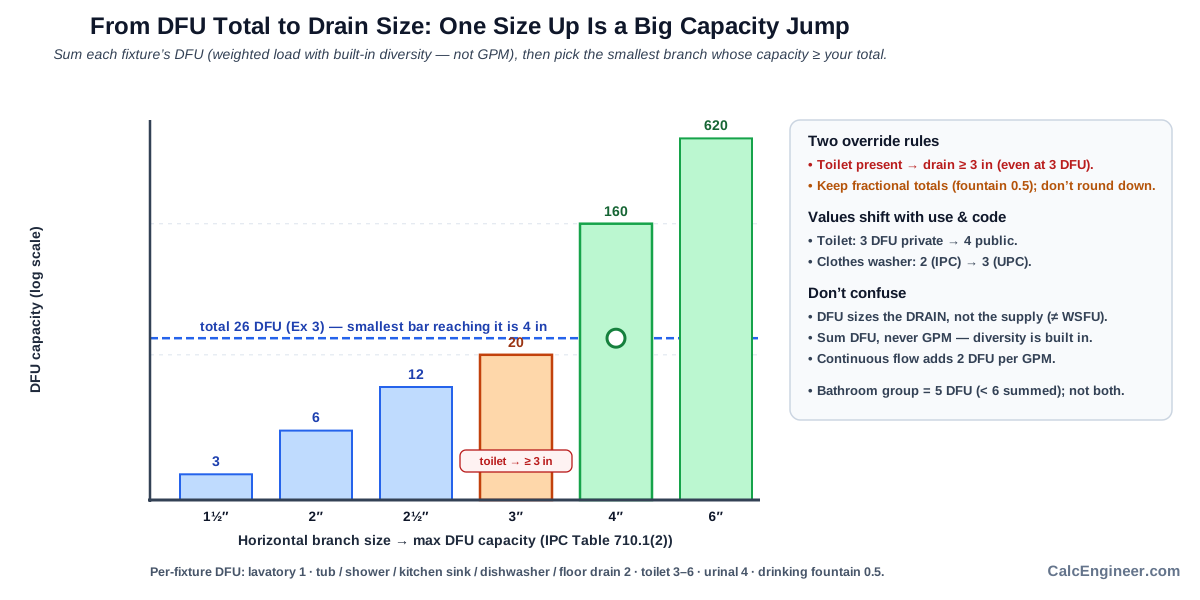
Two rules override the plain lookup: any branch serving a water closet is at least 3 in, and a fractional total is not rounded down first.
Continuous Flow to DFU
Not all drainage load comes from fixtures. A pump, a sump ejector, air conditioning equipment, or a similar device can put a continuous or semi-continuous flow into the drain, and the code converts that flow to DFU directly. The rule is 2 DFU for every gallon per minute of continuous flow, from IPC Section 709.3, and the UPC uses the same 2 units per GPM.
So a 10 GPM continuous flow adds 2 times 10, which is 20 DFU, on top of the fixture total. In metric, the flow is entered in liters per minute and converted to GPM first, so 37.9 L/min becomes 10 GPM and then 20 DFU, not treated as 37.9 GPM.
Water Closet 3 Inch Minimum
There is a rule that overrides the DFU capacity: any drain serving a water closet is at least 3 in, regardless of the DFU total. A single private toilet is only 3 DFU, which by capacity alone would fit a 1-1/2 in branch, but the 3 in minimum applies because a toilet discharges a large volume in a short burst that a smaller pipe cannot clear reliably.
This is why a size reference for any run with a toilet never drops below 3 in. In full sizing, the rule goes further: a building drain with more than two water closets is 4 in, and a building drain serving water closets is often 4 in. The calculator applies the 3 in branch minimum automatically and notes it, and defers the 4 in building-drain rules to the sizing calculator.
What is a Drainage Fixture Unit?
A drainage fixture unit is a weighted number that represents the load a fixture puts on the drain, based on its discharge rate, how long it discharges, and how often. It is a code load value, not a measured discharge rate. It normalizes very different fixtures onto one scale, so they can be added. A lavatory is 1 DFU, a bathtub is 2, and a toilet is 3 or 4, so a drain carrying a toilet and two sinks totals 5 or 6 DFU, and that total sizes the drain.
The reason for the weighting is that fixtures do not all discharge at once, and they discharge different amounts. Adding gallons per minute would badly oversize the drain, because it assumes everything runs together. The DFU method, from the same probability work as fixture units on the supply side, builds the diversity into the values, so the total reflects a realistic peak load. The code then maps the total to a pipe size that keeps the drain flowing without clogging or losing trap seals.
Units
Drainage fixture units are dimensionless code values, the same in US and metric. Only two things convert with the unit selector: the drain-size reference and the water closet flush volume.
| Quantity | US (Imperial) | Metric |
|---|---|---|
| DFU | DFU | DFU (identical) |
| Drain-size reference | in | mm |
| Water closet flush volume | gpf | Lpf |
| Continuous flow | GPM | L/min |
Reference points: the DFU total does not change between systems. The drain-size reference converts: 3 in is 80 mm, 4 in is 100 mm. A water closet flush of 1.6 gpf is 6.0 Lpf. A continuous flow of 10 GPM is 37.9 L/min, and either way it adds 20 DFU.
Key Facts
- A drainage fixture unit is a weighted drainage load value, not a flow rate.
- The total DFU is the sum of every fixture, each at its DFU value for the use and code.
- A private toilet is 3 DFU, a public toilet is 4. Private and public differ.
- A clothes washer is 2 DFU under the IPC and 3 under the UPC. The code differs.
- A lavatory is 1 DFU; a bathtub, shower, kitchen sink, dishwasher, or floor drain is 2 DFU each; a urinal is 4.
- A drinking fountain is 0.5 DFU. Totals can be fractional and should not be rounded down before a size reference.
- A private bathroom group is 5 DFU, lower than summing its fixtures (6), by code diversity. Use one or the other, not both.
- Any drain serving a water closet is at least 3 in, regardless of the DFU total.
- The total DFU gives a horizontal-branch size reference from IPC Table 710.1(2): 3 in carries 20 DFU, 4 in carries 160.
- DFU is a drainage value, not a water supply fixture unit. Do not use it to size the supply pipe.
Applications
- Adding up the drainage load of a bathroom, kitchen, or whole building for drain sizing.
- Comparing the DFU of the same fixtures for private versus public use.
- Comparing IPC and UPC totals for the same fixtures.
- Getting a first drain-size reference before detailed sizing by application and slope.
- Checking whether a remodel adds enough DFU to change the branch reference.
- Estimating the load a continuous-flow device adds, at 2 DFU per GPM.
- Confirming that a run with a toilet is at least 3 in.
- Checking a plumbing license exam problem, where DFU totals and pipe sizes are tested.
Example Calculation
Example 1: Private full bathroom
Given: 1 water closet (private, 1.6 gpf or less), 1 lavatory, 1 bathtub.
Calculation:
- Water closet: 1 × 3 DFU = 3 DFU (private, IPC Table 709.1)
- Lavatory: 1 × 1 DFU = 1 DFU
- Bathtub: 1 × 2 DFU = 2 DFU
- Total = 6 DFU
- Branch reference: 3 in (IPC Table 710.1(2), WC minimum applied)
As a private bathroom group the value is 5 DFU, lower by code diversity. Use the group or the individual fixtures, not both.
Example 2: Same fixtures, public (the use difference)
Given: Same fixtures in a public restroom.
Calculation:
- Water closet: 1 × 4 DFU = 4 DFU (public, 1.6 gpf)
- Lavatory: 1 × 1 DFU = 1 DFU
- Bathtub: 1 × 2 DFU = 2 DFU
- Total = 7 DFU. Same fixtures, higher load, because public use carries a higher value.
Example 3: Small commercial restroom (size reference steps up)
Given: 3 water closets (public), 2 urinals, 4 lavatories, 1 floor drain.
Calculation:
- Water closets: 3 × 4 = 12 DFU
- Urinals: 2 × 4 = 8 DFU
- Lavatories: 4 × 1 = 4 DFU
- Floor drain: 1 × 2 = 2 DFU
- Total = 26 DFU
- 26 DFU exceeds the 3 in capacity of 20, so the branch reference is 4 in (100 mm), capacity 160 DFU.
Example 4: The water closet 3 in minimum
Given: 1 private water closet alone.
Calculation:
- Water closet: 1 × 3 DFU = 3 DFU
- By capacity alone: 1.5 in (carries 3 DFU)
- Water closet minimum applied: 3 in (80 mm). The WC rule overrides the capacity.
Example 5: The code difference
Given: 1 clothes washer.
Calculation:
- Under the IPC: 1 x 2 DFU = 2 DFU
- Under the UPC: 1 x 3 DFU = 3 DFU
- The same fixture, a different load, depending on the code you build under.
Example 6: Continuous flow
Given: A pump delivers a continuous flow of 10 GPM.
Calculation:
- Continuous DFU: 2 x 10 GPM = 20 DFU (IPC Section 709.3)
- In metric, 37.9 L/min converts to 10 GPM first, then adds the same 20 DFU. The flow is not treated as 37.9 GPM.
Example 7: Fractional DFU
Given: 3 drinking fountains.
Calculation:
- Drinking fountains: 3 x 0.5 DFU = 1.5 DFU
- Do not round down to 1 before checking the reference.
- With no water closet, 1.5 DFU references a 1-1/2 in branch (capacity 3 DFU).
Example 8: Bathroom group conflict
Given: 1 private bathroom group (1.6 gpf) plus a water closet, lavatory, and bathtub counted individually.
Calculation:
- The bathroom group already includes the water closet, lavatory, and tub or shower.
- Counting the group plus those fixtures individually counts the same load twice, so the calculator warns instead of summing to a false higher total.
Standards & References
- IPC Section 709.1, Drainage Fixture Unit Values for Fixtures (ICC Digital Codes): the primary DFU table by fixture type, with separate private and public columns and flush-volume dependence for water closets.
- IPC Section 709.3, Continuous Flow Conversion (ICC Digital Codes): 1 GPM of continuous or semi-continuous flow equals 2 DFU.
- IPC Section 710.1, Maximum Fixture Unit Load and Branch Capacity (ICC Digital Codes): horizontal fixture branch capacity table and the water closet 3 in minimum footnote.
- IPC Table 709.1 fixture values, mirror (UpCodes): reference mirror for IPC Table 709.1.
- UPC Section 702, Fixture Unit Equivalents and Table 702.1 (UpCodes): UPC DFU values, which differ from IPC on some fixtures such as the clothes washer.
Limitations
- This tool counts the total DFU load and gives a horizontal-branch size reference. It does not size the pipe by application (branch, stack, building drain, sewer) and slope. That is the Sanitary Drain Pipe Sizing Calculator.
- The drain-size reference is from IPC Table 710.1(2) for horizontal fixture branches. The building drain uses a different table and may require 4 in or more.
- In v1, the by-drain-size table and the drain-size reference use the IPC table. UPC values apply where verified (e.g. clothes washer = 3 DFU).
- This tool does not size vents, traps, or trap arms, and does not handle grease, storm, special waste, or clothes-washer batteries.
- DFU is a drainage value, not a water supply fixture unit. Do not use the total to size the water supply pipe.
- Confirm the local adopted code and any amendments, which can assign different DFU values.
Common Mistakes to Avoid
- Adding up gallons per minute instead of DFU. The DFU method builds in diversity; summing GPM badly oversizes the drain.
- Using the private DFU for a public fixture. A public toilet is 4 DFU, not 3.
- Ignoring the code. A clothes washer is 2 DFU under the IPC and 3 under the UPC.
- Counting a bathroom group and its individual fixtures both. The group value already includes the toilet, lavatory, and tub or shower.
- Rounding a fractional total down. A drinking fountain is 0.5 DFU, and the total keeps the decimal.
- Assuming a low DFU total means a small pipe when a toilet is present. Any drain with a toilet is at least 3 in.
- Confusing DFU with WSFU. Drainage and supply are different loads with different values.
- Treating the size reference as the final pipe size. The full sizing depends on the application and slope.
- Using the horizontal-branch reference for every drain application. A branch, a stack, a building drain, and a building sewer do not all use the same table. The reference is a starting point, not the full design.
- Assuming the UPC is identical to the IPC. Some fixture values differ. If the jurisdiction uses the UPC, confirm the UPC table and any local amendments instead of copying IPC values.
Frequently Asked Questions
What is a drainage fixture unit (DFU)?
How do I calculate total DFU?
What is the DFU value for a toilet?
What is the difference between private and public DFU?
What is the difference between IPC and UPC DFU values?
What is the difference between DFU and WSFU?
Why does a single toilet need a 3 inch drain?
Can I count a bathroom group and the fixtures separately?
How do I convert continuous flow to DFU?
Can DFU totals be fractional?
Does this calculator size the drain pipe?
Frequently Used Together
Engineers often use these calculators in combination for complete project workflows:
Related Calculators
Explore similar calculators that might be useful for your project:
Plumbing Quick Reference — Keep It On Your Phone On Site
A 10-page field reference for catching pressure, velocity, slope, and pump-sizing mistakes before you order pipe, close a wall, or add a booster.
- Velocity limits, fixture pressure minimums, drain slope, and the 80 psi ceiling in one table
- Worked examples that show why a single pressure number gives four different answers
- Keep it on your phone, or print the two field-check pages
Free PDF. Calculators stay free. Unsubscribe anytime.
Calculate
DFU is dimensionless and identical in both systems. Only the drain-size reference (in vs mm) and the water closet flush volume (gpf vs Lpf) change with the unit selector.
Enter the count of each fixture type, or enter fixtures by their drain or trap size for fixtures not in the type list. The by-drain-size table uses the IPC table.
Private is a dwelling or private bathroom. Public is a fixture used by the public or an unknown number of people, which carries a higher DFU. A public toilet is 4 DFU, a private one is 3.
IPC and UPC assign some fixtures different DFU values. A clothes washer is 2 DFU under the IPC and 3 under the UPC. Choose the code your jurisdiction enforces. The by-drain-size table and the drain-size reference use the IPC table.
Number of water closets (toilets). DFU depends on flush volume and use: 3 DFU private 1.6 gpf, 4 DFU public 1.6 gpf, 4 DFU private over 1.6 gpf, 6 DFU public over 1.6 gpf.
A water closet at 1.6 gpf or less is 3 DFU private, 4 public. A water closet over 1.6 gpf is 4 DFU private, 6 public.
Number of lavatories (washbasins). 1 DFU each for both private and public use.
Number of bathtubs. 2 DFU each.
Number of single-head shower stalls. 2 DFU each.
Number of kitchen sinks. 2 DFU each.
Number of dishwashers. 2 DFU each.
Number of clothes washers. 2 DFU each under the IPC, 3 DFU each under the UPC. The code selection above sets the value.
Number of 2 inch floor drains. 2 DFU each.
Number of urinals. 4 DFU each (public/commercial value per IPC Table 709.1, no separate private row for urinals).
Number of bidets. 1 DFU each.
Number of drinking fountains. 0.5 DFU each. Totals can be fractional: do not round down before checking the size reference.
A private bathroom group (water closet, lavatory, and tub or shower) is 5 DFU, lower than summing them (6 DFU) because of code diversity. Do not also count those fixtures individually. Public restrooms use individual fixtures.
For pumps, cooling, or other continuous flows, add the flow. The code counts 1 GPM of continuous flow as 2 DFU (IPC Section 709.3). In metric, the flow in L/min is converted to GPM first.