Drain Pipe Slope Calculator — Grade, Fall & Code Minimum
On this page
Calculate
Sets all fields, labels, and results. The global header switch does not override this selector. Switching converts values rather than reinterpreting them.
Enter a run length and a slope to get the fall, enter a run and a fall to get the slope, or just convert a slope between units.
The grade of the drain. A quarter inch per foot is 2.08 percent, 1 to 48, 1.19 degrees, and 20.83 mm per m.
The grade of the drain in the selected unit. A quarter inch per foot is 2.08 percent, 1 to 48, or 20.83 mm per m.
The horizontal length of the drain run from the upstream point to the connection. Measure horizontally, not along the pipe.
The drain size. The code minimum slope depends on the size, and larger pipes need less slope, not more. Leave unselected for slope conversion only.
Piping upstream of a grease interceptor needs at least 1/4 in/ft regardless of size. The minimum becomes the greater of the code minimum and 1/4 in/ft.
Optional. Sets the Manning roughness for the self-cleansing velocity indicator. Smooth PVC is about 0.010, cast iron and concrete are rougher. The velocity shown is a full-bore estimate only and never drives the code-minimum verdict.
What to Look at First
Code Minimum Check: this tells you whether your slope meets the IPC or UPC minimum for the pipe size. The verdict is COMPLIANT (above minimum), MARGINAL (equals minimum exactly), or BELOW MINIMUM (not code-compliant). Read the result badge first.
Slope conversions: the tool converts your slope to all five units. Enter any unit you have: inch per foot, percent, ratio, degrees, or mm per m, and the tool returns all the others. A quarter inch per foot is 2.08 percent, 1 to 48, 1.19 degrees, and 20.83 mm per m.
Fall: the vertical drop over your run. In Slope to Fall mode, the fall is the run length times the slope. In Fall to Slope mode, the slope is the fall divided by the run. The fall tells you how much lower the downstream end must be than the upstream end.
Practical Maximum advisory: a separate line, independent of the code check. A slope above 1/2 inch per foot can let water outrun solids. It shows as an advisory; it does not change the code-minimum verdict.
How to Use This Calculator
Choose your unit system (US or Metric) using the calculator's own selector. Every field, label, and result follows that selector; the global header switch does not override it.
Choose the mode: Slope to Fall, Fall to Slope, or Convert Slope. Slope to Fall returns the drop over your run. Fall to Slope returns the slope from a measured drop. Convert returns the slope in all units without a run or fall.
Enter the slope or fall values for your chosen mode. For Slope to Fall, enter the run length and slope. For Fall to Slope, enter the run length and measured fall. For Convert, enter a slope in any unit.
Select the pipe diameter and code (IPC or UPC) to check the code minimum. For UPC on 4 inch and larger, mark whether the reduced slope is approved by the authority having jurisdiction.
If the drain run is upstream of a grease interceptor, turn on the Grease Interceptor option.
Read the result. The badge shows the code-minimum check (COMPLIANT, MARGINAL, or BELOW MINIMUM). The practical maximum advisory appears on a separate line. The slope, fall, and all conversions are shown in the breakdown.
This calculator checks the slope for a pipe whose diameter you already know. It does not size the pipe from the fixture load; the Sanitary Drain Pipe Sizing Calculator handles pipe sizing. Slope answers how steep; sizing answers how big.
Inputs & Outputs
Inputs
Mode & Unit System
Slope to Fall & Fall to Slope Inputs
Code Check Inputs (Optional)
Outputs
Code Compliance Status
Slope Conversions
Fall & Velocity
Formula
The tool computes the fall, converts the slope, and checks the code. Imperial forms are shown; metric inputs run through the same relations in SI-consistent units, converted rather than reinterpreted.
US units: length in feet, slope in inch per foot, fall in inches, diameter in inches.
1. Fall from slope
   fall_in = run_length_ft x slope_in_per_ft

2. Slope from fall
   slope_in_per_ft = fall_in / run_length_ft

3. Slope conversions
   percent = (slope_in_per_ft / 12) x 100
   ratio = 12 / slope_in_per_ft  (as 1 to ratio; slope > 0)
   degrees = arctangent(slope_in_per_ft / 12), in degrees
   mm_per_m = (slope_in_per_ft / 12) x 1000
   (1 in/ft = 8.33 percent = 83.33 mm/m)

4. Code minimum by diameter (IPC Table 704.1)
   diameter <= 2.5 in : 1/4 in/ft  (2.08 percent)
   diameter 3 to 6 in : 1/8 in/ft  (1.04 percent)
   diameter >= 8 in   : 1/16 in/ft (0.52 percent)
   UPC: 1/4 in/ft for all; 4 in and larger may use 1/8 in/ft ONLY with approval.

5. Grease interceptor rule
   minimum = max(code_minimum, 1/4 in/ft)

6. Practical maximum (advisory, separate from the code check)
   max_slope = 1/2 in/ft (4.17 percent)

7. Self-cleansing velocity indicator (optional, full-bore Manning)
   V = (1.486 / n) x (D/4)^(2/3) x S^(1/2)
   D in feet, S dimensionless (slope_in_per_ft / 12)
   PVC n ≈ 0.010, cast iron n ≈ 0.013
Overview
A horizontal drain has to slope enough to carry solids along with the water, but not so much that the water races ahead and leaves the solids behind. The code minimum depends on the pipe size, and here is the part that surprises people: larger pipes need less slope, not more. A 3 inch drain under the IPC needs an eighth of an inch per foot, while a 2 inch drain needs a full quarter inch per foot. The most common mistake is assuming every drain needs a quarter inch per foot, even though the required minimum changes with the pipe diameter and the code.
This calculator does three things. It converts a slope between inch per foot, percent, a ratio like one to 48, degrees, and mm per m. It computes the fall (the vertical drop) over a run, since the fall is just the run length times the slope. And it checks the slope against the IPC or UPC minimum for the pipe size, with a separate advisory when the slope is steeper than the practical maximum of half an inch per foot.
The pipe diameter is an input here, not the output. This tool answers how steep the drain must be, not how big it must be. Sizing the diameter from the fixture load is a different job, handled by the Sanitary Drain Pipe Sizing Calculator.
The velocity line this page reports is an indicator rather than the hydraulics. It assumes a full bore and one roughness figure, and it is here so that a run which clears the code minimum and still moves too slowly does not pass unremarked. Where the question is what the pipe actually does at the grade it is given, the velocity at a chosen depth of flow, the capacity in GPM or L/s, and the slope needed to reach a self cleansing 2 ft/s, that is the Pipe Slope Calculator. This page owns the plumbing code minimum and the fall; that one owns the hydraulic performance.
Minimum Drain Pipe Slope by Size
The minimum slope is not a single number. It depends on the pipe size, and it drops as the pipe grows, because a larger pipe reaches the self-cleansing velocity at a shallower grade. Under the IPC (Table 704.1):
| Pipe diameter | IPC minimum slope | Grade |
|---|---|---|
| 2.5 inch and smaller | 1/4 in/ft | 2.08 percent |
| 3 to 6 inch | 1/8 in/ft | 1.04 percent |
| 8 inch and larger | 1/16 in/ft | 0.52 percent |
So a 2 inch fixture drain needs a quarter inch per foot, but a 4 inch building drain needs only an eighth, and an 8 inch sewer needs only a sixteenth.
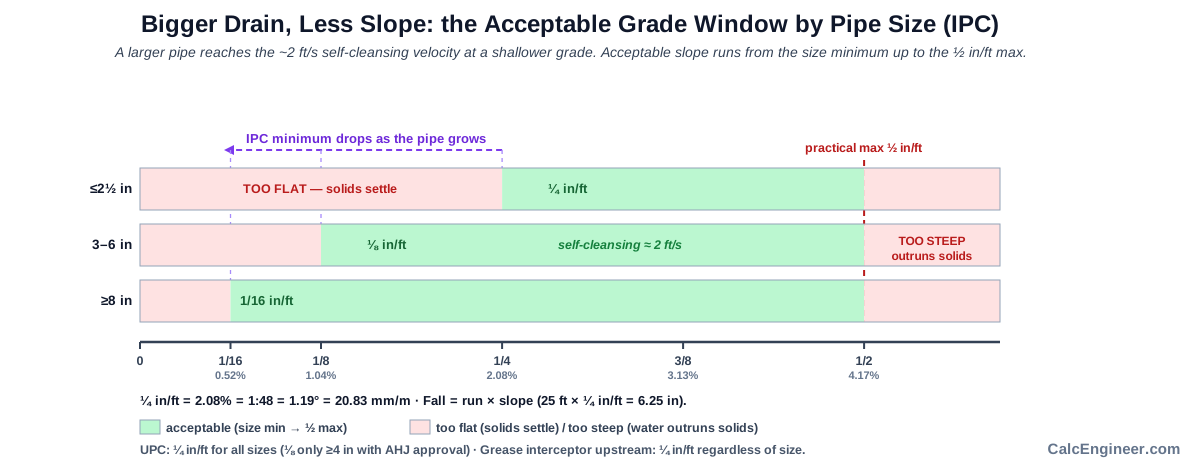
Knowing this saves unnecessary drop on a long run through a basement or crawl space. The UPC is stricter by default, a quarter inch per foot for every size, and only allows 4 inch and larger to drop to an eighth where the local authority approves it.
Drain Pipe Fall Calculator
The fall, also called the drop, is the vertical distance the drain falls over its run. It is the run length times the slope, so the math is quick once you know the two numbers. A 25 foot run at a quarter inch per foot drops 25 times 0.25, which is 6.25 inches. The same run at an eighth inch per foot drops 3.13 inches. Over a 100 foot run, an eighth inch per foot is 12.5 inches of drop.
Measure the horizontal run, not the length of pipe along the slope, since the slope is defined per horizontal foot. On a nearly flat run the difference is tiny, but it is the correct basis. If you already know the available drop, for example the height of a sewer connection above a slab, enter the run and the fall and the tool returns the slope, so you can see whether the elevation you have is enough for the pipe size.
The fall has to come from somewhere, and on a building sewer it comes from two surveyed inverts rather than off a tape measure. Where the upstream and downstream invert elevations are known but the fall between them has not been worked out, or where the real question is the burial depth, the cover over the pipe, or whether the connection is feasible at all, start with the Building Sewer Invert Depth Calculator and bring the fall back here.
Drain Slope Conversion
Slope shows up in several units, and converting between them is a common need. The key equivalents:
| Inch per foot | Percent | Ratio | Degrees | mm per m |
|---|---|---|---|---|
| 1/4 in/ft | 2.08 percent | 1 to 48 | 1.19° | 20.83 |
| 1/8 in/ft | 1.04 percent | 1 to 96 | 0.60° | 10.42 |
| 1/16 in/ft | 0.52 percent | 1 to 192 | 0.30° | 5.21 |
| 1/2 in/ft | 4.17 percent | 1 to 24 | 2.39° | 41.67 |
To convert inch per foot to percent, divide by 12 and multiply by 100. For the ratio, divide 12 by the slope in inch per foot, so a quarter inch per foot is one to 48. For degrees, take the arctangent of the slope over 12. For mm per m, divide by 12 and multiply by 1000. The whole scale anchors on 1 inch per foot, which is 8.33 percent and 83.33 mm per m.
IPC vs UPC Drain Slope
The two model codes treat slope differently, and it is a real source of confusion. The IPC lets the minimum drop as the pipe grows: a quarter inch per foot for 2.5 inch and smaller, an eighth for 3 to 6 inch, and a sixteenth for 8 inch and larger. The UPC is stricter by default, a quarter inch per foot for all horizontal drainage, and it only allows 4 inch and larger pipe to drop to an eighth inch per foot where the authority having jurisdiction approves the reduction.
The practical result is that the same pipe can be compliant under one code and not the other. A 3 inch drain at an eighth inch per foot meets the IPC but falls short of the UPC default of a quarter. Always choose the code your jurisdiction enforces, and confirm any local amendments, which can be stricter than either model code.
Maximum Drain Pipe Slope
A drain can be too steep. The common practical maximum is half an inch per foot. Above that, the water can run faster than the solids it carries, so the solids fall behind and strand, which causes the same clogging as too little slope, especially on longer horizontal runs. This is why steep slopes are treated as a practical design concern rather than a free-for-all.
The maximum is an advisory, not a hard code number in the same sense as the minimum. Some codes address steep runs through offset and cleanout provisions rather than a single ceiling. The calculator reports the maximum as a separate line from the code-minimum check, so a steep run shows as an advisory while the code-minimum result stands on its own. Confirm the local code for any specific steep-run requirements.
Grease Interceptor Drain Slope
Piping upstream of a grease interceptor is a special case. It needs at least a quarter inch per foot regardless of pipe size, because grease is far more likely to settle and build up than ordinary waste, so the higher velocity of the steeper grade is required. This rule can override the shallower minimum that a large pipe would otherwise get.
For example, an 8 inch drain would normally take a sixteenth inch per foot under the IPC, but if it is upstream of a grease interceptor the minimum rises to a quarter inch per foot. Over a 100 foot run that changes the required fall from 6.25 inches to 25 inches, a large difference. The calculator applies the rule as the greater of the code minimum and a quarter inch per foot whenever the grease-interceptor option is on.
Drain Slope vs Drain Pipe Sizing
Slope and sizing are two different questions, and this calculator answers only the first. Here the pipe diameter is already known, and the tool checks whether the drain has enough fall for that diameter under the chosen code, and whether it is too steep. It does not choose the diameter.
Choosing the diameter is a sizing problem, driven by the drainage fixture unit load. The short version: slope answers how steep the drain must be, sizing answers how big it must be. You size the pipe first, then check its slope here.
What is Drain Pipe Slope?
Drain pipe slope, also called grade, pitch, or fall, is the vertical drop of a horizontal drain per unit of horizontal length. In US practice it is usually given in inches of fall per foot of run, or as a percent. A quarter inch per foot is a 2.08 percent grade, an eighth inch per foot is 1.04 percent, and a sixteenth is 0.52 percent.
Slope matters because gravity has to move both the water and the solids it carries. Too little slope and the water crawls, letting solids settle and build up into clogs. Too much slope can let water outrun solids, especially on longer horizontal runs, which is why steep slopes are treated as a practical design concern. The sweet spot is a grade that keeps the flow near the self-cleansing velocity of about 2 feet per second, which is the reasoning behind the code minimums. The counterintuitive part is that a larger pipe reaches that velocity at a shallower grade, so the code minimum drops as the diameter grows, from a quarter inch per foot on small pipes to a sixteenth on 8 inch and larger.
Units
The calculator works in either US or metric units, set by its own selector.
| Quantity | US / Imperial | Metric |
|---|---|---|
| Run length | ft | m |
| Slope | in/ft, percent, ratio, degrees | percent, ratio, degrees, mm/m |
| Fall (drop) | in | mm |
| Velocity | ft/s | m/s |
Reference points: 1 inch per foot equals 8.33 percent and 83.33 mm per m. A quarter inch per foot equals 2.08 percent, 20.83 mm per m, a ratio of about one to 48, and 1.19 degrees. An eighth inch per foot equals 1.04 percent and 10.42 mm per m. A sixteenth inch per foot equals 0.52 percent, 5.21 mm per m, and a ratio of about one to 192. A run of 25 ft is 7.62 m, and a fall of 6.25 inches is 159 mm. Switching the unit system converts the values you entered, it does not reinterpret them.
Key Facts
- Drain slope is the vertical drop per unit of horizontal run, given in inch per foot, percent, ratio, degrees, or mm per m.
- The fall is the run length times the slope: a 25 foot run at 1/4 in/ft drops 6.25 inches.
- The code minimum depends on the pipe size. Larger pipes need less slope, not more.
- IPC minimums: 2.5 inch and smaller need 1/4 in/ft, 3–6 inch need 1/8 in/ft, 8 inch and larger need 1/16 in/ft.
- UPC starts at 1/4 in/ft for all sizes. 4 inch and larger may use 1/8 in/ft only with AHJ approval.
- The practical maximum is 1/2 in/ft; above this, liquid can outrun solids. Reported as a separate advisory.
- Piping upstream of a grease interceptor needs at least 1/4 in/ft regardless of pipe size.
- 1/4 in/ft = 2.08 percent = 1 to 48 = 1.19 degrees = 20.83 mm/m.
- The self-cleansing velocity of about 2 ft/s, from Manning, is the technical basis for the code minimums.
- This tool checks slope; it does not size the pipe diameter from the fixture load.
Applications
- Checking whether a planned drain run meets the IPC or UPC minimum for its size.
- Finding the fall needed over a run before setting pipe elevations.
- Converting a slope between inch per foot, percent, ratio, degrees, and mm per m.
- Comparing IPC and UPC minimums for the same pipe size.
- Sizing the drop for a basement bathroom or long horizontal run.
- Checking a grease-interceptor drain run that needs 1/4 in/ft regardless of size.
- Checking whether available elevation drop is enough for the selected pipe size.
- Flagging a run that is too steep for reliable solids transport.
Example Calculation
Example 1: 3 inch pipe, IPC, slope to fall
Given: 3 inch IPC drain, run 25 ft, slope 1/8 in/ft.
Calculation:
- Fall = 25 x 0.125 = 3.125 inches (79 mm)
- IPC minimum for 3 in: 1/8 in/ft (1.04%)
- Slope rounded: 0.125 in/ft, equals minimum exactly
- Code check: MARGINAL
At exactly the minimum, the slope meets the code but has no margin. Consider increasing slightly to allow for construction tolerance.
Example 2: Same pipe, same run, under UPC
Given: 3 inch UPC drain, run 25 ft, slope 1/4 in/ft.
Calculation:
- Fall = 25 x 0.25 = 6.25 inches (159 mm)
- UPC minimum for 3 in: 1/4 in/ft (2.08%)
- Slope rounded: 0.250 in/ft, equals minimum exactly
- Code check: MARGINAL
Same pipe, same run, but UPC needs twice the fall of IPC. The code selection matters.
Example 3: 8 inch IPC drain, grease interceptor, 100 ft run
Given: 8 inch IPC drain, 100 ft run, upstream of grease interceptor.
Calculation:
- IPC minimum for 8 in: 1/16 in/ft
- Grease interceptor rule: minimum = max(1/16, 1/4) = 1/4 in/ft
- Fall at 1/4 in/ft: 100 x 0.25 = 25 inches vs 6.25 inches at 1/16
- A significant difference on a long run.
Standards & References
- IPC Table 704.1, Slope of Horizontal Drainage Piping (ICC Digital Codes): minimum slope by diameter for building drainage, residential through commercial.
- UPC Section 708.0, Grade of Horizontal Drainage Piping (UpCodes): uniform plumbing code minimum slope, including the 4 in and larger reduced-slope allowance with AHJ approval.
- IRC Table P3005.3, Slope of horizontal drainage piping: residential application of the same IPC minimum slope values.
- Manning's equation for open-channel and partially full pipe flow: the technical basis for the 2 ft/s self-cleansing velocity screening minimum used in the code minimums.
Limitations
- This tool checks the slope and fall for a pipe whose diameter is already known. It does not size the pipe diameter from the drainage fixture unit load.
- The self-cleansing velocity shown is a full-bore Manning estimate. Actual self-cleansing depends on the flow depth at the design flow, which is a partial-flow calculation not included here.
- The half inch per foot practical maximum is an advisory. Some codes handle steep runs with offsets and cleanouts rather than a hard ceiling; confirm local requirements.
- The run must be uniform at a constant slope with no bellies, sags, or reverse grade. A compliant average slope does not guarantee compliance if the run is not straight.
- Trap arm length, vent distance, and hanger spacing are separate code checks not covered here.
- Storm drainage, sewers with depth-of-cover requirements, and pumped drainage systems are out of scope.
- Confirm the local adopted code and any amendments, which can be stricter than the IPC or UPC model code.
Common Mistakes to Avoid
- Assuming every drain needs a quarter inch per foot; the IPC minimum drops with pipe size.
- Thinking larger pipes need more slope. Larger pipes reach self-cleansing velocity at shallower grades.
- Using IPC minimums under a UPC jurisdiction, or vice versa.
- Sloping too steeply: above 1/2 in/ft, water can outrun solids and strand them.
- Forgetting the grease-interceptor rule raises the minimum to 1/4 in/ft regardless of size.
- Treating an average slope as compliant when the run has bellies or sags.
- Losing the grade on a long run; minimum-grade runs need survey-level layout precision.
- Confusing slope calculation with pipe sizing; this tool does not size the pipe.
Frequently Asked Questions
What is the minimum slope for a drain pipe?
How do I calculate the fall or drop for a drain pipe?
Why do larger pipes need less slope?
What is the maximum drain slope before it becomes a problem?
What is the difference between IPC and UPC drain slope requirements?
When does the grease interceptor rule change the minimum slope?
Frequently Used Together
Engineers often use these calculators in combination for complete project workflows:
Related Calculators
Explore similar calculators that might be useful for your project:
Plumbing Quick Reference — Keep It On Your Phone On Site
A 10-page field reference for catching pressure, velocity, slope, and pump-sizing mistakes before you order pipe, close a wall, or add a booster.
- Velocity limits, fixture pressure minimums, drain slope, and the 80 psi ceiling in one table
- Worked examples that show why a single pressure number gives four different answers
- Keep it on your phone, or print the two field-check pages
Free PDF. Calculators stay free. Unsubscribe anytime.
Calculate
Sets all fields, labels, and results. The global header switch does not override this selector. Switching converts values rather than reinterpreting them.
Enter a run length and a slope to get the fall, enter a run and a fall to get the slope, or just convert a slope between units.
The grade of the drain. A quarter inch per foot is 2.08 percent, 1 to 48, 1.19 degrees, and 20.83 mm per m.
The grade of the drain in the selected unit. A quarter inch per foot is 2.08 percent, 1 to 48, or 20.83 mm per m.
The horizontal length of the drain run from the upstream point to the connection. Measure horizontally, not along the pipe.
The drain size. The code minimum slope depends on the size, and larger pipes need less slope, not more. Leave unselected for slope conversion only.
Piping upstream of a grease interceptor needs at least 1/4 in/ft regardless of size. The minimum becomes the greater of the code minimum and 1/4 in/ft.
Optional. Sets the Manning roughness for the self-cleansing velocity indicator. Smooth PVC is about 0.010, cast iron and concrete are rougher. The velocity shown is a full-bore estimate only and never drives the code-minimum verdict.