UV Water Disinfection Sizing Calculator — the 40 mJ Dose and the Transmittance That Decides It
On this page
Calculate
This selector governs every field, label, result and export on this page and takes priority over the site header switch. Switching converts the values you entered rather than reinterpreting them, so 10 gpm becomes 37.9 L/min and returns to exactly 10 when you switch back. Dose, transmittance and turbidity do not convert: 40 mJ/cm2 is 40 in both systems, transmittance is a percentage, and turbidity is in nephelometric turbidity units either way.
The Test and the Source
This is first because it decides the class and whether a system can be selected at all. Class A is for a supply known or suspected to be unsafe. Class B is supplemental treatment for water already deemed acceptable, and published regulatory guidance says it should not be used for producing potable water. Untested water cannot be matched to either, so it returns a stop rather than a size.
The source narrows the transmittance before anything is measured, and it costs nothing. A drilled well typically runs 85 to 97 percent and a dug well or surface source 55 to 80. A spring is shallow and often surface influenced, so it belongs with the second group rather than the first. A municipal supply is usually high and still needs measuring.
The peak instantaneous flow through the reactor, not an average and not a daily figure. Where a pressure tank and pump serve the system the flow arrives in bursts, and the dose during a burst is what the organisms in it receive.
Measured in a laboratory on a sample, at 254 nanometres through one centimetre of water. Leave it blank if it has not been measured: this page then reports the band your source implies and states that a measurement is required before a system is selected, rather than estimating a figure the whole result would turn on. Transmittance is a percentage and is the same figure in both unit systems.
The Transmittance Minimum (all optional)
There is no universal figure. Regulatory guidance gives 75 percent with 85 preferred, several manufacturer manuals give greater than 85, one gives greater than 75, and one asks to be contacted below 80. Leave this unknown and the result reports your measurement against the whole published range rather than against 85 as though it were absolute.
The figure printed in the installation manual for the system you are actually buying. Used only where the selector above is set to the product value, and it is the figure that governs when it is.
The Water Analysis (all optional)
The limit is 0.3. Iron absorbs ultraviolet in solution and scales the sleeve, and dissolved ferrous iron is invisible until it oxidises into particles that scatter the light. Parts per million and milligrams per litre are the same figure.
The limit is 0.05, six times lower than the iron figure. Manganese oxidises into dark particles that absorb ultraviolet wavelengths and interferes at lower concentrations than iron does.
The limit is 7 grains per gallon, which is 120 milligrams per litre. At or slightly below it the quartz sleeve must be cleaned periodically; above it the water should be softened. Hardness scales the sleeve, which blocks the light before it enters the water at all.
The limit is 1 nephelometric turbidity unit, in both unit systems. Turbidity fails differently from everything else on this list: it shields organisms behind particles rather than absorbing the light, so a larger system does not answer it.
The limit is 0.1. Tannins absorb ultraviolet directly and are the usual reason for a low transmittance in water that looks completely clear, which is why clarity is not a substitute for a measurement.
The Candidate System (all optional)
A Class B system on a microbiologically unsafe supply is a hard stop rather than a warning, because Class B is a different device with a different job rather than a smaller Class A.
Read it from the certification listing for the model rather than from the marketing copy. On a supply being made potable, certification is the requirement rather than a dose claimed by a seller.
A lamp-out monitor reports that the lamp is lit and does not measure the dose, so the distinction is a functional one rather than a feature comparison. An intensity monitor measures the light reaching the far side of the water, which is the sensor a Class A system is required to carry.
The flow above which the certified dose is not delivered. It is a ceiling rather than a target, which is why a Class A system carries a flow restrictor or automatic fixed flow rate control.
Published ratings are commonly quoted at 95 percent transmittance, while NSF validated systems use 70 percent as the basis for the flow rate calculation. A rated flow without this figure is not a capacity, and the result says so rather than using it as one.
The Lamp and the Dose (all optional)
From the lamp manual. Lamp life is product specific: published figures run from about 9,000 hours or one year on some lines to 18,000 hours or two years on others, so this page takes the rated life as an input rather than assuming one.
Continuous service is about 8,760 hours a year. The lamp keeps lighting after its germicidal output has fallen below the certified dose, so the calendar governs rather than the glow.
Leave it blank and the class figure applies: 40 for Class A and 16 for Class B. A target above the class figure governs over it. A target below the Class A figure on an unsafe supply stops the calculation. Dose does not convert between unit systems.
A dose figure carries a different weight depending on where it came from, so the result names the source beside the number.
Overview
A UV system is sized to deliver a dose, and a dose is an intensity multiplied by a time. The flow sets the time, so the rated flow is a ceiling rather than a target. The transmittance of the water sets the intensity, and it is the term that decides most installations.
What to Look at First
Read the water block before the flow block. The pre-treatment limits are conditions rather than preferences: iron above 0.3 parts per million does not reduce performance a little, it absorbs the light and scales the sleeve, and turbidity hides organisms behind particles where no size of reactor reaches them. Once the water is inside the limits, the transmittance decides the rest, and a rated flow quoted without the transmittance it was measured at is not a capacity at all.
How to Use This Calculator
Start with the microbiological test, not the flow. Class A is for a supply known or suspected to be unsafe. Class B is supplemental treatment for water already deemed acceptable, and published regulatory guidance says it should not be used for producing potable water. Untested water cannot be matched to either.
Name the source. A drilled well typically sits in the 85 to 97 percent transmittance band and a dug well or surface source in 55 to 80. A spring is shallow and often surface influenced, so it belongs with the second group rather than the first. A municipal supply is usually high and still needs measuring.
Enter the peak instantaneous flow through the reactor, not an average. Where a pressure tank and pump serve the system the flow arrives in bursts, and the dose during a burst is what matters.
Enter the transmittance if you have it. If you do not, this page reports the band your source implies and stops there rather than estimating a figure, because the whole calculation turns on it.
Enter the water quality parameters you have. Each one that is missing is reported as not evaluated rather than assumed to pass, and the result says how much of the check actually ran.
Enter a candidate system with the transmittance its rating is quoted at, and check whether it is NSF validated. Published ratings are commonly at 95 percent transmittance, while NSF validated systems use 70 percent as the basis, so the same number describes very different systems.
Inputs & Outputs
Inputs
Outputs
UV System Sizing Formula
Four short calculations, followed by product checks in prose.
Intensity through a path
fraction = (uvt_percent / 100) ^ path_cm
The share of the light reaching a point, which falls with the transmittance raised to the path length rather than scaling with it. The path is a reactor dimension, so any figure using it here is an illustration at a stated path.
Illustrative flow derating
flow_shown = flow_rated * frac_actual / frac_rated
What the relationship above implies for a rated flow moved from its rating transmittance to the actual one.
Dose ratio against flow
dose_ratio = flow_rated / flow_actual
Dose is inversely proportional to flow, so running at half the rated flow doubles the dose.
Lamp life remaining
hours_left = lamp_rated_life - lamp_hours
Unit conversions
1 gallon per minute equals 3.785411784 litres per minute, and grains per gallon multiply by 17.118 to give milligrams per litre. Dose in millijoules per square centimetre does not convert between systems, and neither does transmittance or turbidity.
The remaining rules are conditions rather than equations: the class definitions and their doses, the pre-treatment limits and their mechanisms, the transmittance bands by source, the lamp replacement rule, and what ultraviolet does not do.
NSF 55 Class A Versus Class B
The first decision on a UV system is not a size. It is which of two certifications applies, and they describe different devices for different water.
NSF/ANSI 55 Class A systems are certified to deliver a dose at least equivalent to 40 millijoules per square centimetre at the alarm set point. They are intended for disinfecting water that is microbiologically unsafe, which on a private supply means a positive coliform result or a source with reason to suspect one.
NSF/ANSI 55 Class B systems are certified to 16 millijoules per square centimetre. They are intended for supplemental treatment of water that has already been tested and deemed acceptable for human consumption, as additional confidence rather than as the barrier the supply depends on.
Published regulatory guidance draws the line without qualification: Class B certified systems should not be used for the production of potable water.
So a Class B unit is not a smaller Class A unit. It is a different device with a different job, certified against a dose less than half as large, and choosing one for an unsafe supply is a category error rather than an under-specification. This calculator treats that combination as a hard stop rather than a warning.
Untested water sits outside both. The class depends on whether the UV system is producing potable water or adding confidence to water already known to be acceptable, and that is a laboratory question rather than an engineering one. A microbiological test comes before the system selection, not after it.
Where a project or an authority sets a target dose above the Class A figure, that figure governs. Where anyone proposes a target below it on an unsafe supply, nothing does.
UV Dose and Rated Flow
Ultraviolet dose is the intensity of the light multiplied by the time the water spends in it, expressed in millijoules per square centimetre at a germicidal wavelength of 254 nanometres. Both terms are outside the lamp control.
The flow sets the time. Water moving through the chamber twice as fast spends half as long in it and receives half the dose, so dose is inversely proportional to flow. That relationship is why the rated flow on a system is a ceiling rather than a target: at the rated flow the certified dose is delivered, and above it, it is not.
This is the reason an NSF 55 Class A system is required to carry a built-in flow restrictor or automatic fixed flow rate control. The certification is not a claim about the reactor alone; it is a claim about the reactor operating at or below a stated flow, and the restrictor is what makes that claim enforceable in a house where somebody opens three taps at once.
It also means the flow figure to use is the peak instantaneous flow through the reactor, not an average and not a daily total. A house served by a pressure tank and pump does not draw water smoothly. It draws in bursts, and during a burst the dose is whatever the burst flow produces.
Read the other way, the relationship is a design lever. Running a system at half its rated flow doubles the dose, which is exactly what the manufacturer guidance for low transmittance water is doing when it recommends a system with more capacity than the duty requires.
What the rated flow does not tell you on its own is what water it was rated on. That is the next section.
UV Transmittance and Flow Derating
Ultraviolet transmittance is the percentage of light at 254 nanometres that passes through one centimetre of water. It is measured in a laboratory on a sample, and it is the single most important water quality figure for a UV system.
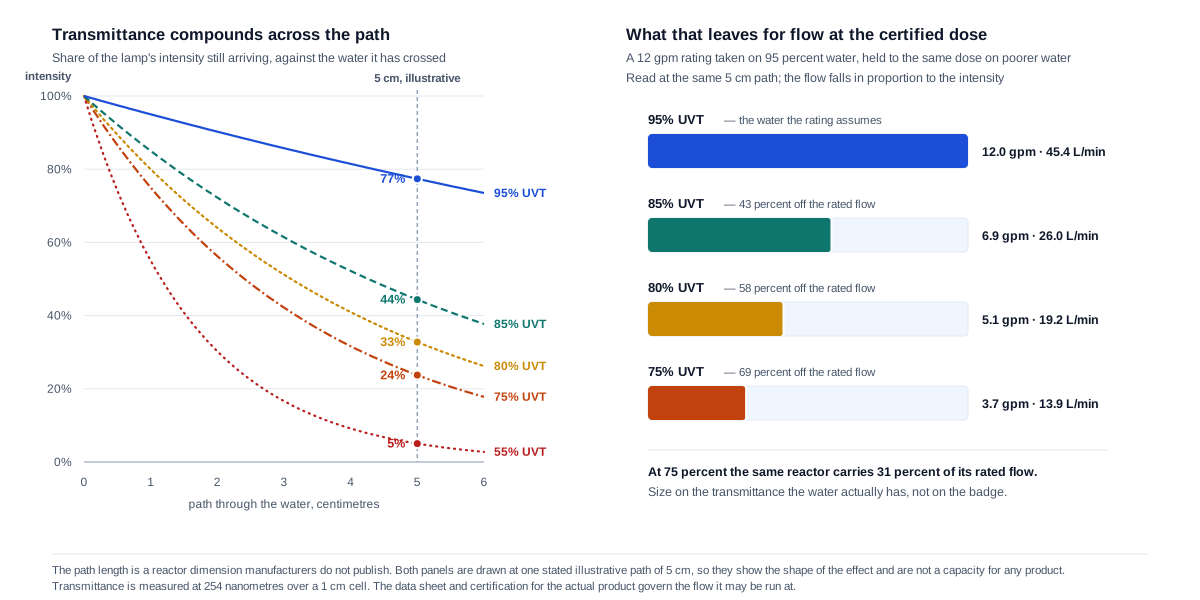
The reason it matters more than it sounds is that the light has to cross the whole annular gap between the lamp sleeve and the chamber wall, and the loss is taken at every centimetre. The fraction of intensity reaching a point is the transmittance raised to the power of the path length in centimetres, so the effect compounds rather than scaling.
Across an illustrative five centimetre path: 95 percent transmittance delivers about 77 percent of the intensity, 85 percent delivers 44, 80 percent delivers 33, 75 percent delivers 24, and 55 percent delivers 5. Read against the 95 percent case that most ratings assume, those are 57, 42, 31 and 6 percent.
Because the dose must be held at the certified figure, the flow has to fall in the same proportion. That is what derating means here, and it is why a system rated comfortably above a household peak can still fail to deliver its dose.
The path length is a reactor dimension that manufacturers do not publish, so those figures show the shape of the relationship and are not a capacity for any product.
What the manufacturers publish instead is a rule of thumb. Where the transmittance falls between 75 and 95 percent, published guidance recommends choosing a system with about 50 percent more flow capacity than the duty requires. That works out to running at about 67 percent of the rated flow, which is generous at the top of the band and short at the bottom, because the underlying effect varies by roughly a factor of two across it. It is offered as a rule of thumb rather than a curve, and the same guidance invites a call for a specific case.
Below 75 percent transmittance after pre-treatment, the published route is activated carbon filtration to improve the transmittance itself rather than a larger system. Where the transmittance is unknown, the published advice is to choose a model with more flow capacity than the duty requires, which is the same rule applied to an unmeasured case.
Rated Flow Basis, 95 Percent Versus 70 Percent UVT
Two systems can carry flow ratings that look comparable and are not, and the reason is published by the manufacturers themselves.
Published guidance states that flow rates for one major range are based on water at 95 percent transmittance, except for NSF validated systems, which use 70 percent transmittance as the basis for the flow rate calculation.
That is a large difference in the condition being described. Seventy percent transmittance is a much harder water to treat than 95, so a system rated at a given flow on 70 percent water is delivering its dose under conditions where a 95 percent rated system would be well short.
The practical consequence: a 15 gallon per minute rating on a 70 percent basis can describe a more capable system than a 20 gallon per minute rating on a 95 percent basis. Comparing the two numbers alone gets the answer backwards.
So a rated flow without its transmittance basis is not a capacity, in the same way that a valve flow range without its pressure differential is not one. This calculator asks for both and reports them together.
There is a second condition on those ratings that is easy to miss. Published flow rates are quoted at the end of the stated lamp life, and one series states the basis explicitly as after 9,000 hours of bulb operation. The rating therefore already accounts for the lamp aging across its rated life.
That matters in a specific way: adding an arbitrary extra margin for lamp aging on top of such a rating is double counting. The correct response to lamp aging is to replace the lamp on schedule, not to oversize the reactor to survive an old one.
UVT by Water Source
Before a sample goes to a laboratory, the source type narrows the answer considerably, and it costs nothing.
Published manufacturer guidance gives two bands. Water drawn from a drilled well typically has a transmittance of 85 to 97 percent. Water drawn from a dug well or a surface source such as a lake or river typically has 55 to 80 percent.
Those bands do not overlap, and the entire surface water band sits below the 85 percent that several manufacturer manuals state as their requirement. So a drilled well is likely to be inside the window and worth measuring to confirm, while a dug well or surface intake is likely to need treatment before a UV system is a candidate at all.
Two source types sit outside those published bands and both need care.
A spring is shallow and frequently surface influenced. It behaves more like a dug well than a drilled one, so this calculator treats it as a shallow source requiring measurement and does not assign it the drilled well band. Assuming otherwise gives a favourable band to a source with no claim to it.
A municipal supply usually has a high transmittance and still needs measuring, because organics and the disinfectant residual both affect the figure. A municipal installation is also usually a supplemental one rather than the primary barrier, which changes the class question as well as the transmittance one.
The same guidance recommends a transmittance test specifically for surface or shallow well sources, and for water that is even slightly coloured. Colour is the clue that absorption is happening, and it is visible long before it is measurable by eye as a number.
UV Pre-Treatment Requirements
A UV system works on water that is already clean enough for the light to get through. The limits that define that are consistent across four independent manufacturer installation manuals, which carries more weight than any single data sheet.
Hardness below 7 grains per gallon, which is 120 milligrams per litre. At or slightly below that figure the quartz sleeve must be cleaned periodically; above it the water should be softened.
Iron below 0.3 parts per million. Manganese below 0.05. Turbidity below 1 nephelometric turbidity unit. Tannins and organics below 0.1 parts per million.
Each has a mechanism, and none of them is solved by a larger reactor.
Hardness scales the quartz sleeve, which blocks the light before it enters the water at all. The lamp is working perfectly and the light is not getting out.
Iron does both things at once. It absorbs ultraviolet in solution, and it scales and stains the sleeve. Dissolved ferrous iron is invisible until it oxidises, at which point the particles scatter the light as well.
Manganese behaves the same way at lower concentrations, oxidising into dark particles that absorb ultraviolet wavelengths.
Tannins absorb the light directly. They are the usual reason for a low transmittance in water that looks completely clear, which is why clarity is not a substitute for a measurement.
Turbidity fails by a different mechanism entirely, and that has its own section below.
Pre-filtration of at least 5 microns ahead of the system is recommended by several manufacturers as a baseline regardless of the measured turbidity.
One coincidence is worth knowing. The iron and manganese limits of 0.3 and 0.05 parts per million are the same figures as the secondary drinking water standards for staining. That is a coincidence of numbers rather than a shared basis, since the standards exist for staining and these limits exist for light transmission, and it is useful: a water only just acceptable aesthetically for iron is already at the boundary for ultraviolet, and the iron filter that fixes one fixes the other.
Why Turbidity Fails Differently
Every other pre-treatment parameter reduces the amount of light. Turbidity does something else, and the distinction changes what the remedy is.
Suspended particles do not primarily absorb ultraviolet. They shield organisms from it. A bacterium sitting behind a grain of silt is in a shadow, and the light passing on either side of that grain does it no harm at all.
That is why turbidity cannot be answered with a larger system. A bigger reactor or a stronger lamp delivers more light to the same shadow, and the organism behind the particle receives the same protection it did before. The dose is delivered to the water and not to the target.
Published guidance puts the scale of it plainly: turbidity above 5 nephelometric turbidity units reduces effectiveness by 50 percent or more, because suspended particles create shadows that protect bacteria from exposure. The manufacturer limit is 1 nephelometric turbidity unit, well below that.
The remedy is filtration. A 5 micron sediment filter ahead of the system is the standard baseline, and where the turbidity is high a backwashing multimedia filter is the usual answer. Both work by removing the particle rather than by out-powering it.
The same shadowing logic applies to anything particulate in the water, which is why oxidised iron is a UV problem as well as a staining one. Iron that has come out of solution is a particle, and particles cast shadows.
This is also the reason a transmittance measurement and a turbidity measurement are both worth having. Transmittance captures absorption well and shadowing imperfectly, because a laboratory sample and a flowing reactor do not see particles the same way.
Lamp Life, Glow and Intensity Monitoring
This is the part of a UV system that has no honest signal, and everything in the certification exists because of it.
Published manufacturer guidance states the position without hedging: the lamp lasts 9,000 hours of use, approximately one year, after which it must be replaced even though it may continue to light, because after 9,000 hours its ability to kill bacteria drops below safe limits.
The visible glow comes from the mercury discharge, and the germicidal output is a specific wavelength within it. The two decline at different rates, so the part a person can see outlasts the part that does the work. A lamp at the end of its germicidal life looks exactly like a new one.
Lamp life is product specific. Some lines are rated at 9,000 hours or one year, others at 18,000 hours or two years, and one source gives 9 to 12 months of effective germicidal output. The rated life comes from the lamp manual rather than from a general figure, which is why this calculator takes it as an input rather than assuming one.
The monitor distinction is where this becomes a purchasing decision. Published guidance states that all systems in one range are equipped with lamp-out monitors, which indicate lamp status. An ultraviolet intensity monitor is a separate feature and appears on specific models within the same families.
A lamp-out monitor detects the lamp failing to strike, which is the failure that announces itself: the light is off and the display says so. It does not detect the lamp aging, the sleeve fouling, or the transmittance dropping, which are the three ways the dose actually falls short in service.
An intensity monitor measures the light that reaches the far side of the water, which is the quantity that matters. That is the sensor an NSF 55 Class A system is required to have, alongside a visual and audible alarm and warning devices or an automatic shutoff at a fail-safe set point below the certified dose. Regulatory guidance commonly requires or recommends the shutoff, and local approval governs.
The reasoning behind the shutoff is worth stating: on an unattended residential system an alarm nobody hears is not a control. Someone drawing a glass of water at two in the morning has no way to know the dose has fallen, and the only mechanism that protects them is the one that stops the water.
The quartz sleeve belongs in the same maintenance discussion. It must be kept free of hardness and iron deposits, and where the hardness sits near its limit or the iron is above its own, the cleaning interval shortens accordingly. A fouled sleeve produces exactly the same invisible failure as an aged lamp.
UV Removes Nothing and Leaves No Residual
Two properties define where a UV system belongs in a treatment train, and both are absences.
It removes nothing. No dissolved metals, no nitrates, no hardness, no chemicals of any kind. Water leaving the reactor has exactly the composition it entered with, minus the viability of the organisms in it. Every figure on the water quality analysis is unchanged, and everything that needed removing still needs removing.
It also adds nothing, which is the corresponding advantage: no chemicals go in, and it generally creates no disinfection by-products.
And it leaves no residual. Treated water carries no disinfectant onward, so a UV system protects the water passing through the chamber at that moment and nothing beyond it. Published guidance states this directly: treated water is susceptible to recontamination if the distribution lines are compromised.
A chlorinated supply carries its protection along the pipe. A UV treated supply does not, and that difference decides two practical things.
Where plumbing downstream of the unit has been contaminated, running the supply through UV does not disinfect it. Shock chlorination of the distribution system is a separate operation on the pipe itself.
On a municipal supply, the incoming water may already carry a residual maintained for the distribution system. A UV unit at the point of entry does not replace that residual, extend it, or remove it. It adds a barrier at one location and changes nothing about what the pipe downstream relies on.
The placement that follows from both properties is the same one every manufacturer specifies. UV goes after the sediment filtration, the iron and manganese removal, the softening where hardness requires it, and the carbon or tannin treatment where the transmittance requires it, so that the water arriving at the reactor is already inside the limits. It goes before distribution, at or near the point of entry, with isolation and bypass arranged per the manufacturer.
What Is UV Water Disinfection
Ultraviolet disinfection passes water through a chamber containing a lamp that emits at 254 nanometres, a wavelength that damages the genetic material of bacteria, viruses and protozoa so they cannot reproduce. It does not remove them; it makes them unable to cause infection.
The measure of the treatment is the dose, and it is the intensity of the light multiplied by the time the water spends in it. Both terms are controlled by things outside the lamp: the flow rate sets the time, and the clarity of the water sets how much of the intensity actually reaches the organisms.
NSF/ANSI 55 is the certification framework, with Class A for microbiologically unsafe water and Class B for supplemental treatment of water already considered acceptable.
What makes UV different from every other treatment on a water system is that it sits at the end of a treatment train rather than at the start of one. The water arriving at it has to be clean enough for the light to get through, which means the equipment that makes UV possible is usually equipment installed before it.
Key Facts
- Ultraviolet dose is intensity multiplied by exposure time, in millijoules per square centimetre, at a germicidal wavelength of 254 nanometres.
- NSF/ANSI 55 Class A is certified to at least 40 millijoules per square centimetre at the alarm set point. Class B is certified to 16 and published regulatory guidance says it should not be used for the production of potable water.
- Published research puts 3-log inactivation of several waterborne viruses below 30 millijoules per square centimetre and vegetative bacteria below 15, while adenovirus requires at least 120 and possibly 200, with 186 adopted by the Environmental Protection Agency for a 4-log credit on regulated surface water systems.
- Dose is inversely proportional to flow. Halve the flow and the dose doubles.
- On a five centimetre path, 95 percent transmittance delivers about 77 percent of the intensity, 85 percent delivers 44, 80 percent delivers 33 and 75 percent delivers 24.
- Published flow ratings are commonly quoted at 95 percent transmittance and at the end of the stated lamp life, one series stating the basis as after 9,000 hours of bulb operation.
- The rating basis is not standard even within one manufacturer: published guidance states that flow rates are based on 95 percent transmittance except for NSF validated systems, which use 70 percent.
- Where the transmittance falls between 75 and 95 percent, published manufacturer guidance recommends about 50 percent more flow capacity than the duty requires. Below 75 percent after pre-treatment, activated carbon filtration is the published remedy.
- Water from a drilled well typically has a transmittance of 85 to 97 percent. Water from a dug well or a surface source typically has 55 to 80 percent.
- Published transmittance minimums vary: regulatory guidance gives 75 percent with 85 preferred, several manufacturer manuals give greater than 85, one gives greater than 75, and one asks to be contacted below 80.
- Four independent manufacturer installation manuals give the same pre-treatment limits: hardness below 7 grains per gallon or 120 milligrams per litre, iron below 0.3 parts per million, manganese below 0.05, turbidity below 1 nephelometric turbidity unit, and tannins below 0.1.
- Turbidity above 5 nephelometric turbidity units reduces effectiveness by 50 percent or more, and it fails by shielding organisms behind particles rather than by absorbing the light.
- Published lamp life figures are product specific: about 9,000 hours or one year on some lines, 18,000 hours or two years on others. The lamp must be replaced even though it may continue to light.
- A lamp-out monitor indicates lamp status only. An ultraviolet intensity monitor is a separate feature and appears on specific models rather than across a range.
Applications
- A homeowner with a positive coliform result works out whether a system is even applicable before the water is corrected, and finds the iron has to come out first.
- A well contractor sizing a system for a drilled well checks the peak flow against a rated flow and reads the transmittance basis the rating was quoted at.
- A designer on a surface source finds the whole published transmittance band sits below the manufacturer minimum, so the question becomes pre-treatment rather than model selection.
- A service technician investigating a system that tested positive after two years checks the lamp hours and finds the lamp still lighting well past its rated life.
- A specifier comparing two systems finds one rated at 95 percent transmittance and the other at 70, and that the two flow figures are not comparable.
- A homeowner with clear water and a low transmittance reading traces it to tannins rather than to anything visible.
- A buyer comparing two models in the same family finds one carries a lamp-out monitor and the other an intensity monitor, and that the difference is not a convenience feature.
- A facilities manager on a municipal supply installs UV for added confidence and confirms it does not replace the residual the distribution system relies on.
Example Calculations
Example 1. The wrong class is a stop, not a compromise
Given: a well with a positive coliform result, and a Class B system offered as a cheaper option at 16 millijoules per square centimetre.
Result: no sizing is returned. Published regulatory guidance states that Class B certified systems should not be used for the production of potable water, and Class B is supplemental treatment for water already deemed acceptable rather than a smaller Class A. The correct answer is a Class A system at 40 millijoules per square centimetre, and no flow figure changes that.
Example 2. Two ratings that cannot be compared
Given: two systems from the same manufacturer, one rated 20 gallons per minute and one rated 15.
The larger number looks like the larger system. But published guidance states that flow rates are based on water at 95 percent transmittance except for NSF validated systems, which use 70 percent as the basis.
Result: if the 15 gallon per minute rating is on the 70 percent basis and the 20 is on the 95 percent basis, the smaller number describes the more capable system, because 70 percent transmittance is a much harder condition to deliver a dose in. A rated flow without its basis is not a capacity, and two rated flows are only comparable once both bases are known.
Example 3. The lamp that is still lighting
Given: a system installed 26 months ago on continuous service with the original lamp, still glowing, on a product rated at 9,000 hours.
Twenty six months of continuous service is roughly 19,000 hours against a 9,000 hour rating.
Result: the germicidal output fell below the certified level more than a year ago. Published guidance is explicit that the lamp must be replaced even though it may continue to light, because after 9,000 hours its ability to kill bacteria drops below safe limits. Nothing about the installation would have signalled this: the water looked the same and the light was on.
Example 4. A missing transmittance blocks the capacity verdict
Given: a drilled well, a household peak of 10 gallons per minute, a candidate rated at 14 gallons per minute at 95 percent transmittance, and no transmittance measurement.
Result: the source band is reported, 85 to 97 percent for a drilled well, and no capacity verdict is issued. The rated flow describes water at 95 percent and the actual water is somewhere in a band that reaches down to 85, where the delivered intensity on the illustrative path is 57 percent of the rating basis. The band narrows the question and does not answer it, so the calculator reports it and stops rather than estimating a figure the whole result would turn on.
Example 5. Two product minimums, one water
Given: a measured transmittance of 80 percent, against one product whose manual states a minimum of 85 percent and another that states 75.
Result: the same water fails the first product minimum and passes the second. Published minimums vary by product and authority: regulatory guidance gives 75 percent with 85 preferred, several manufacturer manuals give greater than 85, one gives greater than 75, and one asks to be contacted below 80. There is no universal figure, so the minimum that applies is the one published for the system being installed.
Passing a minimum is not the end of it either. At 80 percent transmittance the derating still applies, and the published rule of thumb for the 75 to 95 percent band still points at more capacity than the duty requires.
Example 6. A new lamp against an end-of-life rating
Given: a system rated 10 gallons per minute at 40 millijoules per square centimetre, with a lamp just replaced, and a specifier considering an extra margin for lamp aging.
Result: no extra margin is warranted for that reason. Published flow ratings are quoted at the end of the stated lamp life, and one series states the basis as after 9,000 hours of bulb operation, so the aging across the rated life is already in the number. Adding an arbitrary allowance on top of it is double counting.
The correct response to lamp aging is the maintenance schedule rather than the reactor size: replace the lamp before its rated life expires, and clean the sleeve on the interval the water chemistry requires.
Standards & References
- British Columbia Drinking Water Officers Guide, Part B Section 16, Ultraviolet Disinfection of Drinking Water The regulatory source for the Class A dose of 40 millijoules per square centimetre at the alarm set point, the statement that Class B certified systems should not be used for the production of potable water, and the requirements a Class A system must carry.
- BC Small Water Systems, Selecting a UV Reactor The equipment requirements in operational terms: the minimum dose at 254 nanometres, the built-in flow restrictor or automatic fixed flow rate control, the intensity sensor, the visual and audible alarm, and the automatic shutoff at a fail-safe set point below the certified dose. Also the transmittance minimum of 75 percent with 85 percent preferred.
- VIQUA Frequently Asked Questions The transmittance bands by source, 85 to 97 percent for a drilled well and 55 to 80 for a dug well or surface source; the statement that published flow rates are based on 95 percent transmittance except for NSF validated systems, which use 70 percent; the pre-treatment parameters; and the note that all systems in the range carry lamp-out monitors indicating lamp status.
- VIQUA, How Does UV Treatment Work The dose requirement under NSF 55 Class A, and the explanation that turbidity and hardness allow microorganisms to hide behind particles, reducing transmittance.
- Echo Water, UV Disinfection System Operation and Installation Instructions A manufacturer installation manual giving the pre-treatment limits: hardness below 7 grains per gallon or 120 milligrams per litre with periodic sleeve cleaning at or slightly below it and softening above, iron below 0.3 parts per million, manganese below 0.05, turbidity below 1 nephelometric turbidity unit, tannins below 0.1, transmittance above 85 percent, and pre-filtration of at least 5 microns.
- Rainfresh, UV Water Purification Systems A second manufacturer stating the same pre-treatment limits, and the lamp statement this page turns on: the lamp lasts 9,000 hours of use, approximately one year, after which it must be replaced even though it may continue to light, because after 9,000 hours its ability to kill bacteria drops below safe limits.
- ESP Water Products, How to Get the Best Results from a UV Light Disinfection System The mechanisms behind the limits: suspended particles physically shield pathogens from exposure, iron absorbs ultraviolet and causes scale on the quartz sleeve, and hardness builds mineral scale that reduces output.
- Note on attribution NSF/ANSI 55 is a product certification standard rather than a plumbing code table, though many jurisdictions require Class A certification for a system producing potable water. The Class A and Class B doses and the equipment requirements are from regulatory guidance and the standard. Every pre-treatment limit, transmittance band, lamp life figure and derating rule of thumb is manufacturer data and varies by product, and the manufacturer documentation for the selected system governs. The adenovirus figures come from published research and an Environmental Protection Agency rule for regulated surface water systems rather than from NSF 55, and are quoted as the reason 40 is a threshold rather than a design dose for a residential system. The intensity figures across a path length are computed from the transmittance relationship at a stated illustrative path, because reactor path lengths are not published; they show the shape of the effect and are not a capacity for any product. The transmittance minimums differ between sources and no single figure is universal. For commercial and engineered systems, the selected product validated performance data governs where it is available.
Units
Flow is entered and reported in gallons per minute and litres per minute, at 3.785411784 litres per gallon per minute. Published residential ratings of 7, 9 and 14 gallons per minute are 26.5, 34.1 and 53.0 litres per minute.
Dose is in millijoules per square centimetre, which is the same as milliwatt seconds per square centimetre. It does not convert between unit systems: the Class A figure is 40 in both, and the Class B figure is 16 in both.
Ultraviolet transmittance is a percentage and is dimensionless. It is the same figure in both systems.
Turbidity is in nephelometric turbidity units in both systems and does not convert.
Concentrations are in parts per million and milligrams per litre, which are equivalent for water at ordinary temperatures. The limits of 0.3 for iron, 0.05 for manganese and 0.1 for tannins read the same either way.
Hardness is entered in grains per gallon or milligrams per litre, at 17.118 milligrams per litre per grain. The published limit of 7 grains per gallon is 120 milligrams per litre.
Lamp life and hours in service are in hours in both systems.
The internal unit selector governs the fields, labels, math, on-screen result and any exported result, and it takes priority over any site-wide unit switch. Switching converts the values you entered rather than reinterpreting them.
Limitations
- This calculator checks whether a UV system can deliver its certified dose on a given water at a given flow. It does not design a reactor, select a lamp, model residence time distribution or compute a dose from a chamber volume.
- It does not produce a certified capacity for a specific product. The relationship between transmittance and delivered intensity is exact, and turning it into a capacity needs the reactor path length, which manufacturers do not publish. Figures derived from it here are illustrations at a stated path, and the manufacturer own guidance for the selected system governs.
- The manufacturer derating guidance available for residential systems is a rule of thumb rather than a table: about 50 percent more capacity anywhere between 75 and 95 percent transmittance. That is a flat allowance across a band where the underlying effect varies by roughly a factor of two, so it is generous at the top and short at the bottom. For commercial and engineered systems, use the selected product validated performance data where available.
- Rated flows are not comparable without their basis. Published ratings are commonly quoted at 95 percent transmittance and at the end of the stated lamp life, while NSF validated systems use 70 percent, so two figures from the same manufacturer can describe very different systems.
- Transmittance minimums are not universal. Regulatory guidance gives 75 percent with 85 preferred, and manufacturer manuals give 85, 75 or a request to be contacted below 80.
- Lamp life is product specific. Published figures run from about 9,000 hours to 18,000 depending on the product line, so this page takes the rated life as an input rather than assuming one.
- It does not size pre-treatment. Where a parameter is outside its limit, the correction belongs to a filter, a softener or a carbon unit, and those are sized elsewhere.
- It does not model flow variation. The figure required is the peak instantaneous flow through the reactor, and a pressure tank and pump cycling produce bursts this page does not analyse.
- It does not cover distribution system disinfection. Where plumbing downstream of the unit has been contaminated, that is a separate operation.
- Ultraviolet removes no contaminants and leaves no residual, so nothing else on the water analysis is addressed by installing one.
Common Mistakes to Avoid
- Choosing Class B because it is cheaper. Class B is supplemental treatment for water already deemed acceptable, and published regulatory guidance says it should not be used for the production of potable water. It is not a small Class A system.
- Reading the rated flow as a capacity. It is a ceiling under stated conditions, and above it the certified dose is not delivered. That is why a Class A system carries a flow restrictor.
- Comparing two rated flows without their bases. Ratings are commonly quoted at 95 percent transmittance and NSF validated systems use 70, so a smaller number can describe a more capable system.
- Adding a lamp aging margin on top of a rating already quoted at end of lamp life. Published ratings commonly include the aging across the rated life, so an extra allowance is double counting. Replace the lamp on schedule instead.
- Assuming transmittance scales. It compounds: the intensity reaching a point falls with the transmittance raised to the path length, so a 20 point drop can cut the delivered intensity to a third.
- Using an average flow. The dose depends on the instantaneous flow through the reactor, and a pressure tank delivers bursts. The peak is the figure that matters.
- Estimating the transmittance instead of measuring it. The source band narrows the question and does not answer it, and the whole calculation turns on the number.
- Treating a spring like a drilled well. Springs are shallow and often surface influenced, so they belong with the 55 to 80 percent band rather than the 85 to 97.
- Reading clarity as transmittance. Tannins absorb ultraviolet directly without making the water cloudy, so clear water can sit well below the minimum.
- Sizing a bigger system to solve turbidity. Turbidity shields organisms behind particles rather than absorbing the light, so a larger reactor delivers more light to the same shadow. Sediment filtration is the answer.
- Trusting the glow. Published guidance states the lamp must be replaced even though it may continue to light, because after 9,000 hours its ability to kill bacteria drops below safe limits.
- Treating a lamp-out monitor as a dose monitor. It reports that the lamp is lit, which is the failure that announces itself. An ultraviolet intensity monitor is a separate feature.
- Expecting UV to remove something. It removes no metals, no nitrates, no hardness and no chemicals, and everything the water analysis found is still there afterwards.
- Expecting UV to protect the plumbing downstream. There is no residual, so recontamination after the unit is uncorrected.
Frequently Asked Questions
What UV dose does drinking water need?
How do I size a UV system?
What is UV transmittance and why does it matter so much?
What UVT does my water have?
My UVT is below 95 percent. What do I do?
What water quality does a UV system need?
How often does the UV lamp need replacing?
Does UV water treatment remove iron or hardness?
Is a system rated at 70 percent UVT better than one rated at 95 percent?
Can I size a UV system from average water use?
Does clear water mean high UVT?
Does a lamp-out monitor prove the dose is safe?
Where should UV go in a treatment train?
Does UV disinfect the plumbing downstream?
Frequently Used Together
Engineers often use these calculators in combination for complete project workflows:
Related Calculators
Explore similar calculators that might be useful for your project:
Plumbing Quick Reference — Keep It On Your Phone On Site
A 10-page field reference for catching pressure, velocity, slope, and pump-sizing mistakes before you order pipe, close a wall, or add a booster.
- Velocity limits, fixture pressure minimums, drain slope, and the 80 psi ceiling in one table
- Worked examples that show why a single pressure number gives four different answers
- Keep it on your phone, or print the two field-check pages
Free PDF. Calculators stay free. Unsubscribe anytime.
Calculate
This selector governs every field, label, result and export on this page and takes priority over the site header switch. Switching converts the values you entered rather than reinterpreting them, so 10 gpm becomes 37.9 L/min and returns to exactly 10 when you switch back. Dose, transmittance and turbidity do not convert: 40 mJ/cm2 is 40 in both systems, transmittance is a percentage, and turbidity is in nephelometric turbidity units either way.
The Test and the Source
This is first because it decides the class and whether a system can be selected at all. Class A is for a supply known or suspected to be unsafe. Class B is supplemental treatment for water already deemed acceptable, and published regulatory guidance says it should not be used for producing potable water. Untested water cannot be matched to either, so it returns a stop rather than a size.
The source narrows the transmittance before anything is measured, and it costs nothing. A drilled well typically runs 85 to 97 percent and a dug well or surface source 55 to 80. A spring is shallow and often surface influenced, so it belongs with the second group rather than the first. A municipal supply is usually high and still needs measuring.
The peak instantaneous flow through the reactor, not an average and not a daily figure. Where a pressure tank and pump serve the system the flow arrives in bursts, and the dose during a burst is what the organisms in it receive.
Measured in a laboratory on a sample, at 254 nanometres through one centimetre of water. Leave it blank if it has not been measured: this page then reports the band your source implies and states that a measurement is required before a system is selected, rather than estimating a figure the whole result would turn on. Transmittance is a percentage and is the same figure in both unit systems.
The Transmittance Minimum (all optional)
There is no universal figure. Regulatory guidance gives 75 percent with 85 preferred, several manufacturer manuals give greater than 85, one gives greater than 75, and one asks to be contacted below 80. Leave this unknown and the result reports your measurement against the whole published range rather than against 85 as though it were absolute.
The figure printed in the installation manual for the system you are actually buying. Used only where the selector above is set to the product value, and it is the figure that governs when it is.
The Water Analysis (all optional)
The limit is 0.3. Iron absorbs ultraviolet in solution and scales the sleeve, and dissolved ferrous iron is invisible until it oxidises into particles that scatter the light. Parts per million and milligrams per litre are the same figure.
The limit is 0.05, six times lower than the iron figure. Manganese oxidises into dark particles that absorb ultraviolet wavelengths and interferes at lower concentrations than iron does.
The limit is 7 grains per gallon, which is 120 milligrams per litre. At or slightly below it the quartz sleeve must be cleaned periodically; above it the water should be softened. Hardness scales the sleeve, which blocks the light before it enters the water at all.
The limit is 1 nephelometric turbidity unit, in both unit systems. Turbidity fails differently from everything else on this list: it shields organisms behind particles rather than absorbing the light, so a larger system does not answer it.
The limit is 0.1. Tannins absorb ultraviolet directly and are the usual reason for a low transmittance in water that looks completely clear, which is why clarity is not a substitute for a measurement.
The Candidate System (all optional)
A Class B system on a microbiologically unsafe supply is a hard stop rather than a warning, because Class B is a different device with a different job rather than a smaller Class A.
Read it from the certification listing for the model rather than from the marketing copy. On a supply being made potable, certification is the requirement rather than a dose claimed by a seller.
A lamp-out monitor reports that the lamp is lit and does not measure the dose, so the distinction is a functional one rather than a feature comparison. An intensity monitor measures the light reaching the far side of the water, which is the sensor a Class A system is required to carry.
The flow above which the certified dose is not delivered. It is a ceiling rather than a target, which is why a Class A system carries a flow restrictor or automatic fixed flow rate control.
Published ratings are commonly quoted at 95 percent transmittance, while NSF validated systems use 70 percent as the basis for the flow rate calculation. A rated flow without this figure is not a capacity, and the result says so rather than using it as one.
The Lamp and the Dose (all optional)
From the lamp manual. Lamp life is product specific: published figures run from about 9,000 hours or one year on some lines to 18,000 hours or two years on others, so this page takes the rated life as an input rather than assuming one.
Continuous service is about 8,760 hours a year. The lamp keeps lighting after its germicidal output has fallen below the certified dose, so the calendar governs rather than the glow.
Leave it blank and the class figure applies: 40 for Class A and 16 for Class B. A target above the class figure governs over it. A target below the Class A figure on an unsafe supply stops the calculation. Dose does not convert between unit systems.
A dose figure carries a different weight depending on where it came from, so the result names the source beside the number.