Iron Filter Sizing Calculator — Service Flow, the Backwash the Well Must Supply, and the Media Your Water Allows
On this page
Calculate
This selector governs every field, label, result and export on this page and takes priority over the site header switch. Switching converts the values you entered rather than reinterpreting them, so 6 gpm becomes 22.7 L/min and returns to exactly 6 when you switch back. Concentrations do not convert: parts per million and milligrams per litre are equivalent for water at ordinary temperatures, and pH is dimensionless.
The Water
The form decides the equipment and it is free to determine. Fill a glass from the tap: clear at first and orange after a few minutes is ferrous, orange straight from the tap is ferric, and a slimy or stringy growth with an odour is iron bacteria, which ends this calculation and starts a disinfection one.
From a water analysis. Parts per million and milligrams per litre are the same figure. A concentration of zero is a valid entry and returns a result rather than a tank, and staining is reported from levels as low as 0.3.
Every medium publishes a pH floor and the oxidation rate depends on it. pH is dimensionless and identical in both unit systems.
The Two Flows
The flow the pump can sustain for the whole backwash cycle at the pressure the control valve and the drain route need. Not the open discharge yield of the well, and not a momentary figure. This is the number that decides the result.
A well yield and an estimate are both reported as a weak basis, because an open discharge yield is not the sustained flow available at the pressure the valve and drain route require and the real figure is usually lower.
The largest flow the filter has to pass while the house is drawing. It sizes the tank, which then sets the backwash the well has to meet.
A measured peak and a fixture count estimate are not the same confidence.
The Media and the Tank (all optional)
Leave it unselected and the page compares the media your chemistry allows rather than choosing one. Greensand and Katalox Light have no rate published per square foot of cross section in the sources behind this page, so they are reported as not normalised rather than converted on an assumed tank. An air injection system ends the calculation, because a reduced media volume is not sized on the full bed tables.
Select a diameter to check a tank rather than size one. Filter vessels are specified and ordered in inches in both unit systems, so the inch figure leads and the millimetre equivalent rides alongside.
The Rest of the Analysis (all optional)
Manganese changes three things: it enters the dissolved oxygen requirement alongside the iron, it raises the Birm pH floor from 6.8 to 7.5, and its own secondary standard is 0.05, six times lower than the iron figure.
A catalytic medium needs at least 15 percent of the combined iron and manganese as dissolved oxygen. Leave it blank and the requirement is still reported, as a figure to go and check rather than one to assume.
Hydrogen sulfide disqualifies Birm outright regardless of the pH and the oxygen, and it has to be removed ahead of the filter rather than treated by it. A rotten egg odour on the cold tap is the field indication.
For the softener boundary, which is one of the four published conditions and is never reported as satisfied without it. Grains per gallon multiply by 17.118 to give milligrams per litre.
Chlorination greatly reduces the activity of a catalytic medium and high concentrations may deplete the coating. The published Birm limit is 0.5.
The same oxidation takes about ten times as long at 5 C as at 21 C at the same pH, which is why a filter can work in summer and fail in winter with nothing changed.
This does not change the sizing and it informs the result, because oxidised forms are more common where oxygen is readily available such as a shallow spring.
Overview
An iron filter is sized twice and the second number is the one that decides it. The first is the service flow, which comes from the household and is easy. The second is the backwash flow, which comes from the well, runs two to five times higher on the same tank, and is usually the constraint.
What to Look at First
Read the backwash line first. The tank size is arithmetic and the backwash is the verdict, and the two fail independently: a tank chosen only because the well can clean it is as wrong as one chosen only because it serves the house. Where the backwash falls short, read the three remedies before anything else, because the obvious fourth one is not among them and a larger tank makes the problem worse in exact proportion to the service capacity it buys.
How to Use This Calculator
Say which form the iron is in. Water that comes out clear and turns orange in a glass is ferrous and dissolved. Water that is orange straight from the tap is ferric and already a particle. A slimy growth with an odour is iron bacteria, which is a biological problem that disinfection has to handle before any filter will hold.
Enter the iron concentration, the pH, and the manganese if you have it. Manganese matters twice: it raises the Birm pH floor from 6.8 to 7.5, and it enters the dissolved oxygen requirement alongside the iron.
Enter the flow your well can sustain during a backwash. Not the open discharge yield, and not the momentary figure. The sustained flow at the pressure the valve and drain route need is what the filter actually gets.
Enter the household peak service flow, and say where the figure came from. A fixture count estimate and a measured peak are not the same confidence.
Choose a medium if you have one in mind. If you do not, the calculator compares the media your chemistry allows rather than picking one, because the choice depends on product availability, oxidant strategy and cost as much as on water analysis.
Read the backwash line first. The tank size is arithmetic; the backwash is the verdict.
Inputs & Outputs
Inputs
Outputs
Iron Filter Sizing Formula
Five short calculations, and the one that decides the answer is the third.
Tank cross section
area_sqft = 3.14159 * (dia_in / 24) ^ 2
Both flow figures come from this. A 10 inch tank is 0.545 square feet and a 12 inch is 0.785.
Service flow a tank supports
service_gpm = area_sqft * service_rate_min
Using the lower end of the published range, because a tank credited with the optimistic rate is being asked to do more than the medium supports.
Backwash flow a tank demands
backwash_gpm = area_sqft * backwash_rate_max
Using the upper end, because backwashing at the bottom of the range is the under-cleaning this page exists to catch.
Tank area a service flow calls for
area_needed = service_gpm / service_rate_min
Dissolved oxygen required
do_needed_ppm = 0.15 * (iron_ppm + manganese_ppm)
The combined metals, not the iron alone. Five parts per million of iron with one of manganese needs 0.90, not 0.75.
Parallel tanks, combined service
service_total = n * area_each * service_rate_min
Unit conversions
1 gallon per minute equals 3.785411784 litres per minute, 1 inch equals 25.4 mm, 1 square foot equals 0.09290304 square metres, and grains per gallon multiply by 17.118 to give milligrams per litre.
The remaining rules are conditions rather than equations: the media pH floors and interference limits, the rule that parallel tanks backwash one at a time so the instantaneous demand is one tank's, the iron form distinctions, the softener boundary, and the bed depth and freeboard requirements.
Iron Filter Backwash Flow
The backwash flow is the number most sizing conversations skip, and it is usually the one that decides whether a filter works.
Backwashing reverses the flow through the bed, lifts and expands the media, and carries the accumulated iron to drain. It takes far more flow than filtering does, because lifting a bed of granular media is a different job from passing water through it.
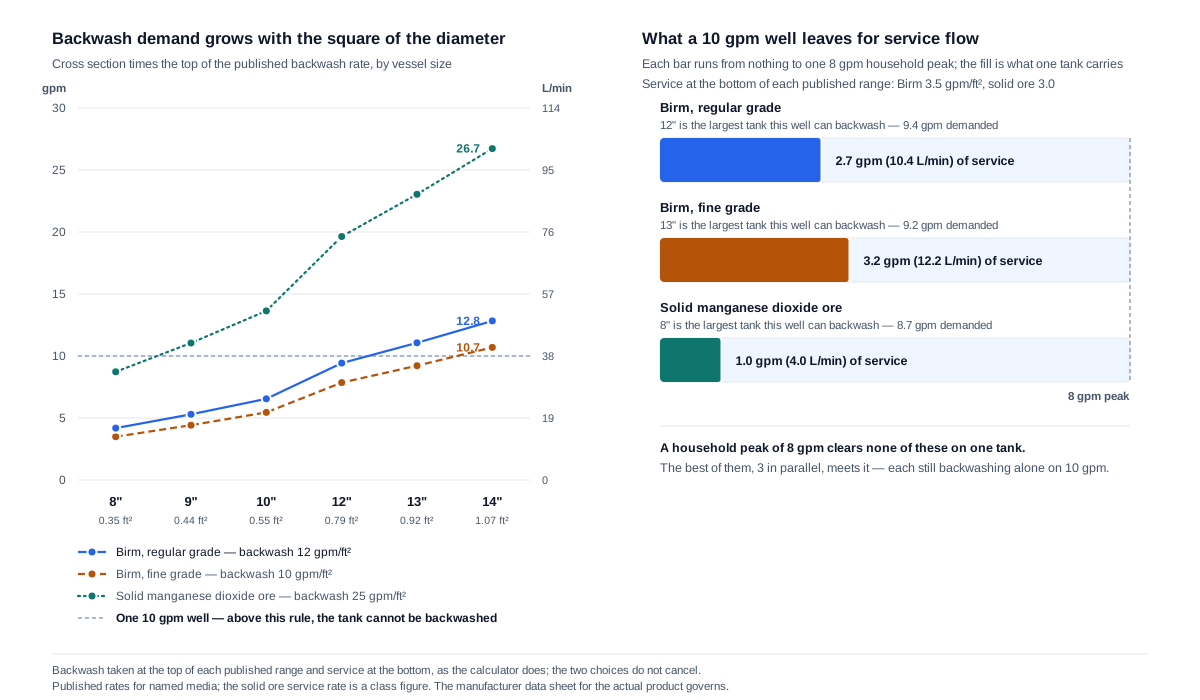
Published rates are 10 to 15 gallons per minute per square foot of tank cross section for coated filter media and 15 to 25 for solid manganese dioxide ore media. Birm specifically is 10 to 12 for the regular grade and 8 to 10 for the fine grade, which is recommended where backwash rates are limited.
Applied to the standard tank sizes at the Birm range, an 8 inch tank demands 3.5 to 4.2 gallons per minute, a 10 inch 5.5 to 6.5, a 12 inch 7.9 to 9.4, and a 14 inch 10.7 to 12.8. In litres per minute those are 13 to 16, 21 to 25, 30 to 36 and 41 to 48. A published trade chart gives 8.6 gallons per minute for a 12 inch Birm filter at a mid range rate, which confirms both the area arithmetic and the rates.
Set that against the service flow the same tanks support at the conservative rate, which is 1.2, 1.9, 2.7 and 3.7 gallons per minute respectively, and the ratio is roughly two to five to one. The backwash demand is always the larger number, and on a typical residential well it is the one that is hard to meet.
This calculator uses the upper end of the published range for the requirement. That is deliberate: backwashing at the bottom of the range is exactly the under-cleaning the page exists to catch, so sizing to the optimistic end would defeat the check.
Two things about the available flow are worth stating, because both are commonly overestimated. It has to be sustained for the whole backwash cycle rather than momentary, and it has to be available at the pressure the control valve and the drain route require. An open discharge well yield is neither of those, and the real figure at the filter is usually lower.
Why a Bigger Iron Filter Is Not Always Better
This is the point where the ordinary instinct about sizing does the most damage, and the trade literature says so in as many words: there is a tendency among filter buyers to assume that their water supply will support any filter and that, therefore, bigger is always better. Not so.
The reason is that both flows scale with the same tank area, and the backwash rate is the larger multiplier. Going up a tank size improves the service flow and worsens the backwash requirement by more.
Take a well delivering 6 gallons per minute. A 12 inch Birm filter supports about 2.7 gallons per minute of service and demands 9.4 to backwash, a shortfall of 3.4. Move to a 13 inch tank and the service flow improves to 3.2 while the backwash demand rises to 11.1, so the shortfall grows to 5.1. The service capacity gained 15 percent and the problem got half again as bad.
What happens to an under-backwashed filter is the part that makes this failure different from the others. It does not stop working on the day it is installed. Published guidance describes it precisely: you can buy the filter and it will work, for a time at least, but it will probably eventually become overwhelmed with iron because it is simply not getting enough backwash water flow to clean itself out.
So the sequence is: the filter holds iron, then holds less, then starts passing it, over months. By the time the staining comes back, the pump flow is not what anyone suspects, and the usual diagnosis is exhausted media rather than a filter that was never cleanable.
Published guidance puts 10 or 12 inches as the maximum diameter for most residential situations for this reason rather than for any reason to do with capacity. Larger private and commercial systems go beyond it under an engineered design.
Three remedies exist where the backwash falls short, and the obvious one is not among them. Use the largest tank the available flow can actually backwash. Choose a medium with a lower backwash rate, such as the fine grade of Birm. Or install two smaller filters in parallel, which is the next section.
Parallel Iron Filters Versus Series
Where a household needs more service flow than one backwashable tank supports, published guidance is specific about the arrangement: using two smaller filters and installing them in parallel rather than in series is usually the best solution.
The word parallel is doing the work, and the arithmetic shows why.
Two 10 inch tanks have 0.545 square feet of cross section each. Together they support about 3.8 gallons per minute of service at the conservative rate, slightly more than a single 14 inch tank's 3.7. But they backwash one at a time, so the instantaneous backwash demand is 6.5 gallons per minute rather than the 12.8 a 14 inch tank would need. The same service flow at about half the peak demand on the well.
Series does not help at all, and it is the arrangement people reach for because it sounds like more filtration. Two tanks in series both see the full service flow, so neither is relieved of any duty, and each still demands its own full backwash rate when its turn comes. What series buys is contact time, which matters for some chemistry, and it buys nothing at all on the flow problem.
One condition decides whether parallel works, and it is easy to leave out of a specification. The controls have to sequence the tanks so that only one backwashes at a time. Two tanks backwashing together demand exactly what a single large tank would, and the entire benefit disappears.
The same shape appears elsewhere in water system design. Where a device has a working range rather than a simple capacity, more duty is met by more devices rather than by a larger one, and the control strategy is part of the design rather than an accessory to it.
Iron Form Before Filter Size
The form the iron is in decides the equipment, and it is free to determine.
Fill a glass from the tap and look at it twice. If the water is clear at first and turns orange or brown over the next few minutes, the iron is ferrous, dissolved, and in what the trade calls clear water iron. If it is orange straight from the tap, the iron is ferric, already oxidised, and particulate.
Those need different equipment. Ferrous iron passes through a filter untouched, so it has to be oxidised into a particle before anything can hold it, which is what a catalytic medium does. Ferric iron is already a particle, so filtration alone can hold it and an oxidising medium is not required for the iron itself.
A third possibility is iron bacteria, which produce a slimy or stringy growth and a distinct odour. That is a biological problem rather than a chemistry one, and a media bed will foul on it rather than treat it. Disinfection comes first.
There is a diagnostic hint in the pH that costs nothing either. Dissolved iron and manganese are most common in groundwater below pH 7.0. Oxidised forms are more common at higher pH, or where oxygen is readily available such as a shallow spring. So a low pH sample that arrives clear is almost certainly ferrous, and that combination has a consequence covered in the pH section below.
The glass test identifies the form and does not replace an analysis. Media selection needs the iron, the manganese, the pH, the dissolved oxygen, the hydrogen sulfide, the hardness and the chlorine at a minimum, and several of those exclude media on their own.
Iron Filter Media Selection
The medium decides both flow rates, so it decides the tank, and the water chemistry decides the medium. That is the order.
Birm is a catalyst that uses dissolved oxygen already in the water rather than a chemical regenerant, which makes it the cheapest to run and the most conditional. It has published conditions covered in the next section, and several of them exclude it outright.
Fine grade Birm is the same medium in a smaller particle size, published at 8 to 10 gallons per minute per square foot of backwash against 10 to 12 for the regular grade. It is recommended specifically where backwash rates are limited, which makes it the first thing to consider when a well falls short rather than a compromise.
Manganese greensand is regenerated with potassium permanganate instead of relying on dissolved oxygen, so it works where the water has too little oxygen for Birm. It is recommended where the combined iron and manganese sits between 3 and 10 milligrams per litre, and the regenerant is toxic and has to be handled and stored accordingly. It also requires the regeneration to happen on schedule, which is a maintenance commitment rather than a one time cost.
Catalytic carbon adsorbs and then oxidises and filters dissolved iron in a single unit, and is effective below 1.0 milligram per litre with at least 4.0 milligrams per litre of dissolved oxygen in the source water. It has no chemical feed, and it has the narrowest concentration window of anything here.
Solid manganese dioxide ore media, of which Filox is one, support a higher service flow per bed size, so a smaller tank carries the same duty. They demand a much higher backwash rate in return, published at 15 to 25 gallons per minute per square foot against 10 to 15 for coated media, with daily backwashing preferred and a media cost close to triple that of Birm. The smaller tank and the higher rate partly cancel.
One caution about comparing published figures. Some manufacturers publish a rate per square foot of cross section and others publish a flow for a bed volume, and the two are not comparable. A figure of 5.5 gallons per minute for a one cubic foot bed reads as 15.8 per square foot in an 8 inch tank, where that cubic foot is 34 inches deep, and 7.0 per square foot in a 12 inch tank, where it is 15 inches deep. The same published number sits above or below the Birm range depending on a tank that was never stated. This calculator carries only media whose rates are published per square foot, and reports the others as not normalised rather than converting them on an assumed tank.
For any specific product the manufacturer data sheet governs over any of these figures.
Birm Filter Requirements
Birm is the most commonly specified iron filter medium and the one with the longest list of conditions, most of which are disqualifying rather than preferences.
The pH floor is 6.8 for iron removal and 7.5 for manganese. Those are different numbers because manganese is harder to oxidise, and a water at pH 7.0 with manganese present fails on manganese while passing on iron.
Dissolved oxygen must be at least 15 percent of the iron content, or of the combined iron and manganese content where manganese is present. On 5 parts per million of iron with 1 of manganese that is 0.90 parts per million, not the 0.75 the iron alone would give. Birm is a catalyst rather than an oxidant: it speeds a reaction between the oxygen already in the water and the iron, and with too little oxygen there is nothing to catalyse. Aeration is the pre-treatment where the oxygen is short.
Hydrogen sulfide must not be present, and it must be removed ahead of the filter rather than treated by it. Oil must not be present either.
Free chlorine must stay below 0.5 parts per million. Chlorination greatly reduces Birm's activity and high concentrations may deplete the catalytic coating, which matters where a chlorine injection system is being considered upstream for bacteria or for pre-oxidation.
Organic matter must not exceed 4 to 5 parts per million, and alkalinity should be greater than twice the combined sulfate and chloride concentration. Neither of those is an input on this calculator, so a Birm result here is Birm allowed on the conditions tested rather than Birm confirmed as suitable.
The vessel has requirements too. Bed depth is 30 to 36 inches, freeboard is at least 50 percent of the bed depth, and backwash bed expansion is 20 to 40 percent. The freeboard exists to give the bed room to expand, so a tank too short for its bed cannot be backwashed properly regardless of the flow available.
One published caveat is worth carrying. Even under ideal conditions, manganese removal efficiency is described as highly variable with Birm filters. A manganese result on this medium carries more uncertainty than an iron one.
pH and Iron Oxidation
Every iron filter medium publishes a pH floor, and the reason is not that performance tapers off below it. The reaction stops happening on any useful timescale.
Published figures for 90 percent oxidation of ferrous iron give 30 seconds at pH 8.0, one hour at pH 7.0 at 21 C, ten hours at that same pH at 5 C, and 100 hours at pH 6.0.
From pH 6 to pH 8 the reaction time changes by a factor of about twelve thousand. Cold water moves it by a factor of ten at the same pH.
A filter bed gives the water a few seconds of contact. At pH 8 that is enough for the reaction to complete several times over. At pH 6 the water would need to sit in the bed for four days.
Two consequences follow, and the second is not obvious.
The first is that pH correction comes before the filter rather than after it, and it is a separate purchase. Neutralising media such as calcite, or a soda ash feed, raise the pH ahead of the filter where the water is below the medium's floor.
The second is a compounding effect. Dissolved iron and manganese are most common in groundwater below pH 7.0, and below pH 7.0 the oxidation that would convert them is at its slowest. Low pH water tends to carry exactly the form that needs oxidising, in the conditions where oxidising is hardest. Those are two statements of the same underlying chemistry, and together they explain why a catalytic medium alone is so often the wrong tool on acidic well water.
Temperature belongs in the same discussion because it produces a complaint that looks like equipment failure. A filter working adequately in summer and poorly in winter has not changed, and neither has the water chemistry. The water is ten degrees colder and the same oxidation is taking ten times as long.
One more figure sets a floor independent of pH. The critical dissolved oxygen concentration is 2 milligrams per litre, below which ferrous oxidation occurs very slowly regardless of the medium or the pH.
Manganese Changes the Answer
Manganese travels with iron in groundwater and it is not a minor co-contaminant. It changes three separate things in this calculation.
It fails six times sooner. The secondary drinking water standard for iron is 0.3 milligrams per litre and for manganese it is 0.05. A water at 0.25 milligrams per litre of iron and 0.10 of manganese passes on iron and sits at twice the standard on manganese, so a test read on the iron figure alone reports a clean result on water that will stain black. Manganese stains are dark rather than orange, which is often the first clue.
It raises the Birm pH floor. Birm needs 6.8 for iron and 7.5 for manganese, so a water at pH 7.0 with manganese present is outside the medium for the manganese even though it is comfortably inside for the iron.
It enters the dissolved oxygen requirement. The Birm figure is 15 percent of the iron or the combined iron and manganese content, so manganese raises the oxygen the medium needs to work. Five parts per million of iron with one of manganese needs 0.90 rather than 0.75, a 17 percent increase from a contaminant that is often not measured at all.
Two more points bear on the equipment choice. Manganese removal on Birm is described in published guidance as highly variable even under ideal conditions, so a manganese target on that medium carries more uncertainty than an iron one. And chlorine is not recommended as an oxidant for very high manganese, because a very high pH is needed to oxidise it completely, which rules out the simplest pre-oxidation route exactly where it would be most needed.
Manganese also carries an EPA Health Advisory at 0.3 milligrams per litre on neurological grounds. That is a different kind of threshold from the aesthetic standard and it sits at six times the aesthetic figure, so a water can be well past the staining standard and still below the health advisory.
Iron Filter Versus Water Softener
A softener does remove iron, and up to a point it is a legitimate answer rather than a compromise. Past that point it is not merely ineffective, it is being destroyed.
Published guidance recommends softeners for iron removal only where three conditions hold together: the pH is above 6.7, the hardness is between 3 and 20 grains per gallon, which is 50 to 350 milligrams per litre, and the dissolved iron concentration is below 5 milligrams per litre. Inside that window a separate iron filter may not be needed at all, and the softener removes the iron by the same ion exchange it uses on calcium and magnesium.
The form matters as much as the concentration. Oxidised iron and manganese foul the resin, and the guidance is explicit: it is critical that the raw water not come into contact with any oxidising agent such as air or chlorine before entering the softener. Using the resin bed as a mechanical filter for oxidised iron is not recommended, because it can damage the bed and require much more frequent backwashing.
So an aerator, a chlorine injection point, or anything else that oxidises the iron upstream turns the softener from a working device into a fouling one. If oxidised iron or manganese is present in the raw water, filtration is the removal method rather than exchange.
Where both devices are in a design, the order is not arbitrary. A published rule of thumb puts the iron filter first where the iron is above 3 parts per million with hardness above 10 grains per gallon, so the softener never meets the load that fouls it. Treat that as a rule of thumb rather than a universal rule; the underlying principle is that the softener should see water the resin can handle.
Iron filters handle a much wider range. Trade sources put dedicated iron filters at 15 to 30 parts per million against a softener limit of 3 to 5, and the cost comparison runs the other way than people expect: media replacement on a filter is far cheaper than replacing resin fouled by iron.
Treatment Ladder by Iron Concentration
An oxidising filter covers the middle of the iron concentration range, and reaching for one at every level buys a backwash problem that a smaller device would not have had.
Below 1.0 milligram per litre of dissolved iron, catalytic carbon adsorbs, oxidises and filters in one unit. It requires at least 4.0 milligrams per litre of dissolved oxygen in the source water, which some groundwater does not have without pre-treatment, and it needs backwashing but no chemical feed.
Below 2 milligrams per litre of dissolved iron, polyphosphate addition is an option, and it is important to understand what it does. It sequesters the iron rather than removing it. The staining stops and the metallic taste remains, the dose usually needs trial and error adjustment, too much of it gives the water a slippery feeling, and the polyphosphate can degrade in a water heater and release the sequestered iron again. It is ineffective on manganese.
Below 5 milligrams per litre of dissolved iron, a softener is within its published window provided the pH and hardness conditions in the previous section also hold.
Between 3 and 10 milligrams per litre of combined iron and manganese, manganese greensand is the recommended oxidising filter, with the maintenance frequency rising as the concentration does.
Above 10 milligrams per litre combined, no single unit is the answer. The effective treatment is oxidation followed by filtration: a chemical feed, usually chlorine but sometimes potassium permanganate or hydrogen peroxide, into a mixing tank or a coil of pipe that provides contact time for the precipitate to form, then a backwashing filter to remove it, and often an activated carbon filter after that to take out the residual taste and odour.
Two footnotes to that ladder. Chlorine is not recommended as the oxidant where manganese is very high, because a very high pH is needed to oxidise manganese completely. And aeration is an alternative oxidant that adds no chemicals, with lower running costs and a higher purchase price, but it still needs a filter after it and the water should be disinfected to keep bacteria from colonising the aerator.
What Is an Iron Filter
An iron filter is a pressure vessel packed with a granular medium that traps iron out of the water and is cleaned by reversing the flow.
Most of them do two jobs at once. Iron in groundwater is usually dissolved, in the ferrous state, and dissolved iron passes straight through a filter. The medium acts as a catalyst that converts it to the ferric state, which is a solid particle, and then holds that particle in the bed. Periodically the flow reverses, lifts and expands the bed, and carries the accumulated iron to drain. That reverse cycle is the backwash, and the ability to perform it is what this page checks.
Iron is not a health contaminant. It has a secondary drinking water standard of 0.3 milligrams per litre set for staining and taste rather than for safety, and one survey found excessive iron in 17 percent of the private water supplies sampled in a single state.
Private water systems serving individual homes are not subject to state or federal drinking water standards, so these figures are guidelines for managing a supply rather than requirements anyone enforces.
Key Facts
- Service flow is commonly 3 to 5 gallons per minute per square foot of tank cross section. Backwash flow is 10 to 15 for coated media and 15 to 25 for solid manganese dioxide ore media, so the backwash demand is roughly two to five times the service flow the same tank supports.
- Tank cross sections: 8 inch is 0.349 square feet, 9 inch 0.442, 10 inch 0.545, 12 inch 0.785, 13 inch 0.922 and 14 inch 1.069. In millimetres the diameters are 203, 229, 254, 305, 330 and 356.
- Backwash demand at the Birm range by tank: 3.5 to 4.2 gallons per minute at 8 inch, 5.5 to 6.5 at 10 inch, 7.9 to 9.4 at 12 inch and 10.7 to 12.8 at 14 inch. A published trade chart gives 8.6 for a 12 inch Birm filter at a mid range rate.
- Birm backwash is 10 to 12 gallons per minute per square foot for the regular grade and 8 to 10 for the fine grade, with a service flow of 3.5 to 5.
- Birm requires pH 6.8 or more for iron and 7.5 or more for manganese, dissolved oxygen at least 15 percent of the combined iron and manganese, no hydrogen sulfide, no oil, organic matter below 4 to 5 parts per million, free chlorine below 0.5, and alkalinity above twice the combined sulfate and chloride.
- Birm bed depth is 30 to 36 inches with freeboard of at least 50 percent of bed depth, and bed expansion during backwash is 20 to 40 percent.
- Ferrous oxidation takes 30 seconds at pH 8.0, one hour at pH 7.0 and 21 C, ten hours at pH 7.0 and 5 C, and 100 hours at pH 6.0. The critical dissolved oxygen concentration is 2 milligrams per litre.
- Dissolved iron and manganese are most common in groundwater below pH 7.0. Oxidised forms are more common at higher pH or where oxygen is readily available, such as a shallow spring.
- Iron has a secondary drinking water standard of 0.3 milligrams per litre and manganese 0.05, six times lower, with an EPA Health Advisory for manganese at 0.3 on neurological grounds.
- Softeners are recommended for iron only where the pH is above 6.7, the hardness is between 3 and 20 grains per gallon, and the dissolved iron is below 5 milligrams per litre.
- Catalytic carbon is effective below 1.0 milligram per litre of dissolved iron and requires at least 4.0 milligrams per litre of dissolved oxygen. Polyphosphate treats below 2 milligrams per litre by sequestering rather than removing. Manganese greensand covers 3 to 10 milligrams per litre combined. Above 10, oxidation followed by filtration.
- For most residential situations 10 or 12 inches is the maximum tank diameter published guidance recommends.
- Two 10 inch tanks in parallel support about 3.8 gallons per minute of service and demand 6.5 at any moment, against 12.8 for a single 14 inch tank of similar capacity.
- A published trade guide states that there is a tendency among filter buyers to assume that bigger is always better, and that it is not.
- Private water systems serving individual homes are not subject to state or federal drinking water standards, so all of these figures are guidelines.
Applications
- A homeowner with staining works out whether the well can backwash the filter a dealer has quoted before agreeing to it.
- A well contractor checks a filter against a pump that has already been selected, and finds the two do not fit.
- A designer with a 5 gallon per minute household discovers that no single residential tank covers it at the conservative service rate, and that parallel is the answer rather than a compromise.
- A service technician diagnosing a filter that stopped holding iron after two years checks the backwash flow rather than replacing the media.
- A homeowner with a pH of 6.4 finds that no catalytic medium will work until the pH is corrected, and that pH correction is the first purchase rather than the filter.
- A specifier comparing media finds that two published backwash figures are in different units and cannot be compared until one is converted.
- A homeowner deciding between a softener and an iron filter checks the published conditions and finds which side of the line the water sits on.
- A well owner whose water passes on iron finds that the manganese is at twice its own standard, which is six times lower.
Example Calculations
Example 1. The two flows, and how far apart they are
Given: a 12 inch tank on Birm media.
The cross section is 3.14159 times 12 divided by 24, squared, which is 0.785 square feet. At the conservative service rate of 3.5 gallons per minute per square foot it supports 2.7 gallons per minute. At the upper backwash rate of 12 it demands 9.4.
Result: the same tank needs more than three times the flow to clean itself than to do its job. That ratio is why the backwash is the binding constraint on almost every residential installation.
Example 2. The published case that names the failure
Given: a residential well with a pumping capacity of 6 gallons per minute, and a 12 inch Birm filter requiring 8.6 gallons per minute of backwash at a mid range rate.
Result: undersized on backwash by 2.6 gallons per minute. The published guidance is explicit: you can buy the filter and it will work, for a time at least, but it will probably eventually become overwhelmed with iron because it is simply not getting enough backwash water flow to clean itself out. The filter holds iron, then holds less, then starts passing it, over months.
Example 3. Why the bigger tank is the wrong answer
Given: the same 6 gallon per minute well, with the buyer considering a 13 inch tank instead of a 12.
The 13 inch tank has 0.922 square feet, supports 3.2 gallons per minute of service and demands 11.1 to backwash.
Result: the service flow improved by 15 percent and the backwash shortfall grew from 3.4 to 5.1 gallons per minute. Every increase in diameter improves one and worsens the other by more, because both scale with the same area and the backwash rate is the larger multiplier.
Example 4. Parallel, and why series does nothing
Given: a household needing about 3.8 gallons per minute of service, considered as one large tank and as two small ones.
A single 14 inch tank supports 3.7 gallons per minute and demands 12.8 to backwash. Two 10 inch tanks support 3.8 together and demand 6.5 at any moment, because they backwash one at a time.
Result: the same service flow at about half the instantaneous demand. Series would achieve nothing: both tanks would see the full service flow and each would still need its own full backwash rate. The controls must sequence the tanks, because two backwashing together demand exactly what one large tank would.
Example 5. The conservative rates, and why they do not cancel
Given: a household peak service flow of 5 gallons per minute.
At the optimistic service rate of 5 gallons per minute per square foot the tank needs 1.00 square feet, about a 13.5 inch diameter, demanding 12.0 gallons per minute of backwash. At the conservative rate of 3.5 it needs 1.43 square feet, about 16.2 inches, demanding 17.1.
Result: choosing conservatively on the service rate makes the backwash requirement worse rather than better, and that is deliberate. An optimistic service rate produces a small tank the well can clean and the household cannot use.
Note also that 16.2 inches is outside every standard residential tank. For this household a single vessel is not the answer at all, and parallel is the design rather than a fallback.
Example 6. Dissolved oxygen, with manganese in it
Given: 5 parts per million of iron with 1 of manganese, on a Birm filter.
Birm requires dissolved oxygen equal to at least 15 percent of the combined iron and manganese content. Fifteen percent of 6 is 0.90 parts per million.
Result: 0.90, not the 0.75 that iron alone would give. Forgetting the manganese understates the requirement by 17 percent, in the direction that lets a filter be specified for water that cannot oxidise on it.
Example 7. pH does not shift the answer, it changes it by four orders of magnitude
Given: the same ferrous iron at three different pH values.
Published figures for 90 percent oxidation: 30 seconds at pH 8.0, one hour at pH 7.0 at 21 C, ten hours at pH 7.0 at 5 C, and 100 hours at pH 6.0.
Result: from pH 6 to pH 8 the reaction time changes by a factor of about twelve thousand, and cold water moves it by a factor of ten at the same pH. A filter bed gives the water a few seconds of contact, so at pH 6 the reaction the medium exists to catalyse is not slow, it is not happening.
Example 8. The two facts about pH are the same fact
Given: a sample at pH 6.5 that arrives clear from the tap and turns orange in a glass.
Dissolved iron and manganese are most common in groundwater below pH 7.0, so the form is unsurprising. And below pH 7 the oxidation that would convert it is at its slowest.
Result: low pH water tends to carry the form that needs oxidising, in the conditions where oxidising is hardest. That is why pH correction so often comes before the filter rather than after it.
Example 9. Manganese fails six times sooner than iron
Given: a water at 0.25 milligrams per litre of iron and 0.10 of manganese.
The secondary drinking water standard for iron is 0.3 milligrams per litre and for manganese 0.05.
Result: the iron passes and the manganese is at twice its standard. A test read on the iron figure alone reports a clean result on water that will stain black. Manganese also carries an EPA Health Advisory at 0.3 on neurological grounds, which sits at six times the aesthetic standard rather than below it.
Example 10. Which treatment the concentration calls for
Given: four waters with dissolved iron at 0.8, 1.8, 4 and 12 milligrams per litre, all at a pH above 6.8.
Result: at 0.8, catalytic carbon is effective provided the dissolved oxygen is at least 4.0. At 1.8, polyphosphate can sequester the iron, though it does not remove it and the metallic taste remains. At 4, a softener is within its published window if the hardness fits. At 12, no single unit is the answer and the treatment is oxidation followed by filtration.
Example 11. The softener boundary, from both sides
Given: two waters, one at 3 milligrams per litre of dissolved ferrous iron with pH 7.2 and hardness 12 grains per gallon, the other at 7 milligrams per litre with some ferric iron present.
Result: the first sits inside all the published conditions and a softener is a legitimate answer. The second is outside them, and a softener there is not merely ineffective: oxidised iron fouls the resin, raw water must not meet air or chlorine before the softener, and using the resin bed as a mechanical filter can damage it.
Example 12. The media figures that cannot be compared
Given: a Birm backwash rate of 10 to 12 gallons per minute per square foot, and a supplier figure of 5.5 gallons per minute for a one cubic foot bed of another medium.
In an 8 inch tank that cubic foot is 34 inches deep over 0.349 square feet, so 5.5 gallons per minute is 15.8 per square foot. In a 12 inch tank it is 15 inches deep over 0.785 square feet, so the same 5.5 is 7.0.
Result: the same published figure reads as either well above or well below the Birm rate depending on a tank that was never stated. Two backwash figures in different units cannot be compared until one is converted.
Example 13. A tank that passes the backwash and fails the household
Given: an 8 inch Birm tank on a well delivering 8 gallons per minute, serving a household peak of 5 gallons per minute.
The 8 inch tank demands 4.2 gallons per minute of backwash at the upper rate, which the well supplies comfortably. It supports 1.2 gallons per minute of service at the conservative rate.
Result: the backwash passes and the service capacity fails by a wide margin. These are two independent checks and both have to clear. A tank chosen only because the well can clean it is as wrong as one chosen only because it serves the house.
Example 14. Dissolved oxygen not measured
Given: a Birm candidate with iron at 4 parts per million, manganese not entered and dissolved oxygen not entered.
Result: the requirement is reported as 0.60 parts per million on the iron alone, with a note that manganese would raise it and that the oxygen figure was not evaluated. Birm is not confirmed until the oxygen is known, because a catalyst with nothing to catalyse does not work. Aeration is the pre-treatment where the figure comes back short.
Example 15. Birm allowed on the conditions tested
Given: a water where the pH, dissolved oxygen, hydrogen sulfide and chlorine all pass for Birm.
Result: Birm is reported as compatible with the entered values rather than as suitable. The published conditions also include organic matter below 4 to 5 parts per million, no oil, and alkalinity greater than twice the combined sulfate and chloride, and none of those is an input here. A pH pass is not a media approval.
Example 16. Zero iron
Given: an iron concentration of zero.
Result: no iron filter is indicated for iron removal. If staining is the complaint, the cause is elsewhere: manganese stains black at a sixth of the iron standard, and sediment, tannins or other constituents produce their own discolouration. A low iron reading is also not the same as zero, since staining is reported from 0.3 milligrams per litre.
Standards & References
- [Penn State Extension, Iron and Manganese in Private Water Systems](https://extension.psu.edu/iron-and-manganese-in-private-water-systems) The primary source for the treatment ladder and the softener boundary used here: the secondary drinking water standards of 0.3 milligrams per litre for iron and 0.05 for manganese with the EPA Health Advisory for manganese at 0.3, the softener conditions of pH above 6.7 with hardness of 3 to 20 grains per gallon and dissolved iron below 5 milligrams per litre, the warning that oxidised iron and manganese foul softener resin and that raw water must not contact air or chlorine before the softener, the Birm pH floors of 6.8 for iron and 7.5 for manganese, the note that Birm manganese removal is highly variable, the manganese greensand range of 3 to 10 milligrams per litre combined, the catalytic carbon limit of 1.0 milligram per litre with a 4.0 milligram per litre dissolved oxygen requirement, the polyphosphate limit of 2 milligrams per litre, the rule that combined iron and manganese above 10 milligrams per litre calls for oxidation followed by filtration, the caution that chlorine is not recommended for very high manganese, and the observation that dissolved forms are most common below pH 7.0.
- [Pure Water Products, Backwash and Flow Rates of Filter Media](https://www.purewaterproducts.com/articles/backwash-chart) The trade backwash chart and the guidance this page is built around: the 12 inch Birm filter requiring 8.6 gallons per minute of backwash against a 6 gallon per minute well, the statement that the filter will work for a time and then become overwhelmed with iron, the warning that there is a tendency to assume bigger is always better, the recommendation of 10 or 12 inches as a residential maximum, and the parallel rather than series solution.
- [Performance Water Products, Birm](https://www.performancewater.com/substrate_/birm/) The published Birm operating conditions: pH range 6.8 to 9.0, dissolved oxygen at least 15 percent of the iron or combined iron and manganese content, alkalinity greater than twice the combined sulfate and chloride, bed depth 30 to 36 inches, freeboard at least 50 percent of bed depth, backwash rate 10 to 12 gallons per minute per square foot for regular grade and 8 to 10 for fine, bed expansion 20 to 40 percent, service flow 3.5 to 5, free chlorine below 0.5 parts per million, and hydrogen sulfide to be removed ahead of the filter.
- [Rutgers New Jersey Agricultural Experiment Station, FS516 Management of Iron in Irrigation Water](https://njaes.rutgers.edu/fs516/) The oxidation rate figures by pH and temperature: 90 percent oxidation of ferrous iron in 30 seconds at pH 8.0, one hour at pH 7.0 at 21 C, ten hours at pH 7.0 at 5 C and 100 hours at pH 6.0, with a critical dissolved oxygen concentration of 2 parts per million.
- [Clean Water Store, How to Size Commercial Filtration Systems for Iron and Manganese Treatment](https://www.cleanwaterstore.com/blog/size-commercial-filtration-systems-iron-manganese-treatment/) Service flow of 3 to 5 gallons per minute per square foot as a conservative figure, and backwash of 10 to 15 for coated media and 15 to 25 for solid manganese dioxide ore media.
- [Pure Water Products, Filox filters for iron, manganese and hydrogen sulfide removal](https://www.purewaterproducts.com/filox-filters) The trade offs on solid manganese dioxide ore media: higher service flow per bed size so a smaller tank carries the same duty, a much higher backwash requirement with daily backwashing preferred, a pH range of 5.0 to 9.0 with correction recommended outside 6.5 to 8.5, and a media cost close to triple that of Birm.
- Note on attribution There is no plumbing code table for iron filter sizing. Every figure on this page comes from a media manufacturer data sheet, published trade guidance or an extension service publication, and the media manufacturer own data sheet governs for a specific product. The secondary drinking water standards are guidelines for private systems rather than requirements, because private water systems serving individual homes are not subject to state or federal drinking water standards. Backwash and service rates are published as ranges and the figures here use the conservative end of each, which is stated where it affects an answer. Media rates published as a flow for a bed volume are not comparable with rates published per square foot and are not used until converted.
Units
Flow is entered and reported in gallons per minute and litres per minute, at 3.785411784 litres per gallon per minute. The published backwash case of 8.6 gallons per minute is 32.6 litres per minute, and a 6 gallon per minute well is 22.7. Tank diameter is entered in inches with millimetres alongside, at 25.4 mm per inch: the standard sizes of 8, 9, 10, 12, 13 and 14 inches are 203, 229, 254, 305, 330 and 356 mm, and diameters stay in inches in both systems because that is how filter vessels are specified and ordered. Cross sectional area is reported in square feet and square metres, at 0.09290304 square metres per square foot, so the 0.785 square feet of a 12 inch tank is 0.0729 square metres. Flow rates per unit area are reported in gallons per minute per square foot and litres per minute per square metre, so the Birm backwash range of 10 to 12 gallons per minute per square foot is 407 to 489 litres per minute per square metre. Concentrations are in parts per million and milligrams per litre, which are equivalent for water at ordinary temperatures and do not convert, so both systems use the same figure. Hardness is entered in grains per gallon or milligrams per litre, at 17.118 milligrams per litre per grain, so the published softener window of 3 to 20 grains per gallon is 51 to 342 milligrams per litre, which the source gives as 50 to 350. Temperature is entered in Fahrenheit or Celsius as a level, converting with the 32 degree offset, and the oxidation rate figures are quoted at 21 C and 5 C, which are 70 F and 41 F. pH is dimensionless and identical in both systems. The internal unit selector governs the fields, labels, math, on-screen result and any exported result, and it takes priority over any site-wide unit switch: switching converts the values you entered rather than reinterpreting them.
Limitations
- This calculator sizes a backwashing filter and checks whether the supply can backwash it. It does not replace a water treatment professional's interpretation of a complete analysis, and every figure it returns follows from the numbers entered.
- It does not size pH correction equipment, aeration, chemical injection or contact tanks, all of which are the answer where the chemistry rules the media out.
- It does not cover air injection systems, which carry a reduced media volume to leave an air pocket and to which the standard media sizing tables do not apply.
- The media table carries only media whose service and backwash rates are published per square foot of cross section. A rate published as a flow for a bed volume depends entirely on the tank the bed sits in and is not comparable until converted.
- The backwash check is a flow check only. It does not verify control valve capacity, drain line size, drain pressure loss or waste disposal capacity, and a supply can deliver the flow while the drain route cannot pass it.
- Backwash water goes to a drain, and on a property with a septic system the volume and the iron loading are a design consideration this page does not size.
- The service and backwash rates are published as ranges. This page uses the lower service rate and the upper backwash rate, which makes the design harder to satisfy rather than easier, deliberately.
- Birm has published conditions that are not inputs here: organic matter below 4 to 5 parts per million, no oil, and alkalinity greater than twice the combined sulfate and chloride. Where Birm is reported as allowed, it is allowed on the conditions tested rather than confirmed as suitable.
- Manganese removal on Birm is described in published guidance as highly variable even under ideal conditions, so a manganese result on that medium carries more uncertainty than an iron one.
- Iron bacteria are a biological problem and this page does not size disinfection.
- There is no plumbing code table behind any of this. It is manufacturer and trade practice, and the data sheet for the actual product governs.
Common Mistakes to Avoid
- Sizing the tank on the service flow alone. The backwash demand is two to five times larger and it is the number the well has to meet.
- Going up a tank size when the backwash falls short. Every increase in diameter improves the service flow and worsens the backwash by more. A 13 inch tank on a 6 gallon per minute well turns a 3.4 gallon shortfall into 5.1.
- Installing two tanks in series to get more flow. Each tank still sees the full service flow and still demands its own full backwash rate. Only parallel splits the load.
- Fitting parallel tanks without sequencing controls. Two tanks backwashing at the same time demand exactly what one large tank would.
- Using the well yield as the available backwash flow. The figure that matters is the sustained flow at the pressure the valve and drain route need, which is lower.
- Computing the dissolved oxygen requirement on iron alone. Birm needs 15 percent of the combined iron and manganese, so 5 parts per million of iron with 1 of manganese needs 0.90 rather than 0.75.
- Calling Birm approved when only the pH was checked. Birm also depends on dissolved oxygen, hydrogen sulfide, chlorine, organic matter, oil and alkalinity relative to sulfate and chloride. A pH pass is not a media approval.
- Reading a manganese result against the iron standard. Iron has a secondary standard of 0.3 milligrams per litre and manganese 0.05, six times lower.
- Treating a low pH as a performance penalty. Ferrous oxidation takes 30 seconds at pH 8 and 100 hours at pH 6. Below a medium's published floor the reaction is not slow, it is not happening.
- Ignoring water temperature. The same oxidation takes ten times as long at 5 C as at 21 C at the same pH, which is why a filter can work in summer and fail in winter with nothing changed.
- Using a softener as an iron filter beyond its window. Oxidised iron fouls the resin permanently, and raw water must not meet air or chlorine before the softener.
- Putting the softener before the iron filter. The published rule of thumb is that iron above 3 parts per million with hardness above 10 grains per gallon puts the iron filter first.
- Comparing two media on backwash figures published in different units. A flow for a one cubic foot bed reads as 15.8 gallons per minute per square foot in an 8 inch tank and 7.0 in a 12 inch one.
- Reaching for a filter at every concentration. Below 1 milligram per litre catalytic carbon may serve, below 2 polyphosphate can sequester, below 5 a softener may be enough, and above 10 no single unit is the answer.
Frequently Asked Questions
How do I size an iron filter?
What backwash flow does an iron filter need?
Can an iron filter be too big?
What happens if my well cannot backwash the filter?
What do I do if the well flow is too low?
Why parallel and not series?
What pH does an iron filter need?
Can a water softener remove iron instead?
What is the difference between clear water iron and red water iron?
Does Birm remove manganese?
Why does the calculator use the upper backwash rate?
Does this calculator size the drain for backwash?
Can I use this for an air injection iron filter?
Why can a filter work at first and fail later?
Frequently Used Together
Engineers often use these calculators in combination for complete project workflows:
Related Calculators
Explore similar calculators that might be useful for your project:
Plumbing Quick Reference — Keep It On Your Phone On Site
A 10-page field reference for catching pressure, velocity, slope, and pump-sizing mistakes before you order pipe, close a wall, or add a booster.
- Velocity limits, fixture pressure minimums, drain slope, and the 80 psi ceiling in one table
- Worked examples that show why a single pressure number gives four different answers
- Keep it on your phone, or print the two field-check pages
Free PDF. Calculators stay free. Unsubscribe anytime.
Calculate
This selector governs every field, label, result and export on this page and takes priority over the site header switch. Switching converts the values you entered rather than reinterpreting them, so 6 gpm becomes 22.7 L/min and returns to exactly 6 when you switch back. Concentrations do not convert: parts per million and milligrams per litre are equivalent for water at ordinary temperatures, and pH is dimensionless.
The Water
The form decides the equipment and it is free to determine. Fill a glass from the tap: clear at first and orange after a few minutes is ferrous, orange straight from the tap is ferric, and a slimy or stringy growth with an odour is iron bacteria, which ends this calculation and starts a disinfection one.
From a water analysis. Parts per million and milligrams per litre are the same figure. A concentration of zero is a valid entry and returns a result rather than a tank, and staining is reported from levels as low as 0.3.
Every medium publishes a pH floor and the oxidation rate depends on it. pH is dimensionless and identical in both unit systems.
The Two Flows
The flow the pump can sustain for the whole backwash cycle at the pressure the control valve and the drain route need. Not the open discharge yield of the well, and not a momentary figure. This is the number that decides the result.
A well yield and an estimate are both reported as a weak basis, because an open discharge yield is not the sustained flow available at the pressure the valve and drain route require and the real figure is usually lower.
The largest flow the filter has to pass while the house is drawing. It sizes the tank, which then sets the backwash the well has to meet.
A measured peak and a fixture count estimate are not the same confidence.
The Media and the Tank (all optional)
Leave it unselected and the page compares the media your chemistry allows rather than choosing one. Greensand and Katalox Light have no rate published per square foot of cross section in the sources behind this page, so they are reported as not normalised rather than converted on an assumed tank. An air injection system ends the calculation, because a reduced media volume is not sized on the full bed tables.
Select a diameter to check a tank rather than size one. Filter vessels are specified and ordered in inches in both unit systems, so the inch figure leads and the millimetre equivalent rides alongside.
The Rest of the Analysis (all optional)
Manganese changes three things: it enters the dissolved oxygen requirement alongside the iron, it raises the Birm pH floor from 6.8 to 7.5, and its own secondary standard is 0.05, six times lower than the iron figure.
A catalytic medium needs at least 15 percent of the combined iron and manganese as dissolved oxygen. Leave it blank and the requirement is still reported, as a figure to go and check rather than one to assume.
Hydrogen sulfide disqualifies Birm outright regardless of the pH and the oxygen, and it has to be removed ahead of the filter rather than treated by it. A rotten egg odour on the cold tap is the field indication.
For the softener boundary, which is one of the four published conditions and is never reported as satisfied without it. Grains per gallon multiply by 17.118 to give milligrams per litre.
Chlorination greatly reduces the activity of a catalytic medium and high concentrations may deplete the coating. The published Birm limit is 0.5.
The same oxidation takes about ten times as long at 5 C as at 21 C at the same pH, which is why a filter can work in summer and fail in winter with nothing changed.
This does not change the sizing and it informs the result, because oxidised forms are more common where oxygen is readily available such as a shallow spring.