
Why Enthalpy Is the Number That Puts the Two Loads Back Together
Every psychrometric quantity covered so far splits air into parts, moisture content on one axis and temperature on another, sensible load against latent load; enthalpy is the one that adds them back up, and it is the only number a coil actually responds to.
Specific enthalpy is the total heat an air state carries, stated per unit mass of the dry air in it, and it holds the temperature energy and the moisture energy in one figure. A cooling coil does not know how much of its work is lowering temperature and how much is condensing water. It receives air at one total energy content and delivers it at a lower one, and the difference multiplied by the mass flow through it is the load. Temperature difference alone cannot express that, because two airstreams entering at the same dry-bulb temperature carry different total heat if their moisture differs. The enthalpy difference captures both halves in one term, which is why coil selection, energy recovery, and economizer logic are all built on it rather than on temperature.
The calculator computes the total enthalpy of an air state from a dry-bulb temperature and any one moisture property, splits it into its sensible and latent components, reports the sensible heat ratio, and in two-point mode returns the enthalpy difference and the coil load when airflow is supplied. It closes the psychrometric sequence: the Sensible Heat Ratio article divided the load, the Latent Heat Load article computed the moisture side, the Humidity Ratio article supplied the variable both depend on, and the Wet Bulb and Dew Point articles fixed the two temperatures that bound the state. Enthalpy is where those threads rejoin. ASHRAE expresses it per unit mass of dry air, a choice that turns out to matter for every mixing calculation in an air handling unit.
Calculator Inputs: One State or Two, and Four Ways to Give the Moisture
Nine fields at most, and the first one decides how many of the rest appear.
Operating Mode. Single State Point returns the total enthalpy, its components, and the sensible heat ratio for one condition. Two State Points returns the enthalpy difference, the component breakdown, the process sensible heat ratio, and the coil load when airflow is given.
Unit System. Imperial (°F, gr/lb, BTU/lb, CFM, BTU/h) or Metric (°C, g/kg, kJ/kg, m³/h, kW). Standard atmospheric pressure is assumed throughout: 14.696 psi (101.325 kPa).
Dry-Bulb Temperature [°F or °C]. The ordinary air temperature at state point 1.
Moisture Input Type. Relative Humidity, Humidity Ratio, Wet-Bulb Temperature, or Dew Point Temperature.
Moisture Value [%, gr/lb, g/kg, °F or °C]. Whichever property the previous field selected.
State Point 2 Dry-Bulb, Moisture Input Type, and Moisture Value. The leaving condition, in two-point mode only.
Airflow [CFM or m³/h], optional. Supplying it turns the enthalpy difference into a coil load.
Outputs are Specific Enthalpy h, Sensible Component h_s, Latent Component h_l, Humidity Ratio W, and Sensible Heat Ratio. Two-point mode adds Leaving Enthalpy h₂, Enthalpy Difference Δh, Sensible Δh_s, Latent Δh_l, Process SHR, Total Coil Load Q, Sensible Load Q_s, and Latent Load Q_l.
Every moisture route converges before the enthalpy is touched:
whichever moisture property → humidity ratio W → enthalpy
The enthalpy formula takes only dry-bulb temperature and W.
Relative humidity, wet-bulb, and dew point are all routes to W, not inputs to h.
Route accuracy follows the ordering the Humidity Ratio and Dew Point articles set out. An entered humidity ratio or a measured dew point carries no approximation beyond the saturation relation, relative humidity inherits whatever the hygrometer is worth, and the wet-bulb route depends on the energy balance holding and on adequate aspiration past the wick.
The calculation does not account for non-standard barometric pressure, whether a two-point process is physically achievable on given equipment, coil bypass factor, apparatus dew point, specific-heat variation at temperature extremes, or the mixing of two airstreams, which is a separate weighted average covered further down.
The Formula and What Each Term Is Doing
The enthalpy expression is two products added together, one for the dry air and one for the water vapor it carries, and each constant in it is a physical property rather than a fitted number.
Imperial (T_db in °F, W in gr/lb, h in BTU per lb of dry air):
  h = 0.240 × T_db + (W/7,000) × (1,061 + 0.444 × T_db)

Metric (T_db in °C, W in g/kg, h in kJ per kg of dry air):
  h = 1.006 × T_db + (W/1,000) × (2,501 + 1.86 × T_db)
Term by term, with the range each holds over:
0.240 BTU/lb·°F (1.006 kJ/kg·K): specific heat of dry air, flat across the HVAC range
1,061 BTU/lb (2,501 kJ/kg): latent heat of vaporization at the reference temperature
0.444 BTU/lb·°F (1.86 kJ/kg·K): specific heat of water vapor
W/7,000 or W/1,000: conversion of the field humidity ratio to a dimensionless mass ratio
Typical h: 15 to 45 BTU/lb (17 to 87 kJ/kg) across ordinary HVAC air states
The unit-consistency check on each pair:
0.240 × 4.1868 = 1.0048 ≈ 1.006 ✓
0.444 × 4.1868 = 1.859 ≈ 1.86 ✓
1,061 and 2,501 pair only once the reference offset is applied, two sections below
The conversion that gets skipped:
Entering W in gr/lb without the 7,000 divisor inflates the vapor term by that factor.
A humidity ratio near 84 is grains; near 0.012 is dimensionless; near 12 is grams per kilogram.
The magnitude identifies the convention.
What the calculator labels as latent:
h_l = (W/7,000) × (1,061 + 0.444 × T_db)
That bracket contains the latent heat of the vapor AND the vapor's own sensible heat.
The split is therefore between dry air on one side and everything the vapor carries on
the other, which is not quite the same as a split between latent and sensible energy.
The 1.08 against 1.1 section below quantifies what that costs.
Worked from the Imperial example:
At 80°F (26.7°C) with W = 83.94 gr/lb (11.99 g/kg):
  h_s = 0.240 × 80 = 19.20 BTU/lb
  h_l = (83.94/7,000) × (1,061 + 35.52) = 0.011991 × 1,096.52 = 13.15 BTU/lb
  h   = 32.35 BTU/lb (57.4 kJ/kg from the metric formula, not from × 2.326)
That parenthetical is not a typographical caution. Absolute enthalpies quoted in both systems throughout this article come from each system's own formula, for the reason two sections below.
Per ASHRAE Handbook Fundamentals, Chapter 1: moist air enthalpy is the dry-air term plus the vapor term, with the specific heats and the latent heat entering as physical constants. The vapor bracket carries both the latent heat and the vapor's sensible heat.
Per Unit Mass of Dry Air, and Why That Choice Makes Mixing Possible
Enthalpy in HVAC is stated per pound or kilogram of dry air rather than of the moist mixture, and that convention is what allows two airstreams to be mixed by a simple weighted average.
The choice:
h is per unit mass of DRY air, not per unit mass of moist air.
Dry-air mass is conserved through heating, cooling, humidification, and dehumidification.
Vapor mass is not.
Why a shifting denominator would break things:
Divide by total moist-air mass and the denominator changes every time a coil condenses water.
Comparing two states, or summing two streams, would then compare different reference quantities.
Referencing everything to the conserved dry-air mass keeps h, W, and specific volume
on one consistent basis through any process.
Mixing follows directly:
h_mixed = x × h_outdoor + (1 − x) × h_return
x = outdoor air fraction by DRY-AIR mass flow, 0 to 1
The same weighting applies to humidity ratio:
W_mixed = x × W_outdoor + (1 − x) × W_return
Both averages are valid only because the weights are dry-air mass fractions.
Worked as an illustration:
Outdoor air at 95°F (35°C) and 75°F (23.9°C) wet-bulb: 38.2 BTU/lb (71.1 kJ/kg)
Return air at 75°F (23.9°C) and 50% relative humidity: 28.1 BTU/lb (47.5 kJ/kg)
At a 25% outdoor air fraction:
  h_mixed = 0.25 × 38.2 + 0.75 × 28.1 = 30.6 BTU/lb (53.4 kJ/kg)
That mixed value is the entering condition for the coil load, not the return value.
The volumetric trap:
Air handling equipment is specified in volumetric flow, but the weighting must be by mass.
Outdoor and return air at different temperatures have different specific volumes,
so a 25% volumetric outdoor fraction is not a 25% mass fraction.
At typical summer conditions the difference is a few percent; at winter design it is larger.
A specific volume calculation supplies the conversion from volumetric to mass flow that this weighting needs.
Per ASHRAE Handbook Fundamentals: enthalpy, humidity ratio, and specific volume are all referenced to unit mass of dry air because that mass is conserved through psychrometric processes, which is what makes mass-weighted mixing valid.
The Reference State: Why h Does Not Convert Between Unit Systems but Delta-h Does
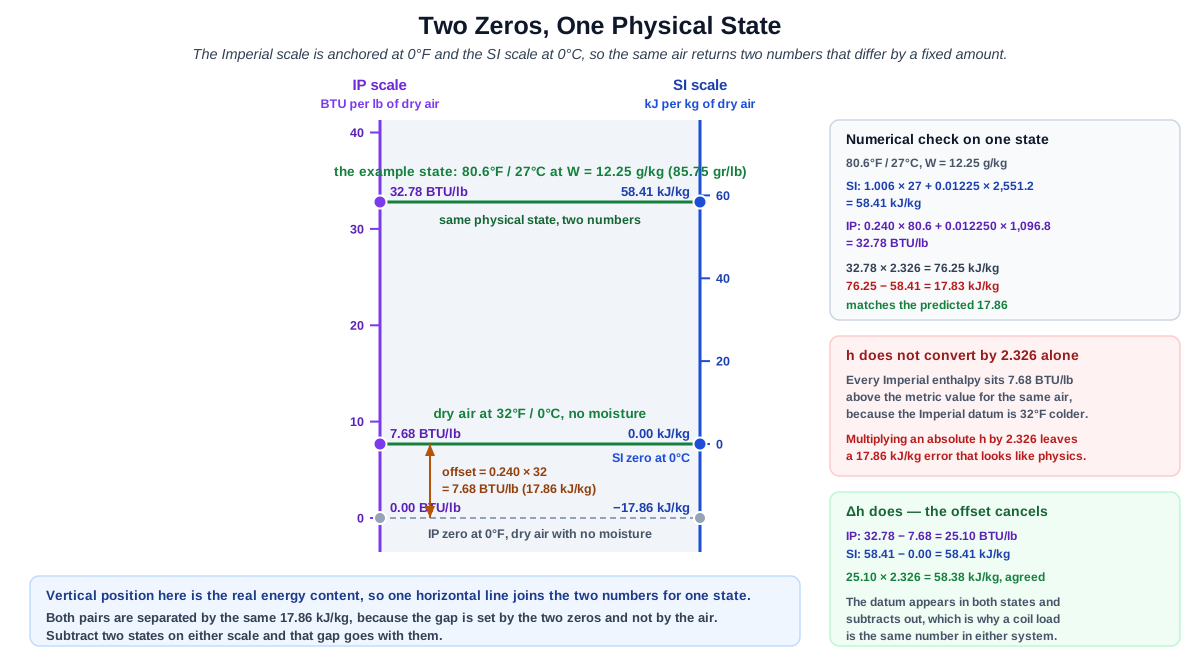
The Imperial and metric enthalpy formulas are anchored to different zero points, so a value in BTU per pound does not become the corresponding value in kilojoules per kilogram by multiplying by 2.326, though an enthalpy difference does.
The two references:
Imperial: h = 0 for dry air at 0°F with no moisture
Metric:   h = 0 for dry air at 0°C with no moisture
The two zeros are 32°F (17.78°C) apart.
The size of the offset:
The gap is the sensible enthalpy of dry air across those 32°F:
  0.240 BTU/lb·°F × 32°F = 7.68 BTU/lb = 17.86 kJ/kg
Every Imperial enthalpy sits that much above the metric value for the same physical state.
Numerical verification on one state:
Air at 27°C with W = 12.25 g/kg:
  Metric:   h = 1.006 × 27 + 0.01225 × (2,501 + 50.22) = 58.41 kJ/kg
The identical state in Imperial terms is 80.6°F with W = 85.75 gr/lb:
  Imperial: h = 0.240 × 80.6 + 0.012250 × (1,061 + 35.79) = 32.78 BTU/lb
  Converted: 32.78 × 2.326 = 76.25 kJ/kg
  Difference: 76.25 − 58.41 = 17.83 kJ/kg, matching the predicted 17.86 within rounding
Why the latent constants still pair correctly:
1,061 BTU/lb is the latent heat extrapolated to the 0°F reference.
2,501 kJ/kg is the same quantity at the 0°C reference.
Evaluated at a common temperature they agree: 1,061 + 0.444 × 32 = 1,075.2 BTU/lb,
and 2,501/2.326 = 1,075.2 BTU/lb. The constants are consistent; the zeros are not.
What this means in practice:
Δh converts cleanly, because the offset appears in both states and cancels.
An absolute h does not. Comparing a metric enthalpy against an Imperial one
without accounting for the offset produces an apparent 7.68 BTU/lb discrepancy
that is entirely an artifact of the reference choice.
Stay in one unit system for a given calculation.
The practical consequence is narrow but sharp — a coil load computed in either system comes out the same because it rests on a difference, while a single enthalpy quoted across systems does not compare unless the datum comes with it.
Per ASHRAE Handbook Fundamentals: the Imperial and SI enthalpy formulations use 0°F and 0°C dry-air references respectively, separated by 7.68 BTU/lb (17.86 kJ/kg). Enthalpy differences are unit-convertible; absolute enthalpies are not.
Where the Sensible Boundary Sits: 1.08 Against 1.1
Two familiar constants both claim to give the sensible coil load, and the small gap between them is not a rounding disagreement but a question of whether the water vapor's own sensible heat counts as sensible or as part of the moisture term.
The two routes to a sensible load:
From the enthalpy split: Q_s = 4.5 × CFM × Δh_s, with Δh_s = 0.240 × ΔT
                         which is Q_s = 1.08 × CFM × ΔT
From the field constant:  Q_s = 1.1 × CFM × ΔT
Where the difference comes from:
1.08 = 4.5 × 0.240, the specific heat of DRY AIR alone
1.1  ≈ 4.5 × (0.240 + W × 0.444), the specific heat of the moist mixture
At W = 0.012 lb/lb: 0.240 + 0.00533 = 0.2453, and 4.5 × 0.2453 = 1.104
The vapor's sensible heat has to sit somewhere:
The enthalpy formula places the 0.444 × W × T term inside the vapor bracket,
which the calculator labels latent. The 1.1 constant instead counts it as sensible.
Neither placement is wrong; they draw the boundary in different places.
Quantified on the worked example:
5,000 CFM (8,495 m³/h), ΔT = 25°F (13.9°C):
  Q_s at 1.08: 135,000 BTU/h (39.6 kW)
  Q_s at 1.10: 137,500 BTU/h (40.3 kW)
  Gap: 2,500 BTU/h (0.7 kW)
Checking that the gap is the vapor sensible term, at an average W of 0.0101 lb/lb:
  0.0101 × 0.444 × 25 × 4.5 × 5,000 = 2,526 BTU/h, matching the gap
The consequence for the reported split:
Because the total Q comes from Δh and the sensible Q_s comes from 1.1,
the latent load reported as Q − Q_s absorbs the difference.
The SHR read from the loads (137,500/229,725 = 59.9%) therefore sits about one
percentage point above the SHR read from the enthalpy split (58.8%).
Which to use:
For internal consistency within one calculation, take both from the same basis.
For comparison against manufacturer data, match whichever basis the rating uses.
The metric formulation avoids the question by using 1.006 throughout,
so its load split and its enthalpy split agree exactly.
Per ASHRAE Handbook Fundamentals: the sensible constants 1.08 and 1.1 differ by whether the water vapor's sensible heat is counted with the air or with the moisture, a gap of roughly 2% that propagates into the reported sensible heat ratio.
The 4.5 Factor and Its Altitude Correction to 3.72
The factor that turns an enthalpy difference into a coil load is nothing more than the mass of dry air a cubic foot per minute delivers in an hour, which is why it moves with elevation.
The derivation:
Q = 4.5 × CFM × Δh   [BTU/h]
4.5 = 60 min/h × 0.075 lb/ft³, the standard sea-level dry-air density
CFM × 4.5 = pounds of dry air per hour
× Δh in BTU per pound = BTU per hour
The metric equivalent keeps the density visible:
Q = (m³/h × Δh × 1.2)/3,600   [kW]
1.2 kg/m³ standard density; the 3,600 converts kJ/h to kW
Altitude:
Sea level:          0.075 lb/ft³ (1.2 kg/m³), factor 4.5
5,000 ft (1,524 m): about 0.062 lb/ft³ (0.993 kg/m³), factor ≈ 3.72
Using 4.5 at 5,000 ft overstates the coil load by roughly 21%
The correction is a simple ratio:
factor = 4.5 × (ρ_actual/0.075)
The metric form takes density as a direct input and needs no separate constant.
The same 4.5 appears elsewhere:
The sensible constant 1.08 is 4.5 × 0.240, and the latent constant 4,840 is 4.5 × 1,076.
All three scale by the identical density ratio, because they share one parent.
The Latent Heat Load article traced that family from the moisture side.
Why the error is easy to miss:
A 21% overstatement on a coil load does not announce itself: the equipment simply
comes in larger than needed, and the oversizing shows up later as short cycling
and poor humidity control rather than as an obvious arithmetic failure.
Per ASHRAE Handbook Fundamentals, Chapter 18: the coil load factor 4.5 is 60 minutes per hour times the standard air density of 0.075 lb/ft³, valid at sea level. At 5,000 ft the correct factor is about 3.72, and using the sea-level value overstates the load by roughly 21%.
Constant Enthalpy Lines and Their Near-Coincidence with Wet Bulb
On a psychrometric chart the lines of constant enthalpy and the lines of constant wet-bulb temperature run so close together that they are often drawn as one family, and understanding why explains a great deal about how the chart is used.
The near-coincidence:
Constant wet bulb: the adiabatic saturation path, along which the air's energy content
  is nearly unchanged because evaporating water only redistributes it between
  sensible and latent form.
Constant enthalpy: total heat unchanged by definition.
The two families differ by a small deviation, generally under 1% across the comfort range.
Why they are not identical:
An adiabatic saturation process adds liquid water at the wet-bulb temperature,
and that make-up water carries a small enthalpy of its own into the airstream.
Enthalpy therefore rises very slightly along a constant wet-bulb line.
What follows from it:
Entering wet bulb serves as a proxy for entering enthalpy, which is why cooling
coil and packaged equipment ratings are published against entering wet bulb
rather than against relative humidity.
An evaporative cooler moves the air along a nearly constant enthalpy path,
converting sensible heat into latent without changing total heat much.
The Wet Bulb article covered the same energy balance from the temperature side — this is that physics read as an energy quantity instead.
The practical reading:
Two air states with the same wet bulb carry nearly the same total heat,
even at very different dry-bulb temperatures and humidities.
That is the basis for reading coil capacity from a single entering wet-bulb figure.
The deviation is small enough to ignore in selection work and large enough to notice in careful energy modelling. Treating the two families as identical shifts an entering enthalpy by well under half a percent at ordinary coil entering conditions, which is far inside the tolerance of the humidity measurement that produced the state in the first place.
Per ASHRAE Handbook Fundamentals: constant enthalpy and constant wet-bulb lines nearly coincide, differing only by the enthalpy of the make-up water in the adiabatic saturation process, which is why equipment ratings are indexed to entering wet bulb.
Sensible Heat Ratio Read Straight from the Enthalpy Split
The sensible heat ratio the calculator reports is the enthalpy split expressed as a fraction, and reading it from a two-point process rather than from a single state is what makes it useful for equipment selection.
Two different ratios:
State-point SHR:  h_s/h × 100, the split of one air state's total heat
Process SHR:      Δh_s/Δh × 100, the split of the change between two states
Only the second matters for selection:
A coil is selected against the process ratio, the split of the work it must do.
The state-point ratio describes an air condition, not a load.
The Sensible Heat Ratio article covered the load-side definition;
this is the same quantity computed from enthalpies rather than from loads.
Worked from the Imperial example:
Δh = 10.21 BTU/lb (23.75 kJ/kg), Δh_s = 6.00 (13.96), Δh_l = 4.21 (9.79)
Process SHR = 6.00/10.21 × 100 = 58.8%
What 58.8% signals:
Below the 0.65 threshold covered in the Sensible Heat Ratio article,
so the process demands more dehumidification than standard equipment rated
near 0.75 to 0.80 will deliver at its rated conditions.
Either the equipment is selected for latent capacity at actual entering conditions,
or the moisture is handled separately.
The rating-condition caveat:
Manufacturer SHR is published at AHRI rating conditions.
A design SHR computed at actual entering conditions is not directly comparable
to a catalogue figure unless the entering conditions match.
The Coil Capacity Calculator carries the equipment side of that comparison.
Per AHRI Standard 210/240 and ASHRAE practice: the process sensible heat ratio, computed from the enthalpy difference rather than from a single state, is the figure to compare against equipment capacity at actual entering conditions.
The Enthalpy Economizer and Why Dry-Bulb Changeover Misleads
An economizer decides whether outdoor air is cheaper to cool than return air, and that comparison is a total-heat comparison, which is why a dry-bulb changeover setpoint gets it wrong in humid weather.
The two control logics:
Dry-bulb changeover: bring in outdoor air while its temperature is below a setpoint
Differential enthalpy: bring in outdoor air while its enthalpy is below return enthalpy
Where dry-bulb fails:
Outdoor air at 70°F (21.1°C) and near saturation: about 34 BTU/lb (61 kJ/kg)
Return air at 75°F (23.9°C) and 50% relative humidity: about 28 BTU/lb (47 kJ/kg)
A dry-bulb economizer sees 70 below 75 and opens the dampers,
admitting air with six BTU per pound (14 kJ/kg) MORE total heat than the air it displaces.
The coil then works harder than it would on full return air.
Why the mistake is invisible:
The space temperature is still controlled, so nothing appears wrong.
The penalty shows up only as elevated cooling energy and, in humid conditions,
as indoor humidity the coil cannot pull back down.
The enthalpy comparison:
Comparing h_outdoor against h_return answers the question directly,
because it is exactly the quantity the coil has to remove.
Sensor practicality:
Enthalpy control requires humidity measurement on both airstreams,
and drifting humidity sensors are a common cause of economizers stuck in a wrong mode.
Energy standards therefore permit fixed dry-bulb high-limit shutoff in dry climates
where the failure mode above rarely occurs, and require more capable logic elsewhere.
The outdoor enthalpy for that comparison comes from the design dew point and dry-bulb pair, which the Dew Point article covered as the climate descriptor.
Per ASHRAE Standard 90.1-2022: economizer high-limit shutoff is specified by climate zone, with differential enthalpy control appropriate where humid outdoor air can carry more total heat than return air at a lower dry-bulb temperature.
Energy Recovery: Total Effectiveness Against Sensible Effectiveness
An energy recovery device is rated on how much of the enthalpy difference between the two airstreams it transfers, and in humid climates the moisture half of that difference can exceed the temperature half.
The definition:
ε_total = (h_outdoor − h_supply)/(h_outdoor − h_exhaust)
Recovered energy = ε_total × mass flow × (h_outdoor − h_exhaust)
Sensible against total:
A sensible-only device (plate exchanger, sensible wheel) transfers temperature.
A total-energy device (enthalpy wheel, membrane core) transfers moisture as well.
Rating a total device on sensible effectiveness alone understates it substantially
wherever the latent share of the enthalpy difference is large.
Worked as an illustration:
Outdoor air at 95°F (35°C) and 78°F (25.6°C) wet-bulb: 41.2 BTU/lb (78.0 kJ/kg)
Exhaust at 75°F (23.9°C) and 50% relative humidity: 28.1 BTU/lb (47.5 kJ/kg)
Total difference: 13.1 BTU/lb (30.5 kJ/kg)
The sensible part, 0.240 × 20 = 4.8 BTU/lb (11.2 kJ/kg), is 37% of it.
A sensible-only device leaves nearly two thirds of the available energy on the table.
Where the balance reverses:
In dry climates the latent difference is small and a sensible device captures most of it.
The choice between device types follows the climate's enthalpy split, not a general rule.
The Energy Recovery Wheel Efficiency Calculator takes the device side of that selection.
The same reasoning decides whether recovery is worth installing at all. A device is paid for by the enthalpy difference it sees over the hours it runs, so a climate whose outdoor air spends most of the year within a few BTU per pound of the exhaust supports a much weaker case than the peak-hour difference above suggests.
Per AHRI Standard 1060 and ASHRAE Standard 90.1: air-to-air energy recovery is rated on total effectiveness against the enthalpy difference, and in humid climates the latent portion of that difference can exceed the sensible portion.
Negative Enthalpy Is a Valid Result
Cold dry air returns a negative enthalpy, and that result is correct rather than an error, because the reference state places zero at a temperature the air can fall below.
Why it happens:
Imperial zero sits at 0°F, metric zero at 0°C, both for dry air with no moisture.
Air colder than the reference, carrying little moisture, has less total heat than that datum.
Worked on one state:
Outdoor air at 0°F (−17.8°C) and 10% relative humidity:
  Imperial: h = 0.10 BTU/lb, barely above zero
  Metric:   h = −17.6 kJ/kg, plainly negative
Same air, same instant, and the sign disagrees purely because of the reference.
A sign change across unit systems is unsettling the first time it appears in a report, and it is worth stating explicitly in any document that carries both, because a reviewer who sees a negative total heat next to a positive one for the same air will otherwise go looking for an input error that is not there.
What it does not mean:
A negative value does not indicate an input error, and it does not mean the air
carries no energy in an absolute sense. Enthalpy here is measured from a datum,
not from absolute zero.
Why differences remain trustworthy:
Heating that air to 70°F (21.1°C) still produces a positive, correct Δh,
because the datum cancels in the subtraction.
This is the same cancellation that makes Δh unit-convertible.
The practical instruction is to read the sign of Δh against which state is entering and which is leaving — in a heating process the leaving enthalpy is higher, so h₁ − h₂ comes out negative.
Per ASHRAE Handbook Fundamentals: enthalpy is referenced to dry air at 0°F or 0°C, so values below that datum are negative and physically valid. Differences are unaffected by the choice of datum.
Worked Example: A Cooling Coil from 32.35 to 22.14 BTU per Pound
A cooling coil takes mixed outdoor and return air and delivers supply air. Entering 80°F (26.7°C) at 55% relative humidity, leaving 55°F (12.8°C) at 90% relative humidity, airflow 5,000 CFM (8,495 m³/h).
Step 1. Entering state moisture.
Tc1 = (80 − 32)/1.8 = 26.67°C
P_sat1 = 0.08855 × exp(17.625 × 26.67/(243.04 + 26.67)) = 0.5058 psi (3.487 kPa)
P_v1 = 0.55 × 0.5058 = 0.2782 psi (1.918 kPa)
W1 = 4,350 × 0.2782/(14.696 − 0.2782) = 83.94 gr/lb (11.99 g/kg)
Step 2. Entering enthalpy and its split.
h1 = 0.240 × 80 + (83.94/7,000) × (1,061 + 0.444 × 80)
   = 19.20 + 0.011991 × 1,096.52 = 19.20 + 13.15 = 32.35 BTU/lb (57.4 kJ/kg)
h_s1 = 19.20 BTU/lb, h_l1 = 13.15 BTU/lb
Step 3. Leaving state moisture.
Tc2 = (55 − 32)/1.8 = 12.78°C
P_sat2 = 0.08855 × exp(17.625 × 12.78/(243.04 + 12.78)) = 0.2136 psi (1.473 kPa)
P_v2 = 0.90 × 0.2136 = 0.1922 psi (1.325 kPa)
W2 = 4,350 × 0.1922/(14.696 − 0.1922) = 57.65 gr/lb (8.24 g/kg)
Step 4. Leaving enthalpy and its split.
h2 = 0.240 × 55 + (57.65/7,000) × (1,061 + 0.444 × 55)
   = 13.20 + 0.008236 × 1,085.42 = 13.20 + 8.94 = 22.14 BTU/lb (33.7 kJ/kg)
h_s2 = 13.20 BTU/lb, h_l2 = 8.94 BTU/lb
Step 5. Enthalpy difference and process split.
Δh   = 32.35 − 22.14 = 10.21 BTU/lb (23.75 kJ/kg)
Δh_s = 0.240 × (80 − 55) = 6.00 BTU/lb (13.96 kJ/kg)
Δh_l = 13.15 − 8.94 = 4.21 BTU/lb (9.79 kJ/kg)
Step 6. Process sensible heat ratio.
SHR = 6.00/10.21 × 100 = 58.8%
Step 7. Coil loads.
Q   = 4.5 × 5,000 × 10.21 = 229,725 BTU/h (67.3 kW, 19.1 tons)
Q_s = 1.1 × 5,000 × 25 = 137,500 BTU/h (40.3 kW)
Q_l = 229,725 − 137,500 = 92,225 BTU/h (27.0 kW)
Step 8. The two sensible bases.
Taking the sensible load from the enthalpy split instead:
  4.5 × 5,000 × 6.00 = 135,000 BTU/h (39.6 kW)
The 2,500 BTU/h (0.7 kW) gap against the 1.1 result is the vapor's sensible heat.
The load-based SHR reads 59.9%, the enthalpy-based 58.8%.
Report one basis consistently.
Step 9. What the moisture removal amounts to.
ΔW = 83.94 − 57.65 = 26.29 gr/lb (3.76 g/kg)
That difference is what the Latent Heat Load calculation turns into a condensate rate.
Step 10. Result.
Δh 10.21 BTU/lb (23.75 kJ/kg) across the coil, total load 229,725 BTU/h
(67.3 kW, 19.1 tons), process SHR 58.8%. Below the 0.65 threshold, so equipment
must be selected for latent capacity at these entering conditions rather than on
total tonnage. Temperature difference alone would have given 137,500 BTU/h
and missed 40% of the load.
The Sensible Heat Ratio Calculator reads the 58.8% against equipment bands, the Latent Heat Load Calculator turns the 26.29 gr/lb into a condensate rate, and the Coil Capacity Calculator carries the load into selection.
Metric Worked Example and the Wet-Bulb Moisture Route
The metric case runs the same coil in metric fields, and the wet-bulb case shows that a second moisture route lands on the same air state.
Metric two-point case, entering 27°C (80.6°F) at 55% relative humidity, leaving 13°C (55.4°F) at 90%, airflow 8,500 m³/h (5,003 CFM):
P_sat1 = 0.61078 × exp(17.625 × 27/(243.04 + 27)) = 3.558 kPa (0.5160 psi)
P_v1   = 0.55 × 3.558 = 1.957 kPa (0.2839 psi)
W1     = 621.945 × 1.957/(101.325 − 1.957) = 12.25 g/kg (85.75 gr/lb)
h1     = 1.006 × 27 + 0.01225 × (2,501 + 50.22) = 27.16 + 31.25 = 58.41 kJ/kg

P_sat2 = 0.61078 × exp(17.625 × 13/(243.04 + 13)) = 1.495 kPa (0.2168 psi)
P_v2   = 0.90 × 1.495 = 1.345 kPa (0.1951 psi)
W2     = 621.945 × 1.345/(101.325 − 1.345) = 8.37 g/kg (58.59 gr/lb)
h2     = 1.006 × 13 + 0.00837 × (2,501 + 24.18) = 13.08 + 21.13 = 34.21 kJ/kg

Δh   = 24.20 kJ/kg (10.40 BTU/lb)
Δh_s = 1.006 × 14 = 14.08 kJ/kg (6.05 BTU/lb)
Δh_l = 31.25 − 21.13 = 10.12 kJ/kg (4.35 BTU/lb)
SHR  = 14.08/24.20 × 100 = 58.2%

Q   = (8,500 × 24.20 × 1.2)/3,600 = 68.57 kW (233,970 BTU/h)
Q_s = (8,500 × 1.2 × 1.006 × 14)/3,600 = 39.90 kW (136,140 BTU/h)
Q_l = 68.57 − 39.90 = 28.67 kW (97,830 BTU/h)
Note the internal consistency:
The metric sensible load uses 1.006, the same constant as the enthalpy formula,
so 39.90/68.57 = 58.2% reproduces the enthalpy-based SHR exactly.
The Imperial pair does not, because of the 1.08 against 1.1 boundary.
Wet-bulb moisture route in Imperial, at the AHRI indoor rating condition of 80°F dry-bulb with 67°F wet-bulb (26.7°C / 19.4°C):
P_sat(T_wb) = 0.08855 × exp(17.625 × 19.44/(243.04 + 19.44)) = 0.3268 psi (2.253 kPa)
W_sat_wb    = 4,350 × 0.3268/(14.696 − 0.3268) = 98.92 gr/lb (14.13 g/kg)

Numerator   = (1,093 − 0.556 × 67) × (98.92/7,000) − 0.240 × (80 − 67)
            = 1,055.75 × 0.014131 − 3.12 = 14.92 − 3.12 = 11.80
Denominator = 1,093 + 0.444 × 80 − 67 = 1,061.52
W           = 7,000 × 11.80/1,061.52 = 77.81 gr/lb (11.12 g/kg)

h = 0.240 × 80 + (77.81/7,000) × 1,096.52 = 19.20 + 12.19 = 31.39 BTU/lb (55.2 kJ/kg)
Route agreement:
The same air state entered as 80°F at 51% relative humidity returns 77.72 gr/lb,
a 0.1% difference. Two inputs, one point on the chart.
Per ASHRAE and AHRI Standard 210/240: the metric case reproduces its enthalpy-based SHR exactly because it uses one specific-heat constant throughout, and the wet-bulb moisture route agrees with the relative-humidity route to within 0.1% at the AHRI indoor rating condition.
Application Boundaries: Pressure, Constant Specific Heats, Process Feasibility
The calculation covers moist-air enthalpy and its components at one or two state points at standard atmospheric pressure, plus the coil load from an enthalpy difference and a volumetric airflow. Nine situations sit outside it.
Non-Standard Barometric Pressure. Fixed at 14.696 psi (101.325 kPa). Elevation changes both the humidity ratio at a given condition and the density factor in the load formula, and above roughly 1,000 ft (305 m) both need correcting.
Constant Specific Heats. The formulation treats 0.240 and 0.444 BTU/lb·°F (1.006 and 1.86 kJ/kg·K) as constants. They are accurate across the HVAC range and drift at temperature extremes.
Process Feasibility. A two-point calculation reports the difference between two states without checking that any particular equipment can achieve it. Whether a coil can reach the leaving state depends on its apparatus dew point and bypass factor, which the Dew Point article covered.
Mixing. Two airstreams are combined by mass-weighted averaging of enthalpy and humidity ratio, computed outside this calculation, and the weights are dry-air mass fractions rather than volumetric fractions.
Sensible Basis. The Imperial sensible load uses 1.1 while the enthalpy split uses 0.240, a difference of about 2% that propagates into the reported latent load and SHR.
Wet-Bulb Route Below Freezing. The wet-bulb moisture route solves the above-freezing form of the balance. Below 32°F (0°C) the sublimation form applies, and results in that region are indicative.
Coil Bypass and Apparatus Dew Point. Not modeled. The leaving state is taken as given rather than derived from coil geometry.
Equipment Rating Conditions. A design SHR computed at actual entering conditions is not directly comparable to a catalogue value published at AHRI rating conditions.
Specific Volume. Converting volumetric airflow to mass flow at non-standard conditions requires specific volume per unit mass of dry air, which is a separate calculation.
Per ASHRAE Handbook Fundamentals and AHRI rating standards: two-state enthalpy analysis at standard pressure is the calculator's scope. Barometric correction, specific-heat variation, process feasibility, stream mixing, the sensible-basis choice, sub-freezing wet-bulb, coil bypass, and rating-condition matching require separate treatment.
Enthalpy Calculator
Moist air enthalpy by the ASHRAE formulation: converts the entered relative humidity, wet-bulb, dew point, or humidity ratio into a moisture content, then adds the dry-air term to the vapor term for the total heat per unit mass of dry air, split into its sensible and latent components with the sensible heat ratio. Two-state mode returns the enthalpy difference and, with airflow, the coil load. Because the difference carries both halves of the load, it sizes a coil where a temperature difference alone cannot. Standard atmospheric pressure is assumed.
Open Enthalpy CalculatorStandards and References
- ASHRAE Handbook, Fundamentals (2021), Chapter 1, Psychrometrics. The moist-air enthalpy formulation, the dry-air reference basis, the 0°F and 0°C reference states, and the specific heat and latent heat constants.
- ASHRAE Handbook, Fundamentals (2021), Chapter 18, Nonresidential Cooling and Heating Load Calculations. The coil load relation Q = 4.5 × CFM × Δh and the standard air density behind the factor.
- ASHRAE Standard 90.1-2022, Energy Standard for Buildings Except Low-Rise Residential Buildings. Economizer high-limit shutoff requirements by climate zone and energy recovery thresholds based on outdoor air enthalpy.
- ASHRAE Standard 55-2023, Thermal Environmental Conditions for Human Occupancy. Comfort context for the indoor state points used in coil calculations.
- ASHRAE Standard 62.1-2022, Ventilation and Acceptable Indoor Air Quality. Outdoor air quantity that sets the mixed-air enthalpy entering a coil.
- AHRI Standard 210/240-2023, Performance Rating of Unitary Air-Conditioning and Air-Source Heat Pump Equipment. Rating conditions at which manufacturer sensible heat ratio data is published, including the 80°F dry-bulb and 67°F wet-bulb indoor condition.
- AHRI Standard 550/590-2023, Performance Rating of Water-Chilling and Heat Pump Water-Heating Packages. Chilled water coil rating conditions for two-state enthalpy calculations.
- AHRI Standard 1060-2018, Performance Rating of Air-to-Air Exchangers for Energy Recovery Ventilation Equipment. Total and sensible effectiveness definitions for energy recovery devices.
- Alduchov and Eskridge (1996), Improved Magnus Form Approximation of Saturation Vapor Pressure, Journal of Applied Meteorology 35(4). The saturation relation behind every moisture route.
FAQ
How do you calculate moist air enthalpy?
Per ASHRAE Handbook Fundamentals: add the dry-air term to the vapor term. In Imperial, h = 0.240 × T_db + (W/7,000) × (1,061 + 0.444 × T_db), with W in grains per pound. At 80°F (26.7°C) and 55% relative humidity that gives 32.35 BTU/lb, of which 19.20 is the dry-air term.
Why is enthalpy expressed per pound of dry air rather than per pound of moist air?
Per ASHRAE Fundamentals: because dry-air mass is conserved through heating, cooling, humidification, and dehumidification while vapor mass is not. A conserved denominator keeps enthalpy, humidity ratio, and specific volume on one consistent basis and makes mass-weighted mixing valid.
Why can't I convert an enthalpy from BTU per pound to kJ per kilogram with 2.326?
Per ASHRAE Fundamentals: because the two formulations use different zero references, 0°F and 0°C, separated by 7.68 BTU/lb (17.86 kJ/kg) of dry-air sensible heat. Enthalpy differences convert cleanly because the offset cancels; absolute enthalpies do not.
What does the 4.5 factor in the coil load formula mean?
Per ASHRAE Fundamentals Chapter 18: it is 60 minutes per hour times the standard sea-level air density of 0.075 lb/ft³, converting volumetric airflow to dry-air mass flow. At 5,000 ft (1,524 m) the correct factor is about 3.72, and using 4.5 there overstates the load by roughly 21%.
Why do 1.08 and 1.1 both appear as the sensible constant?
Per ASHRAE practice: 1.08 is 4.5 times the dry-air specific heat of 0.240, while 1.1 approximates 4.5 times the moist-mixture specific heat, which includes the water vapor's sensible heat. The roughly 2% difference propagates into the reported latent load and sensible heat ratio, so take both from one basis.
Why does an economizer need enthalpy rather than temperature?
Per ASHRAE Standard 90.1: because the coil responds to total heat. Outdoor air at 70°F (21.1°C) near saturation carries about 34 BTU/lb against roughly 28 BTU/lb for return air at 75°F (23.9°C) and 50% relative humidity, so a dry-bulb changeover opens the dampers to air that is more expensive to cool.
Can enthalpy be negative?
Per ASHRAE Fundamentals: yes, and the result is valid. Zero is defined for dry air at 0°F or 0°C, so colder air with little moisture falls below the datum. Differences remain correct regardless, because the datum cancels in the subtraction.
Related Calculators
- Sensible Heat Ratio Calculator: The load split this enthalpy difference produces, read against equipment bands (article).
- Latent Heat Load Calculator: The moisture side, converting the humidity ratio difference into a condensate rate (article).
- Humidity Ratio Calculator: The moisture variable every enthalpy route passes through (article).
- Dew Point Temperature Calculator: The condensation threshold that decides whether a coil can reach its leaving state (article).
- Coil Capacity Calculator: The equipment side of the load this calculation produces.
- Energy Recovery Wheel Efficiency Calculator: Total effectiveness against the enthalpy difference between airstreams.
- Psychrometric Calculator: Full air-state analysis across all moist-air properties at once.
- CFM Calculator: The airflow that converts an enthalpy difference into a coil load.