
Why Latent Load Is a Mass-Transfer Problem Wearing a Heat Equation
Latent cooling load is written as a heat rate in BTU per hour or kilowatts, but the physical event underneath is the condensation of a mass of water, and every term in the equation exists to convert pounds of moisture per hour into an energy rate.
Air carries water vapor, and a cooling coil removes some of it by chilling the air below its dew point so the vapor condenses on the fins. The energy involved is the latent heat of vaporization released as that vapor turns to liquid, roughly a thousand BTU for every pound of water (2,326 kJ per kg). The load therefore depends on how much dry air passes the coil and how much water each pound of that air gives up — not on the temperature drop. A coil can produce a large latent load with almost no temperature change if the entering air is humid, and none at all if the air never reaches its dew point.
The calculator takes the airflow, the entering and leaving humidity ratios, and the air density, computes the humidity-ratio difference, converts it to a latent heat rate, and reports the moisture removal rate that goes with it. The Sensible Heat Ratio article treated the latent load as a known input and showed how its share decides equipment selection; this article computes that input from the air's own moisture content.
The second output, the moisture rate, is often the more practical number, because it sizes condensate drains, sets dehumidifier duty in pounds or kilograms per hour, and translates directly into gallons in a pan. ASHRAE expresses moist-air latent heat through the humidity-ratio difference, which is the fundamental variable in every latent-load calculation.
One thing to settle before any of the arithmetic below is read as gospel. Two Imperial constants circulate for this calculation, 4,840 and roughly 4,750, and they differ only in which latent heat of vaporization they assume. This page runs the second one. Section 6 derives both and Section 15 shows the result card confirming which is in force, so every figure printed in this article is the page's own output rather than a hand calculation on the more familiar constant.
Calculator Inputs: Airflow, Two Humidity Ratios, and a Density Field With No Unit
The calculator collects one airflow, two moisture states, and an optional density, then returns the difference, the load, and the moisture rate.
| Input | Unit | What it is | Typical range |
|---|---|---|---|
| Unit System | — | Imperial (CFM, lb/lb, BTU/hr, lb/hr) or Metric (m³/s, kg/kg, kW, kg/h) | — |
| Airflow Rate | CFM or m³/s | Volume airflow through the coil or airstream | 1,000 to 20,000 CFM (0.5 to 9.4 m³/s) |
| Entering Humidity Ratio W_in | lb/lb or kg/kg | Mass of water vapor per mass of dry air entering the coil | 0.011 to 0.016 in a humid-climate mixed-air state |
| Leaving Humidity Ratio W_out | lb/lb or kg/kg | The same quantity leaving the coil | 0.007 to 0.010 |
| Air Density ρ | kg/m³ in both unit modes | Standard air is 1.202 kg/m³ (0.075 lb/ft³) | 0.9 to 1.21, by elevation |
| Output | Unit | What it is |
|---|---|---|
| Humidity Ratio Difference ΔW | lb/lb or kg/kg | The driving quantity, W_in − W_out |
| Latent Heat Load QL | BTU/hr or kW | The cooling duty the moisture removal represents |
| Moisture Removal Rate | lb/hr or kg/h | The condensate mass the coil sheds |
ΔW = W_in − W_out → latent heat load → moisture removal rate
The density field deserves a flag before anything else, because it is the one input on this page that does not switch units with the unit system. In Imperial mode the field shows no unit at all, and its own helper text says to enter the value in kg/m³. An engineer working in Imperial who reads 0.075 lb/ft³ from the same page and types it lands 16 times low, and the page reports the result without complaint. Section 15 works that case through.
Both humidity ratios go in on the same basis. Enter each as a mass ratio in the same unit. The humidity ratio is dimensionless (mass of water per mass of dry air), so the numeric value is identical in lb/lb and kg/kg.
The ratios themselves come from a psychrometric calculation or chart, given dry-bulb and one moisture property (wet-bulb, dew point, relative humidity, or enthalpy). Entering conditions come from the mixed-air state; leaving conditions from the coil selection.
The calculator does not account for sensible load, total cooling load, coil bypass factor, apparatus dew point, a leaving-air saturation check, outside-air mixing, infiltration moisture generation, condensate carryover or re-evaporation, room relative humidity from a load balance, or equipment latent capacity at real conditions. It is a screening latent-load estimate.
Humidity Ratio Is Not Relative Humidity
The single most consequential input error in latent-load work is entering relative humidity where humidity ratio belongs, because the two describe moisture in fundamentally different ways and differ by three orders of magnitude in numeric value.
| Measure | What it expresses | Unit | Typical indoor air |
|---|---|---|---|
| Humidity ratio W | Mass of water vapor per mass of dry air, an absolute measure | lb/lb or kg/kg | 0.008 to 0.012 |
| Relative humidity RH | Vapor pressure as a percentage of saturation at that temperature, a relative measure | % | 40 to 60 |
Relative humidity cannot drive the equation because air at 50% RH holds very different amounts of water at 60°F (16°C) and at 90°F (32°C), saturation rising steeply with temperature. The same percentage describes different moisture masses. Latent load depends on the mass, so the equation needs the absolute measure.
The magnitude of the error is unmistakable. Entering 50 (percent) where 0.0100 (lb/lb) belongs inflates that term by a factor of 5,000, and the page does not hide the consequence. Enter a plausible-sounding pair of relative humidities, 60% entering and 40% leaving, into a 1,200 CFM coil and the result card reports a humidity-ratio difference of 20.00 lb/lb and a latent heat load of 114,001,441 BTU/hr — about 9,500 tons from a residential air handler. The output is absurd rather than subtly wrong, which is the one mercy of this mistake.
When only relative humidity is known, the humidity ratio follows from dry-bulb temperature and relative humidity through the saturation pressure relation:
W = 0.622 × p_v / (p_atm − p_v), with p_v = RH × p_sat(T)
The Humidity Ratio Calculator or a psychrometric chart performs this step.
Related moisture measures sit alongside the two:
| Measure | What it is |
|---|---|
| Dew point | The temperature at which the air's vapor would saturate; a direct proxy for W |
| Wet-bulb | An evaporative measure combining temperature and moisture |
| Grains per pound | The humidity ratio in grains, 7,000 grains to the pound |
A practical check closes the door on the error. A humidity ratio should be a small decimal, roughly 0.002 to 0.030 for building air. A value above 0.05 or below 0.001 signals a unit or conversion error.
Per ASHRAE Handbook Fundamentals, Psychrometrics chapter, humidity ratio is the mass of water vapor per mass of dry air, an absolute measure, while relative humidity is a percentage of saturation at a given temperature. Latent load depends on moisture mass, so the calculation requires the humidity ratio.
The Humidity-Ratio Difference and Why It Looks So Small
The driving quantity is the difference between entering and leaving humidity ratios, a number in the third or fourth decimal place, and its small appearance disguises how much energy it represents when multiplied by a full airstream.
ΔW = W_in − W_out [lb water per lb dry air, or kg/kg]
Typical magnitudes across the range of applications:
| Application | ΔW |
|---|---|
| Light dehumidification | 0.001 to 0.002 |
| Standard comfort coil in a humid climate | 0.003 to 0.005 |
| Deep dehumidification, DOAS on outdoor air | 0.006 to 0.012 |
The numbers are small because even saturated air at 90°F (32°C) carries only about 0.031 lb of water per lb of dry air. Air is mostly dry air by mass, the moisture running from a fraction of a percent to a few percent, so the differences across a coil are small decimals by nature.
The small number still matters because the airstream is large. At 1,200 CFM (0.566 m³/s) the coil processes roughly 5,400 lb of dry air per hour (2,449 kg/h). Removing 0.0035 lb of water from each pound gives about 19 lb of water per hour (8.6 kg/h), and each pound of condensed water releases roughly a thousand BTU.
The mass-flow bridge, one step per row:
| Step | Arithmetic at 1,200 CFM | Result |
|---|---|---|
| Volume to hourly volume | 1,200 × 60 min/hr | 72,000 ft³/hr |
| Hourly volume to air mass | 72,000 × 0.075 lb/ft³ | 5,400 lb/hr of dry air (2,449 kg/h) |
| Air mass to water mass | 5,400 × 0.0035 | 18.9 lb/hr of water (8.57 kg/h) |
The middle row is the whole reason 4.5 × CFM keeps appearing: 60 × 0.075 = 4.5 lb of dry air per hour per CFM. The page confirms it in reverse. Divide its printed moisture removal rate for the worked case, 18.91 lb/hr, by the entered ΔW of 0.0035 and 5,403 lb/hr comes back — the same dry-air mass flow, recovered from an output rather than assumed.
Precision matters at this scale. Rounding ΔW from 0.0035 to 0.004 overstates the load by 14%. Carry four decimal places on humidity ratios; the third decimal is not enough. In grains, 0.0035 lb/lb equals 24.5 grains per pound, a more legible figure for field work.
That rule has an awkward consequence on this page, because the result card prints ΔW to three decimals. The worked case below enters 0.0130 and 0.0095 and the difference row reads 0.003. Nothing downstream uses the rounded value — the load and moisture rows are computed at full precision — but the row cannot be copied into a hand check without reproducing the very 14% error this paragraph warns against. Section 15 shows a sharper version of the same limit.
Per ASHRAE Fundamentals, the humidity-ratio difference across a coil typically runs 0.001 to 0.012 lb/lb, small because air is mostly dry air by mass. Multiplied by the dry-air mass flow of 4.5 × CFM lb/hr it becomes pounds of water per hour, and each pound carries about a thousand BTU. Carry four decimals.
The Latent Load Equation in Both Unit Systems
The two unit systems express the same physics in different packaging, one with a lumped constant and one with the density and latent heat written out.
The Imperial form:
QL = 4,840 × CFM × ΔW
| Symbol | Meaning | Unit | Typical |
|---|---|---|---|
| QL | Latent heat load | BTU/hr | — |
| CFM | Airflow | ft³/min | 400 to 20,000 |
| ΔW | Humidity ratio difference | lb water per lb dry air | 0.001 to 0.012 |
| 4,840 | Lumped constant embedding standard air density and latent heat | BTU·min/(hr·ft³) | see Section 6 |
The metric (SI) form:
QL = ρ × h_fg × q × ΔW
| Symbol | Meaning | Unit | Typical |
|---|---|---|---|
| QL | Latent heat load | kW | — |
| ρ | Air density | kg/m³ | standard 1.202 |
| h_fg | Latent heat of vaporization | kJ/kg | fixed at 2,454 |
| q | Airflow | m³/s | 0.2 to 10 |
| ΔW | Humidity ratio difference | kg water per kg dry air | 0.001 to 0.012 |
The same three ideas run through both:
| Stage | Operation | What comes out |
|---|---|---|
| 1 | Volume airflow × density | Mass flow of air |
| 2 | Mass flow of air × ΔW | Mass flow of water |
| 3 | Mass flow of water × latent heat | Energy rate |
The Imperial form hides them because the 4,840 collapses the 60 minutes per hour, the 0.075 lb/ft³ density, and a latent heat of 1,076 BTU/lb into one number, which is convenient and opaque. The metric form keeps density and latent heat visible and adjustable.
The practical difference follows from that packaging: metric lets you change air density directly for altitude, while Imperial requires scaling the constant itself.
There is a third difference that matters more than either, and it is invisible in the equations as written. The calculator runs the metric form in both modes. Imperial input is converted to m³/s at the field, the SI equation is evaluated, and the answer is converted back to BTU/hr on the way out. Collapse that round trip and the Imperial constant it implies is 4,750, not 4,840, because the SI latent heat of 2,454 kJ/kg is 1,055 BTU/lb rather than 1,076. The gap is 1.9%, and Section 6 draws it.
An order-of-magnitude check, run on the page rather than by hand: 1,000 CFM (0.472 m³/s) at ΔW 0.004 returns 19,000 BTU/hr (5.57 kW), about 1.58 tons. A hand calculation on 4,840 gives 19,360 and a slightly larger 1.6 tons; the difference is the constant, not an error in either.
A useful mental anchor: on this page, 4.75 BTU/hr per CFM per 0.001 of ΔW.
Per ASHRAE Fundamentals, the Imperial form QL = 4,840 × CFM × ΔW and the SI form QL = ρ × h_fg × q × ΔW express the same chain, volume to air mass to water mass to energy. The metric form keeps density and latent heat explicit; the Imperial constant lumps them.
Where 4,840 Comes From, and Why This Page Runs 4,750
The 4,840 is not an arbitrary lookup value; it is the product of three physical quantities, and knowing them is what lets an engineer judge when the constant no longer applies — including when a tool has quietly assumed a different one.
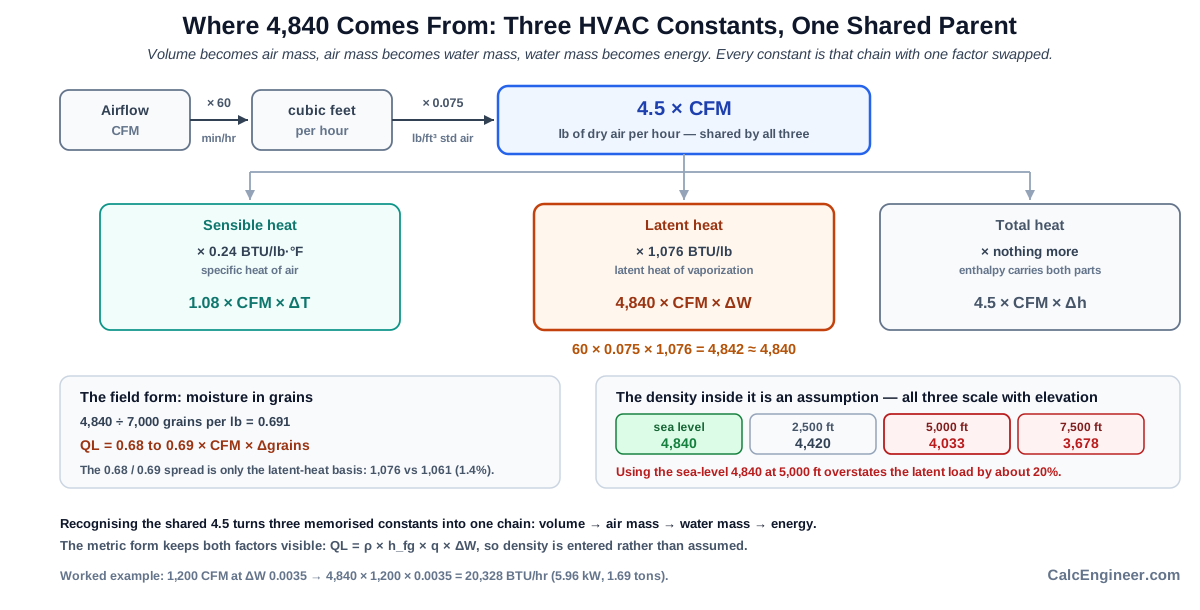
The derivation:
60 min/hr × 0.075 lb/ft³ × 1,076 BTU/lb = 4,842 ≈ 4,840
| Factor | Value | What it is |
|---|---|---|
| 60 | min/hr | Time conversion |
| 0.075 | lb/ft³ | Standard air density, sea level, roughly 70°F (21°C) |
| 1,076 | BTU/lb | Latent heat of vaporization near 70°F (21°C) |
Step by step:
| Step | Multiply by | What you have |
|---|---|---|
| Start | — | CFM |
| 1 | 60 | Cubic feet per hour of air |
| 2 | 0.075 lb/ft³ | Pounds of dry air per hour — the familiar 4.5 × CFM |
| 3 | ΔW | Pounds of water per hour |
| 4 | 1,076 BTU/lb | BTU per hour |
The 4.5 intermediate is where the family shows itself: 60 × 0.075 = 4.5, the standard air mass-flow factor. The same 4.5 sits inside the sensible constant 1.08 (4.5 × 0.24 BTU/lb·°F specific heat) and inside the total-enthalpy constant 4.5 itself. The three familiar HVAC constants share one parent.
The constant family, and the fourth member this page adds:
| Load | Form | What it embeds |
|---|---|---|
| Sensible | 1.08 × CFM × ΔT | 4.5 and specific heat 0.24 BTU/lb·°F |
| Latent, textbook Imperial | 4,840 × CFM × ΔW | 4.5 and latent heat 1,076 BTU/lb |
| Latent, this page | 4,750 × CFM × ΔW | 4.5 and latent heat 1,055 BTU/lb (the SI 2,454 kJ/kg) |
| Total | 4.5 × CFM × Δh | 4.5 alone, enthalpy carries the rest |
The provenance matters because each embedded quantity is an assumption. Standard density assumes sea level and roughly 70°F (21°C); latent heat assumes a temperature. Change the assumption and the constant changes — which is exactly what has happened in the third row. Neither latent heat is wrong. The SI form of this calculation conventionally carries 2,454 kJ/kg, a value nearer typical coil conditions than the 1,076 BTU/lb that the Imperial constant was built around, and running one equation in both modes means the SI choice governs the Imperial answer too.
The consequence is a 1.9% offset between what a hand check on 4,840 gives and what this page prints, in the direction of the page reading lower. On a screening estimate that is immaterial. It stops being immaterial when two tools are compared and the gap is mistaken for a modelling difference, which is why every Imperial figure in this article is the page's own output.
Recognizing the family makes the equations one idea rather than four memorized forms.
Per ASHRAE Fundamentals, the Imperial latent constant is 60 min/hr × 0.075 lb/ft³ × 1,076 BTU/lb, approximately 4,840. Its 4.5 core is shared with the sensible constant 1.08 and the total-heat constant 4.5. Each embedded value is an assumption about air density and latent heat, and a tool that assumes a different latent heat carries a different constant.
The Grains Form: This Page Is the 0.68 Rule
Field practice often states moisture in grains per pound rather than decimal pounds, producing a second form of the equation, and the small spread between its published constants traces directly to which latent heat value was chosen — which is what makes it the fastest way to identify the constant a tool is running.
The grains conversion:
1 lb of water = 7,000 grains = 15,432 grains per kg
At the worked case, ΔW 0.0035 lb/lb × 7,000 = 24.5 grains per pound.
The grains form:
QL = 0.68 × CFM × Δgrains [BTU/hr]
Where the published constants come from:
| Route | Arithmetic | Grains constant |
|---|---|---|
| Textbook Imperial | 4,840 ÷ 7,000 | 0.691 |
| Coil-temperature latent heat | 4.5 × 1,061 = 4,775; 4,775 ÷ 7,000 | 0.682 |
| This page | 4,750 ÷ 7,000 | 0.679 |
Published values of 0.68 and 0.69 differ only by which latent heat was assumed:
| Latent heat | Reference temperature | Where it appears |
|---|---|---|
| 1,076 BTU/lb (2,503 kJ/kg) | Near 70°F (21°C) | Inside the textbook 4,840 constant |
| 1,061 BTU/lb (2,468 kJ/kg) | Nearer coil condensation temperature | The 0.68 field constant |
| 1,055 BTU/lb (2,454 kJ/kg) | The SI convention for this calculation | Inside this page, both modes |
The three sit inside a 2% band, and the ordering has a practical consequence worth stating plainly. Because this page runs 1,055 BTU/lb, the field rule of thumb is a better check on it than its own Imperial-looking equation:
| Cross-check on 1,200 CFM at 24.5 grains | Result | Against the page's 19,950 BTU/hr |
|---|---|---|
| 0.68 × 1,200 × 24.5 | 19,992 BTU/hr | +0.21% |
| 0.69 × 1,200 × 24.5 | 20,286 BTU/hr | +1.68% |
| 4,840 × 1,200 × 0.0035 | 20,328 BTU/hr | +1.89% |
An engineer who checks this page with the 0.68 grains rule scribbled on a drawing lands within a quarter of a percent. One who checks it with 4,840 lands nearly two percent away and may go looking for a bug that is not there. All four figures agree within 2%, and the entire spread is the latent-heat assumption.
Per ASHRAE Fundamentals and standard HVAC practice, the grains form QL = 0.68 × CFM × Δgrains is the same equation scaled by 7,000 grains per pound. Published constants of 0.68 and 0.69, and latent heats of 1,055, 1,061 and 1,076 BTU/lb, differ by about 2%, well inside screening tolerance.
Moisture Removal Rate: The Condensate the Coil Actually Produces
The second output is the mass the heat rate came from, and that number is what sizes condensate drains, rates dehumidifiers, and tells an operator how much water to expect in a pan.
The calculator computes it the direct way, in both unit systems:
ṁ_water = ρ × q × ΔW × 3,600 [kg/h, converted to lb/hr in Imperial mode]
| Stage | Operation | What comes out |
|---|---|---|
| 1 | ρ × q | kg of air per second |
| 2 | × ΔW | kg of water per second |
| 3 | × 3,600 | kg of water per hour |
No latent heat is needed on that path, because the quantity never converts to energy and back. This matters for reading the two output rows together. A common textbook alternative recovers the mass from the energy instead, dividing the Imperial load by a latent heat of 1,061 BTU/lb, and a page built that way would print two rows that disagree by about 1.4% on the water mass. This page does not do that. Both rows descend from the same ρ × q × ΔW product, so they are consistent by construction, and dividing one by the other returns the single latent heat in force:
| Printed row, worked case | Value |
|---|---|
| Latent Heat Load | 19,950 BTU/hr |
| Moisture Removal Rate | 18.91 lb/hr |
| 19,950 ÷ 18.91 | 1,055 BTU/lb — the SI 2,454 kJ/kg, to four figures |
That division is the cheapest audit available on any latent-load tool. Whatever constant a page claims in its formula section, the ratio of its own two output rows is the constant it ran.
Converting to volume, the practical unit, water weighs 8.34 lb per US gallon (1.0 kg per litre), so the worked case's 18.91 lb/hr is 2.27 gallons per hour (8.58 litres per hour). Over an eight-hour occupied period that is roughly 18 gallons (69 litres) into the drain pan.
The volume matters because condensate drain and trap sizing, the pump capacity the Condensate Pump Sizing Calculator sets, and pan overflow risk all follow the volume rate. A drain sized for a mild climate can be overwhelmed in a humid one at the same tonnage.
Dehumidifier ratings translate the same way. Standalone dehumidifiers are rated in pints or litres per day at stated conditions, and 18.91 lb/hr is about 454 lb per day (206 kg per day), roughly 54 gallons or 206 litres per day, a figure that immediately shows whether portable equipment is plausible.
A sanity check against the air itself. The entering air carries 5,403 lb/hr × 0.0130 lb/lb = 70 lb/hr (31.8 kg/h) of water. The moisture rate must be less than that, and removing 18.91 lb/hr is 27% of it.
Per ASHRAE and manufacturer practice, the moisture removal rate converts the latent load back to mass, sizing condensate drains, pumps, and dehumidifier duty. At 8.34 lb per gallon, 18.91 lb/hr is 2.27 gallons per hour, about 18 gallons (69 litres) over an eight-hour period.
Air Density and the Altitude Correction the Constants Hide
Both equations rest on an assumed air density, and because density falls with elevation, the constants that look universal are sea-level values that overstate the load in mountain installations.
Standard air is 0.075 lb/ft³ (1.202 kg/m³) at sea level, roughly 70°F (21°C). The Imperial constant embeds it; this calculator takes it as an explicit input instead — in both unit modes, which is the one place the Imperial-versus-metric packaging genuinely disappears.
Density with elevation:
| Elevation | Density | Below standard | Worked case at that density |
|---|---|---|---|
| Sea level | 0.075 lb/ft³ (1.202 kg/m³) | — | 19,950 BTU/hr |
| 2,500 ft (762 m) | roughly 0.0685 lb/ft³ (1.098 kg/m³) | about 9% | 18,224 BTU/hr |
| 5,000 ft (1,524 m) | roughly 0.0625 lb/ft³ (1.001 kg/m³) | about 17% | 16,614 BTU/hr |
| 7,500 ft (2,286 m) | roughly 0.0570 lb/ft³ (0.913 kg/m³) | about 24% | 15,154 BTU/hr |
Two statements of the same fact are both correct and often confused. At 5,000 ft the air is about 17% thinner than standard, so the load falls 17%. Read the other way round, the sea-level answer is about 20% higher than the correct one — 19,950 against 16,614. The base of the percentage is what changes, not the physics.
Elevation is enough to move a design across a grading band. The same coil is HIGH LATENT LOAD at sea level and at 5,000 ft, and MODERATE LATENT LOAD at 7,500 ft. Equipment chosen on the sea-level answer is oversized on latent capacity in Denver and badly oversized in Leadville.
On a page that hand-scales the constant, the correction is arithmetic. At 5,000 ft:
4,840 × (ρ_actual / 0.075) = 4,840 × 0.833 = 4,033
On this page there is nothing to scale. Type 1.001 into the density field, in either mode, and the answer arrives corrected. The equivalent constant, had you wanted it, is 4,750 × 0.833 = 3,956.
Thinner air carries less moisture load because the load depends on the mass of dry air passing, not its volume. Thinner air means fewer pounds per CFM, so fewer pounds of water per CFM at the same ΔW.
Density also falls as temperature rises, though the effect over normal coil entering conditions is smaller than a few thousand feet of elevation.
The same correction applies elsewhere. The sensible constant 1.08 and the total-heat 4.5 scale by the identical density ratio, because all of them share the 4.5 core.
Per ASHRAE Fundamentals, the standard constants assume sea-level air density. At 5,000 ft (1,524 m), density runs about 17% low; a page carrying a fixed sea-level constant overstates the latent load by about 20% there. This calculator takes density as a direct input in both unit systems.
The Coil Dew Point Floor: Leaving Humidity Ratio Is Not a Free Choice
The leaving humidity ratio entered into the calculation is bounded by physics, because air cannot leave a coil drier than saturation at the coil's effective surface temperature, and real coils never reach even that limit.
W_out cannot fall below the saturation humidity ratio at the coil's apparatus dew point, the effective surface temperature the coil presents to the air. Typical chilled-water and DX coils run 45 to 55°F (7 to 13°C).
Saturation values across that range, at standard barometric pressure:
| Apparatus dew point | Saturation humidity ratio W_sat |
|---|---|
| 45°F (7.2°C) | 0.0063 lb/lb |
| 50°F (10.0°C) | 0.0076 lb/lb |
| 55°F (12.8°C) | 0.0092 lb/lb |
Real coils stay above the floor. Some air passes between the fins without touching a wet surface, the bypass fraction. That bypassed air leaves at its entering moisture content and mixes with the treated air, so the mixed leaving state sits above saturation at the apparatus dew point. Bypass factors commonly run 0.05 to 0.20 depending on rows and fin spacing.
The sanity check runs the same logic backwards:
| Entered W_out | Implied saturation temperature | Verdict |
|---|---|---|
| 0.0095 lb/lb | 55.9°F (13.3°C) | Consistent with an apparatus dew point near 50°F (10°C) plus normal bypass |
| 0.0050 lb/lb | 39.0°F (3.9°C) | Unrealistic for a comfort coil — the input is almost certainly wrong |
Reaching deeper dehumidification requires a colder coil, more rows to cut bypass, or a desiccant stage, each with its own energy and equipment consequence. The entering side has no such floor: W_in is whatever the mixed air carries, set by outdoor conditions and the outdoor-air fraction.
The calculator does not enforce any of this. It will accept a W_out of 0.0050 and report a larger load without comment, because the floor is a property of the coil rather than of the arithmetic.
Per ASHRAE Handbook HVAC Systems and Equipment, the leaving humidity ratio is bounded below by saturation at the coil's apparatus dew point, and bypass air raises the actual leaving state above that limit. A leaving value implying an apparatus dew point far below 45°F (7°C) indicates an input error.
Airflow Against Difference: Many Combinations, One Load
Because the load is a product of airflow and moisture difference, the same latent duty arises from many combinations, and the choice between them is a real design decision rather than an arithmetic detail.
QL = constant × CFM × ΔW
Halve the airflow and double ΔW and the load is the same. Lines of equal latent load are hyperbolas on an airflow-versus-ΔW plot.
Worked equivalence, all three run through the page:
| Airflow | ΔW | Latent load | Moisture removal |
|---|---|---|---|
| 1,200 CFM (0.566 m³/s) | 0.0035 | 19,950 BTU/hr (5.85 kW) | 18.91 lb/hr |
| 600 CFM (0.283 m³/s) | 0.0070 | 19,950 BTU/hr (5.85 kW) | 18.91 lb/hr |
| 2,400 CFM (1.133 m³/s) | 0.00175 | 19,950 BTU/hr (5.85 kW) | 18.91 lb/hr |
What differs between them:
| High airflow, small ΔW | Low airflow, large ΔW | |
|---|---|---|
| Coil | Warmer, shallower | Colder, deeper |
| Apparatus dew point | Higher | Lower |
| Moisture removed per pass | Less | More |
| Fan energy | Higher | Lower |
| Leaving air | Closer to the entering state | Risk of overcooling the supply air |
The dew point constraint picks the winner. The high-difference option needs a leaving humidity ratio that may sit below the coil's floor, while the low-difference option may not reach the room's required supply moisture at all. The feasible band is narrower than the arithmetic suggests.
The sensible side constrains it further. Airflow is usually already fixed by the sensible load and the supply temperature difference, the calculation the CFM Calculator performs. In most designs the latent calculation checks whether that airflow, at an achievable ΔW, covers the moisture, rather than choosing airflow freely.
Where the freedom is real, dedicated outdoor air systems decouple the two: a small airflow at a large ΔW handles the ventilation moisture, leaving the space equipment to handle sensible load. A DOAS unit at 2,000 CFM taking outdoor air from 0.018 down to 0.008 lb/lb returns 95,001 BTU/hr and 90.05 lb/hr of condensate — nearly eight tons of latent duty and almost eleven gallons an hour into the drain, from an airflow a single comfort air handler would carry.
Per ASHRAE practice, equal latent loads trace hyperbolas across airflow and humidity-ratio difference. The coil dew point floor limits the high-difference end and the sensible load usually fixes airflow, so the calculation typically verifies a chosen airflow rather than selecting one. Dedicated outdoor air systems exploit the low-flow, high-difference corner.
How the Latent Load Feeds the Sensible Heat Ratio
This calculation produces one of the two numbers the sensible heat ratio divides, which is how a moisture estimate turns into an equipment-selection decision.
SHR = Q_sensible / (Q_sensible + Q_latent)
This calculator supplies Q_latent, and the Sensible Heat Ratio Calculator performs the division. Taking the worked example's 19,950 BTU/hr (5.85 kW) as the latent side:
| Sensible load beside it | Total | SHR | Reading |
|---|---|---|---|
| 60,000 BTU/hr (17.58 kW) | 79,950 BTU/hr (23.43 kW) | 0.750 | Standard comfort band |
| 30,000 BTU/hr (8.79 kW) | 49,950 BTU/hr (14.64 kW) | 0.601 | Below the 0.65 threshold, indicating enhanced dehumidification |
The same moisture gives two conclusions. The latent load is identical in both rows; what changed is the sensible load beside it. A latent figure means nothing about equipment until it sits next to its sensible partner.
Computing latent separately earns its keep because many load tools report a total and a sensible figure, leaving latent as the remainder. Computing it directly from moisture content is an independent check on that remainder, and it catches ventilation moisture that summary tools sometimes understate.
Boundary consistency governs both numbers. They must come from the same boundary, room-only or coil-total including ventilation. The Sensible Heat Ratio article covers that distinction and the related heat factors.
Equipment matching closes the loop. The moisture removal rate compares directly against a coil's rated latent capacity or a dehumidifier's rated pounds per hour at design conditions, a check that total tonnage cannot provide.
Per ASHRAE and ACCA Manual S, the latent load computed here is the input the sensible heat ratio divides. The same 19,950 BTU/hr gives a ratio of 0.75 beside a 60,000 BTU/hr sensible load and 0.60 beside a 30,000 BTU/hr one, with opposite equipment conclusions. Keep both loads on one boundary.
Worked Example: 1,200 CFM at a 0.0035 Difference to 19,950 BTU per Hour
A commercial cooling coil handles humid-climate mixed air at 1,200 CFM (0.566 m³/s), entering at a humidity ratio of 0.0130 lb/lb and leaving at 0.0095 lb/lb. The air density field is left empty, so the page's 1.202 kg/m³ default applies. The question is the latent duty and the condensate it produces.
Step 1. Humidity-ratio difference.
ΔW = 0.0130 − 0.0095 = 0.0035 lb/lb
That is 0.0035 kg/kg and 24.5 grains per pound. The result card rounds the row to 0.003; the load below is computed on the full 0.0035.
Step 2. Dry-air mass flow.
4.5 × 1,200 = 5,400 lb/hr (2,449 kg/h)
Step 3. Latent heat load. The page returns 19,950 BTU/hr, which is 5.85 kW and 1.66 tons of latent duty. A hand check on the textbook constant, 4,840 × 1,200 × 0.0035, gives 20,328 — 1.9% higher, and the reason is Section 6, not an error.
Step 4. Moisture removal rate. The page returns 18.91 lb/hr (8.58 kg/h).
Step 5. Cross-check by the mass path.
5,400 lb/hr × 0.0035 = 18.9 lb/hr (8.57 kg/h)
The printed 18.91 and the hand 18.9 agree, because the page computes the moisture row on exactly this path rather than dividing the energy by a second latent heat.
Step 6. Cross-check by the grains rule.
0.68 × 1,200 × 24.5 = 19,992 BTU/hr
Within a quarter of a percent of the printed load, which is the tell that this page carries the 0.68 basis.
Step 7. Condensate volume.
18.91 ÷ 8.34 lb per gallon = 2.27 gallons per hour (8.58 litres per hour)
That is about 18 gallons (69 litres) over an eight-hour occupied period. Size the drain, trap, and any condensate pump for this rate.
Step 8. Leaving-state sanity check. W_out 0.0095 lb/lb saturates at 55.9°F (13.3°C), consistent with a coil apparatus dew point near 50°F (10°C) with normal bypass. Plausible.
Step 9. The grade. The result card reports HIGH LATENT LOAD, its band for roughly 15,000 to 30,000 BTU/hr, with a next step pointing at coil latent capacity and a possible DOAS.
Step 10. Result.
| Quantity | Imperial | Metric |
|---|---|---|
| Humidity ratio difference | 0.0035 lb/lb | 0.0035 kg/kg |
| Latent heat load | 19,950 BTU/hr (1.66 tons) | 5.85 kW |
| Moisture removal rate | 18.91 lb/hr | 8.58 kg/h |
| Condensate volume | 2.27 gal/hr | 8.58 L/hr |
| Grade | HIGH LATENT LOAD | HIGH LATENT LOAD |
Compare against the coil's rated latent capacity at the design entering wet-bulb, and size the condensate drain for 2.3 gallons per hour.
The decision is a coil selected on rated latent capacity at 1,200 CFM and the design entering wet-bulb — not on total tonnage. The Sensible Heat Ratio Calculator combines this figure with the sensible load to give the split, the Humidity Ratio Calculator produces the two moisture inputs, and the Condensate Pump Sizing Calculator handles the condensate this coil sheds.
Metric Worked Example and the Parity Check
Step 1. The inputs: airflow 1.0 m³/s, W_in 0.014 kg/kg, W_out 0.010 kg/kg, ρ 1.202 kg/m³, with the fixed h_fg of 2,454 kJ/kg.
Step 2. Humidity-ratio difference.
ΔW = 0.014 − 0.010 = 0.004 kg/kg
That is 0.004 lb/lb and 28 grains per pound.
Step 3. Latent heat load.
QL = 1.202 × 2,454 × 1.0 × 0.004 = 11.80 kW
Step 4. Moisture removal rate, by the direct mass path.
ṁ_water = 1.202 × 1.0 × 0.004 × 3,600 = 17.31 kg/h
Step 5. Condensate volume: 17.31 kg/h is 17.3 litres per hour (4.57 gallons per hour), a substantially larger drain duty than the Imperial example, at more than twice the airflow.
Step 6. The parity check. One cubic metre per second is 2,118.88 CFM. Entering that airflow with the same two humidity ratios in Imperial mode returns 40,259 BTU/hr and 38.16 lb/hr — which is 11.80 kW and 17.31 kg/h to the last printed digit. The two modes are not approximately equivalent here; they are the same equation with unit conversions at the edges, so parity is exact and any disagreement between them means the numbers were typed differently.
Step 7. Where a discrepancy would come from. A hand calculation on the Imperial constant does disagree: 2,118.88 × 4,840 × 0.004 = 41,022 BTU/hr against the page's 40,259, a 1.9% gap. That gap is the latent-heat basis of Section 6 and nothing else. Air density is not involved, since 0.075 lb/ft³ is 1.201 kg/m³.
Step 8. Which value to prefer. Neither latent heat is more correct in general; each is the value at a different reference temperature. For screening, the spread is immaterial. For equipment comparison, use one basis consistently and state it, so two tools are not compared across different assumptions.
Step 9. The practical rule. Stay within one unit system for a given project's latent calculations, and record which constant the tool ran. On this page the record is free: divide the load row by the moisture row.
Step 10. Result.
| Quantity | Metric | Imperial at 2,118.88 CFM |
|---|---|---|
| Humidity ratio difference | 0.004 kg/kg | 0.004 lb/lb |
| Latent heat load | 11.80 kW | 40,259 BTU/hr (3.35 tons) |
| Moisture removal rate | 17.31 kg/h | 38.16 lb/hr |
| Condensate volume | 17.3 L/hr | 4.57 gal/hr |
| Grade | VERY HIGH LATENT LOAD | VERY HIGH LATENT LOAD |
Per ASHRAE Fundamentals, the metric case gives 11.80 kW and 17.31 kg/h, and the Imperial mode reproduces it exactly at the equivalent airflow. A hand recomputation on 4,840 differs by about 2%, tracing entirely to latent heats of 1,076 against 1,055 BTU/lb.
Reading the Result Card: Six Things the Page Does That the Equations Do Not Say
The equations above describe the model. The page implements it with a handful of behaviours that are invisible in any formula and that change how the output should be read. Each of the following was run on the live calculator.
1. The constant is 4,750, and the two output rows prove it. Section 6 derives this and Section 8 shows the audit. Divide 19,950 BTU/hr by 18.91 lb/hr and 1,055 BTU/lb comes back, the SI 2,454 kJ/kg. One latent heat runs the whole card, so the two rows can never disagree with each other — only with a hand check on a different constant.
2. The humidity-ratio difference row is rounded to three decimals, and its last digit is decided by floating-point residue. This is the sharpest limit on the card. Two entirely equivalent ways of writing the same coil produce two different rows:
| Entered W_in and W_out | ΔW row | Latent Heat Load row |
|---|---|---|
| 0.0130 and 0.0095 | 0.003 lb/lb | 19,950 BTU/hr |
| 0.0165 and 0.0130 | 0.004 lb/lb | 19,950 BTU/hr |
Both differences are 0.0035. The load rows are identical because the load is computed at full precision. The ΔW rows differ because binary floating point represents 0.0130 − 0.0095 as very slightly under 0.0035 and 0.0165 − 0.0130 as very slightly over it, and three-decimal rounding then falls on opposite sides. Read the ΔW row as a confirmation that you typed what you meant, never as an input to a hand check: carrying 0.003 forward reproduces the 14% error Section 4 warns about.
3. The air density field takes kg/m³ in Imperial mode, shows no unit, and accepts the wrong one silently. The helper text says kg/m³. The same page prints 0.075 lb/ft³ as the standard density in its own explanatory copy. Type 0.075 into the field on the worked case and the result card reports 1,245 BTU/hr and 1.18 lb/hr, grades it LOW LATENT LOAD, and offers a next step about verifying equipment latent capacity. The answer is 16 times too small and nothing on the page says so. In Imperial mode, always enter 1.202, or the metric density for your elevation.
4. A typed zero in the density field is not a zero. Leaving the field empty and entering 0 both produce 19,950 BTU/hr, because the engine substitutes the 1.202 default whenever the density evaluates to zero. That is the right default for an empty field. It also means an explicit 0, which is physically meaningless and should be rejected, is quietly read as standard sea-level air.
5. There are narrow gaps between the grading bands, and a result can land in one. The bands are defined in kilowatts and applied in both modes:
| Band | Range | Imperial equivalent |
|---|---|---|
| NO LATENT LOAD | −0.001 to 0.001 kW | about ±3 BTU/hr |
| LOW LATENT LOAD | 0.001 to 1.499 kW | up to about 5,115 BTU/hr |
| MODERATE LATENT LOAD | 1.5 to 4.499 kW | about 5,118 to 15,351 BTU/hr |
| HIGH LATENT LOAD | 4.5 to 8.999 kW | about 15,355 to 30,706 BTU/hr |
| VERY HIGH LATENT LOAD | 9.0 kW and above | about 30,709 BTU/hr and above |
Between 1.499 and 1.5 kW, between 4.499 and 4.5, and between 8.999 and 9.0, no band applies. Enter 307.76 CFM at the worked case's humidity ratios and the card prints 5,117 BTU/hr with no grade at all — no badge, no context, no next step, the result explanation simply following the numbers. The window is a tenth of a percent wide, so it is rare, but a missing grade is a gap in the bands rather than a page fault.
Because the cuts are kilowatt values while the Imperial descriptions are round BTU/hr approximations, the two can look inconsistent near an edge. The 7,500 ft case of Section 9 prints 15,154 BTU/hr, is graded MODERATE LATENT LOAD, and is then told its typical range is "approximately 5,000–15,000 BTU/hr" — a range its own value sits just outside. The grade is right; 15,154 BTU/hr is 4.44 kW, comfortably inside the 1.5-to-4.499 kW band. It is the rounded Imperial label that cannot land on the kilowatt cut.
6. The header unit switch relabels the fields without converting what is in them. This is the failure mode with the largest range on the page, and the dangerous direction is the quiet one:
| Mistake | What the card prints | Grade |
|---|---|---|
| Metric numbers (1.0, 0.014, 0.010) read as Imperial | 19.00 BTU/hr | LOW LATENT LOAD |
| Imperial numbers (1,200, 0.0130, 0.0095) read as metric | 12,389 kW | VERY HIGH LATENT LOAD |
The second is obvious — twelve megawatts of latent duty announces itself. The first is not: 19 BTU/hr is a plausible-looking small number carrying a plausible-looking band label, and it is two thousand times below the real answer. Check the mode indicator before reading any result, and remember that the toggle shows the mode currently in force rather than the one it would switch to.
A seventh behaviour is worth a line even though it is a virtue rather than a trap: the relative-humidity mistake of Section 3 cannot hide. Entering 60 and 40 returns 114,001,441 BTU/hr, which no one will mistake for a coil.
Application Boundaries: Psychrometric State, Bypass, Outside Air, Humidity Proof
The calculator covers the latent heat rate and moisture mass rate from an airflow and a humidity-ratio difference, coil latent-load screening, dehumidification and DOAS estimating, and a first-pass check before psychrometric design. Several neighboring questions fall outside that scope.
Sensible and Total Load. The calculator returns only the latent portion. Sensible load and total cooling load are separate calculations run by the Cooling Load Calculator, and the split between them is the sensible heat ratio.
Psychrometric State Points. It takes humidity ratios as given. Deriving them from dry-bulb with wet-bulb, dew point, relative humidity, or enthalpy requires a psychrometric calculation, the work of the Psychrometric Calculator.
Apparatus Dew Point and Bypass Factor. The coil's effective surface temperature and its bypass fraction determine what leaving humidity ratio is actually achievable. Neither is computed here; both bound the input, and neither is enforced.
Outside-Air Mixing. Mixing outdoor and return air to produce the coil entering state is not modeled. Enter the mixed-air humidity ratio, or run outdoor air separately as a dedicated stream sized by the Ventilation Rate Calculator.
Infiltration and Internal Moisture Generation. Moisture entering the space through leakage, occupants, and processes is not generated by the calculator; it must already be represented in the entered humidity ratios or handled as a separate airstream.
Condensate Carryover and Re-Evaporation. At high face velocity, condensate can be entrained into the airstream and re-evaporate downstream, returning moisture to the air. Not modeled.
Room Relative Humidity. A latent load does not by itself predict the resulting indoor humidity, which requires a moisture balance on the space including all sources, the airflow, and the leaving-air moisture.
Equipment Latent Capacity. Rated coil latent capacity varies with entering wet-bulb, airflow, and staging. Manufacturer expanded ratings at the design point govern selection; this figure is the requirement, not the capability.
Altitude and Non-Standard Density. Enter the actual density in kg/m³, in either unit mode. The page does not infer it from an elevation.
Latent Heat Constant Basis. Results carry a roughly 2% spread against tools built on a different latent heat; Section 6 identifies the one in force here and Section 8 shows how to confirm it.
Per ASHRAE Fundamentals and ACCA Manual S, latent-rate screening is the calculator's scope. Sensible and total load, psychrometric state derivation, apparatus dew point and bypass, outside-air mixing, moisture generation, carryover, room humidity prediction, and equipment latent capacity require separate analysis. A qualified engineer completes the selection.
Latent Heat Load Calculator
Latent heat load from the humidity-ratio difference: subtracts the leaving humidity ratio from the entering one, multiplies by the airflow and the air's density and latent heat, and returns the latent cooling rate together with the moisture removal rate that produces it. One equation runs both unit modes, so Imperial and metric agree exactly and the moisture row is the direct mass path rather than a second constant. The moisture rate is the practical output, sizing condensate drains and dehumidifier duty. A screening estimate per ASHRAE psychrometrics, not a full coil analysis.
Open Latent Heat Load CalculatorStandards and References
- ASHRAE Handbook, Fundamentals (2021), Psychrometrics chapter. Humidity ratio definition, moist-air property relations, saturation humidity ratios, and the latent heat of vaporization values behind the constants.
- ASHRAE Handbook, Fundamentals (2021), Nonresidential Cooling and Heating Load Calculations chapter. Latent load components and the standard air constants 1.08, 4,840, and 4.5.
- ASHRAE Standard 62.1-2022, Ventilation for Acceptable Indoor Air Quality. Minimum outdoor air rates by occupancy category and floor area, the code driver behind the ventilation moisture burden.
- ASHRAE Handbook, HVAC Systems and Equipment (2020), Air-Cooling and Dehumidifying Coils chapter. Apparatus dew point, bypass factor, rated latent capacity, and condensate carryover.
- ASHRAE Handbook, HVAC Applications (2023). Natatorium, commercial kitchen, and dedicated outdoor air system moisture loads, the applications where latent duty dominates.
- ASHRAE Standard 55-2023, Thermal Environmental Conditions for Human Occupancy. The indoor humidity context within which a latent-load target is judged.
- ACCA Manual J (8th ed), Residential Load Calculation. Residential latent load, occupant moisture allowances, and infiltration moisture.
- ACCA Manual S, Residential Equipment Selection. Selection against rated latent capacity at design conditions rather than against nominal tonnage.
- ASHRAE psychrometric standard air properties. Density 0.075 lb/ft³ (1.202 kg/m³), 7,000 grains per pound, and latent heat values of 1,076, 1,061 and 1,055 BTU/lb (2,503, 2,468 and 2,454 kJ/kg).
- Manufacturer coil expanded ratings and dehumidifier performance data. Rated latent capacity and moisture removal at stated entering conditions and airflow, the source for actual equipment capability.
FAQ
How do you calculate latent heat load?
Per ASHRAE Handbook Fundamentals: multiply the airflow by the humidity-ratio difference and a constant embedding air density and latent heat. In Imperial the familiar form is QL = 4,840 × CFM × ΔW. This calculator runs the SI equation in both modes, which puts 4,750 in that slot, so at 1,200 CFM and a difference of 0.0035 lb/lb it returns 19,950 BTU/hr (5.85 kW), about 1.66 tons of latent duty.
What is humidity ratio and how does it differ from relative humidity?
Per ASHRAE Psychrometrics: humidity ratio is the mass of water vapor per mass of dry air, an absolute measure typically running 0.008 to 0.012 for indoor air. Relative humidity is a percentage of saturation at a given temperature. Latent load depends on moisture mass, so the calculation requires the humidity ratio. Entering 60 and 40 where ratios belong returns 114,001,441 BTU/hr, which is the error announcing itself.
Where does the 4,840 constant come from, and why does this page give a slightly lower answer?
Per ASHRAE Fundamentals: 4,840 is 60 minutes per hour times the standard air density of 0.075 lb/ft³ times a latent heat of about 1,076 BTU/lb, giving 4,842. Its 4.5 core, the pounds of dry air per hour per CFM, is shared with the sensible constant 1.08 and the total-heat constant 4.5. This page carries the SI latent heat of 2,454 kJ/kg, which is 1,055 BTU/lb, so its Imperial constant is 4,750 and its answers run 1.9% below a hand check on 4,840. Both bases are standard; the spread is inside screening tolerance.
How much condensate will a coil produce?
Per the moisture-removal output: multiply the dry-air mass flow by the humidity-ratio difference. A 19,950 BTU/hr latent load comes with about 18.91 lb/hr (8.58 kg/h), which at 8.34 lb per gallon is 2.27 gallons per hour, roughly 18 gallons (69 litres) over an eight-hour period.
Why do published latent constants differ slightly?
Per standard practice: because they assume latent heat at different reference temperatures — commonly 1,076 BTU/lb near room conditions, 1,061 BTU/lb nearer coil conditions, and 1,055 BTU/lb as the SI 2,454 kJ/kg convention. That produces the familiar 0.69 and 0.68 grains-form constants and a spread of about 2%, inside screening tolerance. The 0.68 rule is the closest hand check on this page.
Does altitude change the latent load calculation?
Per ASHRAE Fundamentals: yes. At 5,000 ft (1,524 m) air density runs about 17% below standard, so the same coil returns 16,614 BTU/hr instead of 19,950 — put the other way, the sea-level answer is about 20% high. This calculator takes density as a direct input in both unit modes, so enter 1.001 kg/m³ rather than rescaling a constant.
Can the leaving humidity ratio be set to any value?
Per ASHRAE Systems and Equipment: no. It is bounded below by saturation at the coil's apparatus dew point, typically 45 to 55°F (7 to 13°C), and bypass air raises the actual leaving state above that floor. A leaving value of 0.0050 lb/lb implies an apparatus dew point of 39°F, unrealistic for a comfort coil. The calculator does not enforce the floor, so the check is yours.
Why does the humidity-ratio difference row show fewer decimals than I entered?
The row is rounded to three decimals while the load and moisture rows are computed at full precision. Entering 0.0130 and 0.0095 shows a difference of 0.003 alongside a load of 19,950 BTU/hr. Use the row to confirm your inputs, not as a value to carry into a hand calculation — 0.003 in place of 0.0035 is a 14% error.
Related Calculators
- Sensible Heat Ratio Calculator: The split this latent load feeds, deciding whether standard equipment can control humidity (article).
- Humidity Ratio Calculator: Produces the entering and leaving moisture values this calculation subtracts.
- Psychrometric Calculator: Full air-state analysis behind the apparatus dew point and the leaving-air condition.
- Condensate Pump Sizing Calculator: Sizes the pump for the moisture removal rate this calculation produces.
- Dehumidifier Sizing for Pools Calculator: Natatorium evaporation, the highest latent loads in building design.
- Ventilation Rate Calculator: Outdoor air quantity per ASHRAE Standard 62.1, usually the dominant moisture source.
- Cooling Load Calculator: The sensible side of the total cooling load.
- CFM Calculator: Airflow, the other factor in the latent product.