Why Psychrometrics Needs an Absolute Moisture Measure
Relative humidity is the moisture number everyone quotes and the one number that cannot carry a load calculation, because it describes how close air sits to saturation rather than how much water it holds, and those are different questions with different answers at every temperature.
Cool a room's air from 75°F to 55°F (24°C to 13°C) without touching its moisture and the relative humidity climbs from 50% toward 100%, yet not one grain of water has been added or removed. The air's capacity changed; its contents did not. Any calculation that depends on the actual mass of water, latent load, dehumidifier duty, condensate volume, or the mixing of two airstreams, needs a measure that stays put when only temperature moves. That measure is the humidity ratio, the mass of water vapor carried per unit mass of dry air, and it is the vertical axis of every psychrometric chart for exactly this reason.
The calculator derives the humidity ratio from a dry-bulb temperature plus one moisture property, relative humidity, wet-bulb temperature, dew point, or a direct entry, and returns the dew point, partial vapor pressure, saturation humidity ratio, and degree of saturation alongside it. The Latent Heat Load article computed a moisture load from the difference between two humidity ratios and pointed to a psychrometric calculation as their source; this is that calculation. Saturation vapor pressure comes from the Magnus approximation, and everything else follows from the ratio of water's molecular mass to that of dry air. ASHRAE Handbook Fundamentals treats humidity ratio as the fundamental moisture variable in moist-air property work.
Calculator Inputs: Dry-Bulb Plus One Moisture Property
The calculator takes one temperature and one moisture property, then returns the humidity ratio together with the derived state properties.
Unit System. Imperial (°F, gr/lb, psi) or Metric (°C, g/kg, kPa). Both assume standard atmospheric pressure.
Dry-Bulb Temperature [°F or °C]. The ordinary air temperature from a shielded thermometer. Typical indoor 68 to 78°F (20 to 26°C), outdoor design up to 95°F (35°C) or beyond.
Moisture Input Type. One of four routes: relative humidity, wet-bulb temperature, dew point temperature, or direct entry of the humidity ratio.
Relative Humidity [%]. 0 to 100, from a hygrometer or a stated design condition.
Wet-Bulb Temperature [°F or °C]. From a sling psychrometer or a measured coil condition. Always at or below the dry-bulb.
Dew Point Temperature [°F or °C]. From a chilled-mirror instrument or a stated design dew point.
Humidity Ratio [gr/lb or g/kg]. Direct entry, when W is already known and the derived properties are wanted.
Outputs are Humidity Ratio W (gr/lb or g/kg), Dew Point Temperature (°F or °C), Partial Vapor Pressure (psi or kPa), Saturation Humidity Ratio W_sat at the dry-bulb (gr/lb or g/kg), Degree of Saturation μ (%), and Relative Humidity (%) when it was not the entered property.
The calculation chain:
T_db → P_sat (Magnus)
moisture property → P_v
P_v + P_atm → W
W → T_dp, μ, and RH if not entered
Both unit systems assume standard atmospheric pressure, 14.696 psi in Imperial and 101.325 kPa in Metric. Above roughly 2,000 ft (600 m) the pressure correction starts to matter, and the altitude section below quantifies how much.
The calculator does not account for non-standard barometric pressure as an input, dissolved salts or contaminants affecting vapor pressure, hygroscopic material interactions, temperatures outside the Magnus range of −40 to 50°C at full accuracy, the distinction between humidity ratio and specific humidity in downstream formulas, or condensation and state changes over time. It performs property derivation at a single air state.
The Mass Ratio Definition and Its Two Unit Conventions
The humidity ratio is a mass of vapor divided by a mass of dry air, which makes it dimensionless in principle and confusing in practice, because HVAC work expresses the same quantity in three different scalings.
The definition:
W = m_vapor / m_dry_air

m_vapor    = mass of water vapor in a sample
m_dry_air  = mass of the dry air carrying it (NOT the total moist air)
The three scalings:
| Scaling | Unit | Typical indoor air | Where it is used |
|---|---|---|---|
| Dimensionless | lb/lb or kg/kg | 0.009 | Psychrometric equations |
| Imperial field | gr/lb (grains per pound) | 65 | Field work; 7,000 grains = 1 lb |
| Metric field | g/kg (grams per kilogram) | 9.3 | Field work; 1,000 g = 1 kg |
Dry air is the denominator because the mass of dry air passing a coil does not change as moisture condenses out. Dividing by a constant makes W a conserved property through moisture-removal processes, which is exactly what a mass balance needs. Dividing by total moist air, which is what specific humidity does, gives a denominator that shifts.
Converting between the field units is a division by seven:
g/kg = gr/lb / 7.0 approximately, because 1,000/7,000 = 1/7
Both are mass ratios, so the pound-to-kilogram factor cancels. 65 gr/lb is 9.3 g/kg, and 84 gr/lb is 12 g/kg.
Typical magnitudes across the range of air a building sees:
| Air condition | Imperial | Metric |
|---|---|---|
| Very dry winter indoor air | 10 to 20 gr/lb | 1.4 to 2.9 g/kg |
| Comfortable indoor air | 47 to 82 gr/lb | 6.7 to 11.7 g/kg |
| Humid summer outdoor air | 120 to 160 gr/lb | 17 to 23 g/kg |
| Saturated air at 90°F (32°C) | about 218 gr/lb | 31 g/kg |
Per ASHRAE Handbook Fundamentals, Chapter 1, the humidity ratio is the mass of water vapor per unit mass of dry air, expressed dimensionlessly in psychrometric equations and in grains per pound or grams per kilogram in field work. Dry air is the denominator because its mass is conserved through moisture removal.
Saturation Vapor Pressure: The Magnus Approximation Underneath
Every route to the humidity ratio passes through the saturation vapor pressure of water at some temperature, and the calculator gets that from the Magnus approximation, a compact exponential fit accurate enough for the entire HVAC range.
The formula:
Metric:   P_sat = 0.61078 × exp(17.625 × T / (243.04 + T))   [kPa, T in °C]
Imperial: P_sat = 0.08855 × exp(17.625 × Tc / (243.04 + Tc)) [psi, Tc = (T_°F − 32)/1.8]
The saturation vapor pressure is the pressure water vapor exerts when air at that temperature is fully saturated. It is a property of temperature alone, independent of how much air is present.
Its exponential character is the whole story of moist air. P_sat roughly doubles for every 20°F (11°C) of temperature rise in the comfort range, which is why warm air holds so much more moisture than cool air, and why the saturation humidity ratio climbs from about 77 gr/lb (11.0 g/kg) at 60°F (16°C) to about 218 gr/lb (31 g/kg) at 90°F (32°C), nearly triple across 30°F (17°C).
The Magnus form (Alduchov and Eskridge, 1996) is accurate within about ±0.4% from −40 to 50°C (−40 to 122°F), which spans every normal HVAC condition. Beyond that range, Hyland and Wexler or the IAPWS formulations are the reference standards.
Worked, the first step of the Imperial example:
T_db 75°F (23.89°C) → Tc = (75 − 32)/1.8 = 23.89°C
P_sat = 0.08855 × exp(17.625 × 23.89/(243.04 + 23.89))
      = 0.08855 × exp(1.578) = 0.08855 × 4.846 = 0.4291 psi (2.959 kPa)
The two leading constants differ only by unit system: 0.61078 kPa and 0.08855 psi are the same pressure at 0°C (32°F). The exponential term is identical in both forms because it takes temperature in Celsius either way.
Per the Magnus formulation (Alduchov and Eskridge, 1996) as used in ASHRAE psychrometric work, saturation vapor pressure follows an exponential in temperature, accurate within about 0.4% across the HVAC range. It doubles roughly every 20°F (11°C), which is why warm air carries so much more moisture.
From Relative Humidity: The Vapor Pressure Route
The most common route starts from relative humidity, which is itself a pressure ratio, so it converts to an actual vapor pressure in one multiplication and then to a mass ratio in one division.
The two steps:
P_v = (RH / 100) × P_sat(T_db)

Imperial: W = 4,350 × P_v / (P_atm − P_v)     [gr/lb]
Metric:   W = 621.945 × P_v / (P_atm − P_v)   [g/kg]
Relative humidity is itself defined as a pressure ratio:
RH = P_v / P_sat(T_db) × 100
It compares the actual vapor pressure with the saturation pressure at the same temperature. That makes it a pressure ratio rather than a mass ratio, which is exactly why it has to be converted before it can carry a load.
The denominator is (P_atm − P_v) because total pressure is the sum of the dry air's partial pressure and the vapor's partial pressure, so the dry air sits at P_atm − P_v. The mass ratio is proportional to the pressure ratio of the two components, scaled by their molecular masses.
Worked, steps two and three of the Imperial example:
P_sat 0.4291 psi (2.959 kPa) at 75°F (23.89°C), RH 50%:
P_v = 0.50 × 0.4291 = 0.2146 psi (1.480 kPa)
W = 4,350 × 0.2146/(14.696 − 0.2146) = 933.5/14.481 = 64.5 gr/lb (9.21 g/kg)
In dimensionless form: 64.5/7,000 = 0.00921 lb/lb
Notice how small the vapor pressure stays. At 0.2146 psi (1.480 kPa) against 14.696 psi (101.325 kPa) total, vapor is under 1.5% of the pressure. Air really is mostly dry air, which is why humidity ratios come out as small decimals.
There is also a nonlinearity hiding in that expression. Because P_v sits in both the numerator and the denominator, W is not exactly proportional to relative humidity. Doubling the relative humidity slightly more than doubles W, a small effect at comfort conditions that grows at high moisture.
Per ASHRAE Handbook Fundamentals, relative humidity converts to vapor pressure by multiplying the saturation pressure, and vapor pressure converts to humidity ratio through W = 621.945 × P_v/(P_atm − P_v) in g/kg, or 4,350 in gr/lb. The dry air occupies the remaining partial pressure.
From Dew Point and Wet Bulb: The Other Two Routes
Dew point gives the humidity ratio in a single step because it is already a moisture measure in temperature clothing, while wet bulb needs a depression correction because it mixes moisture with an evaporative cooling effect.
The dew point route:
W = W_sat(T_dp)
It is one step by definition. The dew point is the temperature at which this air, cooled without moisture change, would reach saturation. At that temperature its actual moisture equals the saturation moisture, so the saturation humidity ratio at the dew point is the humidity ratio. Dry-bulb temperature does not enter the calculation at all.
The wet bulb route:
Imperial: W = [(1093 − 0.556 × T_wb) × W_sat(T_wb) − 0.240 × (T_db − T_wb)]
              ÷ (1093 + 0.444 × T_db − T_wb)          [lb/lb, temperatures in °F]
Metric:   W = [(2501 − 2.326 × T_wb) × W_sat(T_wb) − 1.006 × (T_db − T_wb)]
              ÷ (2501 + 1.86 × T_db − 4.186 × T_wb)   [kg/kg, temperatures in °C]
Every term in that equation is a physical quantity rather than a fitted number. The groups (1093 − 0.556 T_wb) and (2501 − 2.326 T_wb) are the latent heat of vaporization evaluated at the wet-bulb temperature. The 0.240 BTU/lb·°F (1.006 kJ/kg·K) is the specific heat of dry air, so the second numerator term is the sensible heat the air surrenders to drive the evaporation. The denominator is the vapor enthalpy at dry-bulb minus the makeup-water enthalpy at wet-bulb. W and W_sat are both dimensionless here, so scale by 7,000 or 1,000 at the end.
The linearized hand form:
Imperial: W ≈ W_sat(T_wb) − 1.58 × (T_db − T_wb)    [gr/lb, °F]
Metric:   W ≈ W_sat(T_wb) − 0.407 × (T_db − T_wb)   [g/kg, °C]
That depression coefficient is not a constant. It is the specific heat of dry air divided by the denominator above, so it moves with both temperatures:
c = 1.006/(2501 + 1.86 × T_db − 4.186 × T_wb) [kg/kg per °C]
At 24°C dry-bulb and 17.1°C wet-bulb it evaluates to 4.07 × 10⁻⁴, that is 0.407 g/kg per °C, or 1.58 gr/lb per °F after multiplying by 7/1.8 = 3.889. Any Imperial and Metric pair of coefficients must sit in that 3.889 ratio.
The depression term is doing the physical work in that equation. A wet-bulb thermometer reads lower than dry-bulb because evaporation cools it, and the gap between the two measures how much evaporation the air will accept. Saturated air shows no depression; dry air shows a large one. The correction subtracts that evaporative contribution from the saturation value at the wet-bulb temperature.
Which route to prefer depends on what was actually measured:
| Route | What recommends it |
|---|---|
| Dew point | Most direct, no approximation beyond the saturation formula; best when it is the measured property |
| Relative humidity | Most commonly available, from instruments and from design tables |
| Wet bulb | The traditional sling-psychrometer measurement, and the coil rating basis |
| Direct entry | When W is already known and only the derived properties are wanted |
The routes can be checked against one another on a single air state:
| Route | Reading for this air | Humidity ratio |
|---|---|---|
| Relative humidity | 75°F (24°C) and 50% RH | 64.5 gr/lb (9.28 g/kg) |
| Wet bulb, hand form | 62.6°F (17.1°C), a depression of 12.4°F (6.9°C) | 84.5 − 1.58 × 12.4 = 64.9 gr/lb |
| Wet bulb, full equation | The same wet-bulb reading | 64.6 gr/lb |
| Dew point | 55.1°F (12.9°C) | 64.4 gr/lb |
The hand form starts from the saturation humidity ratio at the wet-bulb temperature, W_sat at 62.6°F (17.1°C) being 84.5 gr/lb (12.18 g/kg). Three routes, a spread of 0.3%: they are describing one air state.
That check is worth running because all four routes describe the same air, so entering any of them should return the same humidity ratio within the approximations involved. A spread beyond about 1% points at the instrument or at the entered temperature, not at the formula. A sling psychrometer read without enough air movement over the wick is the usual culprit.
Per ASHRAE Handbook Fundamentals, dew point gives the humidity ratio directly as the saturation value at that temperature, while wet bulb requires the psychrometric equation, whose linearized depression coefficient is about 1.58 gr/lb per °F (0.407 g/kg per °C). That coefficient is a function of both temperatures, strictly c = 1.006/(2501 + 1.86 × T_db − 4.186 × T_wb), rather than a fixed number. All four input routes describe one air state.
Where 621.945 and 4,350 Come From: The Molecular Mass Ratio
Both unit constants trace to one physical fact, that a water molecule weighs about 62% of what an average air molecule weighs, and the rest is unit bookkeeping.
The molecular masses:
Water vapor:  M_w = 18.015 g/mol
Dry air:      M_a = 28.966 g/mol (a weighted average of nitrogen, oxygen, argon, trace gases)
Ratio:        M_w / M_a = 18.015/28.966 = 0.621945
The ratio appears because at the same temperature and volume, partial pressures are proportional to molar quantities, and converting a molar ratio into a mass ratio means multiplying by the molecular mass ratio. That gives the dimensionless form directly:
W = 0.621945 × P_v/(P_atm − P_v) [dimensionless]
The two scaled constants:
Metric g/kg:    1,000 × 0.621945 = 621.945
Imperial gr/lb: 7,000 × 0.621945 = 4,353.6, rounded to 4,350
Both are the same physics wearing different unit jackets.
Water vapor is lighter than air because water is H₂O at 18 g/mol, lighter than both nitrogen at 28 and oxygen at 32. Humid air is therefore less dense than dry air at the same temperature and pressure, a fact that matters for fan and airflow work through the Specific Volume Air Calculator as much as it matters for psychrometrics.
Psychrometric equations, including the ASHRAE enthalpy formulation used by the Enthalpy Calculator, take W dimensionless. Field values in gr/lb divide by 7,000, and values in g/kg divide by 1,000.
Per ASHRAE Handbook Fundamentals, the humidity ratio constants derive from the molecular mass ratio of water to dry air, 18.015/28.966 = 0.621945, scaled by 1,000 for g/kg and by 7,000 for gr/lb. Water vapor's lower molecular mass also makes humid air less dense than dry air.
Why Humidity Ratio Stays Constant Through Sensible Heating and Cooling
The property that makes the humidity ratio useful is its indifference to temperature: heating or cooling air without touching its moisture leaves W exactly where it was, which is why it forms the vertical axis of the psychrometric chart.
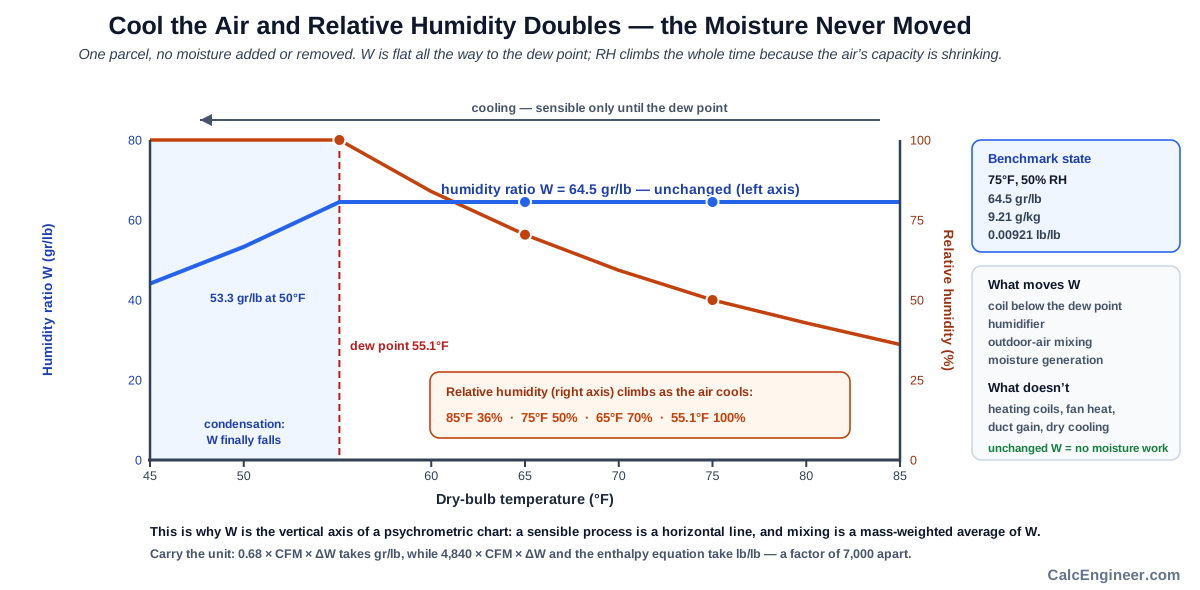
The principle is simple enough to state in one line. In a sensible process the temperature changes and the moisture mass does not. Since W is the vapor mass divided by the dry air mass and neither mass changed, W is unchanged. Relative humidity changes, because the saturation capacity moved underneath it.
Worked through one parcel of air:
| State | Humidity ratio | Relative humidity |
|---|---|---|
| 75°F (24°C), the starting air | 64.5 gr/lb (9.21 g/kg) | 50% |
| Cooled to 65°F (18°C), no condensation | 64.5 gr/lb, unchanged | about 70% |
| Cooled to 55°F (13°C), its dew point | 64.5 gr/lb, still unchanged | 100% |
| Cooled below 55°F (13°C) | Falls, as condensation begins | Saturated |
The same behaviour read off a psychrometric chart:
| Process | Path on the chart |
|---|---|
| Sensible heating or cooling | A horizontal line, moving left or right at constant W |
| Dehumidification | Drops down and to the left |
| Humidification | Rises at roughly constant dry-bulb |
| Mixing two airstreams | Lands on the straight line between the two states |
This matters for calculations because heating coils, sensible-only cooling, duct heat gain, and fan heat all leave W alone. Only coils operating below the dew point, humidifiers, outdoor air mixing, and moisture-generating processes move it. An unchanged W across a device is a check that the device did no moisture work.
Mixing is a mass-weighted average of the two humidity ratios:
Mixed W = (W₁ × ṁ₁ + W₂ × ṁ₂)/(ṁ₁ + ṁ₂)
That works only because W is referenced to dry air, whose mass is conserved in the mix.
Per ASHRAE Handbook Fundamentals, the humidity ratio is unchanged by any sensible heating or cooling process, changing only when moisture is added or removed. This constancy makes it the vertical axis of the psychrometric chart and the correct variable for mixing and load calculations.
Dew Point Is the Temperature Where This Moisture Saturates
The dew point that comes out of the calculation is the same moisture information expressed as a temperature, and it is the number that decides where condensation will form.
The derivation:
P_v from W:
Metric:   P_v = (W/1000) × P_atm/(0.621945 + W/1000)   [kPa]
Imperial: P_v = (W/7000) × P_atm/(0.621945 + W/7000)   [psi]

T_dp from P_v (inverting Magnus):
α = ln(P_v/0.61078) metric, or ln(P_v/0.08855) imperial
T_dp = 243.04 × α/(17.625 − α)   [°C]
Worked, the fourth step of the Imperial example:
P_v 0.2146 psi (1.480 kPa):
α = ln(0.2146/0.08855) = ln(2.423) = 0.886
T_dp = 243.04 × 0.886/(17.625 − 0.886) = 215.3/16.739 = 12.86°C = 55.1°F
What that number tells you is where water will appear. Any surface colder than 55.1°F (12.9°C) in this air will collect condensation, and chilled water piping, supply diffusers, cold window glass, and uninsulated ductwork are the usual candidates.
The design consequences follow directly. Insulation thickness on chilled surfaces is chosen so the outer surface stays above the dew point. Supply air temperature is often limited by diffuser condensation risk in humid spaces. Data centers hold a dew point band to avoid both condensation and static discharge.
Dew point also works as a climate descriptor. Because it tracks absolute moisture, weather data uses it to describe humidity in a way that does not swing with the daily temperature cycle, which makes a design dew point a more useful outdoor input than a design relative humidity.
Per ASHRAE Handbook Fundamentals, the dew point is the temperature at which the air's humidity ratio equals the saturation humidity ratio, obtained by inverting the saturation pressure relation. Surfaces below it collect condensation, which sets insulation and supply temperature decisions.
Degree of Saturation Is Close to Relative Humidity but Not Equal
The calculator reports a degree of saturation alongside relative humidity, and the two sit within a couple of percent of each other at comfort conditions while measuring subtly different things.
The two definitions:
Degree of saturation: μ = W / W_sat(T_db) × 100    [a mass-ratio comparison]
Relative humidity:    RH = P_v / P_sat(T_db) × 100 [a pressure comparison]
They differ because W depends on vapor pressure through P_v/(P_atm − P_v), which is not linear in P_v. Taking a ratio of two humidity ratios therefore does not reproduce the ratio of the two pressures behind them. The gap comes entirely from the (P_atm − P_v) denominator moving between the two states.
Worked, steps five and six of the Imperial example:
W 64.5 gr/lb (9.21 g/kg)
W_sat at 75°F (23.89°C) = 4,350 × 0.4291/(14.696 − 0.4291)
                        = 1,866.6/14.267 = 130.8 gr/lb (18.7 g/kg)
μ = 64.5/130.8 × 100 = 49.3%
Against the entered RH of 50.0%, that is a gap of 0.7 percentage points.
The gap stays below about 2% at normal HVAC conditions. It grows with moisture content, exceeding 5% above roughly 100 g/kg (700 gr/lb), which is territory for industrial drying rather than building HVAC.
Which quantity to reach for depends on the question:
| Quantity | What it is for |
|---|---|
| Relative humidity | Comfort criteria, control setpoints, and material specifications |
| Degree of saturation | Rarely used in design work directly; a chart-construction quantity |
| Humidity ratio | Anything involving mass or energy |
The practical reading is that when the calculator's μ and RH disagree by a fraction of a percent, that is the expected nonlinearity, not an error in either number.
Per ASHRAE Handbook Fundamentals, degree of saturation compares humidity ratios while relative humidity compares vapor pressures, so the two differ slightly because humidity ratio is not linear in vapor pressure. At normal HVAC conditions the gap stays under about 2%.
Altitude Raises Humidity Ratio at the Same Temperature and Relative Humidity
The calculation assumes standard sea-level pressure, and because atmospheric pressure sits in the denominator, thinner air at elevation carries a higher humidity ratio for the same temperature and relative humidity.
The mechanism sits in one term of the defining equation:
W = 0.621945 × P_v/(P_atm − P_v)
Saturation pressure depends only on temperature, so P_v at a given relative humidity is unchanged by elevation. Atmospheric pressure, on the other hand, falls with elevation, shrinking the denominator and raising W.
Pressure with elevation:
| Elevation | Atmospheric pressure |
|---|---|
| Sea level | 14.696 psi (101.325 kPa) |
| 2,500 ft (762 m) | about 13.4 psi (92.4 kPa) |
| 5,000 ft (1,524 m) | about 12.23 psi (84.3 kPa) |
| 7,500 ft (2,286 m) | about 11.1 psi (76.6 kPa) |
The magnitude at 5,000 ft (1,524 m):
Same 75°F (24°C) and 50% RH, P_v stays 0.2146 psi (1.480 kPa).
W = 4,350 × 0.2146/(12.23 − 0.2146) = 933.5/12.015 = 77.7 gr/lb (11.1 g/kg)
Against 64.5 gr/lb (9.21 g/kg) at sea level: about 20% higher.
There is a counterpoint to this on the latent-load side. Elevation raises the humidity ratio for the same conditions, and it also lowers air density, which reduces the mass of dry air passing a coil per unit volume. The Latent Heat Load article covered that density side, where the Imperial constant falls from 4,840 toward 4,033 at 5,000 ft (1,524 m). The two effects act on different terms, and both belong in a mountain-site calculation.
Below about 2,000 ft (600 m), the correction is within normal design tolerance. Above that, correct the atmospheric pressure before using W for load work.
This calculator fixes P_atm at standard pressure. High-altitude work needs the pressure-corrected form, computed separately or with a psychrometric tool that accepts barometric pressure as an input.
Per ASHRAE Handbook Fundamentals, atmospheric pressure appears in the humidity ratio denominator, so at 5,000 ft (1,524 m) the same temperature and relative humidity give a humidity ratio about 20% higher than at sea level. Correct barometric pressure above roughly 2,000 ft (600 m).
The Grains Trap: gr/lb Against lb/lb in Load Formulas
The single largest arithmetic error in latent-load work comes from feeding the wrong scaling of the humidity ratio into a formula, because the two Imperial conventions differ by a factor of seven thousand.
The two constants and their required units:
Q_latent = 0.68 × CFM × ΔW    requires ΔW in gr/lb
Q_latent = 4,840 × CFM × ΔW   requires ΔW in lb/lb (dimensionless)
The two constants are related by exactly that factor:
4,840/7,000 = 0.691
which rounds to 0.68 once the coil-temperature latent heat is folded in. The two forms are the same equation, scaled by the 7,000 grains in a pound.
The error is symmetric and large. Using ΔW in lb/lb with the 0.68 constant understates the load by 7,000 times, and using ΔW in gr/lb with the 4,840 constant overstates it by 7,000 times. Either mistake produces an obviously absurd number, which is the saving grace.
A worked check:
ΔW of 0.0035 lb/lb is 24.5 gr/lb.
0.68 × 1,200 CFM (0.566 m³/s) × 24.5 = 19,992 BTU/hr (5.86 kW)
4,840 × 1,200 × 0.0035 = 20,328 BTU/hr (5.96 kW)
Both land near 20,000 BTU/hr (5.9 kW), confirming the pairing is right.
The enthalpy convention runs the same trap. The ASHRAE enthalpy formulation also takes W dimensionless:
h = 0.240 T + W(1,061 + 0.444 T)
Feeding gr/lb into that expression inflates the latent term catastrophically.
The habit that prevents all of this is carrying the unit with the number in every intermediate step. The magnitude itself identifies the convention:
| Humidity ratio near | Convention it must be |
|---|---|
| 65 | Grains per pound |
| 0.009 | Dimensionless |
| 9 | Grams per kilogram |
Per ASHRAE Handbook Fundamentals and standard HVAC practice, the 0.68 latent constant takes the humidity ratio in grains per pound while the 4,840 form and the enthalpy equation take it dimensionless. Mismatching them produces errors of 7,000 times.
Worked Example: 75 Degrees at 50 Percent to 64.5 Grains per Pound
An office space sits at design indoor conditions at sea level, dry-bulb 75°F (23.9°C) and relative humidity 50%. The question is the full moisture state of that air.
Step 1. Saturation vapor pressure at the dry-bulb.
Tc = (75 − 32)/1.8 = 23.89°C
P_sat = 0.08855 × exp(17.625 × 23.89/(243.04 + 23.89))
      = 0.08855 × exp(1.578) = 0.08855 × 4.846 = 0.4291 psi (2.959 kPa)
Step 2. Actual vapor pressure.
P_v = 0.50 × 0.4291 = 0.2146 psi (1.480 kPa)
Step 3. Humidity ratio.
W = 4,350 × 0.2146/(14.696 − 0.2146) = 933.5/14.481 = 64.5 gr/lb (9.21 g/kg)
Dimensionless: 64.5/7,000 = 0.00921 lb/lb
Step 4. Dew point.
α = ln(0.2146/0.08855) = ln(2.423) = 0.886
T_dp = 243.04 × 0.886/(17.625 − 0.886) = 215.3/16.739 = 12.86°C = 55.1°F
Step 5. Saturation humidity ratio at the dry-bulb.
W_sat = 4,350 × 0.4291/(14.696 − 0.4291) = 1,866.6/14.267 = 130.8 gr/lb (18.7 g/kg)
Step 6. Degree of saturation.
μ = 64.5/130.8 × 100 = 49.3%
Against the entered 50% relative humidity, that is the expected sub-percent gap.
Step 7. Sanity check against the benchmark.
Air at 75°F (24°C) and 50% RH is the standard comfort reference, and roughly 65 gr/lb (9.3 g/kg) is the value worth remembering for quick field checks. The 64.5 gr/lb result matches it.
Step 8. Condensation check.
Any surface below 55.1°F (12.9°C) collects moisture in this air. Chilled water at 45°F (7°C) therefore needs insulation whose outer surface stays above 55.1°F (12.9°C).
Step 9. Comfort envelope check.
ASHRAE Standard 55 puts the upper humidity limit near 84 gr/lb (12 g/kg). At 64.5 gr/lb (9.21 g/kg) this air sits comfortably inside the envelope.
Step 10. Using it downstream.
As entering air to a coil leaving at 0.0095 lb/lb (66.5 gr/lb, 9.5 g/kg), this state gives ΔW = 0.00921 − 0.0095, a negative value, meaning the coil does no dehumidification here. Entering conditions for real dehumidification come from mixed air carrying outdoor moisture, typically 0.011 to 0.016 lb/lb (77 to 112 gr/lb, 11 to 16 g/kg), well above this room state.
The state is fully described: W 64.5 gr/lb (0.00921 lb/lb, 9.21 g/kg), dew point 55.1°F (12.9°C), vapor pressure 0.2146 psi (1.480 kPa), saturation 130.8 gr/lb (18.7 g/kg), degree of saturation 49.3%. The Latent Heat Load Calculator takes the humidity ratio difference between two such states, the Dew Point Temperature Calculator isolates the condensation temperature, and the Enthalpy Calculator adds the energy content of the same state.
Metric Worked Example and the Comfort Envelope
Step 1. The inputs.
Dry-bulb 24°C (75.2°F), relative humidity 50%, standard pressure 101.325 kPa (14.696 psi).
Step 2. Saturation vapor pressure.
P_sat = 0.61078 × exp(17.625 × 24/(243.04 + 24))
      = 0.61078 × exp(1.584) = 0.61078 × 4.874 = 2.978 kPa (0.4319 psi)
Step 3. Vapor pressure.
P_v = 0.50 × 2.978 = 1.489 kPa (0.2160 psi)
Step 4. Humidity ratio.
W = 621.945 × 1.489/(101.325 − 1.489) = 926.1/99.84 = 9.28 g/kg (65.0 gr/lb)
Dimensionless: 9.28/1,000 = 0.00928 kg/kg
Step 5. Dew point.
α = ln(1.489/0.61078) = ln(2.438) = 0.891
T_dp = 243.04 × 0.891/(17.625 − 0.891) = 216.55/16.734 = 12.94°C (55.3°F)
Step 6. Saturation humidity ratio and degree of saturation.
W_sat = 621.945 × 2.978/(101.325 − 2.978) = 1,852.2/98.35 = 18.83 g/kg (131.8 gr/lb)
μ = 9.28/18.83 × 100 = 49.3%
Step 7. Comparing the two examples.
The Imperial case at 75°F gives 64.5 gr/lb, while 24°C (75.2°F) gives 9.28 g/kg, which is 65.0 gr/lb. The 0.5 grain difference is the 0.2°F (0.1°C) difference between the two stated temperatures, nothing more. The degree of saturation is identical at 49.3% in both.
Step 8. The comfort envelope in metric terms.
| Envelope marker | Metric | Imperial |
|---|---|---|
| ASHRAE Standard 55 upper limit | about 12 g/kg (0.012 kg/kg) | 84 gr/lb |
| Dryness discomfort threshold | below about 4 g/kg (0.004 kg/kg) | 28 gr/lb |
| Typical comfortable band at 22 to 24°C (72 to 75°F) and 40 to 60% RH | 6.7 to 11.7 g/kg | 47 to 82 gr/lb |
| This state | 9.28 g/kg | 64.96 gr/lb |
The calculated state sits mid-envelope.
Step 9. What moves a space out of the envelope.
Humid outdoor air raises W toward and past 12 g/kg (84 gr/lb) without any temperature change at all. Winter heating without humidification drops W toward 2 g/kg (14 gr/lb), well under the dryness threshold. Neither movement is visible in a thermostat reading.
Step 10. Result.
Air at 24°C (75.2°F) and 50% RH gives W 9.28 g/kg (65.0 gr/lb, 0.00928 kg/kg), dew point 12.94°C (55.3°F), vapor pressure 1.489 kPa (0.2160 psi), saturation 18.83 g/kg (131.8 gr/lb), and degree of saturation 49.3%. That is mid-envelope for comfort, and a condensation risk on any surface below 12.94°C (55.3°F).
Per ASHRAE Standard 55-2023, the comfort envelope tops out near 12 g/kg (84 gr/lb), with dryness complaints below about 4 g/kg (28 gr/lb). The metric example at 9.28 g/kg sits mid-envelope, matching the Imperial case within the 0.2°F (0.1°C) temperature difference between them.
Application Boundaries: Pressure, Wet-Bulb Approximation, Extremes, Specific Humidity
The calculator covers moist-air property derivation at a single state and standard atmospheric pressure, the four input routes to the humidity ratio, the derived dew point, vapor pressure, saturation humidity ratio and degree of saturation, and psychrometric screening ahead of load and coil work. Several neighboring questions fall outside that scope.
Non-Standard Barometric Pressure. Pressure is fixed at 14.696 psi (101.325 kPa). Elevation above roughly 2,000 ft (600 m), pressurized enclosures, and vacuum processes need the pressure-corrected relation.
Wet-Bulb Approximation. The depression coefficient is a function of both temperatures, not a constant: c = 1.006/(2501 + 1.86 × T_db − 4.186 × T_wb). The familiar 1.58 gr/lb per °F (0.407 g/kg per °C) holds through the ordinary HVAC range and drifts at wide depressions and at the edges of the temperature range, where the full psychrometric equation is the one to use. Sub-freezing wet-bulb readings, taken over an iced wick, follow a different form of that equation. A measured dew point or relative humidity sidesteps the question.
Magnus Range. The saturation formula holds within about 0.4% from −40 to 50°C (−40 to 122°F). Cryogenic, industrial drying, and high-temperature process work call for the Hyland and Wexler or IAPWS formulations.
Specific Humidity. Humidity ratio divides by dry air; specific humidity divides by total moist air, q = W/(1 + W). The two differ by under 1% at HVAC moisture levels and diverge at high moisture. ASHRAE psychrometric formulas take the humidity ratio.
Contaminants and Hygroscopic Materials. Dissolved salts, solvents, and hygroscopic surfaces shift the effective vapor pressure. Industrial processes involving them need additional corrections.
Degree of Saturation Divergence. Above roughly 100 g/kg (700 gr/lb), degree of saturation and relative humidity differ by more than 5%, so the two cannot be used interchangeably in that range.
Time-Dependent Behavior. The output is a single state, not a process. Condensation progress, moisture buffering by materials, and transient response need a time-based analysis.
Load Calculations. The result is the property, not the load. Latent load, sensible load, and coil duty follow from humidity ratio differences and airflow, computed separately.
Instrument Accuracy. Results inherit the accuracy of the entered temperature and moisture reading. A wet-bulb reading taken without adequate air movement over the wick, or a hygrometer out of calibration, propagates directly into W.
Per ASHRAE Handbook Fundamentals, single-state property derivation at standard pressure is the calculator's scope. Barometric correction, wet-bulb approximation limits, the Magnus range, the specific-humidity distinction, contaminant effects, high-moisture divergence, transient behavior, and load calculation require separate treatment. A qualified engineer completes the design.
Humidity Ratio Calculator
Humidity ratio from a dry-bulb temperature plus one moisture property: computes saturation vapor pressure by the Magnus approximation, converts the entered relative humidity, wet-bulb, or dew point into an actual vapor pressure, and returns the moisture mass per unit mass of dry air in grains per pound or grams per kilogram. Dew point, partial vapor pressure, saturation humidity ratio, and degree of saturation come with it. Standard atmospheric pressure is assumed, so correct barometric pressure above roughly 2,000 feet (600 m). A single-state property derivation per ASHRAE psychrometrics.
Open Humidity Ratio CalculatorStandards and References
- ASHRAE Handbook, Fundamentals (2021), Chapter 1, Psychrometrics. Humidity ratio definition, moist-air property relations, saturation humidity ratio, degree of saturation, and the molecular mass ratio behind the unit constants.
- ASHRAE Handbook, Fundamentals (2021), Nonresidential Cooling and Heating Load Calculations chapter. Humidity ratio as the moisture variable in latent load work and the standard air constants that consume it.
- ASHRAE Standard 55-2023, Thermal Environmental Conditions for Human Occupancy. Upper humidity limit near 0.012 kg/kg (12 g/kg, 84 gr/lb) for occupant comfort.
- ASHRAE Standard 62.1-2022, Ventilation for Acceptable Indoor Air Quality. Outdoor air rates by occupancy, the airstream whose humidity ratio drives the ventilation latent load.
- ASHRAE Handbook, HVAC Systems and Equipment (2020), Chapter 23, Dehumidifiers and Dehumidification. Equipment sizing on the humidity ratio difference across a coil or desiccant stage.
- Alduchov and Eskridge (1996), Improved Magnus Form Approximation of Saturation Vapor Pressure, Journal of Applied Meteorology 35(4). The saturation relation used here, accurate within about 0.4% from −40 to 50°C (−40 to 122°F).
- Hyland and Wexler (1983), Formulations for the Thermodynamic Properties of the Saturated Phases of H₂O from 173.15 K to 473.15 K, ASHRAE Transactions 89(2A). The higher-precision reference formulation for conditions outside the Magnus range.
- IAPWS-IF97 (1997, revised 2007), Industrial Formulation for the Thermodynamic Properties of Water and Steam. The reference standard for water and steam property calculation.
- NIST Chemistry WebBook, water vapor pressure data. Independent check values for saturation pressure across the HVAC temperature range.
- Standard psychrometric constants. Molecular mass ratio 18.015/28.966 = 0.621945, 7,000 grains per pound (15,432 grains per kilogram), and standard atmospheric pressure 14.696 psi (101.325 kPa).
FAQ
What is humidity ratio?
Per ASHRAE Handbook Fundamentals: the mass of water vapor carried per unit mass of dry air, expressed in grains per pound, grams per kilogram, or dimensionlessly. At 75°F (24°C) and 50% relative humidity it is about 64.5 gr/lb (9.21 g/kg, 0.00921 lb/lb), the standard comfort benchmark.
Why use humidity ratio instead of relative humidity for load calculations?
Per ASHRAE Fundamentals: because relative humidity changes with temperature even when no moisture moves, while humidity ratio does not. Cooling 75°F (24°C) air at 50% relative humidity down to 55°F (13°C) drives the relative humidity to 100% with the humidity ratio unchanged at 64.5 gr/lb (9.21 g/kg). Loads depend on moisture mass.
How do you convert grains per pound to grams per kilogram?
Per the unit definitions: divide by 7, since 7,000 grains make a pound and 1,000 grams make a kilogram, and both are mass ratios so the pound-to-kilogram factor cancels. 65 gr/lb is 9.3 g/kg; 84 gr/lb is 12 g/kg.
Which input gives the most accurate humidity ratio?
Per ASHRAE Fundamentals: a measured dew point, because the humidity ratio equals the saturation value at that temperature in one step with no depression correction at all. Wet bulb requires the psychrometric equation, whose depression coefficient shifts with both temperatures, and relative humidity depends on hygrometer calibration.
What is degree of saturation and how does it differ from relative humidity?
Per ASHRAE Fundamentals: degree of saturation compares humidity ratios (W/W_sat) while relative humidity compares vapor pressures. Because humidity ratio is not linear in vapor pressure, the two differ slightly, under about 2% at normal HVAC conditions and more above roughly 100 g/kg (700 gr/lb).
How does altitude change the humidity ratio?
Per ASHRAE Fundamentals: atmospheric pressure sits in the denominator, so lower pressure raises the humidity ratio. At 5,000 ft (1,524 m) the same 75°F (24°C) and 50% relative humidity give about 77.7 gr/lb (11.1 g/kg) against 64.5 gr/lb (9.21 g/kg) at sea level, roughly 20% higher. Correct barometric pressure above about 2,000 ft (600 m).
What humidity ratio is comfortable indoors?
Per ASHRAE Standard 55-2023: the upper limit sits near 12 g/kg (84 gr/lb, 0.012 kg/kg). Below about 4 g/kg (28 gr/lb) dryness complaints become common. Typical comfortable conditions at 72 to 75°F (22 to 24°C) and 40 to 60% relative humidity fall between 47 and 82 gr/lb (6.7 to 11.7 g/kg).
Related Calculators
- Latent Heat Load Calculator: Takes the difference between two humidity ratios and turns it into a moisture load and condensate rate (article).
- Sensible Heat Ratio Calculator: The load split that the latent side feeds, deciding equipment selection (article).
- Dew Point Temperature Calculator: The condensation temperature this state implies, isolated as its own calculation.
- Wet Bulb Temperature Calculator: The evaporative measure behind one of the four input routes.
- Psychrometric Calculator: Full air-state analysis across all moist-air properties at once.
- Enthalpy Calculator: The energy content of the same air state, where humidity ratio enters dimensionless.
- Specific Volume Air Calculator: Air density and volume per unit mass, needed to convert airflow to mass flow.
- Ventilation Rate Calculator: Outdoor air quantity per ASHRAE Standard 62.1, the airstream that carries outdoor moisture.