What a Wet Bulb Thermometer Is Actually Measuring
A wet bulb thermometer does not measure a property of the air directly; it measures the temperature at which two competing energy flows balance, and that balance point happens to encode exactly how much more water the air is willing to absorb.
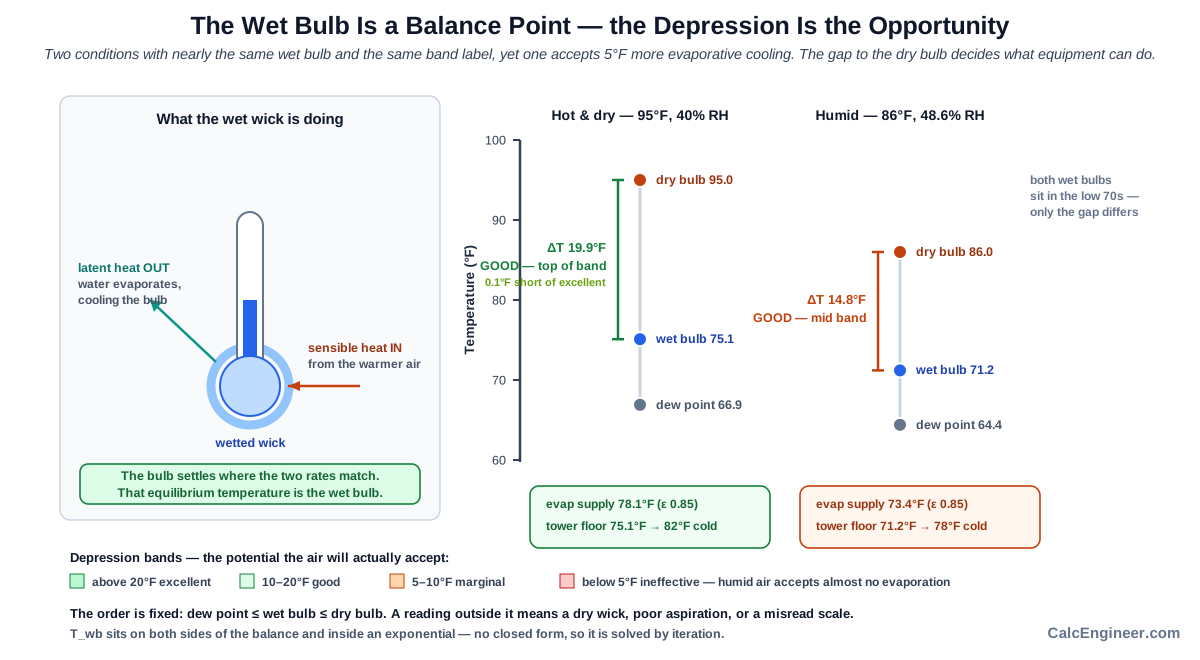
Wrap a thermometer bulb in a wet wick and move air across it. Water evaporates from the wick, and evaporation costs latent heat, which the water takes from the bulb, cooling it. As the bulb cools below the surrounding air, sensible heat flows back into it from that warmer air. The bulb settles where those two rates match: latent heat leaving through evaporation equals sensible heat arriving by convection. That equilibrium temperature is the wet bulb. Dry air pulls water away quickly and drives the bulb far down; nearly saturated air accepts almost no evaporation and leaves the bulb near the ambient temperature.
The calculator derives that equilibrium from a dry-bulb temperature and one moisture property, relative humidity, dew point, or humidity ratio, by solving the ASHRAE adiabatic saturation energy balance. Because the unknown appears on both sides of that equation, the solution is iterative rather than algebraic. Alongside the wet bulb it returns the depression, the moisture properties, and the enthalpy. The Humidity Ratio article covered the absolute moisture measure and listed the wet bulb as one of four ways to reach it; this article covers the wet bulb itself, the quantity that governs cooling tower capacity, evaporative cooler performance, and outdoor heat stress. ASHRAE Handbook Fundamentals treats the thermodynamic wet bulb as one of the three fundamental psychrometric temperatures, alongside dry bulb and dew point.
Calculator Inputs: Dry-Bulb Plus One of Three Moisture Properties
The calculator takes one temperature and one moisture property, then returns the wet bulb together with the full derived psychrometric state.
Unit System. Imperial (°F, gr/lb, psi, BTU/lb) or Metric (°C, g/kg, kPa, kJ/kg). Both assume standard atmospheric pressure.
Input Combination. Three routes: dry-bulb with relative humidity, dry-bulb with dew point temperature, or dry-bulb with humidity ratio.
Dry-Bulb Temperature [°F or °C]. The ordinary air temperature from a shielded thermometer. Design range for HVAC work runs roughly −40 to 150°F (−40 to 65°C).
Relative Humidity [%]. 0 to 100, from a hygrometer or weather data.
Dew Point Temperature [°F or °C]. From a chilled-mirror instrument or a stated design dew point. Always at or below the dry-bulb.
Humidity Ratio [gr/lb or g/kg]. Used when the absolute moisture content is already known.
Outputs are Wet-Bulb Temperature (°F or °C), Wet-Bulb Depression ΔT (°F or °C), Relative Humidity (%), Humidity Ratio W (gr/lb or g/kg), Dew Point Temperature (°F or °C), Vapor Pressure (psi or kPa), and Specific Enthalpy (BTU/lb or kJ/kg), plus a classification of the depression against evaporative-cooling benchmarks.
The calculation chain, common to all three routes:
moisture property → P_v → W
(T_db, W) → iterative solution of the energy balance → T_wb
T_wb → depression, and the remaining properties follow
Why every route passes through the humidity ratio:
The energy balance is written in terms of moisture content, not relative humidity.
Whichever property is entered, it first converts to W, and the solver works from there.
Convergence:
Newton-Raphson iteration, stopping when the step falls below 0.001°C (0.002°F),
which is far tighter than any field measurement.
The calculator does not account for non-standard barometric pressure as an input, the natural (unaspirated) wet bulb used in WBGT, instrument-specific heat and mass transfer corrections such as the Sprung equation, radiant heat gain to the sensor, temperatures outside the Magnus range at full accuracy, the transient response of a real wick, or air velocity effects on the measurement. It performs single-state thermodynamic property derivation.
The Energy Balance That Sets the Equilibrium
The defining equation comes from an adiabatic saturation process, an idealized channel where air is brought to saturation using only the energy already in the airstream, and the temperature it settles at is the thermodynamic wet bulb.
The physical statement:
Latent heat carried away by evaporating water = sensible heat delivered by the air
The ASHRAE form (SI, W in g/kg, temperatures in °C):
W = [(2501 − 2.381 × T_wb) × W_sat(T_wb) − 1.006 × (T_db − T_wb)]
    / (2501 + 1.805 × T_db − 4.186 × T_wb)
The ASHRAE form (IP, W in gr/lb, temperatures in °F):
W = [(1093 − 0.556 × T_wb) × W_sat(T_wb) − 0.240 × (T_db − T_wb)]
    / (1093 + 0.444 × T_db − T_wb)
What each coefficient is:
2501 kJ/kg (1093 BTU/lb): latent heat of vaporization at the reference temperature
1.006 kJ/kg·K (0.240 BTU/lb·°F): specific heat of dry air
4.186 kJ/kg·K (1.0 BTU/lb·°F): specific heat of liquid water
1.805 kJ/kg·K (0.444 BTU/lb·°F): specific heat of water vapor
2.381 = 4.186 − 1.805 (0.556 = 1.0 − 0.444): the difference appearing in the numerator
Published variants exist. ASHRAE Fundamentals states the vapor specific heat as 1.86 kJ/kg·K, which gives 2.326 in place of 2.381, and the Imperial 0.444 BTU/lb·°F converts to 1.859 kJ/kg·K rather than 1.805. Each pair is internally consistent, and the difference changes a computed wet bulb by well under a tenth of a percent, because the affected terms are small against the 2501 kJ/kg (1093 BTU/lb) latent heat that dominates both numerator and denominator.
Where the terms come from:
Numerator: the energy released by condensing the added moisture, less the sensible cooling of the air
Denominator: the enthalpy change per unit of moisture added, evaluated between the two temperatures
Adiabatic saturation against a real wick:
The equation describes an idealized adiabatic saturator, not a thermometer.
A real aspirated wet bulb approaches that value closely, within a few tenths of a degree,
because the heat and mass transfer coefficients for air and water vapor happen to be similar.
That coincidence is what makes the sling psychrometer a practical instrument.
Per ASHRAE Handbook Fundamentals, Chapter 1: the thermodynamic wet bulb is defined by the adiabatic saturation energy balance, equating latent heat removal against sensible heat supply. A real aspirated wet bulb approximates it closely because the transfer coefficients for heat and moisture are nearly equal in air.
Why Wet Bulb Depends on Both Moisture and Temperature
The property that separates wet bulb from dew point is its dual dependence: dew point tracks moisture alone, while wet bulb responds to both moisture content and dry-bulb temperature, which is why one stays put through sensible heating and the other does not.
The contrast:
Dew point: a function of moisture content only. Heat the air without adding moisture and it does not move.
Wet bulb: a function of moisture content and dry-bulb temperature. Heat the air and it rises,
          though less than the dry-bulb does.
Why wet bulb rises with heating:
Warmer air delivers more sensible heat to the wick, so the equilibrium shifts upward.
It rises less than the dry-bulb because the added heat also drives more evaporation,
part of which is spent as latent rather than sensible.
Worked illustration:
Air at 95°F (35°C) and 40% RH has a wet bulb of 75.1°F (23.9°C).
Heat it to 105°F (41°C) with no moisture change: the humidity ratio stays 98.6 gr/lb (14.1 g/kg),
the dew point stays 66.9°F (19.4°C), the relative humidity falls to about 29%,
and the wet bulb rises to roughly 78°F (26°C), a fraction of the 10°F (5.6°C) dry-bulb rise.
The practical consequence:
On a psychrometric chart, constant-wet-bulb lines run diagonally, sloping down to the right,
close to but not identical with constant-enthalpy lines.
A sensible heating process crosses them, which is why a wet bulb reading taken
downstream of a heating coil differs from the same air upstream.
Why the near-coincidence with enthalpy matters:
Because constant wet bulb tracks constant enthalpy closely, the entering wet bulb
serves as a proxy for the total heat content of air entering a cooling coil,
which is why coil ratings are published against entering wet bulb rather than relative humidity.
Per ASHRAE Handbook Fundamentals: dew point depends only on moisture content while wet bulb depends on both moisture and dry-bulb temperature, rising with sensible heating though less steeply than the dry-bulb. Constant wet bulb lines track constant enthalpy closely, which is why coil ratings use entering wet bulb.
The Three Temperatures and Their Fixed Order
Dew point, wet bulb, and dry bulb always fall in that order, and the spacing between them is a direct readout of how far the air sits from saturation.
The ordering:
T_dp ≤ T_wb ≤ T_db, always
At the two limits:
Saturated air (100% RH): all three converge to one value, and the depression is zero.
Perfectly dry air (0% RH): the spread is at its maximum for that dry-bulb temperature.
Worked from the Imperial example:
T_db 95.0°F (35.0°C)
T_wb 75.1°F (23.9°C)
T_dp 66.9°F (19.4°C)
Spread from dry-bulb to dew point: 28.1°F (15.6°C) at 40% RH
Why the order is fixed:
Wet bulb cannot fall below dew point, because evaporation cannot cool the wick past saturation.
Wet bulb cannot rise above dry bulb, because evaporation only ever removes heat.
Any calculated result violating the ordering signals an input error.
As a field check:
A sling psychrometer reading a wet bulb above the dry bulb means a dry or contaminated wick,
insufficient air movement, or a mis-read scale.
A wet bulb below the known dew point means one of the two readings is wrong.
Every calculator run returns all three temperatures, so the ordering is a built-in consistency check on whatever was entered. Per ASHRAE Handbook Fundamentals: the three psychrometric temperatures always order as dew point at or below wet bulb at or below dry bulb, converging at saturation. Any violation of that order indicates an input or measurement error.
The Implicit Equation and Why No Closed Form Exists
The wet bulb cannot be written as a formula because the unknown appears on both sides of its defining equation, once directly and once inside a saturation function that has no algebraic inverse.
Where the unknown appears:
W = [(2501 − 2.381 T_wb) × W_sat(T_wb) − 1.006 (T_db − T_wb)] / (2501 + 1.805 T_db − 4.186 T_wb)

T_wb appears: in the leading coefficient, inside W_sat(T_wb), in the sensible term, and in the denominator.
W_sat(T_wb) itself contains an exponential through the Magnus saturation pressure.
Why that blocks an algebraic solution:
Isolating T_wb would require inverting an expression that mixes it linearly and exponentially.
No elementary rearrangement separates the two, so the equation is transcendental.
What this means in practice:
Every psychrometric tool that reports a wet bulb either iterates on this equation
or reads from a chart or table that was itself produced by iteration.
Empirical alternatives and their cost:
Closed-form fits such as the Stull correlation or the Sprung equation trade accuracy for speed,
typically within a few tenths of a degree over a limited range of conditions.
They are convenient for spreadsheets and weather work, and they approximate
the thermodynamic value rather than defining it.
Why the distinction matters for equipment:
Cooling tower and coil ratings are referenced to the thermodynamic wet bulb.
Sizing against a correlation that drifts a degree in humid conditions
propagates directly into tower approach and coil capacity.
The calculator solves the defining equation itself rather than fitting it, so the returned value is the reference quantity that equipment ratings assume. Per ASHRAE Handbook Fundamentals: the wet bulb equation is implicit and transcendental, with the unknown appearing both linearly and inside an exponential saturation term, so no closed-form solution exists. Empirical correlations approximate it within a few tenths of a degree over limited ranges.
Newton-Raphson: How the Solver Converges
The practical solution rearranges the balance into a residual that should equal zero, then walks toward the root using the local slope, which converges in a handful of steps because the function is smooth and monotonic in the region of interest.
The residual form (Imperial, W in gr/lb):
f(T_wb) = (1093 − 0.556 T_wb) × W_sat(T_wb)
          − 1680 × (T_db − T_wb)
          − W × (1093 + 0.444 T_db − T_wb)
The residual form (Metric, W in g/kg):
f(T_wb) = (2501 − 2.381 T_wb) × W_sat(T_wb)
          − 1006 × (T_db − T_wb)
          − W × (2501 + 1.805 T_db − 4.186 T_wb)
Why the scaled constants appear:
1,680 = 0.240 BTU/lb·°F × 7,000 gr/lb, matching a residual written in gr/lb
1,006 = 1.006 kJ/kg·°C × 1,000 g/kg, matching a residual written in g/kg
Both keep every term on the same unit basis, which is what makes the residual meaningful.
The two scaled constants do not convert into one another: 1,006 × 7/1.8 gives 3,912, not 1,680. The check belongs one level down, at the specific heats they are built from, where 0.240 BTU/lb·°F and 1.006 kJ/kg·°C are the same quantity in different units. The factor of 7,000 against 1,000 is what separates the scaled forms.
The iteration:
T_wb[n+1] = T_wb[n] − f(T_wb[n]) / f'(T_wb[n])
Convergence behavior:
A midpoint between dry bulb and dew point is a reliable starting guess.
The residual is steep and single-signed across the physical range, so the method
converges in roughly five iterations to better than 0.001°C (0.002°F).
Reading a residual as a sanity check:
A positive residual means the trial wet bulb is too high, and the next step moves down.
Watching the magnitude fall by an order of magnitude per step is the signature of the method working.
Precision against measurement:
Convergence to 0.001°C (0.002°F) sits three hundred times tighter than field wet bulb accuracy,
which is typically ±0.5°F (±0.3°C). The numerical precision is never the limiting factor.
Per numerical practice and the calculator's implementation: the balance is recast as a residual and solved by Newton-Raphson with a numerical derivative, converging in about five iterations to within 0.001°C (0.002°F). The scaled constants 1,680 and 1,006 keep the residual dimensionally consistent with humidity ratios expressed in grains per pound and grams per kilogram.
Wet Bulb Depression as a Measure of Evaporative Potential
The depression, the gap between dry bulb and wet bulb, answers a question the wet bulb alone cannot: how much evaporative cooling the air will actually accept.
The definition:
ΔT = T_db − T_wb [°F or °C]
Interpretation bands:
| Depression | Evaporative cooling potential |
|---|---|
| Above 20°F (11°C) | Excellent, favorable for evaporative equipment |
| 10 to 20°F (6 to 11°C) | Good, worthwhile in many climates |
| 5 to 10°F (3 to 6°C) | Marginal, limited benefit |
| Below 5°F (3°C) | Ineffective, humid air accepts little evaporation |
A wet bulb of 75°F (23.9°C) means one thing in Phoenix and another in Miami — the value alone does not say whether evaporative cooling will work. In dry air it sits far below a high dry-bulb, leaving a wide gap to exploit. In humid air it sits just below a moderate dry-bulb, leaving nothing. The gap, not the value, describes the opportunity.
Worked from the two examples:
95°F dry bulb, 75.1°F wet bulb: depression 19.9°F (11.1°C)
  At the top of the range, exactly the condition evaporative cooling was invented for.
30°C dry bulb, 21.7°C wet bulb: depression 8.3°C (14.9°F)
  Moderate, workable for evaporative pre-cooling but not for primary cooling.
The climate pattern:
Arid and high-desert climates produce large depressions through most of the cooling season.
Coastal and subtropical climates produce small ones, particularly at night
when the dry bulb falls toward the dew point and the gap collapses.
The design caution:
Depression varies through the day and the season, and the design condition
is the one that occurs when the load peaks, not the annual average.
Per ASHRAE practice: the wet bulb depression is the direct measure of evaporative cooling potential, with depressions above 20°F (11°C) favorable and those below 5°F (3°C) leaving evaporative equipment ineffective. The gap, not the wet bulb value, describes the opportunity.
The Cooling Tower Limit and the Approach That Follows
A cooling tower cannot produce water colder than the entering wet bulb no matter how large it is, which turns the wet bulb into a hard thermodynamic floor and makes the gap above it the tower's defining performance number.
The limit and the metric built on it:
T_cold_water > T_wb, always. The wet bulb is the theoretical floor, approached but never reached.
Approach = leaving cold water temperature − entering wet bulb temperature
Typical HVAC tower design: 5 to 10°F (3 to 6°C)
Why the limit exists:
A cooling tower rejects heat primarily by evaporating a small fraction of the circulating water.
That process is the same one the wet bulb thermometer performs.
The water can be driven toward the evaporative equilibrium but not past it.
The economics of approach:
A tighter approach demands disproportionately more tower: more fill, more airflow, more fan power.
Halving the approach roughly doubles the required tower size in the practical range.
Below about 5°F (3°C) the cost curve turns steeply upward.
Why dry bulb misleads here:
Sizing a tower against dry bulb rather than wet bulb oversizes it in humid climates,
where the two temperatures sit close together, and undersizes it in dry climates,
where a large depression makes the wet bulb far lower than the dry bulb suggests.
Worked illustration:
Entering wet bulb 78°F (25.6°C) with a 7°F (3.9°C) approach gives 85°F (29.4°C) cold water.
The same tower on a day when the wet bulb rises to 82°F (27.8°C) delivers 89°F (31.7°C),
because the floor moved even though nothing about the equipment changed.
Condenser water temperature drives chiller lift and therefore chiller efficiency, so a rising wet bulb propagates through the tower into plant energy use. A tower selection walked through at a specific design wet bulb, with the sensor and aspiration requirements that go with a commissioning-grade reading, is covered in the cooling tower and WBGT article.
Per CTI Standard STD-201 and ASHRAE Systems and Equipment: cooling tower capacity is bounded by the entering wet bulb, which cannot be undercut regardless of tower size. The approach, typically 5 to 10°F (3 to 6°C) for HVAC towers, is the primary selection metric, and tightening it below about 5°F (3°C) raises cost steeply.
Evaporative Cooler Effectiveness and the Achievable Supply Temperature
A direct evaporative cooler works by pushing air toward its own wet bulb, so the supply temperature it can deliver follows from the depression and a single effectiveness figure.
The relation:
T_supply = T_db − ε × (T_db − T_wb)

ε = saturation effectiveness, typically 0.70 to 0.90 for direct evaporative media
Worked from the Imperial example:
95°F (35.0°C) dry bulb, 75.1°F (23.9°C) wet bulb, depression 19.9°F (11.1°C)
At ε = 0.85: T_supply = 95 − 0.85 × 19.9 = 78.1°F (25.6°C)
At ε = 0.70: T_supply = 95 − 0.70 × 19.9 = 81.1°F (27.3°C)
What effectiveness represents:
How completely the air is brought to saturation as it passes the wetted media.
Deeper media, lower face velocity, and better water distribution raise it.
No practical cooler reaches 1.0, which would mean fully saturated leaving air.
The moisture trade:
Direct evaporative cooling adds moisture as it removes heat, moving along a line
of nearly constant wet bulb toward saturation.
The supply air is cooler and considerably more humid, which limits the approach
to spaces that tolerate elevated humidity or that exhaust continuously.
Indirect and two-stage systems:
Indirect evaporative cooling uses a heat exchanger so the conditioned airstream is cooled
without gaining moisture, at the cost of a smaller temperature drop.
Two-stage arrangements combine indirect and direct sections to reach lower supply temperatures
while limiting the moisture added.
The climate boundary:
The metric example, with an 8.3°C (14.9°F) depression, gives a supply of roughly 22.9°C (73.2°F)
at ε = 0.85, a useful pre-cool but not enough on its own for a summer design load.
Per ASHRAE Systems and Equipment: direct evaporative coolers deliver a supply temperature of the dry bulb less the effectiveness times the depression, with effectiveness typically 0.70 to 0.90. The process adds moisture, which limits it to tolerant applications or drives the use of indirect and two-stage arrangements.
Thermodynamic Wet Bulb Against the Natural Wet Bulb in Heat Stress Work
Occupational heat stress work uses a different wet bulb from the one psychrometrics defines, and conflating the two understates exposure because the natural wet bulb reads higher.
The two quantities:
Thermodynamic (psychrometric) wet bulb: measured with forced aspiration over the wick,
  or computed from the energy balance. The quantity this calculator returns.
Natural wet bulb: measured with a wetted sensor exposed to ambient air movement and radiation,
  without forced aspiration. The quantity WBGT uses.
The difference:
The natural wet bulb typically reads 1 to 3°F (0.5 to 1.7°C) higher,
because reduced air movement slows evaporation and solar or radiant gain warms the sensor.
Where each is used:
Thermodynamic: cooling towers, evaporative equipment, coil ratings, psychrometric analysis
Natural: the wet bulb globe temperature index for occupational and athletic heat safety
The WBGT composition:
Outdoors with solar load: WBGT = 0.7 × natural wet bulb + 0.2 × globe + 0.1 × dry bulb
Indoors or without solar load: WBGT = 0.7 × natural wet bulb + 0.3 × globe
The natural wet bulb dominates either way, carrying seventy percent of the weight.
Why the wet bulb dominates heat stress:
The body sheds metabolic heat mainly by evaporating sweat, and the wet bulb
is precisely the limit of what evaporation can achieve.
As it climbs, the margin for physiological cooling narrows regardless of air temperature.
The survivability threshold:
A sustained wet bulb near 95°F (35°C) marks the theoretical limit of human tolerance,
because at that point skin at its normal temperature can no longer shed heat by evaporation.
The figure is a physiological limit rather than a design condition, and real incapacitation
occurs well below it.
Do not substitute a computed psychrometric wet bulb into a WBGT assessment; use the instrument the standard specifies. Per ISO 7243 and NIOSH heat stress criteria: WBGT uses the natural wet bulb, measured without forced aspiration, which reads 1 to 3°F (0.5 to 1.7°C) higher than the thermodynamic wet bulb this calculation returns. The natural wet bulb carries seventy percent of the WBGT weighting.
Design Wet Bulb: The 0.4 Percent Exceedance Basis
Equipment is not sized against the worst wet bulb ever recorded but against a statistical exceedance value, and knowing which percentile a design uses tells you how many hours a year it is expected to fall short.
The exceedance levels:
0.4% annual: exceeded roughly 35 hours per year, the common basis for critical cooling
1.0% annual: exceeded roughly 88 hours per year, common for standard commercial work
2.0% annual: exceeded roughly 175 hours per year, used where brief shortfalls are tolerable
What the percentile means:
An 0.4% design wet bulb is met or bettered for 99.6% of annual hours.
Equipment sized to it meets load in all but about a day and a half of accumulated time,
spread across the hottest, most humid hours of the year.
Coincident against independent values:
Climate tables publish design dry bulb with mean coincident wet bulb, and design wet bulb
with mean coincident dry bulb.
Cooling towers and evaporative equipment size against the wet bulb series;
air-side sensible equipment sizes against the dry bulb series.
Using the wrong pairing mismatches the equipment to the condition that actually stresses it.
Why wet bulb peaks differ from dry bulb peaks:
The hottest hour of the year is often not the most humid.
A moderate dry bulb with a high dew point can produce a higher wet bulb
than a hot, dry afternoon, which is why the two design series exist separately.
A tower sized to the 1% wet bulb will see its approach widen during the roughly 88 hours a year the condition is exceeded, raising condenser water temperature and chiller energy at exactly the time the load is highest — the shortfall arrives when it is least welcome. Per ASHRAE Climatic Design Conditions: design wet bulb values are published at 0.4%, 1%, and 2% annual exceedance, corresponding to roughly 35, 88, and 175 hours per year. Wet bulb and dry bulb design series peak at different hours, so each carries its own mean coincident partner.
Altitude Lowers Wet Bulb at the Same Moisture Content
Lower atmospheric pressure at elevation makes evaporation easier, which drives the wet bulb down for the same moisture content and improves evaporative cooling prospects in exactly the dry mountain climates where it is already attractive.
The mechanism:
Evaporation proceeds against the total pressure of the surrounding air.
At lower pressure, water molecules escape the wick more readily for the same vapor pressure,
so the evaporative cooling is stronger and the equilibrium settles lower.
Pressure with elevation:
Sea level:          14.696 psi (101.325 kPa)
2,500 ft (762 m):   about 13.4 psi (92.4 kPa)
5,000 ft (1,524 m): about 12.23 psi (84.3 kPa)
7,500 ft (2,286 m): about 11.1 psi (76.6 kPa)
The direction of every effect:
Wet bulb: falls with elevation at fixed moisture content
Humidity ratio: rises with elevation at fixed temperature and relative humidity
Air density: falls with elevation, reducing the mass flow a given airflow carries
The Humidity Ratio article covered the second of those, where the same conditions at 5,000 ft (1,524 m) give a humidity ratio about 20% higher than at sea level. The three effects act on different terms and all belong in a mountain-site calculation.
Where it matters most:
Cooling towers at elevation reach a lower wet bulb floor, which helps,
while the thinner air reduces the mass flow per unit of fan airflow, which hurts.
Manufacturers publish altitude derating that accounts for both.
The threshold for bothering:
Below roughly 1,000 ft (300 m) the correction sits inside normal design tolerance.
Above that, use pressure-corrected psychrometrics for tower and evaporative equipment selection.
The calculator assumes standard sea-level pressure throughout, so high-altitude selection needs a tool that accepts barometric pressure, or manufacturer altitude corrections applied to the sea-level result. Per ASHRAE Handbook Fundamentals: lower atmospheric pressure at elevation increases the evaporation rate and lowers the wet bulb for the same moisture content. Cooling tower and evaporative equipment selection above roughly 1,000 ft (300 m) requires pressure-corrected psychrometrics.
Worked Example: 95 Degrees at 40 Percent to a 75.1 Degree Wet Bulb
An outdoor design condition in a hot dry climate at sea level: dry-bulb 95°F (35.0°C), relative humidity 40%, standard pressure 14.696 psi (101.325 kPa).
Step 1. Saturation vapor pressure at the dry-bulb.
Tc = (95 − 32)/1.8 = 35.00°C
P_sat = 0.08855 × exp(17.625 × 35.00/(243.04 + 35.00))
      = 0.08855 × exp(2.2188) = 0.08855 × 9.197 = 0.8144 psi (5.615 kPa)
Step 2. Actual vapor pressure.
P_v = 0.40 × 0.8144 = 0.3258 psi (2.246 kPa)
Step 3. Humidity ratio.
W = 4,350 × 0.3258/(14.696 − 0.3258) = 1,417.2/14.370 = 98.6 gr/lb (14.1 g/kg)
Step 4. Set up the residual for the solver.
f(T_wb) = (1093 − 0.556 T_wb) × W_sat(T_wb) − 1,680 × (95 − T_wb) − 98.6 × (1093 + 42.18 − T_wb)
Step 5. First trial at 79°F (26.11°C).
Tc_wb = (79 − 32)/1.8 = 26.11°C
P_sat_wb = 0.08855 × exp(17.625 × 26.11/(243.04 + 26.11)) = 0.4849 psi (3.343 kPa)
W_sat_wb = 4,350 × 0.4849/(14.696 − 0.4849) = 148.6 gr/lb (21.2 g/kg)
f(79) = 1,049.05 × 148.6 − 1,680 × 16 − 98.6 × 1,056.18
      = 155,889 − 26,880 − 104,139 = +24,870
A large positive residual, so the trial temperature is too high.
Step 6. Converged solution.
Newton-Raphson steps downward and settles after about five iterations:
T_wb = 75.1°F (23.9°C)
Step 7. Verify the residual at the root.
At 75.1°F (23.9°C): P_sat_wb = 0.4301 psi (2.966 kPa), W_sat_wb = 131.1 gr/lb (18.7 g/kg)
f(75.1) = 1,051.24 × 131.1 − 1,680 × 19.9 − 98.6 × 1,060.08
        = 137,860 − 33,432 − 104,524 ≈ −96
Against terms of order 138,000, the residual is effectively zero.
Step 8. Dew point.
P_v = 0.3258 psi = 2.246 kPa
α = ln(2.246/0.61078) = 1.302
T_dp = 243.04 × 1.302/(17.625 − 1.302) = 316.4/16.323 = 19.4°C = 66.9°F
Step 9. Depression and enthalpy.
ΔT = 95 − 75.1 = 19.9°F (11.1°C)
h = 0.240 × 95 + (98.6/7,000) × (1,061 + 0.444 × 95)
  = 22.80 + 0.01409 × 1,103.2 = 22.80 + 15.54 = 38.34 BTU/lb (89.2 kJ/kg)
Step 10. Reading the result.
Ordering holds: 66.9 ≤ 75.1 ≤ 95.0°F (19.4 ≤ 23.9 ≤ 35.0°C).
A 19.9°F (11.1°C) depression sits at the top of the evaporative range.
A direct evaporative cooler at 0.85 effectiveness would deliver 78.1°F (25.6°C) supply air.
A cooling tower at this condition faces a 75.1°F (23.9°C) floor, giving roughly 82°F (28°C)
cold water at a 7°F (3.9°C) approach.
The condition is favorable for evaporative equipment and unremarkable for a cooling tower, which is the practical distinction the depression captures. The Cooling Tower Calculator takes the entering wet bulb from here, the Humidity Ratio Calculator produced the 98.6 gr/lb (14.1 g/kg) moisture content, and the Enthalpy Calculator carries the 38.34 BTU/lb (89.2 kJ/kg) total heat forward into coil selection.
Metric Worked Example from a Measured Dew Point
Step 1. The inputs.
Dry-bulb 30°C (86.0°F), dew point 18°C (64.4°F), standard pressure 101.325 kPa (14.696 psi)
This is the dry-bulb plus dew point route, common when a chilled-mirror instrument is available.
Step 2. Vapor pressure directly from the dew point.
P_v = P_sat(18°C) = 0.61078 × exp(17.625 × 18/(243.04 + 18))
    = 0.61078 × exp(1.2152) = 0.61078 × 3.371 = 2.059 kPa (0.2986 psi)
Step 3. Humidity ratio.
W = 621.945 × 2.059/(101.325 − 2.059) = 1,280.4/99.266 = 12.90 g/kg (90.3 gr/lb)
Step 4. Saturation pressure at the dry-bulb and the resulting relative humidity.
P_sat_db = 0.61078 × exp(17.625 × 30/(243.04 + 30)) = 0.61078 × exp(1.9364) = 4.234 kPa (0.6141 psi)
RH = (2.059/4.234) × 100 = 48.6%
Step 5. Set up the residual.
f(T_wb) = (2501 − 2.381 T_wb) × W_sat(T_wb) − 1,006 × (30 − T_wb) − 12.90 × (2,555.15 − 4.186 T_wb)
Step 6. First trial at the midpoint of dry bulb and dew point.
T_wb = (30 + 18)/2 = 24°C (75.2°F)
P_sat_wb = 2.985 kPa (0.4330 psi), W_sat_wb = 18.88 g/kg (132.2 gr/lb)
f(24) = 2,444.06 × 18.88 − 1,006 × 6 − 12.90 × 2,454.69
      = 46,144 − 6,036 − 31,665 = +8,443
Positive, so the trial is too high, and the solver steps down.
Step 7. Converged solution and residual check.
T_wb = 21.7°C (71.1°F)
At that value: P_sat_wb = 2.590 kPa (0.3757 psi), W_sat_wb = 16.31 g/kg (114.2 gr/lb)
f(21.7) = 2,449.33 × 16.31 − 1,006 × 8.3 − 12.90 × 2,464.31
        = 39,960 − 8,350 − 31,790 ≈ −180
Against terms near 40,000, effectively zero.
Step 8. Depression and enthalpy.
ΔT = 30 − 21.7 = 8.3°C (14.9°F)
h = 1.006 × 30 + (12.90/1,000) × (2,501 + 1.86 × 30)
  = 30.18 + 0.0129 × 2,556.8 = 30.18 + 32.98 = 63.16 kJ/kg (27.15 BTU/lb)
Step 9. Reading the result.
Ordering holds: 18.0 ≤ 21.7 ≤ 30.0°C (64.4 ≤ 71.1 ≤ 86.0°F).
An 8.3°C (14.9°F) depression is moderate: useful for evaporative pre-cooling, insufficient alone.
A direct evaporative cooler at 0.85 effectiveness would deliver 22.9°C (73.2°F).
Step 10. The contrast with the Imperial case.
The hot dry condition gave an 11.1°C (19.9°F) depression; this humid condition gives 8.3°C (14.9°F).
Both have a wet bulb in the low twenties Celsius, and the depression is what separates them.
Sizing evaporative equipment on the wet bulb alone would treat them as similar conditions.
Per ASHRAE Handbook Fundamentals: the dew point route reaches vapor pressure in one step, and the same iterative balance returns a wet bulb of 21.7°C (71.1°F) with an 8.3°C (14.9°F) depression. The two worked cases share a similar wet bulb while offering very different evaporative potential.
Application Boundaries: Pressure, Instrument Effects, Natural Wet Bulb, Extremes
The calculator covers the thermodynamic wet bulb at a single air state and standard atmospheric pressure, the three input routes and the full derived psychrometric state, and screening ahead of tower, evaporative equipment, and coil selection. Several neighboring questions fall outside that scope.
Non-Standard Barometric Pressure. Pressure is fixed at 14.696 psi (101.325 kPa). Elevation above roughly 1,000 ft (300 m), pressurized enclosures, and vacuum processes need pressure-corrected psychrometrics.
Natural Wet Bulb and WBGT. The result is the aspirated thermodynamic value. Heat stress indices use the natural wet bulb, which reads 1 to 3°F (0.5 to 1.7°C) higher and must be measured with the instrument the standard specifies.
Instrument Corrections. A real psychrometer carries heat and mass transfer effects specific to its wick, aspiration rate, and radiation shielding. The Sprung equation and similar instrument corrections adjust readings toward the thermodynamic value and typically shift results by under 0.5°F (0.3°C).
Air Velocity Over the Wick. Adequate aspiration, conventionally at least 500 fpm (2.5 m/s), is required for a field wet bulb to approach the thermodynamic value. Insufficient movement produces readings that are too high.
Magnus Range. The saturation relation holds within about 0.4% from −40 to 50°C (−40 to 122°F). Cryogenic and high-temperature process work needs the ASHRAE full-range or IAPWS formulations.
Radiant Gain. A wet bulb sensor exposed to solar or hot-surface radiation reads high. Shielding is required for a valid psychrometric measurement.
Transient Response. The output is an equilibrium state. A wick reaching equilibrium takes time, and readings taken during rapid condition changes lag the true value.
Equipment Performance. The wet bulb is the condition, not the capacity. Tower approach, evaporative effectiveness, and coil ratings come from manufacturer performance data at that condition.
Vapor Specific Heat Variants. Published psychrometric coefficients vary slightly between sources for the specific heat of water vapor, shifting computed wet bulb values by well under a tenth of a percent. The choice matters for reproducing another tool's digits, not for design decisions.
Per ASHRAE Handbook Fundamentals and CTI standards: thermodynamic wet bulb at standard pressure is the calculator's scope. Barometric correction, natural wet bulb for heat stress, instrument corrections, aspiration requirements, radiant shielding, transient response, and equipment capacity require separate treatment. A qualified engineer completes the selection.
Wet Bulb Temperature Calculator
Wet bulb temperature by the ASHRAE energy balance: converts the entered relative humidity, dew point, or humidity ratio into a moisture content, then solves the adiabatic saturation equation iteratively for the temperature at which evaporative cooling and sensible heating balance. Because the unknown sits inside an exponential saturation term, no closed form exists, and the solver converges by Newton-Raphson to within a thousandth of a degree. Depression, dew point, humidity ratio, vapor pressure, and enthalpy come with it. Standard atmospheric pressure is assumed.
Open Wet Bulb Temperature CalculatorStandards and References
- ASHRAE Handbook, Fundamentals (2021), Chapter 1, Psychrometrics, Eq. 33 and 35/36. The adiabatic saturation energy balance defining thermodynamic wet-bulb temperature, moist-air property relations, and the specific heat and latent heat coefficients the equation uses.
- ASHRAE Climatic Design Conditions (published with the Fundamentals volume). Design wet-bulb temperatures at 0.4%, 1%, and 2% annual exceedance, with mean coincident dry-bulb values, for locations worldwide.
- ASHRAE Handbook, HVAC Systems and Equipment (2020), cooling towers and evaporative equipment chapters. Tower approach, evaporative cooler effectiveness, and altitude derating.
- ASHRAE Standard 55-2023, Thermal Environmental Conditions for Human Occupancy. The comfort envelope within which psychrometric conditions are evaluated.
- CTI Standard STD-201, Thermal Performance Certification of Evaporative Heat Rejection Equipment. Certification basis referencing entering wet-bulb temperature.
- CTI ATC-105, Acceptance Test Code for Water Cooling Towers. Wet-bulb measurement requirements for tower acceptance testing.
- ISO 7243, Ergonomics of the Thermal Environment: Assessment of Heat Stress Using the WBGT Index. Defines the natural wet-bulb measurement, distinct from the thermodynamic value.
- NIOSH (2016), Criteria for a Recommended Standard: Occupational Exposure to Heat and Hot Environments. WBGT-based exposure limits and measurement practice.
- Alduchov and Eskridge (1996), Improved Magnus Form Approximation of Saturation Vapor Pressure, Journal of Applied Meteorology 35(4). The saturation relation used here, accurate within about 0.4% from −40 to 50°C (−40 to 122°F).
- Sherwood and Huber (2010), An Adaptability Limit to Climate Change Due to Heat Stress, PNAS 107(21). Origin of the 35°C (95°F) wet-bulb physiological limit.
FAQ
What does wet bulb temperature actually measure?
Per ASHRAE Handbook Fundamentals: the temperature at which evaporative cooling and sensible heating balance on a wetted surface. It is the lowest temperature reachable by evaporating water into the air, which makes it the floor for every evaporative process from a swamp cooler to a cooling tower.
How is wet bulb different from dew point?
Per ASHRAE Fundamentals: dew point depends only on moisture content and does not move when air is heated, while wet bulb depends on both moisture and dry-bulb temperature and rises with sensible heating. Dew point marks condensation; wet bulb marks the evaporative limit. They coincide only at saturation.
Why does a wet bulb calculation need iteration?
Per ASHRAE Fundamentals: because the defining equation is implicit. The unknown appears linearly in several terms and again inside the saturation humidity ratio, which contains an exponential. No algebraic rearrangement isolates it, so the equation is solved numerically, converging in about five Newton-Raphson steps.
What wet bulb depression makes evaporative cooling worthwhile?
Per ASHRAE practice: above 20°F (11°C) the potential is excellent, 10 to 20°F (6 to 11°C) is good, and below 5°F (3°C) evaporative equipment achieves little. The depression, not the wet bulb value itself, describes the opportunity, which is why the same wet bulb means different things in different climates.
Why can't a cooling tower cool water below the wet bulb?
Per CTI Standard STD-201: because the tower rejects heat by evaporation, the same process the wet bulb defines. The wet bulb is the thermodynamic floor, approached but never crossed. The gap above it, the approach, typically runs 5 to 10°F (3 to 6°C) for HVAC towers and grows costly to tighten below that.
Is the calculated wet bulb the one used for heat stress assessment?
Per ISO 7243: no. WBGT uses the natural wet bulb, measured without forced aspiration, which reads 1 to 3°F (0.5 to 1.7°C) higher because slower evaporation and radiant gain warm the sensor. Substituting a psychrometric value into a WBGT assessment understates the exposure.
Which design wet bulb should equipment be sized to?
Per ASHRAE Climatic Design Conditions: the 0.4% value for critical cooling, exceeded about 35 hours a year, or the 1% value for standard commercial work, exceeded about 88 hours. Wet bulb and dry bulb design series peak at different hours, so each is published with its own mean coincident partner.
Related Calculators
- Humidity Ratio Calculator: The absolute moisture content every wet bulb route passes through (article).
- Dew Point Temperature Calculator: The condensation threshold, the lower of the three psychrometric temperatures.
- Psychrometric Calculator: Full air-state analysis across all moist-air properties at once.
- Enthalpy Calculator: Total heat content, which constant-wet-bulb lines track closely.
- Cooling Tower Calculator: Tower performance built on the entering wet bulb this calculation returns.
- Coil Capacity Calculator: Coil ratings referenced to entering wet bulb rather than relative humidity.
- Latent Heat Load Calculator: The moisture load that follows from humidity ratio differences (article).
- Sensible Heat Ratio Calculator: The load split behind equipment selection (article).