
Why a Cold Store Door Does Not Leak, It Exchanges
Air does not enter a cold store through an open door the way it enters a leaky building. Envelope infiltration runs on a pressure difference across a crack. A doorway runs on gravity, and it moves air in both directions at once through the same opening, warm air over the top and cold air under the bottom, because two columns of unequal density cannot stand side by side without trading places.
With the door shut, the room holds dense cold air, the dock holds light warm air, and the wall keeps them apart. Open the door and the two pressure profiles cross at one height. Above that height the outside pressure is the greater one and warm air flows in. Below it the inside pressure is greater and cold air flows out. The two mass rates match, because the room neither inflates nor collapses. Nothing pushes the air. Gravity acting on a density difference does all of the work, which is why the exchange runs at full strength the instant the door opens and stops the instant it closes.
That distinction decides what a designer can do about it. Sealing helps an envelope and does nothing for an opening that is deliberately clear. Room pressurisation helps an envelope and only shifts, rather than stops, a doorway exchange. What is left to work with is the opening geometry, the temperature difference, and the number of seconds the door stands open.
The calculator computes that exchange from the door geometry, the two air states, the traffic pattern, and the protection method, then splits the result into sensible and latent halves. The enthalpy article established that a coil responds to a total heat difference rather than to a temperature difference. Here that difference arrives by buoyancy rather than by a fan, and the quantity to be sized is not an airflow the designer chooses but one the physics imposes. In a busy freezer this single term commonly outweighs product cooling and envelope gain together.
Calculator Inputs: Door, Two Air States, Traffic, Protection
Eight fields and a unit toggle, and they fall into the four groups the exchange depends on.
Unit System. Imperial (ft, °F, BTU/hr, lb/h) or Metric (m, °C, W, kg/h), switched at the top of the page.
Door Width [ft or m]. Clear opening width, typically 4 to 12 ft (1.2 to 3.7 m).
Door Height [ft or m]. Clear opening height, typically 7 to 12 ft (2.1 to 3.7 m). Height carries more weight than width for a reason two sections below.
Room Temperature [°F or °C]. The inside storage temperature. A cooler runs 32 to 45°F (0 to 7°C), a freezer −10 to 0°F (−23 to −18°C), a blast freezer down to −40°F (−40°C).
Outside Temperature [°F or °C]. Dry bulb on the warm side. Use the summer design condition rather than an annual average, because the term is at its largest exactly when the plant is most loaded.
Outside Relative Humidity [%]. This one field drives the entire latent half.
Openings per Hour. Traffic frequency across the design hour.
Open Time per Opening [s]. The average seconds the door stands open. Manual and slow doors run 15 to 30 s, high-speed roll doors 3 to 8 s.
Protection Method. None, Strip Curtain, Air Curtain (Unheated), Air Curtain (Heated), or Vestibule plus Air Curtain.
Outputs are Total Infiltration Heat Load, Sensible Heat Load, Latent Heat Load, Air Mass Flow, and Load per Door Area.
The internal chain is short:
two temperatures → two densities from the equation of state
densities → exchange velocity → air mass flow
mass flow × temperature difference → sensible half
mass flow × humidity ratio difference → latent half
What the model leaves out: wind pressure on the dock face, building stack effect between openings at different heights, several doors open at once, the acceleration of the flow within a single opening, the air a forklift displaces as it drives through, local turbulence around racking close to the door, and moisture taken up by product and packaging rather than by the evaporator.
The Velocity Profile and Where the Neutral Plane Sits
The exchange is not a uniform draught. It is a velocity profile that vanishes at one height and grows toward both the head and the sill, and the height at which it vanishes decides how much of the opening works in each direction.
v(y) = sqrt(2 · g · y · Δρ / ρ_mean)     [ft/s or m/s]
y  = distance from the neutral plane   [ft or m], 0 at the plane to H/2 at head and sill
Δρ = density difference                [lb/ft³ or kg/m³], 0.005 to 0.020 (0.08 to 0.32)
ρ_mean = mean of the two densities     [lb/ft³ or kg/m³], 0.070 to 0.090 (1.1 to 1.45)
Three things follow from the shape of that profile. Velocity is zero at the neutral plane and grows as the square root of the distance from it. The maximum sits at the lintel and at the sill rather than at mid height. Sealing the top edge of an opening therefore returns more than sealing the middle of it, which is why strip damage near the head costs more than the same damage at knee level.
Where the plane sits depends on what else the room is connected to:
Equal open area above and below, no other opening → the plane sits at mid height
It moves when: the room is pressurised, extract runs, other openings sit at
different heights, or evaporator fans discharge across the doorway
Displacement is not a curiosity. Pressurising the cold room pushes the neutral plane down, which increases the share of the opening working outward and cuts the warm air coming in. A positive differential of a few pascals measurably reduces the exchange, and pharmaceutical and clean cold rooms use exactly that. The calculator does not model it, and assumes the plane at mid height.
Integrating the profile over the upper half of the opening produces the factor of one third that appears in the mass flow expression. The derivation sits on the calculator page and does not need repeating here. What matters for reading a result is that the one third is not a safety allowance and not a fitted correction: it is what falls out of a velocity that varies over the height instead of being constant.
Per Brown and Solvason (1962) and Gosney and Olama (1975): the velocity profile through a vertical opening grows as the square root of the distance from the neutral plane and goes to zero at the plane itself.
Height Beats Width: The Square Root That Ranks Doors
Door area enters the exchange linearly, but height enters a second time inside the square root, so of two doorways with identical area the taller one always exchanges more air.
m_dot ∝ A · sqrt(H) = W · H · sqrt(H) = W · H^1.5
Three doorways of 48 ft² (4.46 m²) rank as follows:
12 ft wide × 4 ft high  (3.7 × 1.2 m):  sqrt(H) = 2.00,  relative flow 1.00
 6 ft wide × 8 ft high  (1.8 × 2.4 m):  sqrt(H) = 2.83,  relative flow 1.41
 4 ft wide × 12 ft high (1.2 × 3.7 m):  sqrt(H) = 3.46,  relative flow 1.73
Between the lowest and the tallest, at the same area, the gap is 73%.
Applied to the freezer dock door worked through further down, which is the middle case at 6 × 8 ft (1.8 × 2.4 m) and 14,580 BTU/hr (4.27 kW), reshaping the same 48 ft² of opening moves the load a long way. As a 12 ft wide by 4 ft high slot it would draw 10,310 BTU/hr (3.02 kW). As a 4 ft wide by 12 ft high opening it would draw 17,860 BTU/hr (5.23 kW). Nothing about the room, the traffic, or the curtain has changed, only the proportion of an identical hole in the wall.
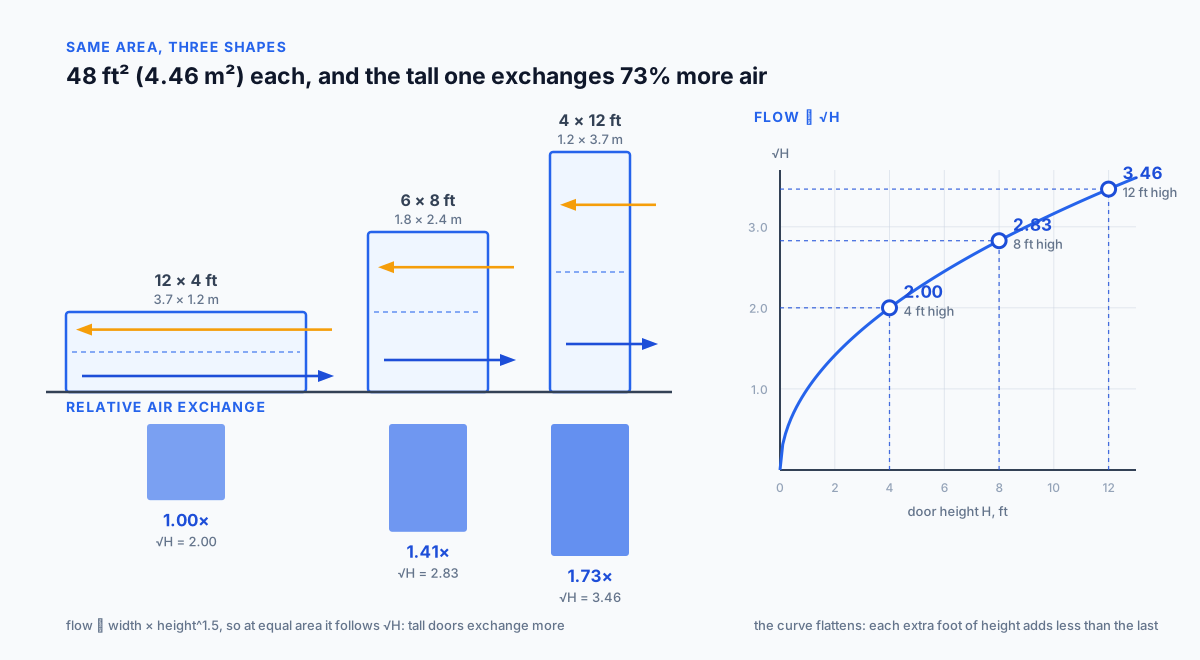
Height enters twice for two separate physical reasons. Once through the area the flow passes through. Once through the driving head, because the taller the opening, the further its outer layers sit from the neutral plane and the faster they move. Width has no second entry: doubling it doubles the exchange, while doubling height multiplies it by 2^1.5, or 2.83.
The design consequence is narrow but real. Where the clearance envelope leaves a choice of proportions, a wide low opening beats a narrow tall one. Practice usually pulls the other way, since reach trucks and stacked pallets set the height, so the saving is more often taken by cutting open time than by reshaping the opening.
Per the buoyancy exchange relation: mass flow scales with width linearly and with height to the power of 1.5, so a tall doorway exchanges more air than a wide one of equal area.
Density from the Ideal Gas Law and Why Freezers Are the Severe Case
Both densities come from the ideal gas law at the two temperatures, and because the relation is inverse in absolute temperature, the density difference grows disproportionately as the room gets colder.
Imperial: rho = 2116.22 / (53.35 × T_R),   T_R = °F + 459.67
Metric:   rho = 101325 / (287.05 × T_K),   T_K = °C + 273.15
rho typical range: 0.070 to 0.092 lb/ft³ (1.12 to 1.47 kg/m³)
For the freezer case used further down:
Room −10°F (449.67 R):  0.0882 lb/ft³ (1.413 kg/m³)
Outside 80°F (539.67 R): 0.0735 lb/ft³ (1.177 kg/m³)
Difference 0.0147 lb/ft³ (0.236 kg/m³), 20% of the outside density
The same outside air against a cooler instead:
Room 35°F (494.67 R):   0.0802 lb/ft³ (1.285 kg/m³)
Outside 80°F, unchanged: 0.0735 lb/ft³ (1.177 kg/m³)
Difference 0.0067 lb/ft³ (0.107 kg/m³), less than half the freezer figure
Flow ratio, all else equal: sqrt(0.0147 / 0.0067) = 1.48
A freezer doorway is the severe case three times over. The larger density difference drives the air faster. The larger temperature difference raises the sensible load carried by every pound that moves. The larger humidity ratio difference raises the latent load on the same pound. All three multipliers pull the same way, which is why a freezer opening produces several times the load of a cooler opening at identical traffic.
One second-order point worth knowing when results are checked against a psychrometric chart: the calculation takes dry-air density at the stated temperature. Moist air at the same temperature is slightly lighter, because the molecular mass of water vapour is below that of air. The effect works in the same direction as temperature and, at ordinary conditions, amounts to a fraction of a percent of the temperature contribution.
Per the ideal gas relation: density falls inversely with absolute temperature, so the density difference across a freezer doorway runs roughly twice that across a cooler doorway at the same outside condition.
The Doorway Flow Factor and the Step at Twenty Degrees
The buoyancy relation describes flow that has fully developed, which a door open for fifteen seconds never achieves, so a doorway flow factor scales the result down. Because it is published as a step rather than as a curve, the model behaves oddly right at the threshold.
|T_out − T_room| above 20°F (11°C)      →  D_f = 0.8
|T_out − T_room| at or below 20°F (11°C) →  D_f = 1.1
Below one is the intuitive half. The flow does not reach full speed the moment the door parts. On a 10 to 20 second opening a noticeable share of the time goes into establishing the profile, so the average exchange sits below the steady-state value, and 0.8 is the published allowance for it.
Above one takes more explaining. When the density difference is weak, the mechanical disturbance of the door leaf moving and traffic passing through mixes the two air masses harder than gravity does, and adds exchange on top of the steady-state figure. Hence 1.1.
The awkward consequence is that the model is not monotonic at the threshold. Taking the calculator's own boundary of 11°C, on a 1.8 × 2.4 m (6 × 8 ft) door with outside air at 27°C (80.6°F):
Room 16.0°C (60.8°F): ΔT = 11.0°C (19.8°F) → D_f = 1.1
Room 15.5°C (59.9°F): ΔT = 11.5°C (20.7°F) → D_f = 0.8
The density term rises across that half degree, but the multiplier drops from 1.1
to 0.8, and the sensible load falls about 22% as the temperature difference grows
That is an artefact of a step function, not the behaviour of a real door. Near the threshold a result should be read as an estimate inside the published spread rather than as a value, and a design decision taken there deserves a run on both sides of the step. The calculator page flags the step character explicitly.
Per ASHRAE Handbook, Refrigeration (2022), Chapter 24: a doorway flow factor of 0.8 applies to cyclically opened doors at temperature differences above 20°F (11°C), and 1.1 below it, published as a step rather than as a continuous function.
Traffic: Frequency and Duration Enter Identically, Fixes Do Not
The model multiplies openings per hour by seconds per opening, so the two arrive as a single product, yet the measures available to reduce them differ completely in cost and in reach.
F_open = (openings per hour × open time per opening) / 3600
F_open typical range: 0.01 to 0.30, dimensionless
Inside the calculation the two are interchangeable. Twenty openings of 15 seconds and ten openings of 30 seconds both give 0.0833 and both give the same load.
On site they are nothing alike. Frequency is set by logistics: pallet counts, shipping rhythm, the layout of the warehouse. Reducing it means changing the process, which is expensive and runs into throughput limits. Duration is set by equipment and discipline. A high-speed roll door that closes in 4 seconds instead of 20 cuts the open fraction by a factor of five at unchanged traffic.
Against the worked example below:
10 openings × 15 s: F_open = 0.0417 → 14,580 BTU/hr (4.27 kW)
10 openings ×  4 s: F_open = 0.0111 →  3,890 BTU/hr (1.14 kW)
A 73% reduction with no change to the number of trips
One caveat on the product form. The model assumes independent openings. Where traffic is grouped and the door opens once for several passes, the total open time drops in a way the product does not capture, so for coordinated traffic the open fraction is better taken from an actual stopwatch survey than from frequency times duration.
Per ASHRAE Chapter 24 and IIAR practice: the door-open fraction is the product of frequency and duration, but cutting duration with a high-speed door is usually cheaper than cutting frequency through process change.
Protection Factors Come From a Different Source Than the Airflow Model
The airflow half of this calculation follows ASHRAE. The protection factors do not, and the gap between the two sources is wide enough to change an equipment selection.
The factors on the calculator page:
None (fully open)          1.00    0% effective
Strip curtain              0.60   40%
Air curtain, unheated      0.40   60%
Air curtain, heated        0.30   70%
Vestibule plus air curtain 0.15   85%
What ASHRAE publishes is materially better: 95% or above for new or well-maintained strip and rapid-fold doors, decaying toward roughly 80% for freezer doorways in service.
The gap between the two sets has a physical origin. ASHRAE's figures describe protection in its design state, with full-length strips, designed overlap, no gaps, and no ice. The page's figures describe the typical condition of a door of unknown age, where strips have been shortened by traffic, some are torn away, overlap is lost, and a curtain has drifted off its commissioned velocity and angle. The distance between the two numbers is a measure of how far service has moved from installation.
That gives a usable rule for which set to apply. New installation with documented maintenance: use the ASHRAE values. Existing door whose condition cannot be confirmed: use the page values. Running both produces a bracket that the real load sits inside, and the width of that bracket is useful information in its own right, because it quantifies what maintenance is worth on that door.
The size of the effect is easy to underrate:
Strip curtain at the page factor of 0.60:        14,580 BTU/hr (4.27 kW)
The same curtain at ASHRAE 95%, a factor of 0.05: 1,215 BTU/hr (0.36 kW)
A twelvefold spread, decided by the state of the strips rather than by the model
Per ASHRAE Handbook, Refrigeration (2022), Chapter 24: protective device effectiveness reaches 95% or better for new or well-maintained installations and decays toward 80% for freezer doorways in service, noticeably better than typical in-service values for doors of unknown condition.
The Latent Half Becomes Frost, and Frost Becomes Defrost
The latent term is not simply a second column in the load table. Below freezing the moisture it represents leaves the air as ice on the evaporator, and removing that ice costs energy that appears nowhere in the infiltration calculation.
warm humid air enters → cools below the frost point →
moisture deposits on the evaporator fins → frost thickens →
heat transfer falls while air-side pressure drop rises →
defrost is required → defrost heaters put heat into the room →
that heat has to be removed as well
The mass involved is easy to picture. In the example below, a latent load of 5,636 BTU/hr (1,652 W) against a heat of desublimation near 1,220 BTU/lb corresponds to about 4.6 lb (2.1 kg) of moisture an hour. Over an eight-hour shift that is roughly 37 lb (17 kg) of ice, distributed across the fin block and across the floor near the opening.
The cycle partly feeds itself. Every defrost adds heat that raises the load, and leaves meltwater, some of which refreezes. Higher infiltration means more frequent defrost, and more frequent defrost raises the average load.
Two operational consequences never show up in a thermal calculation and are often the actual reason a curtain gets installed. Frost near the opening becomes floor ice, which is a hazard to staff and to trucks regardless of the kilowatts. Fog on the warm side of the door cuts visibility for forklift drivers at exactly the point where pedestrian and vehicle traffic mix.
The link back to psychrometrics is direct. The humidity ratio of the entering air comes from its temperature and relative humidity, the humidity ratio inside comes from a state close to saturation over ice at the room temperature, and the difference between those two figures drives the whole chain. The latent heat load article works through that difference on its own terms.
Per ASHRAE Chapter 24 and IIAR guidance: the latent portion of door infiltration deposits as frost on evaporator surfaces, which drives defrost frequency, and the defrost energy itself becomes an additional room load not counted in the infiltration figure.
Where Infiltration Sits in the Total Refrigeration Load
In a low-traffic cold room infiltration is a minor term. In a busy distribution freezer it is the largest one. The same calculation therefore carries very different weight from project to project.
Low traffic, small room:                 5 to 15% of total refrigeration load
Moderate traffic, distribution store:   15 to 35%
High traffic, freezer dock:             30 to 60%
What moves the share is opening frequency, opening size, temperature difference, and whether protection is fitted and maintained. The other components, transmission through the envelope, product pull-down, lighting, and equipment, grow far more slowly than traffic does.
That changes where design effort belongs. Where the share is small, effort repays on insulation thickness and on equipment selection. Where it is large, doorway protection returns more than any panel upgrade, and a door specification decision outranks an envelope decision.
The figure is one component of a larger sum. A complete selection adds transmission gains, product load, internal sources, and equipment heat, then applies a safety factor. The Refrigeration Load Calculator takes this quantity as one of its inputs.
Per ASHRAE Chapter 24: door infiltration ranges from a minor term in low-traffic rooms to the dominant one in busy freezer docks, which decides whether design effort belongs on the envelope or on the doorway.
Worked Example: A Freezer Dock Door at 14,580 BTU per Hour
A distribution freezer dock door, matching the Imperial example on the calculator page.
Opening 6 ft (1.8 m) wide, 8 ft (2.4 m) high, area 48 ft² (4.46 m²)
Room −10°F (−23.3°C), outside 80°F (26.7°C) at 60% RH
10 openings per hour, 15 s each
Strip curtain, protection factor 0.6
Step 1. Open fraction.
F_open = (10 × 15) / 3600 = 0.0417
F_protected = 0.0417 × 0.6 = 0.025
Step 2. Densities from the equation of state.
rho_room = 2116.22 / (53.35 × 449.67) = 0.0882 lb/ft³ (1.413 kg/m³)
rho_out  = 2116.22 / (53.35 × 539.67) = 0.0735 lb/ft³ (1.177 kg/m³)
rho_mean = 0.0809 lb/ft³ (1.296 kg/m³)
Difference 0.0147 lb/ft³ (0.236 kg/m³), 20% of the outside density
Step 3. Exchange velocity.
vel = sqrt(32.174 × 8 × 0.0147 / 0.0809) = sqrt(46.8) = 6.84 ft/s (2.08 m/s)
With the profile factor: (1/3) × 6.84 = 2.28 ft/s (0.695 m/s)
Step 4. Doorway flow factor.
|80 − (−10)| = 90°F (50°C), above the 20°F (11°C) threshold → D_f = 0.8
Step 5. Air mass flow.
m_dot = 48 × 0.0809 × 0.65 × 2.28 × 0.025 × 0.8 = 0.1150 lb/s
Air mass flow = 0.1150 × 3600 = 414 lb/h (188 kg/h)
Step 6. Sensible half.
Q_s = 0.1150 × 0.24 × 90 × 3600 = 8,944 BTU/hr (2,622 W)
Step 7. Latent half.
W_outside = 0.0132 lb/lb at 80°F (26.7°C) and 60% RH
W_room    = 0.0005 lb/lb in the freezer
Q_l = m_dot × 1076 × (W_outside − W_room) × 3600 = 5,636 BTU/hr (1,652 W)
Step 8. Total and structure.
Q_total = 8,944 + 5,636 = 14,580 BTU/hr (4.27 kW, 1.22 tons of refrigeration)
Latent share = 5,636 / 14,580 = 39%
Load per door area = 14,580 / 48 = 304 BTU/hr·ft² (959 W/m²)
Step 9. What the 39% means. Close to five pounds of water an hour turns into frost on the evaporator, near 37 lb (17 kg) over a shift, and that mass sets the defrost interval rather than any thermostat setting. In a more humid climate the latent share passes half, and the defrost schedule, not the compressor, becomes the constraint on availability.
Step 10. The levers, ranked.
As calculated, strip curtain, 15 s openings:  14,580 BTU/hr (4.27 kW)
Same door, open time cut to 4 s:               3,890 BTU/hr (1.14 kW)
Same door, heated air curtain at 0.30:         7,290 BTU/hr (2.14 kW)
Same strip curtain restored to ASHRAE 95%:     1,215 BTU/hr (0.36 kW)
The ranking is worth reading twice. Replacing a strip curtain with a heated air curtain halves the load and costs equipment, power, and commissioning. Restoring the same strip curtain to its design condition, replacing shortened and torn strips so the overlap is what the drawing specified, takes the load an order of magnitude lower for the price of a strip set. The largest lever here is not the equipment selection but the state of the strips and the seconds the door stands open.
Metric Worked Example and the Protection Ladder
The Metric example on the calculator page, with the same protection stepped through its five options.
Opening 1.8 × 2.4 m (5.9 × 7.9 ft), area 4.32 m² (46.5 ft²)
Room −23°C (−9.4°F), outside 27°C (80.6°F) at 60% RH
10 openings per hour, 15 s each, strip curtain 0.6

rho_room = 101325 / (287.05 × 250.15) = 1.411 kg/m³ (0.0881 lb/ft³)
rho_out  = 101325 / (287.05 × 300.15) = 1.176 kg/m³ (0.0734 lb/ft³)
rho_mean = 1.294 kg/m³ (0.0808 lb/ft³)

vel = (1/3) × sqrt(9.81 × 2.4 × 0.235 / 1.294) = (1/3) × 2.068 = 0.689 m/s (2.26 ft/s)
D_f = 0.8, since 50°C (90°F) is above the 11°C (20°F) threshold
m_dot = 4.32 × 1.294 × 0.65 × 0.689 × 0.025 × 0.8 = 0.0501 kg/s
Air mass flow = 180 kg/h (397 lb/h)

Q_s = 0.0501 × 1006 × 50 = 2,519 W (8,600 BTU/hr)
W_outside = 0.0134 kg/kg, W_room = 0.0005 kg/kg
Q_l = 0.0501 × 2,501,000 × 0.0129 = 1,618 W (5,520 BTU/hr)
Q_total = 4,137 W = 4.14 kW (14,120 BTU/hr)
Load per door area = 958 W/m² (304 BTU/hr·ft²)
The same door with each protection option in turn:
None (fully open)          1.00   6.90 kW   (23,530 BTU/hr)
Strip curtain              0.60   4.14 kW   (14,120 BTU/hr)
Air curtain, unheated      0.40   2.76 kW    (9,410 BTU/hr)
Air curtain, heated        0.30   2.07 kW    (7,060 BTU/hr)
Vestibule plus air curtain 0.15   1.03 kW    (3,530 BTU/hr)
Each rung is linear in the factor, so these ratios transfer to any door under the same conditions, at any size, at any temperature difference. That linearity is what makes the ladder worth reading as a whole rather than as five separate calculations.
Read down it and the economics are visible in the arithmetic. The first step, from an unprotected opening to a strip curtain, removes 2.76 kW (9,410 BTU/hr). The last step, from a heated air curtain to a full vestibule, removes 1.04 kW (3,550 BTU/hr), roughly a third as much, for a structural alteration to the building rather than a piece of equipment on the wall. The largest return comes from the cheapest rung, and every rung after it returns less for more capital.
Two qualifications keep that from being read as a purchasing order. The ladder assumes every option is in its design condition, which the section on protection factors already showed is the assumption most likely to be wrong on an existing door. And the heated air curtain rung carries an operating cost the table does not show, because the heater consuming power at the opening does not appear in a load that only counts what crosses the doorway.
Set against the Imperial case, the metric opening is about 3% smaller in area and sits at a marginally smaller density difference, which puts the result about 3% lower once converted. Same physics, different rounding of the door.
Application Boundaries: Wind, Stack Effect, Simultaneous Doors, Transients
The scope is one isolated vertical opening, steady gravity-driven exchange, independent openings, and no external pressure difference. Seven cases fall outside it.
Wind pressure. The model accounts for gravity only. Wind on a facade creates a pressure difference that adds to or subtracts from the buoyancy exchange, and on a windward dock door the exchange can rise by a multiple.
Building stack effect. Openings at different heights within one volume form a circuit through which air moves independently of any single door. In multi-storey and high-bay stores that is a separate calculation.
Several doors open at once. The model treats one door. Two open doors in opposite walls create a through-flow that is not the sum of two independent exchanges.
Transients within an opening. The doorway flow factor handles unsteady flow with a single averaged multiplier. Behaviour inside one opening, including the surge as the leaf starts to move, is not modelled.
Traffic through the opening. A forklift passing through displaces air and breaks up the developing profile. It is captured only indirectly, through the 1.1 factor at small temperature differences.
Neutral plane displacement. The calculation assumes the plane at mid height. Room pressurisation, extract, and other openings move it, which changes how the flow distributes over the height.
Moisture uptake. Part of the moisture settles on product, packaging, and racking rather than on the evaporator. The latent load does not disappear, but it arrives at the coil on a different timescale.
Two further points belong on the same list. The protection factor embeds an assumption about wear, and actual effectiveness depends on strip length and overlap, curtain adjustment, and ice build-up. And the result is one component of a refrigeration load, so a final selection requires all components summed with a safety factor applied.
Per ASHRAE Handbook, Refrigeration (2022), Chapter 24 and Fundamentals (2025), Chapter 16: single-doorway buoyancy exchange is the scope of this model, while wind pressure, building stack effect, simultaneous openings, within-opening transients, traffic disturbance, neutral plane displacement, and moisture uptake by product require separate treatment.
Cold Storage Door Infiltration Calculator
Cold storage door infiltration by the buoyancy exchange model: computes the two air densities from the entered temperatures, integrates the velocity profile over the half of the doorway through which warm air enters, applies the door-open fraction, the protection factor, and the doorway flow factor, and returns the sensible and latent halves of the load together with the air mass flow. The exchange is driven by gravity acting on a density difference rather than by any fan, so door geometry and traffic set the result. A single-doorway estimate per ASHRAE Refrigerated-Facility Loads, not a whole-facility refrigeration load.
Open Cold Storage Door Infiltration CalculatorStandards and References
- ASHRAE Handbook, Refrigeration (2022), Chapter 24, Refrigerated-Facility Loads. The doorway infiltration model, the doorway flow factor and its step at 20°F (11°C), protective device effectiveness, and the share of infiltration in total refrigeration load.
- ASHRAE Handbook, Fundamentals (2025), Chapter 16, Ventilation and Infiltration. Infiltration mechanics generally, stack effect, and wind pressure on the building envelope.
- Gosney, W.B. and Olama, H.A.L. (1975), Heat and Enthalpy Gains through Cold Room Doorways, Proceedings of the Institute of Refrigeration, Vol. 72. The original work from which the adopted model descends.
- Brown, W.G. and Solvason, K.R. (1962), Natural Convection through Rectangular Openings in Partitions, International Journal of Heat and Mass Transfer, Vol. 5. The velocity profile through a vertical opening and its integration over the opening height.
- IIAR, Cold Storage Door Design Guidelines. Application practice for strip curtains, air curtains, and vestibules, and the in-service degradation of doorway protection.
- ASHRAE Standard 90.1-2022, Energy Standard for Buildings Except Low-Rise Residential Buildings. Requirements covering openings into refrigerated spaces.
- ISO 23953-2, Refrigerated Display Cabinets, Part 2: Classification, Requirements and Test Conditions. Test methods for infiltration through open refrigerated openings.
- ASHRAE Handbook, Refrigeration (2022), chapters covering defrost systems. Defrost energy as an additional room load beyond the infiltration figure.
- Manufacturer data for strip curtains, air curtains, and high-speed roll doors. Claimed effectiveness together with the installation and maintenance conditions under which it is achieved.
FAQ
How does air enter a cold storage room through an open door?
Per Gosney and Olama (1975): as a two-way exchange rather than as a leak. Warm air flows in above a neutral plane and cold air flows out below it at the same time, driven by the density difference between the two columns of air. Nothing pushes it, and gravity does all of the work.
Why does door height matter more than width?
Per the buoyancy relation: width enters linearly while height enters twice, once through the area and once through the driving head, so mass flow scales with height to the power of 1.5. Between two doorways of equal area, a 4 ft (1.2 m) high opening and a 12 ft (3.7 m) high one differ by 73%.
What is the doorway flow factor?
Per ASHRAE Handbook, Refrigeration (2022), Chapter 24: a multiplier that accounts for flow which never fully establishes during a short opening. It is 0.8 above a 20°F (11°C) temperature difference and 1.1 below it, published as a step rather than as a continuous curve, so results jump at the threshold.
How much does a strip curtain actually reduce infiltration?
Per ASHRAE Chapter 24: 95% or better for a new or well-maintained installation, decaying toward 80% for freezer doorways in service. Typical in-service values for doors of unknown condition run nearer 40%. The spread reflects strip length, overlap, and damage rather than any difference in the calculation.
Why is the latent load so important in a freezer?
Per ASHRAE and IIAR guidance: because below freezing that moisture leaves the air as frost on the evaporator, which sets defrost frequency, and the defrost energy returns to the room as additional load. A load with a 39% latent share deposits roughly 37 lb (17 kg) of ice over an eight-hour shift.
What reduces infiltration most cheaply?
Per IIAR practice: cutting open time. A high-speed door closing in 4 seconds instead of 20 cuts the door-open fraction by a factor of five at unchanged traffic, which in the worked example takes the load from 14,580 to 3,890 BTU/hr (4.27 to 1.14 kW) without any change to logistics.
Does this calculation account for wind?
Per ASHRAE Handbook, Fundamentals (2025), Chapter 16: no. The model considers gravity alone. Wind pressure on a dock face adds to or subtracts from the buoyancy exchange and needs separate treatment, as does building stack effect between openings at different heights.
Related Calculators
- Refrigeration Load Calculator: The total refrigeration load this quantity enters as one component, alongside transmission, product, and internal gains.
- Latent Heat Load Calculator: The moisture load from a humidity ratio difference, which is the half that becomes frost (article).
- Enthalpy Calculator: The total heat of the two air states whose difference the exchange carries across the opening (article).
- Psychrometric Calculator: Full air-state analysis on both sides of the doorway, including the humidity ratios that set the latent half.
- Chiller Capacity Calculator: The machine capacity that has to remove the summed load once every component is added.
- Ice Rink Refrigeration Load Calculator: The adjacent case of a large refrigeration load across an open surface rather than a vertical opening.
- Cooling Load Calculator: Conventional space loads, useful for comparing orders of magnitude against a freezer dock.
- HVAC Heat Load Calculator: Transmission through the envelope, the second major component of a refrigeration load.